Introduction
In the context of health care, empathy is defined as a cognitive attribute that involves understanding the experiences and perspective of the patient, and the ability to communicate this understanding to the patient.Reference Chen, Lew, Hershman and Orlander1-Reference Hojat, Mangione, Kane and Gonnella3 Empathy in health care is the capacity to understand the patient's perspective and viewpoint without losing sight of one's professional role and responsibilities.Reference Hojat, Gonnella, Nasca, Mangione, Vergare and Magee4
Empathy in health care is important for establishing a positive provider-patient relationship that fosters communication and optimal clinical outcomes,Reference Hojat, Gonnella, Nasca, Mangione, Vergare and Magee4 and is the essence of a meaningful patient-doctor relationship. Empathic patient-physician interactions can: (1) lead to more accurate history and physical examinations; (2) enhance patient satisfaction; (3) increase compliance with treatment regimes; (4) enhance positive attitudes toward elderly patients; and (5) lead to more accurate diagnosis and positive clinical outcomes.Reference Hojat, Mangione, Kane and Gonnella3-Reference Hojat, Gonnella, Mangione, Nasca, Veloski and Erdmann5 Furthermore, empathy establishes patient-provider understanding, quality interpersonal communication, and trust between the patient and provider.Reference Hojat, Gonnella, Mangione, Nasca and Magee2, Reference Hojat, Gonnella, Mangione, Nasca, Veloski and Erdmann5
Paramedics rely on establishing a health care provider-patient relationship and therapeutic rapport with their patients that promotes communication and patient satisfaction, and facilitates appropriate patient assessment and treatment. In order to develop such a relationship, paramedics must have an ability to empathize with patients and family members, as well as to understand a patient's perspective. In their recent systematic review, Yu and Kirk explain that empathy and an understanding of the personal experiences of patients/families are important for nurses (and good for patients/families),Reference Yu and Kirk6 as nurses are primary health care providers, and often the first to encounter patients and their families. Similarly, paramedics also are primary health care providers, and frequently the first health care professionals to meet patients/families. Thus, empathy also is an important skill for paramedics to possess.
There are limited studies of paramedics’ empathy levels,Reference Regehr7, Reference Regehr, Goldberg and Hughes8 and no studies have investigated undergraduate paramedic students’ empathy levels. In contrast, empathy among nurses, medical students, and medical interns has been examined extensively.Reference Chen, Lew, Hershman and Orlander1, Reference Hojat, Mangione, Kane and Gonnella3, Reference Hojat, Gonnella, Mangione, Nasca, Veloski and Erdmann5, Reference Yu and Kirk6, Reference Reynolds9-Reference Winefield and Chur-Hansen16
The primary objective of this study was to assess the extent of empathy in paramedic students enrolled at Monash University. A secondary objective of the study was to assess differences in empathy between genders, and year of study.
Methods
Design
This study utilized a cross-sectional descriptive design survey using a paper-based version of the Jefferson Scale of Physician Empathy (JSPE) Health Professional (HP) version,Reference Hojat, Gonnella, Mangione, Nasca, Veloski and Erdmann5 and the Medical Condition Regard Scale (MCRS).Reference Christison, Haviland and Riggs17
Participants
Study participants were undergraduate paramedic students enrolled in either the Bachelor of Emergency Health (BEH) or the Bachelor of Emergency Health/Nursing (BEH/BN) degree programs at Monash University, Australia. Participation in this study was voluntary; there were no exclusion criteria.
Survey Tools
The Jefferson Scale of Physician Empathy (JSPE) Health Professional (HP) version is a 20-item, psychometrically validated measurement of empathy for health care professionals, in which participants rate their level of agreement with each statement on a 7-point Likert scale (strongly disagree = 1; strongly agree = 7).Reference Chen, Lew, Hershman and Orlander1 Ten of the 20 statements are negatively worded in order to decrease the confounding effect of acquiescence responding; these statements were reversed for purposes of analysis.Reference Hojat, Gonnella, Nasca, Mangione, Vergare and Magee4 Potential scores range from a minimum of 20 through a maximum of 140; the higher the score, the higher the participant's level of empathy. The JSPE has proven reliability and validity.Reference Hojat, Gonnella, Mangione, Nasca and Magee2, Reference Hojat, Gonnella, Nasca, Mangione, Vergare and Magee4, Reference Hojat, Gonnella, Mangione, Nasca, Veloski and Erdmann5, Reference Hojat, Fields and Gonnella18
The Medical Condition Regard ScaleReference Christison, Haviland and Riggs17 is a validated instrument in which participants are asked to rate their level of agreement, on a 6-point Likert scale (1 = strongly disagree; 6 = strongly agree), with statements pertaining to four medical conditions: (1) substance abuse; (2) intellectual disability; (3) attempted suicide; and (4) acute mental illness. In addition, a non-English speaking background was chosen as a construct from which a medical condition might be viewed, and hence, was included as a measurement of regard. These five conditions were selected as they comprise a large number of those encountered by paramedics in Victoria, Australia. Overall regard scores for each condition ranged from a minimum of 11 through a maximum of 66, with a higher score signifying a higher level of regard.
Although other empathy measurement tools exist, such as the Empathy Construct Rating Scale, the Reynolds Empathy Scale, and the Layton Empathy Test,6 the JSPE(HP) has been tested among medical disciplines.
Procedure
At the conclusion of a paramedic lecture for each of the first, second, and third-year levels, students were provided an explanation of the study, informed that participation was voluntary and anonymous, and were invited to participate in this study during September and October 2009. A non-teaching member of the staff facilitated the process, and participants were administered a questionnaire containing the JSPE, the MCRS, and a brief set of demographic questions, which took approximately 20 minutes to complete. Consent was implied by completion and return of the questionnaire.
The study was approved by the Monash University Standing Committee on Ethics in Research Involving Humans.
Analysis
Data were extracted and analyzed using Statistical Package for the Social Sciences Version 15.0 (SPSS Inc., Chicago, Illinois, USA). Descriptive statistics and t-test or one-way analysis of variance (ANOVA) test were used to compare the differences between gender, age group, and year of study. The effect sizes were calculated using Cohen's definitions of 0.2-0.49 as a small effect size, 0.50-0.79 as a moderate effect size, and 0.80+ as a large effect size.Reference Baker19 All findings were considered statistically significant if the P-value was <.05.
Results
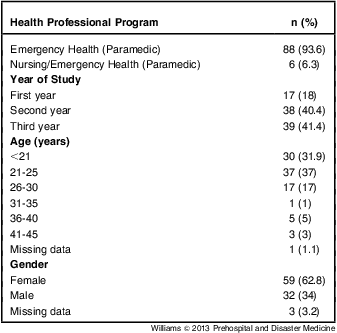
A total of 94 (40.5%) of the students enrolled in the paramedic program participated in the study; 59 (62.8%) were female, 32 (34%) were male, and the remainder did not answer the gender question. Thirty-seven (39.4%) of the participants were 21 through 25 years of age; 30 (31.9%) were <21 years of age. Other demographic data are listed in Table 1. Eighty-eight (94%) of the participants were enrolled in the Bachelor of Emergency Health program, while six (6%) of the students were enrolled in the Bachelor of Emergency Health/Bachelor of Nursing program. By year of study, 39 (41.5%) of the participants were in their third year of study; 38 (40.4%) were in their second year of study; and 17 (18%) were in their first year of study.
Demographics of Study Participants (n = 94)

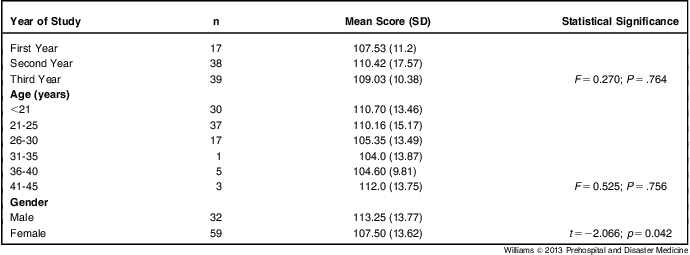
Male participants had significantly higher JSPE (HP) mean empathy scores than did the females (113.25 vs 107.05, respectively, P = .042). The magnitude of the differences in the means (mean difference = -6.1; 95% CI, -12.1 to -0.23) was small (n 2 = 0.22).
The JSPE (HP) empathy scores were lowest among the first-year paramedic students (mean = 107.53, SD = 11.2), while second-year paramedic students had the highest mean empathy scores (110.71, SD = 17.5). Third-year students attained a mean empathy score of 109.03 (SD = 10.3). By year of study, none of the differences in empathy scores were significant (P = .764).
The mean JSPE (HP) empathy scores also were not significantly different between the age groups of the participants (P = .756). Paramedic students 41-45 years of age scored the highest mean empathy score of 112.0 (SD = 13.7), while 36-40 year-old paramedic students scored the lowest mean empathy score (104.6, SD = 9.8). Table 2 provides comparisons of the JSPE (HP) scores.
Mean Jefferson Scale of Physician Empathy Scores According to Paramedics’ Year of Study, Age, and Gender
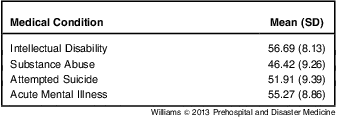
Overall, the mean MCRS scores were lowest for compassion towards substance abuse (46.42, SD = 9.26) (Table 3). The first- and second-year paramedic students had significantly more regard for intellectual disability, attempted suicide, and acute mental illness patients than did the third-year students P = .047 (n 2 = 0.27), P = .011 (n 2 = 0.45) and P = .021 (n 2 = 0.36), respectively. Statistically significant differences were not present in the other dependent variables of age or gender.
Mean Scores and Standard Deviations for the Medical Conditions Assessed by the Medical Condition Regard Scale

Discussion
This study is the first Australian study to investigate the empathy and attitudes of paramedic students toward patients with specific conditions. Previous studies involving medical students, medical residents, physicians, and nurses have demonstrated varying degrees of empathy levels as measured by the JSPE. Most notably, Hojat et al reported a mean JSPE score of 124 among nurses and pediatricians, and a mean JSPE score of 118 among hospital-based physicians.Reference Hojat, Gonnella, Mangione, Nasca and Magee2 Among final-year medical students, the same authors reported a mean JSPE score of 117.8.Reference Hojat, Mangione, Nasca, Gonnella and Magee20 The overall findings from the current study reveal slightly lower JSPE scores than reported by previous researchers among other health workers. It is possible that paramedic students have lower empathy levels than nurses, pediatricians, and medical students, as they see the patients very early in the patient's health care journey, and for a short period of time. However, it is important to note that empathy currently is not taught as a concept or integrated into the paramedic program.
The results of this study are difficult to generalize, as no other studies have been conducted on undergraduate paramedic students. Also, some of the participating paramedic students may have had previous exposure to health care, and/or previous health-related qualifications that impacted their empathy levels. This factor was not explored in this study. Among medical students, empathy levels and JSPE scores have been shown to be higher in preclinical years than during their clinical years.Reference Chen, Lew, Hershman and Orlander1 Other research findings have demonstrated a consistent, but not significant, decline in JSPE scores among medical residents during post-graduate training.Reference Hojat, Gonnella, Mangione, Nasca and Magee2 This raises the question of whether clinical experience and an associated decline in empathy are generalizable in health care domains outside of the medical profession. It also suggests that future studies, such as longitudinal cohort studies, should be considered in an attempt to answer this question.
The gender differences in JSPE scores found in this study are not supported by findings from previous studies in which female medical students attained significantly higher JSPE scores than did their male counterparts.Reference Chen, Lew, Hershman and Orlander1, Reference Hojat, Gonnella, Mangione, Nasca, Veloski and Erdmann5 Although researchers disagree on an explanation for gender differences in empathy scores, one belief is that females develop more caring attitudes and are more perceptive to emotions than are males.Reference Hojat, Gonnella, Mangione, Nasca and Magee2 Why the male students in this study demonstrated more caring attitudes than their female counterparts, and thus attained higher empathy scores than females, is unclear. Further research involving a large sample size with reduced sampling error techniques is warranted in order to improve the external validity of these results.
The idea that empathy levels would be greatest in first-year undergraduate paramedic students, and lowest among third-year undergraduate paramedic students, was not supported by the findings from this study in which there was no significant difference in empathy levels among the year levels. Among medical students, Chen et al found that second-year medical students had a significantly higher empathy score compared to third-year medical students who had begun their clinical rotations.Reference Chen, Lew, Hershman and Orlander1 It is possible that clinical experience may influence empathy levels in the undergraduate paramedic student also; at the time of testing in this study, neither first- nor second-year paramedic students had experienced ambulance clinical placements. While it is believed that medical and health care students embark on their health profession education with the intention to heal and help others, decreases in empathy throughout the educational process may occur as a result of a decline in humanistic qualities, the development of cynicism, and “burn out.”Reference Hojat, Gonnella, Mangione, Nasca and Magee2, Reference Astrom, Nilsson, Norberg, Sandman and Winblad21, Reference Astrom, Nilsson, Norberg and Winblad22
Limited research has been conducted investigating the association between age and levels of empathy. One study of medical students found a small, yet significant, increase in JSPE scores as age increased.Reference Hojat, Gonnella, Mangione, Nasca and Magee2 However, age was not correlated with medical student's empathy scores on an alternative empathy scale (i.e., the Hogan Empathy Scale).Reference Harsch12 The lack of difference in empathy scores among the different age groups in this study is in agreement with those findings. It may be that by adulthood, individuals have developed fully their cognitive attribute of empathy, and it does not change further.
The Medical Condition Regard Scale scores of the paramedic students in this study were higher than those found among medical students studied by Christison et al.Reference Christison, Haviland and Riggs17 In their study, mean MCRS scores of 46.2 were reported regarding depression and intermittent suicide, while mean scores of 44.8 and 44.5 were reported for panic disorder and alcohol dependence, respectively.Reference Christison, Haviland and Riggs17 One belief is that low regard for patients with psychiatric disorders may occur as a result of the frustration the health provider experiences in caring for these patients.Reference Christison, Haviland and Riggs17 However, an increase in regard for psychiatric and alcohol-dependent patients was noted among those medical students who had rotated through psychiatric clinical placements and addiction treatment program placement.Reference Christison, Haviland and Riggs17 The higher MCRS scores for attempted suicide and mental issues found among the paramedic students in the current study may be related to the recent inclusion of mental illness and self-harm topics in the paramedic curriculum. Another possible influencing factor is the likelihood that some third-year students had experience caring for these patients during their clinical placements.
Limitations
The BEH/BN is a new program with low enrollment, and consequently, it provided a substantially smaller sample compared to the BEH program.
This study also is potentially limited by the convenience sampling and self-reporting measures used to ascertain empathy levels. The use of convenience sampling facilitates study recruitment, but limits the generalizability of the study.
Another potentially limiting factor is that some students may have had previous health-related experience prior to their undergraduate paramedic coursework, which may have affected their scores. Further research is required to include another paramedic sample with an alternative sampling technique in order to reduce the likelihood of self-selection bias, and improve the generalizability of the results to other paramedic groups.
It is possible that paramedic students’ self-reported empathy does not correlate with empathetic behavior. Additionally, a lack of clinical exposure to the various medical conditions identified in the MCRS may have affected the findings, and therefore, results may be invalid for individuals who have not been exposed to these conditions. Finally, the MCRS inventory was not inclusive of either a general medical condition or a specific psychiatric disorder. In future testing, it is suggested that the MCRS instrument include these two additional conditions in order to allow direct comparison to previous research findings.Reference Christison, Haviland and Riggs17
Despite the methodological limitations identified, this study provides an important foundation for further research in this area. Data from this study suggest the need for further evaluation, as well as the integration of an empathy teaching program and learning “toolkit,” along with an increased focus on non-technical skills in patient simulation laboratories in the paramedic education program. Findings from the MCRS survey also suggest that a closer examination of specific medical conditions be undertaken. The results of this study provide an impetus to examine the current paramedic curriculum to ensure that it meets the needs of the students, as well as community expectations.
Conclusions
The findings from this study demonstrated that empathy scores were lowest among first-year paramedic students, and that age was not a significant variable on empathy scores. The medical condition that evoked the lowest regard by paramedic students was substance abuse. These results provide academics and other educators the impetus to integrate evidence-based teaching into the paramedic curriculum including the assimilation of empathy into active learning processes such as immersive simulation and/or patient-centered learning.
Acknowledgements
The authors thank the students involved in this study.