Introduction
Intrauterine growth restriction (IUGR) is the failure of the fetus to reach its genetically established growth rate. IUGR is mainly due to inadequate supply of nutrients and oxygen,Reference Brodsky and Christou 1 either by maternal malnutrition/hypoxia and/or placental insufficiency.Reference Nardozza, Araujo Júnior and Barbosa 2 , Reference Cetin, Mando and Calabrese 3 Occurrence of IUGR at low-altitude in developed countries (i.e. related to placental insufficiency) is estimated to be around 6%,Reference Baschat 4 , Reference Ghidini 5 but increases up to 15% in less favored areas and even to around 17% in case of maternal hypobaric hypoxia at high altitude.Reference Moore, Niermeyer and Zamudio 6 – Reference Giussani, Niu and Herrera 9 IUGR is a concerning health issue because of its implications in perinatal mortality and morbidity and its long-term consequences on health and disease risk of the individuals; mainly on neurological, metabolic, immune, cardiovascular and renal features.Reference Ismail and Chang 10
Prenatal programming inherent to IUGR has rapidly emerged as a plausible cause for postnatal disorders, in spite of little direct evidence in humans.Reference Saffery 11 Most of the translational research performed in the area has been traditionally focused on the cardiometabolic consequences of IUGR. However, there is also increasing evidence that prenatal programming following IUGR may impair nephrogenesis, causing a decrease in the glomerular number but a compensatory glomerular enlargement. The consequences are reduced nephron endowment, hypertension and renal diseases in adulthood.Reference Ismail and Chang 10 , Reference Puddu, Fanos, Podda and Zaffanello 12 – Reference Dötsch, Alejandre-Alcazar and Janoschek 14 Hence, there is a strong necessity of preclinical and clinical research on improved detection methods and biomarkers as an optimal antenatal surveillance may be highly beneficial for early detection of IUGR and alleviation of its postnatal effects.
Currently, ultrasonographic monitoring of fetal anatomy and growth is a routinely clinical procedure in which IUGR is suspected in case of abnormal fetal size; after that, evaluation of symmetry, structural and/or chromosomal anomalies, and Doppler hemodynamics are used to differentiate asymmetric IUGR fetuses secondary to maternal and/or placental disorders and oxygen from those symmetric IUGR fetuses secondary to chromosomal and genetic syndromes and intrauterine infections.Reference Miller, Turan and Baschat 15 , Reference Rizzo and Arduini 16 However, choosing appropriate monitoring and intervention tools and intervals still remains as a main clinical challenge as adequate antenatal diagnosis, treatment and timely delivery may significantly diminish the risks of the disease.Reference Kouskouti, Regner, Knabl and Kainer 17
Preclinical studies in animal models are an important source of information for a systematic analysis of pregnancy disturbances and IUGR.Reference Gonzalez-Bulnes, Astiz, Parraguez, Garcia-Contreras and Vazquez-Gomez 18 Models have been traditionally based on laboratory rodents, especially rats and mice.Reference Armitage, Taylor and Poston 19 – Reference Rosenfeld 21 However, rodents have marked differences with humans in developmental patterns, metabolic and endocrine routes and physiology of organs and systems.Reference Neitzke, Harder and Schellong 22 , Reference Neitzke, Harder and Plagemann 23 The use of large animal species may overcome these limitations and offer numerous profitable characteristics for preclinical research.Reference Gonzalez-Bulnes, Astiz, Parraguez, Garcia-Contreras and Vazquez-Gomez 18 Specifically in sheep, the effects of exposure to undernutrition on fetal growth patterns and the occurrence of IUGR were early describedReference Charlton and Johengen 24 and therefore the model has been traditionally used for studies on IUGR.Reference Symonds, Budge, Stephenson and McMillen 25 , Reference Wallace, Aitken, Milne and Hay 26 Finally, the temperament and size of sheep facilitate fetal screening by non-invasive techniques like B-mode and Doppler ultrasonography.Reference Morel, Pachy and Chavatte-Palmer 27 , Reference Vonnahme and Lemley 28
The present study used a sheep model of IUGR, combining maternal undernutrition and twinning, to determine a possible marker of early damage to the fetal kidney. Our hypothesis was based on the ‘brain-sparing’ effect occurring during IUGR processes, which consists of a redistribution of the blood circulation to maximize the supply of oxygen and nutrients to the brain.Reference Scherjon, Smolders-DeHaas, Kok and Zondervan 29 In consequence, the growth of the brain is increased to the expenses of the growth of the body and other organs, like the kidney. Hence, we assessed, by Doppler ultrasonography, the occurrence of early deviations in fetal hemodynamics which may be indicative of changes in blood perfusion.
Methods
Animals and experimental procedures
The experiment involved a total of 24 multiparous pregnant ewes (Sarda breed) from the experimental flock of AGRIS Sardegna (Italy). These females became pregnant after natural breeding following cycle synchronization with intravaginal pessaries impregnated with progestagens [20 mg of fluorogestone acetate (FGA), Chronogest© CR; MSD-AH, Madison, NJ, USA) for 12 days plus a single i.m. injection of 200 IU of eCG (Folligon©; MSD-AH), concurrent with pessary insertion. The day of mating was considered Day 0 for experimental purposes. At Day 24 after mating (around 15% of the total length of ovine pregnancy, estimated in a mean of 150 days), pregnancy diagnosis was performed by transrectal ultrasonography, with a real-time B-mode scanner (Aloka SSD 500; Aloka Co., Tokyo, Japan) fitted with a 7.5 MHz linear-array probe. The ewes were pair matched in two groups (control and food-restricted) according to age, body weight and prolificacy (singleton or twins). All the sheep were fed with the same standard grain-based diet but fulfilling either their daily maintenance requirements for pregnancy (control group; n=12, six singleton pregnancies and six twin pregnancies) or only the 50% of such quantity (food-restricted group; n=12; four singleton pregnancies and eight twin pregnancies). Inappropriate maternal nutrition during early and mid-pregnancy can significantly disrupt placental development, which reaches a maximum growth by approximately Day 75–80 of gestation.Reference Osgerby, Wathes, Howard and Gadd 30
Ultrasonographic biometry and Doppler evaluation of fetal hemodynamics
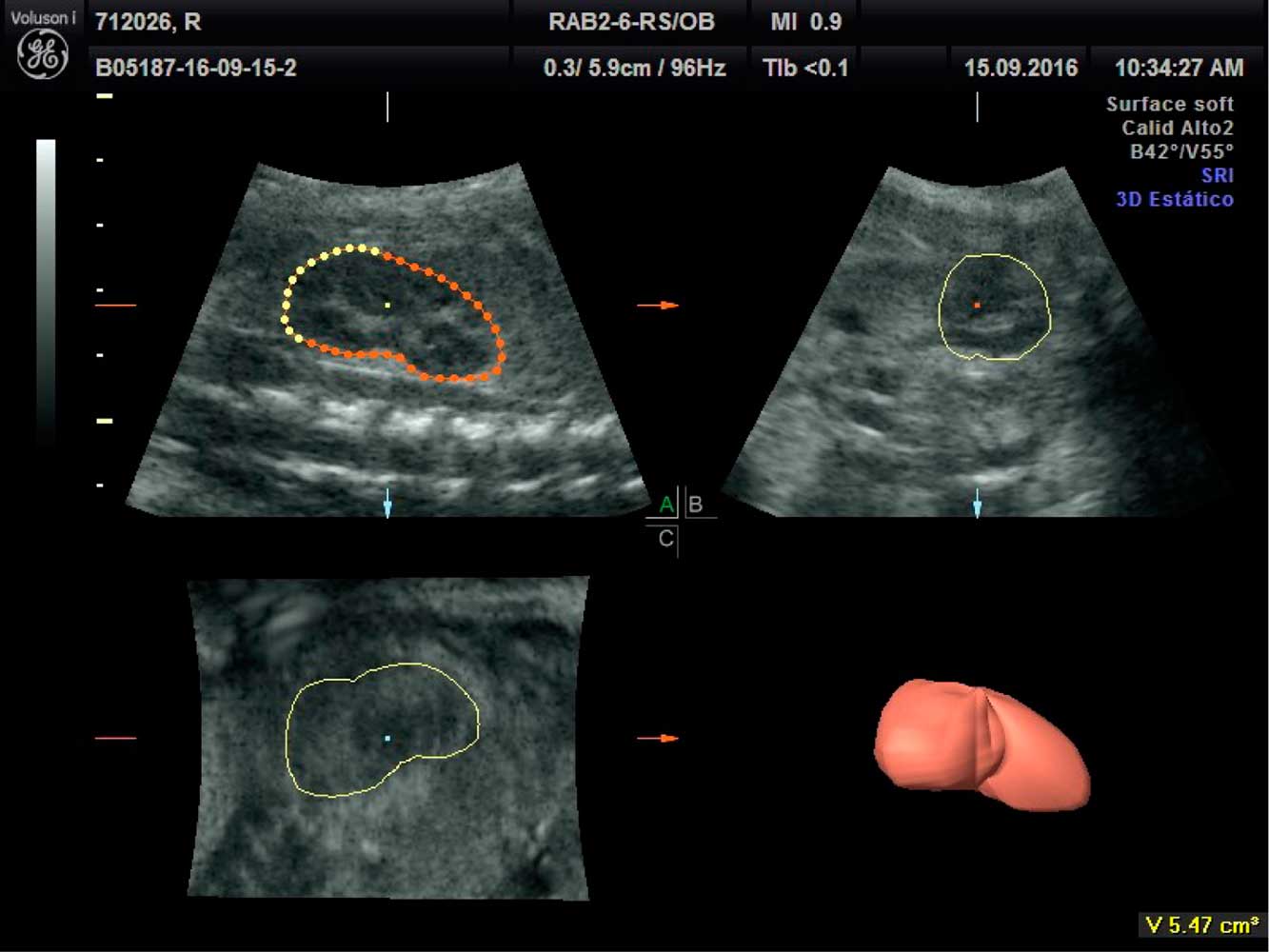
All the fetuses were assessed by ultrasonography at Day 115 of pregnancy (around 75% of the total length of ovine pregnancy), just before the overt growth arrest which becomes apparent between 120 and 130 days of pregnancy.Reference Symonds, Budge, Stephenson and McMillen 25 Ultrasonographic scans were performed with a Voluson-i ultrasound machine (GE, Tiefenbach, Austria) equipped with an automatic 2–5 MHz 4D convex probe. Scans were recorded using the ‘cine-loop’ option and measurements were obtained in all the fetuses with built-in electronic calipers. As fetus size was too large for viewing the entire body-length at this pregnancy stage, measurements included the thoracic diameter (TD), the biparietal diameter (BPD) and the length and volume of the left kidney (KL and KV; Fig. 1). The acquisition of kidney volume was performed using the 3D ultrasound mode. Scans of satisfactory quality and without artifacts, after examining the multiplanar display obtained to ensure that the whole kidney had been captured, were used to calculate the volume of the organ by the Virtual Organ Computer Aided anaLysis (VOCAL).
Integration of multiplanar ultrasound scans and measurements (longitudinal, transversal and coronal planes) for three-dimensional assessment of renal volume in a control sheep fetus.

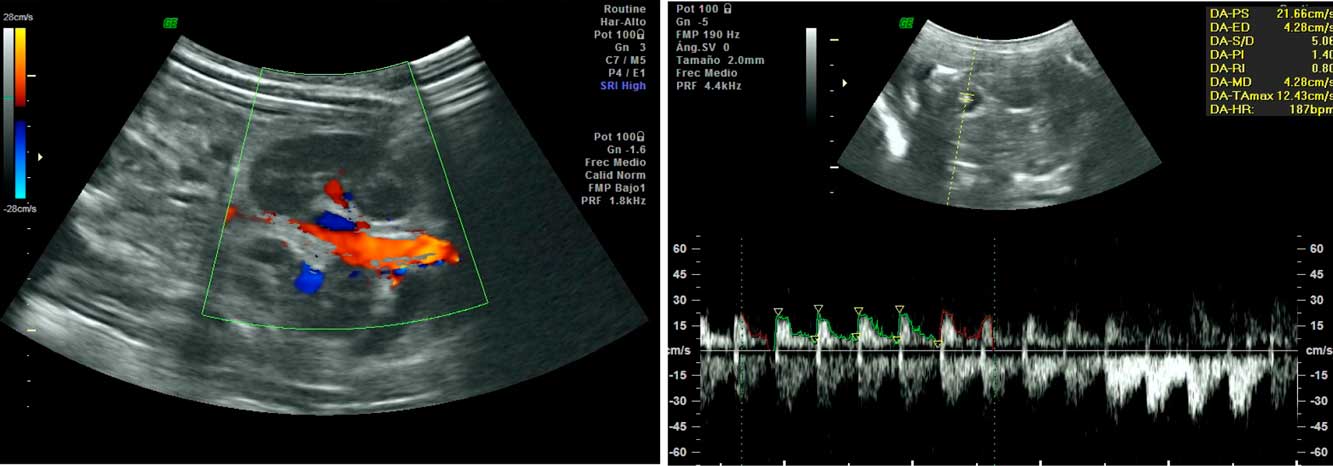
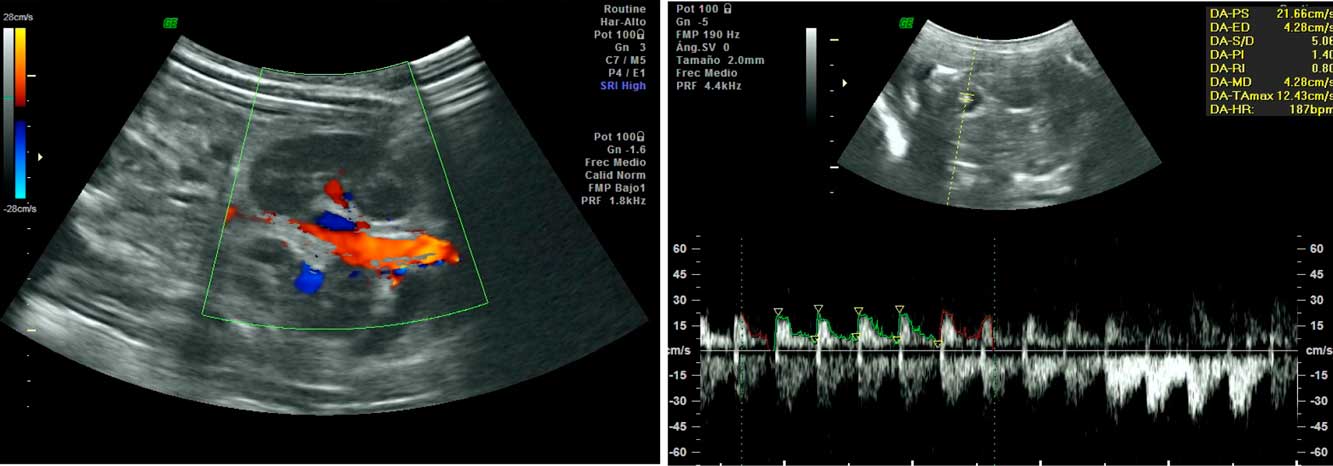
The blood flow parameters from umbilical cord (UA), middle cerebral (MCA) and renal arteries (RA) were determined in all the fetuses (Fig. 2). Briefly, after identifying the vessels by using color Doppler (UAs were found at the free-floating UA proximal to the placental insertion; MCAs were located after Circle of Willis identification; RAs were assessed proximal to kidney insertion), the sample pulsed Doppler gate was placed over the vessels. Then, the waveforms of three consecutive cardiac cycles in each vessel were recorded, disregarding views with insonation angles between 0° and 50°. Measurements were obtained once the entire examination was recorded and included resistance index (RI), pulsatility index (PI) and systolic-to-diastolic peak velocity ratio (SD-ratio). Assessment of brain-sparing was performed by determining the cerebro-umbilical ratios (i.e. the ratios between MCA and UA values) for RI, PI and SD-ratio.
Identification of the renal artery by using color Doppler (left image) and detection of the waveform in the portion proximal to kidney insertion (right image) in a control sheep fetus.
Statistical analysis
The effects from independent variables (i.e. maternal diet and prolificacy) and their interaction on dependent variables related to offspring phenotype (morphometric and hemodynamic parameters) were assessed using two-way analysis of variance (ANOVA). Maternal diet was categorized in control v. restricted diets and prolificacy was categorized in singleton v. twin pregnancies. Morphometric and hemodynamic parameters included TD, BPD, length and volume of the left kidney (KL and KV) and blood flow parameters (RI, PI and SD-ratio) from UA, MCA and RA. Possible relationships among morphometric and hemodynamic data of the offspring were determined by Pearson correlation procedures. All data were reported as means±s.e.m. and probabilities were considered significant at P<0.05.
Results
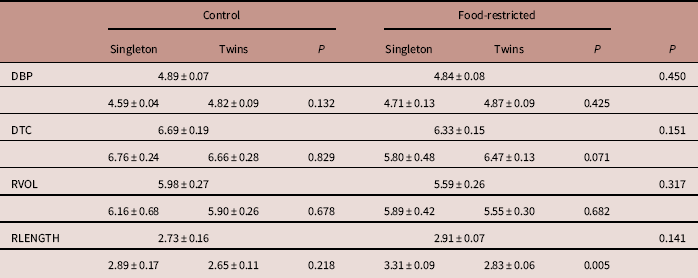
There were no significant differences in the mean values of biparietal and thoracic diameters of the fetuses when comparing control v. singleton pregnancies and food-restricted v. twin pregnancies at Day 115 of gestation (Table 1). The same was found for the volume of the kidneys although the value for kidney length was numerically higher in restricted pregnancies. Within restricted pregnancies, kidney length was significantly higher in singleton than in twin pregnancies (33.1±0.9 v. 28.2±0.6 mm, respectively; P<0.01).
Mean values (±s.e.m.) for biparietal (DBP) and thoracic diameters (DTC), and volume and length of the kidney (RVOL and RLENGTH, respectively) in singleton and twin control and food-restricted fetuses at Day 115 of pregnancy

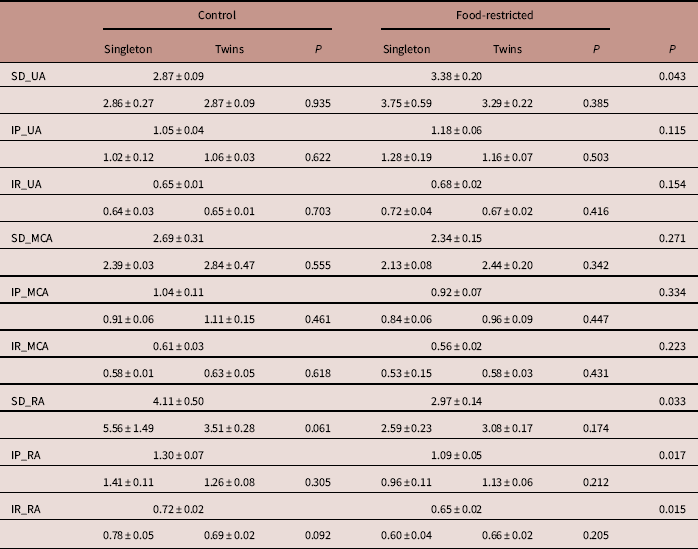
Assessment of fetal hemodynamics (Table 2) at the UA showed that maternal food restriction was related to a higher SD-ratio (3.37±0.09 v. 2.86±0.20 in the control group; P<0.05), without effects on RI and PI. There were no effects when evaluating these parameters at the MCA or when evaluating the cerebro-umbilical (MCA/UA) ratios.
Mean values (±s.e.m.) for fetal hemodynamics assessment [systolic-to-diastolic peak velocity ratio (SD), resistance index (RI) and pulsatility index (PI)] performed at the umbilical cord artery (UA), middle cerebral artery (MCA) and renal artery (RA) of singleton and twin control and food-restricted fetuses at Day 115 of pregnancy

On the other hand, there were no effects from twinning in any the absolute hemodynamic parameters at UA and MCA of both control and restricted fetuses. Assessment of the cerebro-umbilical ratios showed no effects of twinning in the control pregnancies, but twinning in restricted pregnancies was associated to significantly higher cerebro-umbilical ratios for SD-ratio and RI (P<0.05 for both).
The assessment of the kidney showed that maternal food restriction, despite the lack of significant effects on size of the organ, induced a significant decrease in all the hemodynamic parameters at the RA (P<0.05 for all) and, consequently, in the corresponding reno-umbilical ratios (SD-ratio: P<0.005; RI: P<0.05; PI: P<0.01). Twinning in control pregnancies was associated to lower reno-umbilical SD-ratio and IR (P<0.05 for both) but, in contrast, there were no significant differences between singletons and twins in restricted pregnancies.
The assessment of possible relationships between fetal size and hemodynamic features obtained by the Pearson procedure showed a lack of effects at the level of both UA and MCA in both control and restricted fetuses. However, comparison of fetal size and hemodynamics at the RA showed significant differences between the two nutritional regimes. There were no significant effects of fetal size in the control group, but restricted fetuses with larger BPD had higher reno-umbilical ratios for IP and IR (r=0.974, P<0.05 and r=0.993, P<0.01, respectively).
Discussion
The results from the present study indicate that maternal undernutrition is related to a decrease in the materno-fetal blood flow but an increase in in the blood supply to the offspring kidneys. These changes are even earlier to the blood flow redistribution occurring during the ‘brain-sparing’ effect and even previous to changes in size of the fetuses, and the proper kidney, which are characteristics of IUGR processes. Fetuses at the greatest challenge (twins in underfed pregnancies) showed, in addition to hemodynamic changes in the cerebro-umbilical ratios indicating early stages of brain-sparing, morphological changes evidenced by a decrease in kidney size, which supports the notion that fetal renal excretory function is affected in risk pregnancies.Reference Zywicki, Blohowiak, Magness, Segar and Kling 31
Currently, ultrasonographic monitoring of fetal growth and symmetry, followed by Doppler assessment of fetal hemodynamics, is routinely used to determine occurrence and type of IUGR.Reference Miller, Turan and Baschat 15 , Reference Rizzo and Arduini 16 Doppler sonography is used to detect changes in the uteroplacental and fetal perfusion through assessment of blood vessels of clinical relevance like the uterine, umbilical and middle cerebral arteries and the ductus venosus. The most common assessment is based on umbilical artery (UA) Doppler data which, however, cannot constitute a useful diagnosis because abnormal UA indexes are only found when irreversible adverse perinatal outcomes are established.Reference Unterscheider, Daly and Geary 32 On the contrary, UA values may be within normal range in IUGR fetuses with early cerebral vasodilatation and therefore Doppler measurements of MCA and cerebro-placental ratios (CPR) are most valuable tools.Reference Mureşan, Rotar and Stamatian 33 CPR is considered the best predictor as it reflects not only the circulatory insufficiency of UA but also the adaptive changes resulting in modifications of the MCA hemodynamics.Reference Shahinaj, Manoku, Kroi and Tasha 34 Hence, even with normal UA Doppler indexes, abnormal CPR values are indicative of fetal distress, acidemia, neurologic disorders and adverse perinatal outcomes.Reference Mureşan, Rotar and Stamatian 33 , Reference DeVore 35 , Reference Nassr, Abdelmagied and Shazly 36
In any case, abnormal Doppler indexes at either brain or umbilical vessels have a poor predictive value,Reference Albu, Anca, Horhoianu and Horhoianu 37 as they are only found when fetuses already have damages and the only option is programmed delivery after weighing the risks of prematurity against the risks of adverse intrauterine condition. Hence, there is a strong need for earlier markers of changes in fetal hemodynamic which will likely lead to targeted monitoring intervals and to the implementation of new protocols for early diagnosis and management of IUGR.
In this scenario, the data of the present study, obtained just prior the overt growth arrest occurring in case of IUGR,Reference Zywicki, Blohowiak, Magness, Segar and Kling 31 have a significant value for both increasing the availability of tools for an adequate clinical follow-up of pregnancy and the knowledge of the pathophysiology of renal damage. In our study, maternal malnutrition was related to a higher UA SD-ratio which, even within a normal range, may indicate an increased risk of compromise to the fetus.Reference Devoe, Gardner, Dear and Faircloth 38 There were still no evidences of IUGR or brain-sparing since, except in the most compromised fetuses (twins in restricted pregnancies), which showed higher cerebro-umbilical indexes reflecting modifications of blood flow at the brain.Reference Shahinaj, Manoku, Kroi and Tasha 34 Conversely, we found clear evidences of changes in the blood supply to the kidneys, supporting that organs with a rich arterial blood supply (i.e. eye, kidney, heart and brain) are the primary target to blood pressure changes.Reference Mensah, Croft and Giles 39 We found, unexpectedly, a significant decrease in all the hemodynamic parameters at the RA and, in consequence, in the corresponding reno-umbilical ratios. Overall, these changes are indicating an increased blood flow to the kidneys.
The existence and extent of hemodynamics changes at the RA of IUGR fetuses was the focus of an intense debate from earlier studies, with authors claiming a diminished blood flowReference Vyas, Nicolaides and Campbell 40 – Reference Yoshimura, Masuzaki, Gotoh and Ishimaru 42 and other authors claiming no changes or even a reduction in downstream resistance.Reference Surányi, Streitman and Pál 43 , Reference Stigter, Mulder, Bruinse and Visser 44 The common current idea is that IUGR affects kidney development and, hence, renal blood flow is decreased due to the brain-sparing effect; however, the differences among the cited studies may be caused by differences in the timing of pregnancy and the degree of IUGR at the Doppler evaluation.
In fact, the increased blood flow to the fetal kidney found in the present study (performed at the beginning of the third trimester and just prior the overt growth arrest occurring during IUGR) reinforces early studies with Doppler ultrasound, which addressed that the renal flow response to hypoxia depends on the degree of hypoxia and IUGR.Reference Arbeille 45 First data were obtained by surgery and the microsphere technique,Reference Peeters, Sheldon, Douglas-Jones, Makowski and Meschia 46 and indicated that the blood flow to kidneys remains constant or increases during the transition from high to moderately low levels of arterial oxygen content and then decreases abruptly after more severe hypoxia. In turns, these evidences support earlier hypotheses addressing that the renal blood flow in the fetuses appears to be maintained by autoregulation independently of the blood flow redistribution to the brain in IUGR fetuses.Reference Shepherdj and Abboudf 47 , Reference Tanabe 48 By joining these data and the data in current study, we can conclude that assessment of renal hemodynamics can be used as a diagnostic tool for identifying fetuses at the earlier stages of IUGR.
Acknowledgments
The authors thank AGRIS personnel for their help in the care and handling of the ewes. A.B. and A.G.B. are members of the EU COST-Action BM1308 ‘Sharing Advances on Large Animal Models (SALAAM)’. Authors’ Contributions: A.B., C.P., A.G.B. and F.B. conceived and designed the experiments, A.B., C.P., A.S., S.S., M.D., M.G., G.M., S.N., A.G.B. and F.B. performed the experiments; A.B., C.P., G.M., A.G.B. and F.B. analyzed the data; A.B., C.P., A.G.B. and F.B. wrote the paper; and A.S., S.S., M.D., M.G., G.M. and S.N. revised the paper.
Financial Support
The experimental work was supported by funds from Regione Autonoma della Sardegna – Progetti ricerca fondamentale o di base - L.R. 7/2007 - annualità 2013 (CRP 78167).
Conflicts of Interest
None.
Ethical Standards
The experimental procedures with animals (sheep, Ovis aries) were approved by the Animal Care and Use Committee of the University of Sassari, Italy. All the experimental work was carried out at the facilities of the Department of Animal Production of AGRIS (Bonassai, Sardegna, Italy). These facilities meet the requirements of the European Union for Scientific Procedure Establishments. The experimental procedures followed ethical guidelines for care and use of animals for research (European Union Directive 2010/63/UE for animal experiments).