The literature on banking and financial crises has paid special attention to the links between risk-taking behavior by banks and market discipline. It is often argued that events that trigger increases in risk taking, such as privatizations or financial liberalizations, can lead to crises unless banks are penalized for risky behavior by bank depositors or shareholders. For example, during the 1994 crisis, the banking sector in Mexico was characterized by a lack of depositor discipline.1
See Gruben, Koo and Moore, “Financial Liberalization.”
In other words, depositors did not penalize banks for excessive risk-taking behavior, leading to the accumulation of nonperforming loans in the banking sector.
2 For evidence that the 1994 crisis was a bank-risk-led crisis, see Gruben and McComb, “Privatization.”
In this article we test for the presence of market discipline in a different period in Mexican banking history, namely the last ten years of the “Porfiriato,” 1900–1910. The economy in this period had several features in common with the modern Mexican economy. In particular, an unrestricted capital account and the development of a financial system led to an investment boom and strong economic growth in the first part of the period.3
However there are also significant institutional differences between these two periods. In the earlier period there was no lender of last resort, banks issued private money and, from 1905, the economy operated on a bimetallic standard where the relative price between gold and silver was fixed. The insurance scheme for notes and deposits was limited to 50 percent of the book value of capital in contrast to the unlimited deposit insurance available to contemporary depositors.
In 1907 the collapse of copper prices in the United States provoked a widespread financial panic. Liquidity dried up in the New York financial markets and several banks closed their doors. Whereas the United States economy recovered rapidly, the resulting economic crisis in Mexico was prolonged. Most economic indicators of the real economy stopped growing by 1907 or 1908, and did not recover until 1911.
4 Haber, Razo and Maurer, Politics of Property Rights.
This recovery proved short-lived: the Mexican revolution of 1910 engendered an era of political instability, violence, and civil war, which lasted for almost two decades.
Many historians believe that the roots of the Mexican revolution can be traced to the depression of 1907.5
See for example, Meyer, Forge; LaFrance, “Regional Nature”; and Hart, Revolutionary Mexico.
The shortcomings of the Mexican banking system, and the consequent misallocation of resources, are seen as one of the prime causes of the depression.
6 See for example, Batiz Vasquez and Canudos Sandoval, “Aspectos Financieros.”
Bank directors lent money to their own enterprises, unsupervised and unregulated. The peculiar regulatory framework and branching restrictions prevented competition between banks. Banks issued notes, which circulated as legal tender. There were no incentives for note holders to monitor banks, given the existence of a payments system (the Banco Central) that guaranteed at-par redemption of the notes. Patrice Robitaille, for example, argues that “considerable government intervention weakened the disciplinary role of the Banco Central and thus made the system more prone to collapse.”
7 See Robitaille, “Private Payment Systems.”
We explore the hypothesis that a lack of market discipline was responsible for the inadequacies of the Mexican banking system. By market discipline we mean discriminating behavior on the part of private agents with respect to risk taking by individual banks. For example, riskier banks may need to offer higher interest rates to depositors to attract funds. Creditors may penalize behavior that they perceive as excessively risky by withdrawing their deposits. Furthermore, market discipline may force inefficient banks to exit the industry and reduce the need for government supervision and regulation. If private agents exerted discipline over banks, the argument that the prerevolutionary banking system contained the seeds of its own destruction is severely weakened.
We construct a panel data set of quarterly observations of banks' balance sheets between 1900 and 1910 and focus on the relationship between bank fundamentals and depositor and note holder behavior. In particular, we test whether depositors penalized excessive taking on the part of banks by withdrawing deposits and whether risky behavior on the part of banks reduced the acceptability of bank notes.8
Several historical studies (see for example Gorton, “Reputation Formation”) on market discipline focus on the discount on privately issued bank notes as an indicator of market discipline. However, in 1900 a clearing house system was established in Mexico, which provided at-par redemption of bank notes. By 1902 there was no discounting of bank notes, which circulated at par through the country.
Our analysis is complicated by the fact that several banks ceased to function as note-issuing banks in this period and stopped accepting deposits. This induces a selection bias in our sample, because some factors that caused these banks to exit, such as the quality of the management, could also be related to the behavior of deposits and note issue. In other words, we only observe changes in deposits and notes outstanding of relatively healthy banks because failure led to a bank dropping out of the sample rather than generating a large observed fall in deposits or notes. Consequently, the strength of the relationship between fundamentals and bank outcomes is underestimated if selection bias is ignored. However, we have a unique data set that contains information on exiting banks after they stopped issuing notes and were converted into mortgage houses. This feature of our data allows us to control for selection bias in our estimations.
We find significant evidence of market discipline in early-twentieth-century Mexico. Bank fundamentals influenced both deposits and note issue in a statistically significant manner. For note issue this effect is present throughout the period under study, whereas depositor discipline manifested itself in the period after the introduction of the gold standard in 1905. Controlling for the bias induced by exit is central in obtaining the result for depositor discipline. When we do not account for exit, bank fundamentals are not a significant determinant of depositor behavior and the evidence for depositor discipline is weak. The issue of notes, in contrast, although strongly related to the factors that influence survival of the bank, is related to bank fundamentals even without conditioning on survival.
Our results suggest that even if government regulation impaired the disciplinary role of the Banco Central, banks were still exposed to other disciplinary forces—those exacted by depositors and note holders.9
For evidence that Mexican banks were also tightly monitored by their shareholders, see Maurer, “Banks and Entrepreneurs.”
It may therefore be an overstatement to blame a lack of market discipline for the shortcomings of the banking system.
Our findings are consistent with those of Gary Gorton, who finds that the discount on private bank notes was related to measures of bank riskiness in the United States between 1839 and 1858.10
See Gorton, “Reputation Formation.”
In contemporary economies, there is also evidence of market discipline in the market for insured and uninsured deposits in the United States
11 See, for example, Baer and Brewer, “Uninsured Deposits”; Hannan and Hanweck, “Bank Insolvency Risk”; Cook and Spellman, “Repudiation Risk”; Ellis and Flannery, “Does the Debt Market”; Goldberg and Hudgins, “Response”; and Park and Peristiani, “Market Discipline.” Not all studies have found evidence of market discipline in modern economies. Billett et al., “Cost of Market vs Regulatory Discipline,” find that banks can circumvent the costs of increased risk taking by increasing insured deposits at the expense of uninsured deposits.
In emerging markets in Latin America, L. Schumacher and M. S. Martinez Peria and S. L. Schmukler find evidence of market discipline in the banking industry.
12 See Martinez Peria and Schmukler, “Do Depositors”; and Schumaker, “Bubble.”
Our results are relevant for more than Mexican history. First, as we have already mentioned, in the early 1900s the Mexican economy shared many features of current emerging market economies. The removal of restrictions on trade and capital movements and the expansion of the financial system stimulated capital inflows and economic growth. At the same time, the economy was left highly vulnerable to external shocks. All these are features that characterize modern emerging economies. Hence, our results and methodology may bear relevance on the study of market discipline in developing economies.
Second, our results contribute to the debate about deposit insurance and market discipline. Martinez Peria and Schmukler find that the presence of deposit insurance does not weaken the incentives of depositors to exert discipline, whereas A. Demirguc-Kunt and E. Detragiache find the opposite result.13
See Martinez Peria and Schmukler, “Do Depositors”; and Demirguc-Kunt and Detragiache, “Does Deposit Insurance.”
We show that in a period when there was limited deposit insurance, depositors punished banks for risky behavior and provided stability to the system. This is in contrast to contemporary Mexican banking, where unlimited deposit insurance is widely believed to have eliminated depositors' incentives to monitor banks.
Finally, our results show that when testing for market discipline in the banking sector, it is important to consider the selection bias introduced by exiting banks. Exiting banks tend to be less successful than surviving banks, and this is reflected in their balance sheets. Hence using only survivor banks to test for market discipline creates a bias in the estimation.
HISTORICAL BACKGROUND
Following independence from Spain in 1821, Mexico went through a 50-year period of political instability, fueled by internal turmoil and wars with external powers.14
See Maurer, Finance; and Robitaille, “Private Payment Systems,” for extensive accounts of the history of Mexico's financial sector.
In 1876 General Porfirio Diaz seized power and was subsequently elected president, a position he held until the revolution in 1910, except for a brief interruption between 1880 and 1884. The “Porfiriato” was a period of political stability and economic growth. Internal tariffs were abolished, restrictions on international trade and investment were lifted, and the transport infrastructure was greatly expanded. The period was also characterized by development of the financial sector, albeit limited compared to that of other countries.
In the early 1900s note-issuing banks were the predominant type of depository institution in Mexico, with banks of issue accounting for 92 percent of the assets of chartered banks in 1897. There existed two types of banks of issue, “national” banks and “state” banks. The former were allowed to operate throughout the country, whereas the latter could not branch out of specific regions. There were two national banks: the Banco Nacional de Mexico (BANAMEX) and the Banco de Londres y Mexico, which together accounted for 80 percent of the assets of the banking system in 1897. BANAMEX, which had been created to secure international funding for Porfirio Diaz's government, enjoyed several special privileges. The minimum denomination of its notes was one peso (as compared to five pesos for other banks), it was subject to a smaller specie reserve requirement than other banks, and only its notes were accepted by the Treasury for tax payments. In addition BANAMEX was the only bank allowed to use government bonds to back its notes.15
It should be emphasized though, that BANAMEX cannot be considered a central bank, despite the special privileges it enjoyed. (see Maurer, Power). It was never granted a monopoly on bank note issue, nor was it a lender of last resort.
Unlike the national banks, state banks were not allowed to branch outside specific—sometimes overlapping—regions, and were prohibited from operating in Mexico City. By 1906 there were 29 chartered note-issuing banks, including the two national banks. Both types of banks issued notes that were backed by specie. However, whereas the notes issued by the national banks circulated at par throughout the country, initially this was not the case for state bank notes. Indeed, the branching restrictions made it difficult for state banks' notes to be accepted widely.
In 1898 a group of 13 state banks created a private payments system, the Banco Central, with the intention of ensuring at-par redemption of state bank notes in Mexico City. Banco Central operated as did the Suffolk Bank System of New England to the extent that it acted as a clearing house for bank notes and checks.16
For more details on the Suffolk Bank, see Rolnick et al., “Lessons.”
Its operations greatly enhanced the acceptability of notes issued by state banks, and by 1902 these notes circulated at par throughout the country. In 1904 the Banco Central established a limited mutual assistance scheme to provide additional protection to depositors and holders of notes issued by state banks. Under this scheme, if any member bank faced a bank run or had liquidity problems, it could utilize resources from a fund created for this purpose by all contributing members. Each member contributed 2 percent of the book value of its capital and had insurance cover up to 50 percent of the book value of its capital. The Banco Central also acted as a financial institution for Mexico City in its own right. However, unlike the Suffolk Bank and other clearing houses in the United States at this time, Banco Central did not possess rights to monitor its members. For example, it could not assume control over its members' operations in emergencies, nor did it have access to its members' books.
Until 1905 Mexico operated under a bimetallic standard, with a flexible exchange rate between gold and silver specie, the latter being the predominant commodity money circulating in the country. In 1905 the country joined the gold standard and fixed the exchange rate between silver and gold coins. However, between 1905 and 1907, the market price of silver increased by about 17 percent and the real exchange rate between silver and gold appreciated considerably. Hence the book value of banks' capital, which consisted to a large extent of silver specie, increased substantially. This led banks to expand the volume of outstanding notes and increase the money supply. In addition, they also expanded their scale of operations by attracting additional capital in the form of new shares—to a great extent held by foreigners.
In October 1907 a crisis hit the U.S. banking industry, brought on by a sharp decline in the international price of copper. Banks that had invested in copper futures suffered heavy losses. This crisis also interrupted capital flows to Mexico from the United States. As a consequence, domestic interest rates rose from 6 percent to 10 percent. The price of Mexican government bonds in international markets declined from 34 to 31 pounds sterling. The price of silver also dropped by 25 percent between 1908 and 1910. This reversed the effects of the earlier appreciation and was a further cause of capital outflow. In addition, region-specific factors, such as a decline in the price of hemp and droughts in some areas, exacerbated these problems for banks that operated in predominantly agricultural areas.
Several banks faced problems in honoring their liabilities. The Banco de Oaxaca was forced to declare bankruptcy in 1909, as was the Banco de Chiapas. The Banco de Morelos and the Banco de Aguascalientes suffered bank runs. The latter was purchased by the Banco de Jalisco in December 1908. The Banco de Sonora took heavy losses when several of its clients in the mining industry declared bankruptcy. Two banks in the Yucatan were affected by the hemp crisis and were merged into one in 1908. The Banco de Campeche and the Banco de Michoacan went bankrupt, and were subsequently converted into mortgage banks. By 1909 seven of 29 note-issuing banks had received government assistance, been bought by another bank, or closed down. The government also bailed out the Banco Central when it faced severe liquidity problems in 1908.
Given these repeated bailouts and the Banco Central operated insurance scheme, one might expect that private agents had little incentive to impose discipline on the Mexican banking industry in this period. We now turn to a formal test of this hypothesis.
THE EMPIRICAL SPECIFICATION
We test for the presence of discipline in the market for short-term deposits in the last 11 years of the “Porfiriato” by studying the evolution of deposits for 27 note-issuing banks and the Banco Central.17
An analysis identical to that for short-term deposits is also made for the market for bank notes. Although there were 29 note issuing banks in this period, we drop Banco de Oaxaca and Banco de Chiapas from our sample, for reasons that we go into in the next section. In addition, the two banks in the Yucatan that were merged in 1908 are treated as one throughout the sample.
In particular, we test whether deposits respond to changes in bank fundamentals measuring idiosyncratic risk. We control for systemic risk in the banking sector as well as for macroeconomic indicators.
18 By systemic risk we mean the willingness of the public to keep their money in the banking system as a whole. We measure this willingness by looking at the amount of silver specie in the hands of the public.
We also control for certain bank-specific effects, reflecting the type of bank— national versus state—and certain regional factors. The latter are important because of the branching restrictions on state banks, which imposed a severe constraint on state banks' ability to diversify their portfolio.
Moreover, and in contrast to the earlier literature, we explicitly account for the selection bias introduced by banks that exited the industry during the period under study. These banks were restructured and continued operating as mortgage banks, but were prohibited from issuing notes and taking deposits. Hence, we have data for these banks after they stopped being deposit institutions and can therefore estimate the probability of exit.
We want to estimate the following equation
Here Wit represents the change in deposits of bank i between time t and t-1. SYSt stands for the systemic risk in the banking system. MACROt is a vector of macro-economic variables. Both systemic risk and macroeconomic variables change over time but are common for individual banks. BANKit-1 is a vector of bank fundamentals. This vector is included with a lag, to account for the fact that balance sheet information is available to the public with some delay. Also this prevents reverse causality, i.e., the possibility of the change in deposits influencing bank fundamentals. Finally, DTYPEi is a dummy variable indicating whether bank i is a national or a state bank or the Banco Central, and DZONEi is a dummy for the geographical region in which bank i operates.
The selection problem arises because we do not observe Wit for the entire sample of banks. Indeed, we know changes in deposits at time t only for those banks that did not exit at the end of time t-1. Hence the variable Wit is truncated and we only observe it conditional on the fact that the bank was functioning in the period. In other words, the equation we have to estimate is
where Wit|BiCOt denotes the change in deposits, conditional on the fact that bank i continues to operate at time t. The error term in this equation is unlikely to have a zero mean and the estimates are likely to be biased. We use the Heckman two-step estimator to estimate this bias by determining the probability that bank i operates at time t, based on certain bank indicators.
19 See Heckman, “Sample Selection Bias.”
To do so we define
where Dit* is a latent variable, the value of which determines whether bank i continues functioning at time t. Xit is a matrix of variables that can be observed for all banks at all times, independent of whether they are functioning as a deposit institution or a mortgage house. Dit* is not observable, but we define the observable dummy variable Dit as follows
Dit indicates whether bank i issues deposits at time t or not.
Selection bias arises because uit and vit are very likely to be related. In other words, unobserved (by the econometrician) factors that influence survival or exit, such as the quality of the management, are also likely to influence the whether depositors are willing to keep their money in the bank. Correcting for this bias, we have
20 To find the conditional expectation of E(uit|Dit = 1) we assume that the error terms in both equations are distributed according to a bivariate normal distribution, that is,
Then
where phi; (.) is the density and Φ (.) is the area under the standard normal distribution.
where
is the inverse Mills ratio and ηit is an error term orthogonal to the other variables.
Our estimation therefore proceeds in two steps. We first estimate the vector γ/σv by a probit on equation 3 and use it to construct a measure of the bias. Using this estimate of the bias, we estimate the coefficients of equation 4 for banks that functioned throughout the sample period. This gives us consistent estimates of the parameters. As mentioned previously, an equation analogous to equation 4 can be estimated for note issue, correcting for selection bias.
DATA
The data on bank balance sheets come from the Diario Oficial de la Federacion, a daily government publication that published quarterly bank balance sheet data on (or around) the last day of March, June, September, and December. As mentioned earlier, we use quarterly data on 27 of the 29 note-issuing banks, and the Banco Central, from 1900 to 1910.21
Although balance sheet data are available for some banks since 1897, there are many missing values from 1897 to 1900. Also, before 1900 several banks made no distinction between sight and term deposits.
The two banks in the Yucatan that were merged are treated as one bank for the entire sample. Banco de Chiapas and Banco de Oaxaca were dropped from the sample because no information about them is available after they went bankrupt in 1908, and hence they could not be included in the probit analysis. However, because these were very small banks their exclusion is unlikely to affect our estimations significantly.
22 Banco de Chiapas accounted for 0.17 percent of the total assets of the banking system. The corresponding figure for Banco de Oaxaca was 0.68 percent.
In addition, we have data for the Banco de Guerrero only from its inception in the third quarter of 1906 to the first quarter of 1910.
Explanatory Variables
We now turn to a description of the explanatory variables used in the estimation. The dependent variable in the withdrawals equation is always the change in short-term bank deposits between time t and t-1 as a ratio of the total assets of each bank. Similarly, the dependent variable in the note issue equation is the change in bank notes outstanding between time t and t-1 as a ratio of the total assets of each bank.
Systemic Risk
We measure the level of public confidence in the banking system by the amount of metallic money in the hands of the public. This was measured as the total amount of metallic money in existence at time t less the amount of metallic money held by the banks. A more conventional measure would include all components of M1, such as bank notes. However, during the Porfiriato bank notes represented idiosyncratic rather than systemic risk. A higher level of metallic money in the hands of the public would indicate a lower degree of confidence in the banking system as a whole.
Macro Variables
We use two variables to reflect macroeconomic conditions in this period. The first is the price of silver, which, as mentioned earlier, was the principal component of bank reserves. Although a high price of silver would raise the value of banks' reserves, it would also induce the public to substitute it for other assets, including bank deposits. The second variable we use is the price of Mexican public bonds, which were traded on the London stock market. This serves as an indicator of the interest rate in this period. The price of silver was obtained from the Historical Statistics of the INEGI and the monthly price of bonds is calculated as the average of the monthly highs and lows published by the Boletin Financiero y Minero.
Type and Zone Dummies
We use a dummy for the national banks because, as mentioned earlier, they faced very different operating conditions from the state banks. In addition, we use a dummy for the Banco Central which, apart from its regular banking operations, also functioned as a clearing house for the notes of state banks.
Four zone dummies were used to capture the idea that the operations of state banks were restricted to specific regions. These regions were not very diversified economically and the fortunes of particular banks were closely tied with the economy of the region. The industry and commerce dummy was used for the six banks which functioned in the states with a high level of commerce and manufacturing. These were Aguascalientes, Guadalajara, Veracruz, Monterrey, Tamaulipas, and the state of Mexico. The mining dummy was used for states with mining operations, which typically received heavy foreign investment. These states were Chihuahua, Sonora, Durango, and Coahuila. The agricultural activity dummy was used for banks in the Yucatan, Campeche, Morelos, Guerrero, and Tabasco. The underdevelopment dummy was used for banks that operated in states with a very low level of industrialization or old mines that did not yield much return. These states were Michoacán, León, Puebla, Querétaro, Guanajuato, Zacatecas, Hidalgo and San Luis Potosí.
Bank Fundamentals
We use the following variables to measure bank fundamentals.
- The ratio of the change in bank notes issued by bank i between period t and t-1 to the total change in bank notes issued by all banks in this period. This ratio measures the level of confidence in each bank relative to the total banking system. However the scheme of at-par redemption, guaranteed by the Banco Central, subsidized relatively inefficient banks. A disproportionately high level of notes issued by a particular bank in any period could also be an indicator of free riding.
- The short-term assets to liabilities ratio for each bank. Short-term assets include commercial paper, debt outstanding, and investment in stocks and bonds.23
Although all loans were required to be of less than six month duration, this rule was regularly violated during the Porfiriato (Maurer, Finance). Hence the loans referred to may not all be truly short term.
- The ratio of loans to total assets for each bank, which indicates the composition of assets and measures the banks' exposure to risk. Total assets include cash and metallic reserves, commercial paper, total loans outstanding, real estate, and property. The loans include commercial paper, loans with collateral, mortgage loans, and other loans.
- The equity capital to net assets ratio, which indicates the degree of capitalization for each bank.
- The ratio of change in metallic money held by the bank to total assets. The numerator represents the proportion of liquid, risk free assets to total assets. Total assets are defined as in (3).
- The ratio of liabilities to total loans. The liabilities consist of notes issued, sight and term deposits, loans taken by the bank, and reserves. This variable also measures the liquidity and riskiness of the bank.
- The extent of insurance coverage. This was the ratio of 50 percent of the book value of capital to the sum of notes issued and short-term deposits of banks. This variable is defined by the mutual insurance scheme run by the Banco Central, which guaranteed 50 percent of the book value of capital, and measures the insured portion of the banks' deposits and issued notes.
- Relative bank size. This is the total assets of each bank divided by the sum of assets of all banks for that period.
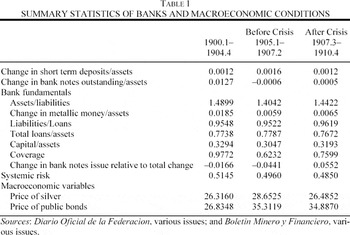
Summary statistics of all the variables, before and after the crisis of 1907, are presented in Table 1. We also compute the values of these variables before 1905 for comparison.
The 1905 to 1907 period was one of expansion in the banking sector. Interest rates were at their lowest and deposits grew at a faster rate than they had in the preceding period. Banks increased their lending activities, while they reduced their reserves and equity capital (relative to assets) at the same time. As a result the insurance coverage for notes and deposits also dropped substantially.
The immediate effect of the crisis of 1907 was to induce banks to increase their liquidity. The metallic reserves to assets ratio increased, as did the capital to assets ratio. Banks reduced their lending and increased their insurance coverage. Deposit growth also slowed down.
The amount of metallic money in the hands of the public, which is our measure of systemic risk, seems to have marginally declined after the crisis. This is somewhat surprising. However, there was a small drop in the period immediately after the crisis and a subsequent increase due to a fall in the price of silver. The average figure reflects both of these effects. As mentioned earlier, the price of silver fell between 1908 and 1910, which is reflected in the data. The price of public bonds also fell, implying an increase in the interest rates.
THE RESULTS
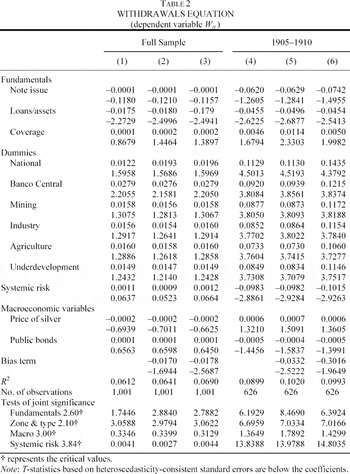
We present our results for depositor discipline in Table 2. The top left panel presents the results for the full sample. The first column is an estimation of equation 1 that does not take the selection bias into account. The second and the third column are results for equation 4 after estimating a probit on equation 3. The columns differ only in the variables used in the probit for the selection bias.24
The independent variables used in the first specification of the probit are the liabilities to loans ratio, the ratio of the change in metallic reserves to total assets and the assets to capital ratio. All coefficients are positive and significant. The second specification uses the assets to liabilities ratio and the change in metallic reserves to total assets.
ratios are presented below the coefficients. The bottom left panel gives the
F tests for joint significance of each group of variables for each estimation. In each case, the dependent variable is the ratio of the change in deposits between period
t and
t-1 as a proportion of total assets. The panel on the right presents the same results for the period 1905 to 1910.
The first column shows that, apart from the loans to asset ratio, the variables that represent bank fundamentals are not significant if we do not correct for selection bias. All the coefficients do however, have the expected sign. The issue of new bank notes relative to total issue enters negatively, suggesting that new bank note issue reflects a free rider problem, rather than confidence in the bank. The loans to assets ratio is significant and negative because it represents low liquidity and high risk. The coefficient on the insurance coverage ratio is also positive, as we may expect, but not significant. An F test however, rejects the hypothesis that fundamental variables are all jointly significant. The macroeconomic variables are neither individually nor jointly significant. The coefficient on the price of public bonds (which is inversely related to the interest rate) is positive, while that on the price of silver is negative. Contrary to what we might expect, the coefficient on systemic risk has a positive sign. However its magnitude is very small, and it is not significant.
The zone and type dummies are all jointly significant. Among the regional dummies, the underdevelopment dummies are the smallest, suggesting that operating in such areas was less advantageous to a bank than operating in states with well-developed industry, mining, or commerce. The dummy for the Banco Central is large and significant, and the dummy for the national banks, while also large, is not significant.
This estimation would seem to suggest that apart from the loans to assets ratio, bank fundamentals were not important in determining the behavior of bank deposits. The institutional structure and economic conditions, as represented by the type and zone dummies were the main variables that explained systematic variation in deposits of banks. Macroeconomic variables such as the price of silver and the price of public bonds were also not significant.
We now turn to the results that correct for the selection bias. The second column shows that including the bias term makes the fundamentals jointly significant. In addition, the coefficient on coverage doubles and increases substantially in significance. The coefficients of the loans to assets ratio increases slightly, although the coefficient on note issue is still small and not significant. The coefficient on the bias term is significant at the 10-percent level. The coefficients on the regional and bank specific dummies are basically unchanged, as are those on macroeconomic variables and systemic risk as these are not affected by selection issues.
The third column shows that our results are robust to alternative specifications of the selection bias. The coefficients for the fundamental variables are still jointly significant as is the coefficient on the bias term. The coefficients on the dummies are slightly larger. Systemic risk and the macro variables continue to be, both individually and jointly, not significant.
We now turn to the right-hand-side panel, which shows the same estimations for the period 1905 to 1910, namely after the introduction of the gold standard. The results in this period are different in many respects. First, with or without the bias term, the coefficients on the fundamentals are substantially larger and jointly significant. As in the full sample, the loans to asset ratio is always significant, and the coverage term becomes significant after the inclusion of the bias, in both its specifications. The coefficients on the note issue variable are substantially larger and also more significant. The other important difference in this period is that the coefficient on systemic risk is negative and very significant, reflecting that the level of confidence in the banking system influenced the movement of deposits very strongly. The coefficients on the zone dummies also increase substantially as do those on the type dummies. The macro variables are still not significant individually or jointly.
We see, therefore, that accounting for selection bias reveals that bank fundamentals exerted an influence on deposits throughout the period under study, and especially in the latter half of the period. This implies that depositors were able to penalize banks that indulged in excessive risk taking, as evidenced from the negative coefficients on the loans to asset ratios and the emission of bank notes, and the positive coefficient on insurance coverage. All this suggests that depositor discipline played an important role in the market for short-term deposits. It is also worth re-emphasizing that our data set is very unusual in that it allows us to account for the selection bias induced by exit in a way that other studies are unable to.25
See for example, Schumacher, “Bubble.”
Why does correcting for selection bias change our results? Without this correction, our sample just retains observations for surviving banks. These banks could be in one of two situations: they could have good observed fundamentals, or they could have bad observed fundamentals and good unobserved fundamentals (such as management quality, or intangible assets) that enable them to survive. In both cases, banks are able to attract deposits. Hence the relationship between deposits and observed fundamentals appears weak. Once we introduce banks that did not survive (through the bias correction term), we introduce banks with bad observed or unobserved fundamentals with a corresponding drop in deposits. This shows the real strength of the relationship between bank fundamentals and deposits.
Given the existence of depositor discipline, it is also worth asking how large the effect was in economic terms. It is difficult to answer such a question completely, because we do not observe a counterfactual outcome without market discipline. However our analysis does provide us some clues. For example, if we consider the period as a whole, if banks had doubled their loans, given actual asset levels, the coefficient on the loans to assets ratio implies a 2-percent decline in the change in deposits to assets ratio. This implies that the outflow of sight deposits would have been about 18 percent of total deposits in this period, assuming that bank assets grew at the rate we observe in the data. For the 1905–1910 period, the effect is still stronger: a doubling of the loans to asset ratio, given actual asset levels, would have produced an outflow of deposits equal to almost 30 percent of deposits in this period.
Perhaps more compelling evidence comes from a period in Mexican history where there was no depositor discipline, namely the banking crisis of 1994. Between 1991 and 1994, credit to the private sector grew at a rate of 20 percent per year. By the eve of the crisis, nonperforming loans accounted for more than 10 percent of total loans outstanding.26
Mishkin, “Global Financial Instability.”
As W. C. Gruben, J. Koo, and R. R. Moore show, there was no market discipline, i.e., depositors did not punish banks for the quality of their loans.
27 Gruben, Koo, and Moore, “Financial Liberalization.”
The consequences of this were quite dramatic. When the devaluation occurred in December 1994, the resulting deterioration in bank balance sheets implied a large decline in the supply of loanable funds.
28 This deterioration in bank balance sheets happened in two ways. First, firms that had borrowed from banks faced a large negative shock to their balance sheets because the value of dollar denominated debt increased by about 50 percent in real terms. This increased the proportion of bad debts the bank owned. Second, banks themselves had borrowed heavily in dollar denominated loans. An increase in the value of these liabilities meant further deterioration in their balance sheets.
As a consequence, private sector borrowing fell by about 20 percent and remained at that level up to 2000. Output fell by over 6 percent. If banks had faced the crisis with stronger balance sheets, it is safe to infer that the consequences of the devaluation would have been less severe. On the other hand, from
Table 1 we see that the loans to asset ratio after the crisis 1907 declined only by about 2 percent. It seems reasonable to attribute this to the presence of depositor discipline.
Finally, another dimension along which we can investigate the presence of market discipline is note issue. As mentioned earlier, from 1902 onwards notes of all banks circulated at par throughout the economy. On the other hand, there is no evidence of excessive note issue, i.e., throughout this period banks issued notes well below capacity.29
Banks were allowed to issue notes up to two times the value of their metallic reserves less deposits or three times the value of their equity capital.
In fact, average capacity utilization through the period was about 90 percent in terms of metallic reserves and only 30 percent in terms of equity capital. By 1906 banks had exhausted the profits to be made from note issue, and this, combined with an increase in the use of checks, meant that note issue declined through the period.
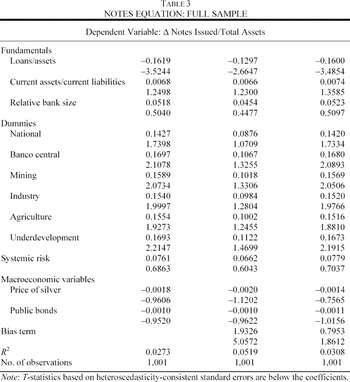
30 Table 3 shows our results for note holder discipline in the full sample.31
Results for 1900–1904, and for 1905–1910 are very similar and are available on request from the authors.
The dependent variable in all cases is the change in notes outstanding as a ratio of total assets. The results without accounting for selection bias are presented in the first column, and the estimations that correct for selection bias using the two probits are presented in the second and third columns. As the first column shows, the coefficient on the loans to asset ratio is always negative and significant, suggesting that banks that took greater risks could issue fewer notes. The other two variables representing bank fundamentals are the current assets to liabilities ratio, which gives information about bank liquidity, and the size of the bank relative to other banks, which captures the degree of confidence in the bank. These variables have the expected signs but are not significant. The fundamental variables are, however, jointly significant.
32 Sensitivity tests using coverage instead of bank size or unutilized note issuing capacity yield the similar results, i.e., the fundamental variables are always significant.
The coefficients on the dummies are relatively similar and are significant in several cases, indicating that being a national bank or belonging to a particular zone did not confer any advantage in terms of the acceptability of bank notes.
33 Although Banco Central did not issue notes, it did issue cashiers bonds, which we are treating as notes. Results excluding the Banco Central are very similar.
This was probably a result of the establishment of a clearing house for notes, which, as mentioned earlier, guaranteed widespread redemption of notes. The coefficient on systemic risk is not significant, nor are the coefficients on the macroeconomic variables.
The introduction of the selection bias term as an additional explanatory variable does not change our results significantly. In column 2 the bias is strongly significant, suggesting that the factors that are related to a bank's survival are positively correlated with its ability to issue notes. However, the coefficients on the bank fundamentals do not change substantially in magnitude or in significance. The coefficients on the dummies are slightly smaller though still very similar to each other. As before, the macro variables and systemic risk are not significant. The third column also shows a similar trend. The bias term is significant at the 10-percent level, and the coefficients on the fundamentals are very similar to those in the other two columns. The coefficients on the dummies and all other variables are also very similar.
CONCLUSIONS
Our analysis reveals that, despite considerable government intervention, market discipline played an important role in determining bank deposits and note issue in Porfirian Mexico. The presence of a partial insurance scheme as well as the at-par clearing house system of the Banco Central, which effectively subsidized less efficient banks, did not hinder depositors from discriminating against and punishing banks that undertook risky behavior. For the entire period, the most important determinants of depositor behavior seem to have been bank fundamentals and type and zone dummies. For the period from 1905 to 1910, a measure of systemic risk also seems to be relevant. It is also interesting to note that depositor discipline is much stronger for the latter period from the inception of the gold standard. Note issue was also strongly influenced by bank fundamentals. Although the zone and type dummies are significant, they are not substantially different from each other, suggesting that the wide acceptability of notes through the country did not confer a special advantage on any one type of bank.
What could account for the presence of depositor discipline in Mexico in this period? There is evidence that banks competed fiercely in loan markets whenever possible.34
See Maurer, “Banks and Entrepreneurs.”
The state banks faced competition from the local branches of national banks. In addition, the states of Chihuahua, Nuevo León, and Yucatan had multiple state banks. There is no reason to believe that such competition did not exist in the market for deposits and notes as well. In addition, the presence of silver as legal tender provided an alternative to deposits and notes as a store of wealth. An increase in the market price of silver relative to that of gold in the 1905–1907 period meant that the real exchange rate between silver and gold was much higher than the one fixed by the bimetallic standard. This increased the opportunity cost of holding deposits in the banking system and could be a reason why depositor discipline was stronger in the latter period, because depositors had more to lose and therefore greater incentive to monitor banks.
There is also some evidence that the insurance scheme guaranteed by the Banco Central did not enjoy much public credibility.35
The Banco Central was chronically short of funds, so much so that it had to be bailed out by the government in 1908.
36 This could also be a reason why we observe stronger depositor discipline in the post 1905 period. The 1907 crisis severely tested the credibility of the Banco Central, and the exit of several banks made it clear that they could not count on government bailouts if they engaged in excessive risk taking.
Members were not required to deposit reserves in the Banco Central and it had to offer an 8-percent interest rate to attract deposits. In addition, it lacked legislative powers usually associated with a payments system. Unlike the Suffolk Bank of New England, for example, it could not assume control over member operations in emergencies. It also had no special access to members' books. All this conspired to weaken the role of the Banco Central as a regulator of banks. Our results show that this role was, at least in part, taken up by the market.
We are grateful to Noel Maurer for many enlightening discussions. We also acknowledge helpful comments from David Kaplan and participants at the Stanford LACLIO 2000 conference and the Stockholm SED 2001 conference. Rainer Schwabe provided excellent research assistance. The views expressed in this article are those of the authors and do not necessarily reflect the views of the World Bank. The responsibility for all errors is ours.