Introduction
How morphologically complex words are represented in the mental lexicon and processed in real time by native speakers and L2 learners has been a standing issue in the literature. A well-established finding is the morphological priming effect observed in the masked priming paradigm (e.g., Forster, Reference Forster1998), widely adopted to study early-stage automatic processing of morphologically complex words. This effect occurs when a brief presentation of a morphologically complex prime (derived or inflected) below the level of consciousness facilitates participants’ response to its base target (e.g., darkness as prime for DARK; Rastle & Davis, Reference Rastle and Davis2008). Given that different paradigms tap into different processing stages (Drews & Zwitserlood, Reference Drews and Zwitserlood1995; Feldman & Prostko, Reference Feldman and Prostko2002; Jacob et al., Reference Jacob, Heyer and Veríssimo2018), this article focuses on early-stage processing of morphologically complex words as revealed by masked priming studies.
In the L1 morphological processing literature, interpretations of the morphological priming effect vary and are broadly categorized by Milin et al. (Reference Milin, Smolka, Feldman, Fernández and Cairns2017) and Feldman and Milin (Reference Feldman, Milin, Berthiaume, Daigle and Desrochers2018) as “lexicon-based” theories and “learning-based” theories. Lexicon-based theories posit that words are composed of morphemes (e.g., Anderson, Reference Anderson1982; Aronoff, Reference Aronoff1976, Reference Aronoff1994; Marslen-Wilson et al., Reference Marslen-Wilson, Tyler, Waksler and Older1994; Pinker & Ullman, Reference Pinker and Ullman2002; Rastle & Davis, Reference Rastle and Davis2008; Rastle et al., Reference Rastle, Davis and New2004), and the morphological priming effect under the masked priming paradigm reflects early, automatic prelexical decomposition. In contrast, learning-based approaches forgo explicit morpheme representations and morphological relationships, attributing morphological priming to learned sensitivity to form-meaning mappings of a language (e.g., Baayen et al., Reference Baayen, Milin, Durdevic, Hendrix and Marelli2011, Reference Baayen, Hendrix and Ramscar2013; Feldman et al., Reference Feldman, Kostić, Basnight-Brown, Durdević and Pastizzo2010; Rueckl et al., Reference Rueckl, Mikolinski, Raveh, Miner and Mars1997; Seidenberg & McClelland, Reference Seidenberg and McClelland1989).
Given the high controversy in the theoretical accounts of morphological processing mechanisms, even for L1 speakers, research on L2 morphological processing is considerably more challenging. Generally adopting lexicon-based approaches, masked priming studies on L2 morphological processing yielded controversial results. Some showed that L2 learners adopt a more whole-word approach (e.g., Clahsen et al., Reference Clahsen, Felser, Neubauer, Sato and Silva2010; Silva & Clahsen, Reference Silva and Clahsen2008), while others found evidence of L2 early automatic decomposition similar to native speakers (e.g., Coughlin & Tremblay, Reference Coughlin and Tremblay2015; Diependaele et al., Reference Diependaele, Duñabeitia, Morris and Keuleers2011).
Comparing morphological priming to pure orthographic or semantic priming
Since primes in the morphological condition are not only morphologically but also orthographically and semantically related to the target, it is important to compare the magnitude of priming in the morphological condition to that in the form (e.g., pillow–PILL) and semantic (tablet–PILL) control conditions (e.g., Coughlin & Tremblay, Reference Coughlin and Tremblay2015; Jacob et al., Reference Jacob, Heyer and Veríssimo2018). A larger priming effect in the transparent morphological condition than in the form and semantic control conditions constitutes evidence for explicit representation of morphological structure (e.g., Coughlin & Tremblay, Reference Coughlin and Tremblay2015; Jacob et al., Reference Jacob, Heyer and Veríssimo2018). Nevertheless, considering the possibility that shared form and shared meaning may reinforce each other, morphological facilitation could not be compared to a simple addition of orthographic and semantic facilitation to argue for or against the involvement of processing at the morphological level (Feldman & Milin, Reference Feldman, Milin, Berthiaume, Daigle and Desrochers2018).
L1 masked priming studies generally show, across languages, significant morphological priming but no orthographic priming and therefore larger priming in the morphological than the orthographic condition (e.g., Diependaele et al., Reference Diependaele, Sandra and Grainger2009; Longtin et al., Reference Longtin, Segui and Hallé2003; Marslen-Wilson et al., Reference Marslen-Wilson, Tyler, Waksler and Older1994; Rastle & Davis, Reference Rastle and Davis2008; Rastle et al., Reference Rastle, Davis, Marslen-Wilson and Tyler2000, Reference Rastle, Davis and New2004; Raveh & Rueckl, Reference Raveh and Rueckl2000; Taft & Forster, Reference Taft and Forster1975). As for L2 learners, an overwhelming majority of masked priming studies have demonstrated similar magnitudes of morphological priming (with semantically transparent primes) and orthographic priming across L2 proficiency levels and L1 backgrounds, suggesting that L2 learners rely heavily on surface form during early-stage processing of morphologically complex words (e.g., L1 German advanced learners of L2 English in Heyer & Clahsen, Reference Heyer and Clahsen2015; Turkish heritage speakers with effective operational proficiency in both German and Turkish in Jacob & Kırkıcı, Reference Jacob and Kırkıcı2016; L1 Chinese ESL learners quite proficient in English in Li & Taft, Reference Li and Taft2020; the low-proficiency group of L1 Serbian learners of L2 English in Feldman et al., Reference Feldman, Kostić, Basnight-Brown, Durdević and Pastizzo2010; the lower-intermediate group of Chinese EFL learners in Gu, Reference Gu2024; the less proficient group of Chinese EFL learners in J. Li et al., Reference Li, Taft and Xu2017). Qualitatively similar magnitudes of morphological and orthographic priming have also been revealed in L2 learners but not L1 speakers with overt visual priming (Ciaccio & Jacob, Reference Ciaccio and Jacob2019) and cross-modal priming (Basnight-Brown et al., Reference Basnight-Brown, Chen, Hua, Kostic and Feldman2007). L2 learners’ heavy reliance on surface form information in lexical representation and processing in general has also been demonstrated in non-priming studies (e.g., Altarriba & Mathis, Reference Altarriba and Mathis1997; Jiang & Zhang, Reference Jiang and Zhang2021; Qu et al., Reference Qu, Cui and Damian2018; Talamas et al., Reference Talamas, Kroll and Dufour1999; Veivo & Järvikivi, Reference Veivo and Järvikivi2013; Veivo et al., Reference Veivo, Järvikivi, Porretta and Hyönä2016). Consequently, it has been argued that L2 morphological priming may reflect sensitivity to orthographic units rather than morphological units per se (e.g., Jacob, Reference Jacob2015, Reference Jacob2018). In studies without orthographic controls, potential differences between L1 and L2 morphological processing might be concealed by the apparent similarities of significant priming in the morphological condition for both L1 and L2 participants (e.g., Ciaccio & Jacob, Reference Ciaccio and Jacob2019; Heyer & Clahsen, Reference Heyer and Clahsen2015).
It needs to be recognized, however, that there also exist a limited number of masked priming studies that reported L2 significant morphological (derivational or inflectional) priming but no orthographic priming, and a significant difference between the two (e.g., Foote et al., Reference Foote, Qasem and Trentman2020; Jacob et al., Reference Jacob, Heyer and Veríssimo2018; Kırkıcı & Clahsen, Reference Kırkıcı and Clahsen2013; and Chinese ESL learners in J. Li et al., Reference Li, Taft and Xu2017). There have also been a few L2 masked priming studies that attested significant facilitation in both the morphological and orthographic conditions, with the former significantly larger than the latter (e.g., Coughlin & Tremblay, Reference Coughlin and Tremblay2015; Diependaele et al., Reference Diependaele, Duñabeitia, Morris and Keuleers2011; the advanced and intermediate groups of Chinese EFL learners in Gu, Reference Gu2024). Such an inconsistency with regard to the significance of the orthographic priming effect may be attributed to several possible reasons potentially simultaneously at work, including differences across studies in statistical power (Jiang & Wu, Reference Jiang and Wu2022), the length of prime words (Jiang & Wu, Reference Jiang and Wu2022), the degree of orthographic overlap (Jiang & Wu, Reference Jiang and Wu2022), L2 proficiency, or the L1 background of L2 participants.
As for semantic processing under the masked priming paradigm, some researchers hold the form-then-meaning account (e.g., Davis & Rastle, Reference Davis and Rastle2010; Rastle & Davis, Reference Rastle and Davis2008; Rastle et al., Reference Rastle, Davis and New2004), which argues against early access to meaning and predicts no priming from semantically related primes on targets, and no difference in priming from semantically transparent morphological primes (e.g., teacher–TEACH) and semantically opaque morphological primes (e.g., department–DEPART) or pseudo-derived (e.g., corner–CORN) primes. Most masked priming studies that compared morphological priming with pure semantic priming have generally shown no pure semantic priming in L1 or L2 speakers (e.g., Coughlin & Tremblay, Reference Coughlin and Tremblay2015; Jacob et al., Reference Jacob, Heyer and Veríssimo2018; Veríssimo et al., Reference Veríssimo, Heyer, Jacob and Clahsen2018; Zhang et al., Reference Zhang, Liang, Yao, Hu and Chen2017). Other researchers argue for a form-with-meaning account which posits that meaning is accessed during early-stage processing, as evidenced by significant priming from semantically related primes and a difference in morphological priming due to the semantic transparency of morphologically complex words (e.g., Feldman et al., Reference Feldman, O’Connor and Del Prado Martin2009, Reference Feldman, Kostić, Basnight-Brown, Durdević and Pastizzo2010, Reference Feldman, Kostić, Gvozdenovic, O’Connor and Martín2012, Reference Feldman, Milin, Cho, Moscoso del Prado Martín and O’Connor2015).
Comparing the L2 early-stage processing mechanisms of derived and inflected words
Traditional “realization-based” (Kırkıcı & Clahsen, Reference Kırkıcı and Clahsen2013, p. 776) approaches to morphology (e.g., Anderson, Reference Anderson1982; Aronoff, Reference Aronoff1976, Reference Aronoff1994; Perlmutter, Reference Perlmutter, Hammond and Noonan1988) generally draw a theoretical demarcation between derivations and inflections (i.e., the Split Morphology Hypothesis). According to those “realization-based” approaches, derivational processes create new lexical items (e.g., hunter ), usually change grammatical class, occur in the lexicon, and are not constrained by syntax. Inflectional processes, in contrast, are argued to be integrated with and constrained by syntax, altering only the form of the base without creating a new lexical entry or changing word class (e.g., hunted ). The psychological reality of this theoretical distinction has been tested in psycholinguistic research comparing the online processing of derived and inflected words. Studies with L1 speakers have generally shown similar early-stage processing for both types, as evidenced by qualitatively the same magnitudes of masked priming (e.g., Jacob et al., Reference Jacob, Heyer and Veríssimo2018; Raveh, Reference Raveh2002). In L2 research, direct comparisons within the same experiment are limited (e.g., Ciaccio & Veríssimo, Reference Ciaccio and Veríssimo2022; Jacob et al., Reference Jacob, Heyer and Veríssimo2018; Kırkıcı & Clahsen, Reference Kırkıcı and Clahsen2013; Veríssimo et al., Reference Veríssimo, Heyer, Jacob and Clahsen2018). The majority of these scant L2 studies showed evidence for decompositional processing of derived words but whole-word processing of inflected forms in early-stage processing in advanced adult L2 learners (e.g., Jacob et al., Reference Jacob, Heyer and Veríssimo2018; Kırkıcı & Clahsen, Reference Kırkıcı and Clahsen2013; Veríssimo et al., Reference Veríssimo, Heyer, Jacob and Clahsen2018). Such differential processing mechanisms have been argued to support the psychological reality of the contrast between derivation and inflection in realization-based models of morphology (e.g., Jacob et al., Reference Jacob, Heyer and Veríssimo2018; Kırkıcı & Clahsen, Reference Kırkıcı and Clahsen2013; Veríssimo et al., Reference Veríssimo, Heyer, Jacob and Clahsen2018).
The initial study, Jacob et al. (Reference Jacob, Heyer and Veríssimo2018 )
Jacob et al. (Reference Jacob, Heyer and Veríssimo2018) was the first L2 masked priming study that compared derivational and inflectional priming on the same target (to avoid the confound of different baselines for the two morphological conditions) and that at the same time included orthographic and semantic control conditions enabling comparison of morphological priming vs. orthographic and semantic priming. The authors used German infinitival verbs as targets, with the nominalization suffix -ung for derived primes and the past participle suffix -t Footnote 1 (along with a prosodic piece ge-, required by German phonology) for inflected primes. They found, in highly proficient L1 Russian (fusional morphology) learners of L2 German (fusional), significant priming by derived but not inflected words, with no facilitation in the orthographic or semantic conditions, suggesting that their L2 participants were able to automatically decompose derived words (as L1 speakers do) but not inflected words (different from L1 speakers).
Motivation for the current replication of Jacob et al. (Reference Jacob, Heyer and Veríssimo2018 )
Some previous research focusing exclusively on either derivational or inflectional processing challenges Jacob et al.’s (Reference Jacob, Heyer and Veríssimo2018) claim. Several studies have reported substantial L1 vs. L2 differences in derivational processing, with larger derivational than orthographic priming in L1 speakers but either no derivational priming (e.g., Clahsen & Neubauer, Reference Clahsen and Neubauer2010) or similar magnitudes of derivational and orthographic priming in L2 learners (e.g., Heyer & Clahsen, Reference Heyer and Clahsen2015; Li & Taft, Reference Li and Taft2020). Furthermore, some studies have found similar inflectional priming effects in L1 and L2 speakers (e.g., Coughlin & Tremblay, Reference Coughlin and Tremblay2015; the more proficient L2 group in Feldman et al., Reference Feldman, Kostić, Basnight-Brown, Durdević and Pastizzo2010), suggesting that proficient L2 speakers can decompose inflected forms.
Existing L2 studies that directly compared derivational and inflectional priming in the same experiment have mostly focused on L2 learners from morphologically rich, alphabetic L1s, e.g., L1 Russian (fusional morphology) learners of L2 German in Jacob et al. (Reference Jacob, Heyer and Veríssimo2018), L1 German (fusional) learners of L2 English in Ciaccio and Veríssimo (Reference Ciaccio and Veríssimo2022), or Turkish (agglutinative)-German bilinguals in Veríssimo et al. (Reference Veríssimo, Heyer, Jacob and Clahsen2018). These studies consistently reported no significant L2 orthographic priming (Jacob et al., Reference Jacob, Heyer and Veríssimo2018; Kırkıcı & Clahsen, Reference Kırkıcı and Clahsen2013; Veríssimo et al., Reference Veríssimo, Heyer, Jacob and Clahsen2018), contrasting with the majority of L2 studies that found significant L2 orthographic priming (e.g., Heyer & Clahsen, Reference Heyer and Clahsen2015; Jiang & Wu, Reference Jiang and Wu2022; J. Li et al., Reference Li, Taft and Xu2017) and comparable magnitudes of orthographic and semantically transparent morphological priming (e.g., Heyer & Clahsen, Reference Heyer and Clahsen2015; J. Li et al., Reference Li, Taft and Xu2017). This inconsistency suggests that L2 derivation-inflection processing asymmetry (Jacob et al., Reference Jacob, Heyer and Veríssimo2018; Kırkıcı & Clahsen, Reference Kırkıcı and Clahsen2013; Veríssimo et al., Reference Veríssimo, Heyer, Jacob and Clahsen2018) may be limited to specific L1-L2 pairings. This possibility is supported by previous findings that the morphological or orthographic characteristics of a language influence L1 morphological processing (e.g., Casalis et al., Reference Casalis, Quémart and Duncan2015; Gimenes et al., Reference Gimenes, Brysbaert and New2016; Lehtonen & Laine, Reference Lehtonen and Laine2003; Lehtonen et al., Reference Lehtonen, Niska, Wande, Niemi and Laine2006; Mousikou et al., Reference Mousikou, Beyersmann, Ktori, Javourey-Drevet, Crepaldi, Ziegler, Grainger and Schroeder2020) and that L1 background affects L2 inflectional processing (e.g., Basnight-Brown et al., Reference Basnight-Brown, Chen, Hua, Kostic and Feldman2007; Portin et al., Reference Portin, Lehtonen, Harrer, Wande, Niemi and Laine2008; Vainio et al., Reference Vainio, Pajunen and Hyönä2014). Nevertheless, there still lacks evidence whether such morphological or orthographic effects on L1 and L2 morphological processing might emerge under the masked priming paradigm, since existing evidence comes from more overt paradigms.
To evaluate the generalizability of the proposed L2 derivation-inflection processing distinction, the present study replicated Jacob et al. (Reference Jacob, Heyer and Veríssimo2018) with a new group: native Chinese learners of L2 English, as no prior research has directly compared derivational and inflectional priming in the same experiment in L2 learners from a morphologically impoverished, logographic L1. Existing studies on Chinese learners of L2 English have exclusively examined only one morphological process (either derivation or inflection), limiting comparisons across morphological processes due to potential confounds such as language setting, L2 proficiency, and age of acquisition (e.g., Gu, Reference Gu2024; J. Li et al., Reference Li, Taft and Xu2017; Veríssimo et al., Reference Veríssimo, Heyer, Jacob and Clahsen2018).
Previous masked priming studies on Chinese learners of English generally showed no difference in facilitation from derived and form control primes, suggesting heavy reliance on surface form during early-stage processing of derived words (e.g., Gu, Reference Gu2024; J. Li et al., Reference Li, Taft and Xu2017; Li & Taft, Reference Li and Taft2020). If this form-based processing extends to inflected words, it would challenge Jacob et al.’s (Reference Jacob, Heyer and Veríssimo2018) claim for a qualitative L2 derivation-inflection processing asymmetry and suggest that such a distinction may be group-specific. Current masked priming studies on inflectional processing with Chinese learners of L2 English (Rehak & Juffs, Reference Rehak, Juffs, Granena, Koeth and Lee-Ellis2011; Silva & Clahsen, Reference Silva and Clahsen2008) lacked orthographic controls and found no facilitation in the inflectional condition, findings not readily explained by the heavy-reliance-on-form account. Whether Chinese learners of L2 English show larger inflectional than orthographic priming in early-stage processing remains an open question.
Method
Participants
Data from 121 native Chinese learners of L2 English at a Chinese university were included in this studyFootnote 2 as the L2 group (mean age: 20.51, range: 19–26, 1st quartile, i.e., Q1: 20, 3rd quartile, i.e., Q3: 21; 14 males). Their mean LexTALE score was 75.00 (range: 51.25–95.00, Q1: 70.00, Q3: 82.50), mostly corresponding to an approximate Common European Framework level of B2 (Upper intermediate) (Lemhöfer & Broersma, Reference Lemhöfer and Broersma2012).
To validate materials and replicate previous findings regarding L1 derivational vs. inflectional processing, 51Footnote 3 native English speakers (mean age: 19.47, range: 18–28, Q1: 18, Q3: 20; 15 males) at a US university were included as the L1 group, with a mean LexTALE score of 94.24 (range: 77.50–100.00, Q1: 92.50, Q3: 97.50).
The L1 participants in this study received course credit, and the L2 participants received monetary compensation (60 RMB) for their participation. Participants reported no language or hearing problems and had normal or corrected-to-normal vision.
Materials
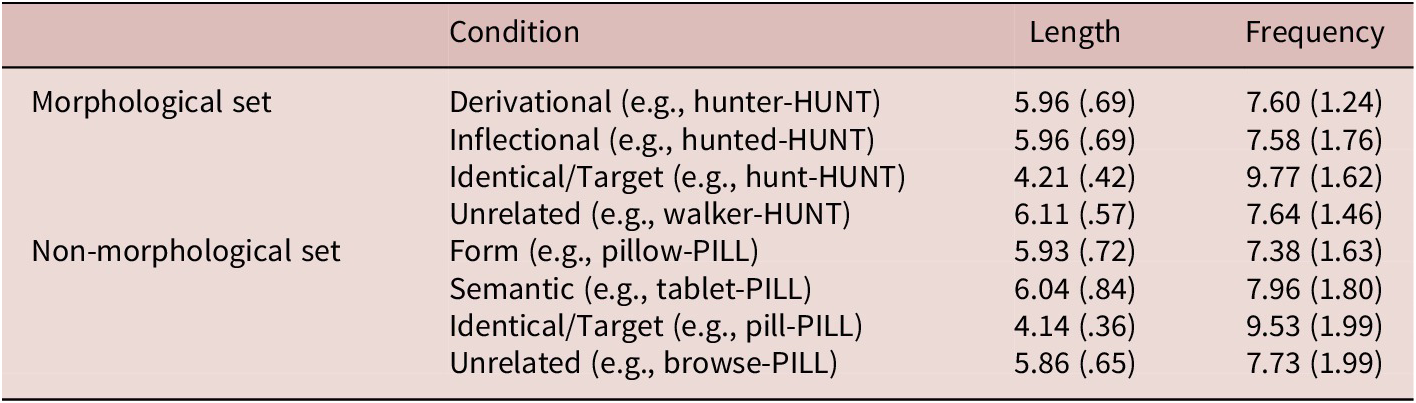
Our materials closely followed those of Jacob et al. (Reference Jacob, Heyer and Veríssimo2018). Four counterbalanced lists were created for the same 56 critical word targets, half in the morphological set and the other half in the non-morphological set. In the morphological set (see Table 1), the prime was either a transparentFootnote 4 derived (-er suffixed), inflectional (-ed suffixed), identical, or unrelated form (bimorphemic, half suffixed with -er and half with -ed) of the target. The targets were all verbsFootnote 5 fully contained in their derived and inflected primes. In the non-morphological set, the prime was either orthographically related (e.g., pillow-PILL), semanticallyFootnote 6 related (e.g., tablet-PILL), identical (e.g., pill-PILL), or unrelated (e.g., browse-PILL) to the target. The targets in this set varied in grammatical class (nouns, verbs, adjectives). Unlike Jacob et al. (Reference Jacob, Heyer and Veríssimo2018), who used separate orthographic sets and semantic sets, we included four prime types in a single non-morphological set mirroring the morphological set to enable direct comparisons between the form control or semantic condition and the identical condition. Unrelated primes for both sets shared minimal orthographic and semantic overlap with their targets. An additional 70 filler trials consisted of derived-word primes with suffixes other than -er and unrelated word targets (e.g., weekly-DIRE) (to reduce the frequency of critical suffixes).
The means and standard deviations of length and frequency of primes and targets in each condition along with examples

Note: The frequency values of all words were drawn from the English Lexicon Project (Balota et al., Reference Balota, Yap, Hutchison, Cortese, Kessler, Loftis, Neely, Nelson, Simpson and Treiman2007).
Each of the four word lists (with 126 word targets each) was coupled with the same nonword list (126 nonword targets). The nonwords were regularly pronounceable in English and were judged by the authors to be word-likeFootnote 7. Primes for the nonwords were either the target plus a pseudo-suffix (14 total: 7 with -ed, e.g., proceed-PROCE; 7 with -er, e.g., banter-BANT) or plus a non-suffixal string (14, e.g., bureau-BURE), or identical to the target (14, e.g., fook-FOOK), or a simplex unrelated word (14, e.g., spouse-DAMA), or a derived word unrelated to the target with a non-critical suffix (70, e.g., namely-BAVE). The first three conditions functioned to eliminate participants’ potential strategy of giving a word decision whenever there was an -er or -ed ending in the prime, a direct repetition of the prime in the target, or a simplex prime.
Words and nonword targets were matched in length across conditions, and their primes in each condition were matched in length and frequency (except for shorter primes in the identical condition; see Table 1). Overall, each participant saw 252 stimuli, with one third of both word and nonword targets preceded by related primes. All materials, data, and R script are available on the Open Science Framework (https://osf.io/dt2v7/).
Using English as the target language introduced several material differences from Jacob et al. (Reference Jacob, Heyer and Veríssimo2018). A limitation of our design is the affixal homonymy (e.g., Bertram et al., Reference Bertram, Laine, Baayen, Schreuder and Hyönä2000) of the -er and -ed suffixes, which can serve more than one semantic and/or syntactic function (e.g., -ed for both past tense and past participle, -er for both nominalization and comparative). The advantage in our study, however, was that targets were fully contained within their primes, unlike Jacob et al. (Reference Jacob, Heyer and Veríssimo2018), where almost no targets were fully contained within their primes due to the addition of the infinitive ending -n or -en in the target and a prosodic piece ge- in the past participle which ensured the first syllable is unstressed (e.g., the primes Änderung “change” and geändert “changed” for the target ändern ). These material differences are taken into account in our interpretation and discussion of results.
Due to differences in L1 background, target L2, and affixal homonymy, our study qualifies as a conceptual replication, which entails the most amount of change from the original study (McManus, Reference McManus, Mackey and Gass2023; Porte & McManus, Reference Porte and McManus2019; Schmidt, Reference Schmidt2009). Unlike exact, close (or partial), or approximate replications, which allows for no, only one, or two variables respectively to be modified, conceptual replication allow for changes in nearly every methodological aspect of the original study (McManus, Reference McManus, Mackey and Gass2023) to ascertain the generalizability and understand the limits of the theory in the original study and to potentially develop or build upon the original theory (Makel & Plucker, Reference Makel and Plucker2014; Porte & McManus, Reference Porte and McManus2019; Schmidt, Reference Schmidt2009).
Procedure
Participants completed a visual masked priming lexical decision task using the E-Prime 3.0 software (Psychology Software Tools, 2016 Pittsburgh, PA) on a computer screen (with a resolution of 1024 by 768 and a refresh rate of 60 Hz). Each trial began with a 500 ms forward mask (a row of hash signs matching the prime’s length), followed by a 50 ms lowercase prime, and then an uppercase target presented for up to 2500 ms (e.g., Diependaele et al., Reference Diependaele, Duñabeitia, Morris and Keuleers2011) or until response, and then a 500 ms feedback on reaction time (RT) and correctness. Participants were asked to press “f” for nonwords and “j” for words as quickly and as accurately as possible. The inter-trial interval was 1000 ms. All stimuli appeared in 18-pt Courier New font, and trial order was fully randomized per participant (e.g., Diependaele et al., Reference Diependaele, Duñabeitia, Morris and Keuleers2011; Feldman et al., Reference Feldman, O’Connor and Del Prado Martin2009, Reference Feldman, Kostić, Basnight-Brown, Durdević and Pastizzo2010, Reference Feldman, Kostić, Gvozdenovic, O’Connor and Martín2012, Reference Feldman, Milin, Cho, Moscoso del Prado Martín and O’Connor2015; Rastle et al., Reference Rastle, Davis and New2004).
After the masked priming lexical decision task, participants took the LexTALE test (Lemhöfer & Broersma, Reference Lemhöfer and Broersma2012) as a measure of their English proficiency.
Results
Several steps were involved in data trimming. First, timeouts or RTs under 300 ms (e.g., Jacob et al., Reference Jacob, Heyer and Veríssimo2018; Jiang & Wu, Reference Jiang and Wu2022) were excluded (L1: 6 data points, 0.21%; L2: 17, 0.20%). Next, following Jacob et al. (Reference Jacob, Heyer and Veríssimo2018), targets with mean accuracy below 70% in either group (Jacob et al., Reference Jacob, Heyer and Veríssimo2018) were excluded (6 total: 3 targets in the morphological set, BREW, SURF, and DINE, and 3 in the nonmorphological set, PROM, MOLE, and CLAM). 28 L2 participants (but no L1 participants) were removed based on the 80% mean accuracy threshold, as mentioned in the Participants section.
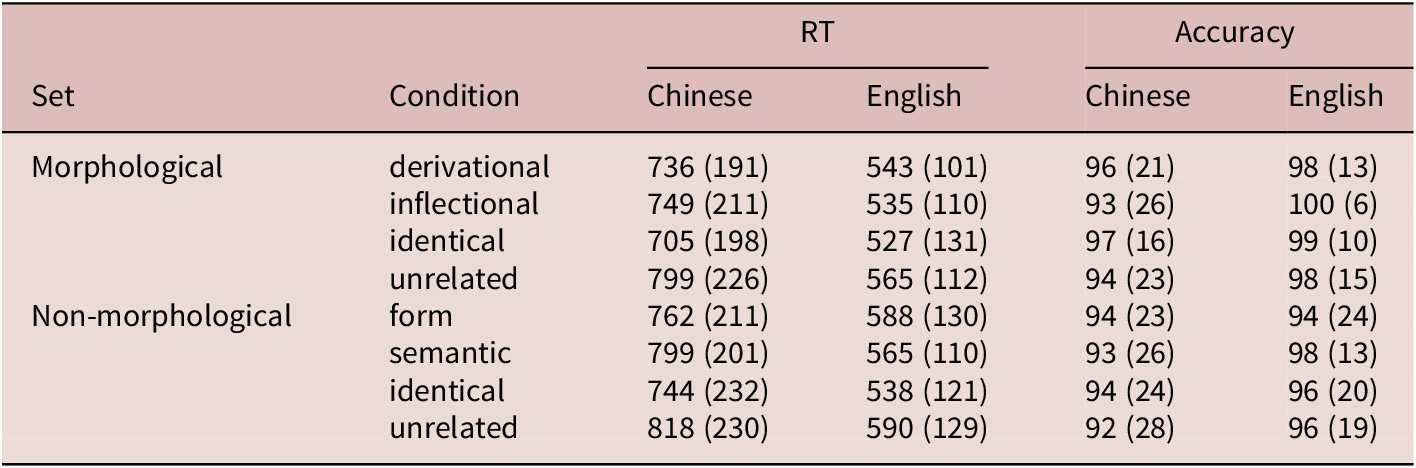
Finally, extreme RTs beyond 2.5 standard deviations away from each participant’s mean were removed (L1: 2.57% of the remaining data; L2: 2.82%). The remaining participants performed near ceiling in accuracy on the remaining targets, so analyses focused on correct-trial RTs (e.g., Ciaccio & Jacob, Reference Ciaccio and Jacob2019). The final data trimming procedure involves checking for sparse data in each condition per participant or per target, resulting in the removal of 1 L1 and 3 L2 participants, who each had fewer than three observations in at least one of the conditions, but no removal of targets. Participants’ mean RT in correct trials and mean accuracy per condition and group after data cleansing are shown in Table 2.
The means and standard deviations of correctly responded RTs (ms) and accuracy (% correct) for word targets in each condition for each language group

Linear mixed-effects analyses were conducted in R (R Core Team, 2021) using the lme4 package (Bates et al., Reference Bates, Maechler, Bolker and Walker2015) on the final RT data (which were inversely transformed based on box-cox transformation, Box & Cox, Reference Box and Cox1964). The fixed effects of interest in the model included the three main effects of Set (morphological vs. nonmorphological), Group (L1 vs. L2), and PrimeType. The factor PrimeType had four levels, including RelatedA (the derivational and form control conditions), RelatedB (the inflectional and semantic conditions), identical (in both sets), and unrelated (in both sets). This way of coding PrimeType allowed for comparisons of derivational vs. form priming, and inflectional vs. semantic priming. The fixed effects also included the two-way and three-way interactions among PrimeType, Set, and Group. PrimeType, Set, and Group were all dummy coded. A series of covariates were tested, including trial number to partial out fatigue effects and the inverse RT and correctness of the previous trial to partial out local effects (Kuperman et al., Reference Kuperman, Schreuder, Bertram and Baayen2009; Wu & Juffs, Reference Wu and Juffs2019), as well as the length, the log of frequency, orthographic and phonological neighborhood, and bigram frequencies (sum, mean, and by position) of the prime and the target drawn from the English Lexicon Project (Balota et al., Reference Balota, Yap, Hutchison, Cortese, Kessler, Loftis, Neely, Nelson, Simpson and Treiman2007). All covariates were converted into z-scores except for the sum-coded correctness of the previous trial. Covariates that significantly improved model fit were included in the final model, which included the inverse RT and correctness of the previous trial, trial number, the length of the prime, and the length, the log of frequency, and the sum of the bigram count (by position) of the target.
In terms of the random-effects structure, we started our model building with the maximal structure (Barr et al., Reference Barr, Levy, Scheepers and Tily2013), and then gradually simplified the structure by reducing the complexity of random slopes for targets and participants to yield a final model with the most complex random-effect structure without boundary (singular) fit or convergency issues. The final, most complex random-effect structure allowed only random intercepts for targets and for participants.
For the comparisons of derivational vs. semantic priming and inflectional vs. form priming, the same models were run, but with a different way of coding PrimeType, which also had four levels, but with derivational and semantic conditions coded as RelatedC, inflectional and semantic conditions as RelatedD, along with the identical and unrelated conditions.
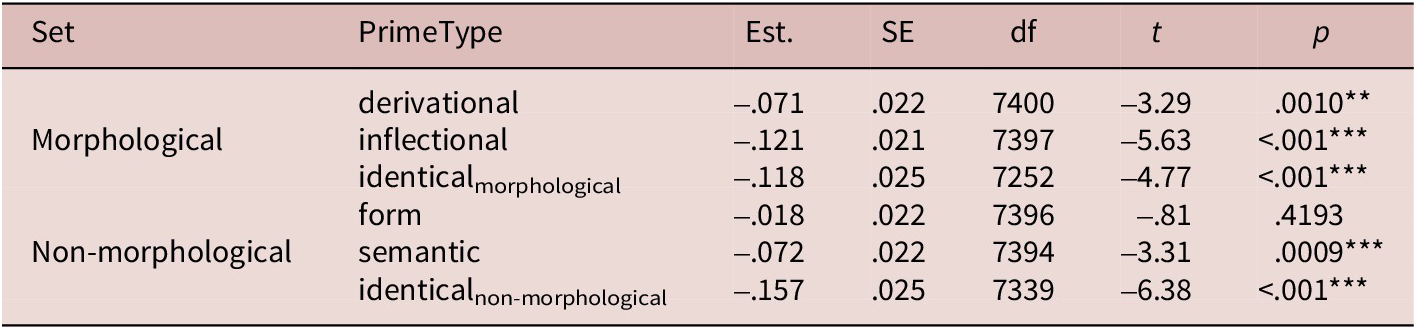
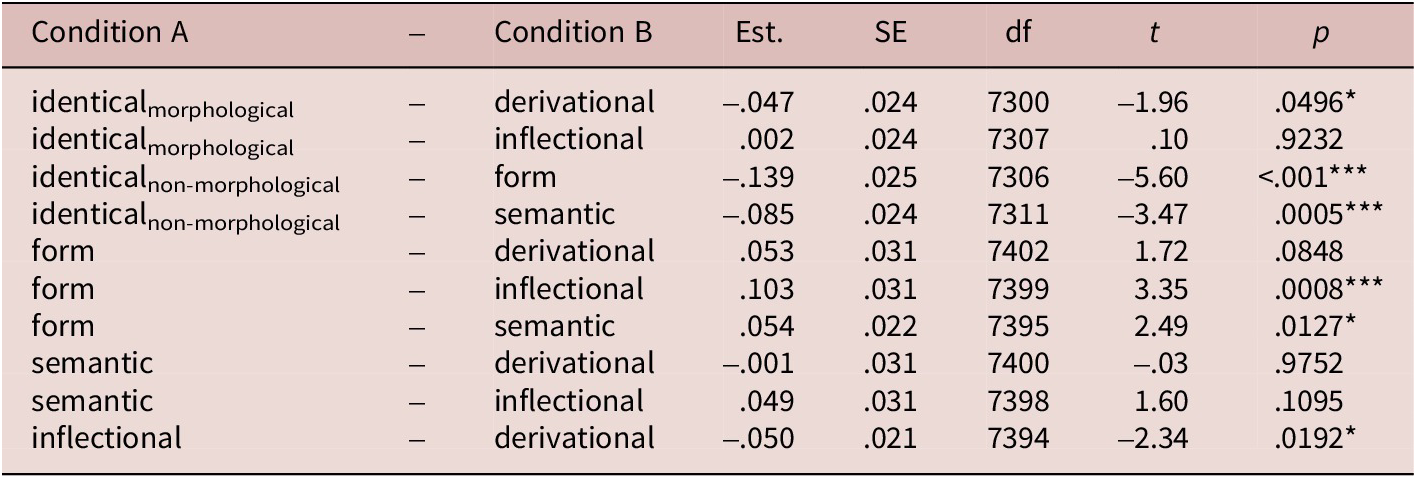
The anova() function of the final model showed a main effect of PrimeType (F(3, 6665.4) = 38.73, p < .001), a main effect of Set (F(1, 44.8) = 7.59, p < .01), a main effect of Group (F(1, 172.9) = 218.94, p < .001), significant two-way interactions between PrimeType and Set (F(3, 7400.5) = 5.33, p < .01), between PrimeType and Group (F(3, 7393.6) = 10.37, p < .001) and between Set and Group (F(1, 7393.7) = 4.31, p < .05), and a significant three-way interaction among PrimeType, Set, and Group (F(3, 7397.0) = 3.32, p < .05). Changing the reference levels of PrimeType, Set, and Group allowed us to obtain, from the model summary of the same model (e.g., Beyersmann et al., Reference Beyersmann, Ziegler, Castles, Coltheart, Kezilas and Grainger2016; Heyer & Kornishova, Reference Heyer and Kornishova2018), our results of interest, including the priming effect (related–unrelated) for each priming condition (Tables 3 and 5) and direct comparisons between the priming effects of different priming conditions (Tables 4 and 6) for each Group. All p-values were computed via Satterthwaite’s degrees of freedom method by the lmerTest package (Kuznetsova et al., Reference Kuznetsova, Brockhoff and Christensen2017).
Priming effects in each condition relative to the unrelated condition in their respective set in terms of inverse reaction time for word targets for the L1 English group

Note: Significance codes are *** p < .001, ** p < .01, and * p < .05. Model formula: Target.IRT~1+PrimeType*Set*Group+ZPrevIRTCentered+PrevACC+ZTrialNum+ZPrimeLen+ZTargetLen+ZTargetLogFreqHAL+ZTargetBGFreqByPos+(1|Subject)+(1|Target)
Condition comparisons in priming magnitude in terms of inverse reaction time for the L1 English group

Note: Significance codes are *** p < .001, ** p < .01, and * p < .05. Model formula: Target.IRT~1+PrimeType*Set*Group+ZPrevIRTCentered+PrevACC+ZTrialNum+ZPrimeLen+ZTargetLen+ZTargetLogFreqHAL+ZTargetBGFreqByPos+(1|Subject)+(1|Target)
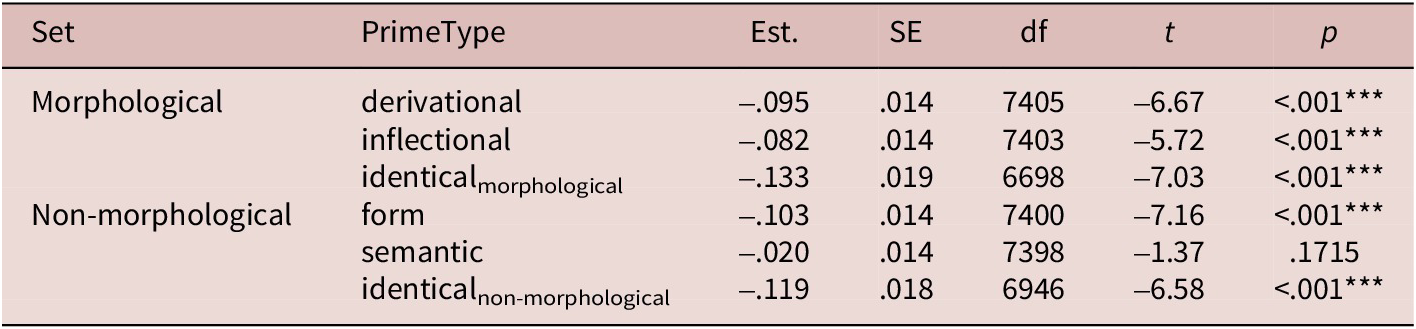
Priming effects in each condition in terms of inversed reaction time for the L2 English group

Note: Significance codes are *** p < .001, ** p < .01, and * p < .05. Model formula: Target.IRT~1+PrimeType*Set*Group+ZPrevIRTCentered+PrevACC+ZTrialNum+ZPrimeLen+ZTargetLen+ZTargetLogFreqHAL+ZTargetBGFreqByPos+(1|Subject)+(1|Target)
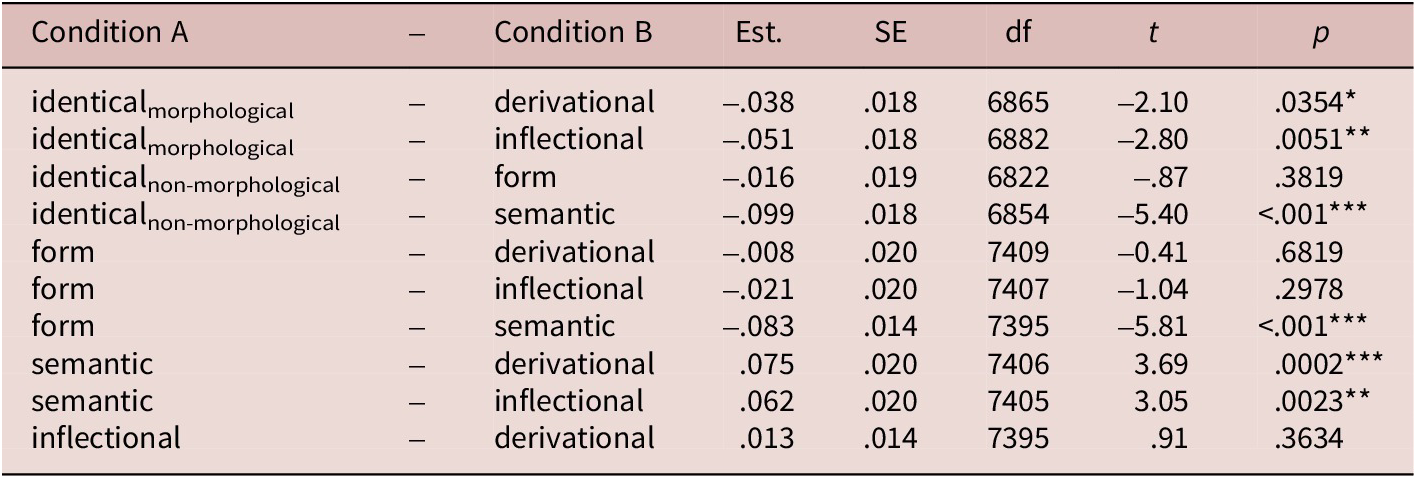
Condition comparisons in priming magnitude in terms of inverse reaction time for the L2 English group

Note: Significance codes are *** p < .001, ** p < .01, and * p < .05. Model formula: Target.IRT~1+PrimeType*Set*Group+ZPrevIRTCentered+PrevACC+ZTrialNum+ZPrimeLen+ZTargetLen+ZTargetLogFreqHAL+ZTargetBGFreqByPos+(1|Subject)+(1|Target)
L1 English group results
The L1 English group showed significant facilitatory priming effects in the derivational, inflectional, identical, and semantic conditions, but not in the form control condition (see Table 3). Both the inflectional and identical conditions elicited significantly larger priming than the form condition (see Table 4), suggesting that facilitation in the inflectional condition and the identical condition could not be attributed to only orthographic overlap. The facilitation in the derivational condition did not differ significantly from the form control group. The priming magnitude in the derivational condition was significantly smaller than that in the identicalmorphological condition, whereas priming in the inflectional condition did not significantly differ from that in the identicalmorphological condition. The magnitude of priming in the inflectional condition is significantly larger than that in the derivational condition (p < .05). The priming effects in the derivational and inflectional conditions did not significantly differ in magnitude from that in the semantic condition, failing to provide evidence for morphological processing beyond semantic relatedness, whereas the identicalnon-morphological condition yielded significantly larger priming than the semantic condition (p < .001).
L2 English group results
The L2 English group showed significant facilitatory priming effects in the derivational, inflectional, identical, and form conditions (all ps < .001) but not the semantic condition (see Table 5). Both the derivational and the inflectional conditions elicited larger priming than the semantic condition (p < .001; p <.01) (see Table 6). Priming effects were smaller in both the derivational condition and the inflectional condition as compared to the identicalmorphological condition (p < .05; p < .01). The derivational and inflectional conditions did not significantly differ from the form control condition in their magnitude of priming (ps > .05), indicating that the morphological conditions did not provide an extra boost from decompositional processing beyond pure orthographic overlap. The priming magnitudes did not differ between the derivational condition and the inflectional condition (p > .05).
Discussion
In a masked priming lexical decision task, the current study examined whether the early-stage processing mechanism for derivations and inflections differed in native English speakers and/or Chinese learners of L2 English. Results revealed significant facilitatory priming in all related conditions except the form control condition for native English speakers, in contrast to significant facilitatory priming in all related conditions except the semantic condition for Chinese learners of L2 English. Our L1 finding of significant semantic facilitation is consistent with the form-with-meaning account (e.g., Feldman et al., Reference Feldman, O’Connor and Del Prado Martin2009, Reference Feldman, Kostić, Gvozdenovic, O’Connor and Martín2012, Reference Feldman, Milin, Cho, Moscoso del Prado Martín and O’Connor2015). Our L2 findings are consistent with previous studies on the same population revealing significant L2 orthographic priming (e.g., Jiang & Wu, Reference Jiang and Wu2022; J. Li et al., Reference Li, Taft and Xu2017) but nonsignificant L2 semantic priming (e.g., Coughlin & Tremblay, Reference Coughlin and Tremblay2015; Jacob et al., Reference Jacob, Heyer and Veríssimo2018; Zhang et al., Reference Zhang, Liang, Yao, Hu and Chen2017), providing further evidence for form prominence in the L2 lexicon (Jiang & Zhang, Reference Jiang and Zhang2021).
Comparing across conditions, we found that in our L1 group inflectional priming was significantly larger than derivational priming, and inflectional priming (but not derivational priming) was significantly larger in magnitude than form priming. Moreover, priming magnitude in the derivational condition was significantly smaller than that in the identical condition, while there was no significant difference between inflectional and identical priming. These results provided some support for a qualitative difference in the L1 representation and early-stage processing of inflected vs. derived words under the masked priming paradigm, which contrasts with some prior findings (e.g., Jacob et al., Reference Jacob, Heyer and Veríssimo2018; Kırkıcı & Clahsen, Reference Kırkıcı and Clahsen2013; Veríssimo et al., Reference Veríssimo, Heyer, Jacob and Clahsen2018; Voga et al., Reference Voga, Anastassiadis-Syméonidis and Giraudo2014), but echoes previous studies with overt priming that have reported larger priming effects from inflected than derived words (e.g., Feldman, Reference Feldman1994; Feldman et al., Reference Feldman, Barac-Cikoja and Kostić2002; Raveh, Reference Raveh2002; Stanners et al., Reference Stanners, Neiser, Hernon and Hall1979; but cf. Raveh & Rueckl, Reference Raveh and Rueckl2000).
Our L2 group showed heavy reliance on surface form processing for both derived and inflected words, with no significant difference in the magnitude of derivational, inflectional, and orthographic priming. Therefore, the priming effects in the derivational and inflectional conditions can be attributed to orthographic overlap between the prime and the target, i.e., are orthographic in nature (e.g., Ciaccio & Jacob, Reference Ciaccio and Jacob2019; Heyer & Clahsen, Reference Heyer and Clahsen2015; Jacob, Reference Jacob2015). Such results are consistent with previous work revealing reliance on surface form during early-stage processing of derived words by the same population of Chinese learners of L2 English (e.g., Gu, Reference Gu2024; J. Li et al., Reference Li, Taft and Xu2017; Li & Taft, Reference Li and Taft2020) and complement this line of research by further showing that Chinese learners of L2 English relied heavily on surface form information when processing inflected words as well. It could be argued that any difference between derivational and inflectional processing may have been concealed by orthographic effects in the morphological conditions for the L2 group, echoing previous claims of the possibility of orthographic facilitation concealing L1-L2 morphological processing differences (e.g., Ciaccio & Jacob, Reference Ciaccio and Jacob2019; Heyer & Clahsen, Reference Heyer and Clahsen2015).
Our results thus complement previous work arguing for L2 early-stage decompositional processing for derived words and whole-word processing for inflected words (Jacob et al., Reference Jacob, Heyer and Veríssimo2018; Kırkıcı & Clahsen, Reference Kırkıcı and Clahsen2013; Veríssimo et al., Reference Veríssimo, Heyer, Jacob and Clahsen2018), by suggesting that the claim for a qualitative difference in L2 early-stage processing of derived vs. inflected words applies to only some learner groups. As our study is a conceptual replication of Jacob et al. (Reference Jacob, Heyer and Veríssimo2018) with several differences in experimental design, it is difficult to pinpoint exactly the reason(s) for the result differences between our study and Jacob et al. (Reference Jacob, Heyer and Veríssimo2018). First, the observed differences in results could be due to differences in the target language in terms of either morphological type (analytic English vs. fusional German) or orthographic depth (opaque English vs. transparent German). Previous studies have shown that native speakers from a richer morphological system tend to have a higher degree of morphological processing efficiency of derived words (e.g., Casalis et al., Reference Casalis, Quémart and Duncan2015) and decompose more inflected words in their native language (e.g., Gimenes et al., Reference Gimenes, Brysbaert and New2016; Lehtonen et al., Reference Lehtonen, Niska, Wande, Niemi and Laine2006; Lehtonen & Laine, Reference Lehtonen and Laine2003), suggesting influence from their long-term experience with the morphological characteristics of their native language. Advanced L2 learners, with many years of input and experience with the L2, may also exhibit similar influence from the morphological characteristics of the L2. The qualitatively similar effects of derived vs. inflected primes on mean reaction times in L2 English in our study and those in Ciaccio and Veríssimo (Reference Ciaccio and Veríssimo2022) and in Voga et al. (Reference Voga, Anastassiadis-Syméonidis and Giraudo2014), in contrast to qualitatively different derivational and inflectional priming in Jacob et al. (Reference Jacob, Heyer and Veríssimo2018) with L2 German, suggest a likely effect of the morphological characteristics of the L2 on L2 morphological processing. Regarding the effect of orthographic depth, it has been suggested that skilled native readers of deep orthographies would rely more on morphological units than on phonological units during reading due to the less consistent grapheme-to-phoneme mapping of the language (e.g., Bar-On & Ravid, Reference Bar-On and Ravid2011; Katz & Frost, Reference Katz, Frost, Frost and Katz1992; Mousikou et al., Reference Mousikou, Beyersmann, Ktori, Javourey-Drevet, Crepaldi, Ziegler, Grainger and Schroeder2020). As our L2 English (opaque) learners showed less morphological processing as compared to the L2 German (transparent) learners in Jacob et al. (Reference Jacob, Heyer and Veríssimo2018), it is not very likely that the orthographic depth of the L2 has exerted a significant effect.
Second, the suffixes (the -ed and -er) in our study being homonymous may have influenced the results, as the processor may try to distinguish between the homonymous suffixes in relation to their relative frequency and/or productivity or between the homonymous primes in relation to their relative frequency, which could slow down processing and reduce the priming effect. Current empirical evidence for an effect of suffixal homonymy on morphological processing comes from simple lexical decision tasks (e.g., Bertram et al., Reference Bertram, Laine, Baayen, Schreuder and Hyönä2000), and there is still a lack of evidence regarding the suffixal homonymy effect in the early stage of processing. We consider such an effect to be not quite strong in our study as our results on Chinese-English bilinguals’ processing of derived words are generally consistent with previous studies on this same population (e.g., Gu, Reference Gu2024; J. Li et al., Reference Li, Taft and Xu2017; Li & Taft, Reference Li and Taft2020) that have targeted a range of other derivational suffixes that are not homonymous.
In addition, as the suffix -ed in our study can be a past participle or a past tense suffix, and because primes were presented in isolation, and given that isolated past tense forms are very rare while certain past participles (e.g., “Finished!”, “Done!”, “Closed!”, etc.) occur more commonly in isolation, it is possible that the -ed-suffixed primes were interpreted as past participles. Although most traditional accounts have treated past participles as inflected forms (e.g., Booij, Reference Booij and Brown2006, Reference Booij2012; Stump, Reference Stump2001), some accounts question the inflectional status of participles, arguing that certain participial forms, particularly those used adjectivally or nominally, may belong more to a derivational paradigm (e.g., Blevins, Reference Blevins, Aarts and McMahon2006, Reference Blevins2016). From this perspective, neither Jacob et al.’s (Reference Jacob, Heyer and Veríssimo2018) study (where the inflectional suffix was the past participle) nor ours compared the processing of derived and inflected words, but rather two types of derived words. However, in English, isolated past participles or past tense forms are relatively infrequent and largely limited to a small set of verbs, and do not reflect a general tendency across our stimuli, as most verbs in our morphological set do not typically occur in isolation in either form. We therefore consider it highly unlikely that our primes were interpreted as past participles.
Moreover, in Jacob et al. (Reference Jacob, Heyer and Veríssimo2018), targets were not fully contained in their primes and there was the prosodic piece ge- in the inflected primes, so the larger discrepancy between the target and the prime in Jacob et al. (Reference Jacob, Heyer and Veríssimo2018) may have led to a reduction in priming. Similarly, Heyer and Kornishova (Reference Heyer and Kornishova2018), contrasting pseudo-derived primes that either fully contain the targets (e.g., corn-er vs. corn) or are not fully decomposable (e.g., har-ness vs. harp, as in Feldman et al., Reference Feldman, O’Connor and Del Prado Martin2009), also suggested that “the discrepancy between the result of a decompositional process… and the presented target… might have led to a reduction of priming for pseudo-derived items in some studies” (p. 1114). Yet, despite those larger discrepancies between the decomposed prime and the target in Jacob et al. (Reference Jacob, Heyer and Veríssimo2018), Jacob et al. (Reference Jacob, Heyer and Veríssimo2018) but not our study revealed significant L2 derivational priming beyond orthographic overlap, suggesting these prime-target discrepancy factors are relatively minor.
Third, our study and Jacob et al. (Reference Jacob, Heyer and Veríssimo2018) differ in the L1 background of L2 learners in terms of both morphological complexity (fusional Russian vs. analytic Chinese) and orthography (alphabetic Russian vs. logographic Chinese). Although current evidence for effects of L1 morphological type and L1 orthographic depth (e.g., Basnight-Brown et al., Reference Basnight-Brown, Chen, Hua, Kostic and Feldman2007; Portin et al., Reference Portin, Lehtonen, Harrer, Wande, Niemi and Laine2008; Vainio et al., Reference Vainio, Pajunen and Hyönä2014) on L2 inflectional processing comes from studies using other experimental paradigms than masked priming (such as simple lexical decision, self-paced reading, etc.), there is the possibility of such effects surfacing in the masked priming paradigm as well. Nevertheless, due to the inclusion of only one group of L2 learners, our study does not allow for a strong conclusion regarding effects of L1 morphological complexity or L1 orthography on L2 early-stage derivational vs. inflectional processing.
Fourth, our L2 group differs from that in Jacob et al. (Reference Jacob, Heyer and Veríssimo2018) in the L2 English setting (EFL vs. ESL) and potentially in the amount of L2 reading experience. With an EFL setting and potentially less L2 reading experience, the L2 group in our study may rely more on orthography than the L2 group in Jacob et al. (Reference Jacob, Heyer and Veríssimo2018), which may have also contributed to the significant orthographic priming in our study but no significant orthographic priming in Jacob et al. (Reference Jacob, Heyer and Veríssimo2018). This contrast further highlights the need to include an orthographic control condition in morphological priming research.
Comparisons between the current study and previous L2 masked priming studies in order to analyze the potential effect of L1 morphology or orthography are not quite feasible due to differences in experimental materials and even the target language. On the one hand, the similarity between our study and Voga et al. (Reference Voga, Anastassiadis-Syméonidis and Giraudo2014) suggests a potentially more robust effect of the target language than L1 background. On the other hand, the recurrent finding in our study and in previous studies that Chinese learners of L2 English demonstrated no semantically transparent derivational priming beyond orthographic overlap during early-stage processing stands in contrast to some learner groups of L2 English that did demonstrate morphological effects beyond orthographic overlap (e.g., Spanish and Dutch learners of L2 English in Diependaele et al., Reference Diependaele, Duñabeitia, Morris and Keuleers2011), suggesting that the effects of L1 background could not be ignored. There is a high likelihood of an interplay of effects of both the target language and the L1 in L2 early-stage processing of derived vs. inflected words. Our study could be a starting point of a large multi-site study that examines how advanced learners from different L1 morphological type and orthography process L2 English derivations and inflections, which could help arrive at a more systematic understanding of the effects of L1 morphological type and orthography on L2 early-stage processing of English derived vs. inflected words.
Data availability statement
The experiment in this article earned Open Data and Open Materials badges for transparent practices. The materials, data, and R script are available at: https://osf.io/dt2v7/.
Acknowledgments
This research was supported by the MOE (Ministry of Education, China) Project of Humanities and Social Sciences (Grant No. 20YJC740069) and the Fundamental Research Funds for the Central Universities (Grant No. 2019JJ010). We are grateful to the editors and reviewers for their insightful comments and constructive suggestions.
Competing interests
The authors declare none.