Interpersonal self-support is an indigenous Chinese interpersonal personality and is defined as a set of five traits that help individuals solve interpersonal problems in daily life and facilitate their social development (Xia, Reference Xia2010; Xia & Huang, Reference Xia and Huang2008). Interpersonal self-support consists of interpersonal independence, the tendency and ability to deal with interpersonal activity or problems independently, interpersonal initiative, the tendency to initiate affiliations and communications with other individuals, interpersonal responsibility, the tendency to be faithful, respectful, and honest to others, interpersonal flexibility, the tendency to deal with interpersonal events contingently and flexibly, and interpersonal openness, the tendency to accept other individuals positively.
Interpersonal self-support represents the idealized interpersonal dispositions with respect to effective interpersonal problems solving, harmonious social relationships, and good character in China’s collectivistic and interdependent culture (Xia, Reference Xia2010). Interpersonal self-support traits are believed to play positive roles with regard to interpersonal relationships and mental health in China (Xia, Reference Xia2010). Previous studies support these views with respect to the two positive functions of interpersonal self-support in Chinese culture. First, interpersonal self-support traits were found to be related to good interpersonal problem-solving (Xia, Huang, Wan, & Yang, Reference Xia, Huang, Wan and Yang2011), social support (Xia et al., Reference Xia, Ding, Hollon and Fan2012), and popularity with peers (Xia & Huang, Reference Xia and Huang2009) and negatively correlated with interpersonal stress (Xia, Reference Xia2011). Second, interpersonal self-support traits were inversely associated with psychological symptoms, especially the emotional and interpersonal symptoms (Xia, Reference Xia2010, Reference Xia2011; Xia, Ding, Hollon, & Fan, Reference Xia, Ding, Hollon and Fan2012; Xia & Ding, Reference Xia and Ding2011). For example, low interpersonal self-support was correlated with depression in four cross-sectional surveys using different samples and different depression measures (Xia, Reference Xia2010; Xia, Wan, Song, & Yang, Reference Xia, Huang, Wan and Yang2011). A longitudinal study revealed that interpersonal self-support traits, especially interpersonal responsibility, negatively predicted depressive symptoms six months later (Xia et al., Reference Xia, Ding, Hollon and Fan2012). In addition, low interpersonal self-support also was associated with posttraumatic stress disorder (PTSD; Xia & Ding, Reference Xia and Ding2011), alienation (Xia, Reference Xia2010), and anxiety (Xia, Reference Xia2010).
Personality is believed to be closely related to emotion and personality traits are assumed to include emotional models (McCrae & Costa, Reference McCrae, Costa, John, Robins and Pervin2008; Roberts, Wood, & Caspi, Reference Roberts, Wood and Caspi2008). Further, the two basic emotional dimensions of positive affect and negative affect are believed to be associated with personality traits such as extraversion and neuroticism (Larsen & Ketelaar, Reference Larsen and Ketelaar1991; McCrae & Costa, Reference McCrae and Costa1991; Rusting, Reference Rusting1998; Watson, Wiese, Vaidya, & Tellegen, Reference Watson, Wiese, Vaidya and Tellegen1999). Social activities always include emotional expression and regulation. Presumably, interpersonal aspects of personality may be closely related to positive or negative emotion. As mentioned above, interpersonal self-support traits were found to be negatively related to emotional symptoms. Thus, it seems that interpersonal self-support traits also may refer to negative and positive emotion. However, support for the relation between interpersonal self-support and emotion has been derived largely from self-reported survey questionnaires (Xia, Reference Xia2010; Xia & Ding, Reference Xia and Ding2011; Xia, Ding, et al., Reference Xia, Ding, Hollon and Fan2012; Xia, Gao, Wang, & Hollon, Reference Xia, Gao, Wang and Hollon2014; Xia, Wan, et al., Reference Xia, Huang, Wan and Yang2011). Thus, the current study explored the relation between interpersonal self-support and emotional information processing using laboratory experiments and hoped to uncover the cognitive mechanisms underlying the relationship between interpersonal self-support and emotion. The reason why interpersonal self-support is assumed to be related to emotional information processing is because interpersonal self-support traits are thought to refer to emotional dispositions.
Personality is thought to affect emotion through temperamental, experiential and instrumental pathways (McCrae & Costa, Reference McCrae and Costa1991). Larsen and Ketelaar (Reference Larsen and Ketelaar1991) extended these notions to encompass a temperamental and an instrumental view. The temperamental view posits that certain personality traits such as extraversion and neuroticism represent an endogenous susceptibility or response tendencies to positive or negative emotion stimuli respectively that directly influence the emotion experience (Larsen & Ketelaar, Reference Larsen and Ketelaar1991; McCrae & Costa, Reference McCrae and Costa1991). The temperamental view suggests that emotional dispositions are the reason why personality traits are directly related to emotion (Clark, Watson, & Mineka, Reference Clark, Watson and Mineka1994; Larsen & Ketelaar, Reference Larsen and Ketelaar1991). The instrumental view refers to traits such as agreeableness and conscientiousness that indirectly influence emotion by virtue of affecting the life environment related to affective feeling.
The relation between interpersonal self-support and emotion is believed to be both temperamental and instrumental. The instrumental view with respect to the relation between the low interpersonal self-support and emotional symptoms was partly supported by prior studies that found the interpersonal self-support traits negatively predicted emotional symptoms through the mediating effects of stressors and social support (Xia, Ding, Hollond, & Wan, Reference Xia, Ding, Hollond and Wan2013; Xia, Wan, et al., Reference Xia, Huang, Wan and Yang2011).
There are three reasons why the relation between interpersonal self-support and emotion also is thought to be temperamental. First, most self-support traits such as interpersonal independence, interpersonal initiative, and interpersonal responsibility also directly predict emotional symptoms even after controlling for the mediating variables such as stress and social support (Xia, Ding, et al., Reference Xia, Ding, Hollond and Wan2013, Xia, Wan, et al., Reference Xia, Huang, Wan and Yang2011). This suggests that interpersonal self-support may be directly related to emotion through the temperamental pathway. Second, low interpersonal independence is similar to neuroticism, especially the subscale of self-consciousness in the Five-Factor Model. Interpersonal initiative is similar to extraversion, especially the warmth and gregariousness subscales of the Five-Factor Model. Neuroticism and extraversion are believed to be emotional traits and refer to negative and positive affectivity (Izard, Libero, Putnam, & Haynes, Reference Izard, Libero, Putnam and Haynes1993; Larsen & Ketelaar, Reference Larsen and Ketelaar1991; McCrae & Costa, Reference McCrae and Costa1991; Rusting, Reference Rusting1998; Tellegen, Reference Tellegen, Tuma and Maser1985; Watson et al., Reference Watson, Wiese, Vaidya and Tellegen1999). Third, people with low interpersonal responsibility and interpersonal openness have negative interpersonal attitudes to other people such as disrespecting, despising, or being disgusted with people (Xia, Reference Xia2010). Presumably, low interpersonal responsibility and low interpersonal openness may be related to negative affectivity. In sum, interpersonal self-support is thought to refer to both negative and positive emotional dispositions.
On the basis of the trait-congruency hypothesis linking personality traits and processing of trait-congruent information, personality traits that include emotional dispositions may predispose certain individuals to selectively processing emotional information (Rusting, Reference Rusting1998). The attentional substrates of emotional traits have been explored in numerous studies (Rusting, Reference Rusting1998). For instance, high trait-anxiety has an attentional bias toward angry faces (Waters, Henry, Mogg, Bradley, & Pine, Reference Waters, Henry, Mogg, Bradley and Pine2010) and high neuroticism is associated with selective processing of negative emotional words (Prehn et al., Reference Prehn, Heekeren, Blasek, Lapschies, Mews and van der Meer2008). In addition, evidence from studies of event-related potential (ERP; Yuan, He, Lei, Yang, & Li, Reference Yuan, He, Lei, Yang and Li2009) revealed that extroverts are sensitive to positive emotional information. These studies always focused on the relationship between emotional information processing and a single trait and a limited number of studies explored the combined effects of several traits on the attentional bias toward emotional stimulus (e.g. Derryberry & Reed, Reference Derryberry and Reed1994).
According to the foregoing views, interpersonal self-support may include both negative and positive emotional dispositions. Consequently, low interpersonal self-support refers to high negative affectivity and low positive affectivity, like neurotic introverts. Conversely, high interpersonal self-support indicates low negative affectivity and high positive affectivity. In other words, the effect of interpersonal self-support on selective attention toward emotional information may reflect the combined effects of negative and positive emotional dispositions.
The component of attention is not unitary. The attention-orienting network includes attentional engagement, shift, and disengagement. Engagement refers to direct or focused attention to a new target, shift refers to moving attention from one stimulus to another, and disengagement refers to taking away from the current focus of attention (Posner, Inhoff, Friedrich, & Cohen, Reference Posner, Inhoff, Friedrich and Cohen1987; Posner & Petersen, Reference Posner and Petersen1990).
The current study focused on disengagement, because a prior study (Derryberry & Reed, Reference Derryberry and Reed1994) showed that neurotic introverts (individuals with high negative affectivity and low positive affectivity) had difficulty shifting away from negative information. In addition, depressed people have been consistently found to have difficultly disengaging from negative information (Gotlib & Joormann, Reference Gotlib and Joormann2010). Depression also was thought to encompass high negative affect and low positive affect (Beck, Ward, Mendelson, Mock, & Erbaugh, Reference Beck, Ward, Mendelson, Mock and Erbaugh1961; Radloff, Reference Radloff1977; Ross & Mirowsky, Reference Ross and Mirowsky1984). Thus, the present study hypothesized that low interpersonal self-support would be associated with difficulty disengaging from negative emotional faces.
Although extraversion has been found to be associated with processing positive emotional information (Derryberry & Reed, Reference Derryberry and Reed1994; Yuan et al., Reference Yuan, He, Lei, Yang and Li2009), neurotic extraverts but not individuals with low negative and high positive affectivity showed slower attentional disengagement from positive signals (Derryberry & Reed, Reference Derryberry and Reed1994). In other words, the combined effect of low negative and high positive affectivity on the emotional faces processing may be not significant. Thus, the present study tried to explore the relationship between high interpersonal self-support and preference on positive emotional faces, but had no a priori hypotheses about the nature of this relationship.
The spatial cuing task was believed to be adequate to measure participants’ difficulty disengaging attention from negative information (Pérez-Dueñas, Acosta, & Lupiáñez, Reference Pérez-Dueñas, Acosta and Lupiáñez2009). Consequently the spatial cuing task was used in current study to examine the forgoing hypotheses. On the other hand, the spatial cuing task, with emotional cues, may not have enough validity to measure individual differences on attentional engagement (Pérez-Dueñas et al., Reference Pérez-Dueñas, Acosta and Lupiáñez2009). That may be the reason why the prior study (Derryberry & Reed, Reference Derryberry and Reed1994) did not find a relationship between neurotic introverts and orienting toward negative stimulus using spatial cuing task. Thus, the present study did not focus on the relationship between interpersonal self-support and orienting toward emotional faces. In addition, prior studies (Cisler & Olatunji, Reference Cisler and Olatunji2010; Reed & Derryberry, Reference Reed and Derryberry1995) have shown that the relation between personality factor and attention disengagement from emotional information should be revealed at the 500 ms onset asynchrony (SOA). Thus, we chose 500ms as the duration of cues presentation.
Depression has been found to be related to both low interpersonal self-support (Xia, Reference Xia2010; Xia, Ding, et al., Reference Xia, Ding, Hollon and Fan2012; Xia, Wan, et al., Reference Xia, Huang, Wan and Yang2011) and difficulty disengaging from negative information (Gotlib & Joormann, Reference Gotlib and Joormann2010). In addition, the affective features of depression seem similar to low interpersonal self-support. Thus depression was included as covariate in the present study.
Method
Design
A mixed-model design was employed with cue validity (x2: valid, invalid) and cue valence (x3: positive, neutral, and negative) being the within-subjects variables, and interpersonal self-support (x2: high, low) as the between-subjects variable, and depression as the covariate.
Participants
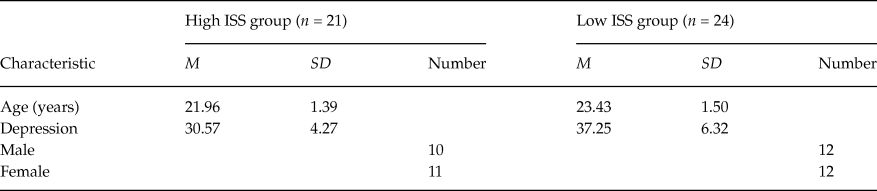
Demographic characteristics and scores on the Self-Rating Depression Scale of the two interpersonal self-support groups are shown in Table 1.
Characteristics of Participants

Note: ISS = interpersonal self-support.
The participants were recruited from 234 undergraduate college students assessed on the Interpersonal Self-Support Scale for Adolescent Students (ISSS-AS; Xia & Huang, 2008) who left the requested correspondence information. Because their scores on every ISSS-AS subscales were higher or lower than the mean of the subscale, 21 students were selected for the high interpersonal self-support group and 24 students were selected for the low interpersonal self-support group.
All 45 selected participants were found to have 20/20 vision (some corrected) according to an eyesight test conducted with a visual chart.
Prior to participation in the experimental tasks, a depression measure was administrated to all 45 participants.
Materials
Stimuli
Ninety-six emotional faces were selected from the Chinese Facial Affective Picture System (Wang & Luo, Reference Wang and Luo2005). These faces were categorized to three types: 32 neutral, 32 positive, and 32 negative. The mean valence scores and standard deviations (SD) were 5.7 ± .73 for the positive faces, 2.58 ± .40 for the negative faces, and 4.30 ± .35 for the neutral faces. The arousal scores for the positive and negative faces did not differ, t = 1.82, p = .10.
The Interpersonal Self-Support Scale for Adolescent Students (ISSS-AS; Xia & Huang, 2008)
The ISSS-AS was designed to measure the five interpersonal traits of interpersonal independence (e.g., “I feel nervous when I communicate with opposite sex by myself”), interpersonal initiative (e.g., “I actively make new friends”), interpersonal responsibility (e.g., “I never give others empty promises”), interpersonal flexibility (e.g., “When I turn down the request of others, I can make them not feel offended”), and interpersonal openness (e.g., “I cannot accept those who have many shortcomings”). It consists of 20 items (4 on each subscale) rated on 5 - point Likert - type scales from 1 (completely disagree) to 5 (completely agree). Test-retest reliabilities for the five scales in a college sample over a 10-week interval ranged from .60 to .79 and both exploratory and confirmatory factor analysis supported the structure of the scale (Xia et al., Reference Xia, Ding, Hollond and Wan2013; Xia & Huang, 2008). The Cronbach alphas of five subscales for the current sample ranged from .69 to .73.
The Self-Rating Depression Scale (SDS; Zung, Reference Zung1965)
The SDS is a self-report scale with 20 items rated on a 4-point scale from 1 (a little of the time) to 4 (most of the time) that is used to assess the degree of depressive experience over the last week. The reliability and validity of SDS were found to be adequate in a Chinese sample (Liu, Tang, Chen, Hu, & Wang, Reference Liu, Tang, Chen, Hu and Wang1995). Furthermore, the SDS is one of the most widely used measures of depression in Chinese mainland. The Cronbach alpha of the scale in the current sample was .71.
Procedures
A spatial cuing paradigm with emotional and neutral cues was employed in the present study. In this task, participants are asked to focus on a fixation point located between two rectangles. Then a cue appears in one of two rectangles, followed by the appearance of a target in either the rectangle in which the cue was presented (valid cue) or the rectangle in which the cue was not presented (invalid cue). Participants are instructed to identify the position of the target stimulus as quickly as possible without sacrificing accuracy. Two types of indices of attentional bias are calculated using response times for target stimuli. Attentional engagement towards emotional stimuli is indicated by faster responses on valid emotional cues relative to neutral cues. Attentional disengagement from emotional stimuli is indicated by slower responses on invalid emotional cues relative to neutral cues.
Participants were tested individually in a psychology lab. Informed consent was obtained from all students when they come to the lab. The Self-Rating Depression Scale (SDS) then was administrated to participants, followed by the experimental session.
All experimental tasks including the instructions were presented on a Dell computer with a 1700 Dell LCD monitor using E – prime software package. Participants were seated about 60cm from the computer screen. The formal experiment began when participants mastered the task demands on the practice trials.
All stimuli were presented against a gray background. A fixation cross presented in the middle of the screen was flanked by 2 black frames(6 × 6 cm) for 500ms. Then, a cue (face) appeared in one of the two black frames (left or right) for 500ms and 50ms later a target (“*”, 1 cm diameter) was presented in either frame until a response was made or until 2000ms had elapsed. Participants were asked to indicate whether the target appeared on the left or on the right by pressing the “Z” or “M” keys respectively as quickly as possible without mistake. The intertrial interval varied randomly from 500ms-1000ms. Two-thirds of the experimental trials (240) were valid (i.e., the target appeared in the same frame as the cue), and one-third (120) were invalid (i.e., the target appeared in the opposite frame from the cue). The probability of any particular face appearing in the left or right frame was equal. In order to avoid response sets, the experiment added 12 trials without targets and 12 trials without cues. All trials were divided into four blocks, each with 96 trials. All blocks and trials in blocks were random. Participants were allowed to have a 2-minute rest after every block.
Results
The correlation coefficients between the five subscales (interpersonal independence, interpersonal initiative, interpersonal responsibility, interpersonal flexibility, and interpersonal openness) of the Interpersonal Self-Support Scale for Adolescent Students (ISSS-AS) and Self-Rating Depression Scale (SDS) ranged from –.39 to –.21, all Ps < .05. The total scores on the SDS were greater for the low interpersonal self-support group than for the high group, t = 4.09, p < .001, g = 1.22.
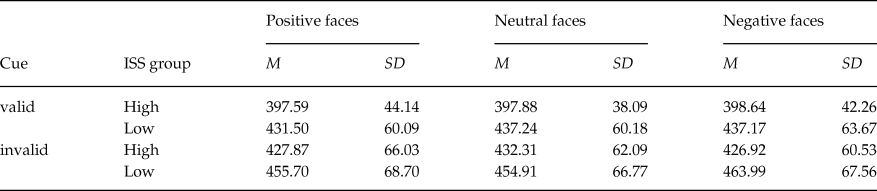
The reaction times (RTs) of participants were recorded. Incorrect responses and RTs less than 100 ms or more than 2.5 SDs were removed from the analyses. The descriptive statistics of RTs in the each experimental condition in present study are shown in Table 2.
Descriptive Statistics for Reaction Times (millisecond)

Note: ISS = interpersonal self-support.
First, a repeated-measures analysis of variance (ANOVA) was conducted with cue validity (valid, invalid) and cue valence (positive, neutral, and negative) being the within-subjects factors and interpersonal self-support (high, low) as the between-subjects variable. The results of the ANOVA showed that there was a significant main effect for cue validity, F(1,43) = 57.93, p < .01, η2 = .57, with responses being slower in the invalid cues condition than in the valid cues condition. There was a significant three-way interaction between interpersonal self-support × cue validity × cue valence, F(2,42) = 3.95, p < .05, η2 = .16.
Then, in order to test the analysis of covariance (ANCOVA) assumption of homogeneity of regression (slope) for depression, the interactions between interpersonal self-support × cue validity × cue valence × depression were calculated and found to be not significant, F(2,40) = 1.62, p = .20, η2 = .04. Thus, the assumption of homogeneity of the depression regression slopes was not violated. Last, a repeated measures ANCOVA was conducted with depression as the covariate. The results of ANCOVA showed that there was a significant main effect for cue validity, F(2,41) = 56.60, p < .01, η2 = .57, with responses being slower on invalid cues condition than on valid cues condition, and for depression, F(1,41) = 4.71, p < .05, η2 = .10. There were no significant interactions between cue validity × cue valence × depression, F(2,41) =.37, p = .69, η2 = .01. Importantly, there was a significant three-way interaction between interpersonal self-support × cue validity × cue valence, F(2,41) = 3.95, p < .05, η2 = .09. In order to explore the features of attentional bias on emotion faces, the RTs on the valid and invalid cues were tested independently.
Valid cues
A 2 (interpersonal self-support) × 3 (cue valence) repeated measures ANOVA was conducted first. The results of the ANOVA showed that there was a significant main effect for interpersonal self-support, F(1,43) = 5.65, p < .05, η2 = .12, but no significant main effect for cue valence, F(2,42) = 1.49 p =.24, η2 = .07. Furthermore, there was no significant interaction between interpersonal self-support × cue valence, F(2,42) =.91, p = .37, η2 = .04. Then, a repeated measures ANCOVA with depression as the covariate was conducted next. The results of ANCOVA showed that there were significant main effect for interpersonal self-support, F(1,42) = 6.28, p < .05, η2 = .13, and depression, F(1,42) = 5.74, p < .05, η2 = .12, but no significant main effect for cue valence, F(2,41) = 1.77, p =.18, η2 = .04. Furthermore, there were no significant interactions between interpersonal self-support × cue valence, F(2,41) = 1.00, p = .37, η2 = .02, or between cue valence × depression, F(2,41) =.88, p = .42, η2 = .02.
Invalid cues
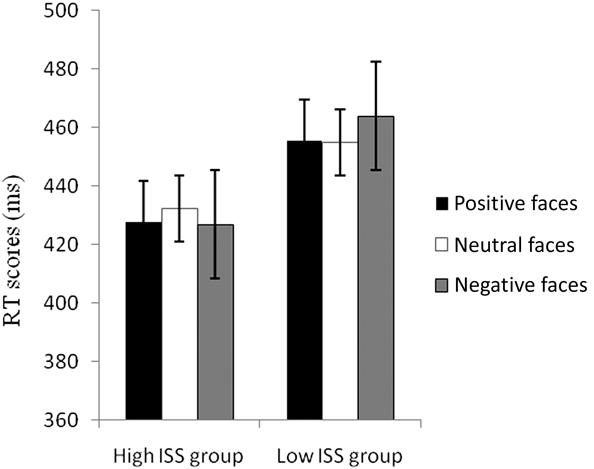
A 2 (interpersonal self-support) × 3 (cue valence) repeated measures ANOVA was conducted first. The results of the ANOVA showed that there were no significant main effects for interpersonal self-support, F(1,43) = 2.25, p = .14, η2 = .05, or cue valence, F(2,42) = 1.89, p =.16, η2 = .08. However, there was a significant two-way interaction between interpersonal self-support × cue valence, F(2,42) = 5.81, p < .01, η2 = .22. Then, a repeated measures ANCOVA with depression as the covariate was conducted next. The results of ANCOVA showed that there were no significant main effect for interpersonal self-support, F(1,42) = 2.40, p = .13, η2 = .05, cue valence, F(2,40) = 1.85, p =.16, η2 = .04, or depression, F(1,41) = 3.73, p = .06, η2 = .08. There also was no significant interaction between cue valence × depression, F(2,41) =.54, p = .59, η2 = .01. Importantly, there was a significant two-way interaction between interpersonal self-support × cue valence, F(2,41) = 6.18, p < .01, η2 = .13. The Sidak corrected multiple pairwise tests showed that low interpersonal self-support participants exhibited greater RTs on negative faces than on either neutral faces or on positive faces, Ps < .05 (see Figure 1), while the differences in RTs on negative, neutral, and positive faces in the high interpersonal self-support group were not significant, F(2,41) = 1.18, p = .32, η2 = .05. This means that although individuals with low interpersonal self-support have difficulty shifting away from negative emotional faces compared to neutral and positive faces, attentional disengagement from positive, negative and neutral faces were all similar for high interpersonal self-support people. In addition, the RTs for low interpersonal self-support participants were greater than those for high interpersonal self-support participants on negative faces, p < .01, positive faces, p < .05, and neutral faces, p < .05. This suggests that low interpersonal self-support participants use more time in shifting away from faces of all emotional valences (negative, positive, and neutral) than high interpersonal self-support participants. We will discuss these results further in the discussion section.
Means and standard errors of the RT scores (in milliseconds) for valenced faces in the different ISS groups under invalid condition (RT = reaction time; ISS = interpersonal self-support).

Discussion
As expected, on invalid cues, the low interpersonal self-support participants exhibited longer RTs to negative faces than to neutral or positive faces, even after controlling for depression. Moreover, the RTs for low interpersonal self-support participants on negative faces were significantly greater than those for high interpersonal self-support participants. These results suggested that low interpersonal self-support participants had difficulty disengaging from negative emotional faces. These results were consistent with previous study (Derryberry & Reed, Reference Derryberry and Reed1994) that found that neurotic introverts had difficultly shifting attention away from negative stimulus. These findings support our hypotheses and suggest that interpersonal self-support may refer to emotional dispositions, especially negative emotional dispositions. In addition, interpersonal self-support may be related to emotion directly. The difficulty disengaging from emotional information may be a cognitive substrate of the relationship between low interpersonal self-support and emotion.
Although low interpersonal self-support participants seem to use more time in shifting away from faces of all valences (negative, positive, and neutral) than high interpersonal self-support participants, the differences in RTs between high and low interpersonal self-support group in disengaging from positive and neutral faces were modest, p = .041 and .042, respectively. Thereby, whether people with low interpersonal self-support using more time in disengaging from positive and neutral faces than high group warrants further examination in future.
As previously described, although none of interactions between interpersonal self-support groups and cue valences were significant on valid cues, that did not mean that low interpersonal self-support participants did not engage to negative emotional faces. Neuroticism has been found to be related to the facilitation of the automatic orienting of attention (Wallace & Newman, Reference Wallace and Newman1998). Low interpersonal independence is similar to neuroticism and low interpersonal self-support is thought to refer to negative emotional disposition. Thus low interpersonal self-support may be related to orienting to negative emotional information. This relationship warrants further study.
The results of the current study suggested that high interpersonal self-support was irrelevant to difficulty shifting away from positive information. These findings were in line with a previous study that showed that neurotic extraverts but not individuals with low neuroticism and high extraversion have difficulty disengaging from positive signals (Derryberry & Reed, Reference Derryberry and Reed1994). These findings suggest that the relation between the interaction of negative affectivity and positive affectivity and difficulty disengaging from positive information may be different from the relation between positive affectivity and selective attentional process on positive information. However, the relation between people with low negative and high positive affectivity and difficulty disengaging from positive information should be examined further.
The main effect for cue validity was significant and responses were faster for valid cues than for invalid cues. This reflects a facilitation effect that includes benefits from valid cues and cost from invalid cues. The stimulus onset asynchrony (SOA) in the present study was 500ms. The short SOA always assures the involuntary and reflexive attention toward the targets followed the cues and the facilitation effect (Pérez-Dueñas et al., Reference Pérez-Dueñas, Acosta and Lupiáñez2009).
The present results show that depression does not seem to be associated with difficulty disengaging from emotional faces. This unexpected finding is inconsistent with the results of previous studies (Gotlib & Joormann, Reference Gotlib and Joormann2010). This null result is likely due to three reasons. First, the amount of variation in depression was relatively modest among participants in our study as a whole. The normal range of scores on the Self-Rating Depression Scale (SDS) is 20–49. However, the highest score on the SDS was 48 in present sample. In other words, none of the participants in the present sample would have met criteria for depression. Prior studies suggest that the relationship between depression and emotional information may be minimal among people who are not really depressed (Rusting, Reference Rusting1998). And this finding supports the perspective that natural variation in mood is not robust enough to affect emotional information processing (Rusting, Reference Rusting1998, Reference Rusting1999). Second, SDS scores may not accurately reflect depressive symptomatology. For example, an adequate time-frame evaluation of depressive symptoms should refer to the last two weeks, but the SDS only refers to the last one week. Third, the cues presentation time of 500 ms may be not sufficient for revealing the relationship between depression and attentional bias. Prior studies (Gotlib & Joormann, Reference Gotlib and Joormann2010; Koster, Leyman, De Raedt, & Crombez, Reference Koster, Leyman, De Raedt and Crombez2006) indicated that the relationship between depression and attentional bias toward negative stimuli should be revealed in the 1000 ms or longer stimuli presentation.
A number of limitations need to be acknowledged. First, this is the first test of the relation between interpersonal self-support and attentional disengagement from emotional stimuli. Thus, the present results should be replicated using different samples and different cognitive tasks, and controlling for Western traits such as big five personality. Second, the relation between the specific interpersonal self-support trait and attentional bias was not explored in the current study. Future studies should clarify the relation between every interpersonal self-support trait and attentional bias and examine which interpersonal self-support trait refers to positive or negative affectivity. Third, only depression was included as covariate in the present study. Mood may moderate or mediate the relationship between personality and attentional bias (Rusting, Reference Rusting1998). Thus, negative and positive mood both should be included in future studies to explore the relation among interpersonal self-support, mood, and attentional bias. Fourth, the present study only focused on the valence of the emotional faces, but ignored the basic emotion categories. Previous studies (Bimler & Kirkland, Reference Bimler and Kirkland2001; Wang et al., Reference Wang, Hoosain, Lee, Meng, Fu and Yang2006) showed the categorical perception effect in emotional faces process. Consequently, the relationship between interpersonal self-support traits and attentional disengagement from a specific type of basic emotional faces warrants explore in future. Finally, the Interpersonal Self-Support Scale for Adolescent Students was not administrated to the participants again before the spatial cuing task. It is not clear that whether every participant still satisfied the criteria to enter in the high or low interpersonal self-support group.
Notwithstanding these limitations, the present findings extend our knowledge with respect to the relationship between personality and attentional disengagement by revealing that the interaction of five Chinese interpersonal traits is associated with difficulty disengaging from negative emotional faces. In addition, these findings are beneficial to discover the cognitive mechanism of interpersonal self-support.
This research was supported by the Fundamental Research Funds for the Central Universities (SWU1409117) and the Key Project for Team Development of Faculty of Psychological Science at Southwest University (TR201206–4).