INTRODUCTION
Coastal lagoons are shallow estuarine environments where salt and freshwater interact, usually oriented parallel to the coast, separated from the ocean by some type of sedimentary barrier, and connected to the open sea by one or more restricted inlets (Isla, Reference Isla and Perillo1995). Because of permanent exposure to the effects of the tides, seasonal amount of freshwater entering the estuarine environment and oceanic storms that may push in more salt water, coastal lagoons are extremely rigorous ecosystems, with highly fluctuating physical (temperature, salinity, turbidity and dissolved oxygen) and biological (recruitment, predation and competition) factors (Whitfield, Reference Whitfield1999; Hemingway & Elliott, Reference Hemingway, Elliott, Elliott and Hermingway2002).
Coastal lagoons are considered highly productive, even more so than the open sea (Day et al., Reference Day, Blaber, Wallace and Day1981). The functional roles of these habitats to fish have been extensively investigated worldwide, in temperate, subtropical and tropical areas (e.g. Whitfield, Reference Whitfield1999; Elliott & Hemingway, Reference Elliott and Hemingway2002; James et al., Reference James, Cowley, Whitfield and Lamberth2007), with a particular focus on their nursery function. These habitats also have long been recognized as important feeding areas for fish, and the role of coastal lagoons to commercial fish as a spawning area is relatively well understood (Elliott & Hemingway, Reference Elliott and Hemingway2002). This importance is related to the fact that coastal lagoon fish communities are seasonally dominated by high densities of juvenile stages of many marine species (Day et al., Reference Day, Blaber, Wallace and Day1981), potentially enhancing their early growth and survival (Elliot & Hemingway, 2002).
Fish fauna occurring in these habitats is a mixture of tolerant species from both marine and freshwater environments, species migrating from one environment to another, and a small number of resident species (Moyle & Cech, Reference Moyle and Cech2004). Therefore, these ecosystems are known as sites of low diversity but high abundance of a few dominant species (Veiga et al., Reference Veiga, Vieira, Bexiga, Sá and Erzini2006).
The abundance of individual species and the composition, abundance, and diversity of the total fish fauna have been widely studied in both tropical (Araújo & Costa de Azevedo, Reference Araújo and Costa de Azevedo2001; Kuo et al., Reference Kuo, Lin and Shao2001) and temperate lagoons (Vieira & Musick, Reference Vieira and Musick1994; Whitfield, Reference Whitfield1999; Gordo & Cabral, Reference Gordo and Cabral2001).
Several factors have been reported to influence fish species composition and distribution amongst which are depth, salinity, temperature, pH and dissolved oxygen and turbidity (Thiel et al., Reference Thiel, Sepúlveda, Kafemann and Nellen1995; Marshall & Elliott, Reference Marshall and Elliott1998; Whitfield, Reference Whitfield1999).
The fish composition of Mar Chiquita coastal lagoon has been studied during the last decade and several fish species have been reported to make extensive use of the lagoon, in a permanent, seasonal or occasional way (Díaz de Astarloa et al., Reference Díaz de Astarloa, Figueroa, Cousseau and Barragán2000; Figueroa et al., Reference Figueroa, Díaz de Astarloa and Cousseau2000; Cousseau et al., Reference Cousseau, Díaz de Astarloa, Figueroa and Iribarne2001; González Castro et al., Reference González Castro, Díaz de Astarloa and Cousseau2006).
The available literature on the fish communities of Mar Chiquita lagoon suggests that the area is likely important as nursery ground for some marine species (Cousseau et al., Reference Cousseau, Díaz de Astarloa, Figueroa and Iribarne2001; Rivera Prisco et al., Reference Rivera Prisco, García De La Rosa and Díaz de Astrarloa2001). However, further studies are required on aspects such as temporal/spatial usage and trophic interactions on fish assemblage.
The aim of the present work is to: (a) analyse the composition and relative abundance of the fish of Mar Chiquita coastal lagoon in relation to their spatial and temporal distribution; and (b) evaluate the relative contribution of some environmental variables over the abundance/distribution patterns of the main fish species.
MATERIALS AND METHODS
Study area
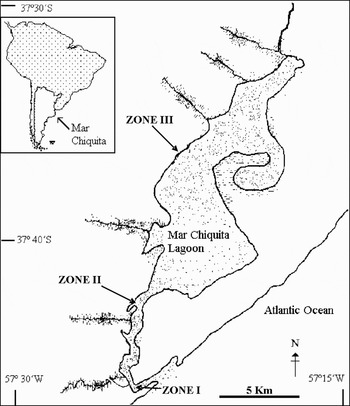
Mar Chiquita coastal lagoon is located on the south-west Atlantic in the Buenos Aires province of Argentina (37°32′–37° 45′S 57°19′–57°26′W) (Figure 1). It is a shallow estuarine system with a maximum length of 25 km and a maximum width of 4.5 km delimiting a total area of 46 km2 (Rivera Prisco et al., Reference Rivera Prisco, García De La Rosa and Díaz de Astrarloa2001).
Map of Mar Chiquita coastal lagoon showing sampled localities: Zone I, near to the mouth of the lagoon in the sea; Zone II, San Gabriel, in the middle of the lagoon; Zone III, San Antonio, located in the extreme north of the lagoon.

This irregularly shaped brackish-water lagoon is separated from the sea by a sandbar with an inlet of 6 km length and 200 m width, which links the lagoon to the ocean. The depth varies between 0.5 and 3 m. Seawater enters in the lagoon with the high tides, and the quantity depends on the direction and intensity of the winds. The largest inflows occur with strong south-easterly winds and minimum inflows with westerly or north-westerly winds. Freshwater inflow is from several streams and artificial channels, which contribute abundant quantities of water during the rainy periods. Temperature and salinity are extremely variable. Variations of surface temperature ranged between 6°C (in winter) and 21°C (in summer). Salinity fluctuates over a wide range between 0 and 36, and has a horizontal gradient (Reta et al., Reference Reta, Martos, Perillo, Piccolo, Ferrante and Iribarne2001). Since 1996 the Coordination Council of the Man and Biosphere Program (MaB) of UNESCO (Iribarne, Reference Iribarne2001) considers it a World Reserve of Biosphere.
Sampling techniques
Fish were sampled monthly between January 2005 and December 2006 using different nets according to fish sizes, at three localities of the lagoon that represent different environments related to salinity horizontal range, that hereafter will be called Zone I, II and III. Zone I, near to the mouth of the lagoon in the sea, with mixo-eurihaline waters and great marine water influence, Zone II in the middle of the lagoon with mixo-mesohaline waters and Zone III, located in the extreme north of the lagoon, where waters are mixo-oligohaline (Figure 1). In 2006 only two localities were sampled: Zone I and Zone III. Zone II was not possible to be sampled because of logistical problems.
Large and adult fish species were collected with three 25 m long, 1.5 m high-monofilament-gill nets with 120, 68 and 57 mm mesh size set for approximately a low plus a high tide. Specimens of small-sized fish species and juveniles of migrant species were captured using an 18 m long, 1.8 m wide nylon beach seine-net with a 12 mm stretch mesh size and 4 m cod-end, only for Zone I. This net was pulled parallel and hauled to shore by 2 m lines. Two replicate hauls were made at each station, each of which covered an area of about 900 m2. Water temperature (°C) and salinity data were registered at each station, using an alcohol thermometer and a Hydrobios refractometer, respectively.
All fish were transported in ice to the laboratory and taxonomically identified, counted and weighed to the nearest 0.1 g on a Metler Toledo PB 3002 digital scale. Sex and sexual maturity have been determined employing a macroscopic maturity scale of seven stages: (1) virginal; (2) immature; (3) incipient maturity; (4) advanced maturity; (5) spawning; (6) spent; and (7) resting (Christiansen & Cousseau, Reference Christiansen and Cousseau1971).
Data analysis
A matrix containing the specimen data for each species/month/gill-net, as well as salinity and temperature, was performed for each locality sampled.
The diversity was calculated using the Shannon–Weiner diversity index (H′) (Krebs, Reference Krebs1989) which is expressed as:

where pi = proportion of species i.
It was calculated for total catches by locality for each season of the year and annually. Monofilament-gill-net captures and nylon beach seine-net captures were calculated separately. This index incorporates components of species diversity, species richness and evenness (Allen et al., Reference Allen, Findlay and Phalen2002). A Hutcheson test (Zar, Reference Zar1999) was performed to evaluate significant differences between Shannon–Weiner diversity indices from different zones sampled (P = 0.05; Ho: no significant differences between zones).
The relationships between species abundance and environmental variables (temperature and salinity) were analysed performing Correspondence Analysis (CA) (Peña, Reference Peña2002), using Multivariado ® software (Salomón et al., Reference Salomón, Melo and Winzer2004). The CA was performed on a data matrix that included all species collected by means of gill-net in 2005 and 2006, with more than 20 individuals captured (28 species representing 100% of total catch) in order to reduce the influence of rare or occasional species.
Both environmental variables were analysed separately, grouping each one in four ranges: low, mid–low, mid–high and high. For salinity these were 0–8, 9–17, 18–26 and 27–36 respectively and for temperature 5–9, 10–14, 15–19 and 20–24. Previously, a Chi-square test (P = 0.05) was used to test the independence/dependence between both kinds of variables (biological and environmental).
To categorize the fish assemblage functional structure within the coastal lagoon, fish species were grouped in bio-ecological categories, adapted from Whitfield (Reference Whitfield1998), Cousseau et al. (Reference Cousseau, Díaz de Astarloa, Figueroa and Iribarne2001) and Moyle & Cech (Reference Moyle and Cech2004) that comprehend estuarine-resident fish (ER) (those that inhabit during their whole life cycle in estuarine waters), estuarine-dependent-marine fishe (ED) (marine species which are predominantly found in lagoons at some stage of their life cycle), estuarine-nondependent marine fish (END) (species commonly found in both estuarine and coastal inshore areas and do not depend upon estuarine environment to complete their life cycles), occasional-marine-visitor fish (OV) and freshwater fish (FW).
RESULTS
Species composition and abundance
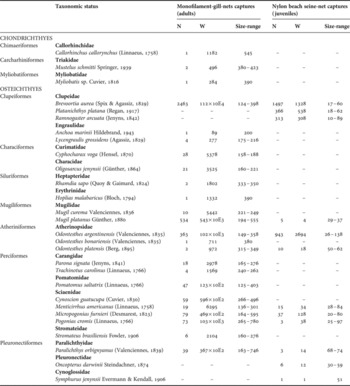
A total of 6977 (3778 with gill-nets, and 3199 with beach seine-net) fish of 18 families and 28 species were collected (Table 1), with Sciaenidae (four species), Clupeidae (three species) and Atherinopsidae (three species) being the most represented families. In terms of economic importance, 19 of the captured species have commercial value, sustaining important artisanal and semi-industrial fisheries along the coastal waters of Buenos Aires Province. Although most of the fish were teleosts, three chondrichthyan species were captured during the current work: Callorhinchus callorynchus, Mustelus schmitti and Myliobatis sp. (Table 1), representing the first documented records for Mar Chiquita coastal lagoon.
Taxonomic status, specimens total number (N), weight in grams (W) and size-range (as standard length measured in mm) of the species captured in Mar Chiquita coastal lagoon during 2005–2006.

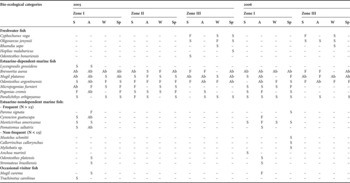
In terms of abundance, we found that Brevoortia aurea, Mugil platanus, Odontesthes argentinensis, Micropogonias furnieri and Pogonias cromis were the most abundant species captured with the gill-nets, representing the 65.0, 14.1, 9.6, 2.1, and 1.9 percentage, respectively of the total number of specimens sampled throughout 2005 and 2006, together accounting for 92.7% of the total catch. Remaining species had low abundances, some represented by a few individuals (Stromateus brasiliensis, Trachinotus carolinus, Oncopterus darwinii) or in some cases by only a single specimen (Symphurus jenynsi, Odontesthes bonariensis, Hoplias malabaricus, Anchoa marinii, Callorhinchus callorynchus and Myliobatis sp.). Brevoortia aurea was present basically throughout the four seasons (2005–2006) in the three zones studied, except in winter 2005–2006 (Zone III). Zone I had higher abundance of this species for both years (Table 2).
Bio-ecological categories of fish collected with gill-nets in Mar Chiquita coastal lagoon and relationship with localities and seasons. Absence (–), 0 individuals; scarce (S), 1–5 individuals; frequent (F), 6–20 individuals; abundant (Ab), more than 20 individuals. Seasons: S, summer; A, autumn; W, winter; Sp, spring.

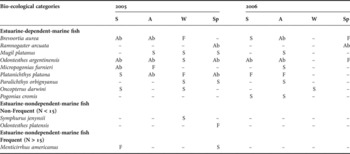
Brevoortia aurea (46.8%), Odontesthes argentinensis (29.5%), Platanichthys platana (11.4%) and Ramnogaster arcuata (9.8%) were the most abundant species of the total number of specimens sampled with seine net. Brevoortia aurea was usually present throughout 2005–2006, with peaks in autumn for both years. Odontesthes argentinensis was present largely in the two years, with the exception of winter 2006. The abundance pattern of Platanichthys platana was different between years, being more abundant in 2005, and absent in winter and spring of 2006. Ramnogaster arcuata had a regular pattern along the two years sampled, because it was abundant (N = 313; Table 1) in spring of 2005 and 2006, being absent during the rest of the seasons for both years (Table 3). None of the three estuarine-nondependent-marine fish species was abundant, showing an irregular pattern with few captures in all cases.
Bio-ecological categories of juvenile fish collected with beach-seine net in Mar Chiquita coastal lagoon (Zone I) and relationship with year seasons. Absence (–), 0 individuals; scarce (S), 1–5 individuals; frequent (F), 6–20 individuals; abundant (Ab), more than 20 individuals. Seasons: S, summer; A, autumn; W, winter; Sp, spring.

In terms of biomass, Brevoortia aurea (54.3%), Mugil platanus (26.4%), Pogonias cromis (5.0%), Odontesthes argentinensis (4.9%), Cynoscion guatucupa (Cuvier, 1830) (2.9%), Micropogonias furnieri (2.3%) and Paralichthys orbignyanus (Valenciennes, 1839) (1.8%), together accounting for 97.6% of the total catch collected by means of the gill-nets, dominated the fish fauna. The species Odontesthes argentinensis (52.6%), Brevoortia aurea (25.9%), Platanichthys platana (10.5%) and Ramnogaster arcuata (6.0%) were the most important species collected with the beach seine, representing 95% of the total biomass of small fish species (Table 1).
Reproductive ecology
The presence of high densities of Brevoortia aurea in spring/summer (Zones II and III) was correlated with mature/ripe ovaries, as was revealed by sexual maturity stage analysis performed at macroscopic level. This strongly suggests that reproductive events should occur in the northern zone of Mar Chiquita coastal lagoon. Specimens of Mugil platanus were collected in the three zones sampled, being scarce/absent in winter, except in winter 2006 (Zone III) (Table 2). Shoals were found in the nearby of the mouth (Zone I) in autumn 2005/2006. This comprises adult individuals in advanced gonadal maturation stage. In contrast, Zone III shows high abundance of adults in summer and spring (Table 2). Most of them were in resting period during the seasons cited above, suggesting that the species occur in the northern locations of Mar Chiquita lagoon with feeding/maturation purposes. When mature, they exhibit their shoaling behaviour in the nearby Zone I and migrate to coastal seawater.
The marine silverside Odontesthes argentinensis showed high abundances in autumn 2005/2006 for Zones I and III (also Zone II in minor way). Ripe and spent females were found in Zone III between June and November confirming reproductive events of the marine silverside inside Mar Chiquita coastal lagoon.
Bio-ecological categories
In terms of bio-ecological categories, the estuarine-dependent-marine fish were the group that showed the highest percentage (93.9% of monofilament-gill-nets total catch) and corresponded to the orders Clupeiformes, Mugiliformes, Atheriniformes, Perciformes and Pleuronectiformes. Brevoortia aurea, Mugil platanus, Odontesthes argentinensis and Paralichthys orbignyanus were found during the four seasons of the sampling period and in the three zones (Table 2), although the number of individuals differed seasonally, spring and summer being the most abundant catch. In contrast, Micropogonias furnieri and Pogonias cromis were infrequent inhabitants of the low salinity area (Zone III) (Table 2), but again with the most abundant catch during the warmer seasons. Lycengraulis grossidens (Agassiz, 1829), was captured only nearby of the mouth (Zone I), during the summer and autumn of 2005. Ramnogaster arcuata, Platanichthys platana and Oncopterus darwinii, all captured with beach seine net only, were also grouped in this category (Table 3).
The estuarine-nondependent-marine-fish were the second best representative bio-ecological category in the lagoon, accounting for more than 30% of the species captured. The eleven species captured (gill-nets plus seine-net) were divided into two groups, frequent and non-frequent, based on their total number of individuals captured (Tables 2 & 3).
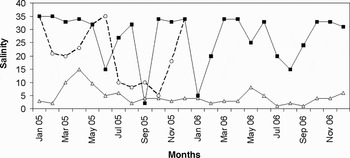
Freshwater fish were usually captured in Zone III (Figure 1), where the lowest salinity values were recorded (Figure 2). No estuarine-resident fish could be found.
Water salinity values obtained for the zones sampled in Mar Chiquita coastal lagoon during 2005–2006. Zone I, black squares; Zone II, open circles; Zone III, open triangles.

Only two species classified as occasional marine visitors were captured during the sampling period (Table 2): the white mullet Mugil curema and the Florida pompano Trachinotus carolinus, both collected close to the mouth of the lagoon (Zone I), where the highest salinity values have been recorded (Figure 2).
Specific diversity index (H′)
The diversity (H′) had a seasonal and spatial trend.
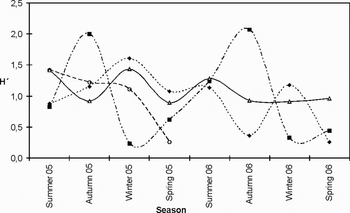
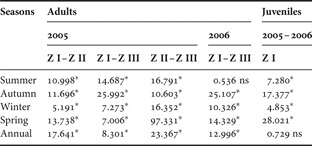
All H′ comparisons showed significant differences (P = 0.05) between zones except in summer 2006 for Zones I and III (Table 4). Unfortunately, as was explained in the Materials and Methods section, Zone II was not sampled in 2006. Zone I (mouth of the lagoon) showed the highest diversity values in autumn 2005 and 2006 (1.99 and 2.03, respectively). Also, the lowest diversity values were obtained for this zone in winter 2005 and 2006 (0.23 and 0.32, respectively) (Figure 3). Zone III, had the highest values in winter 2005 (1.43), and summer 2005 and 2006 (1.41 and 1.27, respectively).
Shannon–Weiner specific diversity index (H′) calculated for total catches by zone for each season of the 2005–2006 period. Zone I, black squares; Zone II, open circles; Zone III, open triangles; juveniles (Zone I), black rhomb.

Results of Hutcheson's test for Shannon–Weiner specific diversity index (H′) (seasonal and annual) of the three zones (Z) studied.*, significant differences; ns, no significant differences (P = 0.05).

The diversity of small size and juvenile specimens collected with the beach seine in Zone I showed an inverse pattern compared to the diversity of species collected with the gill-nets in the same area (Figure 3) with highest values in winter 2005–2006 (1.60 and 1.18 ) and lowest values in autumn and spring 2006 (0.35 and 0.25 respectively). There were seasonal significant differences between years in all cases (P = 0.05) as revealed by the Hutcheson test (Table 4).
With respect to the annual H′, Zone III had the highest values for both years (1.338 and 1.315 respectively), followed by Zone I with 1.123 and 0.979 (2005–2006) and Zone II with the lower one (0.653). All annual H′ values showed significant differences as revealed by the Hutcheson test (Table 4; P = 0.05). No H′ annual significant differences were found for juvenile specimens (Zone I) (Table 4; P = 0.05).
Temperature and salinity variation
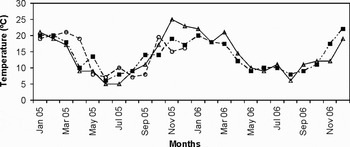
During the study period, water temperatures averaged 13.9°C (5.39 SD) and ranged from 5°C in June/July to 25°C in November (Figure 4). Salinity ranged from 35 in January, February and June to one in July/September. A clear seasonal pattern was observed for temperature, with highest values in summer and lowest in winter. However, the same seasonal trend was not observed for salinity. Strong differences have been found when the zone sampled was taken into account. Although salinity varied from typical freshwater (Zone III), brackish water (Zone II), and marine water (Zone I) close to the mouth of the lagoon, in some cases marked differences between months were found. As evident in Figure 2, Zone III showed the lowest values of salinity along the two-year period of study, averaging 4.7 (3.33 SD) with a peak during autumn (April 2005 and May 2006). Conversely, the highest values were observed in Zone I (35) but in September 2005 and January 2006 salinity severely decreased reaching values proximate to freshwater. As it was expected, Zone II showed intermediate values between Zones I and III with significant differences among months.
Water temperature values (°C) obtained for the zones sampled in Mar Chiquita coastal lagoon during 2005–2006. Zone I, black squares; Zone II, open circles; Zone III, open triangles.

Relationships between species abundance and environmental variables
SALINITY INFLUENCE
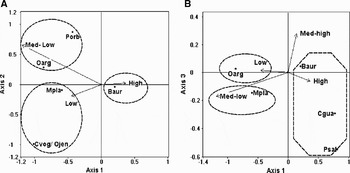
The CA of salinity and distribution of species abundance produced three eigenvalues, being 0.25 the total inertia of this analysis. The first two correspondence axes accounted for 94.8% of the total inertia in the data (i.e. represented the environmental influence on the species within the coastal lagoon).
Odontesthes argentinensis was the species with highest absolute contribution (35.9%) to the first axis inertia, followed by Mugil platanus (25%) and Brevoortia aurea (14%). The second axis was determined by Paralichthys orbignyanus (21.8%), Cyphocharax voga (20.5%), Odontesthes argentinensis (20%) and Oligosarcus jenynsii (15.5%), followed by Pogonias cromis (7%). At last, the third axis was defined by medium–high salinity, being Pomatomus saltatrix (29.8%), Mugil platanus (24%) and in minor way Cynoscion guatucupa (10.7%) and Brevoortia aurea (10.3%), the species with higher contributions to the inertia.
As shown in the ordination diagrams, correspondence was observed between high salinity and the species Brevoortia aurea, Cynoscion guatucupa and Pomatomus saltatrix, which clustered at the right side of the plots (Figure 5A, B). In contrast, the estuarine-dependent marine fish Mugil platanus and Odontesthes argentinensis, and the freshwater species Cyphocharax voga and Oligosarcus jenynsii were most abundant in samples positioned at the left side of the ordination plot, showing correspondence with low salinity. The paralichthyid Paralichthys orbignyanus occupied the upper-left side of the axis 1–axis 2 diagram (Figure 5A), showing correspondence with samples characterized by mid–low salinity. It is noticeable in the near-centroidean location of Brevoortia aurea, which reflected its association with all salinity ranges involved in this analysis. The species and salinity ranges mentioned above showed relative contributions higher than 80%, ensuring that in the considered plane (axis 1/axis 2, or axis 1/axis 3) there existed an appropriate representation of the inertia of each variable.
Correspondence Analysis (CA) between salinity and distribution of species.

TEMPERATURE INFLUENCE
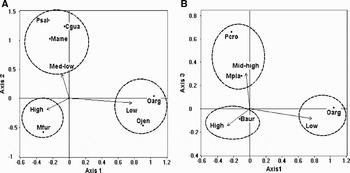
CA results of temperature and species showed three eigenvalues, being 0.22 the total inertia of this analysis. The first two correspondence axes accounted for 87% of the total inertia in the data.
Among the species involved in this study, Odontesthes argentinensis was the species with highest absolute contribution (82.8%) to the first axis inertia, with small contributions by Brevoortia aurea (7.4%) and Oligosarcus jenynsii (3.6%). The second axis was determined by Cynoscion guatucupa (37.2%) and Pomatomus saltatrix (35%), with minor contributions to the inertia by Micropogonias furnieri (9.6%) and Menticirrhus americanus (Linnaeus, 1758) (8.2%). With respect to the third axis, this was defined by medium–high temperature (70%) and in minor way high (25%) temperature ranges. Mugil platanus (39.3%), Pogonias cromis (29.4%) and in minor way Brevoortia aurea (16.9%) were the species with higher absolute contributions to the inertia. Again, the species and temperature ranges mentioned above showed relative contributions higher than 80% for the considered plane (axis 1/axis 2 or axis 1/axis 3).
Odontesthes argentinensis and Oligosarcus jenynsii were positioned at the right side of the ordination diagrams (Figure 6A, B) which reflected their correspondence with low temperatures. In contrast, Micropogonias furnieri and Brevoortia aurea were corresponded with high temperatures as positioned in the left side (third quadrant) of the ordination plot. However, Brevoortia aurea located around the origin of the diagram indicating a degree of correspondence with all temperature ranges. Mugil platanus and Pogonias cromis clustered near samples with mid–high temperatures, whereas Cynoscion guatucupa, Pomatomus saltatrix and Menticirrhus americanus occupied the upper-left side of the plot (Figure 6A) indicating a higher correspondence with mid–low temperatures.
Correspondence Analysis (CA) between temperature and distribution of species.

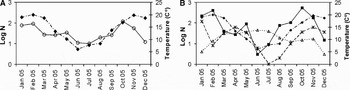
Monthly species abundance showed a straight correlation with water temperature variation (Figure 7A). Of the three most abundant adult species of Mar Chiquita lagoon, the abundance of both Mugil platanus and Brevoortia aurea reflects a direct pattern with the monthly variations of water temperature (Figure 7B). This characteristic reflects its life cycle as was explained above. Conversely, Odontesthes argentinensis presented an inverse pattern showing higher abundances of adult specimens in late autumn and winter when the lowest temperatures in the lagoon were recorded (Figure 7B), its correspondence agreeing with lower temperatures obtained in CA (Figure 6A, B).
DISCUSSION
Species composition and abundance
The present study is the first to analyse quantitatively the spatial–temporal fish composition of Mar Chiquita coastal lagoon in a two-year period and the relationships between environmental variables (salinity and temperature) and abundance of fish species.
The fish fauna of Mar Chiquita coastal lagoon is similar structurally to the ichthyofauna of other temperate lagoons or estuaries around the world. A worldwide review by Blaber (Reference Blaber2002) underlined that the number of fish species in subtropical and tropical estuaries is much greater than in temperate regions: at least 100 species, with some reaching more than 200. Yañez-Arancibia et al. (Reference Yañez-Arancibia, Linares, Day and Kennedy1980) and Villarroel (Reference Villarroel1994) recorded 121 and 62 species respectively, in tropical estuaries and lagoons of the Caribbean Sea. Atlantic areas appeared relatively low regarding the worldwide average species richness of tropical estuaries (Simier et al., Reference Simier, Laurent, Ecoutin and Albaret2006). In the western Atlantic temperate regions, 54 species were collected in the small Slocum river estuary of Massachusetts (Hoff & Ibara, Reference Hoff and Ibara1977) and 45 were found in a beach seine study in dos Patos Lagoon, south Brazil (Garcia et al., Reference Garcia, Vieira and Winemiller2001), while only 41 (Gordo & Cabral, Reference Gordo and Cabral2001) and 28 species (Salgado et al., Reference Salgado, Costa, Cabral and Deegan2004) were collected along the north-eastern Atlantic. The number of fish species (28) found in the present study is consistent with the widely held view that latitude plays a critical role influencing diversity, with tropical areas being more diverse in species composition than temperate ones (Pianka, Reference Pianka1966). However, some investigations (Monaco et al., Reference Monaco, Lowery and Emmett1992; Araújo & Costa de Azevedo, Reference Araújo and Costa de Azevedo2001) supported the hypothesis that the width of the mouth and surface areas of estuaries and lagoons are the main factors predicting the number of species allowing the access and diversity of habitats. Mar Chiquita coastal lagoon (37°S) is 46 km2 with an inlet of 200 m width. On the other hand, Los Patos lagoon in southern Brazil (32°S) is 10,360 km2, connected in its southern extreme to the South Atlantic via an entrance channel 3 km in width (Garcia et al., Reference Garcia, Vieira and Winemiller2001) and the estuarine ichthyofauna is composed of ~110 species (Chao et al., Reference Chao, Pereira, Vieira and Yañez-Arancibia1985).
Many (67%) of the fish species caught in the present study are economically important, namely mugilids, sciaenids, flatfish, clupeids and atherinopsids. Comparable results were obtained in European (Veiga et al., Reference Veiga, Vieira, Bexiga, Sá and Erzini2006), American (Lazzari et al., Reference Lazzari, Sherman and Kanwit2003) and Australian (Thomas & Connolly, Reference Thomas and Connolly2001) estuarine areas, who reported values of 64.7%, 38%, 53.8%, respectively. All species belonging to these families are represented by both adult and juvenile specimens, which emphasizes the role of Mar Chiquita coastal lagoon as a nursery site or refuge place for adults.
The most representative families identified in the present study were Sciaenidae, Clupeidae and Atherinopsidae with four, three and three species, respectively. These families, together with Mugilidae, Paralichthyidae, and Carangidae, are common inhabitants of estuarine and salt marsh assemblages worldwide (Harrison & Whitfield, Reference Harrison and Whitfield1995; Whitfield, Reference Whitfield1998; Garcia et al., Reference Garcia, Vieira and Winemiller2001; Allen et al., Reference Allen, Findlay and Phalen2002). In more temperate regions of the northern Gulf of Mexico (Sheridan & Livingston, Reference Sheridan, Livingston and Livingston1979) and along the east coast of the United States (Hoff & Ibara, Reference Hoff and Ibara1977), the sciaenids replace the more tropical Gerreidae as the dominant demersal forms, and some clupeids (Anchoa sp. and Brevoortia tyrannus (Latrobe, 1802)) accounted for the most abundant species (Stoner, Reference Stoner1986). The atherinopsids, poecilids, in addition to mugilids, constitute the dominant species-group in the estuarine shallow areas of the temperate south-western Atlantic, which replace the more tropical affinity families Ariidae and Gerreidae dominating the northern part of the warm-temperate region of the south-west Atlantic (Vieira & Musick, Reference Vieira and Musick1994). Mugilidae, Atherinopsidae and Sciaenidae were the most abundant families reported in a Uruguayan coastal lagoon (Ramos & Vieira, Reference Ramos and Vieira2001). This largely agrees with the obtained results of the present study, in which Clupeidae, Atherinopsidae and Mugilidae were the most abundant families sampled in terms of number of specimens collected.
It is a general characteristic that inshore fish populations are dominated in abundance by a small number of species that comprise overall a large percentage of the total number of fish species collected (Cattrijsse et al., Reference Cattrijsse, Makwaiá, Dankwa, Hamerlynck and Hemminga1994; Cabral et al., Reference Cabral, Duque and Costa2000). The adult/subadult fish composition of Mar Chiquita coastal lagoon is dominated by a low number of species (Brevoortia aurea and Mugil platanus accounted for ~80% of the total catch with monofilament-gill-nets) some of which present high fluctuations in densities and biomass throughout the year. A similar structure has been reported in several estuarine areas from different parts of the world. Five species from a total of 36 collected in a coastal area of the Tagus estuary of Portugal accounted for 80% of the total catch (Prista et al., Reference Prista, Vasconcelos, Costa and Cabral2003), and from a list of 111 species reported to be occurring in an Indo-Pacific lagoon (Kuo et al., Reference Kuo, Lin and Shao2001) ten of them represented 73.7% of the total catch. In south-western Atlantic estuarine areas, three species of Mugilidae (Mugil curema, Mugil gaimardianus Desmarest, 1831 and M. platanus), two species of Atherinopsidae (Odontesthes bonariensis and Atherinella brasiliensis (Quoy & Gaimard, 1825)) and the sciaenid Micropogonias furnieri were the most abundant fish in the shallow waters of the Patos lagoon estuary (Chao et al., Reference Chao, Pereira, Vieira and Yañez-Arancibia1985; Garcia et al., Reference Garcia, Vieira and Winemiller2001). In the present study Brevoortia aurea, Mugil platanus, Odontesthes argentinensis, Micropogonias furnieri and Pogonias cromis accounted for 92.7% of the total catch of 24 species collected with the gill-nets. According to the range size, most of the individuals were adults or sub-adults. Although only 12 species were collected with the seine net, they corresponded to juvenile specimens according to the range sizes compared on the size at first maturity reported in the literature (Cousseau et al., Reference Cousseau, Díaz de Astarloa, Figueroa and Iribarne2001; Cousseau & Perrotta, Reference Cousseau and Perrota2004; Rosso, Reference Rosso2007). Two species (Brevoortia aurea and Odontesthes argentinensis) contributed with the highest abundance (76.3%) of the total catch. In terms of biomass, the mugilids (largely Mugil platanus) were the second most dominant group collected with gill-nets in Mar Chiquita coastal lagoon. However, mullet biomass might be clearly underestimated because these fish escaped by jumping over the float line during the fishing operations, as was reported by González Castro (Reference González Castro2007). This behaviour has also been reported by other authors (Allen et al., Reference Allen, Service and Ogburn-Matthews1992; Cattrijsse et al., Reference Cattrijsse, Makwaiá, Dankwa, Hamerlynck and Hemminga1994; Veiga et al., Reference Veiga, Vieira, Bexiga, Sá and Erzini2006), who observed that these fish also escape by swimming around the net. Mugil platanus was also one of the most abundant fish in the shallow waters of the Patos lagoon (Chao et al., Reference Chao, Pereira, Vieira and Yañez-Arancibia1985). The species spawns in the sea and uses shallow waters of the estuary as a nursery ground (Vieira, Reference Vieira1991). González Castro (Reference González Castro2007) found that Mugil platanus uses Mar Chiquita for growth and gonad maturation between January and mid-April/ May, and in winter mature specimens migrate towards the sea to reproduce.
Bio-ecological categories
The fish fauna of estuarine systems has long been regarded as dominated by estuarine-dependent or estuarine-opportunist marine species, with ecological analogues replacing particular species along a geographical latitudinal gradient (Vieira & Musick, Reference Vieira and Musick1994). Both, estuarine-dependent and non-dependent marine fish were the more diverse groups caught during our study. Similar results were reported by other authors worldwide (Araújo & Costa de Azevedo, Reference Araújo and Costa de Azevedo2001; Gordo & Cabral, Reference Gordo and Cabral2001; Salgado et al., Reference Salgado, Costa, Cabral and Deegan2004). Although resident estuarine species make a high contribution both in terms of abundance and biomass in different estuaries and lagoons worldwide (Gordo & Cabral, Reference Gordo and Cabral2001; Salgado et al., Reference Salgado, Costa, Cabral and Deegan2004; Veiga et al., Reference Veiga, Vieira, Bexiga, Sá and Erzini2006), no species of this bioecological category was found in this study. However, one gobiid species (Gobiosoma parri Ginsburg, 1933) has been previously reported as a permanent inhabitant of Mar Chiquita coastal lagoon (Cousseau et al., Reference Cousseau, Díaz de Astarloa, Figueroa and Iribarne2001). Due to its particular way of living sheltering in polychaete reefs made by the sedentary calcareous tube-dwelling worm Ficopomatus enigmaticus (Fauvel, 1923), this species may have avoided the sampling gears used in this study making difficult to be collected.
As reported in the literature (Veiga et al., Reference Veiga, Vieira, Bexiga, Sá and Erzini2006) freshwater fish are a minor group in estuarine systems. They occur with variable intensity depending on the hydrological conditions within the estuary. Here, the freshwater fish fauna were caught only in Zone III (upper part of the lagoon) where salinity was low enough for their occurrence and survival. Only two species captured in the studied period belonged to the category occasional marine visitors fish (Table 2): the white mullet Mugil curema and the Florida pompano Trachinotus carolinus. Both species were captured nearby of the mouth (Zone I), with higher salinities and have been recently documented as first recorded species for Argentinean waters (Díaz de Astarloa et al., Reference Díaz de Astarloa, Figueroa, Cousseau and Barragán2000; González Castro et al., Reference González Castro, Díaz de Astarloa and Cousseau2006). Other occasional visitors have been reported in the lagoon namely Serranus auriga (Cuvier, 1829) (Figueroa et al., Reference Figueroa, Díaz de Astarloa and Cousseau2000) and more recently Torpedo puelcha Lahille, 1926 (Belleggia et al., Reference Belleggia, Barbini, Scenna, Figueroa and Díaz de Astarloa2008).
Fish composition and environmental variables
The influence of abiotic parameters such as temperature and salinity are known to influence the composition, distribution and abundance of fish communities in estuarine systems both tropical and subtropical (Kuo et al., Reference Kuo, Lin and Shao2001; Simier et al., Reference Simier, Laurent, Ecoutin and Albaret2006) and temperate (Thiel et al., Reference Thiel, Sepúlveda, Kafemann and Nellen1995; Marshall & Elliott, Reference Marshall and Elliott1998; James et al., Reference James, Cowley, Whitfield and Lamberth2007) environments. In the present study, temperature showed a clear seasonal pattern with highest values in summer and lowest in winter, as also observed in other estuarine environments (Marshall & Elliott, Reference Marshall and Elliott1998; Salgado et al., Reference Salgado, Costa, Cabral and Deegan2004; Veiga et al., Reference Veiga, Vieira, Bexiga, Sá and Erzini2006). However, Zone III showed both the highest and lowest temperature values, probably due to the lower depth when compared with the other zones. Salinity, in turn, showed a spatial gradient, varying from freshwater in the upper part of the lagoon to nearly marine water near the connection to the sea, and was not correlated seasonally. This characteristic was different from that reported for other estuaries, where salinity values accompanied those reported for temperature with lowest in winter and highest in summer (Salgado et al., Reference Salgado, Costa, Cabral and Deegan2004; Veiga et al., Reference Veiga, Vieira, Bexiga, Sá and Erzini2006). However, strong variations have been observed in several months throughout the two-year period of study within the same zone sampled. The low values observed in September 2005 and January 2006 in Zone I (mouth of the lagoon, where salinity is expected to be high), near to freshwater affinity gradient could be related to the hydroclimatic conditions in those periods. September 2005 and January 2006 were especially severe with strong rainfalls, characterized by higher freshwater discharge of Mar Chiquita tributaries; this may explain the low values of salinity reported for both months. Species composition abundance within Mar Chiquita coastal lagoon is influenced by both salinity and temperature factors. Decreases in temperature during the cooler autumn–winter period, when water temperatures within the lagoon were below average, were accompanied by a decrease in abundance of the most common fish species (Figure 7A, B). This positive correlation between temperature and species abundance seems to be related to seasonal migrations. The abundance of Mugil platanus decayed from autumn to winter in all localities sampled, with the exception of Zone III for winter 2006. This was because, as demonstrated by González Castro (Reference González Castro2007), mullet adult specimens migrate to the sea to spawn. On the opposite, the silverside Odontesthes argentinensis showed an inverse pattern between abundance and water temperature values. This fact can be directly related to its life cycle, which implies a shoaling behaviour of ripe individuals in the northern zone of the lagoon for reproductive purposes.
Relation of monthly variation of temperature in Mar Chiquita coastal lagoon (calculated as the average of the temperature obtained in the three zones sampled during 2005) and: (A) log of total number of the five more abundant species; (B) log of the three more abundant species. Temperature, black rhomb; total number of the five more abundant species, open circles; Brevoortia aurea, black squares; Mugil platanus, asterisk; Odontesthes argentinensis, open triangles.

Fish distribution in Mar Chiquita coastal lagoon was related to a longitudinal salinity gradient. Attempts to correlate the distribution of estuarine fish with environmental factors have emphasized the importance of salinity (Elliott & Hemingway, Reference Elliott and Hemingway2002), and it is usually noticed that species richness decreases in low salinity areas (Thiel et al., Reference Thiel, Sepúlveda, Kafemann and Nellen1995). For a given month the highest H′ in Mar Chiquita was registered in Zone I, close to the mouth of the lagoon where the highest salinity was recorded. The highest values of H′ observed in autumn can be explained by the input of estuarine non-dependent marine fish and occasional marine visitors in that season (i.e. 77 specimens of both Cynoscion guatucupa and Pomatomus saltatrix have been collected with gill-nets during autumn 2005, and 17 specimens during 2006).
Salinity significantly varied spatially between 2 and 35, with higher salinities close to the mouth of the lagoon, intermediate values in the mid-part of the lagoon and lower salinities at the upper part, near the major river inflows. Coastal lagoons present a marked stable salinity gradient, which is the main determinant of spatial fish distribution in these systems, acting directly on the osmotic potential of the organisms (Araújo & Azevedo, 2001). In the present study, salinity influences the distribution of fish through their salinity tolerance. For instance, the occurrence of some species throughout the lagoon namely Brevoortia aurea, Mugil platanus and Odontesthes argentinensis was typical of resident (euryhaline) species, which are highly tolerant of variable environmental conditions, as was corroborated in the present work by CA. Both frequent and non-frequent estuarine non-dependent marine fish, in turn, have been only collected near the mouth of the lagoon in association with higher salinities as was demonstrated for Cynoscion guatucupa and Pomatomus saltatrix in the CA. Moreover, Micropogonias furnieri, although regarded as an estuarine-dependent marine fish has not been collected in the upper part of the lagoon where the lower salinities have been registered. However, in many cases the range of salinities at which the fish are habitually found is much narrower than their tolerance range.
These results are consistent with other studies (Hoff & Ibara, Reference Hoff and Ibara1977; Marshall & Elliott, Reference Marshall and Elliott1998; Gordo & Cabral, Reference Gordo and Cabral2001) which have reported salinity and/or temperature as important abiotic parameters in explaining changes in fish composition.
Consequently, it is important to carry on periodic monitoring of the fish fauna of this ecologically valuable protected area in order to obtain a long-term data series that will allow future assessment of human impact.
ACKNOWLEDGEMENTS
The authors would like to thank Julio Mangiarotti (forest guard of Mar Chiquita Biosphere Reserve) and Town Hall Mar Chiquita authorities. This work was funded by CIC (2005) and UNMdP (2006) grants. M.G.C. was supported by a CIC Doctoral Fellowship (2005) and UNMdP Postdoctoral Fellowship (2006–2007).