INTRODUCTION
Chagas disease (CD) is caused by the parasite Trypanosoma cruzi and mainly transmitted by blood-sucking vectors of the Reduviidae family. This disease is considered unattended and a serious public health problem in Latin America (Texeira et al. Reference Téllez, Mejía-Jaramillo and Triana2006). The World Health Organization estimates that about 10 million people are infected by the parasite (Rassi et al. Reference Rassi, Rassi and Marcondes de Rezende2012). CD is clinically characterized by the presence of two phases (acute and chronic phase). The first is usually asymptomatic and in some cases is possible to evidence the site of entry of the parasite by the presence of a located chagoma. About 30–40% of infected individuals develop cardiomyopathy and/or present alterations in the motility of the oesophagus and colon (Jelicks and Tanowitz, Reference Jelicks and Tanowitz2011; Hemmige et al. Reference Hemmige, Tanowitz and Sethi2012; Rassi et al. Reference Rassi, Rassi and Marcondes de Rezende2012).
Trypanosoma cruzi presents a wide intraspecific genetic diversity and is classified into six Discrete Typing Units (DTUs) named from TcI-TcVI (Zingales et al. Reference Zingales, Andrade, Briones, Campbell, Chiari, Fernandes, Guhl, Lages-Silva, Macedo, Machado, Miles, Romanha, Sturm, Tibayrenc and Schijiman2009) with the emergence of a genotype associated with bats called TcBat (Marcili et al. Reference Marcili, Lima, Cavazzana, Junqueira, Veludo, Maia Da Silva, Campaner, Paiva, Nunes and Teixeira2009; Ramírez et al. Reference Ramírez, Tapia-Calle, Munoz-Cruz, Poveda, Rendón, Hincapié and Guhl2014; Lima et al. Reference Lima, Espinosa-Álvarez, Ortiz, Trejo-Varón, Carranza, Pinto, Serrano, Buck, Camargo and Teixeira2015). TcI has the broadest geographical distribution, which covers the southern United States to northern Argentina and Chile. This DTU can be found in the sylvatic and domestic transmission cycles (Añez et al. Reference Añez, Crisante, da Silva, Rojas, Carrasco, Umezawa, Stolf, Ramirez and Teixeira2004) and has recently gained importance because of its association with severe forms of cardiomyopathy (Burgos et al. Reference Burgos, Diez, Vigliano, Bisio, Risso, Duffy, Cura, Brusses, Favaloro, Leguizamon, Lucero, Laguens, Levin, Favaloro and Schijiman2010; Ramirez et al. Reference Ramirez, Guhl, Redon, Rosas, Marin and Morillo2010). Recent phylogenetic studies based on nuclear and mitochondrial markers have identified a clade called TcIDom that is distributed from Central America to South America due to human migration and associated with the domestic transmission cycle (Ramirez and Guhl, Reference Ramirez and Guhl2012; Zumaya-Estrada et al. Reference Zumaya-Estrada, Messenger, Lopez, Lewis, Flores, Martinez, Pennington, Cordon, Carrasco, Segovia, Miles and Llewellyn2012). TcIDom strains behavioural studies have demonstrated a profile of high parasitaemia and low rate of tissue invasion in ICR-CD1 mice (Cruz et al. Reference Cruz, Vivas, Hernández, Montilla, Florez, Parra and Ramírez2015).
The murine model has been reported as an excellent experimental model for the study of cellular and humoural immunity induced against T. cruzi infection. The different inbred lines of mice differ in the immune response, existing from highly resistant strains to highly susceptible strains, suggesting a genetic control involved in the phenomenon of resistance (Holf et al. Reference Holf, Lynch and Kirchhoff1993), but so far, it is not well understood with certainty the factors involved in resistance or susceptibility to T. cruzi infection (Zuñiga et al. Reference Zuñiga, Motran, Montes, Yagita and Gruppi2002). Several studies report the use of murine models in order to understand the biological characteristics of T. cruzi I and T. cruzi II strains (Costa, Reference Costa1999; Marcondes et al. Reference Marcondes, Borelli, Yoshida and Russo2000; Cruz et al. Reference Cruz, Vivas, Hernández, Montilla, Florez, Parra and Ramírez2015). However, few studies include the use of TcI strains isolated from domestic and sylvatic cycles to unravel the biological behaviour in terms of parasitaemia, organ or tissue tropism and immune responses (Cruz et al. Reference Cruz, Vivas, Hernández, Montilla, Florez, Parra and Ramírez2015). Due to the lack of knowledge regarding the biological behaviour of sympatric TcI strains; the purpose of this study was to determine the biological properties of two TcIDom strains and one sylvatic TcI strain evaluating the parasitaemia, antigenicity profiles and pathological effects in an inbred line (BALB/c) and two non-consanguineous colonies (ICR-CD1 and National Institute of Health (NIH)) mice.
MATERIAL AND METHODS
Parasites
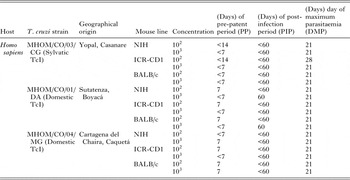
Blood trypomastigotes of two TcIDom strains (MHOM/CO/01/DA, MHOM/CO/04/MG) and one sylvatic (MHOM/CO/03/CG) strain from three departments of Colombia were used (Table 1). These strains were previously typed using the intergenic region of mini-exon gene (SL-IR) and mitochondrial multilocus sequence typing (León et al. Reference León, Hernández, Montilla and Ramírez2015). The strains were maintained in the culture collection of the NIH according to established protocols.
Biological and geographical origin of domestic and sylvatic TcI strains including data of PP, PIP and DMP

Preparation of T. cruzi inoculum
Eighteen mice of the outbred colony ICR-CD1 were infected with each of the three strains of T. cruzi. Individuals were intraperitoneally anaesthetized with Ketamine and Xilacine before being bled by cardiac puncture, 21 days post-inoculation. The blood obtained was subjected to parasitic count in Neubauer chamber to determine the initial concentration. This stock was subsequently diluted in liver infusion tryptose medium to reach concentrations of 102 and 103 trypomastigotes 10 µL−1.
Biomodels inoculation
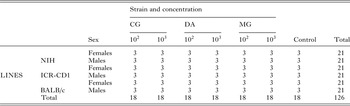
A total of 126 animals of 21 days of age (10–20 g) supplied by the animal facility of the Division of Production and experimental animals of the NIH (Bogotá, Colombia) were used. This study considered the recommendations and bioethical principles for the use of animals in research. A total of 42 mice (21 males and 21 females) for each line (BALB/c, NIH, ICR-CD1) were inoculated with trypomastigotes of each of the T. cruzi strains (MHOM/CO/01/DA, MHOM/CO/04/MG, MHOM/CO/03/CG). These mice were categorized as follows: 54 mice were inoculated intraperitoneally (i.p.) at a concentration of 102 parasites 10 µL−1, 9 mice were inoculated i.p. with saline solution and used as negative controls. The remaining 63 animals were subjected to the same procedure but with a concentration of 103 parasites 10 µL−1 (Table 2). These animals were kept under biosafety regulations, macro-environmental conditions, humidity 60% ± 5, temperature: 20 °C ± 2, 10–15 ventilation changes per hour, housed in cages on a T3 type stainless steel, 48 cm long, 26 cm wide and 16 cm high, with a capacity of 3 animals per cage. The cages were equipped with chip, water and food ad lib, following the principles for animal experimentation stipulated in the animal facility and under national and international regulations.
Total number of the biomodels inoculated by each strain

NIH, National institute of health.
Evaluation of parasitaemia
Every 7 days and when 60 days post-infection (dpi) were completed, levels of parasitaemia were analyzed in blood samples taken from the terminal part of the tail of each biomodel (50 µL approx.) using heparinized capillaries. This blood sample was submitted to 1/20 dilution for Neubauer chamber counting.
Determination of antibody levels
To determine the levels of IgG antibodies in mice, additional samples were taken in hematocrit without heparin for obtaining serum on the same days of sampling for parasite count. The sera was centrifuged at 5000 rpm for 5 min and the serum obtained was stored at −20 °C. Trypanosoma cruzi epimastigotes from a domestic strain (TcIDom) MHOM/CO/01/DA were fixed in 1% formaldehyde. The fixed antigen was diluted with saline solution to a concentration of 20–30 parasites per field. The antigen was served on indirect immunofluorescence antibody test (IFAT) slides and incubated at 37 °C for 1 h. As positive control, mouse sera infected with T. cruzi TcIDom and as negative control mouse sera free of infection were used.
Histopathology
At the end of 60 dpi (or day on which the death of experimental animals occurred) all biomodels used in the experiments were sacrificed by Carbon Dioxide (CO2) chamber. Autopsies were performed to remove the heart, liver, spleen, skeletal muscle and small intestine. The respective organs were sent to the Pathology Laboratory of the NIH for histopathology analyses (Cruz et al. Reference Cruz, Vivas, Hernández, Montilla, Florez, Parra and Ramírez2015).
Statistical analysis
For the evaluation of parasitaemia, analysis of variance (ANOVA) was performed with data retrieved from the post-infection period (PIP: days after day 1 pi until the day in which T. cruzi trypomastigotes were not observed in the Neubauer chamber), Pre-patent Period (PP: period in which T. cruzi trypomastigotes were found in peripheral blood, to perform quantification by Neubauer chamber), Day of Maximum Parasitaemia (MDP: day on which the maximum concentration of T. cruzi trypomastigotes was observed in peripheral blood, to conduct quantification by Neubauer chamber) and Maximum Parasitaemia (MP: maximum concentration of T. cruzi trypomastigotes when performing quantification by Neubauer chamber on peripheral blood). The analyses were performed on the StatGraphics Centurion 2005 version software, with a confidence level of 95%. We proceeded to perform a test of contrasts when ANOVA revealed a statistically significant difference. The graphs of the curves of parasitaemia were performed with the aid of software GraphPad Prism 6 Demo. Finally, survival curves were calculated for each strain and mouse line with the aid of software GraphPad Prism 6 Demo.
RESULTS
Parasitaemia
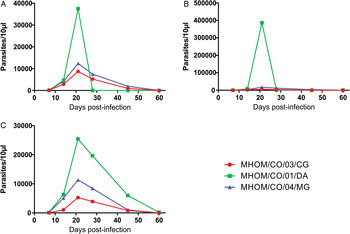
The MDP was achieved at day 21 pi across the 3 strains and the mouse lines evaluated (Fig. 1). Higher parasite count was obtained with the concentration of 103 parasites 10 µL−1 and the TcIDom strain DA. The average peak of parasitaemia for each of the strains with concentration of 103 parasites 10 µL−1 was 8·7 × 103 parasites 10 µL−1 for MHOM/CO/03/CG, 3·8 × 104 parasites 10 µL−1 for MHOM/CO/01/DA and 1·2 × 103 parasites 10 µL−1 for MHOM/CO/04/MG in the NIH mice; 5·9 × 103 parasites /10 µL−1 for MHOM/CO/03/CG, 3·6 × 104 parasites 10 µL−1 for MHOM/CO/01/DA and 1·3 × 104 parasites 10 µL−1 for MHOM/CO/04/MG in the ICR-CD1 mice; 5·2 × 103 parasites 10 µL−1 for MHOM/CO/03/CG, 2·5 × 104 parasites 10 µL−1 for MHOM/CO/01/DA and 1·1 × 104 parasites 10 µL−1 for MHOM/CO/04/MG in BALB/c mice. No statistically significant differences were observed in the pre-patent period (PP) and PIP.
Parasitaemia plots of the different TcI strains across the three mouse lines. (A) NIH; (B) ICR-CD1; (C) Balb/c. NIH, National institute of health.

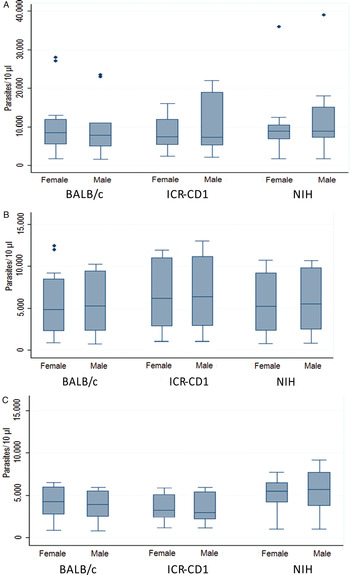
The ANOVA indicated that there were significant differences in the degree of parasitaemia between the two domestic strains and sylvatic strain (P < 0·05) and the subsequent test Scheffe of multiple comparisons showed that BALB/c showed statistically significant differences with the NIH and ICR-CD1 (P = 0·0326). In none of the subgroups considered were statistically significant differences by sex and/or mice line with the three strains of T. cruzi. (P = 0·8506) (Fig. 2).
Parasitaemia comparison in terms of sex of mouse lines and TcI strains. (A) MHOM/CO/01/DA; (B) MHOM/CO/04/MG; (C) MHOM/CO/03/CG.

Indirect immunofluorescence antibody test
We observed that the initiation of the immune response matches with the maximum level of parasitaemia (day 21 pi and day 28 for ICR-CD1) in all T. cruzi strains and the mice lines analyzed. The maximum titre observed in all experimental units was 1/256, there was no statistically significant difference in the mice lines assessed (data not shown).
Histopathology
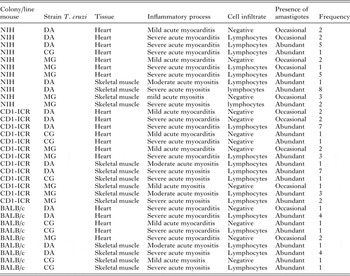
The organs that showed greater degree of involvement were the heart and skeletal muscle (severe acute myocarditis and myositis with the presence of abundant amastigotes and lymphocytic infiltrate) when the infection with domestic strains MHOM/CO/01/DA and MHOM/CO/04/MG was performed. However, all the mice infected with the sylvatic strain (MHOM/CO/03/CG) showed abundant nests of amastigotes. In Table 3 the most relevant histopathological changes in each line are shown. Data for other organs can be seen in the online Supplement Table S1.
Relevant histopathological findings in the mice lines infected with the three T. cruzi strains

NIH, National institute of health.
Survival curves
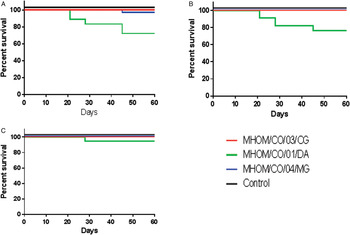
Once the experimental follow-up of murine models finished was observed that the T. cruzi strain and line with lower survival rate was the TcIDom strains MHOM/CO/01/DA and NIH line with sylvatic TcI (Fig. 3). It was determined that the inbred line BALB/c showed only 2 deaths during the 60 days of experimentation compared with the two inbred lines analyzed.
Survival curves of the different TcI strains across the three mouse lines. (A) NIH; (B) ICR-CD1; (C) Balb/c.

DISCUSSION
Trypanosoma cruzi is a parasite that presents a wide genetic diversity where the characterization of its diversity has been the main axis to understand the transmission dynamics and their impact on the epidemiology of the disease (Tibayrenc et al. Reference Tibayrenc, Barnabé, Telleria, Telleria and Tibayrenc2010). TcI has been reported as the major cause of cardiomyopathy and oral infections associated with severe myocarditis and cardiac abnormalities compared with other DTUs (Ramirez et al. Reference Ramirez, Guhl, Redon, Rosas, Marin and Morillo2010, Reference Ramírez, Tapia-Calle, Munoz-Cruz, Poveda, Rendón, Hincapié and Guhl2014; Segovia et al. Reference Segovia, Carrasco, Martínez, Messenger, Nessi, Londoño, Espinosa, Martínez, Mijares and Llewellyn2013). These premises suggest the importance of DTU behaviour in the understanding of the natural history of T. cruzi infection. Most of the studies conducted with the aim of understanding the biological behaviour of T. cruzi strains have been depicted in the comparison of TcI vs TcII/TcVI strains but the behaviour of different TcI strains in diverse murine models has never been attempted.
Previous studies with the Brazil strain, Wrightsman et al. demonstrated that strains of mice with high levels of parasitaemia died in a short time while those with low levels survived infection, suggesting that the degree or extent of parasitaemia is responsible for death (Wrightsman et al. Reference Wrightsman, Krassner and Watson1992). In our case, domestic strains showed higher parasitaemia compared with the sylvatic strain (Fig. 1). However, this had no severe consequences in terms of mortality with the exception of MHOM/CO/01/DA strain that showed to have a hyper virulent profile (Fig. 3). The same isogenic mouse line presents different degrees of susceptibility to infection caused by different strains of T. cruzi (Andrade et al. Reference Andrade, Machado, Chiari, Pena and Macedo1999, Reference Andrade, Machado, Chiari, Pena and Macedo2000). Some studies suggest that mice susceptible to infection are capable of establishing an immune response that unlike what happens in resistant lines is slow, less vigorous and insufficient to handle high doses of virulent parasites (Dos Reis et al. Reference Dos Reis, Monteiro, Piovezana, Teston, Gomes, de Araujo, Barbosa and de Ornelas Toledo2012). This was observed in infections with domestic strain MHOM/CO/04/MG because only one individual died in the line NIH and no deaths with the ICR-CD1 and BALB/c lines. The sylvatic MHOM/CO/04/CG strain reported no death in the three murine models; however it has to be considered that only 60 days of follow-up were performed. If the follow-up window had been increased we could have observed new mortality features (Cruz et al. Reference Cruz, Vivas, Hernández, Montilla, Florez, Parra and Ramírez2015). These findings imply that the genetic background of the mice might be one driver of acquisition of susceptibility to infection in virulent strains as T. cruzi I.
The maximum level of parasitaemia was obtained at day 21 pi in the two strains of TcIDom and sylvatic TcI (MHOM/CO/04/CG) in the three murine models evaluated, unlike what was found by Cruz et al. (Reference Cruz, Vivas, Hernández, Montilla, Florez, Parra and Ramírez2015) where the MP obtained with domestic strains was 33 days pi, however Cruz et al. (Reference Cruz, Vivas, Hernández, Montilla, Florez, Parra and Ramírez2015) only used ICR-CD1 and the initial inoculum was different, which suggests a difference in the behaviour across murine models (Téllez et al. Reference Téllez, Mejía-Jaramillo and Triana2008; Cruz et al. Reference Cruz, Vivas, Hernández, Montilla, Florez, Parra and Ramírez2015) (Figs 2 and 3). No significant differences were observed in the levels of parasitaemia in males and females in the three mouse models but domestic strains showed higher parasitaemia compared with the sylvatic strain and in accordance with Cruz et al. (Reference Cruz, Vivas, Hernández, Montilla, Florez, Parra and Ramírez2015) (Figs 1 and 2). The increase in antibody titres coincided with the day of occurrence of the maximum level of parasitaemia (day 21 pi) in all the strains evaluated across the three murine models; the highest titre achieved in the IFAT was 1/256. It has been reported that the antibody titre may vary depending on the type of DTU evaluated (Ragone et al. Reference Ragone, Pérez, Padilla, Monje, Lauthier, Alberti, Tomasini, Cimino, Romero, Portelli, Nasser, Basombrío and Diosque2012) but in our case it did not occur may be due to the close genetic relatedness of TcI genotypes (Cruz et al. Reference Cruz, Vivas, Hernández, Montilla, Florez, Parra and Ramírez2015).
It was observed that the TcIDom strains have a tropism for heart and muscle tissues, where the presence of myocarditis and severe myositis was observed, this tropism for this type of tissue has been reported in other studies (Téllez et al. Reference Téllez, Mejía-Jaramillo and Triana2008; Ragone et al. Reference Ragone, Pérez, Padilla, Monje, Lauthier, Alberti, Tomasini, Cimino, Romero, Portelli, Nasser, Basombrío and Diosque2012; Cruz et al. Reference Cruz, Vivas, Hernández, Montilla, Florez, Parra and Ramírez2015). Some authors have linked the existence of sylvatic TcI strains with the appearance of severe chronic Chagas heart forms (Mantilla et al. Reference Mantilla, Zafra, Macedo and Gonzalez2010; Ramirez et al. Reference Ramirez, Guhl, Redon, Rosas, Marin and Morillo2010; Zafra et al. Reference Zafra, Mantilla, Jácome, Macedo and González2011). In our results, it is interesting to observe that in those mice infected with the sylvatic strain (MHOM/CO/03/CG) the presence of abundant amastigotes nests was mandatory (Table 3), which is in accordance with previous findings suggesting that the severity of infection could be associated with sylvatic TcI genotypes (Ramirez et al. Reference Ramirez, Guhl, Redon, Rosas, Marin and Morillo2010; Cruz et al. Reference Cruz, Vivas, Hernández, Montilla, Florez, Parra and Ramírez2015). However, we did not find strict significant differences in terms of histopathology between domestic and sylvatic strains. This might have been due to the short follow-up period (60 days) compared with longer periods as 91 days reported by Cruz et al. (Reference Cruz, Vivas, Hernández, Montilla, Florez, Parra and Ramírez2015). Therein, they were able to detect differences between domestic and sylvatic strains. In previous histopathologic studies have shown that inflammatory lesions occur in both susceptible and resistant animals. Recent tissue lesions appear to be caused by the parasitic filtration, but over time phenomena repair are induced as the parasite load is controlled by various immunological mechanisms. Whereas, in susceptible animals damage appears progressively despite of disappearing or decrease of tissue parasite burden (Bice and Zeledon, Reference Bice and Zeledon1970). This corroborates those BALB/c mice that showed a high percentage of tissue damage. This also reinforces our hypothesis that the genetic background plays a fundamental role in the TcI infection process and the likely ability of the parasite to generate cardiac alterations.
In terms of the survival curves, we observed that MHOM/CO/01/DA strain generated a high mortality rate. This strain was isolated from an acute case of (CD) that ended up in the decease of the patient and in different studies shows to be a hyper virulent strain; this might explain the high mortality rate in the different murine models (Fig. 3). However, it is interesting to observe the pattern of resistance that Balb/c exhibited diminishing the rate of mortality. In this sense, our hypothesis of the relevance of the genetic background of the host is important due to the ability of this mouse line to impede the death. However, the histopathology showed a high degree of tissue damage, it is necessary to increase the follow up period of infection to fulfil this hypothesis.
Herein, we were able to evaluate different murine models using two distinct T. cruzi I genotypes. We could observe that NIH and ICR-CD1 lines are susceptible but Balb/c is less susceptible to disease progression. Therefore, it is recommended to use NIH or ICR-CD1 lines to understand the course of infection across TcI isolates. These results have strong implication in the understanding of the pathogenesis of CD and provide insights regarding the importance of domestic and sylvatic genotypes.
SUPPLEMENTARY MATERIAL
The supplementary material for this article can be found at https://doi.org/10.1017/S0031182016001980.
ACKNOWLEDGEMENTS
Bioterio Group of the National Institute of Health Colombia and Health Technology Center (CETESA), Bogotá Colombia.
FINANCIAL SUPPORT
This research received no specific grant from any funding agency, commercial or not-for-profit sectors.