Introduction
In 1981, Schen and Singer-Edelstein reported their experience of administering 1850 subcutaneous (SC) infusions, or hypodermoclysis (HDC), to 270 elderly patients (average age 82 years) in a hospital geriatric department and in two nursing homes.Reference Schen and Singer-Edelstein1 Side-effects were few and not serious and they concluded that HDC was the method of choice for giving fluid supplements to elderly patients in non-emergency situations. Twenty-five years later, Schen then aged 85 years, pleaded with the young doctors managing him for an episode of dehydration to treat him with SC hydration because he had no veins. Ironically his entreaties were fruitless.Reference Schen2
Normal ageing is associated with decreased total body water, decreased intracellular fluid, reduced perception of thirst, decreased glomerular filtration rate, decreased renal capacity to dilute and concentrate urine, abnormal secretion of vasopressin, increased natriuretic hormone secretion, decreased plasma renin activity and decreased aldosterone production.Reference Miller, Halter, Ouslander, Tinetti and Studenski3 These changes place older people at high risk of dehydration when exposed to relatively minor stresses, for example deprivation of fluid for a few hours, heat stroke, or a mild episode of vomiting or diarrhoea.Reference Harchelroad4 This effect is worsened substantially in the presence of cognitive impairment, frailty or immobility and in those with pre-existing pathologies such as congestive heart failure, kidney failure and liver cirrhosis.
In some cases, oral intake is not possible and venous access may be difficult or even harmful. In such cases, HDC is a simple and useful procedure for treating moderate dehydration and for maintaining hydration. It has also been recommended for use at home and in long-stay settings, reducing the need for hospitalization and health care costs.Reference Dardaine-Giraud, Lamande and Constans5, Reference Worobec and Brown6
The purpose of this review is to clarify the indications, contraindications, advantages and disadvantages of this simple technique, in order to encourage its use in older patients. Medline was searched, using the words ‘hypodermoclysis’ and ‘subcutaneous fluids’ and ‘older people’, and the reference lists of the articles identified were also reviewed for additional papers.
Historical background
The Italian physician Cantani was the first reported to use HDC in 1865 and subsequently during the cholera epidemic in Venice in 1886.Reference Dall'Olio7 The technique was considered to be very successful and was replicated by American doctors in the last years of the nineteenth century. In 1895, Daland wrote about the technique: ‘. . . attempts to administer liquids directly into the veins have been made, but in cholera all of the veins are collapsed, and are discovered with difficulty, and in many cases it is impossible to secure a vein of sufficient size for this purpose without proceeding to a formal operation for the exposing of those more deeply situated. . . The most natural and simple method . . . is by the subcutaneous injection of a solution of a 6 percent (or two small teaspoonfuls) of sodium chloride in a quart of hot water, and sterilized, to which two ounces of brandy may be added. The operation was . . . one of great simplicity, requiring for this purpose a small sized aspirating needle and cannula, which is attached to the rubber tube of an ordinary fountain syringe. The best point for the introduction of the needle is in the flanks between the ribs and the crest of the ileum; the inner surface of the thighs may also be used. Observation has shown that there is danger in the injection of liquids beneath the skin of the neck, as two cases of fatal oedema of the larynx following such injection have been reported.’ Reference Daland8
By 1903, HDC was widely used in hospitals for treating dehydrated patients.Reference Evans9 A report written in 1921 advocated its benefits, avoiding the technical difficulties of intravenous infusion and the discomfort and impracticality of alternative techniques such as proctoclysis, or administration of fluids through the gallbladder, peritoneum or pleura.Reference Bartlett10 Despite its successful use in the first half of the twentieth century, the technique fell into disrepute because of reports in the 1950s of severe complications. One of the most publicized reports involved a 13-month-old child hospitalized with dehydration and given fluids subcutaneously using a mixture of three parts 5% dextrose in water to two parts of distilled water. Within hours, the child developed severe hyponatraemia with seizures and subsequent death.Reference Israels and Wylie11 Analysis of most of the reported complications suggests that the problem was not with the HDC itself, but rather with the misuse of hypertonic solutions leading to fluid overload, use of solutions without electrolytes and inappropriate use of HDC in cases of severe dehydration.Reference Gill, Dasgupta and Rochon12
In the 1980s the technique was resurrected,Reference Schen13, Reference Berger14 but despite its multiple advantages, especially in geriatric patients, it still remains underused by physicians and nurses.Reference Abdulla and Keast15 This appears to be largely due to ignorance. A Dutch study of geriatricians and physicians who worked in nursing homes found that only 34% used HDC as a method of rehydration in their older patients, and that lack of experience with the technique was the main reason given for non-use.Reference Olde Rikkert, Bogaers and Bruijns16 Recent experience shows that, when used properly and when contraindications are respected, HDC is very useful and should be used more widely in geriatric settings.Reference Dardaine, Ferry and Constans17 However, even in the United Kingdom, where guidelines were laid down in 1998 by a Hypodermoclysis Working Group, the use of the technique has been less than expected.18
Physiology and pathophysiology
The paper by Barua and Bhowmick provides an overview of the growth in understanding of the physiological and pathophysiological principles underlying the use of HDC over the past hundred years or more.Reference Barua and Bhowmick19 In a landmark study in 1894, Starling and Tubby had observed that when fluid was placed in the pleural cavity, its constituents moved between it and blood in the adjacent blood vessels such that each took from each other the constituents that it lacked. In 1909, Starling described the osmotic and hydrostatic pressures that cause diffusion. Those using HDC should bear in mind that the infusion rate should be within the limits of tissue perfusion, in order to avoid drawing water and sodium from the intravascular compartment. Fluids can be administered subcutaneously at a speed so slow that the forces of diffusion and perfusion transfer the liquid to the circulation at a rate equal to the speed of infusion.Reference Berger20
More recently, the absorption of fluids subcutaneously in older people has been studied by nuclear medicine. No difference was found between absorption after administration of fluids by the SC or intravenous (IV) route. The absence of radioactivity one hour after the administration of fluids by HDC was indicative of complete clearance at this level.Reference Barton, Fuller and Dudley21
A randomized trial compared HDC and IV fluid administration in 96 patients with a mean age of 85 years and diagnosed with mild to moderate dehydration requiring fluid replacement. Each group consisted of 48 patients. Thirteen patients in the HDC group had to switch to the IV group because of the need for IV medications, while 17 patients in the original IV group had to change to the SC route because of particular difficulties with venous access. Clinical outcomes were similar in both groups.Reference Slesak, Schnurle, Kinzel, Jakob and Dietz22
Settings and suitable patients
A feature that makes this technique an attractive tool in geriatric care is the diversity of settings in which it can be used, ranging from the patient's own home to nursing homes, hospices and hospitals. In addition to frail older patients, those with cancer and terminal illness appear to benefit from use of the technique.Reference Lybarger23–Reference Fonzo-Christe, Vukasovic, Wasilewski-Rasca and Bonnabry25
Frail older people in long-stay homes
Dehydration increases morbidity and mortality in frail elderly people and maintenance of an IV line in these cases is often problematic, especially in agitated patients. One study from Israel reviewed experiences in 57 long-stay patients on 118 different occasions.Reference Arinzon, Feldman, Fidelman, Gepstein and Berner26 The most common indications for HDC were dehydration in 64% and fever in 21%. The average duration of HDC was 16 days and patients were administered, on average, 1.1 litres of SC fluid per day. Outcomes were generally positive, with 77% of patients having an improvement in their condition, treatment failure in 12% and death in 11%.Reference Arinzon, Feldman, Fidelman, Gepstein and Berner26 In frail older people living in nursing homes, the presence of dehydration may force relocation to hospital, with discomfort for the patient and higher costs. This makes the use of HDC an attractive technique that should always be considered as an alternative to hospital admission in this scenario.
Terminally ill patients and those with advanced cancer
An Argentinian randomized (but unblinded) controlled trial sought to determine the usefulness of HDC to control thirst, nausea and delirium in terminally ill patients with advanced cancer, or as an alternative when IV administration of fluids was felt to be inconvenient.Reference Cerchietti, Navigante, Sauri and Palazzo27 All patients received 2.5 mg haloperidol SC for management of delirium and 10 mg metoclopramide every 4 hours to control nausea. The study group also received 1000 ml of 5% dextrose in water plus 140 milliequivalents per litre (mEq/l) of sodium chloride at a rate of 42 ml/hour/day administered subcutaneously. Both groups showed similar and significant improvement in relieving thirst and nausea. In patients with advanced cancer, who often have chronic nausea, vomiting, intestinal obstruction, confusion or dysphagia, HDC should be considered. It has the advantage that it does not require supervision by physician or nurse and can be stopped or restarted at any time.Reference Mancini and Body28
In another study, 58 patients with advanced cancer requiring non-oral hydrationReference Bruera, Legris, Kuehn and Miller29 received HDC using a solution of two-thirds 5% dextrose and one-third saline, administered at an infusion rate of 20–100 ml/h, with hyaluronidase (750 U per litre of infusion) and 20–40 mEq of potassium chloride per litre. On average, the infusion was given for 14 days at a rate of 1300 ml/day (range 500–3000 ml/day). There was local infection in two cases and mild bleeding in another two. The authors concluded that HDC is safe and effective in patients with advanced cancer.
Hospice
In hospices, HDC has been used in patients unable to swallow or with persistent vomiting. Over 6 months, a study from Singapore found that HDC was used in 51 of 266 patients (19%). The main indications were vomiting and drowsiness; the most common complications were erythema (16%), leakage (15%), and bleeding (2.5%). No patients had infection.Reference Yap, Tan and Koo30
Older people living at home
HDC has been proven useful in the management of older patients with adequate support living in the community.Reference Schen and Edelstein-Singer31, Reference Jones and McGeorge32 However, guidelines and protocols to assist health professionals implementing this technique in home care need to be developed.Reference Moriarty and Hudson33
Fluids for use in HDC
Rochon and colleaguesReference Rochon, Gill, Litner, Fischbach, Goodison and Gordon34 performed a systematic review of the literature in order to identify the most appropriate solutions for use in HDC. Several studies have used dextrose solutions. Among the mixtures used with good therapeutic results and minimal side-effects are 5% dextrose in saline, 5% dextrose with 4 g sodium chloride, and two-thirds 5% dextrose with one-third normal saline.Reference Lybarger23, Reference Rochon, Gill, Litner, Fischbach, Goodison and Gordon34, Reference Turner and Cassano35 Isotonic or hypotonic solutions with electrolytes must be used and never isotonic or hypertonic solutions without electrolytes. Infusion rates should be slow.Reference Rochon, Gill, Litner, Fischbach, Goodison and Gordon34
Hyaluronidase
Hyaluronidase is an enzyme that temporarily interferes with the normal interstitial barrier in the SC tissue, lowering its viscosity and thus increasing the absorption of infused fluids for 24–48 hours. The dose used is 150 units per litre of fluid infused. Some patients may have trouble with local reactions to hyaluronidase.Reference Sasson and Shvartzman36 In their systematic review, Rochon and colleaguesReference Rochon, Gill, Litner, Fischbach, Goodison and Gordon34 identified two randomized controlled studies of hyaluronidase, both with only small numbers of patients and neither showing significant benefits. They conclude that there is presently inadequate evidence to recommend hyaluronidase to facilitate the absorption of fluids. It is generally considered not to add hyaluronidase because this simplifies the infusion process, is more convenient for the patient, avoids the risk of allergy or reaction and decreases costs.Reference Hays37
Potassium
One of the first descriptions of the use of potassium with HDC was made by Schen and Arieli in 1981.Reference Schen and Arieli38 They described 67 patients, with a mean age of 82 years, who were given the electrolyte at a maximum dose of 34 mEq per litre of infusion, to treat mild to moderate hypokalaemia. Although some patients complained of discomfort at the infusion site, in general there was no serious complication, and slowing the rate of infusion decreased discomfort. However, the authors themselves stress the need to give potassium intravenously in severe cases of deficit.Reference Schen and Arieli38
Medications
Some drugs can be administered by HDC, but far fewer than can be given by IV or intramuscular (IM) administration. Those who cannot tolerate opioid drugs such as morphine and hydromorphone via the oral or transdermal route may find that SC administration is effective, especially using hydromorphone since infusion of only small amounts is required.Reference Fonzo-Christe, Vukasovic, Wasilewski-Rasca and Bonnabry25, Reference Bruera, Brenneis and Michaud39 Studies comparing IV and SC administration have shown similar results regarding pain control.Reference Gill, Dasgupta and Rochon12 Patients with severe vomiting may be given SC metoclopramide, lorazepam, diphenhydramine, dexamethasone, or promethazine. In agitated patients, in whom HDC can be placed on the back, sedative drugs including midazolam and flurazepam can be givenReference Fonzo-Christe, Vukasovic, Wasilewski-Rasca and Bonnabry25, Reference Woodall40 There are also reports of administration of cytosine arabinoside, clodronate and narcotic analgesics.Reference Frisoli Junior, de Paula, Feldman and Nasri41 Recently, the use of esomeprazole by HDC was reported in patients with severe dementia and digestive tract bleeding, in whom oral intake was not possible and IV use was complicated. The drug used by HDC was esomeprazole for intravenous use, diluted in 50 ml saline and administered over one hour.Reference Desmidt and Constans42
Administration of antibiotics by HDC is probably deserving of greater consideration, but experience is limited and no data are available from sick elderly patients. The pharmacokinetics of tobramycin given as a single dose of 80 mg, by HDC or IV has been studied in 10 young and 10 older volunteers.Reference Champoux, Du Souich, Ravaoarinoro, Phaneuf, Latour and Cusson43 In young people, the maximum plasma concentration was reached at 32 min after IV administration, compared with 88 min when given SC. In the older subjects, the respective values were 27 and 89 min. The plasma concentration of tobramycin 30 min after completion of the infusion was lower in both age groups when given by HDC rather than IV, as was the area under the curve, though this was not statistically significant. HDC administration was well tolerated in both young and older subjects. The researchers conclude that when using the HDC, the entry of the antibiotic into the systemic circulation is delayed, but the total amount available is not affected.Reference Champoux, Du Souich, Ravaoarinoro, Phaneuf, Latour and Cusson43
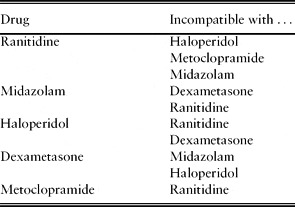
Although drug infusion pumps are not essential when medications are given by HDC, many clinicians prefer use of such a device. The following medications have been given by infusion pumps: atropine, dexametasone, haloperidol, hydromorphone, hydroxyzine, methadone, methotrimeprazine, metoclopramide, midazolam, morphine, octreotide, phenobarbital, promethazine and scopolamine.Reference Sasson and Shvartzman36 It is important to keep in mind that some drugs are incompatible when given simultaneously with others (Table 1).Reference Sasson and Shvartzman36, Reference Woodall44 In that case they should not be mixed, but separate infusions must be used.
Drugs that are incompatible when administered simultaneously by HDC (information from Sasson and Shvartzman, 2001Reference Sasson and Shvartzman36 and Woodall, 2002Reference Woodall44)

Indications and contraindications
HDC is indicated for the hydration of patients with mild to moderate dehydration who do not tolerate oral intake because of cognitive impairment, severe dysphagia, advanced terminal illness or intractable vomiting. It is also indicated to prevent dehydration, especially in frail elderly residents living in long-term care settings who reject the oral route for any reason.Reference Remington and Hultman45 HDC is not indicated in patients with severe dehydration or shock, patients with coagulopathy or receiving full anticoagulation, patients with severe generalized oedema (anasarca) or congestive heart failure, and those with fluid overload (see Table 2). HDC should not be administered on broken skin, or where there is swelling or signs of inflammation. It is generally not recommended for use in emergencies and should never replace the IV route when an acute situation requires venous access.Reference Gill, Dasgupta and Rochon12, Reference Lybarger23–Reference Fonzo-Christe, Vukasovic, Wasilewski-Rasca and Bonnabry25, Reference Sasson and Shvartzman36, Reference Molloy and Cunje46–Reference O'Keeffe and Geoghegan49
Advantages and limitations of HDC compared with IV administration

Adverse events
One of the largest case series in the literature reflects the experience of HDC in 634 patients.Reference Schen and Singer-Edelstein50 There were only five cases of SC oedema and four of heart failure with pulmonary oedema. In one case there was local infection, which responded easily to antibiotics. Arinzon and colleaguesReference Arinzon, Feldman, Fidelman, Gepstein and Berner26 studied 57 long-term care patients receiving HDC and reported local oedema in 11%, pain in 5%, local inflammatory signs in 3.5% and no cases of fluid overload. In the systematic review by Rochon and colleagues,Reference Rochon, Gill, Litner, Fischbach, Goodison and Gordon34 adverse effects were reported in 3.4%.
Hyponatraemia occurs with the same or less frequency than when given intravenous fluids. For example, in a study of 34 older patients with stroke, half were given fluids by HDC and half received IV fluids. There were episodes of hyponatraemia (sodium <130 mEq/l) in two patients hydrated subcutaneously and four patients intravenously.Reference Challiner, Jarrett, Hayward, Al-Jubouril and Julious51
Rochon and colleaguesReference Rochon, Gill, Litner, Fischbach, Goodison and Gordon34 describe the case of a patient who mistakenly received 300 ml of 25% dextrose in the thigh, which caused only moderate local pain. By contrast, there was peripheral vascular collapse in a patient who received a post-operative hypertonic solution with 10% invert sugar, 5% Amigen (a solution of amino acids, carbohydrates and electrolytes) and 5% dextrose in distilled water. Recently, a case of intestinal perforation requiring laparotomy was described in a woman aged 86 with dementia who received SC hydration. A 24 G cannula had been inserted into the right lower quadrant. The authors suggest that in lean subjects requiring HDC in the abdomen, this should be performed on the left side where there is more distance between the intestine and the abdominal wall.Reference Mongardon, Manach, Lescot, Langeron and Tresallet52 A case of fatal bleeding following HDC has also been reported recently.Reference O'Hanlon, Sheahan and McEneaney53
Practical considerations
Administration of fluids
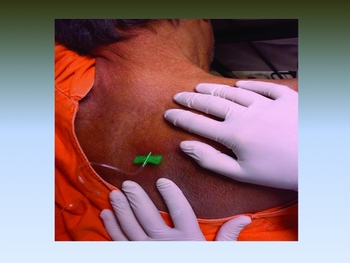
Figure 1 shows the sites used for the administration of HDC: they are the interscapular region on the back, outer surface of the forearms, anterior thighs and abdomen flanks. The pectoral region may be used in males, but not in women who find this area is very painful. Figure 2 shows how the needle is inserted in the interscapular area. This area is a good place for application of liquids in confused or agitated patients who may try to remove cannulas.
Puncture sites suitable for HDC

Needle inserted in the interscapular area

The fluids recommended are 0.45% saline, 2.5% dextrose, or 5% dextrose with normal saline. All are effective for hydration.Reference Dutertre and Constans47 The recommended infusion rate is 75 ml/h, with a maximum of 125 ml/h and a minimum of 20 ml/h to prevent blocking the pathway. The maximum daily amount should not exceed 3000 ml per patient and 2000 ml per site, to avoid local oedema. Periodic massage of the infusion site increases absorption and minimizes discomfort, so that the use of hyaluronidase is not required. Up to two access sites can be used simultaneously; for example, if a patient requires 3000 ml in a day, 1500 ml can be administered in each of the selected sites. Alternatively, to minimize restriction on mobility, fluids can be administered for several hours and the cannula then removed, to restart later or the next day as needed.
Technique
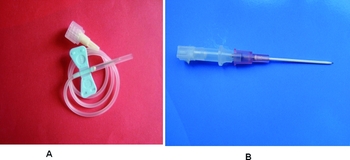
The equipment needed for HDC is the same as that used to administer IV fluids, using a needle with a small bore (20 to 25 G). The type of cannula used is usually a Butterfly, but a teflon paediatric Jelco is also suitable (see Figure 3). Once the procedure has been explained to the patient (or caregiver when there is cognitive impairment) and consent given, the skin is cleaned with alcohol or iodine solution. The selected area of skin is then taken between the forefinger and thumb of the operator and the needle is inserted beneath the skin, following the direction of the folds parallel to the underlying fascia at an angle of 45 degrees. The needle is then secured with transparent adhesive tape, in the same way as when placing intravenous fluids.Reference Molloy and Cunje46 Careful placement and fixation is recommended to prevent injury to adjacent structures.Reference Gluck54
A, Butterfly needle; B, Jelco cannula suitable for HDC

Monitoring
The injection site should be regularly monitored for signs of fluid accumulation in the SC tissue and, if this develops, oedema may be resolved with gentle massage or by decreasing the rate of infusion. Consideration should be given to a change of injection site if the patient complains of pain at the site of administration, the skin becomes red, or turns white or hard and if there is blood in the cannula or the needle.Reference Young55 Repositioning should take place immediately if there is the possibility of infection.Reference Molloy and Cunje46 Attention should also be given to signs of fluid overload, such as dyspnoea, pulmonary rales, hypertension, tachycardia or oedema of lower limbs.
Conflicts of interest
The authors have no conflicts of interest to declare.