Introduction
Population ageing is a worldwide phenomenon (De Meijer et al. Reference De Meijer, Wouterse, Polder and Koopmanschap2013; United Nations Department of Economics and Social Affairs 2013). Whereas the global share of people aged ⩾60 years was 9.2 per cent in 1990, it increased to 11.7 per cent in 2013, and is expected to rise to 21.1 per cent by 2050 (United Nations Department of Economics and Social Affairs 2013). Population ageing is particularly pronounced in Organisation of Economic Co-operation and Development (OECD) countries, with the oldest population cohorts (⩾80 years) growing fastest (OECD 2005). As limitations in activities of daily living (ADLs) and instrumental activities of daily living (IADLs) strongly increase with age (Chatterji et al. Reference Chatterji, Byles, Cutler, Seeman and Verdes2014; Hayase et al. Reference Hayase, Mosenteen, Thimmaiah, Zemke, Atler and Fisher2004), the number of disabled and dependent persons is expected to rise in the process (OECD 2005). As a result, dependency ratios – i.e. population with limitations in ADLs divided by working population – are predicted to increase as well (OECD and European Commission 2013; World Health Organization (WHO) 2007). Higher dependency ratios indicate a greater burden on the workforce in supporting the older (dependent) population. These trends are assumed to go along with manifold economic and social challenges (Bloom et al. Reference Bloom, Chatterji, Kowal, Lloyd-Sherlock, McKee, Rechel, Rosenberg and Smith2015; De Meijer et al. Reference De Meijer, Wouterse, Polder and Koopmanschap2013; Harper Reference Harper2014), amongst others, regarding the delivery and financing of long-term care (LTC) (OECD 2013a; OECD and European Commission 2013).
LTC is at the interface of medical and social services (Norton Reference Norton, Culyer and Newhouse2000; Swartz, Miake and Farag Reference Swartz, Miake and Farag2012). It comprises a range of care activities that aim to ensure that – permanently, or for an extended period of time – functionally disabled individuals can maintain the highest possible quality of life (QOL), with the greatest degree of independence, participation, personal fulfilment and human dignity (Gaugler Reference Gaugler, George and Kenneth2016; Kane and Kane Reference Kane and Kane2000; WHO 2000). In difference to health care, which primarily aims to restore patients’ health by diagnosing and treating injuries and acute and chronic illnesses, LTC is concerned with delaying functional decline and maintaining QOL. Because LTC service use sharply increases with age, with 12.7 per cent (30%) of persons aged ⩾60 (⩾80) years having received LTC in OECD countries in 2011 (OECD 2013b), LTC-related expenditures are heavily concentrated on the older population as well (Colombo et al. Reference Colombo, Llena-Nozal, Mercier and Tjadens2011; OECD 2005). Not surprisingly, LTC expenditures are projected to increase (OECD and European Commission 2013; WHO 2007), for instance, in OECD countries from 0.8 per cent of Gross Domestic Product in 2008 to 2.1 per cent in 2060 on average (OECD and European Commission 2013).
The adequate provision and financing of LTC services requires information on how individuals appraise and value different aspects of LTC (Kane and Kane Reference Kane and Kane2001). Integrating knowledge on individuals’ preferences into care services goes along with improved care outcomes and wellbeing (Cvengros et al. Reference Cvengros, Christensen, Cunningham, Hillis and Kaboli2009; Rathert, Wyrwich and Boren Reference Rathert, Wyrwich and Boren2012; Swift and Callahan Reference Swift and Callahan2009). Understanding care preferences is a central tenet of patient/person-centred care (Batavia Reference Batavia2002; Keirns and Goold Reference Keirns and Goold2009), which is endorsed by health-care and research agencies around the world (Department of Health 2001; OECD 2013b; Ruggiano Reference Ruggiano2012; Salzburg Global 2011). In contrast to the expected value of information on LTC preferences and ongoing research for at least three decades (Kane and Kane Reference Kane and Kane2001), the corresponding literature has never been comprehensively reviewed. Previous syntheses, available in empirical studies (Eckert, Morgan and Swamy Reference Eckert, Morgan and Swamy2004; Halperin Reference Halperin2013; Iwasaki et al. Reference Iwasaki, Pierson, Madison and McCurry2015; Min and Barrio Reference Min and Barrio2009; Pope and Riley Reference Pope and Riley2013; Schroder-Butterfill and Fithry Reference Schroder-Butterfill and Fithry2014) and literature reviews with related topics (de Sao Jose et al. Reference de Sao Jose, Barros, Samitca and Teixeira2016; Edwards, Courtney and Spencer Reference Edwards, Courtney and Spencer2003; Kane and Kane Reference Kane and Kane2001; Ottmann, Allen and Feldman Reference Ottmann, Allen and Feldman2013), present inconsistent and contradictory conclusions. Aiming to provide a comprehensive description and coherent synthesis of findings, this article identifies and summarises original peer-reviewed research studies in which LTC preferences – based on study respondents’ statements (Ali and Ronaldson Reference Ali and Ronaldson2012) – were empirically evaluated.
Method
Search strategy
With the objective of obtaining an overview of the relevant literature, we initially conducted explorative searches in Google Scholar using combinations and typographical variations of the terms ‘long-term care’ and ‘preferences’. Based on the findings, a search strategy for electronic databases with pertinent terms for LTC and preferences was developed. Following computerised literature searches in PubMed and EBSCOhost, a final wide search strategy was devised in January 2016, with 18 key terms relating to LTC (e.g. elderly care, aged care, social care, informal care) and 31 to preferences (e.g. desire, priority, intention to use, willingness to pay). In February 2016, systematic searches were performed in the databases PubMed, Ovid and ScienceDirect.Footnote 1 In addition, we conduced bibliographic hand searches in relevant documents identified.
Inclusion criteria
Articles were included if they (a) were original research studies published in peer-reviewed scientific journals between 1 January 1990 and 31 December 2015, (b) were written in English or German, (c) empirically investigated preferences for LTC (e.g. settings, care-givers, programmes), with (d) preferences based on participants’ statements, and (e) analysed general or special population samples (e.g. ethnic minorities, disabilities, informal care-givers). Studies were deliberately excluded if they (a) investigated preferences of institutionalised persons (e.g. nursing home (NH) residents) or patients sharing specific diseases (e.g. dementia), (b) analysed preferences for narrow LTC services (e.g. morning care), and (c) reported preferences derived from LTC utilisation (i.e. revealed preferences; Ali and Ronaldson Reference Ali and Ronaldson2012). No further restrictions were imposed on geography/country, setting, population or methods.
Study selection and data extraction
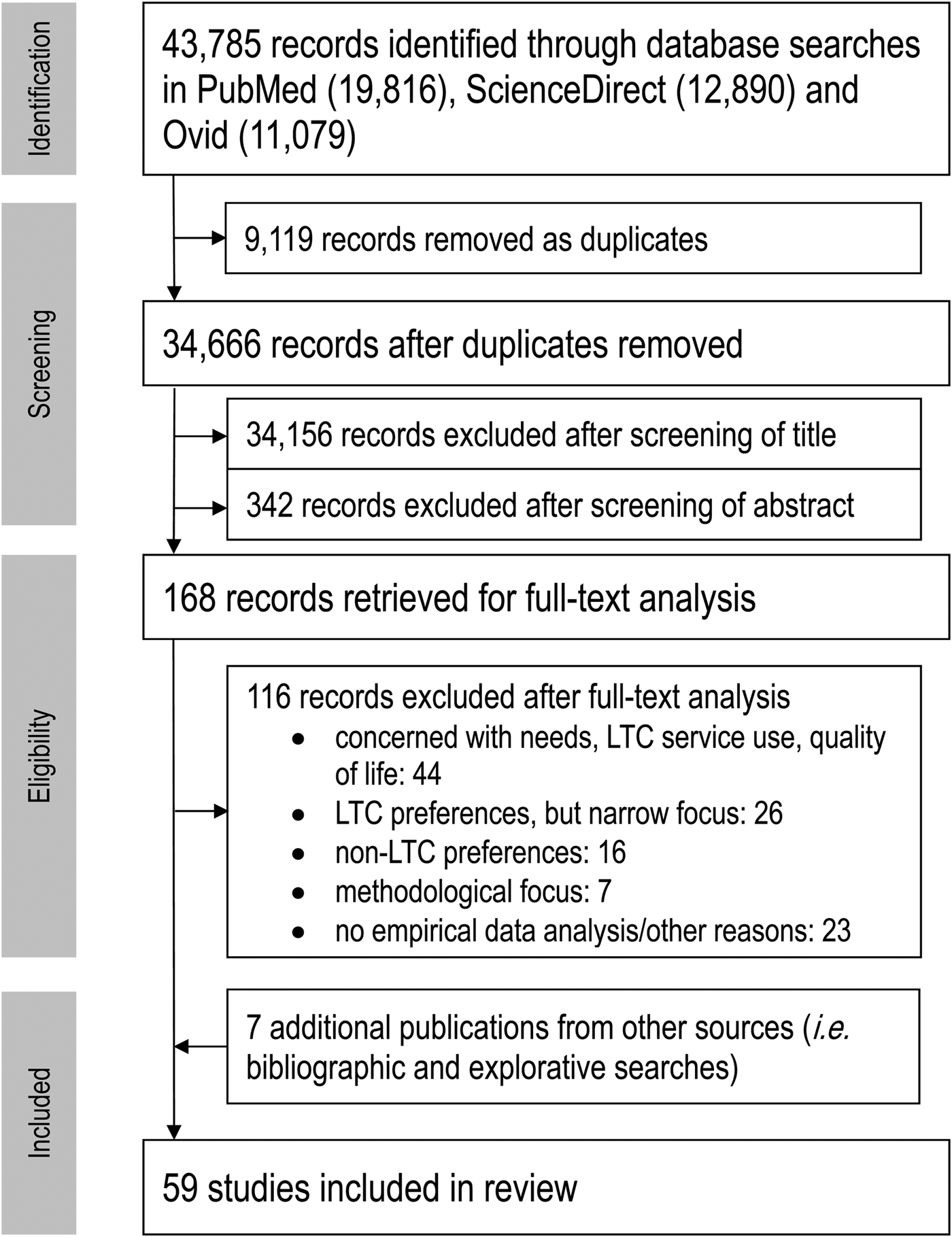
The searches produced 43,785 records, of which 9,119 were duplicates. From the remaining 34,666 records, the first author (TL) selected 510 based on a screening of their titles. TL, MH and KH independently executed all subsequent steps; disagreements were resolved through discussion with the last author (HHK). Of the 510 records selected for abstract screening, 168 publications were retrieved for full-text assessment, of which 116 publications were excluded, mostly because they focused on LTC need or use, QOL, methodological questions, or very specific LTC preferences or preferences not related to LTC. Altogether, 59 studies were included, with 52 coming from databases and seven identified via explorative and bibliographic searches (Figure 1). Data extraction focused on methodological aspects (e.g. research question, approach, sampling procedure, response rate, operationalisation and measurement of outcomes, statistical analyses), respondents’ characteristics (e.g. population/sample, setting, predictors) and study findings.
Flowchart of the study selection process.
Analysis and synthesis
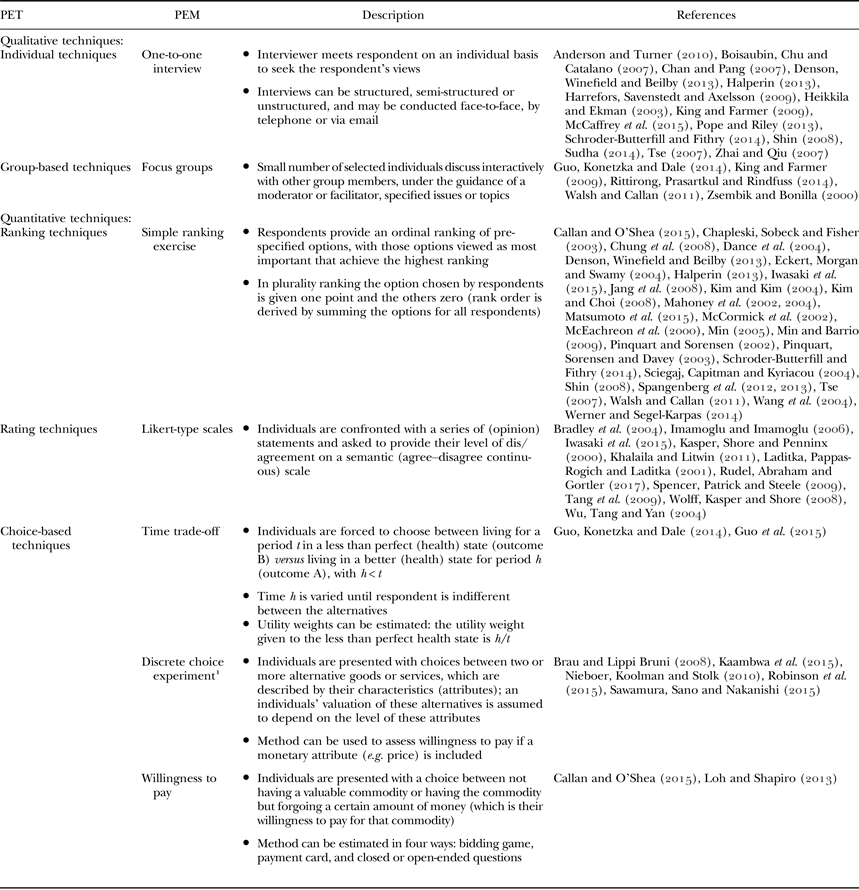
The included publications were first classified as qualitative (N = 12), quantitative (N = 40) or mixed-methods (N = 7) studies. The taxonomy of techniques for the elicitation of public preferences by Ryan et al. (Reference Ryan, Scott, Reeves, Bate, van Teijlingen, Russell, Napper and Robb2001) was adopted to group these studies further. Qualitative analyses were classified as using either individual- or group-based techniques, with one-to-one interviews and focus groups as respective elicitation methods. Quantitative analyses were classified as using either ranking techniques, rating techniques or choice-based techniques. All analyses using ranking techniques employed some form of simple ranking exercises as elicitation method; all analyses using rating techniques applied Likert-type scales. Three types of elicitation method were used by analyses employing choice-based techniques, i.e. time trade-off, discrete choice experiments and willingness to pay (WTP) methods. Further information on each technique/method is provided in Table 1. Note that some studies employed more than one elicitation technique (Table 2).
Preference elicitation techniques and methods used to structure the included literature
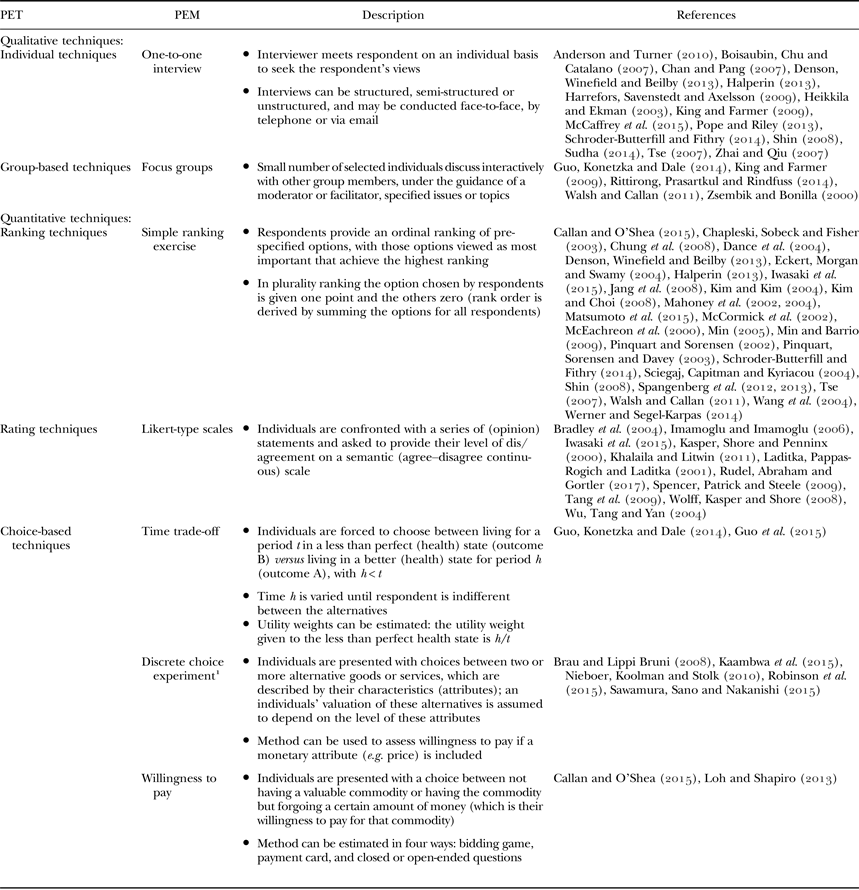
Notes: The taxonomy of techniques for the elicitation of public preferences was adopted from Ryan et al. (Reference Ryan, Scott, Reeves, Bate, van Teijlingen, Russell, Napper and Robb2001). 1. Ryan et al. (Reference Ryan, Scott, Reeves, Bate, van Teijlingen, Russell, Napper and Robb2001) do not explicitly refer to discrete choice experiments in Chapter 3. However, in Chapter 7 (p. 57) they state that in the literature, choice-based conjoint analysis is also referred to as discrete choice modelling and discrete choice experiments. Thus, within their taxonomy, discrete choice experiments are a variant of, or equal to, choice-based conjoint analysis. PEM: preference elicitation method. PET: preference elicitation technique.
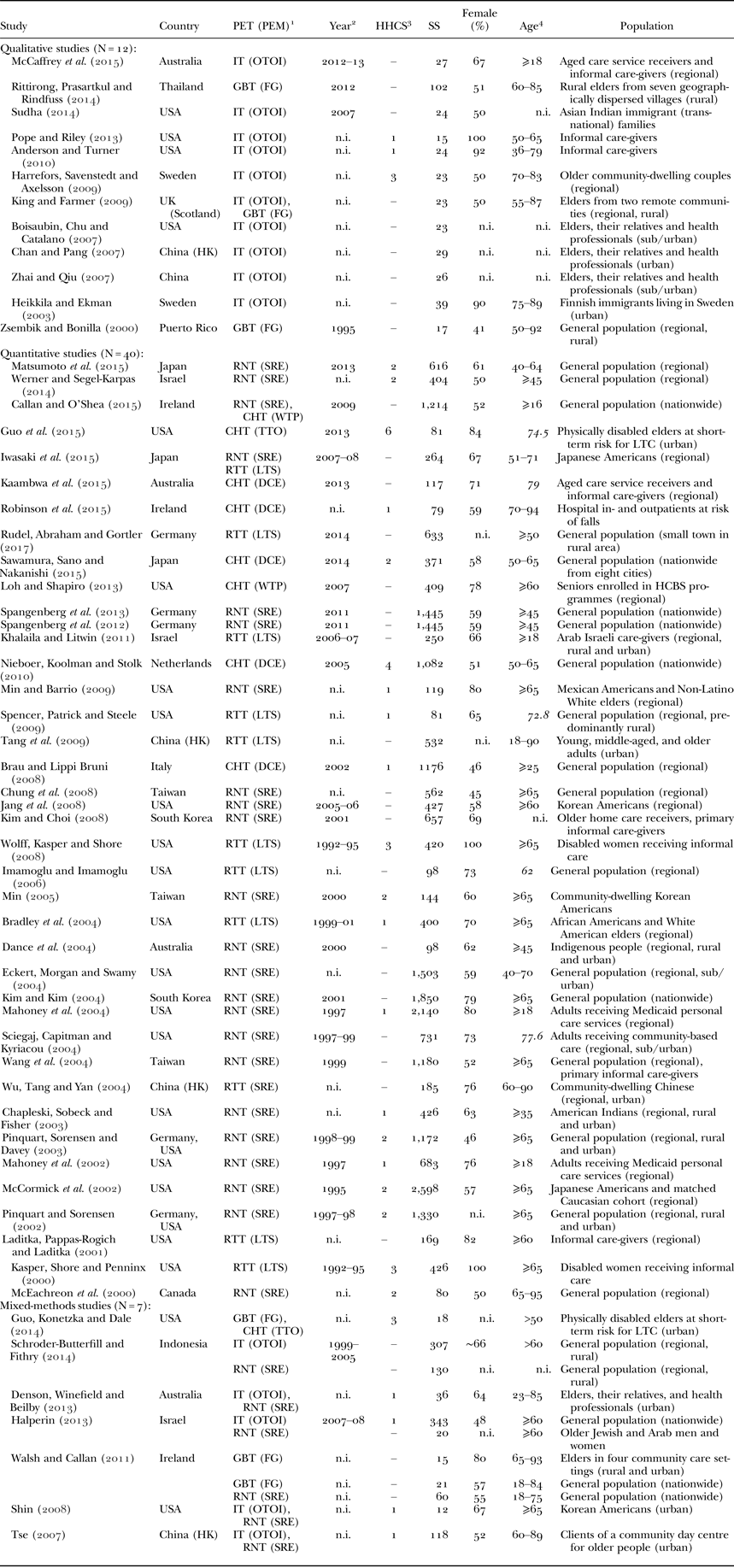
Overview of studies included in the literature review
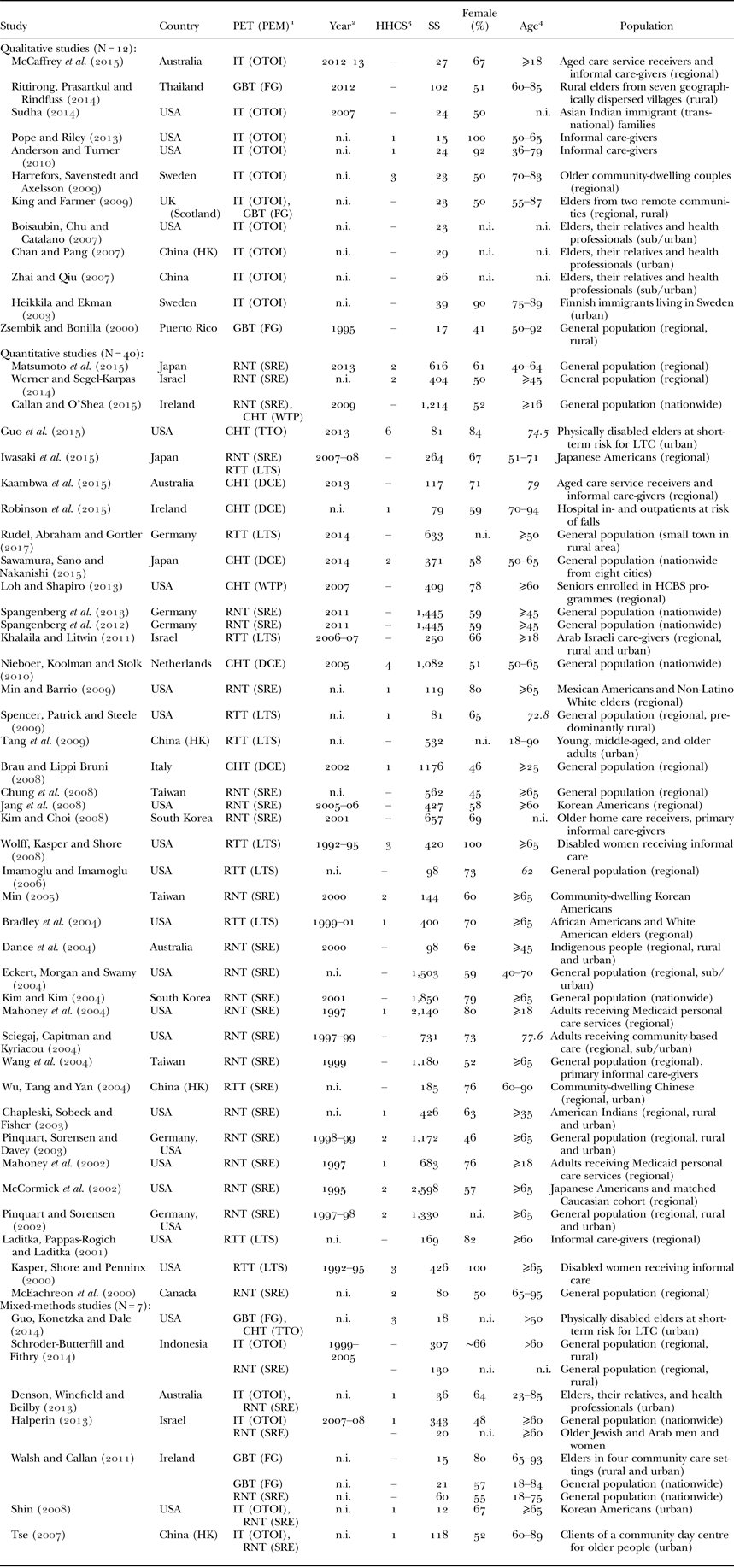
Notes: 1. Classifies studies by distinct empirical analyses based on preference elicitation technique (PET) (preference elicitation method (PEM)) introduced by Ryan et al. (Reference Ryan, Scott, Reeves, Bate, van Teijlingen, Russell, Napper and Robb2001). 2. Indicates the year(s) the data were collected. 3. Indicates whether and (if so) how many different hypothetical health and/or care scenarios (HHCS) were presented to study participants in the elicitation of long-term care (LTC) preferences. 4. Data in italics indicate the mean age of the sample (presented in studies which did not provide an age range). CHT: choice-based techniques. DCE: discrete choice experiment. FG: focus group. GBT: group-based technique. HCBS: home- and community-based services. HK: Hong Kong. IT: individual technique. LTS: Likert-type scale. n.i.: not indicated. OTOI: one-to-one interviews. RNT: ranking techniques. RTT: rating techniques. SRE: simple ranking exercise. SS: sample size. TTO: time trade-off. UK: United Kingdom. USA: United States of America. WTP: willingness to pay.
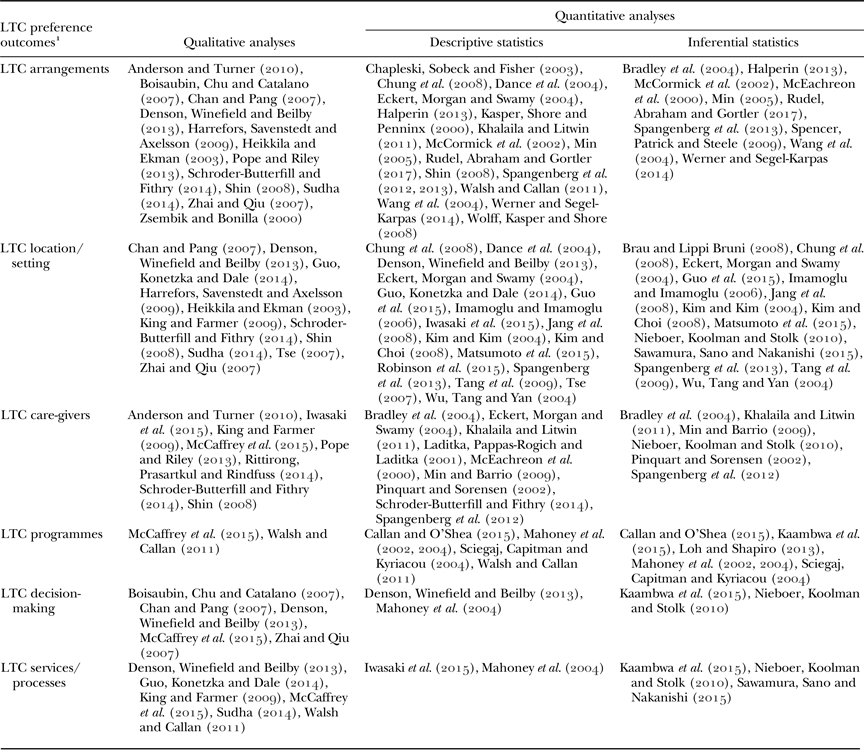
Findings from studies were extracted as empirical analyses, based on the use of elicitation techniques/methods employed in distinct populations/samples, with respect to the following LTC preference outcomes: location/setting, care-givers, arrangements (i.e. combination care location and care-givers), LTC programmes, LTC decision-making and LTC services/processes (Table 3). The impact of influencing factors, which had been investigated via descriptive (sub-group), bivariate and multivariate methods in quantitative analyses, was summarised based on the extraction of variables significant at p < 0.05 in fully adjusted models. Andersen's model of health service use, differentiating between predisposing, enabling, need and psycho-social factors (Andersen Reference Andersen1995), was drawn upon to structure and summarise the respective evidence. Note that our presentation of these findings is limited to influencing factors with consistent effects on LTC preference outcomes.
Long-term care (LTC) preferences outcomes investigated

Notes: The table lists, for the six LTC outcomes considered in this review, the references which contain evidence from qualitative and quantitative analyses. Analyses relate to the preferences elicitation techniques and methods (see Table 2). 1. LTC arrangements intermingle location and care-givers into outcomes, for instance, mixed home care (i.e. care at home by informal and formal/professional/paid care-givers). LTC programmes refer to defined service models (e.g. ‘cash option’ in home- and community-based services; Mahoney et al. Reference Mahoney, Simon-Rusinowitz, Loughlin, Desmond and Squillace2004). LTC decision-making refers to how (who) the decision on e.g. LTC arrangements is made. LTC services/processes refer to specific aspects of LTC, e.g. the availability of transportation services (Nieboer, Koolman and Stolk Reference Nieboer, Koolman and Stolk2010) or the level of contact with the service providers (Kaambwa et al. Reference Kaambwa, Lancsar, McCaffrey, Chen, Gill, Cameron, Crotty and Ratcliffe2015).
Synthesis of findings from quantitative analyses was limited by methodological differences between analyses, also within the group of studies using ranking, rating and choice-based techniques, regarding the operationalisation and inclusion of predictors and the LTC preference outcomes (and reference categories) investigated, amongst others. Qualitative analyses were synthesised, based on an extraction of themes and sub-themes identified in the included analyses, following a qualitative approach (Harden et al. Reference Harden, Garcia, Oliver, Rees, Shepherd, Brunton and Oakley2004). Due to marked overall (methodological) heterogeneity in the included literature, study synthesis was qualitative and no quality appraisal was conducted.
Results part 1: description of the literature
Study characteristics overview
A total of 59 studies, published between 2000 and 2015, were included. These include 71 empirical analyses, of which 50 used quantitative techniques (ranking, rating, choice-based techniques) and 21 qualitative techniques (individual or group-based techniques). Characteristics of studies and empirical analyses included therein are depicted in Table 2. The analysed data came from North America (N = 25), Asia (N = 15), Europe (N = 13), Australia (N = 4), Israel (N = 3) and Puerto Rico (N = 1); two studies conducted comparative analyses with data from Germany and the United States of America (USA) (Pinquart and Sorensen Reference Pinquart and Sorensen2002; Pinquart, Sorensen and Davey Reference Pinquart, Sorensen and Davey2003). With the exception of a longitudinal study investigating the stability of preferences over a one-year time period (Wolff, Kasper and Shore Reference Wolff, Kasper and Shore2008), the remaining studies were cross-sectional.
The 59 studies (71 empirical analyses) include a total of 25,982 individuals, with sample sizes ranging from 12 (Shin Reference Shin2008) to 2,598 (McCormick et al. Reference McCormick, Ohata, Uomoto, Young, Graves, Kukull, Teri, Vitaliano, Mortimer, McCurry, Bowen and Larson2002). Eight analyses used (partially) the same data (Chung et al. Reference Chung, Hsu, Wang, Lin, Huang, Amidon and Kao2008; Kasper, Shore and Penninx Reference Kasper, Shore and Penninx2000; Mahoney et al. Reference Mahoney, Desmond, Simon-Rusinowitz, Loughlin and Squillace2002, Reference Mahoney, Simon-Rusinowitz, Loughlin, Desmond and Squillace2004; Spangenberg et al. Reference Spangenberg, Glaesmer, Brähler and Strauß2012, Reference Spangenberg, Glaesmer, Brahler, Kersting and Straus2013; Wang et al. Reference Wang, Chung, Lai, Chou and Kao2004; Wolff, Kasper and Shore Reference Wolff, Kasper and Shore2008), albeit with different research questions. Twenty-four analyses sampled individuals from the general population, the remainder special populations, e.g. older home care receivers, informal care-givers and ethnic minorities/groups. While most studies were limited to regionally restricted samples, six analysed nationwide random samples (Callan and O'Shea Reference Callan and O'Shea2015; Kim and Kim Reference Kim and Kim2004; Nieboer, Koolman and Stolk Reference Nieboer, Koolman and Stolk2010; Sawamura, Sano and Nakanishi Reference Sawamura, Sano and Nakanishi2015; Spangenberg et al. Reference Spangenberg, Glaesmer, Brähler and Strauß2012, Reference Spangenberg, Glaesmer, Brahler, Kersting and Straus2013). Non-random sampling was used more often than (stratified) random sampling, resulting in non-representative findings in respective analyses.
The large majority of analyses investigated individuals aged ⩾45 years, nearly half of the individuals were ⩾60 years. Nine analyses sampled all or most adult age groups, i.e. ⩾16 years (Callan and O'Shea Reference Callan and O'Shea2015), ⩾18 years (Khalaila and Litwin Reference Khalaila and Litwin2011; Mahoney et al. Reference Mahoney, Desmond, Simon-Rusinowitz, Loughlin and Squillace2002, Reference Mahoney, Simon-Rusinowitz, Loughlin, Desmond and Squillace2004; McCaffrey et al. Reference McCaffrey, Gill, Kaambwa, Cameron, Patterson, Crotty and Ratcliffe2015; Tang et al. Reference Tang, Wu, Yeung and Yan2009; Walsh and Callan Reference Walsh and Callan2011), 23–85 years (Denson, Winefield and Beilby Reference Denson, Winefield and Beilby2013) and ⩾25 years (Brau and Lippi Bruni Reference Brau and Lippi Bruni2008). The share of females ranged from 41 per cent (Zsembik and Bonilla Reference Zsembik and Bonilla2000) to 100 per cent (Kasper, Shore and Penninx 2000; Pope and Riley Reference Pope and Riley2013; Wolff, Kasper and Shore Reference Wolff, Kasper and Shore2008), with the great majority of analyses investigating samples where the share was >50 per cent.
Preferences for LTC were assessed in relation to hypothetical health/care scenario (HHCS) vignettes in 28 studies (32 empirical analyses). HHCS vignettes depict hypothetical individuals in need of care, for instance, by referring to functional impairments or common indications (e.g. hip fracture, stroke, dementia), sometimes in addition indicating the living circumstances (e.g. living alone/with partner). Study participants were asked to place themselves in the position of the person depicted in the HHCS, when stating their LTC preferences. The purpose of HHCS vignettes was to specify and hold constant the level/severity of care needs, especially in (younger) populations without or with little pre-existing IADL or ADL limitations and/or care needs.Footnote 2
Quantitative analyses: ranking and rating techniques
A total of 41 analyses using either ranking (N = 30) or rating techniques (N = 11) were extracted from 33 quantitative and six mixed-methods studies.Footnote 3 Almost half used one or more HHCS vignettes to elicit LTC preferences. Data were collected via face-to-face or telephone interviews in 30 analyses and via postal surveys in eight analyses. One study used both modes (Jang et al. Reference Jang, Kim, Chiriboga and Cho2008), another did not provide sufficient information (Eckert, Morgan and Swamy Reference Eckert, Morgan and Swamy2004). Preference measurement in analyses using ranking techniques was based on closed or open-ended questions. Respondents choose their preferred answer category (value) from those pre-specified by the researchers in the former (with multiple choices allowed in some studies), while qualitative answers were grouped into distinct outcome categories by researchers in the latter. Analyses using rating techniques assessed LTC preferences based on statements regarding possible LTC options, to which respondents provided their level of dis/agreement on Likert-type scales. With the aim of reflecting a clear preference for/against a LTC preference outcome, several authors dichotomised respondent choices from analyses employing rating techniques. Being dependent on the research question, LTC preference outcomes inevitably differed between the 41 analyses.
Determinants for LTC preference outcomes were investigated in descriptive (sub-group), bivariate and multivariate analyses in a sub-set of analyses using ranking or rating techniques. Several respective multivariate analyses utilised Andersen's model of health service use (Andersen Reference Andersen1995) as a framework to investigate and present the effects of influencing factors on LTC preference outcomes (Bradley et al. Reference Bradley, Curry, McGraw, Webster, Kasl and Andersen2004; Kim and Choi Reference Kim and Choi2008; Kim and Kim Reference Kim and Kim2004; Min Reference Min2005; Min and Barrio Reference Min and Barrio2009; Werner and Segel-Karpas Reference Werner and Segel-Karpas2014). Among analyses applying inferential statistics, multivariate logistic regression was the most commonly used. Other procedures employed were Tobit regression (Rudel, Abraham and Gortler Reference Rudel, Abraham and Gortler2017), factor analysis (Spencer, Patrick and Steele Reference Spencer, Patrick and Steele2009), multivariate analysis of variance (Pinquart, Sorensen and Davey Reference Pinquart, Sorensen and Davey2003) and structural equation modelling (Imamoglu and Imamoglu Reference Imamoglu and Imamoglu2006).
Quantitative analyses: choice-based techniques
Nine analyses using choice-based techniques were extracted from eight quantitative and one mixed-method study, all of which were published after 2008.Footnote 4 HHCS vignettes were used in six analyses. Five analyses employed discrete choice experiments (Brau and Lippi Bruni Reference Brau and Lippi Bruni2008; Kaambwa et al. Reference Kaambwa, Lancsar, McCaffrey, Chen, Gill, Cameron, Crotty and Ratcliffe2015; Nieboer, Koolman and Stolk Reference Nieboer, Koolman and Stolk2010; Robinson et al. Reference Robinson, Ni Bhuachalla, Ni Mhaille, Cotter, O'Connor and O'Keeffe2015; Sawamura, Sano and Nakanishi Reference Sawamura, Sano and Nakanishi2015), two time trade-off (Guo, Konetzka and Dale Reference Guo, Konetzka and Dale2014; Guo et al. Reference Guo, Konetzka, Magett and Dale2015) and two WTP methods [i.e. Contingent Valuation with bidding game using payment cards (Callan and O'Shea Reference Callan and O'Shea2015) and with closed and open-ended questions (Loh and Shapiro Reference Loh and Shapiro2013)]. Beyond this methodological grouping, the nine analyses using choice-based techniques vary greatly, amongst others, with regard to study aims, populations, operationalisations and LTC preference outcomes investigated. For instance, discrete choice experiment designs differed regarding attributes and their levels, which ranged from four (with two or three levels) in a study with persons aged ⩾70 years at risk of hip fracture in the USA (Robinson et al. Reference Robinson, Ni Bhuachalla, Ni Mhaille, Cotter, O'Connor and O'Keeffe2015) to ten (with two to four levels) in a study in the general population aged 50–65 years in the Netherlands (Nieboer, Koolman and Stolk Reference Nieboer, Koolman and Stolk2010).
Four studies investigated preferences and/or WTP for (different attributes of) LTC programmes, i.e. LTC insurance coverage in Italy (Brau and Lippi Bruni Reference Brau and Lippi Bruni2008) and home- and community-based services (HCBS) in Ireland (Callan and O'Shea Reference Callan and O'Shea2015), Australia (Kaambwa et al. Reference Kaambwa, Lancsar, McCaffrey, Chen, Gill, Cameron, Crotty and Ratcliffe2015) and the USA (Loh and Shapiro Reference Loh and Shapiro2013), the remainder preferences for (different attributes of) LTC arrangements in the Netherlands (Nieboer, Koolman and Stolk Reference Nieboer, Koolman and Stolk2010), Japan (Sawamura, Sano and Nakanishi Reference Sawamura, Sano and Nakanishi2015) and the USA (Guo, Konetzka and Dale Reference Guo, Konetzka and Dale2014; Guo et al. Reference Guo, Konetzka, Magett and Dale2015; Robinson et al. Reference Robinson, Ni Bhuachalla, Ni Mhaille, Cotter, O'Connor and O'Keeffe2015). Statistical methods employed to analyse preferences were linear regression (Robinson et al. Reference Robinson, Ni Bhuachalla, Ni Mhaille, Cotter, O'Connor and O'Keeffe2015), multinomial probit (Brau and Lippi Bruni Reference Brau and Lippi Bruni2008), multinomial logit (Brau and Lippi Bruni Reference Brau and Lippi Bruni2008; Kaambwa et al. Reference Kaambwa, Lancsar, McCaffrey, Chen, Gill, Cameron, Crotty and Ratcliffe2015; Nieboer, Koolman and Stolk Reference Nieboer, Koolman and Stolk2010) and nested logit models (Brau and Lippi Bruni Reference Brau and Lippi Bruni2008) in discrete choice experiments, and random effects logistic (Loh and Shapiro Reference Loh and Shapiro2013) and ordinary least-square regression models (Callan and O'Shea Reference Callan and O'Shea2015; Guo et al. Reference Guo, Konetzka, Magett and Dale2015) in studies using WTP and time trade-off.
Qualitative analyses: individual and group-based techniques
From seven mixed-method and 12 qualitative studies, 21 qualitative analyses were extracted, six of which used focus groups and 15 individual techniques (i.e. semi-structured face-to-face interviews).Footnote 5 Almost half of the studies came from the USA (N = 6) and Europe (N = 4), the remainder from Asia (N = 6, i.e. Israel, China, Thailand and Indonesia), Australia (N = 2) and Puerto Rico (N = 1). Sample sizes ranged from 12 in an analysis of Korean Americans aged ⩾65 years in Chicago, USA (Shin Reference Shin2008) to 307 in a study using a total population survey of adults aged ⩾60 years from two rural villages in Indonesia (Schroder-Butterfill and Fithry Reference Schroder-Butterfill and Fithry2014). Sampling was non-random, resulting in non-representative samples in all but one of the remaining analyses (Heikkila and Ekman Reference Heikkila and Ekman2003). HHCS vignettes were used in eight analyses, two of which varied (increased) care needs. The majority of the analyses were concerned with special populations, such as informal care-givers (N = 2), receivers of HCBS (N = 2), ethnic minorities/groups (N = 4), rural populations (N = 5) and LTC stakeholders (N = 6); the remainder were concerned with general population samples. Data were analysed using qualitative content analyses or related techniques; four studies did not provide specifics (Guo, Konetzka and Dale Reference Guo, Konetzka and Dale2014; Schroder-Butterfill and Fithry Reference Schroder-Butterfill and Fithry2014; Walsh and Callan Reference Walsh and Callan2011; Zhai and Qiu Reference Zhai and Qiu2007).
Results part 2: synthesis of findings from included studies
Quantitative analyses: ranking and rating techniques
Findings from descriptive analyses show that the large majority of respondents wanted to remain in their known physical (community, neighbourhood, home) and social (family, friends, acquaintances) environment for as long as possible. When little to moderate care needs are present (implicated via HHCS), more than 50 per cent of the respondents from general populations (Chung et al. Reference Chung, Hsu, Wang, Lin, Huang, Amidon and Kao2008; Eckert, Morgan and Swamy Reference Eckert, Morgan and Swamy2004; Kasper, Shore and Penninx Reference Kasper, Shore and Penninx2000; Khalaila and Litwin Reference Khalaila and Litwin2011; Pinquart, Sorensen and Davey Reference Pinquart, Sorensen and Davey2003; Spangenberg et al. Reference Spangenberg, Glaesmer, Brahler, Kersting and Straus2013; Walsh and Callan Reference Walsh and Callan2011; Wang et al. Reference Wang, Chung, Lai, Chou and Kao2004; Wolff, Kasper and Shore Reference Wolff, Kasper and Shore2008) and selected populations, such as ethnic minorities/groups (Bradley et al. Reference Bradley, Curry, McGraw, Webster, Kasl and Andersen2004; Chapleski, Sobeck and Fisher Reference Chapleski, Sobeck and Fisher2003; Dance et al. Reference Dance, Brown, Bammer and Sibthorpe2004; Halperin Reference Halperin2013; McCormick et al. Reference McCormick, Ohata, Uomoto, Young, Graves, Kukull, Teri, Vitaliano, Mortimer, McCurry, Bowen and Larson2002; Min Reference Min2005) and informal care-givers (Khalaila and Litwin Reference Khalaila and Litwin2011; Wang et al. Reference Wang, Chung, Lai, Chou and Kao2004), preferred informal and/or formal care at home. Among home-care arrangements, informal care at home was usually the most preferred, followed by mixed care (mixture of informal and formal care-givers) and all formal home care (Eckert, Morgan and Swamy Reference Eckert, Morgan and Swamy2004; Kasper, Shore and Penninx Reference Kasper, Shore and Penninx2000; Laditka, Pappas-Rogich and Laditka Reference Laditka, Pappas-Rogich and Laditka2001; Pinquart, Sorensen and Davey Reference Pinquart, Sorensen and Davey2003; Rudel, Abraham and Gortler Reference Rudel, Abraham and Gortler2017; Walsh and Callan Reference Walsh and Callan2011; Wolff, Kasper and Shore Reference Wolff, Kasper and Shore2008). Analyses concerned with preferences for care-givers found that most respondents prefer informal over formal care-givers in situations where little to moderate LTC is needed and care is thus deemed manageable at home (Eckert, Morgan and Swamy Reference Eckert, Morgan and Swamy2004; Laditka, Pappas-Rogich and Laditka Reference Laditka, Pappas-Rogich and Laditka2001; Pinquart and Sorensen Reference Pinquart and Sorensen2002; Pinquart, Sorensen and Davey Reference Pinquart, Sorensen and Davey2003; Rudel, Abraham and Gortler Reference Rudel, Abraham and Gortler2017). Among potential informal care-givers, respondents strongly favoured close kin, particularly spouses or children, over distant kin and friends/acquaintances (Eckert, Morgan and Swamy Reference Eckert, Morgan and Swamy2004; Rudel, Abraham and Gortler Reference Rudel, Abraham and Gortler2017; Spangenberg et al. Reference Spangenberg, Glaesmer, Brähler and Strauß2012). For instance, Eckert, Morgan and Swamy (Reference Eckert, Morgan and Swamy2004), who analysed data from 1,503 adults aged 40–70 years from the general population in Maryland (USA), found that 58 per cent of respondents wanted to be cared for in a home or community context, of whom 89 per cent aspired to kin as informal care-givers.
While many respondents were in principle open to relocate when LTC needs develop (Iwasaki et al. Reference Iwasaki, Pierson, Madison and McCurry2015; Jang et al. Reference Jang, Kim, Chiriboga and Cho2008; Rudel, Abraham and Gortler Reference Rudel, Abraham and Gortler2017), moving in with relatives was endorsed by very few respondents (Chapleski, Sobeck and Fisher Reference Chapleski, Sobeck and Fisher2003; Eckert, Morgan and Swamy Reference Eckert, Morgan and Swamy2004; Iwasaki et al. Reference Iwasaki, Pierson, Madison and McCurry2015; Kasper, Shore and Penninx Reference Kasper, Shore and Penninx2000; Pinquart, Sorensen and Davey Reference Pinquart, Sorensen and Davey2003; Spangenberg et al. Reference Spangenberg, Glaesmer, Brahler, Kersting and Straus2013; Wolff, Kasper and Shore Reference Wolff, Kasper and Shore2008). Because of the widespread preference for LTC at one's own home, residential care was aspired to by very few respondents (Chapleski, Sobeck and Fisher Reference Chapleski, Sobeck and Fisher2003; Iwasaki et al. Reference Iwasaki, Pierson, Madison and McCurry2015; Kasper, Shore and Penninx Reference Kasper, Shore and Penninx2000; Pinquart, Sorensen and Davey Reference Pinquart, Sorensen and Davey2003; Walsh and Callan Reference Walsh and Callan2011; Werner and Segel-Karpas Reference Werner and Segel-Karpas2014; Wolff, Kasper and Shore Reference Wolff, Kasper and Shore2008). Among the different forms of residential LTC, those associated with more freedom, independence and flexibility, such as retirement communities and sheltered housing or assisted living facilities, were largely preferred to NH (Chapleski, Sobeck and Fisher Reference Chapleski, Sobeck and Fisher2003; Chung et al. Reference Chung, Hsu, Wang, Lin, Huang, Amidon and Kao2008; Imamoglu and Imamoglu Reference Imamoglu and Imamoglu2006; Iwasaki et al. Reference Iwasaki, Pierson, Madison and McCurry2015; Kasper, Shore and Penninx Reference Kasper, Shore and Penninx2000; Pinquart, Sorensen and Davey Reference Pinquart, Sorensen and Davey2003; Shin Reference Shin2008; Spangenberg et al. Reference Spangenberg, Glaesmer, Brahler, Kersting and Straus2013; Walsh and Callan Reference Walsh and Callan2011; Werner and Segel-Karpas Reference Werner and Segel-Karpas2014; Wolff, Kasper and Shore Reference Wolff, Kasper and Shore2008). For example, Chung et al. (Reference Chung, Hsu, Wang, Lin, Huang, Amidon and Kao2008) investigated LTC preferences in a random sample of 562 individuals ⩾65 years from northern Taiwan and found that 16 per cent preferred residential LTC, with 12 per cent endorsing residential shelter and 4 per cent NH. However, 38 per cent of the respondents also pointed out that their final decision would depend on their overall life and health situation.
Evidence from analyses investigating preferences for LTC programmes complement the above findings, indicated, in particular, by a high appreciation of programmes and models promoting independent choices (e.g. via cash payments) (Callan and O'Shea Reference Callan and O'Shea2015; Mahoney et al. Reference Mahoney, Desmond, Simon-Rusinowitz, Loughlin and Squillace2002, Reference Mahoney, Simon-Rusinowitz, Loughlin, Desmond and Squillace2004; Walsh and Callan Reference Walsh and Callan2011). On the other hand, many respondents were not particularly interested in co-ordinating their own care (Mahoney et al. Reference Mahoney, Simon-Rusinowitz, Loughlin, Desmond and Squillace2004; Sciegaj, Capitman and Kyriacou Reference Sciegaj, Capitman and Kyriacou2004). Most (older) care receivers thus prefer HCBS programmes that allow for more independence and co-determination of specific services and tasks. The desired level of involvement differs, with many HCBS receivers not interested in being continuously involved in the organisation of their own care.
The impact of influencing factors on the above LTC outcomes was investigated in descriptive sub-group, bivariate and multivariate analyses in several of the included studies employing ranking and rating techniques. The impact of care needs on LTC preferences was analysed in two divergent ways, i.e. exogenously defined as current needs via HHCS vignettes (alike for all respondents) or assessed as pre-existing needs variables (vary depending on respondents’ health impairments or functional limitations at the time of the survey). With respect to the former, when the extent or duration of care needs increased in HHCS, preferences gradually shifted away from informal home care towards mixed or formal home care and, when care needs were extensive, towards residential forms of LTC (Kasper, Shore and Penninx Reference Kasper, Shore and Penninx2000; Matsumoto et al. Reference Matsumoto, Naruse, Sakai and Nagata2015; McCormick et al. Reference McCormick, Ohata, Uomoto, Young, Graves, Kukull, Teri, Vitaliano, Mortimer, McCurry, Bowen and Larson2002; McEachreon et al. Reference McEachreon, Salmoni, Pong, Garg and Viverais-Dresler2000; Min Reference Min2005; Pinquart and Sorensen Reference Pinquart and Sorensen2002; Werner and Segel-Karpas Reference Werner and Segel-Karpas2014; Wolff, Kasper and Shore Reference Wolff, Kasper and Shore2008). For instance, Wolff, Kasper and Shore (Reference Wolff, Kasper and Shore2008), who used data from an epidemiological study of disabled women ⩾65 years from the Baltimore area (USA), asked the participants to state their preferred LTC arrangement in relation to three HHCS vignettes depicting increasing IADL needs. When daily help with IADLs was depicted, 89 per cent of respondents aspired to care in their own home (informal: 66%; formal: 23%) whereas 6 per cent chose residential LTC (assisted living: 4%; NH: 2%). When the vignette illustrated a situation where daily help with IADLs and ADLs was needed, the respective shares were 78 per cent (informal: 48%; formal: 28%) and 17 per cent (assisted living: 10%; NH: 8%) and changed to 35 per cent (informal: 20%; formal: 15%) and 60 per cent (assisted living: 10%; NH: 50%) when daily help with IADLs and ADLs because of dementia was depicted (Wolff, Kasper and Shore Reference Wolff, Kasper and Shore2008). Except for one study with individuals aged 40–70 years from Maryland (USA) by Eckert, Morgan and Swamy (Reference Eckert, Morgan and Swamy2004), the evidence from multivariate analyses investigating the impact of pre-existing needs shows that persons with more diseases or IADL limitations (Min Reference Min2005; Werner and Segel-Karpas Reference Werner and Segel-Karpas2014), worse self-rated health (Jang et al. Reference Jang, Kim, Chiriboga and Cho2008; Min Reference Min2005; Wu, Tang and Yan Reference Wu, Tang and Yan2004) or a high subjective risk of becoming sick (Spangenberg et al. Reference Spangenberg, Glaesmer, Brahler, Kersting and Straus2013; Werner and Segel-Karpas Reference Werner and Segel-Karpas2014), were less (more) likely to prefer informal LTC at home (residential LTC).
Among the predisposing variables, consistent effects were observed for having children and being married/living with a partner, whereas age, gender, ethnicity and education yielded inconsistent results. Individuals with children (Iwasaki et al. Reference Iwasaki, Pierson, Madison and McCurry2015; Kim and Choi Reference Kim and Choi2008; Kim and Kim Reference Kim and Kim2004; Pinquart and Sorensen Reference Pinquart and Sorensen2002; Spangenberg et al. Reference Spangenberg, Glaesmer, Brähler and Strauß2012) and those being married/living with their partner (Kim and Choi Reference Kim and Choi2008; McCormick et al. Reference McCormick, Ohata, Uomoto, Young, Graves, Kukull, Teri, Vitaliano, Mortimer, McCurry, Bowen and Larson2002; Min Reference Min2005; Pinquart and Sorensen Reference Pinquart and Sorensen2002; Spangenberg et al. Reference Spangenberg, Glaesmer, Brähler and Strauß2012, Reference Spangenberg, Glaesmer, Brahler, Kersting and Straus2013) were more likely to prefer informal LTC arrangements.
Among the enabling variables, the health and LTC infrastructure (e.g. availability of hospitals, ambulatory nursing services, NH) at the current and potential future place of living influenced the preference to relocate/move for LTC-related reasons (Iwasaki et al. Reference Iwasaki, Pierson, Madison and McCurry2015; Rudel, Abraham and Gortler Reference Rudel, Abraham and Gortler2017). Better subjective knowledge about (Eckert, Morgan and Swamy Reference Eckert, Morgan and Swamy2004; Jang et al. Reference Jang, Kim, Chiriboga and Cho2008) and previous receipt of formal care services (Min Reference Min2005; Pinquart and Sorensen Reference Pinquart and Sorensen2002) was found to increase the preference for formal LTC, whereas the subjectively perceived ability to obtain informal care (Bradley et al. Reference Bradley, Curry, McGraw, Webster, Kasl and Andersen2004) as well as the previous receipt of informal LTC (Pinquart and Sorensen Reference Pinquart and Sorensen2002) increased the preference for informal care. Individuals with higher incomes or a better financial situation were also more likely to prefer informal care (Kim and Kim Reference Kim and Kim2004; Kim and Choi Reference Kim and Choi2008; Werner and Segel-Karpas Reference Werner and Segel-Karpas2014). Informal care providers differed in their preferred LTC arrangements from care receivers in sub-group (Kasper, Shore and Penninx Reference Kasper, Shore and Penninx2000; Kim and Choi Reference Kim and Choi2008; Wang et al. Reference Wang, Chung, Lai, Chou and Kao2004) and multivariate analyses (Khalaila and Litwin Reference Khalaila and Litwin2011; Spangenberg et al. Reference Spangenberg, Glaesmer, Brähler and Strauß2012), with three studies reporting a lower preference for informal care among (former) informal care providers (Khalaila and Litwin Reference Khalaila and Litwin2011; Kim and Choi Reference Kim and Choi2008; Wang et al. Reference Wang, Chung, Lai, Chou and Kao2004).
The evidence from the psycho-social variables suggests that attitudes towards different LTC settings/services and related social norms influence LTC preferences. Not surprisingly, respondents thinking that the government is responsible for the provision of LTC services (Kim and Choi Reference Kim and Choi2008), worried about or intending to avoid care-giving burden on family members (typically, children) (Khalaila and Litwin Reference Khalaila and Litwin2011; Kim and Choi Reference Kim and Choi2008; Werner and Segel-Karpas Reference Werner and Segel-Karpas2014) or having a positive attitude towards NH (Bradley et al. Reference Bradley, Curry, McGraw, Webster, Kasl and Andersen2004; Min and Barrio Reference Min and Barrio2009; Tang et al. Reference Tang, Wu, Yeung and Yan2009; Werner and Segel-Karpas Reference Werner and Segel-Karpas2014; Wu, Tang and Yan Reference Wu, Tang and Yan2004) were more likely to prefer residential LTC, whereas those who value independence highly (Tang et al. Reference Tang, Wu, Yeung and Yan2009; Werner and Segel-Karpas Reference Werner and Segel-Karpas2014; Wu, Tang and Yan Reference Wu, Tang and Yan2004) were more likely to prefer (informal) care at home. Not surprisingly, individuals who adhere to traditional cultural norms and values, such as filial piety, were more likely to prefer informal care (Bradley et al. Reference Bradley, Curry, McGraw, Webster, Kasl and Andersen2004; Chapleski, Sobeck and Fisher Reference Chapleski, Sobeck and Fisher2003; Khalaila and Litwin Reference Khalaila and Litwin2011; Min Reference Min2005; Min and Barrio Reference Min and Barrio2009).
Quantitative analyses: choice-based techniques
Except for one discrete choice experiment (Kaambwa et al. Reference Kaambwa, Lancsar, McCaffrey, Chen, Gill, Cameron, Crotty and Ratcliffe2015) and WTP (Loh and Shapiro Reference Loh and Shapiro2013) study concerned with HCBS, all remaining analyses provide evidence on preferences for different LTC locations. Findings suggest that the setting is among the most important aspects of LTC (Brau and Lippi Bruni Reference Brau and Lippi Bruni2008; Nieboer, Koolman and Stolk Reference Nieboer, Koolman and Stolk2010; Robinson et al. Reference Robinson, Ni Bhuachalla, Ni Mhaille, Cotter, O'Connor and O'Keeffe2015; Sawamura, Sano and Nakanishi Reference Sawamura, Sano and Nakanishi2015) and that most respondents prefer care in the community, ideally at home, when care needs are not extensive (Brau and Lippi Bruni Reference Brau and Lippi Bruni2008; Guo, Konetzka and Dale Reference Guo, Konetzka and Dale2014; Guo et al. Reference Guo, Konetzka, Magett and Dale2015; Nieboer, Koolman and Stolk Reference Nieboer, Koolman and Stolk2010; Robinson et al. Reference Robinson, Ni Bhuachalla, Ni Mhaille, Cotter, O'Connor and O'Keeffe2015; Sawamura, Sano and Nakanishi Reference Sawamura, Sano and Nakanishi2015). Evidence comes from discrete choice experiments, indicated by a high WTP for home care (Robinson et al. Reference Robinson, Ni Bhuachalla, Ni Mhaille, Cotter, O'Connor and O'Keeffe2015) and negative utility/WTP for NH (Nieboer, Koolman and Stolk Reference Nieboer, Koolman and Stolk2010; Robinson et al. Reference Robinson, Ni Bhuachalla, Ni Mhaille, Cotter, O'Connor and O'Keeffe2015), from time trade-off, indicated by significantly higher anticipated QOL for home care compared to NH (Guo, Konetzka and Dale Reference Guo, Konetzka and Dale2014; Guo et al. Reference Guo, Konetzka, Magett and Dale2015), and from analyses using WTP methods, indicated by a higher WTP for home care packages (e.g. compared to community-care packages) (Callan and O'Shea Reference Callan and O'Shea2015; Loh and Shapiro Reference Loh and Shapiro2013).
Findings from discrete choice experiments moreover show that respondents value regular and constant care-givers (Nieboer, Koolman and Stolk Reference Nieboer, Koolman and Stolk2010; Sawamura, Sano and Nakanishi Reference Sawamura, Sano and Nakanishi2015) who are punctual (Nieboer, Koolman and Stolk Reference Nieboer, Koolman and Stolk2010) and flexible (Kaambwa et al. Reference Kaambwa, Lancsar, McCaffrey, Chen, Gill, Cameron, Crotty and Ratcliffe2015). Respondents generally valued flexible LTC services, indicated by the wish to save unused funds for future use among receivers of HCBS in Australia (Kaambwa et al. Reference Kaambwa, Lancsar, McCaffrey, Chen, Gill, Cameron, Crotty and Ratcliffe2015), and the desire to receive care according to individual preferences, rather than standardised care, among individuals from the general population in the Netherlands (Nieboer, Koolman and Stolk Reference Nieboer, Koolman and Stolk2010). Other LTC-related aspects highly valued by respondents were the availability of transportation and co-ordinated service delivery (versus co-ordination by recipient), as well as the opportunity for regular interaction with family and friends and the availability of services without waiting time (Nieboer, Koolman and Stolk Reference Nieboer, Koolman and Stolk2010; Sawamura, Sano and Nakanishi Reference Sawamura, Sano and Nakanishi2015).
Evidence from eight analyses using choice-based techniques indicate the presence of heterogeneity in the preference structure of study participants. The impact of current care needs was investigated through HHCS vignettes and the impact of pre-existing care needs in multivariate analyses (Brau and Lippi Bruni Reference Brau and Lippi Bruni2008; Loh and Shapiro Reference Loh and Shapiro2013). The higher the presumed and actual care needs, the lower the preferences for (informal) home care. Evidence comes from analysis using WTP (Loh and Shapiro Reference Loh and Shapiro2013), discrete choice experiments (Nieboer, Koolman and Stolk Reference Nieboer, Koolman and Stolk2010; Sawamura, Sano and Nakanishi Reference Sawamura, Sano and Nakanishi2015) and time trade-off (Guo, Konetzka and Dale Reference Guo, Konetzka and Dale2014; Guo et al. Reference Guo, Konetzka, Magett and Dale2015). Guo et al. (Reference Guo, Konetzka, Magett and Dale2015) quantified QOL for different hypothetical modes of LTC in relation to six HHCS vignettes, characterised by a stepwise increase in ADL limitations, in a sample of 81 persons ⩾55 years from Chicago (USA) using time trade-off (0 = dead, 1 = perfect health). When help with one ADL was needed, mean QOL for home care (NH care) was 0.72 (0.43), but it decreased to 0.58 (0.37) and 0.21 (0.25) when help with three and six ADLs was needed, respectively. Receiving LTC at home was thus associated with an additional QOL of 0.30, compared to residential care at NH, when functional limitations were minor, while NH care was associated with a 0.04 higher QOL, when limitations were very extensive. A discrete choice experiment in the general population aged 50–65 years from the Netherlands found a negative WTP for NH, and overall lower WTP for arrangements other than to live independently at home, in relation to a HHCS depicting physical frailty, compared to one illustrating dementia (Nieboer, Koolman and Stolk Reference Nieboer, Koolman and Stolk2010). Respondents’ preferences and WTP for residential LTC thus increased when care needs were more comprehensive and complex.
Findings from multivariate analyses moreover suggest that preferences for the investigated LTC outcomes differed by age (Brau and Lippi Bruni Reference Brau and Lippi Bruni2008; Callan and O'Shea Reference Callan and O'Shea2015), gender (Brau and Lippi Bruni Reference Brau and Lippi Bruni2008; Callan and O'Shea Reference Callan and O'Shea2015), ethnic background (Loh and Shapiro Reference Loh and Shapiro2013), education (Brau and Lippi Bruni Reference Brau and Lippi Bruni2008; Guo et al. Reference Guo, Konetzka, Magett and Dale2015), income (Brau and Lippi Bruni Reference Brau and Lippi Bruni2008; Callan and O'Shea Reference Callan and O'Shea2015; Loh and Shapiro Reference Loh and Shapiro2013; Nieboer, Koolman and Stolk Reference Nieboer, Koolman and Stolk2010; Sawamura, Sano and Nakanishi Reference Sawamura, Sano and Nakanishi2015), marital status/living situation (Callan and O'Shea Reference Callan and O'Shea2015; Kaambwa et al. Reference Kaambwa, Lancsar, McCaffrey, Chen, Gill, Cameron, Crotty and Ratcliffe2015; Nieboer, Koolman and Stolk Reference Nieboer, Koolman and Stolk2010), insurance status (Callan and O'Shea Reference Callan and O'Shea2015; Guo et al. Reference Guo, Konetzka, Magett and Dale2015) and the previous provision of informal care (Sawamura, Sano and Nakanishi Reference Sawamura, Sano and Nakanishi2015), amongst others. Not surprisingly, respondents with higher incomes had higher WTP for HCBS programmes (Brau and Lippi Bruni Reference Brau and Lippi Bruni2008; Callan and O'Shea Reference Callan and O'Shea2015; Loh and Shapiro Reference Loh and Shapiro2013) and for various LTC service and process attributes (Nieboer, Koolman and Stolk Reference Nieboer, Koolman and Stolk2010; Sawamura, Sano and Nakanishi Reference Sawamura, Sano and Nakanishi2015). However, differences in WTP between high- and low-income respondents were not uniform, but higher especially for LTC attributes allowing for more independence, autonomy or choice, for instance, to receive care at home (Nieboer, Koolman and Stolk Reference Nieboer, Koolman and Stolk2010), have regular care staff (Nieboer, Koolman and Stolk Reference Nieboer, Koolman and Stolk2010; Sawamura, Sano and Nakanishi Reference Sawamura, Sano and Nakanishi2015), the availability of transportation (Nieboer, Koolman and Stolk Reference Nieboer, Koolman and Stolk2010) and individual meal choices (Sawamura, Sano and Nakanishi Reference Sawamura, Sano and Nakanishi2015). Interestingly, this WTP discrepancy was levelled and partly reversed when more complex care needs due to dementia were implied in HHCS (Sawamura, Sano and Nakanishi Reference Sawamura, Sano and Nakanishi2015), and moreover markedly differed when the presence of a spouse was implied in HHCS (Nieboer, Koolman and Stolk Reference Nieboer, Koolman and Stolk2010).
Qualitative analyses: individual and group-based techniques
Participants in studies conducting qualitative analyses largely preferred LTC at home (Boisaubin, Chu and Catalano Reference Boisaubin, Chu and Catalano2007; Chan and Pang Reference Chan and Pang2007; Guo, Konetzka and Dale Reference Guo, Konetzka and Dale2014; Harrefors, Savenstedt and Axelsson Reference Harrefors, Savenstedt and Axelsson2009; Heikkila and Ekman Reference Heikkila and Ekman2003; King and Farmer Reference King and Farmer2009; Pope and Riley Reference Pope and Riley2013; Sudha Reference Sudha2014; Walsh and Callan Reference Walsh and Callan2011; Zhai and Qiu Reference Zhai and Qiu2007), whereas residential LTC was reserved for situations when advanced care is needed (Boisaubin, Chu and Catalano Reference Boisaubin, Chu and Catalano2007; Guo, Konetzka and Dale Reference Guo, Konetzka and Dale2014; Harrefors, Savenstedt and Axelsson Reference Harrefors, Savenstedt and Axelsson2009; Zhai and Qiu Reference Zhai and Qiu2007). Frequently stated reasons for the home-care preference were to preserve social and personal identities, self-image, belonging, autonomy, control, independence and dignity (Boisaubin, Chu and Catalano Reference Boisaubin, Chu and Catalano2007; Denson, Winefield and Beilby Reference Denson, Winefield and Beilby2013; Guo, Konetzka and Dale Reference Guo, Konetzka and Dale2014; Harrefors, Savenstedt and Axelsson Reference Harrefors, Savenstedt and Axelsson2009; King and Farmer Reference King and Farmer2009; Shin Reference Shin2008; Walsh and Callan Reference Walsh and Callan2011). By contrast, NH care was perceived negatively by many respondents, associated with a loss of freedom (dependency), autonomy and privacy, and with feelings of insecurity, loneliness and isolation (Harrefors, Savenstedt and Axelsson Reference Harrefors, Savenstedt and Axelsson2009; Shin Reference Shin2008; Tse Reference Tse2007).
While informal care-givers were typically preferred over professional care-givers (Boisaubin, Chu and Catalano Reference Boisaubin, Chu and Catalano2007; Chan and Pang Reference Chan and Pang2007; Harrefors, Savenstedt and Axelsson Reference Harrefors, Savenstedt and Axelsson2009; Pope and Riley Reference Pope and Riley2013; Rittirong, Prasartkul and Rindfuss Reference Rittirong, Prasartkul and Rindfuss2014; Shin Reference Shin2008; Sudha Reference Sudha2014; Zhai and Qiu Reference Zhai and Qiu2007; Zsembik and Bonilla Reference Zsembik and Bonilla2000), two studies with informal care-givers from the USA reported weaker or reversed informal care-giver preferences (Anderson and Turner Reference Anderson and Turner2010; Pope and Riley Reference Pope and Riley2013). These care-experienced respondents were acutely aware of the demands and negative aspects of informal care provision, particularly the burden it may impose on their children and hence the parent–child relationship. To ensure future emotional and social support, they were more readily willing to forgo informal care from their children (Anderson and Turner Reference Anderson and Turner2010; Sudha Reference Sudha2014). Emotional support by close kin, especially one's children, is considered of fundamental importance in situations of (formal) LTC receipt (Boisaubin, Chu and Catalano Reference Boisaubin, Chu and Catalano2007; Chan and Pang Reference Chan and Pang2007; Harrefors, Savenstedt and Axelsson Reference Harrefors, Savenstedt and Axelsson2009; Sudha Reference Sudha2014). Several of the qualitative studies indicate that (care-dependent) people are well aware of the burden their care may impose on informal care-givers, which most want minimise or avoid (Boisaubin, Chu and Catalano Reference Boisaubin, Chu and Catalano2007; Halperin Reference Halperin2013; Harrefors, Savenstedt and Axelsson Reference Harrefors, Savenstedt and Axelsson2009; Rittirong, Prasartkul and Rindfuss Reference Rittirong, Prasartkul and Rindfuss2014; Shin Reference Shin2008; Zhai and Qiu Reference Zhai and Qiu2007; Zsembik and Bonilla Reference Zsembik and Bonilla2000). Characteristics of care-givers considered especially important were, besides specialised training, knowledge and experience (King and Farmer Reference King and Farmer2009; Pope and Riley Reference Pope and Riley2013), especially soft skills like empathy (i.e. to understand the care receivers’ physiological, psychological and spiritual needs), kindness/gentleness and respectfulness (Harrefors, Savenstedt and Axelsson Reference Harrefors, Savenstedt and Axelsson2009; King and Farmer Reference King and Farmer2009; Pope and Riley Reference Pope and Riley2013; Walsh and Callan Reference Walsh and Callan2011; Zsembik and Bonilla Reference Zsembik and Bonilla2000).
Qualitative studies investigating preferences for (relevant aspects of) LTC programmes are also suggestive of the importance many individuals attach to social/emotional-relation aspects of LTC (King and Farmer Reference King and Farmer2009; McCaffrey et al. Reference McCaffrey, Gill, Kaambwa, Cameron, Patterson, Crotty and Ratcliffe2015; Walsh and Callan Reference Walsh and Callan2011). Two studies with subjects from Ireland (Walsh and Callan Reference Walsh and Callan2011) and Scotland (King and Farmer Reference King and Farmer2009) found a favourable attitude towards the incorporation of technological innovations into LTC services, especially measures that foster social contact and/or allow people to remain longer at home, while measures intended to increase the ‘technical efficacy’ of care were perceived negatively (King and Farmer Reference King and Farmer2009). McCaffrey et al. (Reference McCaffrey, Gill, Kaambwa, Cameron, Patterson, Crotty and Ratcliffe2015) investigated the importance of different features of HCBS in a sample of older HCBS receivers and their informal care-givers in Australia and found that respondents particularly endorsed the possibility of choosing care-givers themselves and to change their activities flexibly. However, these authors also noted that ‘individual preferences varied widely possibly influenced by individuals’ personalities, experience, expectations, capabilities and support networks’ (McCaffrey et al. Reference McCaffrey, Gill, Kaambwa, Cameron, Patterson, Crotty and Ratcliffe2015: p. 662). Other qualitative analyses reported differences in preferences for (different levels of) care needs (Denson, Winefield and Beilby Reference Denson, Winefield and Beilby2013; Guo, Konetzka and Dale Reference Guo, Konetzka and Dale2014; Harrefors, Savenstedt and Axelsson Reference Harrefors, Savenstedt and Axelsson2009; Shin Reference Shin2008), by gender (Guo, Konetzka and Dale Reference Guo, Konetzka and Dale2014; Harrefors, Savenstedt and Axelsson Reference Harrefors, Savenstedt and Axelsson2009; Rittirong, Prasartkul and Rindfuss Reference Rittirong, Prasartkul and Rindfuss2014; Schroder-Butterfill and Fithry Reference Schroder-Butterfill and Fithry2014) and ethnic/religious background (Guo, Konetzka and Dale Reference Guo, Konetzka and Dale2014; Halperin Reference Halperin2013; Heikkila and Ekman Reference Heikkila and Ekman2003; Rittirong, Prasartkul and Rindfuss Reference Rittirong, Prasartkul and Rindfuss2014; Schroder-Butterfill and Fithry Reference Schroder-Butterfill and Fithry2014; Sudha Reference Sudha2014; Zsembik and Bonilla Reference Zsembik and Bonilla2000), amongst others. Some respondents explicitly pointed out that their care preferences will depend on their overall living situation when care is needed, which is difficult to imagine and foresee (Chan and Pang Reference Chan and Pang2007; Harrefors, Savenstedt and Axelsson Reference Harrefors, Savenstedt and Axelsson2009; King and Farmer Reference King and Farmer2009; Pope and Riley Reference Pope and Riley2013).
Evidence for the variable effects of cultural/societal norms on care preferences comes from analyses of Asian populations (Chan and Pang Reference Chan and Pang2007; Halperin Reference Halperin2013; Rittirong, Prasartkul and Rindfuss Reference Rittirong, Prasartkul and Rindfuss2014; Schroder-Butterfill and Fithry Reference Schroder-Butterfill and Fithry2014; Zhai and Qiu Reference Zhai and Qiu2007), of Asian immigrants in the USA (Shin Reference Shin2008; Sudha Reference Sudha2014) and Finnish immigrants in Sweden (Heikkila and Ekman Reference Heikkila and Ekman2003), and a study from Puerto Rico (Zsembik and Bonilla Reference Zsembik and Bonilla2000). Various collectivistic norms among Chinese (Chan and Pang Reference Chan and Pang2007; Zhai and Qiu Reference Zhai and Qiu2007), Indian (Sudha Reference Sudha2014), Indonesian (Schroder-Butterfill and Fithry Reference Schroder-Butterfill and Fithry2014), Korean (Shin Reference Shin2008), Thai (Rittirong, Prasartkul and Rindfuss Reference Rittirong, Prasartkul and Rindfuss2014) and Puerto Rican (Zsembik and Bonilla Reference Zsembik and Bonilla2000) people result in (filial) expectations for the care of dependent parents/relatives, for instance, by moving in with children when no longer able to live alone in India (Sudha Reference Sudha2014). While preferences for care-givers were often task-dependent (Halperin Reference Halperin2013; Rittirong, Prasartkul and Rindfuss Reference Rittirong, Prasartkul and Rindfuss2014; Schroder-Butterfill and Fithry Reference Schroder-Butterfill and Fithry2014; Zsembik and Bonilla Reference Zsembik and Bonilla2000), there is evidence that female care-givers are usually preferred for personal and intimate care, especially among women (Rittirong, Prasartkul and Rindfuss Reference Rittirong, Prasartkul and Rindfuss2014; Schroder-Butterfill and Fithry Reference Schroder-Butterfill and Fithry2014). However, social norms may moreover be interlinked with religious precepts, such as a cross-gender taboo for intimate care among Muslims in West Sumatra, Indonesia (Schroder-Butterfill and Fithry Reference Schroder-Butterfill and Fithry2014), or notions of social status and honour among Israeli Arabs (Halperin Reference Halperin2013), for example.
Discussion
This review aimed to explore and scope the international peer-reviewed literature concerned with stated preferences for LTC. The 59 included studies were initially grouped into quantitative (N = 40), qualitative (N = 12) and mixed-methods (N = 12). Subsequently, 71 empirical analyses were extracted using the taxonomy of public preference elicitation techniques and methods by Ryan et al. (Reference Ryan, Scott, Reeves, Bate, van Teijlingen, Russell, Napper and Robb2001), based on which a structured methodological description and synthesis of the main findings was conducted. Coming from various scientific disciplines (e.g. gerontology, nursing science, health services research, public health and health economics), bringing along diverse research questions, methodological approaches and specific terminology (Phillips, Johnson and Maddala Reference Phillips, Johnson and Maddala2002), the included literature naturally is, with respect to both methods and findings, heterogeneous. Even studies using the same preference elicitation techniques and methods often markedly differed from each other.
The heterogeneity in outcomes stems from differences between studies, and differences in preferences between individuals within studies. The former particularly relate to methodological aspects (i.e. the definition, operationalisation and measurement of LTC preference outcomes and predictors) and population characteristics (with samples drawn from populations from different cultures, countries and LTC systems). The latter relate to, for example, differences in the framing and understanding of questions used to elicit LTC preference outcomes. Unfortunately, both sources of heterogeneity are hard to disentangle, as they may be present on the level of the study (via differences in operationalisation and measurement of outcomes) and on the level of the individual study participants (via differences in framing of study questions).
Summary of findings
Irrespective of the elicitation technique/method used and the population investigated, some findings consistently emerged. Most respondents preferred to remain in their known physical (community, neighbourhood, home) and social (family, friends, acquaintances) environment. With moderate care needs, most respondents aspired to LTC in their own home, aiming to preserve their personal and social identity, self-image, independence, autonomy, control and dignity. NH care was associated with a loss of freedom, autonomy and privacy, and feelings of isolation, loneliness and insecurity for the majority of respondents, on the other hand. Informal care-givers were typically preferred over formal care-givers when care needs were not extensive, with close kin – particularly spouses or children – being favoured over distant kin and friends or acquaintances. Respondents moreover valued, besides specialised training and technical care-giving skills, regular/constant, flexible, reliable and punctual care-givers, and particularly endorsed soft skills like empathy, kindness, gentleness and respectfulness. Naturally, informal care-givers satisfy such characteristics more easily and may in addition be more willing and capable, because of the long-standing relationship with the care recipient, to fulfil these expectations. Analyses concerned with preferences for (aspects of) LTC programmes largely complement these findings. Respondents valued HCBS models that facilitate their independence, e.g. by the availability of transportation services, by incorporating technological innovations that allow them to remain at home or foster social contact/inclusion, or by choosing and co-ordinating care-givers themselves. However, evidence also indicates that many HCBS receivers do not want to be continuously involved in organising their own care.
Naturally, LTC preferences were found to depend on a variety of personal, (built) environmental, social and cultural aspects. The summarised literature points towards substantial heterogeneity in LTC preferences among study participants, which is in line with findings from other reviews on patient preferences (Gomes et al. Reference Gomes, Calanzani, Gysels, Hall and Higginson2013; Gu et al. Reference Gu, Lancsar, Ghijben, Butler and Donaldson2015; Jung et al. Reference Jung, Baerveldt, Olesen, Grol and Wensing2003; Parker et al. Reference Parker, Clayton, Hancock, Walder, Butow, Carrick, Currow, Ghersi, Glare, Hagerty and Tattersall2007). Few predictors yielded consistent effects across studies in descriptive (sub-group), bivariate and multivariate analyses, though. Similar to studies investigating health service use (Babitsch, Gohl and von Lengerke Reference Babitsch, Gohl and von Lengerke2012), differences in care needs had the strongest impact on LTC preference outcomes. In the included studies, the analysis of care needs was performed in two ways: current needs were investigated in relation to HHCS (i.e. vignettes depicting hypothetical individuals in need of LTC), pre-existing needs (i.e. actual health/functional impairments present at the time of the survey) in sub-group, bivariate and multivariate analyses. When current care needs increased in HHCS, preferences shifted from informal towards mixed or exclusively formal home care, and towards residential care when care needs were extensive. Respondents thus seemingly acknowledged that in a state with severe health and functional impairments, care requirements could better be satisfied in specialised LTC facilities by teams of professional care-givers. Findings regarding the impact of pre-existing needs in multivariate analyses show a similar trend. Respondents with higher health burden (e.g. more disease, ADL limitations, worse self-rated health) were more likely to endorse formal LTC arrangements.
Few other variables yielded consistent effects on LTC preference outcomes in multivariate analyses. Among the predisposing variables, having (more) children and being married/living with a partner increased the likelihood to prefer informal care, while age, gender, education and ethnic background yielded inconsistent effects. From the enabling variables, people with higher income/better financial situation and those with prior experiences receiving informal care were more likely to prefer informal LTC arrangements, whereas persons providing informal care to a family member and those with better knowledge or previous receipt of formal LTC services were more likely to prefer formal LTC arrangements. Naturally, the un/availability of in/formal LTC services, and barriers to service access, also impact LTC preferences. Finally, the evidence for the effects of psycho-social variables suggests that attitudes towards LTC services as well as social norms exert a substantial impact on LTC preferences. While effects of the former are in the expected direction (e.g. attitude to avoid care-giver burden was associated with a decrease in preferences for informal care), the influence of social norms can be complex and contradictory (Schroder-Butterfill and Fithry Reference Schroder-Butterfill and Fithry2014). Some collectivistic norms related to intra-family support/help result in (mutual) expectations towards informal home-care arrangements (Lum Reference Lum2012; Rittirong, Prasartkul and Rindfuss Reference Rittirong, Prasartkul and Rindfuss2014; Schroder-Butterfill and Fithry Reference Schroder-Butterfill and Fithry2014), especially in countries with no or underdeveloped formal LTC services, whereas individualistic norms around modern family life in many Western countries may free children from expectations to provide informal care, in favour of ongoing social and emotional support to ageing parents.
The evidence furthermore indicates that LTC preferences are task-dependent, situation-specific and dynamic over time, ultimately depending on the overall life situation when LTC is needed. Since future worsening of health and functionality are (emotionally) difficult to imagine and foresee (Neville Reference Neville2003), care preferences are not easily anticipated in advance, uncertain to some degree and, thus, hard to generalise. This conjecture is empirically supported by studies investigating quality of (person-centred) residential care (Bangerter et al. Reference Bangerter, Abbott, Heid, Klumpp and Van Haitsma2016a, Reference Bangerter, Van Haitsma, Heid and Abbott2016b; Heid et al. Reference Heid, Eshraghi, Duntzee, Abbott, Curyto and Van Haitsma2014; Van Haitsma et al. Reference Van Haitsma, Abbott, Heid, Carpenter, Curyto, Kleban, Eshraghi, Duntzee and Spector2014) and the consistency of care preferences over time (Van Haitsma et al. Reference Van Haitsma, Abbott, Heid, Carpenter, Curyto, Kleban, Eshraghi, Duntzee and Spector2014; Wolff, Kasper and Shore Reference Wolff, Kasper and Shore2008).
LTC preferences and human needs
Evidence from qualitative studies suggests that preferences for LTC are linked to the (subjectively perceived) satisfaction of needs for independence, self-determination, autonomy, control, social participation/inclusion, security, privacy and dignity. These underlying needs closely resemble basic psychological/social-mental needs as proposed by Maslow (Reference Maslow1943) and others (Deci and Ryan Reference Deci and Ryan2000; Kenrick et al. Reference Kenrick, Griskevicius, Neuberg and Schaller2010; Kim and Kollak Reference Kim and Kollak2006). Empirical evidence for the notion of (culture-independent) basic human needs, which may be broadly separated into physiological/somatic needs and psychological/social-mental needs comes from cross-cultural investigations (Church et al. Reference Church, Katigbak, Locke, Zhang, Shen, Vargas-Flores, Ibanez-Reyes, Tanaka-Matsumi, Curtis, Cabrera, Mastor, Alvarez, Ortiz, Simon and Ching2013; Dijkstra et al. Reference Dijkstra, Yont, Korhan, Muszalik, Kedziora-Kornatowska and Suzuki2012; Fischer and Schwartz Reference Fischer and Schwartz2011; Schwartz et al. Reference Schwartz, Cieciuch, Vecchione, Davidov, Fischer, Beierlein, Ramos, Verkasalo, Lonnqvist, Demirutku, Dirilen-Gumus and Konty2012). When these basic needs are not sufficiently met, wellbeing and QOL can be diminished (ten Bruggencate, Luijkx and Sturm Reference ten Bruggencate, Luijkx and Sturm2017), which typically triggers goal-directed behaviour aimed towards the satisfaction of unmet needs (Kim and Kollak Reference Kim and Kollak2006; Kovach et al. Reference Kovach, Noonan, Schlidt and Wells2005; Majercsik Reference Majercsik2005). While we consider the desire to meet basic needs a universal human trait (Kenrick et al. Reference Kenrick, Griskevicius, Neuberg and Schaller2010), LTC preferences and subsequent LTC utilisation are dependent upon a variety of personal and environmental aspects.
Taking the above into consideration and drawing on information from conceptual models of LTC preferences (Cantor Reference Cantor1979; Forbes and Hoffart Reference Forbes and Hoffart1998; Keysor, Desai and Mutran Reference Keysor, Desai and Mutran1999; Maloney et al. Reference Maloney, Finn, Bloom and Andresen1996; Wielink and Huijsman Reference Wielink and Huijsman1999; Wielink, Huijsman and McDonnell Reference Wielink, Huijsman and McDonnell1997), models of information-processing/social cognition (Armitage and Conner Reference Armitage and Conner2000; Deci and Ryan Reference Deci and Ryan2000; Wyer Reference Wyer2006) and on subjective expected utility theory (Fishburn Reference Fishburn1981), we propose that LTC preferences are a function of the (subjectively perceived) ability of a specific LTC arrangement to satisfy an individual's basic needs, mantled by that individual's experiences, resources and (environmental) restrictions, amongst others. The main purpose of LTC is to satisfy these basic needs in individuals unable, because of functional or cognitive limitations, to satisfy these needs sufficiently themselves, which corresponds to the definition and purpose of LTC presented in the introduction (Kane and Kane Reference Kane and Kane2000; OECD 2013a; WHO 2000). Assuming that the environment people choose to live in (home) normally allows them to satisfy their basic needs sufficiently (Benefield and Holtzclaw Reference Benefield and Holtzclaw2014; Wiles et al. Reference Wiles, Leibing, Guberman, Reeve and Allen2012), the default preference for ageing in place/informal care at home is not surprising. Most older people not only prefer to receive LTC at home, but many also prefer to receive end-of-life care and to die at home (Gomes et al. Reference Gomes, Calanzani, Gysels, Hall and Higginson2013; Hoare et al. Reference Hoare, Morris, Kelly, Kuhn and Barclay2015).
When serious health problems, functional impairments and ultimately high care needs develop, people assume a low QOL, irrespective of the care setting (Guo, Konetzka and Dale Reference Guo, Konetzka and Dale2014; Guo et al. Reference Guo, Konetzka, Magett and Dale2015). The presumed benefits of living at one's home, for instance, higher levels of freedom, independence, belonging and connectedness, may not prevail over the disadvantages, for instance, more personal responsibilities, safety concerns and less control than in residential LTC facilities, when impairments are extensive (e.g. when bedridden or when severe cognitive limitations are present) (Callaghan and Towers Reference Callaghan and Towers2014; Larsson Ranada and Hagberg Reference Larsson Ranada and Hagberg2014; Nord Reference Nord2016). Callaghan and Towers (Reference Callaghan and Towers2014) investigated 618 older subjects’ sense of control in different care settings in the UK and found that those living in care homes consistently reported feeling more in control than those receiving home care. As entry into residential LTC is often preceded by a period of functional and cognitive decline (Luppa et al. Reference Luppa, Luck, Weyerer, Konig, Brahler and Riedel-Heller2010), oftentimes exacerbated by unexpected negative (health) events and hospitalisations (Gill et al. Reference Gill, Murphy, Gahbauer and Allore2013), people understand that remaining in their homes goes along with increased worries and real risks of serious injury or even death (Nord Reference Nord2016). Residential LTC may allow dependent persons to satisfy their basic needs better, compared to LTC at home, when functional limitations and thus care needs are considerable.
Limitations
This review has several limitations. The main limitation was the inability to include all studies meeting the inclusion criteria. Our search strategy may have been insufficient or inappropriate to identify all relevant studies. Defining and applying criteria for inclusion/exclusion of studies was complicated by conceptual and definitional ambiguities of key concepts. Because of the explorative and scoping focus of the review, being the first exclusively concerned with preferences for LTC outcomes, our goal was to identify and include a broad range of respective studies. We therefore purposely developed a search strategy using a large number of terms for LTC and preferences, which necessarily identified a very large number of records. Relevant studies may have been missed, for example, because they were not included in the searched databases. Seven included studies (12%) were indeed identified via explorative and bibliographic searches. Relevant empirical evidence may moreover be contained in grey literature (American Association of Retired People (AARP) 2007; Heuchert, König and Lehnert Reference Heuchert, König and Lehnert2017).
Another major limitation relates to the synthesis of study findings and display of information. The diversity of the reviewed literature hindered a common qualitative way to synthesise and display findings. To assure a minimum level of methodological quality, only studies from peer-reviewed journals were included. Yet, some studies did not provide very detailed methodological information and/or did not discuss study limitations thoroughly. Synthesis was moreover impeded by the diverse preference outcomes investigated, differences in operationalisations and measurements, and by the fact that similar LTC outcomes do not necessarily comprise the same set of services in different countries (Da Roit and Le Bihan Reference Da Roit and Le Bihan2010; Swartz, Miake and Farag Reference Swartz, Miake and Farag2012). Hence, although some relevant articles may not have been identified, we are cautiously optimistic that our search strategy and selection procedures produced an unbiased sample of pertinent publications, and that the thorough methodological grouping of the evidence allowed a representative summary of the main collective evidence reported in the included studies.
Research and policy implications
Information on LTC preferences can be useful to care providers in future care planning and to decision-makers in shaping LTC reimbursement policies, and may ultimately achieve a better congruence between wishes and LTC utilisation (Kane Reference Kane2001; Kodner Reference Kodner2003; Matsuda and Yamamoto Reference Matsuda and Yamamoto2001). The provision and use of LTC services in a patient-centred way is associated with improvements in care outcomes and wellbeing (Cvengros et al. Reference Cvengros, Christensen, Cunningham, Hillis and Kaboli2009; Rathert, Wyrwich and Boren Reference Rathert, Wyrwich and Boren2012; Swift and Callahan Reference Swift and Callahan2009). The precondition is that the empirical preference findings are reliable and valid, which requires a thorough theoretical understanding of both the concept of preferences and LTC services and outcomes. As previously noted by Swartz, Miake and Farag (Reference Swartz, Miake and Farag2012) and Gaugler (Reference Gaugler2014), many unresolved ambiguities and uncertainties exist in research on LTC in general, which is why an integration and standardisation of methodologies, especially concerning the definition, operationalisation and measurement of key concepts, would be desirable (Kane Reference Kane2001; Kane and Kane Reference Kane and Kane2000; Morley et al. Reference Morley, Caplan, Cesari, Dong, Flaherty, Grossberg, Holmerova, Katz, Koopmans, Little, Martin, Orrell, Ouslander, Rantz, Resnick, Rolland, Tolson, Woo and Vellas2014). However, consolidation efforts may be complicated by the notion that much research on LTC is closely linked to country and LTC system-specific issues and questions, which can differ in many ways (Bihan and Martin Reference Bihan and Martin2006; Low, Yap and Brodaty Reference Low, Yap and Brodaty2011; Lum Reference Lum2012; OECD 2005).
Although conceptual models of preferences for LTC have been constructed and evaluated in the past (Forbes and Hoffart Reference Forbes and Hoffart1998; Keysor, Desai and Mutran Reference Keysor, Desai and Mutran1999; Maloney et al. Reference Maloney, Finn, Bloom and Andresen1996; Wielink and Huijsman Reference Wielink and Huijsman1999; Wielink, Huijsman and McDonnell Reference Wielink, Huijsman and McDonnell1997), more recent studies on LTC preferences did not explicitly refer to or use them for theoretical guidance, which may account for the low degree of commonality in this line of research. Information provided in this review can be used for the development of a suitable theoretical framework, while our findings can be valuable for future research on LTC preferences, both original research studies and literature reviews. Future literature reviews should answer more specific questions, summarising more similar studies, for instance, limited to selected preference elicitation techniques, populations or LTC preference outcomes.
The applicability of preference data relies on the presumption that (future) LTC use is closely correlated with stated preferences (Unroe et al. Reference Unroe, Hickman, Torke and Group2016). While there is generally little information available on this topic (Sepucha and Ozanne Reference Sepucha and Ozanne2010; Winn, Ozanne and Sepucha Reference Winn, Ozanne and Sepucha2015), this is particularly true for LTC (Chiu et al. Reference Chiu, Tang, Liu, Shyu, Chang and Chen1998). Therefore, the relation of preferences and respective LTC service use should be investigated and reasons for a discrepancy between care preferences and service use (e.g. barriers to service access, changes in preferences over time) be fathomed (Ayanian et al. Reference Ayanian, Cleary, Weissman and Epstein1999; Chiu et al. Reference Chiu, Tang, Liu, Shyu, Chang and Chen1998).
Conclusions
This review explored and scoped the peer-reviewed literature that investigated stated preferences for LTC. With studies coming from different scientific fields, a thorough grouping based on established preference elicitation techniques and methods was undertaken, based on which a methodological description and synthesis of study findings was conducted. This synthesis strongly suggests that people prefer to ‘age in place’, preferably at home, with as few unnecessary alterations and added uncertainties to their daily life and routines as possible. LTC should therefore integrate seamlessly into people's lives. Many influencing factors were identified that alter this default (informal) home-care preference, most importantly the level and type of care needs (i.e. the preference for informal care-givers and residential LTC increased when care needs increased), but also the availability of and attitudes towards (informal) care-givers and professional LTC services, the financial situation and different social norms, amongst others. Naturally, our findings largely overlap with recommendations towards core elements for LTC systems and services from various national (Kaye Reference Kaye2014) and international organisations (OECD 2005; WHO 2000). Qualitative evidence suggests that LTC preferences are linked to (the satisfaction of) underlying human needs (e.g. nutrition, hygiene, security, autonomy, social participation). Because of gradual changes in health and functional abilities, and thus care needs, LTC preferences are dynamic to some degree and thus difficult to generalise. In contrast to medical care, where outcomes are determined by pre-specified processes and technical aspects to a greater extent (e.g. appropriate treatment being dependent on correct diagnostic procedures), LTC services aim to counterbalance functional limitations. Person-centred care therefore seems particularly relevant and valuable in relation to LTC.
Supplementary material
To view supplementary material for this article, please visit https://doi.org/10.1017/S0144686X18000314.
Acknowledgements
We thank Andre Hajek, Oliver Günther and Anne Toussant for their insightful feedback throughout the work on the literature review. This work was supported by the Federal Ministry of Education and Research (BMBF), Germany (FKZ: 01EH1101B IIIB). The BMBF had no further role in the study design; in the collection, analyses and interpretation of data; in writing the report; and in the decision to submit the paper for publication. The publication of study results was not contingent on the sponsor's approval. All authors contributed equally to the literature review and all authors read and approved the final manuscript. There are no competing interests.