INTRODUCTION
In a traditional crop breeding programme, elite lines are inter-crossed and then the highest yielding lines are selected. However, yield selection is empirical due to low heritability and a high genotype–environment interaction (Reynolds et al. Reference Reynolds, Rajaram and Sayre1999). It also requires the evaluation of a large number of advanced lines in field-yield trials over several years and locations (Ball & Konzak Reference Ball and Konzak1993). An indirect selection method that gives an early yield prediction is a potential alternative approach for screening large numbers of genotypes in breeding programmes for identifying and selecting high-yielding lines (Richards Reference Richards1982; Shorter et al. Reference Shorter, Lawn and Hammer1991; Marti et al. Reference Marti, Bort, Slafer and Araus2007). However, the development of a selection index must integrate several traits, their interrelations and repeatability (high heritability) for predicting yield in breeding programmes (Baker Reference Baker1986; Bouman Reference Bouman1995).
Yield prediction based on models derived from remotely sensed information can be used for this purpose because many genotypes are evaluated in a fast, cheap and accurate way, thereby reducing the time and effort required by breeders to select for high yield among thousands of lines in diverse environments (Reynolds et al. Reference Reynolds, Dreccer and Trethowan2007). Spectral reflectance indices (SRIs) are frequently employed for assessing yield among genotypes under optimal and adverse growing conditions (Araus et al. Reference Araus, Casadesus, Bort, Reynolds, Ortiz-Monasterio and McNab2001). The best known SRI is the normalized difference vegetation index (NDVI), which has been used to predict grain yield in wheat and maize under optimal and nitrogen deficient environments (Raun et al. Reference Raun, Solie, Johnson, Stone, Lukina, Thomson and Schepers2001; Osborne et al. Reference Osborne, Schepers, Francis and Schlemmer2002). However, other SRIs also offer great potential for predicting yield, such as several water indices (WIs; the original WI and four normalized water indices (NWIs)), which are based on near infrared wavelengths (WI=R970/R900, NWI-1= R970−R900/R970+R900, NWI-2=R970−R850/R970+R850, NWI-3=R970−R880/R970+R880 and NWI-4=R970− R920/R970+R920) (Penuelas et al. Reference Penuelas, Filella, Biel, Serrano and Savé1993; Babar et al. Reference Babar, Reynolds, Van Ginkel, Klatt, Raun and Stone2006; Prasad et al. Reference Prasad, Carver, Stone, Babar, Raun and Klatt2007). These WIs have been used for predicting the yield of wheat genotypes under well irrigated, water deficit stress and rainfed conditions in spring and winter wheat (Babar et al. Reference Babar, Reynolds, Van Ginkel, Klatt, Raun and Stone2006; Prasad et al. Reference Prasad, Carver, Stone, Babar, Raun and Klatt2007) as well as in hot environments with spring wheat (Gutierrez et al. Reference Gutierrez, Reynolds, Raun, Stone and Klatt2010a). WIs have been used as an alternative breeding tool for the indirect selection of high-yield potential and for predicting yield in different environments. Similarly, canopy temperature (CT) has demonstrated a strong relationship with grain yield among advanced wheat lines under well irrigated, water-stressed and hot conditions (Reynolds et al. Reference Reynolds, Rajaram and Sayre1999; Babar et al. Reference Babar, Reynolds, Van Ginkel, Klatt, Raun and Stone2006; Gutierrez et al. Reference Gutierrez, Reynolds, Raun, Stone and Klatt2010a).
Since 1964, the wheat breeding programme at The International Maize and Wheat Improvement Center (CIMMYT) has selected advanced wheat lines that have been subsequently distributed via international nurseries around the world through diverse yield trials (Trethowan & Crossa Reference Trethowan and Crossa2007). The primary goal of CIMMYT associated with the distribution of advanced breeding materials to developing countries is to increase their adaptation to local conditions and to select for other desirable traits not present in Mexico (major genetic diversity) (Reynolds & Borlaug Reference Reynolds and Borlaug2006). National programmes can choose from over 1500 new genotypes each year free of charge (Reynolds & Borlaug Reference Reynolds and Borlaug2006). The advanced breeding lines are evaluated annually by diverse international cooperators who collect and send grain yield and other agronomic data to the CIMMYT database (Trethowan et al. Reference Reynolds, Trethowan, Crossa, Vargas and Sayre2002; Lillemo et al. Reference Lillemo, Van Ginkel, Trethowan, Hernandez and Crossa2005; Trethowan & Crossa Reference Trethowan and Crossa2007). Every nursery represents a specific agroclimate (i.e. dry and rainfed) and breeders can request those sets that are more appropriate for their environments in order to select well-adapted genotypes (Reynolds & Borlaug Reference Reynolds and Borlaug2006). Three of these international yield trials are the Elite Spring Wheat Yield Trial (ESWYT), the Semi-Arid Wheat Yield Trial (SAWYT) and the High Temperature Wheat Yield Trial (HTWYT) (Trethowan & Crossa Reference Trethowan and Crossa2007; Lage et al. Reference Lage, Trethowan and Hernandez2008). The ESWYT includes advanced breeding lines that are targeted for highly productive irrigated areas, the SAWYT includes advanced lines for semi-arid regions and the HTWYT is comprised of advanced lines for heat-stressed areas (Trethowan et al. Reference Trethowan, Crossa, Van Ginkel and Rajaram2001; Trethowan & Crossa Reference Trethowan and Crossa2007; Lage et al. Reference Lage, Trethowan and Hernandez2008). These yield trials represent an important data feedback on how effective CIMMYT's targeting of germplasm is in terms of yield (international yield performance) by analysing how physiological or other traits are expressed across locations. It allows CIMMYT to evaluate the relevance of local requirements for future germplasm development and composition of international nurseries (Reynolds & Borlaug Reference Reynolds and Borlaug2006).
Several studies involving international yield trials have been reported using grain yield data from the CIMMYT database (Peterson & Pfeiffer Reference Peterson and Pfeiffer1989; DeLacy et al. Reference DeLacy, Fox, Corbett, Crossa, Rajaram, Fischer and Van Ginkel1994; Trethowan et al. Reference Trethowan, Crossa, Van Ginkel and Rajaram2001, Reference Trethowan, Van Ginkel, Ammar, Crossa, Payne, Cukadar, Rajaram and Hernandez2003; Lillemo et al. Reference Lillemo, Van Ginkel, Trethowan, Hernandez and Rajaram2004, Reference Lillemo, Van Ginkel, Trethowan, Hernandez and Crossa2005). CIMMYT's germplasm has made important contributions to international wheat breeding by increasing yield, especially for developing countries (Dixon et al. Reference Dixon, Nalley, Kosina, La Rovere, Hellin and Aquino2006; Reynolds & Borlaug Reference Reynolds and Borlaug2006). Trethowan et al. (Reference Trethowan, Crossa, Van Ginkel and Rajaram2001) evaluated and examined the yield data of advanced lines included in the SAWYT at 122 locations that represented diverse environments over 6 years for grouping sites with similar growth conditions. The yield testing of advanced lines in diverse environments and/or regions is an important consideration to identify environmental factors that affect yield performance among lines (Lillemo et al. Reference Lillemo, Van Ginkel, Trethowan, Hernandez and Crossa2005). Yield progress across years for advanced lines in the ESWYT was explained by the amount of annual rainfall in dry areas (Trethowan et al. Reference Trethowan, Crossa, Van Ginkel and Rajaram2001). Reynolds et al. (Reference Reynolds, Trethowan, Crossa, Vargas and Sayre2002) analysed the environmental data of diverse advanced wheat lines from the ESWYT to determine pre- or post-anthesis effects over the genotype due to environment interactions; they found that the post-anthesis conditions had greater effects to explain the genotype×environment interactions. Lage et al. (Reference Lage, Trethowan and Hernandez2008) grouped individual sites into clusters using a shifted-multiplicative model combining environmental data and grain yield (35 years average) and when several CIMMYT yield trials were compared, including the ESWYT, the SAWYT and the HTWYT, they found that 18 sites were similar and 23 sites were contrasting. Lage & Trethowan (Reference Lage and Trethowan2008) reported that the interspecific hybridization with Triticum turgidum ssp. and Aegilops tauschii have over time (10–15 years) improved the yield of the advanced lines in the SAWYT for rainfed environments.
North-west Mexico (Yaqui Valley) has been used extensively to develop and select advanced lines based on yield per se for irrigated, water-stressed and hot environments. These advanced materials are subsequently delivered to international cooperators around the world (Lillemo et al. Reference Lillemo, Van Ginkel, Trethowan, Hernandez and Crossa2005). Several studies have previously proposed the WIs and CT as indirect selection criteria to identify high-yielding lines over time for distinct environments, but most of these reports have originated from the same source location (Yaqui Valley) (Babar et al. Reference Babar, Reynolds, Van Ginkel, Klatt, Raun and Stone2006; Reynolds et al. Reference Reynolds, Dreccer and Trethowan2007; Gutierrez et al. Reference Gutierrez, Reynolds, Raun, Stone and Klatt2010a). In the present study, the main goal was to compare the expression of yield and two remotely sensed selection criteria, namely, water indices (WIs and NWIs) and CT measured in the selection environment of north-west Mexico (Yaqui Valley), with the expression of yield across a range of international target locations. Specific objectives were (i) to evaluate the ability of indirect selection criteria obtained from the WIs and CT to estimate genetic-yield potential of lines included in international nurseries and (ii) to determine the added value of using indirect selection criteria to select or target new breeding lines for international distribution.
MATERIALS AND METHODS
Advanced lines of yield trials
Advanced breeding lines developed by CIMMYT were used for the present study. The advanced lines corresponded to three international trials: ESWYT, comprising 25 lines developed for irrigation conditions; SAWYT, composed of 40 lines developed for reduced irrigation or semi-arid conditions; and HTWYT, containing 18 lines for high-temperature environments (previously reported in Gutierrez et al. Reference Gutierrez, Reynolds, Raun, Stone and Klatt2010a). The advanced lines corresponded to the 24th ESWYT, the 11th SAWYT and the 11th HTWYT, which were evaluated for grain yield during three growing seasons (2006, 2007 and 2008) and in three environments (well irrigated, water-stressed and high-temperature) in north-west Mexico.
Growing conditions for north-west Mexico (Yaqui Valley)
The 24th ESWYT lines were grown under well-irrigated conditions, the 11th SAWYT lines under well irrigated and water-stressed conditions and the 11th HTWYT lines under well irrigated, water-stressed and high-temperature conditions (Gutierrez et al. Reference Gutierrez, Reynolds, Raun, Stone and Klatt2010a). All advanced lines were planted at CIMMYT's experimental station in Ciudad (Cd.) Obregon, north-west Mexico (27°18′N, 109°54′W, 38 m asl) during three growing seasons (2006, 2007 and 2008), except the 11th HTWYT which was grown under water-stressed conditions only during 2007 and 2008. The seeding rate for each experiment was 78 kg/ha, and the advanced lines were fertilized with nitrogen (150 kg N/ha) and phosphorous (22 kg P/ha) in early January of each season, at the 3–4 leaf stage (growth stage (GS) 13–14; Zadoks et al. Reference Zadoks, Chang and Konzak1974). Field plots consisted of two raised beds, 5 m long and 0·8 m wide, 0·28 m apart, each containing two rows of wheat. The plots were arranged in an alpha lattice design with two replications.
Genotypes were planted in early November and plants reached booting (GS 39–47) and heading (GS 55–69) during February–March for the well irrigated and water-stressed conditions in each growing season. For the experiments under high-temperature conditions, lines were planted in early–mid February and reached heading in late April and May when temperatures were 30–40°C.
Flood irrigation was applied every 20–25 days for well-irrigated treatments. In trials submitted to drought-stressed conditions, one irrigation was applied before seeding, providing 100 mm of available water, plus two additional irrigations of 50–70 mm prior to the booting stage. For the high-temperature trials, irrigations were also applied as required to prevent drought stress.
Grain yield was determined at maturity by harvesting the complete plot, excluding a 0·5 m border at each end in all experiments.
Spectral reflectance and CT measurements in north-west Mexico
Canopy reflectance was measured in the 350–1100 nm range using a FieldSpec spectroradiometer (Analytical Spectral Devices, Boulder, Colorado, USA). Data were collected during cloud-free days at solar noon (10·30 and 14·00 h) with a previous calibration using a white plate of barium sulphate (BaSO4) that provides maximum reflectance (Labsphere Inc., North Sutton, New Hampshire, USA). Four measurements in each plot were taken at a height of 0·5 m above the canopy with a field of view of 25°C during heading and grain filling (see Gutierrez et al. Reference Gutierrez, Reynolds, Raun, Stone and Klatt2010a).
Canopy spectral reflectance was measured during the three seasons at heading (mid February for water-stress, early March for well irrigated and late April–early May for high-temperature conditions), and at grain filling (early March for water-stress, late March for well irrigated and mid–late May for high-temperature) according to the growth conditions in each experiment. Five WIs were computed as follows: WI=R970/R900, NWI-1=R970−R900/R970+R900, NWI-2=R970− R850/R970+R850, NWI-3=R970−R880/R970+R880 and NWI-4=R970−R920/R970+R920 (Penuelas et al. Reference Penuelas, Filella, Biel, Serrano and Savé1993; Babar et al. Reference Babar, Reynolds, Van Ginkel, Klatt, Raun and Stone2006; Prasad et al. Reference Prasad, Carver, Stone, Babar, Raun and Klatt2007).
CT was determined in the same yield trials and growth conditions in north-west Mexico during grain filling (early March for water-stress, late March for well irrigated and mid-late May for high-temperature) using a hand-held infrared thermometer (Mikron M90 Series, Mikron Infrared Instrument Co. Inc., Oakland, New Jersey, USA).
Grain yield data for international locations
CIMMYT's database for the advanced lines of the 24th ESWYT, the 11th SAWYT and the 11th HTWYT corresponded to the year 2003 when these three yield trials were evaluated for grain yield at many international locations. The database contained yield data, latitude, longitude, altitude, seasonal rainfall and irrigations reported by collaborators at each testing site. However, the information provided by many collaborators was incomplete, especially for the amount of irrigation, annual or seasonal rainfall and fertilizers applied.
List of international locations where advanced lines of the 24th ESWYT, the 11th SAWYT and the 11th HTWYT were planted and evaluated

All advanced breeding lines were planted in an alpha lattice design with two replications at each location/country. Seeds of all trials were packaged and randomized at CIMMYT and grown under local agronomic practices for every testing site.
Annual rainfall
Average annual rainfall data for each testing site were obtained through several websites such as World Climate (http://www.worldclimate.com, verified 14 April 2011), Falling Rain Genomics (http://www.fallingrain.com/world/index.html, verified 14 April 2011) and The National Oceanic and Atmospheric Administration website (http://www.ncdc.noaa.gov, verified 14 April 2011). Longitude, latitude and altitude for several international locations were completed using the CropForge website (http://www.CropForge.org, verified 14 April 2011), which reports the majority of the CIMMYT testing sites.
Statistical analysis
Grain yield data for the advanced lines at international locations in each yield trial were analysed by SAS using Proc Mixed and the adjusted means were obtained according to the alpha lattice design (SAS Institute 2001). Pearson correlation coefficients were used to estimate the phenotypic relationships of the WIs, CT and yield in north-west Mexico with grain yield at the international locations.
RESULTS
Geographic and rainfall diversity among international locations
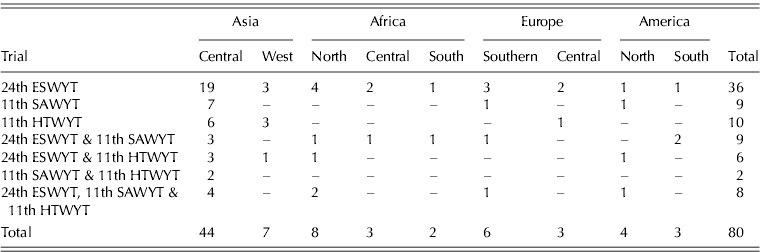
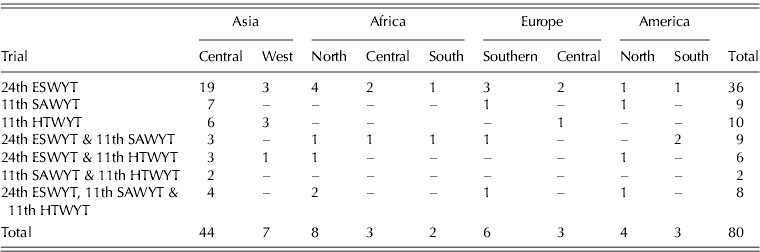
The advanced lines of the 24th ESWYT, the 11th SAWYT and the 11th HTWYT were evaluated in 80 international locations, which were widely distributed in Asia, Africa, Europe and America (Tables 1 and 2). The 24th ESWYT was evaluated at 59 sites, the 11th SAWYT at 28 sites and the 11th HTWYT at 26 sites. Some international locations evaluated only one-yield trial, but others combined two- or three-yield trials at the same site (Table 2). The 24th ESWYT was evaluated singly at 36 sites, the 11th SAWYT at nine sites and 11th HTWYT at 10 sites. The 24th ESWYT and the 11th SAWYT trials were evaluated together at nine sites, the 24th ESWYT and the 11th HTWYT at six sites, the 11th SAWYT and the 11th HTWYT at two sites and the three yield trials were evaluated together at eight sites. Central Asia was the region with the highest number of locations for evaluating one, two or three yield trials (44 locations), while the other regions (West Asia, North, Central and South Africa, Southern and Central Europe, and North and South America) showed less than 10 locations each (Table 2).
International locations distributed by regions where the advanced lines of the 24th ESWYT, the 11th SAWYT and the 11th HTWYT were planted and evaluated

The geographic diversity among international locations was responsible for considerable variations in annual rainfall (Table 1). Few locations had very low rainfall (six sites with ⩽100 mm) and few had very high rainfall (two sites with ⩾1900 mm) (Table 1). Most of the international locations displayed low to moderate annual rainfall (⩽800 mm in 69 sites) and the others had moderately high rainfall (>800 mm in 11 sites). Irrigation was commonly employed in sites with low, intermediate and high rainfall and only four locations were reported as non-irrigated. This means that rainfall was absent or minimal during the cropping season in the majority of the international locations (Table 1).
Grain yield diversity among international locations
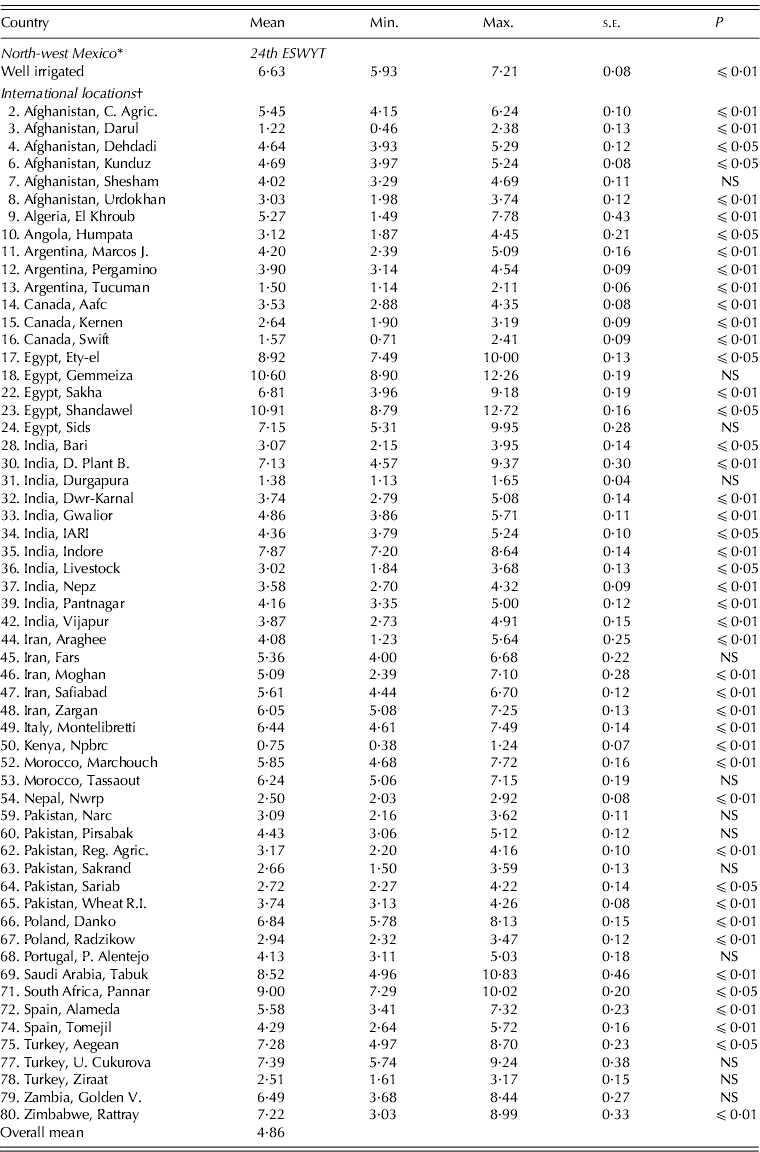
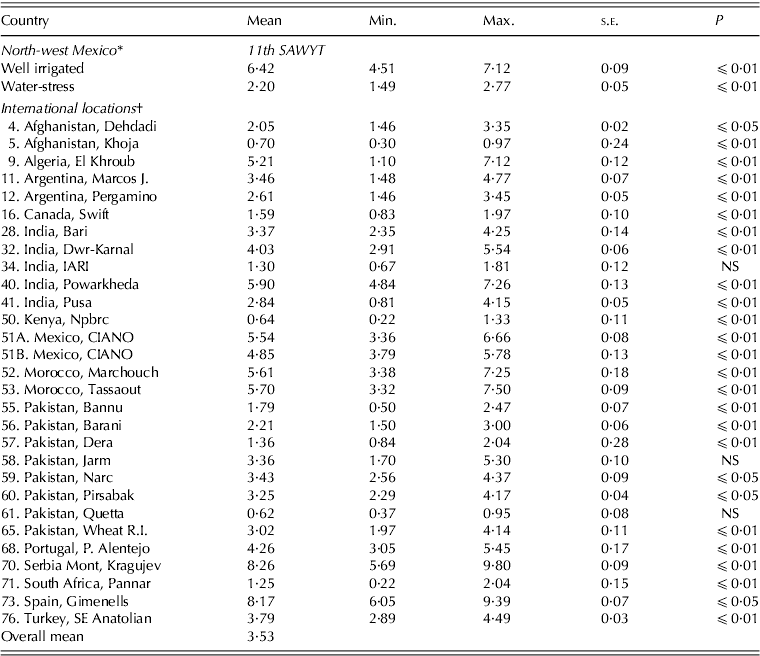
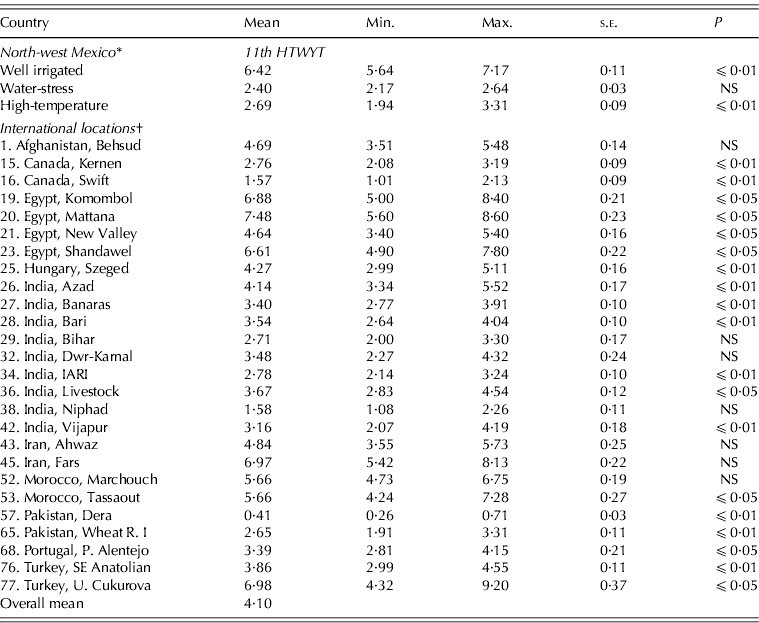
There was considerable variation in the average grain yield of the advanced lines from the 24th ESWYT, the 11th SAWYT and the 11th HTWYT among the testing sites (Tables 3–5). The average grain yield ranged from 0·8 to 12·7 t/ha for the 24th ESWYT entries, from 0·6 to 8·2 t/ha for the 11th SAWYT entries and from 0·4 to 7·5 t/ha for the 11th HTWYT entries. The average yield of the advanced lines from the 24th ESWYT was higher (4·9 t/ha) than the 11th SAWYT lines (3·5 t/ha) and the 11th HTWYT lines (4·1 t/ha) when all sites were combined for each yield trial. There were genotypic differences in most locations and the genotype by environment interaction was highly significant (P⩽0·01) (data not shown).
Minimum, maximum, mean grain yield (t/ha), standard error (s.e.) and significance level (P) among advanced lines (n=24) of the 24th ESWYT planted in NW Mexico (2006, 2007 and 2008) and at international locations (2003)

* Average of 3 years (2006, 2007 and 2008).
† Average of 1 year (2003).
NS: not significant.
Minimum, maximum, mean grain yield (t/ha), standard error (s.e.) and significance level (P) among advanced lines (n=24) of the 11th SAWYT planted in NW Mexico (2006, 2007 and 2008) and at international locations (2003)

* Average of 3 years (2006, 2007 and 2008).
† Average of 1 year (2003).
NS: not significant.
Minimum, maximum, mean grain yield (t/ha), standard error (s.e.) and significance level (P) among advanced lines (n=24) of the 11th HTWYT planted in NW Mexico (2006, 2007 and 2008) and at international locations (2003)

* Average of 3 years (2006, 2007 and 2008).
† Average of 1 year (2003).
NS: not significant.
Association of the north-west Mexico parameters with grain yield of international locations
Grain yield from international locations showed significant associations with the five WIs (one WI and four NWIs) measured in north-west Mexico under stressed and non-stressed conditions. There were minor differences among the five indices (data not shown), but NWI-3 consistently gave the strongest correlations of the five WIs, and it will be presented in the current study to illustrate the relationship of the WIs and their utility to predict yield at international locations. Similarly, CT determined in north-west Mexico also showed significant associations with grain yield at international locations. For both parameters, NWI-3 and CT were only considered to have good predictive potential if the grain yield from international locations was associated during 2 or 3 years with these two parameters (tested during 3 years in north-west Mexico).
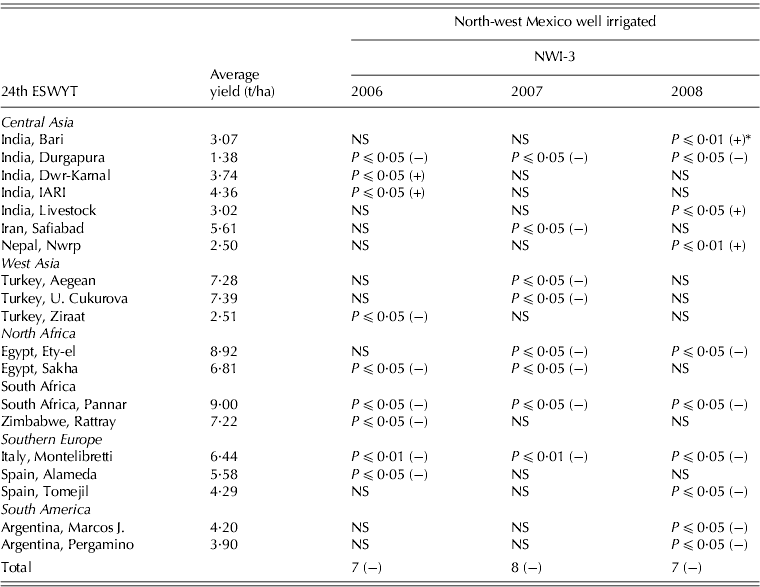
NWI-3, CT and grain yield determined in north-west Mexico showed significant relationships with the grain yield of the advanced lines from the 24th ESWYT, the 11th SAWYT and the 11th HTWYT, displaying both negative and positive correlation values (Tables 6–14). The negative association of NWI-3 and CT with grain yield from international locations was the primary interest in order to find sites with similar yield performance, which could be reaffirmed with positive associations between the grain yield from north-west Mexico and the grain yield from international sites.
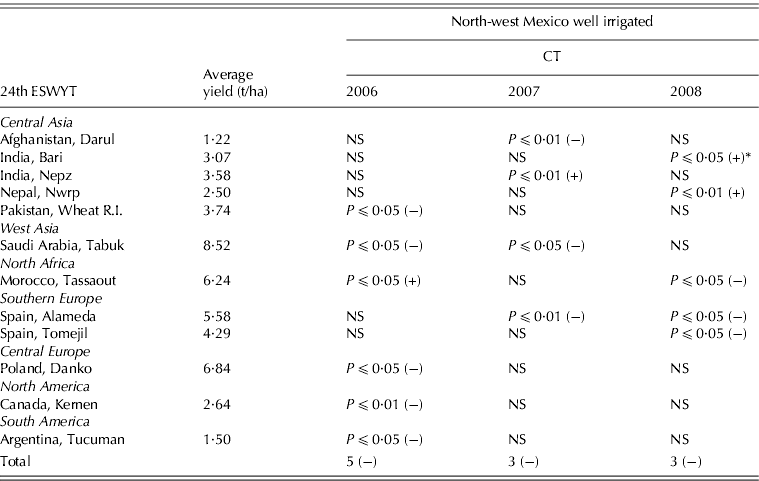
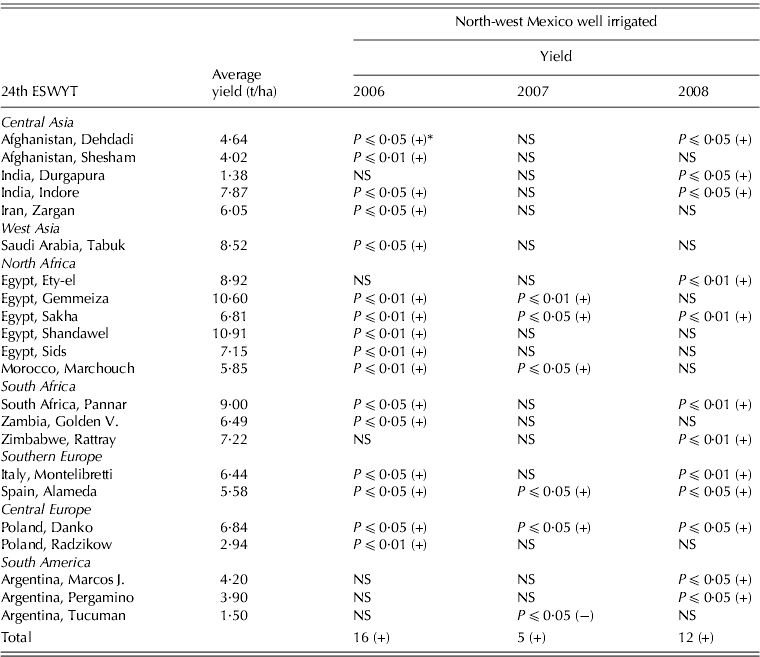
NWI-3, which was determined during three growing seasons in north-west Mexico, gave a few significant negative associations (P⩽0·05 and 0·01) in all worldwide regions for the 24th ESWYT (Table 6). One location with low grain yield in India (1·4 t/ha), and two locations each with high grain yield in Italy (6·4 t/ha) and South Africa (9 t/ha), showed significant negative associations (P⩽0·05 and 0·01) with NWI-3 during 3 years. Two locations with high grain yield in Egypt (6·8 and 8·9 t/ha) also showed significant negative associations (P⩽0·05) with NWI-3 during 2 years. CT only showed negative associations (P⩽0·05 and 0·01) during 2 years with locations of high grain yield in Saudi Arabia (8·5 t/ha) and Spain (5·6 t/ha) (Table 7). Grain yield from north-west Mexico gave several significant correlations with grain yield at international locations (positively associated at P⩽0·05 and 0·01) during 2 and 3 years in central Asia, north and south Africa and central and southern Europe, and some of these locations were the same locations associated with NWI-3 and CT (Table 8).
Correlation coefficients between the NWI-3 measured under well-irrigated conditions in north-west Mexico and grain yield from international locations for advanced lines of the 24th ESWYT

* Sign in parentheses indicates negative or positive significant correlations.
NS: no significant correlation.
Correlation coefficients of CT measured under well-irrigated conditions in north-west Mexico and grain yield from international locations for advanced lines of the 24th ESWYT

* Sign in parentheses indicates negative or positive significant correlations.
NS: no significant correlation.
Correlation coefficients between grain yield measured under well-irrigated conditions in north-west Mexico and grain yield from international locations for advanced lines of the 24th ESWYT

* Sign in parentheses indicates negative or positive significant correlations.
NS: no significant correlation.
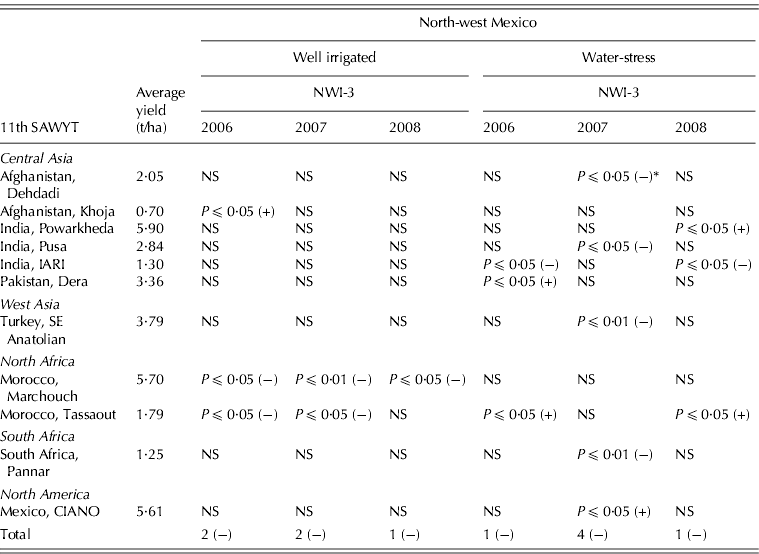
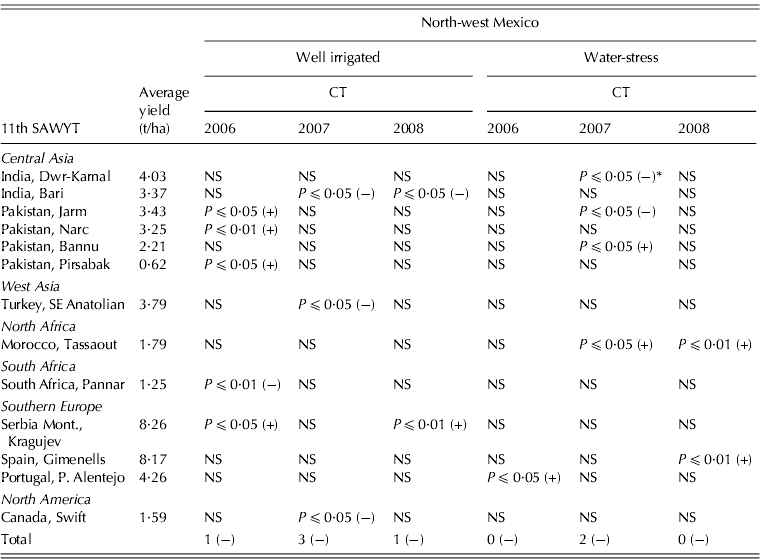
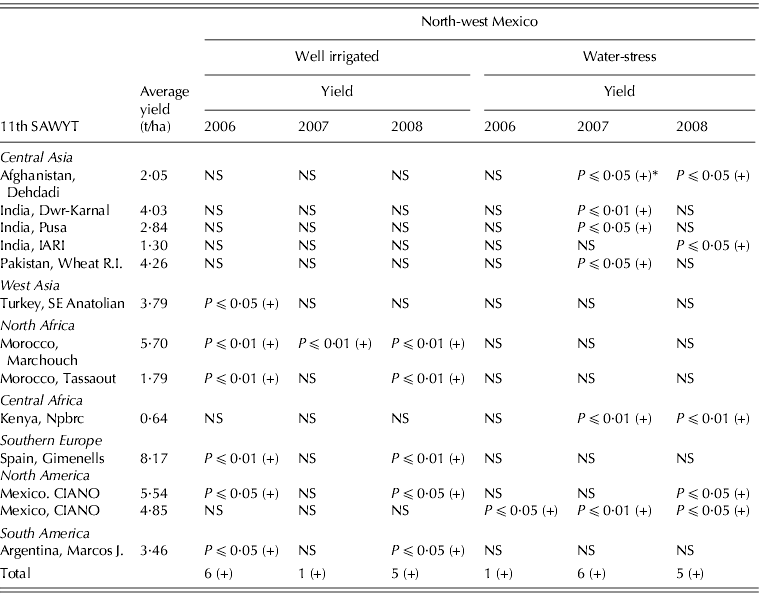
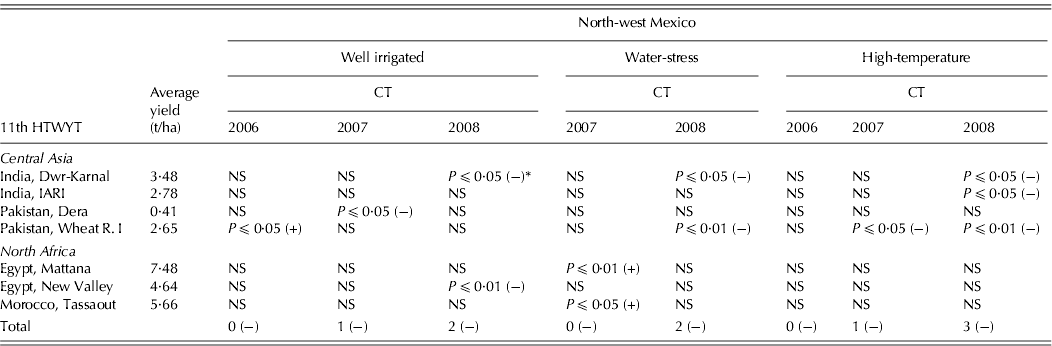
NWI-3 determined in the well-irrigated environment in north-west Mexico for the 11th SAWYT trial displayed negative associations (P⩽0·05 and 0·01) with two locations in Morocco, one with high grain yield (5·7 t/ha) and one with low grain yield (1·8 t/ha), which were correlated during 3 and 2 years, respectively (Table 9). CT showed a negative association (P⩽0·05) during 2 years with one site in India with low grain yield (3·4 t/ha) (Table 10). For water-stressed environments, NWI-3 displayed a negative association (P⩽0·05) during 2 years with one location in India with low grain yield (1·3 t/ha), while CT only showed negative associations (P⩽0·05) during 1 year for two locations (Tables 9 and 10). Grain yield in north-west Mexico under irrigated and water-stressed conditions showed several positive correlations (P⩽0·05 and 0·01) with the grain yield at international locations, but few corresponded to the same locations associated with NWI-3 and CT (Table 11).
Correlation coefficients between the NWI-3 measured under well irrigated and water-stressed conditions in north-west Mexico and grain yield from international locations for advanced lines of the 11th SAWYT

* Sign in parentheses indicates negative or positive significant correlations.
NS: no significant correlation.
Correlation coefficients between CT measured under well irrigated and water-stressed conditions in north-west Mexico and grain yield from international locations for advanced lines of the 11th SAWYT

* Sign in parentheses indicates negative or positive significant correlations.
NS: no significant correlation.
Correlation coefficients between grain yield measured under well irrigated and water-stressed conditions in north-west Mexico and grain yield from international locations for advanced lines of the 11th SAWYT

* Sign in parentheses indicates negative or positive significant correlations.
NS: no significant correlation.
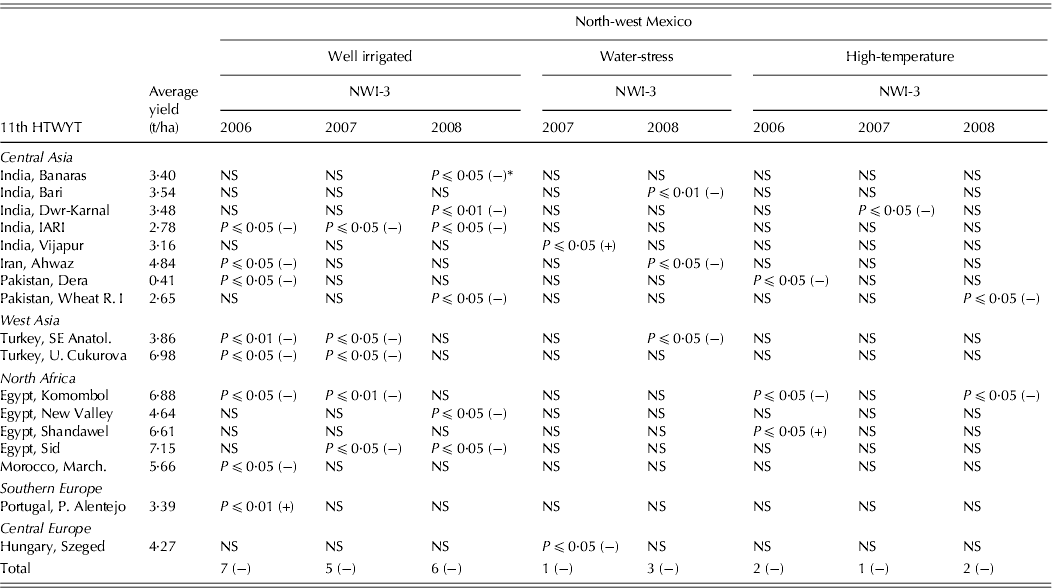
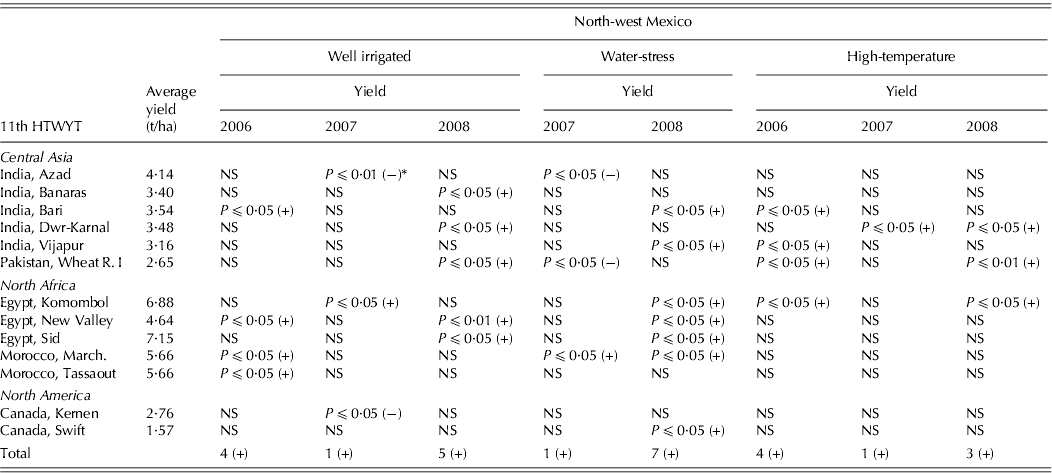
NWI-3 and CT for the 11th HTWYT were measured in north-west Mexico in three environments (irrigated, water-stressed and high-temperature) (Tables 12–14). The NWI-3 obtained from the well-irrigated environment showed negative associations (P⩽0·05 and 0·01) during 2 and 3 years for locations with low grain yield in India (2·8 t/ha) and Turkey (3·9 t/ha) and high grain yield in Turkey (7·0 t/ha) and Egypt (6·9 and 7·2 t/ha) (Table 12). CT only displayed significant negative associations (P⩽0·05) during 1 year for several international locations (Table 13). For the north-west Mexico parameters determined under water-stress (2007 and 2008 seasons), neither NWI-3 nor CT showed any significant associations (Tables 12 and 13). Finally, NWI-3 and CT determined in the high-temperature environment displayed significant negative association (P⩽0·05 and 0·01) with one location with high grain yield in Egypt (6·9 t/ha) and with one low grain yield in Pakistan (2·7 t/ha) during 2 years. Grain yield from north-west Mexico measured in the three environments displayed significant correlations (positively associated at P⩽0·05 and 0·01) during 2 years in several international locations and only two corresponded to the same locations associated with NWI-3 and CT (Table 14).
Correlation coefficients between NWI-3 measured under well irrigated, water-stressed and high-temperature conditions in north-west Mexico and grain yield from international locations for advanced lines of the 11th HTWYT

* Sign in parentheses indicates negative or positive significant correlations.
NS: no significant correlation.
Correlation coefficients between CT measured under well irrigated, water-stressed and high-temperature conditions in north-west Mexico and grain yield from international locations for advanced lines of the 11th HTWYT

* Sign in parentheses indicates negative or positive significant correlations.
NS: no significant correlation.
Correlation coefficients between grain yield measured under well irrigated, water-stressed and high-temperature conditions in north-west Mexico and grain yield from international locations for advanced lines of the 11th HTWYT

* Sign in parentheses indicates negative or positive significant correlations.
NS: no significant correlation.
DISCUSSION
Annual rainfall of international locations
Apparently, local weather conditions such as low annual rainfall in several international locations were the primary reason for evaluating more than one CIMMYT yield trial. The cooperators probably assumed that this would improve the chance of finding lines well adapted to the local conditions, although most of the international testing sites employed some irrigation during the cropping season (Tables 1 and 2). Out of 80 testing sites in Asia, Africa, Europe and America, 60 had less than 800 mm of annual rainfall, indicating that many sites were irrigated dry sites (Table 1).
Association between north-west Mexico parameters and grain yield of international sites
In a previous study conducted during three growing seasons (2006, 2007 and 2008) in north-west Mexico (Gutierrez et al. Reference Gutierrez, Reynolds, Raun, Stone and Klatt2010a), NWI-3 and CT determined in three environments showed significant negative associations with grain yield of the advanced lines from the 24th ESWYT (well irrigated), the 11th SAWYT (well irrigated and water-stress) and the 11th HTWYT (well irrigated, water-stress and high-temperature). Better associations with grain yield were obtained when heading and grain filling determinations were combined for NWI-3 and when CT determinations were taken at grain filling. Both remote sensing parameters demonstrated high genetic gain and heritability across years, which indicated their high potential as indirect selection approaches to detect, identify and select high-yielding lines in the three environments. In the current study, NWI-3 and CT measured from north-west Mexico (reported by Gutierrez et al. Reference Gutierrez, Reynolds, Raun, Stone and Klatt2010a) showed significant negative associations (P⩽0·05 and 0·01) with grain yield at international locations, indicating that WIs and CT can predict the yield performance of advanced yielding lines in some international sites (Tables 6–14). The negative associations of NWI-3 and CT with grain yield at international locations signifies that the same low- and high-yielding lines across international locations performed in a similar fashion as in north-west Mexico (Yaqui Valley), which is widely employed to develop advanced wheat lines for well irrigated, water-stressed and hot environments (Lillemo et al. Reference Lillemo, Van Ginkel, Trethowan, Hernandez and Crossa2005). The significant negative associations occurred for 1, 2 or 3 years, respectively, but the better potential for predicting yield at international sites was when the significant associations occurred for 2 or 3 years (Tables 6–14). The variations of NWI-3 and CT from one year to another caused the lack of association for the same testing sites. The negative association of grain yield at international locations with NWI-3 and CT was sometimes supported with positive associations with the grain yield from north-west Mexico in the three yield trials.
The 24th ESWYT represented advanced lines selected for high-yield potential in irrigated environments (Trethowan et al. Reference Trethowan, Van Ginkel, Ammar, Crossa, Payne, Cukadar, Rajaram and Hernandez2003). In the present study, grain yield of seven testing locations (i.e. 0·12 of the total number of sites) in central and west Asia, north and south Africa and southern Europe showed significant negative associations for 2 or 3 years with NWI-3 and CT (Tables 6 and 7). The advanced lines in the 11th SAWYT, which were selected by CIMMYT breeders for high yield in semi-arid regions (Trethowan et al. Reference Trethowan, Crossa, Van Ginkel and Rajaram2001), were evaluated under both well-irrigated and water-stressed conditions in north-west Mexico (Gutierrez et al. Reference Gutierrez, Reynolds, Raun, Stone and Klatt2010a). NWI-3 and CT determined under both environments during 2 or 3 years gave only four negative significant associations (0·14 of sites) with testing sites in central Asia and northern Africa (Tables 9 and 10). The advanced lines of the 11th HTWYT were selected for high yield in heat-stressed environments (Lillemo et al. Reference Lillemo, Van Ginkel, Trethowan, Hernandez and Crossa2005) and were evaluated under well irrigated, water-stressed and high-temperature conditions in north-west Mexico. The highest significant associations for NWI-3 and CT with grain yield from north-west Mexico were found in the high-temperature environment (Gutierrez et al. Reference Gutierrez, Reynolds, Raun, Stone and Klatt2010a). In the present study, the highest number of negative associations of NWI-3 with grain yield at international testing sites was found for the determinations conducted from the well-irrigated environment. Six locations (0·23 of sites) with low and high yield in central and west, and north Africa gave significant correlations with NWI-3 (Table 12). In all yield trials, CT showed a lower association than NWI-3 with grain yield at the international locations.
North-west Mexico (Yaqui Valley) has been widely employed as a site for evaluating and selecting advanced lines for high yield for well irrigated, water-stressed and high-temperature environments (Lillemo et al. Reference Lillemo, Van Ginkel, Trethowan, Hernandez and Crossa2005). Lage et al. (Reference Lage, Trethowan and Hernandez2008) grouped individual sites into clusters using a shifted multiplicative model based on environmental data and grain yield (35 years average) and found that 18 sites were similar and 23 sites were contrasting when ESWYT, SAWYT and HTWYT data were analysed together. Lage et al. (Reference Lage, Trethowan and Hernandez2008) found that Yaqui Valley site was similar to six nursery sites in western and central Asia (southwest Turkey, north-east and north-west Pakistan and Syria). Trethowan et al. (Reference Trethowan, Van Ginkel, Ammar, Crossa, Payne, Cukadar, Rajaram and Hernandez2003) found that some nurseries from Egypt and Pakistan were also associated with yields from north-west Mexico for the ESWYT trial. Similarly, Trethowan & Crossa (Reference Trethowan and Crossa2007) reported that other nurseries located in north Africa, western Asia and South America (Argentina) were also similar to north-west Mexico when advanced lines of ESWYT, SAWYT and HTWYT were evaluated. In the present study, grain yield from some dry and irrigated locations, mainly in central Asia (India and Pakistan), west Asia (Saudi Arabia and Turkey) and north Africa (Egypt and Morocco), showed stronger associations with the three parameters measured in north-west Mexico (Tables 6–14).
Power of the north-west Mexico parameters for indirect selection of high yielding lines
Plant breeders have repeatedly considered the potential of developing new selection indices that integrate several traits with high repeatability (genetically linked) for predicting yield in breeding programmes at relatively low cost (Baker Reference Baker1986; Milligan et al. Reference Milligan, Balzarini and White2003). Previous studies (Babar et al. Reference Babar, Reynolds, Van Ginkel, Klatt, Raun and Stone2006; Gutierrez et al. Reference Gutierrez, Reynolds, Raun, Stone and Klatt2010a) indicated that NWI-3 and CT offered great potential for the indirect selection of high yielding lines under optimal and adverse growth conditions (well irrigated, water-stressed and high-temperature) and also demonstrated high genetic gain and heritability for the same selection site (Yaqui Valley, north-west Mexico). It has been demonstrated using advanced wheat lines that NWI-3 and CT are related to the canopy water content (lower leaf water potentials), cooler CTs (high transpiration rates) and enhanced root capacity for tapping water in deeper soil layers under water-stressed conditions (Gutierrez et al. Reference Gutierrez, Reynolds and Klatt2010b). The hypothesis for the present study was that by using the two remote sensing parameters determined in north-west Mexico, yield performance of advanced lines could be predicted at international testing sites. However, NWI-3 and CT measurements taken in north-west Mexico were associated with grain yield at only a few testing sites for the 24th ESWYT (0·12), the 11th SAWYT (0·14) and the 11th HTWYT (0·23) (Tables 6–14). The majority of international locations did not show strong associations with the north-west Mexico parameters, indicating that probably other factors (i.e. drought) were involved in the yield performance of the advanced lines, thereby reducing the association with NWI-3 and CT. Many international locations had low grain yield (average grain yield was 4·9 t/ha for the 24th ESWYT, 3·5 t/ha for the 11th SAWYT and 4·1 t/ha for the 11th HTWYT), indicating that rainfall and irrigations were probably limited and drought may have occurred during the cropping season in many international locations. Trethowan et al. (Reference Trethowan, Crossa, Van Ginkel and Rajaram2001) established that drought was a common event in many testing sites and sometimes reduced/eliminated yield performance of advanced lines, especially in semi-arid sites.
The parameters (NWI-3 and CT) measured in north-west Mexico measured in three environments gave the opportunity to explore a wider range of international locations associated with NWI-3 and CT, but the number of associated testing sites were low (Tables 6–14). The lack of association could also indicate that few advanced lines were well adapted to local growth conditions in each location. Mohammadi et al. (Reference Mohammadi, Amri, Haghparast, Sadeghzadeh, Armion and Ahmadi2009) reported that 20 genotypes evaluated in 19 testing sites were differently adapted to warmer and cooler environments of Central Asia (Iran). Dwarf and early maturating genotypes with low to medium yields were better adapted to warmer environments, which were clearly distinctive of genotypes adapted to cooler environments. Data on the weather (ambient temperature and precipitation) and amount of irrigation during the cropping season for each location required to make major inferences in respect to the yield performance of lines across testing sites were lacking in the present study.
NWI-3 and CT presented several limitations for the yield prediction of international locations because few of them showed significant associations (Tables 6–14). The grain yield for one year (2003) for all international testing sites was considered in relation to NWI-3, CT and yield measurements in north-west Mexico, while other studies have analysed the genetic improvement across years for the SAWYT, ESWYT and HTWYT genotypes (i.e. 35 years analysis reported by Lage et al. Reference Lage, Trethowan and Hernandez2008). The multiple year analysis made it easier to establish and identify the parameters that were influencing yield. Sener et al. (Reference Sener, Arslan, Soysal and Erayman2009) found that the genetic improvement in yield among wheat cultivars delivered in the Mediterranean region (representing 23 years) were caused by changes in some physiological traits, such as higher harvest index, grain weight and grain number per spike.
Breeders are continuously looking for new indirect selection parameters for screening among genotypes to detect yield differences and to find strong associations with yield, such as stomatal conductance among wheat genotypes under rainfed conditions (Condon et al. Reference Condon, Richards, Rebetzke and Farquhar2004), chlorophyll fluorescence among triticale winter genotypes (Hura et al. Reference Hura, Hura and Grzesiak2009), water potential to screen plant water status (drought resistance) among wheat genotypes under water-stressed conditions (Munjal & Dhanda Reference Munjal and Dhanda2005), and wheat stem water-soluble carbohydrates determined at anthesis in a water-limited environment (Xue et al. Reference Xue, McIntyre, Rattey, Van Herwaarden and Shorter2009). However, for breeding purposes, these approaches are expensive and time-consuming methods for yield screening, especially if thousands of genotypes have to be evaluated in several locations and environments. Even though we identified only a limited association of NWI-3 and CT with grain yield from international locations, both parameters continue to offer great advantages (inexpensive and non-time consuming) for yield evaluation in north-west Mexico (Babar et al. Reference Babar, Reynolds, Van Ginkel, Klatt, Raun and Stone2006; Gutierrez et al. Reference Gutierrez, Reynolds, Raun, Stone and Klatt2010a) and to predict yield performance in a few testing sites in central and west Asia, and north Africa.
The conclusion from the present work is that NWI-3 and CT measurements from north-west Mexico were only marginally effective in identifying advanced lines with broad adaptation across many international testing sites for the three international yield trials. The NWI-3 and CT from north-west Mexico measured in three environments (well irrigated, water-stressed and high-temperature) showed few consistent significant associations with the grain yield of nurseries located in diverse worldwide regions where the three yield trials were evaluated. Apparently, the lack of association could be due to other weather factors (drought) that affected the yield performance, and/or that few advanced lines were well adapted to local growing conditions at each testing site. Even though these two indirect selection parameters were basically ineffective in predicting yield performance at international sites, they have demonstrated their ability to serve as an indirect selection tool for high yield in spring and winter wheat at a single location.
We acknowledged to Oklahoma State University, The International Maize and Wheat Improvement Center (CIMMYT), and National Council of Science and Technology of Mexico (CONACYT) for all facilities provided for the present study.