


Introduction
Data are the lifeblood of modern clinical practice, translational science, and Learning Health Systems (LHS). A LHS continuously collects data from routine care, analyzes it and returns usable insights to the point of care. A companion Learning Research System (LRS) extends this process into discovery, allowing hypotheses, evaluation, and improvement to occur iteratively within clinical workflows rather than apart from them [Reference Rizzo1]. Together, these systems transform care from episodic interpretation to continuous, data-supported reasoning and actionable knowledge.
Digital twins (DTs) are continuously updating, patient-specific computational models that integrate multimodal data to simulate health trajectories and therapeutic responses [Reference Voigt, Inojosa, Dillenseger, Haase, Akgun and Ziemssen2–Reference Vidovszky, Fisher and Loukianov4] effectively operationalizing the principles of AI, the LHS and the LRS. DTs also support in silico trials, which simulate clinical experiments to identify biomarkers, test therapies, and stratify patients for precision care, accelerating discovery while reducing patient burden [Reference Maleki, Crispino and Italia5,Reference Sips, Pappalardo, Russo and Bursi6]. At the University of Nebraska Medical Center (UNMC), we are developing DT frameworks as part of precision health initiatives embedded within the LHS and LRS, with multiple sclerosis (MS) serving as a primary use case. The Department of Neurological Sciences leads this work in collaboration with the NIH National Institute of General Medical Sciences (NIGMS) Great Plains Institutional Development Award–Clinical and Translational Research Network (GP-IDeA-CTR-N) (U54GM115458).
Although DTs are increasingly discussed as tools for disease simulation and predictive modeling, translation into routine clinical care requires approaches that address uncertainty, governance, workflow integration, and shared clinical reasoning within real-world health systems. In contrast to prior DT literature, which outlines modeling techniques or disease-specific simulations, this manuscript contributes to the growing work on conceptual implementation frameworks for DTs [Reference Rahimi, Baradaran, Khameneifar, Gore and Issa7], tailoring our framework to an MS DT embedded within the LHS and LRS, developed as part of the NEurOinformatics Network (NEON) at UNMC. The framework is intended as a conceptual guide for implementation, emphasizing informatics architecture, clinical reasoning, governance, and operational workflow. We describe the current status of this multiphase DT initiative, identify barriers encountered during early implementation, and discuss practical strategies to address them.
Clinical motivation: heterogeneity, uncertainty, and escalation decisions in MS
MS is a complex, chronic autoimmune disease of the central nervous system characterized by heterogeneous inflammatory and neurodegenerative processes [Reference Montalban, Lebrun-Frenay and Oh8]. This heterogeneity complicates prognosis and individualized treatment, as conventional measures often fail to capture subtle yet clinically meaningful changes in function. Patients may experience early deviations from their own baseline, such as increased fatigue, slowed cognitive processing or greater gait variability, well before population-based criteria confirm progression.
These early signals frequently arise at moments when therapeutic decisions carry substantial consequences. Clinicians must balance the risk of overtreatment with high-efficacy immunotherapies that carry infectious, immunologic or oncologic risks against the risk of undertreatment that may permit irreversible neurological decline. Because population-based criteria may not capture early within-person change, DTs can complement standard clinical evidence by integrating multimodal longitudinal data, detecting patient-specific variability, and representing probable future disease states during high-stakes treatment decisions.
This decision context, characterized by subtle longitudinal within-person shifts rather than discrete events, motivated the development of a DT framework for MS within NEON. MS thus serves as both a compelling clinical use case and a generalizable implementation test bed for DT development in other complex neurological disorders. Because these decisions carry clinical risk, DT-based decision support must be embedded within clear governance structures that specify how uncertainty is represented, responsibility is assigned, and clinical accountability is maintained, as addressed in later sections.
NEON initiative: program development and objectives
An institutional IT and bioinformatics needs assessment conducted in early 2021 through the GP-IDeA-CTR-N identified gaps in research-grade IT capacity, interoperability, data accessibility, and workforce expertise, alongside increasing demand for scalable analytics and longitudinal real-world data infrastructure. These findings clarified the infrastructure, workforce, and regulatory prerequisites for an LHS capable of supporting DT methodologies.
Building on this assessment, we designed the NEON initiative at UNMC as a translational bridge linking data science, clinical care, and human-centered design within the LHS and LRS. The initiative began with a horizon scan to identify priority clinical needs and emerging DT approaches, followed by an assessment of existing LHS infrastructure and capabilities. These steps informed a preliminary staged development plan that emphasizes secure data integration, accountable analytics, and alignment with clinical workflows, which are described in subsequent sections.
Conceptual framework development
Horizon scan and literature review
The horizon scan, consisting of discussions with domain experts and workflow shadowing, identified four core clinical needs relevant to MS care: longitudinal monitoring, early detection of deviation from baseline, prognostic modeling, and tools to support precision medicine. The scan confirmed that DT approaches offer potential clinical utility by integrating multimodal data streams to enable individualized forecasting and decision support. Together, these findings translated clinical needs and emerging DT methods into explicit requirements for informatics architecture and operational integration, which are addressed in the sections that follow.
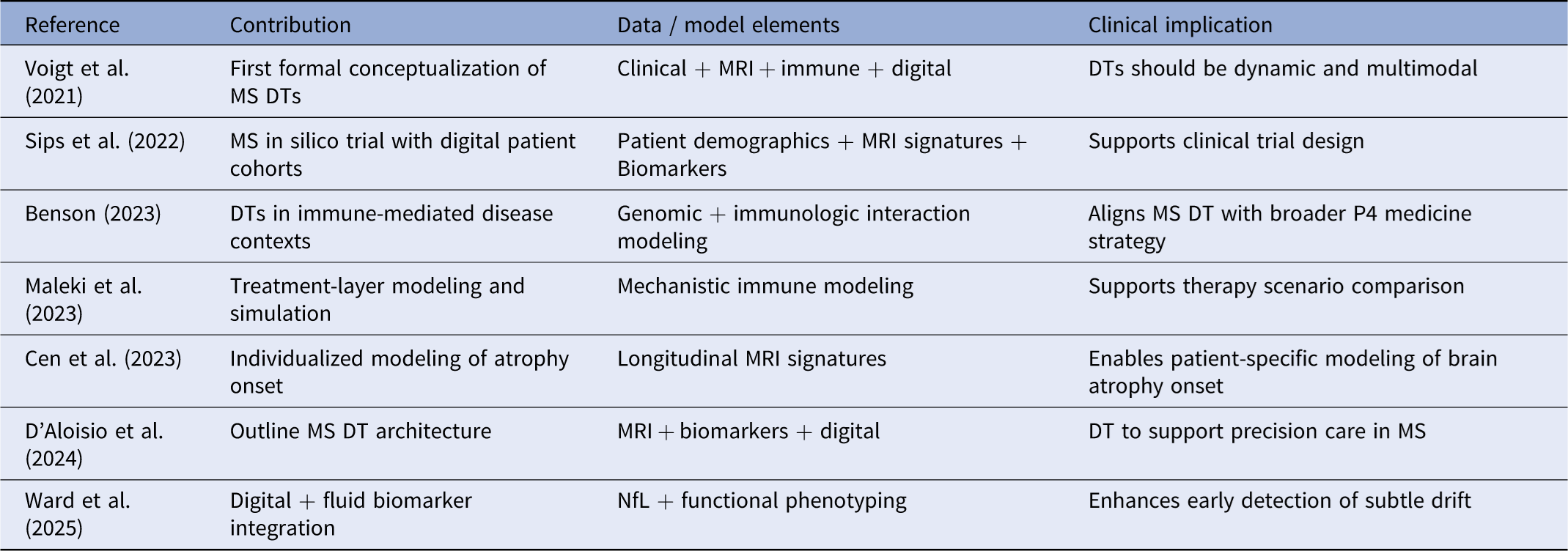
Emerging DT methodologies include patient-specific, digital models for disease onset detection, disease progression and treatment simulation [Reference Maleki, Crispino and Italia5,Reference Sips, Pappalardo, Russo and Bursi6,Reference Cen, Gebregziabher, Moazami, Azevedo and Pelletier9–Reference Benson12]. Literature specific to DTs in MS, including translational relevance and clinical implications, is summarized in Table 1. Across these approaches, effective DT development requires access to harmonized multimodal data sources, including electronic health records, neuroimaging, internet-of-things (IoT) derived measures and biological biomarkers. This requirement clarified the need for a registry capable of ingesting, linking and sustaining diverse longitudinal data streams.
Key recent literature on MS digital twins and biomarker integration: summary of findings and translational relevance

Table 1. Long description
A table with four columns and seven rows. The columns are labeled Reference, Contribution, Data / model elements, and Clinical implication. The rows are as follows: Row 1: Reference, Voigt et al. (2021); Contribution, First formal conceptualization of MS DTs; Data / model elements, Clinical + MRI + immune + digital; Clinical implication, DTs should be dynamic and multimodal. Row 2: Reference, Sips et al. (2022); Contribution, MS in silico trial with digital patient cohorts; Data / model elements, Patient demographics + MRI signatures + Biomarkers; Clinical implication, Supports clinical trial design. Row 3: Reference, Benson (2023); Contribution, DTs in immune-mediated disease contexts; Data / model elements, Genomic + immunologic interaction modeling; Clinical implication, Aligns MS DT with broader P4 medicine strategy. Row 4: Reference, Maleki et al. (2023); Contribution, Treatment-layer modeling and simulation; Data / model elements, Mechanistic immune modeling; Clinical implication, Supports therapy scenario comparison. Row 5: Reference, Cen et al. (2023); Contribution, Individualized modeling of atrophy onset; Data / model elements, Longitudinal MRI signatures; Clinical implication, Enables patient-specific disease onset. Row 6: Reference, D’Aloisio et al. (2024); Contribution, Outline MS DT architecture; Data / model elements, MRI + biomarkers + digital; Clinical implication, DT to support precision care in MS. Row 7: Reference, Ward et al. (2025); Contribution, Digital + fluid biomarker integration; Data / model elements, NFL + functional phenotyping; Clinical implication, Enhances early detection of subtle drift.
NfL = neurofilament light chain.
This assessment demonstrated strong alignment with next-generation registry principles [Reference Labkoff, Quintana and Rozenblit13] emphasizing multi-modality, longitudinal continuity, and support for diverse analytic use cases. These principles are consistent with national initiatives such as All of Us, the National Clinical Cohort Collaborative (N3C) [Reference Labkoff, Quintana and Rozenblit13], and the Data COUNTSTM real world data network [Reference Kleinstreuer14]. The horizon scan thus clarified the operational need for an informatics architecture built on next-generation registry principles to enable DTs and underscored its relevance to institutional and national LHS and LRS efforts in precision medicine.
Building on this foundation, we review existing LHS capabilities that form the foundation for embedding DTs into clinical workflows. The Nebraska Medicine LHS strengthens the real-time operational data environment needed for DTs by integrating tools such as Palantir Hospital 360, Epic’s bed priority scoring, and CarePort to capture patient flow, capacity, and transitions across acute and post-acute settings. These platforms generate the longitudinal, time-stamped data that support system-level DT applications of health systems, including modeling alternative care pathways, incorporating operational constraints, and forecasting outcomes. This approach aligns directly with NIH Data COUNTsTM principles, which rely on scalable architectures built with Palantir Foundry tools, the same platform used by NIH in the N3C secure enclave to align and analyze large-scale EHR data, and reflects the broader role of AI-enabled operational data environments in supporting clinical simulation and DT development [Reference Rizzo1].
Digital twin operational model
An MS DT functions as a patient-specific, continuously updating computational model that utilizes multiple data types (Figure 1). Electronic health record data encompass structured diagnosis codes, medication and relapse histories, Expanded Disability Status Scale (EDSS) scores, timed walk tests, neuropsychological assessments, clinician notes, and patient-reported outcomes (PRO). The PROs capture fatigue severity, perceived cognitive efficiency, motor effort, and daily recovery time. These measures often reveal early signs of reduced functional reserve, when patients report that tasks are still achievable but require greater effort. Real-world measures collected through IoT sensors extend this view into daily life, tracking activity levels and sleep.
Multimodal digital twin pipeline integrating electronic health records, MRI, biomarkers, and wearable sensor data. Processing algorithms extract clinically meaningful features from each modality to inform a patient-specific digital twin. Created in https://BioRender.com.

In MS, functional decline often unfolds over time, although in relapsing–remitting MS (RRMS) it may occur in association with discrete clinical relapses. While gradual and subtle changes can occur in RRMS, including relapse-independent mechanisms, relapses remain an important driver of functional deterioration in this phenotype, making differentiation between true relapses and pseudo-relapses clinically relevant. In contrast, in secondary progressive MS and primary progressive MS, functional decline is typically gradual and insidious, often occurring independently of overt relapses and remaining difficult to capture through episodic clinical assessment alone. Accordingly, longitudinal digital technologies that track real-world functional data and individual trajectories are particularly well suited to progressive forms of MS, while also providing within-person context that may support relapse adjudication, detection of progression independent of relapse activity (PIRA), and treatment decision-making in selected clinical settings.
Escalation decisions arise when clinicians and patients consider intensifying or modifying disease-modifying therapy in response to disease activity or functional change. We use the term escalation decisions to denote high-stakes therapeutic inflection points at diagnosis or during follow-up, when treatment intensity or mechanism is reconsidered in pursuit of no evidence of disease activity. These decisions often occur under conditions of uncertainty and require balancing the risks of undertreatment against overtreatment. Because escalation decisions directly influence long-term disability and quality of life, they are a primary focus for DT-supported shared clinical reasoning. In this context, the DT translates complex longitudinal data into interpretable narratives aligned with patient experience.
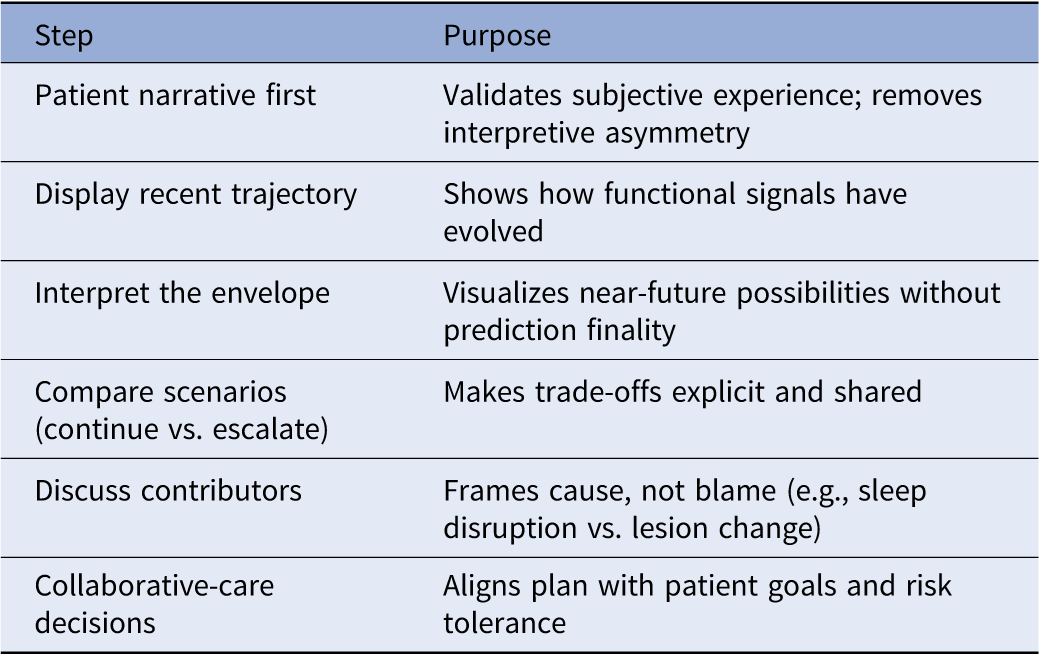
The DT clinical workflow, summarized in Table 2, describes how DTs are incorporated into patient visits. Clinicians first elicit the patient’s experience before reviewing model output, allowing unanchored clinical reasoning and attention to emotional tone. The DT then presents functional trajectories as bounded envelopes representing plausible future states. The clinician and patient review scenarios such as continuing, escalating, or pausing therapy, and explore contributors to change using explainable AI (XAI) methods. The visit concludes with a shared decision on monitoring or escalation, grounded in patient priorities. This operational model informed NEON’s implementation roadmap and illustrates a reproducible pathway for DT adoption within CTSA and IDeA environments.
DT clinical workflow: process for integrating DT into patient visits to support clinical decisions and collaborative treatment planning

Table 2. Long description
A table with two columns and six rows. The first column is labeled ‘Step’ and the second column is labeled ‘Purpose’. Row 1: Patient narrative first, Validates subjective experience; removes interpretive asymmetry. Row 2: Display recent trajectory, Shows how functional signals have evolved. Row 3: Interpret the envelope, Visualizes near-future possibilities without prediction finality. Row 4: Compare scenarios (continue vs. escalate), Makes trade-offs explicit and shared. Row 5: Discuss contributors, Frames cause, not blame (e.g., sleep disruption vs. lesion change). Row 6: Collaborative-care decisions, Aligns plan with patient goals and risk tolerance.
Implementation roadmap
DTs link individual-level patient data to real-time learning and clinical decision support. They update continuously as new data are acquired, enabling an adaptive approach to precision medicine [Reference Katsoulakis, Wang and Wu15,Reference Papachristou, Katsakiori, Papadimitroulas, Strigari and Kagadis16]. This capability depends on a coordinated extract, transform, and load (ETL) process that harmonizes electronic health records, imaging, PROs, and wearable sensor data into standard data models, including HL7 FHIR, the OMOP Common Data Model and BIDS. Within this framework, institution specific ETL pipelines map data to a standard format while harmonizing across various data sources and temporal scales. Emerging efforts such as the Unified Study Definitions Model within the Digital Data Flow initiative extend this standards-based approach upstream by encoding clinical information as machine-readable objects, enabling automated ETL pipelines that support DT development. Together, these processes establish secure data linkages between hospital and university environments and ensure alignment with clinical, informatics, and regulatory standards.
Beyond harmonization, the pipelines incorporate specialized algorithms that generate the DT’s core inputs. MRI segmentation algorithms extract lesion counts [Reference Hu, Ren and Chen17]; wearable data streams are processed using validated algorithms [Reference Choi, Liu, Matthews and Buchowski18,Reference Cole, Kripke, Gruen, Mullaney and Gillin19] while automated functions perform quality control, detect missingness, and align data temporally across modalities. These steps transform raw data into clinically meaningful features and support shared infrastructure, linking healthcare operations with translational research capabilities within NEON.
The DT learns patterns from heterogeneous retrospective patient datasets and synthetic data during development and is individualized and continuously updated with longitudinal patient-specific data [Reference Alam, Basilico and Bertolini10,Reference Bertolini, Loukianov and Smith11]. It generates a distribution of plausible future states, summarized as clinically interpretable outcomes, such as predicated risk or median trajectory, with appropriate uncertainty measures, such as prediction or credible intervals [Reference Alam, Basilico and Bertolini10]. Forecasts are benchmarked against observed longitudinal outcomes, established prediction methods, and clinician assessments using independent data. Benchmarking evaluates discrimination, calibration, uncertainty, subgroup performance, and clinical utility at prespecified time points and determines whether the DT adds value beyond standard clinical judgement. Clinicians can visualize projected trajectories and uncertainty and use XAI methods, including Shapley Additive Explanations (SHAP) [Reference D’Aloisio, Di Matteo and Cipriani3,Reference Alam, Basilico and Bertolini10,Reference Vimbi, Shaffi and Mahmud20], to examine feature contributions. For example, SHAP could show that increased NfL, new MRI lesion burden, worsening gait speed, and prior relapses contributed to higher predicted risk of MS progression, while treatment adherence contributed to a lower predicted risk. These contributions explain the model’s prediction but do not establish causality. They can also explore scenarios involving continued, escalated, or paused therapy and non-pharmacological interventions such as rehabilitation or behavioral strategies. These projections support discussions of trajectories, uncertainty, and modifiable risk factors but should not be interpreted as causal treatment effects unless the model has been designated and validated for that purpose. Embedded prompts allow clinicians to agree or disagree with projections, supporting ongoing model monitoring and maintenance.
Rigorous evaluation and validation are conducted in alignment with the V3 framework for verification, analytical validation, and clinical validation [Reference Goldsack, Coravos and Bakker21], as well as Good Machine Learning Practice principles [22]. Performance is assessed using multiple metrics, with XAI techniques supporting transparency, bias detection, and interpretability. Counterfactual simulations test clinically plausible scenarios, while validation against retrospective patient data and in silico trial simulations evaluates predictive accuracy and reliability. Additional validation compares DT outputs with clinician judgment to ensure end-user relevance [Reference Tulk Jesso, Kelliher, Sanghavi, Martin and Henrickson Parker23]. Prospective clinical trials assess DT utility in diverse populations over time, with attention to model drift, bias, and real-world usability. Once deployed, DT outputs can be aggregated for population health applications, post-market surveillance, and iterative updates to maintain trustworthiness.
Ethical considerations are addressed throughout the development process [Reference Papachristou, Katsakiori, Papadimitroulas, Strigari and Kagadis16,Reference Stroud, Anzabi and Wise24]. Clinician and patient concerns include AI literacy, workflow integration, trust, liability, privacy, data security, bias, inaccurate outputs, and reduced autonomy. Sensitive longitudinal data require secure storage, access controls, retention policies, and clear governance of ownership, secondary use, and recourse. Federated networks reduce the need to centralize patient-level data but do not eliminate the risks from unauthorized access, data leakage, inconsistent institutional safeguards, model inversion, or shared model updates. End-user discussions emphasize that DTs support rather than automate clinical decisions. Human factors analyses examine whether DT interfaces support clinical reasoning, while patient interviews assess how individuals interpret digital representations of their health. These findings guide design principles focused on safety, transparency, privacy, and clinical utility. Legal, privacy, cybersecurity, and governance experts help clarify responsibility for data and potential harms. Informed consent specifies where data are stored, who may access them, how they may be used, and what may be shared through a federated network. Because capacity to consent may change in MS, safeguards are needed to reassess capacity and stop data collection when valid consent can no longer be proved.
This multi-phase process, summarized in Figure 2, integrates data infrastructure, workflow alignment, validation, human factors, and patient engagement to support DT deployment as a scientific and sociotechnical innovation within the LHS.
Five-phase implementation roadmap for a multiple sclerosis digital twin, progressing from clinical use-case definition through data harmonization, model development, workflow integration, and initial clinical deployment. Each phase identifies milestones, expected outputs, and contributing teams. Created in https://BioRender.com.

Leveraging large data sources for DT development
DT development for MS requires large, disease-specific longitudinal datasets [Reference Voigt, Inojosa, Dillenseger, Haase, Akgun and Ziemssen2] that capture real-world heterogeneity in disease progression, imaging, and treatment response. Training DTs on these datasets enables precision modeling by providing the volume and longitudinal depth required to learn complex, subtle patterns of disease evolution. Incorporating population-level variability improves model generalizability, reduces bias, and supports uncertainty-aware forecasting. In practice, these datasets serve complementary roles in DT development, supporting model training, calibration, and external validation, while informing clinically plausible ranges of disease trajectories. Use of large external registries also introduces regulation and validation considerations, including data provenance, consent alignment, and reproducibility across sites. Within NEON, these resources inform DT development through governed analytic workflows that preserve institutional control while enabling alignment with national and international learning efforts.
The role of synthetic data for scalable and representative DT development
Large MS datasets provide the empirical distributions needed to train and validate DTs, but they often contain missingness, underrepresentation of rare phenotypes, or access constraints related to privacy and governance. Synthetic data, defined as algorithmically generated data that preserve the statistical and structural properties of real-world populations, extend these distributions by filling gaps where real data are sparse or inaccessible.
Using existing methods, including probabilistic models, variational autoencoders, generative adversarial networks, and diffusion models, researchers generate realistic clinical trajectories, multimodal biomarker patterns, synthetic imaging, wearable time series, and structured EHR-like records [Reference Pezoulas, Zaridis and Mylona25,Reference Miletic and Sariyar26]. When used alongside real data, synthetic datasets enable DTs to represent rare phenotypes, explore counterfactual scenarios, and conduct in silico experiments that simulate treatment response, relapse risk, and biomarker evolution. This capability supports hypothesis generation and hybrid mechanistic and data-driven DT frameworks within the LHS and LRS.
Synthetic data are not a substitute for real-world validation. Within NEON, their use is in model development governed by explicit validation requirements, including comparison to source registry distributions and assessment of biological and clinical plausibility. These safeguards align with emerging FDA discussions on model transparency and patient safety, ensuring that DT outputs deployed in clinical settings remain grounded in real patient data.
Implementation challenges and mitigation strategies
Developing the implementation roadmap of the MS DT revealed several key barriers and corresponding mitigation strategies that shaped both the registry and the DT model, supported by the underlying LHS and LRS features.
The lack of standardized guidelines for the implementation of DTs in healthcare represents a significant gap. In alignment with FDA priorities for AI regulation [22,Reference Warraich, Tazbaz and Califf27], the development of conceptual protocols at the translational science level that articulate principles for safety, transparency, interoperability, and equity is essential. Such guidelines should provide actionable guidance for governance, validation, and ethical integration, ensuring that innovation advances without compromising patient trust or regulatory compliance. The schema presented here offers a structured point of entry by organizing implementation into five phases, as outlined and summarized in Figure 2.
Managing data heterogeneity and variability in healthcare data remains a notorious technical challenge. It is addressed through intensive ETL processes that map data to standard models. This process not only puts data into a usable format but also reconciles the incompatibility between tools and software. These ETL pipelines are often institution specific, proprietary, and high security. Establishing nondisclosure and consulting agreements between institutions with established ETL pipelines fosters team science and expedites innovation.
Utilizing a DT within an LHS and/or LRS to its full potential requires continuous, real-time data inputs. These inputs are often obtained through IoT sensors from wearables and phones, but many digital biomarkers derived from these devices have not yet been validated for clinical use. The integration of DTs should therefore be accompanied by robust translational science efforts aimed at validating emerging digital biomarkers [Reference Ward, Reddel, Leocani and Barnett28].
Achieving the necessary resources, organization, and skilled workforce to advance this capability also requires building, coordinating, and sustaining technical expertise, secure data infrastructure, and advanced computational platforms across IDeA states. This aligns directly with the NIGMS vision for the IDeA-CTR networks and advances our regional NEON strategy by expanding shared analytic capacity, FAIR data pipelines, and scalable digital research tools. This barrier highlights the related need for new teaching and training programs in AI and machine learning so that clinicians, scientists, and data professionals in IDeA states can design, validate, and interpret DTs, a goal addressed through our design of a structured curriculum in AI in Clinical and Translational Medicine.
Discussion
At present, NEON’s efforts leverage existing data assets and governance structures to establish a next-generation registry architecture that supports multimodal data harmonization and provides the foundation for DT development. In parallel, we are finalizing documentation and procedures required for long-term regulatory compliance. To support DT literacy and responsible use, a course has been developed to equip clinicians, researchers, and informaticians with core AI competencies. Partnerships with external translational researchers working on DTs have led to regular collaborative meetings that accelerate methodological development. Model engineering, longitudinal validation, in-clinic deployment, and multi-site generalization are advancing through staged phases consistent with best practices outlined earlier. Future work will extend these foundations toward federated, multi-institutional deployment and formal evaluation within clinical trials.
The translational impact of DT technology depends on meaningful clinical communication that extends beyond statistical accuracy [Reference Rizzo1]. Standards-based deployment supports downstream scalability and generalization across diverse clinical and institutional contexts [Reference Rizzo1]. Explainability is essential for trust, enabling clinicians and patients to understand the rationale underlying model outputs [Reference Alam, Basilico and Bertolini10,Reference Vimbi, Shaffi and Mahmud20]. Equity auditing is required to identify and mitigate disparities in model performance and deployment [22]. Federated architectures enable privacy-preserving multi-center learning, allowing knowledge to accumulate across sites without compromising data security [Reference Darzidehkalani, Ghasemi-Rad and van Ooijen29]. Co-designed solutions that align with clinical workflows and incorporate patient perspectives promote adoption, usability, and ethical integration into care [Reference Tulk Jesso, Kelliher, Sanghavi, Martin and Henrickson Parker23]. When embedded within an LHS and LRS, these principles position DTs as a practical mechanism for translating integrated, multimodal data into actionable, shared understanding for the management of MS [Reference Voigt, Inojosa, Dillenseger, Haase, Akgun and Ziemssen2,Reference D’Aloisio, Di Matteo and Cipriani3].
Beyond supporting clinical decision-making, DTs enable bidirectional integration of care and research by enabling matching of patients to research opportunities based on biological signatures, clinical features, or projected trajectories aligned with trial eligibility criteria. This capability supports adaptive and precision trials [Reference Benson12], including emerging studies of adoptive cell transfer immunotherapies such as CAR-T cell approaches [Reference Fischbach, Richter and Pfeffer30]. Embedding discovery within routine clinical workflows accelerates translation while preserving patient-centered decision-making.
The framework described here is extensible to other neurological and systemic disorders characterized by heterogeneity, fluctuating trajectories, and complex treatment trade-offs. In Parkinson’s disease, DTs could integrate motor, cognitive, and digital mobility biomarkers to guide individualized therapy adjustments and detect early progression. In Alzheimer’s disease, multimodal DTs combining imaging, fluid biomarkers, and behavioral data could support early detection, progression forecasting, and personalized clinical trial participation [Reference Bertolini, Loukianov and Smith11]. Across these applications, the DT serves as a unifying analytic and communication tool connecting patients, clinicians, and researchers through shared interpretation of dynamic, real-world health trajectories. Critically, this enables the iterative learning and shared reasoning that define modern translational science and precision medicine.
Acknowledgments
The author(s) thank Ryan Lee, Devin DeLuna, Ryan Kenney, Lat Munson, Donna Weis, Ran Dai, Jun Ha Chang, Elizabeth Vlock, and Susan Gregurick for providing medical, technical, and editorial support.
Author contributions
Carrie Bailey: Conceptualization, Investigation, Methodology, Writing - original draft, Writing - review & editing; Laura Lienemann: Conceptualization, Writing - original draft, Writing - review & editing; Elizabeth Hartman: Writing - original draft, Writing - review & editing; Lakshman Arcot Jayagopal: Writing - original draft, Writing - review & editing; Matthew Rizzo: Conceptualization, Funding acquisition, Methodology, Project administration, Resources, Supervision, Writing - original draft, Writing - review & editing.
Funding statement
This research was supported by the Kelley Family Multiple Sclerosis Research Fund at the University of Nebraska Foundation and the National Institute of General Medical Sciences, U54 GM115458, which funds the Great Plains IDeA-CTR Network. The content is solely the responsibility of the authors and does not necessarily represent the official views of the NIH.
Competing interests
Elizabeth A. Hartman is a Co-investigator for clinical trials. All other authors declare no competing interests.



 Open access

