Introduction
According to the conflict monitoring theory, control processes are instigated when the conflict monitor detects interference (i.e., conflict; Botvinick, Braver, Barch, Carter & Cohen, Reference Botvinick, Braver, Barch, Carter and Cohen2001; Botvinick, Cohen & Carter, Reference Botvinick, Cohen and Carter2004). Detecting this conflict will also lead to conflict adaptation, which facilitates interference resolution in the subsequent trial, and thus improves performance (for a recent review, see Schuch, Dignath, Steinhauser & Janczyk, Reference Schuch, Dignath, Steinhauser and Janczyk2019). In the current study, we set out to investigate conflict adaptation during multilingual language production by examining a novel measure, namely the n-3 effect, which is an effect that has recently been demonstrated outside the language domain (Schuch & Grange, Reference Schuch and Grange2015; Reference Schuch, Dignath, Steinhauser and Janczyk2019).
To the best of our knowledge, no study has directly investigated the possibility of conflict adaptation during multilingual language production (for a recent study examining conflict adaptation during multilingual language comprehension, see Eben & Declerck, Reference Eben and Declerck2019). Yet, some models of multilingual language production have proposed that language control, a process assumed to reduce cross-language interference during multilingual language processing (for a review, see Declerck & Philipp, Reference Declerck and Philipp2015), is initiated by conflict monitoring (Abutalebi & Green, Reference Abutalebi and Green2007; Green & Abutalebi, Reference Green and Abutalebi2013). Additionally, several studies have provided evidence for conflict monitoring during multilingual language production (e.g., Abutalebi, Annoni, Zimine, Pegna, Seghier, Lee-Jahnke, Lazeyras, Cappa & Khateb, 2007; Branzi, Della Rossa, Canini, Costa & Abutalebi, Reference Branzi, Della Rosa, Canini, Costa and Abutalebi2015). More specifically, these studies observed activation of the anterior cingulate cortex, which is thought to be the main neural substrate of conflict monitoring (e.g., Botvinick et al., Reference Botvinick, Cohen and Carter2004).
In the current study, we set out to investigate conflict adaptation during multilingual language production with a new measure, namely the n-3 effect. The n-3 effect is closely linked to n-2 repetition costs, which is a well-documented finding in the language control literature (Babcock & Vallesi, Reference Babcock and Vallesi2015; Branzi, Calabria, Boscarino & Costa Reference Branzi, Calabria, Boscarino and Costa2016; Declerck, Thoma, Koch & Philipp, Reference Declerck, Thoma, Koch and Philipp2015; Declerck & Philipp, Reference Declerck and Philipp2018; Guo, Liu, Chen & Li, Reference Guo, Liu, Chen and Li2013; Guo, Ma & Liu, Reference Guo, Ma and Liu2013; Philipp, Gade & Koch, Reference Philipp, Gade and Koch2007; Philipp & Koch, Reference Philipp and Koch2009; Timmer, Calabria, Branzi, Baus & Costa, Reference Timmer, Calabria, Branzi, Baus and Costa2018). To obtain n-2 language repetition costs, participants typically name pictures or digits in three languages within a mixed language block, depending on a language cue (e.g., a colored frame around the stimulus). These n-2 language repetition costs entail worse performance in language A during ABA sequences compared to those in CBA sequences, where “A”, “B” and “C” represent trials in the three different languages. This cost is explained with persisting inhibition: when switching away from language A to language B in an ABA sequence, language A will be inhibited to a large degree. This inhibition is assumed to persist, and thus when switching from language B back to language A in an ABA sequence, this inhibition will have to be overcome. In a CBA sequence, the participant will have switched away from language A longer ago, and thus the persisting inhibition will have decayed over time. Consequently, performance on language A will be worse in an ABA than in a CBA sequence.
A similar effect has been observed when switching between three tasks instead of three languages (e.g., Mayr & Keele, Reference Mayr and Keele2000; for a review, see Koch, Gade, Schuch & Philipp, Reference Koch, Gade, Schuch and Philipp2010). Moreover, Schuch and Grange (Reference Schuch and Grange2015; Reference Schuch and Grange2019) recently showed that a trial after an ABA sequence is facilitated relative to a trial after a CBA sequence (participants in these studies switched between three non-linguistic tasks, e.g., categorizing faces based on emotional expression, age, or gender). They accounted for this effect with conflict adaptation: in ABA sequences, task A was inhibited only one trial ago and thus is strongly inhibited relative to the other two tasks. In turn, the two non-target tasks will interfere to a high degree with task A, whereas this is less so in CBA sequences. Consequently, trial A in ABA sequences are high-conflict trials. Therefore, conflict adaptation should result in improved interference resolution and better performance in the trial after trial A in an ABA sequence, relative to after trial A in a CBA sequence. This effect was found and termed the “n-3 effect”.
In the current study, we set out to investigate whether a n-3 effect could be observed during multilingual language production. Prior research provided evidence that the processes concerning control are shared to some degree across multilingual and non-linguistic contexts (e.g., Declerck, Grainger, Koch & Philipp, Reference Declerck, Grainger, Koch and Philipp2017; Prior & Gollan, Reference Prior and Gollan2011; Timmer, Calabria & Costa, Reference Timmer, Calabria and Costa2019; see also Declerck, Ivanova, Grainger & Duñabeitia, Reference Declerck, Ivanova, Grainger and Duñabeitia2020). However, this was not the case in all studies (e.g., Branzi et al., Reference Branzi, Calabria, Boscarino and Costa2016; Calabria, Branzi, Marne, Hernández & Costa, Reference Calabria, Branzi, Marne, Hernández and Costa2015; Jylkkä, Lehtonen, Lindholm, Kuusakoski & Laine, Reference Jylkkä, Lehtonen, Lindholm, Kuusakoski and Laine2018). So, even though the n-3 effect was observed by Schuch and Grange in a non-linguistic context, it is not clear whether a n-3 effect, and thus evidence for conflict adaptation, would be found in the context of multilingual language production.
Additionally, next to the multilingual n-3 effect, we also examined a non-multilingual n-3 effect using a similar methodology as the one used with the multilingual paradigm (cf. Declerck et al., Reference Declerck, Grainger, Koch and Philipp2017). This was done to assure that our setup would allow for the observation of the n-3 effect in a non-multilingual context, similar to the findings of Schuch and Grange (Reference Schuch and Grange2015; Reference Schuch and Grange2019).
Method
Participants
Twenty-four German natives, that spoke English as their L2 and French as their L3, took part (twenty females; mean age 21.1 years). Prior to the experiment, the participants filled in a questionnaire about their German, English, and French proficiency (see Table 1). After the experiment, they also completed a vocabulary test of German, English, and French (i.e., LexTale; Brysbaert, Reference Brysbaert2013; Lemhöfer & Broersma, Reference Lemhöfer and Broersma2012).
Overview of the demographic information (SD in brackets). The information consists of the average age-of-acquisition of all three languages. Furthermore, the average self-rated scores for speaking and reading for all three languages is given, with 1 being very bad and 7 being very good, as is the average LexTALE scores out of 100.

Stimuli
During the language switching (LS; i.e., the multilingual context) and task switching (TS; i.e., the non-multilingual context) blocks, stimuli consisted of digits 1-9, with the exception of 5. The language cue in the LS part consisted of a colored frame around the digit to indicate whether the participants would have to produce their response in German (yellow frame), English (brown frame), or French (blue frame). Similarly, in the TS part, a colored frame indicated whether participants had to vocally respond to the magnitude (green frame; is the digit larger or smaller than five?), parity (black frame; is the digit odd or even?), or position (pink frame; is the digit positioned on an inner [3, 4, 6, 7] or outer [1, 2, 8, 9] location within the sequence) of the digit.
Procedure
In total there were three LS blocks and three TS blocks. In the LS part, participants had to switch between the three languages, based on the cue, and perform a magnitude task throughout one block (vocal responses in German: “klein” or “groß”, English: “small” or “large”, and French: “petit” or “grand”), a parity task throughout another block (vocal responses in German: “gerade” or “ungerade”, English: “even” or “odd”, and French: “pair” or “impair”), and a position task throughout one more block (vocal responses in German: “innen” or “außen”, English: “inner” or “outer”, and French: “intérieur” or “extérieur”). In the TS part, participants had to switch between the three tasks, based on the cue, and produce their responses in German throughout one block (vocal responses for the magnitude task: “klein” or “groß”, parity task: “gerade” or “ungerade”, and position task: “innen” or “außen”), in English throughout another block (vocal responses for the magnitude task: “small” or “large”, parity task: “even” or “odd”, and position task: “inner” or “outer”), and in French in one more block (vocal responses for the magnitude task: “petit” or “grand”, parity task: “pair” or “impair”, and position task: “intérieur” or “extérieur”).
The LS blocks were presented consecutively, as were the TS blocks. In the LS part, the order of the tasks per block was counterbalanced across participants, as was the order of the languages per block for the TS part. Finally, the order of the LS part and TS part were counterbalanced across participants.
Each block consisted of 96 trials and was preceded by a practice block of 8 trials. Half of the trials consisted out of ABA trials, and the other half out of CBA trials. Each block also consisted out of an equal number of languages/tasks. No consecutive trials contained the same language in the LS blocks, and no consecutive trials contained the same task in the TS blocks. Additionally, digits were always different on consecutive trials in both the LS and TS blocks.
Each trial started with the parallel presentation of both digit and the colored frame, which stayed on the screen until a response was registered. At the onset of the vocal response, a fixation cross would appear for 500 ms. After the fixation cross, the next trial would start.
Analysis
The first three trials of each block (3.1% for both the LS and TS part) and the error trials were excluded from RT analyses, as were the three trials following an error trial and voice key malfunctions (3.8% for the LS part and 4.2% for the TS part). Furthermore, RTs smaller than 200 ms or larger than 4000 ms were discarded as outliers from the RT analysis (2.5% for the LS part and 4.3% for the TS part).
The RT and error data were analyzed using linear (Baayen, Davidson & Bates, Reference Baayen, Davidson and Bates2008) or logistic (Jaeger, Reference Jaeger2008) mixed-effects regression modeling, respectively. Participants and items were considered random factors with all fixed effects (n-3 effect [the trial after each ABA sequence versus the trial after each CBA sequence] and switching task [LS versus TS]) and their interaction varying by all random factors (Barr, Levy, Scheepers & Tily, Reference Barr, Levy, Scheepers and Tily2013).Footnote 1 Additionally, the RT data were inverse-transformed (-1000/RT) prior to analysis for the purpose of normalization. Finally, t- and z-values larger or equal to 1.96 were deemed significant (Baayen, Reference Baayen2008).
Results
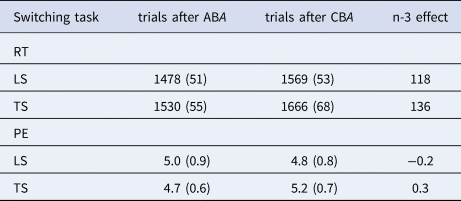
The RT analysis showed a significant n-3 effect, b = 0.057, SE = 0.010, t = 5.580, with smaller RTs for the trial after each ABA sequence (1504 ms) relative to the trial after each CBA sequence (1631 ms; see Table 2). There was no significant difference between the switching tasks, b = 0.024, SE = 0.021, t = 1.136, and the interaction was also not significant, b = 0.004, SE = 0.010, t = 0.386.Footnote 2
Overall mean reaction time (RT) in ms and error rates (PE) in percentages (SE in parenthesis) as a function of trials after ABA or after CBA sequences and in the LS or TS part.

The error analysis showed no significant n-3 effect, b = 0.019, SE = 0.122, z = 0.159. There was also no significant difference between the switching tasks, b = 0.069, SE = 0.111, z = 0.623, nor a significant interaction, b = 0.136, SE = 0.160, z = 0.847.
Discussion
In the current study, we set out to investigate whether conflict adaptation occurs during multilingual language production. To this end, we examined a novel measure, namely the n-3 effect (cf. Schuch & Grange, Reference Schuch and Grange2015; Reference Schuch, Dignath, Steinhauser and Janczyk2019), which entails faster responses in the trial after an ABA sequence than after a CBA sequence. The results showed a n-3 effect, both in a multilingual and non-multilingual context.
The n-3 effect observed in the TS part is a replication of Schuch and Grange (Reference Schuch and Grange2015; Reference Schuch and Grange2019) with different stimuli, tasks, and a different response modality. The n-3 effect observed in the LS part is a generalization of the findings of Schuch and Grange to the domain of multilingual language production. The latter has important implications for the idea of domain-general language control. Prior research has provided evidence for both similarities (e.g., Declerck et al., Reference Declerck, Grainger, Koch and Philipp2017; Prior & Gollan, Reference Prior and Gollan2011; Timmer et al., Reference Timmer, Calabria and Costa2019) and differences (e.g., Branzi et al., Reference Branzi, Calabria, Boscarino and Costa2016; Calabri et al., Reference Calabria, Branzi, Marne, Hernández and Costa2015) between control processes in a multilingual language context and a non-linguistic context. The observation of a similar n-3 effect, and thus a similar conflict adaptation process, in different contexts in the current study provides additional evidence for shared underlying processes across domains.
Within the framework of the conflict monitoring theory, the n-3 effect would be explained with conflict adaptation (cf. Schuch & Grange, Reference Schuch and Grange2015; Reference Schuch, Dignath, Steinhauser and Janczyk2019): language/task A in ABA sequences is inhibited more than in CBA sequences. Consequently, the other two languages/tasks will interfere even more in ABA sequences than in CBA sequences, which should result in higher conflict. According to the conflict adaptation process, trials following high conflict will result in better performance. So, performance should be better in our study after ABA sequences than after CBA sequences, which is the pattern that we observed.
However, several effects that are due to conflict adaptation according to the conflict monitoring theory have also been explained without the notion of conflict adaptation. More specifically, they can be explained with the feature integration account (for a review, see Egner, Reference Egner2007). According to the feature integration account, encountering a target stimulus with a specific cue and response will result in a common episodic memory representation of all these features. For example, when encountering a trial in our study, the cue, stimulus, and response would be stored in a common episodic memory. So, when one of these features is activated (e.g., cue), the other two features will also be activated (stimulus and response). When only one or two features are repeated in a later trial, performance will be worse as the previous feature binding has to be overcome, whereas facilitation will occur when all features overlap with the previous encounter. Hence, for the feature integration account to be able to explain our facilitatory n-3 effect, there should be a larger number of trials with a total feature overlap for trial n-3 after ABA sequences and the previous encounter with that cue (or the stimulus or the response) than after CBA sequences and the previous encounter with that cue (or the stimulus or the response). Since feature repetition was not our manipulation of interest, and thus totally random, it would be highly unlikely that this was the case. A closer look at our lists of trials indicates that there was a total feature overlap between trials and the last time the same cue was used for 9.2% of all trials, and it occurred slightly more often for trials after a CBA sequence (5.1%) than for trials after an ABA sequence (4.1%). Therefore, our findings could not be explained with the feature integration account.
Taken together, in the current study we observed n-3 effects in a non-multilingual context and a multilingual language production context. The n-3 effect is considered a measure of conflict adaptation, and thus the current study shows that conflict adaptation can occur in different contexts, including multilingual language production.