INTRODUCTION
The administrative arm of international organisations (IOs) has become a major field of study for scholars interested in international affairs (see Trondal et al. Reference Trondal, Larsson, Martinssen and Veggeland2010; Bauer et al. Reference Bauer, Ege and Schomaker2018, Reference Coe2019). The vibrant scholarship has shown that administrative autonomy, styles, recruitment and behavioural logics within international bureaucracies have become indispensable in contemporary international order (Olsen Reference Olsen2007; Trondal Reference Trondal2016). While this scholarship has advanced knowledge and is clearly on the rise, the case selection has often been confined to organisations housed in countries of the Organisation for Economic Co-operation and Development (OECD) (see Finnemore Reference Finnemore1993; Ege & Bauer Reference Ege, Bauer and Reinalda2013; for an exception, see Gänzle et al. Reference Gänzle, Trondal and Kühn2018). These studies focus primarily on the European Union (EU), the United Nations organisations (UN), the World Trade Organization (WTO), and the Bretton Woods system more generally, even though most of the growth in the absolute numbers of IOs and international bureaucracies in the last two decades have occurred in the Global South (Braveboy-Wagner Reference Braveboy-Wagner2009; Coe Reference Coe2019).
The neglect of Southern-based IOs and their bureaucracies, especially those in Africa, is surprising given the centrality of regional economic communities (RECs) and continental organisations, such as the African Union (AU) in regional governance. Since 2002, the AU and its executive arm, the African Union Commission (AUC), have spearheaded the development of regional rules, norms and decision-making structures covering state sovereignty, military interventions, peace and security, gender, international criminal justice, democracy, elections, governance and other key aspects of African politics and international order (Williams Reference Williams2009; Abdulqawi & Fatsah Ouguergouz Reference Abdulqawi and Ouguergouz2012; Tieku Reference Tieku2012; Hardt Reference Hardt2014; Haastrup Reference Haastrup, True and Davies2019).
Studies show that the AU norms and decision-making structures influence political dynamics within African countries (Witt Reference Witt2019), shape African international relations (Karbo & Murithi Reference Karbo and Murithi2018; Tieku Reference Tieku2018a), and even impact the politics of other regions (Souaré Reference Souaré, Coleman and Tieku2018). Hardt has persuasively argued that AU member states delegate to the AUC even in sovereignty-sensitive areas such as peace operations (Hardt Reference Hardt2016: 179). This paper seeks to take this analysis further as the AUC could not have been this influential without its staff.
In fact, research shows that AUC staff do not only act as ideational entrepreneurs (Souaré Reference Souaré2014) and help African governments to develop their positions on global issues (Ayebare Reference Ayebare, Karbo and Murithi2018: 20); they actually join forces with NGOs, think-tanks, consultants and independent academics to influence African states to develop common rules and norms (Engel & Porto Reference Engel and Porto2010; Dersso Reference Dersso2019; Kioko Reference Kioko2019). Thus, the AUC staff are not mere neutral servants of African politicians (Tieku Reference Tieku, Shaw, Grant and Cornelissen2011, Reference Tieku2018a) but potentially influential decision-makers shaping politics and policies on the African continent.
Despite the influential position that the AUC staff occupy, we know little about these international civil servants and thus those who run the premier pan-African executive body. Therefore, the ambition of this study is to unpack AUC staff composition and recruitment. The study offers three main findings. First, combining organisational theory and informality as analytical lenses, the study suggests that informal international practices (IIPs) are organisationally embedded in AUC recruitment processes. Second, the study shows that the AUC is composed largely of short-term contracted staff and relies on fixed-term personnel. As Figure 1 shows, a total of 61% of AUC workforce are on short-term contracts. Third, the staff structure of AUC is bottom-heavy. A total of 73% of AUC personnel are lower-ranked officials or in the bottom half of the AUC pay grade (see below). Some of these lower-ranked officials are deeply involved in policy/decision-making of AUC, putting into question the assumption in existing scholarship that decision-makers of IOs are primarily reliant on top-ranked A-level officials (i.e. senior management). This assumption informs prominent works in the field, such as the 2013 survey study of the European Commission (Kassim et al. Reference Kassim, Peterson, Bauer, Connolly, Dehousse, Hooghe and Thompson2013). Our study suggests that even ‘lower-level’ officials, especially the P2 and P3, are intimately involved in the policymaking processes of the AUC.
Distribution of staff categories (frequencies).
Source: Authors, based on data submitted to PRC Sub-Committee on Structural Reforms.

The paper proceeds in five stages. The first section briefly outlines the theoretical approach that informs the core argument. The second section presents the mixed research methodology that is employed to gather data, and the following section sketches out the nature of AU staff and the organisational structure of the AUC. The fourth section turns attention to the selection processes of the AUC, which includes examining the resources that staff brought to the AUC and what enabled them to play influential roles in African politics. The final section discusses the implications of the research findings and indicates future research directions.
A FRAMEWORK FOR ANALYSIS: ORGANISATIONal THEORY AND INFORMALITY
Drawing on organisational theory and public administration literature (see Kassim et al. Reference Kassim, Peterson, Bauer, Connolly, Dehousse, Hooghe and Thompson2013; Trondal & Peters Reference Trondal and Peters2013: 295–307), this study is grounded on the idea that recruitment practices significantly impact on the level of organisational efficiency, level of corruption, values staff practice, and the influence staff have on societal well-being (Dahlström et al. Reference Dahlström, Lapuente and Teorell2012; Rothstein Reference Rothstein, Peters and Pierre2012; Pedersen & Johannsen Reference Pedersen, Johannsen, Sager and Overeem2015). It has been shown that organisations that practice merit-based recruitment are significantly less marked by corruption than those that recruit on patronage (Dahlström et al. Reference Dahlström, Lapuente and Teorell2012). Civil servants who are recruited and promoted due to their skills and merits, rather than their social and political connections, tend to embrace values of integrity more than others (Pedersen & Johannsen (Reference Pedersen, Johannsen, Sager and Overeem2015). Moreover, scholars have found a positive correlation between ‘impartial’ public bureaucracies, and good living conditions and societal well-being (Rothstein Reference Rothstein, Peters and Pierre2012). Two proxies are applied to gauge the degree of meritocracy in AUC recruitment processes. The first measurement is whether expertise is weighed relatively more than the nationality of recruits. The question then becomes, how much emphasis does the AUC place on expertise of candidates (i.e. track record, formal education and accumulated professional experience) relative to their country of origin or nationality or other demographic characteristics, such as ethnicity, gender and age? A related question is how much weight the AUC puts on the technical expertise of candidates compared with other formal qualifications such as diplomatic background (experiences from other IOs, embassies, etc.). The second measure looks at the extent to which independent recruitment apparatus, which insulates the process from member-state governments and patronage, has been installed at the AU-level. Organisational theory ascribes an autonomous role for pre-existing structures, both formal and informal, i.e. practices that are not codified or written into treaties (Olsen Reference Olsen2010). Independent recruitment apparatus encourages a more formalised approach to recruitment at the AUC level, while a weak organisational structure biases recruitment practice towards informality. This paper finds that a fine-grained version of informality called ‘informal international practices’ (IIPs) are embedded in AUC recruitment process. IIPs, which are unofficial actions, activities, rules and decision-making structures that exist in the international arena (Tieku Reference Tieku2019a), are part of informal international relations (IIR) (Tieku Reference Tieku2019b). Tieku (Reference Tieku2019a) suggests seven features of IIPs:
First, IIPs are unofficial in the sense that they are practices not sanctioned or approved by official government agencies like the legislature and/or enforceable by official state institutions, such as domestic courts and international tribunals. In other words, IIPs lack the double consent that states give to international law or formal international rules (Hurd Reference Hurd2017; Park Reference Park2018).
Second, IIPs are partially written or wholly unwritten. Unlike formal practices, which can be found in written texts in the form of resolutions, charters, treaties, conventions, among others, most IIPs are not codified precepts. They typically do not exist in textual form, although some of them may be partially written. An example of a partially written informal practice can be seen in declarations of international organisations. Many declarations of IOs are partially written, but the extent to which these pronouncements are respected is totally dependent on informal understanding and practices of IOs members (Tieku Reference Tieku2019b). A relevant example of the unwritten or partially written practice is the convention that enabled only American citizens to become the World Bank's president or the practice that allowed only a citizen of European countries to assume the position of the IMF's managing director (Glenn Reference Glenn2009). This partially written practice has so far trumped the so-called open and merit-based formal election rules in the books of the two international organisations.
Third, IIPs are reflexive. Actors such as states and non-governmental organisations (NGOs) are aware of their existence or know what IIPs expect of them in any given international social setting. Actors are socialised to know even the unwritten IIPs. This enables them to follow them either consciously or unconsciously (Checkel Reference Checkel2001).
Fourth, IIPs are self-regulatory. There is no official government agency that has the responsibility to enforce them or punish actors who break them. Actors within the international system have developed several self-regulatory punishment regimes, which include isolation, naming and shaming, ostracism, retaliation, as well as the court of the opinion of ingroup-members to enforce IIPs (Tieku Reference Tieku2019b).
Fifth, IIPs are respected. Like many international norms, IIRs are followed even though there are no third-party bodies to enforce them or oversee them. There is no third-party agency to ensure respect for ‘a meeting of the P5’, a tacit agreement between the permanent members (China, France, Russia, the UK and the USA) to consult each other on resolutions before they are distributed to other Security Council members. However, there is almost always some form of consultation between the P5 members on resolutions before they are formally submitted to the Security Council.
Sixth, IIPs are widely shared ways of doing things among in-group members. In-group members often believe that respect for IIPs is either appropriate, serves their interests, or both. In other words, the most effective IIPs often have the logic of appropriateness (LOA) and the logic of consequences (LOC) embedded in them. Thus, IIPs are respected in part because of the influence of LOA, and in part because of the operating logic of the LOC (March & Olsen Reference March and Olsen1989).
Seventh, IIPs are temporal and short-term. Informal practices may emerge in institutions as temporary measures due to the fact that officials have yet to agree on permanent rules, they intend to develop a permanent measure to replace them, or they have to account for the concerns of third parties, such as other international organisations or donors.
One consequence might be the rise in the recruitment of short-term staff. Reliance on short-term contracted staff has increased in government institutions across the Western world. The short-term hiring is also a consequence of New Public Management (NPM) (Murdoch & Trondal Reference Murdoch and Trondal2013). One driver has been substantial (financial) constraints when government institutions facing fiscal austerity tend to initiate budget cuts, thereby down-sizing permanent staff and up-sizing short-term contracted staff (Hall Reference Hall2002). This follows one of the curative prescriptions of the NPM reform wave, and is designed to promote greater flexibility in, and performance of, public services (Lægreid & Wise Reference Lægreid, Wise, Raadschelders, Toonen and van der Meer2007). Although this trend has been extensively studied in national-level bureaucracies (Hall Reference Hall2002), contracted personnel working above the state have thus far escaped any comprehensive analysis (Newman & Ravndal Reference Newman, Ravndal, Stone and Moloney2019). This study contributes to filling this theoretical gap.
DATA AND METHODS
This study is based on data gathered through mixed research method techniques. First, a thorough examination of scholarship on IO staffing was conducted, supplemented by analysis of soft primary materials such as decisions, declarations and resolutions made by the AU, as well as an archival research of internal documents such as confidential reports, memos, activity reports, meeting notes and rapporteurs’ reports of closed-door meetings. In particular, the research benefited from assessment reports of the AUC, including the May 2019 comprehensive study of the structure, staffing needs and funding of the AUC by consultants, as well as the 256-page confidential report that the Chairperson of the AUC wrote on the study which was submitted to the Permanent Representative Council on 27 May 2019.
Second, we launched an online survey inside the AUC, collaborating with the African Union Leadership Academy (AULA), to survey altogether 137 AUC staff, representing approximately 9% of the total global workforce of the AUC. More fundamentally, the survey captures the views of all categories of AU employees, including regular staff, short-term employees, professional staff and non-professional workers of the AUC. To probe further on questions that the online survey was unable to capture, a member of the research team conducted approximately 21 open-ended interviews with key AUC officials between 16–30 June 2019, at the AU Headquarters in Addis Ababa. As the interviewees have been promised anonymity, we can only disclose their ranks and the time of the interview.
ORGANISATIONAL AND DEMOGRAPHIC CHARACTERISTICS OF THE AUC
Established in May 2001 by the Constitutive Act, the AUC became operational in 2002 after the Assembly of the AU had adopted its Statutes (African Union 2001). The Statutes of the AUC (henceforth Statutes) explained in detail the functions and the composition of the AUC. In functional terms, the AUC acts as the ‘engine room’ (Fagbayibo Reference Fagbayibo2012: 15) of the AU and is responsible for the day-to-day management of AU affairs (African Union 2002). According to Article 3(2) of the Statutes, the AUC is mandated to: represent the AU and defend its interests under the guidance of, and as mandated by the Assembly and Executive Council; initiate proposals to be submitted to the AU's organs, as well as implement decisions taken by them; act as the custodian of the AU Constitutive Act and OAU/AU legal instruments; provide operational support for all AU organs; assist member-states in implementing the AU's programmes; draft common African positions and coordinate member-states’ actions in international negotiations; manage the AU budget, resources and strategic planning; elaborate, promote, coordinate and harmonise the AU's programmes and policies with those of the Regional Economic Communities (RECs); ensure gender mainstreaming in all AU programmes and activities; take action as delegated by the Assembly and Executive Council (African Union 2014: 46). These functions highlight the AUC's central role in contributing to pan-African integration and management of African affairs.
Composition of the AUC: elected officials
The AUC comprises 10 elected officials called Commissioners and an appointed ‘corps of suitably qualified, experienced, and well-motivated senior administrative, professional, and technical staff’ (African Union 2002). The elected officials include the Chairperson of the Commission (COC), the Deputy Chairperson of the Commission (DCP) and eight Commissioners. Each one of the five regions of Africa (i.e. Central Africa, East Africa, North Africa, Southern Africa and West Africa), is entitled to two Commissioners. According to Article 6 of the Statutes, one of the two Commissioners from each region must be a woman. The Article, moreover, implied that the COC and the DCP could not come from the same region, by stipulating that the ‘region from which the Chairperson and the Deputy Chairperson are appointed, shall be entitled to one (1) Commissioner each. All other regions shall be entitled to two (2) Commissioners’ (African Union 2002: 5). Thus, the Statutes were inclusive of both regional and gender balance in the selection of the elected officials.
The COC is elected by the Assembly together with the DCP. The COC acts as the AU's Chief Executive Officer (CEO) and its accounting officer. As the CEO, the COC is supposed to assume the overall management of the AUC. This means that in practice, the COC is mandated to develop and execute strategic plans of the AUC, take measures to enhance the performance of the AU, promote its activities, act as secretary at meetings of other AU organs, appoint and manage AUC staff, as well as chair all AUC meetings when present.
In addition, the COC is supposed to consult and coordinate the AU's work with member governments, the African regional economic communities and international partners. The COC is required to enhance the functioning, decision-making and reporting of all units of the AUC, and ensure that activities of AU organs are in conformity with the AU's agreed policies, strategies, programmes and projects. As the accounting officer, the COC is supposed to render account for the performance of the AUC to the Assembly. Finally, the COC acts as a depository for all AU and OAU treaties and other legal instruments, and also represents the AU at international forums.
The DCP is not a typical deputy of an IPA or IO, as this individual is neither appointed nor can be fired by the COC. The Statutes of the AUC further strengthened the position of the DCP by making them responsible for the administration and finance of the AUC. This means, in practice, that the DCP controls both the purse of the AUC and the international civil servants who work in various units of the AUC. In practice, the AUC staff report to the DCP rather than the chairperson. The longstanding joke at the AUC is that all roads lead to the 17th floor, the location of the DCP's office, rather than the 18th floor where the COC is housed. Thus, although the DCP is accountable to the COC, the former does not have any power to dismiss or even discipline the latter. In other words, the DCP is a powerful chord within the AU system, and the COC has little choice but to co-manage with the deputy.
The checks and balances embedded in the management of the AUC do not end at the doorsteps of the COC and the DCP, as each one of the eight AUC departments is headed by a Commissioner who is selected by the Council of the AU and appointed by the Assembly of the Union. Although Commissioners are accountable to the COC, they cannot be fired or disciplined by the COC or the DCP. Only the Assembly has the power to terminate the appointment of Commissioners. The Statutes further enhanced the powers of Commissioners by making each one of them responsible ‘for the implementation of all decisions, policies and programmes in respect of the portfolio for which he/she has been elected’ (AU Assembly 2002).
In practice, each Commissioner has a fiefdom, and both the COC and the DCP cannot micromanage any department without the acquiescence of a Commissioner (Interview with a Commissioner; also, see Tieku Reference Tieku2018b). Indeed, even though Commissioners are accountable to the Chairperson of the Commission in theory, the COC does not have the powers to discipline or fire Commissioners, including the DCP. It is only the Assembly of Heads of State and Government of the AU that has the power to hire, fire and even discipline Commissioners. The checks and balances built into the AUC and the limited power that the COC has over departments and directorates under Commissioners and the DCP have forced the COC to co-manage the AUC with other Commissioners. Thus, unlike the single corporate IPA model as operated by the UN and the Association of Southeast Asian Nations (ASEAN), the AUC has been characterised as a co-management IPA (Tieku Reference Tieku2018a). The reform proposal submitted by the current COC to AU members makes a strong and sustained case for changing the current system to the single corporate model (African Union 2019: 232).
Composition of the AUC: appointed staff
The appointed staff of the AUC are made up of approximately 1,720 (May 2019 figure) at the headquarters in Addis Ababa, and at the representative missions around the world (African Union 2019: 232). They are categorised into two groups: Professional Staff (ranked from P1 to D1) and General Service Staff (GSS). The GSS people are grouped into General Service A (GSA) and General Service B (GSB). The GSA people are primarily administrative, clerical, maintenance and paramedical personnel, while the GSB, or what the AUC calls the Auxiliary Staff, are mainly drivers and security personnel.
The grading scale for those in the professional category are: D1 is a designation for directors of departments, directorates and the Chief of Staff of the Chairperson; P6 are advisers, and they are mostly in the Bureau of the Chairperson, the Bureau of the Deputy Chairperson and the Deputy Chief of Staff; P5 are heads of various divisions; P4 are primarily interpreters; P3 are senior policy officers; P2 are policy officers; finally, P1 are mostly documenters (Interview with P4 on 18 June 2019). The AUC operates a 1–10 step scale at each grade, and a step is given for each year that a member of staff spends at the AUC. In other words, it would take about 10 years to move from P1 to P2, and so on. Even then promotion to a higher level is not automatic. To move to another level in the AUC system, a staff member must possess the requisite qualification for the advanced position, apply to be considered for appointment to the position, and then must be prepared to go through a competitive recruitment process. In other words, the AUC does not use an automatic career progression system. The AUC appointed staff are housed in departments, directorates and representational offices. As of March 2020, there were eight portfolio Departments, each under a Commissioner, 4 Directorates under the Deputy Chairperson, 11 Directorates/Offices, Permanent Representational Offices (PRO) and Special Envoys under the Chairperson.Footnote 1
The typical AUC official is middle-aged. While 43 out of the 83 (52%) who responded to our survey indicated between 30–44 years as their age, 28 of 83 (34%) selected between 45–60 years as their age.Footnote 2 Only 17 out of 83 (20%) and 9 out of 83 (11%) indicated they were either below 30 years of age or above 60 years of age. In the case of gender classification, respondents’ demographic balance mirrors that of the workforce of the AUC. Eighty-two respondents, including 34 (41%) female-identifiable and 48 (59%) of self-identifiable males, indicated their gender. The gender balance of respondents reflects fairly well the male-female ratio of the global AUC workforce, which is male-dominated. As of March 2020, the female identifiable staff constituted about 34% of the total appointed workforce of the AUC while approximately 66% are classified as men.Footnote 3 The ratio is 50% men and 50% women among the 10 elected officials of the AUC.
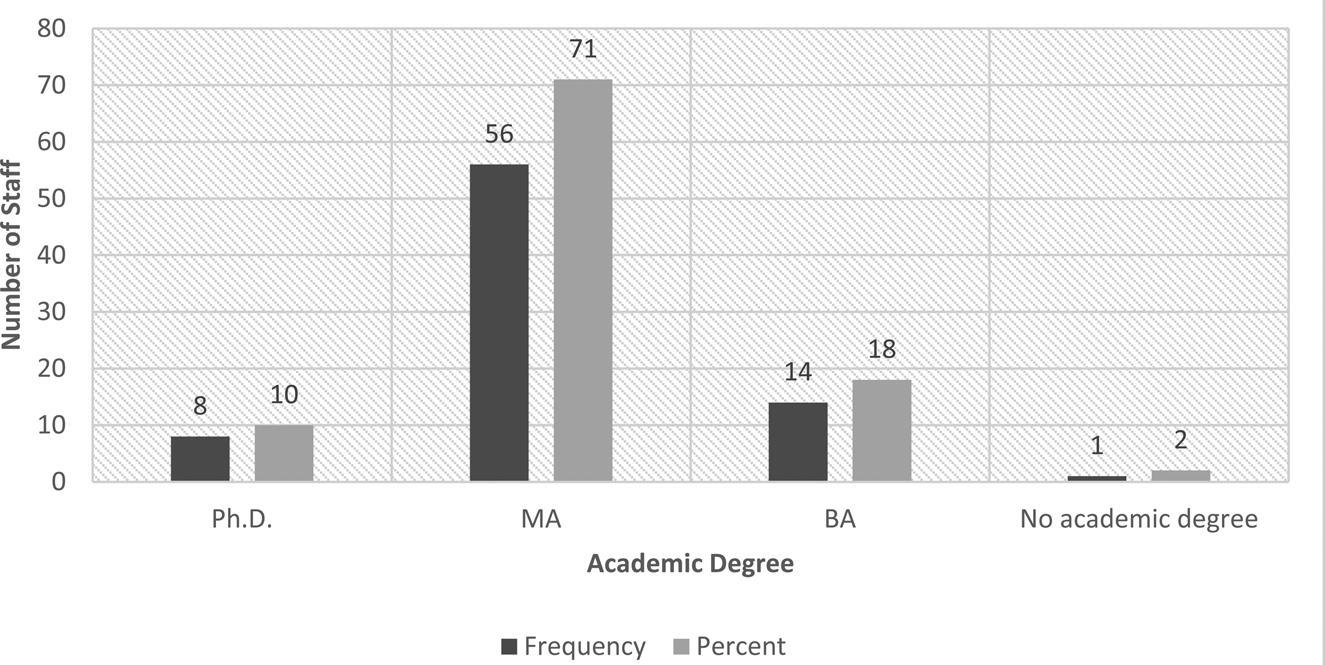
The typical AUC staff member is highly educated, as a majority of those responding to the survey indicated they possessed at least one postgraduate degree. As Figure 2 shows, 81% respondents who provided information about their highest level of education indicated they possessed either an MA degree or a PhD degree. While a small majority (52%) have studied abroad, a great majority (78%) are educated in social sciences. Although the nature of respondents may have exaggerated the actual number of postgraduate degree holders in the AUC system, the highly sought-after nature of international organisation jobs in the African continent, and the AUC management's insistence on a postgraduate degree for even internship positions, suggest that the majority of AUC staff are highly trained and educated.
Distribution of educational backgrounds (frequencies and %) (N = 79).

AUC STAFFING AND RECRUITMENT PROCESSES: BOTTOM-HEAVY, SHORT-TERM AND INFORMAL
The nature of the AUC staffing is a story of a bottom-heavy organisation, in the sense that the AUC is heavily reliant on staff at the lower-level of the pay grade; 1,261 (73%) of the 1,720 total AUC staff are lower-level officials or in the P3 category, or below.Footnote 4 Of the 1,261 lower-level officials, 906 (52%) are non-professional staff and may have little to do with the policymaking processes of the AUC. Only 814 (47%) of the AUC workforce are in the professional category and involved in the day-to-day execution of the AUC mandate. Of the professional category, only 29% (i.e. 236 staff) are in the P4–D1 range, which is considered to be a middle to senior professional level in a conventional international public administrative set-up.
The other 578 professional staff (71%) are in the P1–P3 range and would be expected to have little influence on policymaking. It is also important to note that the 83 (10%) who are in the P1 level are documenters, and the 71 (9%) in the P4 are mostly interpreters. The AUC staff in these two categories are less likely to get involved in the decision-making of the AUC. The work of P1 staff does not normally go beyond documentation, while the overwhelming majority of the staff in the P4 category confine themselves strictly to the interpretation of AUC meetings.
That said, it would be a mistake to conclude that all AUC lower-level officials do not shape and influence AUC decision-making processes. The P2 and P3 AUC staff are major players in the AUC system. Data from our survey show that the P2 and P3 staff are deeply involved in the decision-making processes (also see the quotation from an interview with a member of the P3 below). A variety of reasons explains why the P2 and P3, or the so-called lower-level officials, are influential in the AUC's decision-making processes. First, the fact that most of the professional officers in the AUC system (495 or 61% of the AUC professional staff) are concentrated in the P2 and P3 levels means that the scanty number of staff in the top half of the AUC administrative structure (i.e. the 39% of the staff who are at the level of P4 and beyond) have little choice but to download some of the decision-making to those at the P2 and P3 levels. In fact, the AUC leadership prefers hiring professional staff at P2 and P3 levels in part because it is cost-effective for the AUC, and in part because of a broad understanding (see features 3 and 4 of IIP) that the P2 and P3 officials do most of the heavy lifting in the AUC system. As one of them put it when answering an unstructured question about the role of P2 and P3 in the AU system,
I don't need to tell you what we the nobodies do in this building … Let me ask you who does most of the work when you go to DPS (Department of Peace and Security) meetings? Isn't it my colleagues who develop work schedule of our units, write the concept papers, identify and invite you people to meetings, prepare reports and make them ready for everyone, and write speeches that directors and commissioners read? It is the same everywhere in this building. (Interview with a member of the P3 group on 18 June 2019)
While it may well be that this member of the AUC staff is exaggerating the influence of the P2 and P3 people, the survey backs up the view that the lower-level officials are deeply involved in the decision-making processes. As Table I suggests, while 35% of P1–3 staff indicated they spend as much/very much of their time on drafting proposals, 50% noted they provide information to AUC leadership. This finding is consistent with Tieku's (Reference Tieku, Coleman, Kornprobst and Seegers2019c) observation that most key AU policy ideas/documents such as AU transitional justice policy and post conflict and reconstruction policy were initiated by AUC bureaucrats (not member states), often in collaboration with actors he called Outinsiders.
How much/very much time do you spend on specific tasks (frequency and per cent).

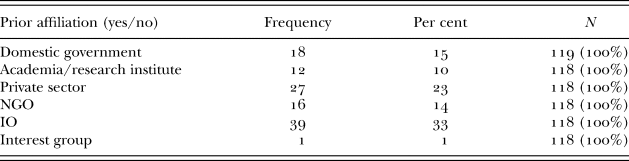
Second, many of those who enter the AUC system are experienced professionals. Those who enter the entry-level position of the AUC have often worked in the public service of African states or IOs. As Table II shows, 48% of those surveyed indicated they had worked for government or an IO before joining the AUC. The minimum requirement to apply for Step One of P2 position (i.e. the entry stage of P2) is five years’ work experience in a related field (African Union 2014–2020). This factor, together with the AUC's preference for mature workers and the relatively high pay level of the AUC positions, means that many of those shortlisted for P2 and P3 positions often have postgraduate degrees and work experience well beyond the required skills-set indicated by the AUC.
Prior work affiliation before joining the AUC (frequency and per cent).

Third, the relatively high skill-level of the typical AUC P2 and P3 staff compared with even senior officers in public services of AU member-states, may also account for their influence. The survey shows that most of the AUC staff, including the P2 and P3 members, hold postgraduate degrees and are by no means novices in policymaking processes or in African affairs. In recognition of the fact that most people who join the AUC are highly educated and have extensive work experience, the informal practice that has emerged in AUC hiring processes is that although the AUC professional category starts at P1, almost all the policy officers recruited since 2003, when the AUC came into existence, were given P2 level and up contracts (see IIP features 1 and 2; interview with P5 member on 18 June 2019). The informal practice of barring the hiring of professional policy officers at the P1 level is unwritten yet highly respected (see IIP features 1, 5 and 6).
The reservation of the P1 level for those who take care of AU documents largely explains why only a handful of people, approximately 5% of the total AUC staff, are at the P1 level. The informal practice of hiring professionals at the P2 instead of the P1 level emerged in part also to address the tortoise-like mobility or grading scale system that the AUC operates. This IIP, together with other unwritten rules in AUC recruitment processes, including the practice of hiring only interpreters at P4 level, provides a good idea about the importance of informality in recruitment processes (one of the most formal spaces in the international system).Footnote 5
AUC recruitment processes: the influence of formal structures and IIPs
The AUC recruitment processes are based on a mix of informal practices, guidelines in AUC staff rules, and hiring procedures provided in the AUC Statutes. According to Article 18 of the AUC Statutes, appointment of ‘senior administrative, professional and technical staff of the Commission shall be made by a Recruitment Board, comprising the Members of the Commission, the Head of Human Resources, the Legal Counsel and a Representative of the Staff Association’ (African Union 2002). Article 8(3) of the Statutes added that ‘prior to the commencement of the recruitment process of senior administrative, professional and technical staff of the Commission, the approval of the Advisory Sub- Committee on Administrative, Budgetary and Financial Matters of the PRC shall be obtained, upon the submission of job descriptions, justification and financial implications’ (African Union 2002). Article 8(3) was inserted in the Statutes to ensure that AU member-states exercise control over the hiring of AUC staff, but it has never been invoked.
The first generation of AU Commissioners, led by the former President of Mali Alpha Konaré (2003–5), developed informal recruitment practices that rendered the invocation of Article 8(3) unnecessary and further prevented member-states through the PRC from micromanaging AUC hiring processes (Interview with P5 member on 20 June 2019). Instead of seeking approval from the PRC before the commencement of recruitment, the Konaré Commission developed hiring processes that started and ended with the Chairperson of the AUC (Interview with P4 on 18 June 2019). Drawing on his reputation as a highly respected former president, his direct access to the leadership of African states as well as the independence granted in the Statutes to the Commission, the Konaré Commission developed a four-stage recruitment processes.Footnote 6
First, approval for new positions will be sought from the Bureau of the Chairperson rather than the PRC. Second, the Konaré Commission empowered the Human Resources Division of the Administration and Human Resource Management Directorate (AHRMD) to establish a hiring committee made up of AUC staff, including a representative of the AUC unit where the services of the prospective staff will be needed to manage all new recruits. The purpose of the hiring committee is to shortlist candidates, interview them, and conduct written tests for prospective staff. Third, the results from the test and interviews are forwarded to the Chairperson through an Appointment, Promotion and Recruitment Board (APROB) chaired by the Deputy Chairperson of the Commission. The job of the APROB is to rank candidates and make recommendations of the four best candidates to the Chairperson for appointment. At the final stage, the Chairperson has the right to select among four recommended persons.
As a result of the liberty granted to the Chairperson to appoint anyone from the four recommended candidates, it is not uncommon for Chairpersons to appoint the fourth-ranked candidate instead of the first person recommended by the APROB. Many Chairpersons have used this opportunity to appoint staff who may not necessarily be the best-ranked candidate, but who might help the Chairperson to achieve his/her objective, whatever that might be. For instance, Dr Nkosazana Dlamini-Zuma was accused of overusing it to address the gender imbalance within the AUC staff (Interview with P4 on 18 June 2019).
The AU's involvement in several peace missions in its first decade together with donor support for such operations, raised concern about transparency, accountability, as well as clear rules for mission staff. In response to this, the AUC Peace Support Operation Division (PSOD) attempted from 2010 onwards to develop detailed recruitment procedures and staff rules for field personnel on peace support missions.Footnote 7 This effort, together with the appointment in 2014 of Amine Idriss Adoum as AHRMD director, led to the development of a detailed recruitment policy in 2015 that covered hiring of staff at the headquarters and those on field missions.Footnote 8 The Deputy Chairperson of AUC Erastus Mwencha tried to formalise the recruitment policy in 2015 by submitting it to the PRC for consideration for adoption by the Assembly (African Union 2015a).Footnote 9
Although the recruitment policy was not formally adopted and approved by the AU member-states, the roadmap proposed in the draft policy is shaping current AUC recruitment (Interview with P4 on 19 June 2019). The roadmap established guiding recruitment principles (see African Union 2014–2020). The guidelines required that potential applicants for the AUC position must demonstrate a high level of technical knowledge, be motivated, and have a strong commitment to the policies and programmes of AUC. In addition, applicants must be able to work well in a multicultural environment, as well as have working experience at national and/or international level. Furthermore, they should be proficient in at least one of the official languages of the organisation (Arabic, English, French and Portuguese), and have a working knowledge of a second. Moreover, it committed the AUC to non-discrimination on any grounds including race, creed or sex thereby promoting diversity among the workforce and achieving a broad representation of member country nationals. Last, this was meant to provide an environment where the contribution of everyone is valued, as well as dedicating the AUC to the selection of staff on a competitive basis (African Union 2014–2020).
The informal recruitment policy introduced new elements into the AUC recruitment processes. It moved the AUC away from the manual submission of application materials to an online recruitment database called E-recruitment, where a prospective applicant can create a profile and submit an application (African Union 2015a). The launch of the AUC career and recruitment website on 21 December 2015 to process applications electronically provided open access to AUC jobs, which were hitherto gated and controlled by the African diplomatic community and political class (Interview with P5 member on 20 June 2019). The electronic system opened the gate for ‘the African Union to attract not only African applicants from the continent and diaspora but also maintain talent warehouse of potential candidates who can join the AU team as and when demand arises’ (African Union 2015a). The informal policy insisted on a thorough medical examination of prospective staff by a qualified medical team and facility. An appointment letter is issued only after the prospective candidate has submitted the result of the medical examination. Finally, it retained the two-stage interview process, including the oral interview by the AHRMD in conjunction with the relevant unit recruiting the prospective staff and the written examination (Interview with newly hired P2 on 19 June 2019).
Short-termism
This section suggests that the IIP approach to recruitment adopted by the AU is driven by short-term considerations (see feature 6 of IIP). This is because the majority of AU staff are on short-term contracts. A total of 1043 (61%) of the AUC global workforce are on short-term contracts while only 677 (39%) staff are on regular contracts (African Union 2019: 232).
There are at least five types of short-term contracts out of a total of seven kinds of appointments that the AUC make (African Union 2010). The first short-term contract is called the ‘Fixed-term appointment’, which refers to appointments made for a period not exceeding two years, but not less than one year, with terms and conditions of services often stipulated in the contract. Many of the staff given this type of appointment are individuals working on projects funded by donors, or senior professional staff. Many of the professional people in P3 and upwards, including many heads of division, are on this type of contract. For instance, as of September 2019, the heads of all four divisions in the Department of Peace and Security were on this type of contract (Interview with P5 on 20 June 2019). This further demonstrates that the AU has become very dependent on these short-term staff.
The second type of limited-term appointment is called ‘Short-term Appointment’, which is a contract given to AUC staff for a period not exceeding one year, but not less than three months. Similar to the fixed-term contract, those given this type of appointment also work on projects usually funded by donors. These contracts are often given to researchers and those who write reports for the AU. The third short-term contracts are ‘Consultancy contracts’, which are given for a period not exceeding three months. These contracts are specifically termed as consultancy contracts to signify that a person/firm has been recruited for the purpose of providing services on a pre-determined timeframe. Those given these contracts usually have a regular appointment with another institution but work on AU projects within the three-month period. These contractors support the AU with research and technical knowledge or are given special assignments.
The fourth short-term contracts are what the AUC calls ‘Special Services Appointment’. These contracts are awarded on a very short-term basis and are renewable as often as the person is needed by the AUC. However, the AUC does not confer a staff member of any kind to that employee. Usually, those individuals are often brought to the AU to do specific tasks, and the appointment would continue as long as that individual's work continues to be needed by the AUC. This is of course subject to the availability of funds. The final short-term contracts are the ‘Political and Special Appointments’, which are given to elected officials for a duration usually not exceeding four years and renewable once. In other words, no elected official can stay for more than eight years.
Even the regular AUC appointments, or the so-called permanent staff, are not permanent in the strict sense of the word. This is because regular staff are given a fixed-term contract for a period of three years, the first 12 months of which are considered as a probational period (African Union 2010). The so-called permanent staff are required to renew their contracts every two years, subject to performance and the needs of the AUC. The staff who have served a five-year term for the AU on a regular service are considered permanent staff. They are considered permanent even though they always have to renew their contracts every two years and can be allowed to leave the organisation based on mutual consent, or when their superiors feel their services are no longer needed. Put differently, these permanent staffs exist largely on the goodwill of their superiors and the needs of the organisation. Interestingly, the AU staff rules stipulate that the AU shall ensure that the number of continuing staff members shall not exceed 51% of regular staff of the AUC (i.e. those who have continuing appointments cannot be in the majority of any staff category) (African Union 2010: 15).
This staffing situation is, by and large, the result of the tremendous growth of donor-funding of the AU programme budget and short-term posts. According to the AU Golden Rules for financial management, approximately 30% of the total AU budget should go to the operational budget, while about 70% is devoted to the programme budget, which is largely funded by donors through short-term financial arrangements (African Union 2020). The temporary nature of donor funding arrangements means that only short-term contracts can be issued for positions paid from these extra-budgetary supports.
The preeminent position of these extra-budgetary supports in AUC recruitment processes raises the contentious issue of the influence of funders on the AU. Although the issue is beyond the scope of the current study, it is important to note that salaries and allowances are supposed to be paid from the operational budget of the AU. According to Assembly decision 578(XXV) of June 2015, AU members are supposed to pay for 100% of the operating budget yet the salaries of hundreds of AUC staff are still paid by external funders, such as the UNDP and the EU (African Union 2015b).Footnote 10
It will however be a mistake to conclude, as most journalistic writings on the AU tend to assume and intuitive reasoning may suggest, that donors call the shots at the AUC including on recruitment matters. As those who know the relationship between AU-external partners intimately and have studied the issue in a systematic way such as Engel (Reference Engel, Engel and Mattheis2019: 28) have shown, ‘donors may play an important financing role, but they do not call the tune’. This begs a number of important questions, including why and how such a resource-dependent organisation located in the Global South is able to take money from powerful global actors but can still manage to maintain a semblance of independence/decision-making autonomy? And what impact does dependence on external funding have on AU legitimacy and credibility? These are some of the questions that future research may explore.
The short-term approach to staffing has enormous implications for recruitment and staff dynamics. It is often stretched to its limit when it comes to the appointment of female employees and gender dynamics in the AU system. As a letter from the Deputy Chairperson of the Commission Ambassador Kwesi Quartey to the President of Ghana, Nana Addo Dankwa Akuffo-Addo, stated, ‘female staff were deliberately being given short-term contracts (around three months) so that the renewal (of contracts) then would be negotiation between unequal parties’, often involving favours in return for extending these contracts (Ouartey Reference Ouartey2018). The practice of targeting female employees for short-term contracts does not exist in any AU policy document on recruitment (see IIP feature 2). It did not receive the explicit consent of state parties (see IIP feature 1). Yet, the practice is widely followed within the AUC system even though it is not written anywhere, nor approved by member-states. The female employers, as well as their superiors, agree to this informal practice, in part because of the logic of consequences (see IIP feature 6). The females acquiesce to it due to fear for their jobs and in the case of the male superiors, they do it because of apprehension that their proposal will be rejected without the promise of a contract extension (see IIP feature 5).
CONCLUSIONS
This study contributes to the IPA literature by examining the politics of staffing and recruitment of IO headquartered outside the OECD area. Studying AUC recruitment ties into a broader scholarship on open organised systems (Scott & Davis Reference Scott and Davis2016), organisational theory (Pfeffer Reference Pfeffer1982; Egeberg & Trondal Reference Egeberg and Trondal2018), sociology of regionalism (Parthenay Reference Parthenay2019), and representative bureaucracy (Gravier & Roth Reference Gravier and Roth2019; Christensen Reference Christensen2020). Three key contributions are highlighted. First, the AUC is heavily dependent on short-term contracted staff with a staff structure that is largely fixed-term. This finding supports previous research that shows that administrative bodies of IOs are becoming overly reliant on short-term contracted staff, often directly placed by governments (Egeberg et al. Reference Egeberg, Schäfer and Trondal2003: 19–40; Murdoch & Trondal Reference Murdoch and Trondal2013), or seconded agentsFootnote 11 from various non-governmental/donor organisations. Although secondment is not very prominent in the AUC in terms of absolute numbers, the IPA and IO literature will benefit from a systematic study of seconded personnel and consultants, especially their impact on AU decision/policymaking processes.
Moreover, the finding joins previous studies in drawing attention to the emergence or re-emergence of short-term contracting as the preferred approach to staffing of IOs. Contracted personnel have become an important part of international public governance, as governments aim towards more flexibility in the management of international affairs. It was quite the norm for IOs, such as the EU, to rely on contracted staff in its early days (see Duchêne Reference Duchêne1994). Although contracted staffing never dominated the EU Commission staff, their number has steadily increased – especially during the 1990s, when the rapid expansion under the Delors Commission created a need for additional staff outside regular posts (Murdoch & Trondal Reference Murdoch and Trondal2013: 1–21; Trondal et al. Reference Trondal, Suvarierol and van den Berg2008). The re-appearance of contracting staffing has important implications, including the critical fact that it makes IO staff live in precarious job environments and may compromise international civil servants’ security of tenure. Also, short-term contracting may open the door for member-states to use secondments of government officials to control international bureaucracies and lead to short-lived and erased institutional memories, especially in IOs that do not have stellar documentation track records (Egeberg & Trondal Reference Egeberg and Trondal2018). In addition, it may make international public governance less resilient.
Second, the study reveals that the AUC is bottom-heavy, and that lower-ranked staff are important in governing the AUC. Many of these so-called ‘lower-level’ officials, especially those in the P2 and P3 grades, are intimately involved in AUC policy processes and decision-making, contrary to the assumption in existing scholarship which suggests that decision-makers of IOs are primarily reliant on top-ranked A-level officials. Scholars interested in IOs and their administrative staff may lose key insights by focusing mainly on senior-ranked officials or neglecting junior staff.
Finally, this study suggests that informal international practices are embedded in AUC recruitment processes and they influence the overall staff structure. This finding is significant because previous studies have ignored, or rendered peripheral, informal dimensions of IPA recruitment. Our study shows how informal practices are deep-rooted in one of the most formal arenas in the international system. Informalisation of staffing is unlikely to be a peculiar AUC phenomenon. Scholars of international affairs may have lost invaluable knowledge by failing to study in a systematic way informal dimensions of administrative staffing of IOs. This study provides a guide and direction for further research into the role and influence of informal international practices in IOs.