Summoned by the magic call of the Empress Queen, ‘Greater Britain’ has suddenly stepped forward on the field as an actual and integral part of her Realm and Empire.Footnote 1
As Queen Victoria approached the end of her sixtieth year on the throne, the Order of the Sons of England in Canada evoked this ‘Greater Britain’ by coordinating a sustained global celebration. An exclusive English and Protestant organization found only in Canada and South Africa, the Sons appealed to kindred associations around the globe, including the Orange Order and the St George societies, to mark the jubilee with ‘a scheme that is at once novel [and] patriotic’.Footnote 2 Their aim was for ‘the Jubilee Service of a continuous anthem around the world, to take place on Sunday, the 20th of June, the actual anniversary of Her Majesty's accession’.Footnote 3 ‘Greater Britain’ thus rose as one to sing the national anthem at around 4 p.m. local time, with Englishmen in Fiji, New Zealand, Australia, Asia, Europe, North America, and even on board British ships in the Pacific Ocean joining the ‘Wave of Song’.Footnote 4
Despite ‘the many doubts … expressed as to the possibility of its being actually accomplished’, the Sons of England Supreme Grand President averred after the event that the desired outcome was achieved. By utilizing communication networks, which ‘were opened up with all the Colonial bishops and clergy’ and ‘Patriotic societies and the secretaries of the Royal Colonial Institute’, the services had followed ‘the sun westward’, traversing ‘the world in one unbroken line through the colonies of the Empire of the Union Jack’.Footnote 5 Dunedin, Balclutha, Lawrence, Riversdale, and Waiau, all in the South Island, New Zealand, conformed to the plan.Footnote 6 In Launceston, Tasmania, people of all denominations sang the anthem together; in Adelaide, the singing took place after a fine tea; and in Melbourne, at 4:20 p.m. – precisely the time listed by the Sons – the national anthem rang out at the Augustine Congregational Church.Footnote 7 In Perth, Western Australia, where the Anglican bishop and the local St George's Society joined forces, ‘one of the most striking features of the service’ was a large number of young children singing the anthem, being fully ‘in accordance with the wish of the Sons of England Society’.Footnote 8 In North America, too, ‘our own brethren in Newfoundland and Canada and patriots in the United States took the service up with energy and enthusiasm’.Footnote 9 British Americans in Milwaukee followed suit, as did British subjects in Galveston, who accompanied the anthem with cricket and other sports.Footnote 10 In Charleston, South Carolina, the anthem was sung in the afternoon, and a dinner, jointly organized by the St Andrew's and St George's societies, was held in the evening.Footnote 11 A hint of the inclusivity of English imperial values was given, as Jews and Christians, both Catholics and Protestants, were involved in the celebrations.Footnote 12 For example, a circular was sent by the Revd Monsignor Farrelly to the pastors of churches in the Archdiocese of Kingston, Canada, calling for Catholics to ensure that ‘the day be properly honoured, enthusiastically celebrated, and marked in the calendar’.Footnote 13
So it was that the Sons of England had mobilized powerful networks of church and confraternity in veneration of one of the strongest icons of identity in the empire and at home: the monarchy.Footnote 14 Monarchical ceremonialism had been turned into an imperial event in 1877 with Benjamin Disraeli's orchestration of the fortieth anniversary celebrations for Victoria's reign.Footnote 15 By the 1890s, royal jubilees, coronations, funerals, and visits had become inherently imperial occasions.Footnote 16 While the monarchy had enjoyed ceremonial power before the age of empire, the imperial context provided significantly greater potential for expressions of adoration. The efforts of English societies in 1897 required no official prompt, thus suggesting that Disraeli's vision had been realized, with monarchy and empire inseparably intertwined.
The English societies creating this collective splash formed part of a formidable world of associations: Freemasons, Orangemen, the Navy League, the Magna Charta Association, and English county associations – all of them shared the imperial ideal. Against the backdrop of the Boer War, masculine groups, such as those analysed here, were matched by a flowering of female loyalist and imperial organizations, including New Zealand's Victoria League, Canada's Imperial Order Daughters of the Empire, and the South African Guild of Loyal Women.Footnote 17 However, until the First World War, English associations primarily drew upon masculine traditions. Our research focuses on the strongest, most widespread examples of English associationalism, the St George's societies and the Sons of England, drawing upon archives in North America and Australia, and digitized newspapers from a number of countries.Footnote 18 We do not, however, explore the Anglican Church: Anglican links were important, as the above episode shows, but, while English ethnic societies were connected to the churches and welcomed clerics as speakers, the associations were essentially secular. Moreover, Anglicanism in empire, an enormous topic worthy of separate consideration, has already found its historians.Footnote 19 Much less is known of the organizations we discuss here.Footnote 20
Whether in their private gatherings, in their public celebrations, or through the deployment of powerful ethno-cultural symbols, such as St George slaying the dragon,Footnote 21 English associations often utilized rituals similar to those of other ethnic societies established by migrants from the British Isles – societies often framed by a broadly pro-imperialist worldview. Except at the margins (for example, in the form of Fenianism), this also included the Irish, who made a major contribution to upholding the values of the British empire.Footnote 22 Only militant separatists sought to wrest Ireland entirely from political federation with Great Britain. Such militancy as there was existed particularly powerfully in the United States, where Irish identity was more strongly nationalist than at home. In fact, English societies and wider British loyalist organizations came into conflict, at times serious, with highly organized and powerful Irish nationalist organizations in the United States – and with the Boers in South Africa.
This article therefore examines the wider context of what was an extraordinarily well-executed celebration of Victoria's sixty-year reign, unravelling the identity of a group – the English – that is not usually characterized by ethnic behaviour. As such, ethnic associations provide an important and sensitive test-bed, for June 1897 revealed a global network of such associations uniting otherwise unconnected peoples as a single corporate identity, tied together by transnational communication.
English associations and Englishness
For J. R. Seeley, the nineteenth-century admirer of empire, ‘the history of England is not in England, but in America and Asia’.Footnote 23 More specifically, according to Robert Young, English ethnicity was made, not in England, but in the empire.Footnote 24 Young argues that the Saxon in England was reworked into a global Anglo-Saxon identity expressly so that it could be utilized by people of English descent in America and the colonies. Thus there emerged a global brand of Englishness that eventually fed back to England, promoting imperial unity in the face of rival imperialisms and indigenous nationalisms.
The formation of the Royal Society of St George (RSStG), in England in the 1890s, as a centripetal focus for an otherwise scattered collective, aligns with modernist notions of nationalism, particularly the wave sweeping late Victorian England. However, this was not the period of the first coherent expression of Englishness. As Hastings observes in his challenge to modernist ideas of nationalism, ‘one can find historians to date “the dawn of English national consciousness” … in almost every century from the eighth to the nineteenth’.Footnote 25 Some trace this identity to Bede's first usage of the term gens Anglorum to describe an English people; others cite roots in the post-Norman settlement, the English Civil War, or the eighteenth century – all quite separate from those preferring modern origins.Footnote 26 However, critics of Hastings and other ‘perennialists’ point out that, despite pre-modern precursors, national identity did not become a unified ideology until the modern period.Footnote 27 Moreover, in the rise of associational Englishness, English people abroad responded to external pressures, which influenced Colley's classic interpretation of the formation of the British identity.Footnote 28
While our article appears to conform to modernist readings of nationalism, English ethnicity was more complicated than that: it emerged before the age of modern nationalism, drawing upon older traditions of Englishness and encompassing the empire as much as the nation. Despite the emergence of Britishness in response to the formation of the United Kingdom, ‘England’ and ‘Englishness’ continued to be used as synonyms for ‘Britain’ and ‘Britishness’Footnote 29 – a tendency also evident among English societies across the world. While pre-modern symbols and meanings appeared in expressions of Englishness, modern factors – the conditions of imperial growth and transnational communications networks – were vital to the global and coherent application of these symbols.
Beyond the United Kingdom, there was a striking degree of continuity in the way in which empire became an extension of England and Britain. This emphasizes the importance of the external context for English identity: indeed, scholars have demonstrated beyond question how much of England's and Britain's history took place outside the British Isles.Footnote 30 Within a global empire, the concept of Englishness lacked the inclusiveness and flexibility to be useful to an expanding population under London's control. Overlapping with Britishness, while at the same time lying at the core of the wider idea of being a Briton, Englishness intimated a discrete, separate, narrower identity, necessarily crowded out or lost in a world dominated by Britain, and later ‘Greater Britain’. Yet Englishness still served a purpose by providing the core values of Britishness, especially within the imperial context. While we do not go as far as Kumar, who suggests that English identity of this type was effectively missionary nationalism,Footnote 31 we value another of his terms: imperial nationalism. Kumar sees English nationalism as doubly imperialist in the light of the way in which ‘English’ has served for ‘British’.Footnote 32
Imperial nationalism is useful when describing the global efflorescence of English societies in our period: our research shows the formation and spread of a series of ethnic societies that were fundamentally reliant on imperialism for impetus. While the terms ‘English’ and ‘British’ were often used interchangeably to describe aspects of imperialism, martial prowess, economic power, and culture, speakers at meetings were quite precise in their association of Englishness with certain political values – Magna Carta, the Bill of Rights, and habeas corpus.Footnote 33 Charles F. Benjamin captured the essence well in a lecture to the North American St George's Union, an amalgam of English and wider British associations, when he described ‘English-speaking communities’ as a ‘group of political societies’ that has ‘for a common inheritance the language, literature, laws and habitudes popularly described as Anglo-Saxon’.Footnote 34 It was these common people whose numbers and range were expanded by mass migration, and who asserted their commonalities through shared history, ancestry, customs, and values.
The roots of English ethnic societies can be located in the eighteenth century, forming part of the networks of clubs and societies, brilliantly described by Peter Clark, that honeycombed the Atlantic world.Footnote 35 At that point, however, they were localized instances of Enlightenment cosmopolitanism, underpinned by sociability and charity.Footnote 36 They were not governed by transnational ethnic attachments, except in their response to incoming charity cases. In the nineteenth century, however, this ‘unimagined community’ became something akin to Benedict Anderson's highly influential ‘imagined community’.Footnote 37 Since most of the people who joined English societies knew about, but never met, their peers in far-flung lands, we find Anderson's model, with its emphasis on the importance of modern media communication, appealing to explain transnational identity, for English ethnic societies certainly formed and maintained impressive transnational systems of ethnic celebration.Footnote 38
Our article describes a tradition of ethnic associationalism that has been written about for Scots, Irish, and others, but whose English dimensions have been largely overlooked or downplayed. While scholarship on British identities has grown rapidly since the 1990s and studies of Englishness have also appeared regularly in that period, empirical discussions are few and far between.Footnote 39 No one has yet undertaken this type of transnational study. Yet associative behaviour has long been recognized as an important sphere of study, and the English, like so many other ethnic communities, chose to express their corporate identities in this way. The very notion that the empire included associations that were actively English is not mentioned in key recent histories of the English – something that would be unthinkable for a study of the Irish or Scots.Footnote 40 These factors partly explain Harper and Constantine's observation on the Canadian situation that ‘the lack of recognition given to English settlement is remarkable … Their profile seems to have suffered from a perception that they were founding people rather than an ethnic group.’Footnote 41
Historians from the United States tend to ignore or disavow the idea that the English were ethnic, which explains the condition that Harper and Constantine describe. In most conceptions, the ‘English’/‘British’ were viewed as the external threat against which other ethnicities were formed. Narratives of ethnicity tend to portray ethnic diasporas as politicized spaces, drawing on the Jewish experience as a model.Footnote 42 As historians in the US began studying immigrants as a series of sub-sets – hyphenated Americans – contributing to the wider national culture, the English were left out.Footnote 43 Indeed, only Rowland Berthoff touches on the notion of the English in the US as ethnic.Footnote 44 Writing after Berthoff, the premier historian of the English, Charlotte Erickson, viewed them as ethnically ‘invisible’, dismissing the societies that we study here as mere ‘social events of an elite who were not in touch with the larger immigrant community’.Footnote 45 Similarly, in Australia, studies of English settlement say little of the cultural institutions of the English.Footnote 46 Hammerton and Thomson's investigation of post-war emigration from Britain to Australia stresses their invisibility; and Jupp's overview of two centuries of English settlement dismisses English ethnic associations, particularly the elitist, conservative, imperialist RSStG.Footnote 47 Meanwhile, New Zealand has no specific study of English ethnic cultures, with general accounts focusing on migration rather than ethnicity.Footnote 48
Although English societies had first emerged in the United States in the eighteenth century, they proliferated in all parts of the British empire in the half-century prior to the First World War – what we now recognize as the first age of globalization. The global network of English societies traced here – societies usually restricted to English-born members or their descendants – expressed a shared commitment to what they accepted as English values: liberty, opposition to tyranny, fair play, charity, and an unbending sense of the natural role of the English as leaders of the world. In the following discussion we hope to show that the truest picture of English ethnic identity is one that focuses on the modern period, when such corporate identity became most sustained and noticeable, but also engages with the imperial context. This perspective is demonstrated through the agency of ethnic associations.
The evolution and spread of English associations
During the eighteenth and early nineteenth centuries, in an effort to stave off the disrupting effects of uprooting themselves, emigrants to the New World carried with them a plethora of confraternities, friendly societies, and clubs.Footnote 49 Recognized as an intrinsic part of an emerging civil society, and a signature of an emerging public discourse in the New World, associations promoted both private enjoyment and public values.Footnote 50 Following the rhythms of emigration and settlement, the English first organized themselves in the American colonies, then in Canada, and later in Australasia and Asia. The earliest recorded English association was Charleston's St George's Society (1733), followed by those of New York (1770), and Philadelphia (1772). The earliest societies in Canada appeared from the 1830s.Footnote 51
The English thus planted ethnic markers in the form of societies almost as early as their Scottish counterparts and at about the same time as the Irish. Welsh, French, German, and Italians all followed suit.Footnote 52 Like the St David's Society for the Welsh, or the Sons of Hermann for the Germans, the St George's Society was established as a wide-ranging friendly and benevolent society whose primary aim was to give support to new immigrants. Membership of the society was normally restricted to those born in England or their descendants. In 1834, Montreal's St George's Society embraced ‘those who are natives of England, or descendants of natives of England’. By-laws from the 1860s make further membership specifications that resonate with those elsewhere: ‘Any person who is a native of England or Wales, born in the British Possessions, may become a member of this Society, after being proposed and elected by open voting … and paying a subscription fee of no less than three dollars’.Footnote 53 Welshmen were also ‘eligible as members’ in Baltimore (though ‘natives of Scotland and Ireland’ were excluded), while the St George's Society of British Columbia had the sole concern of ‘bringing together Englishmen for their mutual benefit’.Footnote 54 Typically, the founding statutes of Philadelphia's Society of the Sons of St George declared that it existed ‘for the ADVICE and ASSISTANCE of ENGLISHMEN in DISTRESS’.Footnote 55
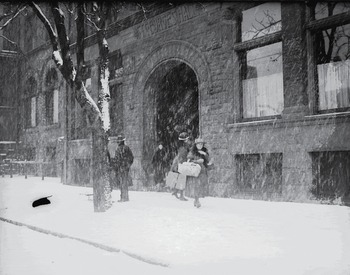
More than a century later, the New York St George's Society stressed similar principles, with the added espousal of sociability. The society ‘arose from the congenial feelings of some native English settled here, who felt, that though this was to be their permanent residence, they could not restrain the gratifying recollections of their native land, or be unmindful of the condition of any who might resort to their vicinity in a state of indigence or distress’.Footnote 56 Through such efforts, the English became successful in accumulating ‘endowments and annually dispensed several thousand dollars among hundreds of persons’.Footnote 57 Charity remained a constant throughout, but it was with mass migration in the nineteenth century that it became a more persistent issue and English associations in North America began offering practical support for immigrants.Footnote 58 Associational benevolence extended to handouts, meal tickets, employment agencies, return tickets home, forward passage to towns with work, and information about the state of the American economy. In New York, relief distribution systems were highly regulated to prevent abuse,Footnote 59 while English associations elsewhere stressed the importance of aiding the ‘deserving poor’.Footnote 60 The focus on the ‘deserving’ perhaps explains why Albert Jones of Toronto did not receive support from the local St George's Society: he was a single man with alcohol problems that affected his ability to work. Jones met the refusal with the comment that it was ‘unEnglish’ to do so.Footnote 61 Although it chose not to help Jones, the Toronto Society made many and varied contributions, including seasonal offerings to the English poor. In 1859, members made a ‘gratuitous distribution of meat, bread, potatoes, and wood on the day before Christmas’, thereby carrying ‘warmth and gladness to many a darkened home’.Footnote 62 Such ‘Christmas cheer’ remained a key feature of English associationalism in Toronto until well into the twentieth century (see Figure 1), and was common in other cities. Other St George's societies sought to intervene before such charity was needed, seeking to stem migration when times were hard. Hence the Philadelphia society placed adverts in English newspapers to warn immigrants against leaving home,Footnote 63 while in Canada the society wrote to the British government to oppose those emigration schemes from England that are ‘keeping this country overflowing with pauperism’.Footnote 64
‘Distributing Xmas cheer, St Georges Society’, 1922. Source: City of Toronto Archives, Fonds 1266, Item 0048.

Such patrician benevolence was a central component of Englishness overseas, especially that of the predominantly middle-class leaders of English associations: it was a powerful tool used to assert an English identity, but was also one founded on the principal belief that brotherly charity was necessary to solve prevailing social problems that were not sufficiently addressed by governments in the new places of settlement. The latter point also helps explain why benevolence was particularly important in the early phase of English associationalism in North America, but played no role, for instance, in New Zealand. The latter was only settled from the mid nineteenth century, and migrants who arrived there tended to be better off in socioeconomic terms than those migrating to other parts of the world. Consequently, there was comparatively less need for the type of patrician benevolence so crucial in North America: New Zealand's ethnic associations tended to focus on cultural pursuits and sociability rather than charity.Footnote 65
English associations and mass migration in the Anglo-world
English associations, well established in the easterly states of the US by the 1840s, moved west and south with migration. As the Midwest was opened up, Madison, Wisconsin, reported the existence of a St George's Society in 1856; two years later the tradition had made its way east to Milwaukee, as the number of English settlers proliferated.Footnote 66 The prominence of English societies, as evinced by the press, suggests that the established pattern of middle-class leadership remained key. Thus, in 1858, with their society newly formed, the Milwaukee English held their first major St George's Day dinner.Footnote 67 In Chicago, the St George's Society was founded in 1860; four years later members made an impressive splash with their sustained celebrations of the tercentenary of the birth of the bard, William Shakespeare.Footnote 68 These celebrations echo the character of the fine dinners, religious services, and other celebrations that were organized across the world. Some of the most impressive events occurred among the wealthy of New York at Delmonico's restaurant, or, in India, at the Mansion House, but similar events were also organized by the Cape Town St George's Society and various county associations in the 1890s.Footnote 69 In the US, Chicago had four different English groups by the mid 1890s: the Sons of St George, the St George Benevolent Society, the British American Society, and the Joliet Order of St George.Footnote 70 Meanwhile, in the eastern United States, with further migrations constantly replenishing English migrant communities, St George's societies were supplemented by smaller organizations, such as the Albion Society, which continued to hold annual dinners in the 1880s and 1890s.Footnote 71
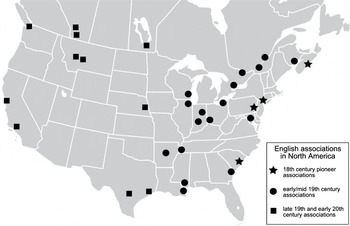
English societies began to appear further west in the 1880s (see Figure 2), reaching the Pacific coast from British Columbia to southern California.Footnote 72 Again, the role of the middle classes was in evidence, with ‘fifty influential English gentlemen’ forming the St George's Society of Southern California to combine ‘the usefulness of a club and some of the objects of a friendly association’.Footnote 73 An equivalent organization in San Francisco, the Sons of St George, also indicated the importance of economic collectivism in the style of friendly societies, being listed in a local newspaper under ‘Secret Societies’, along with many other financial-mutual organizations.Footnote 74 In the same decade, the Albion Society of Denver was holding large New Year parties.Footnote 75 As migrations also swept southwards, St George's Society activity was recorded in places such as New Orleans and Knoxville, Tennessee.Footnote 76 By the early 1900s societies had reached the Pacific shoreline, with branches in both Los Angeles and Pasadena.Footnote 77 In interwar Oakland, the two lodges of the American Order of the Sons of St George – Albion and Derby – were listed with dozens of other fraternities and societies.Footnote 78
English associations in North America: geographic trajectories over time.

In Canada, establishment of lodges of the Sons of England accompanied westward expansion. In Calgary, Alberta, the first Sons of England lodge, the United Roses Lodge No. 117, was established in 1890, when Harry Symons, a delegate from the Grand Lodge in Toronto, met with those interested in forming a branch.Footnote 79 Twenty members ‘were initiated into the order, taking the Red Rose Degree’.Footnote 80 The local press welcomed the establishment of the United Roses Lodge, noting that ‘we shall be greatly surprised if the Calgary lodge does not prove to be one of the largest and most prosperous in Canada’. Two years later in Winnipeg, Manitoba, the Sons were advertised specifically as a benevolent society, organized into lodges and holding regular meetings and annual events.Footnote 81 George Clift King was the United Rose Lodge's first president. Born in Chelmsford, Essex, in 1848, King had emigrated to Canada in 1874 and joined the North-West Mounted Police that year, making his way to the prairies. After being discharged, King settled in Calgary and was appointed postmaster, also serving as the city's mayor in the later 1880s and as a councillor thereafter. A recipient, in 1934, of the Order of the British Empire, King is a suitable representative of the type of middle-class Englishmen who loyally acclaimed the old home through associative behaviour.Footnote 82
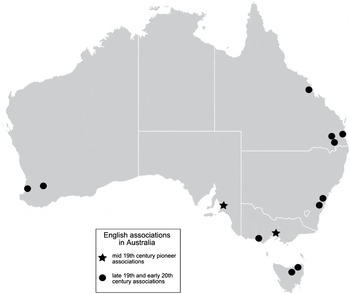
A similar relationship between the spread of English associations and migration and colonization is also noticeable in Australasia (see Figure 3). The country's first St George's Society was set up in Melbourne in 1847,Footnote 83 while Adelaide Englishmen mooted one in early 1845 before finally meeting in 1850.Footnote 84 Organized by dedicated Englishmen, the celebration of the national festival at times preceded the official formalization of associational structures, frequently providing a spark for their establishment.Footnote 85 By the turn of the century, numerous larger St George's societies could be found across the country, from Kalgoorlie and Perth in Western Australia, to Hurstville and Sydney in New South Wales; from Scottsdale and Launceston in Tasmania, and Warrnambool in Victoria, to Toowoomba and Brisbane in Queensland.Footnote 86
English associations in Australia: geographic trajectories over time.

In New Zealand, St George's societies were much sparser than in either Australia or North America and were late to develop – this tells us something about the comparatively small, concentrated populations of New Zealand, and may reflect a society characterized by Fairburn as lacking the social glue of associationalism.Footnote 87 The St George's Society in Auckland organized saint's day events between 1859 and 1861Footnote 88 and appeared to offer advice to potential immigrants from England, outlining ‘the peculiar advantages the Province of Auckland possesses as a field of emigration’.Footnote 89 But little else is known about the society. St George's Day had become a bank holiday in the 1870s in New Zealand. By the 1890s, 23 April was filled with sporting activities as part of a national culture of annual sports’ days and festivals that encompassed immensely popular Scottish Caledonian Games, Irish St Patrick's Day sports, races, and regattas.Footnote 90
English associations also extended to the remoter Pacific colonies and to the mercantile empire in Asia, where developments were not supported by large-scale immigrations. Hawai’i hosted a St George's Society;Footnote 91 and, in 1869, the Duke of Edinburgh, Prince Albert, offended members of the St George's Society in the Sandwich Islands by refusing an official dinner hosted by them.Footnote 92 In Madras, Singapore, Hong Kong, and Shanghai, English clubs were the preserve of elite administrators and military personnel rather than a popular movement. Events organized throughout the Anglo-world, such as the visit of the ‘Heir-Apparent and Prince-Consort’ to Singapore,Footnote 93 were not for hoi polloi. In parts of Africa – for example, Salisbury, Rhodesia and Cape Town, South Africa – elites and settlers blended together in English associations,Footnote 94 and middle-class elements established conversazione (polite, intellectual discussions and debates), while in India in the 1880s patriotic poetry was produced.Footnote 95
The growth of English societies in South Africa was primarily shaped by tensions with the larger Afrikaner population. Many societies there were transplanted directly from England; others were introduced from Canada,Footnote 96 which explains the existence of the Sons of England in Canada and South Africa alone. In Canada and the United States the English clubbed together against Irish and French threats, but in South Africa, where the Irish were sparse, Boer nationalism was the enemy. Lambert in particular has done much to recognize the flowering of various societies and associations in South Africa as focal points for expressing British identity in an increasingly hostile environment.Footnote 97 While certainly not as numerous as in other dominions, St George's Societies and the Sons of England were more important in South Africa than has been recognized, especially when added to the county societies that proliferated there, as they did in New Zealand.Footnote 98 Like their peers elsewhere, members in South Africa serviced social and cultural needs, laced occasionally with politics.
In the frontier towns of North America, associational ethnicity was much earthier than the middle-class enterprises of benevolence and fine dinners in the big cities of the east. In the prairie towns of the west, Canada's Sons of England organized coyote hunts, and their lodges took on the appearance of fraternal societies, with sashes and other paraphernalia.Footnote 99 Across all sites of settlement, however, the English sponsored membership as a way of life for all family members rather than just for males. Just as with churches, football clubs, Boy Scouts, and many other ethnic associations (such as the St Andrew's Society, the Hibernians, and the Orange Order), English societies offered rational recreation for youngsters in the hope of raising good citizens of empire. Thus in 1920 the Sons of England had juvenile lodges in Toronto and Ottawa with 150 members in total.Footnote 100
Transnational connections between English ethnic associations
We began with a spectacular instance of transnational corporate identity: the ‘Wave of Song’ uniting English ethnic associations around Queen Victoria's Diamond Jubilee. Such connectivity had earlier roots. Not simply localized in their organization, English societies federated within and across national communities. In the United States, the working-class Sons of St George organized gatherings of county and state delegates from the east coast and the Midwest.Footnote 101 Transnational connections were also fostered through societies hosting visiting dignitaries from back home. When Lord Napier, the queen's minister in Washington, addressed the St George's Society dinner in New York, in 1857, he reflected on ‘Anglo-Saxon amity’ and the union of the peoples of Britain and America.Footnote 102 The Liberal politician Joseph Chamberlain returned from a visit to the United States full of praise for the hospitality of the Sons of St George, more than three thousand of whom had attended his reception. They were, he wrote, ‘as fine a lot of working men, all of them British with the exception of a few from the North of Ireland, as I have ever seen … and intensely sympathetic with the old country, while they were also loyal American citizens’.Footnote 103
The North American St George's Union was formed in the early 1870s to bring together diverse US and Canadian English organizations. From the early 1880s local English societies hosted roving conventions for this organization, each in a different city. In 1880, the convention met in Ottawa; at other times, Union events – meetings, picnics, and gatherings – were reported as far afield as San Francisco and Petersburg, Virginia.Footnote 104 In August 1884, the Eleventh Convention met in Chicago, hosted by the Chicago St George's Benevolent Association and attracting delegates from Washington, Toronto, Philadelphia, and Bridgeport, Connecticut. Topics suggested for discussion ranged from how Shakespeare's works might ‘be further popularized as the best means of perpetuating vigorous English speech’, to ‘the future relations of the English-speaking communities with respect to the motherland and to each other’.Footnote 105 Members were treated to lectures and cultural activities; reunions were another intrinsic feature, as were leisure pursuits, such as the ‘drive about the city’ and an excursion to Pullman. The 1894 Convention in Toronto brought together delegates from over 100 lodges, while the 1927 meeting hosted over 200 representatives.Footnote 106
The RSStG, founded in London in 1894, provides the clearest example of the transnationalism of Englishness, becoming a global focal point for English ethnic associations throughout the world. Forming such a society confirmed middle-class domination of ethnic societies, but also marked a significant imperial turn – from economic collectivism or simple sociability to a staunch defence of empire. Glorification, celebration, and an urgent form of identity replaced the more gentlemanly credo of the eighteenth century. Crucially, this was an example, pace Young, of the English at home responding to Englishness in the colonies. The essence was captured well in the message of Howard Ruff, honorary secretary of the RSStG, London:
… it is now generally conceded … that a day of celebration in the interests of Empire is a pressing necessity of our times, and there is a general consensus of opinion that St George's Day, 23rd April, is the most suitable day in every way for that purpose – and one which all members of our glorious Empire, irrespective of creed or party, could adopt.Footnote 107
The RSStG became the headquarters of many new branches. Sydney Englishmen formed a branch in 1900;Footnote 108 in Blantyre, in modern-day Malawi, notables spent late 1904 and early 1905 establishing a branch.Footnote 109 In the early 1900s, numerous RSStG branches were noticed in Southeast Asia: Singapore, Kuala Lumpur, Negri Sembilan, Malacca, and Shanghai. Local papers reported instances of St George's societies and published RSStG annual reports, thereby ensuring that branch societies in Singapore and the surrounding areas were connected to the global community.Footnote 110 Salisbury, Rhodesia, inaugurated a branch in 1912; a year later, Mombasa experienced similar developments; and, after much discussion, a branch appeared in Gwelo, Bulawayo, in 1918.Footnote 111
Connections were cemented by grand dinners and lavish events organized by far-flung St George's societies for visiting politicians, writers, admirals, or clerics, and by telegraphic communications from headquarters to the branches. Many rose to give approving applause at dinners around the world, such as when Admiral Sir George Fowler addressed the Sydney branch in 1913, news of the event reaching New Zealand.Footnote 112 When the London group sent St George's Day greetings around the world via cable, the branch in Launceston, Tasmania, responded ‘your England is our England’.Footnote 113
In all sites of settlement, monarchical loyalty was a requirement, though few went as far as the wealthy Philadelphia St George's Society, which commissioned a portrait by William Sully to mark Queen Victoria's accession.Footnote 114 Reverence for the queen could, however, create accusations of divided loyalty. In 1862, during the American Civil War, with notable tensions between Britain and the US, the Philadelphian Englishmen included ‘England’ and ‘America’ in their programme of toasts, but not the queen. Sometimes the order of toasting placed the queen ahead of the president, sometimes not.Footnote 115 In contrast, Canadian loyalists raised glasses, without fear of criticism, to both the queen and the governor-general.Footnote 116 The St George's Society, Hawai’i, toasted the president, the queen, and the king of Hawai’i.Footnote 117 In Australia, the St George's Society demonstrated clear patriotic intent, in November 1904, by asking the Australian prime minister to adopt the reigning monarch's birthday as Empire Day.Footnote 118
Besides dinners and toasts, St George's societies held dances, promoted lectures, and organized sports.Footnote 119 At Blantyre, the RSStG put on cricket matches, ‘old English glees, games, and dances’, and fancy dress balls.Footnote 120 In Malacca, in 1923, St George's Day was celebrated with a cricket match and a fancy dress ball. The Malacca Society had a membership of 143 in 1925, while the Selangor membership stood at 231 in 1927.Footnote 121 At Kuala Lumpur, in 1934, a pyjamas dance was ‘among the suggestions for celebrating the day of England's patron saint’; while, in 1937, 300 loyal followers of St George came together for the annual gathering at the Eastern Hotel, where they ‘were a chorus of merry-makers’.Footnote 122
New Zealand proffered fewer instances of English national associations than any other country.Footnote 123 As was observed by the editor of The Star, Auckland, ‘for some unexplained reason, St George's Day has never been observed in New Zealand, except as a bank holiday’.Footnote 124 Equally, four years later, when the Englishmen of the town of Thames considered establishing a branch of the RSStG, readers of the local newspaper were reminded that ‘It has long been a reproach to New Zealand that in this Dominion there exists only one branch of the Royal Society of St George’.Footnote 125 But New Zealand made up for its lack of English national societies with English county societies.Footnote 126 In many cases, these societies were surrogates for national associations, taking responsibility for festivities on the national saint's day and other patriotic events. In Wellington, a Yorkshire Society was established in 1895.Footnote 127 The Society's inaugural dinner was held in January the following year, complete with ‘sheep's trotters, stewed tripe and onions’ and Yorkshire pudding. ‘The object of the society’, stated its president, the Rev. J. C. Andrew, ‘was to promote social feeling among Yorkshiremen, to aid in charitable work, and … to read and receive papers upon the antiquity of the county’.Footnote 128 Settlers from Lancashire, Cheshire, Dorset, Kent, Northumberland, and Durham made similar efforts.Footnote 129
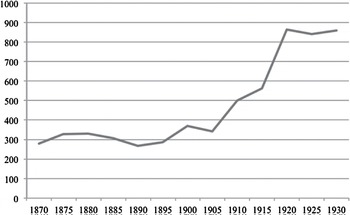
These widespread examples of English associational activity demonstrate that English associationalism was much more important than has been recognized. It may not have attracted the sheer weight of numbers of Irish organizations, such as the Ancient Order of Hibernians, and was certainly no more geographically widespread than the many Scottish societies. Yet English associations were not small or restricted. Annual membership of the New York St George's Society alone came close to 900 in the 1920s, and had averaged over 3300 from the 1870s (see Figure 4).Footnote 130 On an entirely different scale, the working-class Sons of England, Canada, counted 30,000 members on the eve of the First World War.Footnote 131
New York St George's Society Annual Membership, 1870–1930

During the early twentieth century, when these societies reached their maximum extent across the Anglo-world, commemorating military victories became a common point of connection. In 1904, in Brisbane, imperial patriotism inspired a series of celebrations of both Balaclava and Agincourt.Footnote 132 The English of St John, New Brunswick, marked the hundredth anniversary of Trafalgar in 1905 with a dinner, and a suitable resolution was passed to honour Lord Nelson, ‘the greatest of admirals, whose memory should be revered’.Footnote 133 In 1907, their peers in Hobart, Tasmania, marked Trafalgar Day with dinners, lectures, and memorials.Footnote 134 Magna Charta day also entered the St George's Society calendar and was specifically sponsored in the 1920s by the Magna Charta Association.Footnote 135 Described as ‘an English-speaking Union’, the Association certainly convinced newspapers in as diverse places as Adelaide and Iowa that this was a worthy ventured based on shared liberties enshrined at Runnymede.Footnote 136 Sir James Barrett, the prominent Victorian doctor and civic leader, ran Australia's Magna Charta Association for years.Footnote 137 For him, the First World War had been about defending the principles wrested from the craven King John.Footnote 138
These associations also demonstrated transnational loyalty during war and other times of crisis. The Hong Kong English sold First World War bonds to raise funds for the imperial war effort. Posters and brochures depicting St George attacking a German soldier brought the themes of Englishness and war together – an effort also supported by the Patriotic League of Britons Overseas. In January 1916, the League wrote to the Charleston St George's Society asking whether they would assist in setting up a branch of the League, which ‘now has 129 branches in various parts of the world, all of which have been established in the last nine months’.Footnote 139 After the War, the RSStG in South Australia petitioned the state government to make cheap land available for returning servicemen at the expense of ‘Germans’, ‘enemy aliens’, and ‘disloyalists’ who have not supported the war.Footnote 140 During the 1930s, the wealthy of the colonial world turned their benevolence towards the sufferings of the unemployed in Britain and Europe, with Kuala Lumpur and Singapore making considerable donations.Footnote 141 Like their American counterparts many years earlier, the Shanghai RSStG warned ‘about the increasing number of unemployed Englishmen arriving in Shanghai in search of work’.Footnote 142
The English and inter-ethnic relations
Thus far, our analysis has focused upon the ties that bound Englishmen and Britons together through the agency of ethnic associations. While St George's Day celebrations, as we have seen, were by no means universal (a fact sometimes blamed on the Englishman's less ‘clannish nature’Footnote 143), English activities met with approval in all of the British dominions and in the wider empire. In three places, however, there was varying hostility to English and British imperialism: in Ireland, where nationalist sympathies evoked a degree of anti-imperial feeling; in South Africa, during the Second Anglo-Boer War, where the Dutch settlers directly resisted the empire; and in the United States, where Irish nationalist passions consistently ran highest. Particularly in the US, sustained discordant notes were sounded, and English and British conflict with the Irish could be severe. We see this in the dissentient noises heard in response to the Diamond Jubilee celebrations in 1897. Catholic priests in Chicago, for example, marked the jubilee with a memorial service for Irishmen martyred by British rule in Ireland.Footnote 144 And, in Ireland, James Connolly and Maud Gonne denigrated the jubilee with black flags bearing the grim statistics of the famine and a symbolic coffin, which they marched through Dublin and dumped in the River Liffey.Footnote 145
Yet sectarian cleavages had not been present at the inception of these associations. The Sons of St George Society, for example, was avowedly constructed ‘not for the Purpose of keeping alive invidious national Distinctions, which ought particularly to be avoided between the different Nations which compose the British State in America, where, all the Freemen (from wheresoever they originally migrated) are BRETHREN, FRIENDS, and COUNTRYMEN’.Footnote 146 For elites, charity and humanitarianism remained guiding principles. Consequently, ethnic attachments did not prevent wealthy Englishmen and Irishmen from socializing.Footnote 147 Such gatherings were acts of gentlemanliness among civic notables, visiting dignitaries, and the immigrant community's wealthiest members. By the 1880s, English gatherings in New York, Philadelphia, Toronto, and other major centres had become key dates in the civic social calendar. Thus, in the 1890s, with tables packed with senators and local dignitaries, the Hibernians of Philadelphia welcomed the Albion Society to their annual St Patrick's dinner.Footnote 148
However, for a wider spectrum of Irish society, ethnic cooperation with the English presented a severe challenge. The Great Famine (1845–52), which sent a million Irish to their deaths and even more fleeing Ireland's shores, had helped create an Irish-American lobby that was voluble in its critique of English imperialism. Growing Irish nationalism flowed into currents of American identity defined by revolution against the colonial British enterprise. While the elite may have been perfectly happy in pan-ethnic company, united in their social interests more than divided by their national origins, militant viewpoints also existed. Consequently, the president of the St Patrick's Society of New York was chided severely in 1854 for accepting an invitation to the annual St George's dinner.Footnote 149
Irish anti-English attitudes tapped a wider American ideal: loyalty to the United States alone. Some Americans questioned the English tendency to toast their queen in a free, foreign country. As one magazine editor wrote, American citizens of English birth, who had ‘solemnly abjured and renounced’ Victoria in favour of ‘plain Uncle Sam’, had no right to maintain a dual affection for empire and republic.Footnote 150 Thus Englishmen were often challenged to demonstrate loyalty, not to monarch and empire, but to the president and the republic of their adopted homeland. St George's societies courted favour in this respect by commenting upon the shared libertarian heritage of England and America, ensuring that both monarch and president were toasted. In loyalist Canada, or Australia and New Zealand, pledges of English pride carried none of the negative connotations that Irish nationalists and American republicans imputed to St George's societies in the United States.
Englishmen felt the threat of Irish nationalism, manifested most clearly in Fenianism. In 1866, in the context of the Fenian raids on Canada, the Chicago Tribune picked up on cross-border anxieties when it reported simultaneous celebrations to mark the queen's birthday in both the US and ‘the land of beaver and Fenian scares’.Footnote 151 But less well-known threats also existed. The British Consul noted how, in the 1870s, Britons and Americans founded the Sons of St George in Scranton, Pennsylvania,Footnote 152 because ‘three Englishmen were brutally murdered in the coal regions’ of the state, and he recognized how fraught English–Irish relations in that state could be. Matters were made more serious, in English eyes, when the community hid the killers’ identities, while ‘two of the known murderers and their families were quietly spirited away from the processes of the law’. The cause of these activities was ‘the well-remembered “Molly Maguires”, an organisation of assassins said to be a wing of the Ancient Order of Hibernians’.Footnote 153 After the Mollies’ outrages had subsided, however, the Sons began to focus on cultural dimensions of ethnicity, with ‘the families of the various lodges meet[ing] together socially on stated occasions, thereby keeping live the English love of the country and the festivities of her fête days’.Footnote 154
Specific displays of English and British patriotic imperialism sometimes stirred violent indignation in the Irish. Boston, in 1887, provided a spectacular case, as thousands of Irish sought to scupper celebrations for Victoria's Golden Jubilee. In a city where the Irish had fought hard to secure a political bridgehead against the Brahmin elite,Footnote 155 the jubilee provided a further opportunity for assertions of Irish civic-political power. Fired up by an Irish priest who thought this display of monarchical devotion would be a ‘desecration of the Cradle of Liberty’,Footnote 156 15,000 of them surrounded the public hall to prevent the banquet. The English met this threat by taking up citizenship en masse to block the political power of the Irish, simultaneously reaching a concordat with city Yankees. A branch of the British American Association (BAA) was the result, founded by the committeemen who had planned the Queen's Jubilee celebrations.Footnote 157 Indeed, the progress of the BAA suggests that this sectarian conflict was commonplace. First appearing in New Jersey in 1874, the BAA spread to Worcester, Massachusetts, in 1883, Philadelphia three years after that, and then to New Bedford, Massachusetts, by 1887.Footnote 158 Boston was simply the latest city in which the English, in the shadow of growing Irish power, had resolved to protect their interests.Footnote 159 By the 1880s there were branches in Chicago, Milwaukee, and nearby towns.Footnote 160 In the mid 1890s, the British-born of Chicago – Manx, Canadian, Irish, Scots, Welsh, and English – reorganized the BAA into the Victoria Club with the same intention: to win political influence.Footnote 161
Patrick Ford, editor of the Irish World and Industrial Liberator, America's most prominent Irish nationalist newspaper, regularly attacked England's Irish policies. Patriotic gatherings of Englishmen on St George's Day were obvious targets for nationalist ire. In 1898, the paper lambasted the ‘Anglomaniacs’, men ‘born on American soil’ who ‘are more English than the English themselves’, who criticized all things American. The warmth of transatlantic relations clearly irked a newspaper dedicated to removing the British from Ireland, hopefully with American help. It also noted critically how Charles Turner, the American Consul-General in Ottawa – an ‘Angloman who craves for an Anglo-American alliance’ – was fêted by the Canadian St George's Society on St George's Day.Footnote 162 The same theme was picked up again in animated fashion in 1899 when the newspaper attacked the British, the pro-British administration in Washington, Protestant ministers, and the St George's Society of New York, under the heading ‘Anglo-Saxons to rule the earth’.Footnote 163 The headline was a quotation from a caption in the New York Herald, ‘over its account of the self-glorification in which these expatriated Englishmen indulge’.Footnote 164 In the same year, the newspaper also levelled a blow at the Brooklyn Sons of St George, a society ‘composed of Englishmen who are in the United States for money making only’, who were gathered in honour of the queen's birthday. In particular the paper was critical of the main speaker, the Rev. Dr F. De Costa, later president of the Magna Charta Association, who claimed that Queen Victoria was the most ‘important woman in the world’ since the Virgin Mary, something the Catholic Irish World regarded as blasphemy.Footnote 165
Sectarian competition also reared up in Canada, where, in 1874, the initially clandestine, militant Sons of England was formed. Anti-Englishness fired up the pioneers. George Carrette, one of the founder members, told the Sons’ first historian that he helped establish the Order after his friend told him of ‘some words he had heard … against Englishmen’ that raised in him a belief that it was ‘time for Englishmen to combine for their own protection’.Footnote 166 Comparatively weak associationalism played a part: of all ethnic groups derived from the British and Irish Isles, the Sons reckoned, only the English poor were so ill-cared-for that they had to turn to the parish for help.Footnote 167 The weakness of English efforts next to those of the Scots and Irish caused the Sons to ask: ‘Is an Englishman's heart less warm or less true to his countrymen than are the hearts of those claiming a different nationality to his own?’Footnote 168 The Sons first came to public attention in the 1887, when they caused a stir as part of a general mustering of loyalists against the supporters of home rule during a series of lectures by the nationalist MP, William O’Brien. The authorities feared a general riot and the press lumped the Sons of England, which was said to have 10,000 members, with the Orange Order and various militias as a potentially violent bulwark against Irish nationalism.Footnote 169 This aspect of Englishness – belligerent, proletarian, Unionist, anti-nationalist, and anti-Catholic – found a natural home with Canadian and American Nativist organizations.Footnote 170
In Australia, too, there was a degree of sectarian watchfulness about these English and British societies. The Melbourne St George's Society was formed at a time, in the 1840s, when the local press believed that the Irish Ribbon Society was at large in the colony.Footnote 171 The English were chided for not forming societies when the Irish versions flowered. Much later, in the 1880s, the press teased Englishmen for looking on while the Scots and Irish ran the colonies.Footnote 172 However, the English expressed ethnic viewpoints when it suited them. When Colonel Burrows addressed the St George's Society of Kalgoorlie in 1918, he lamented how, though the majority of troops fighting in the First World War were English, their deeds were not separated from the British and received none of the attention given to Irish, Scottish, or Welsh contributions.Footnote 173 In 1920, Brisbane's St George's Society voiced strong opposition to the appointment of an Irishman, Mr W. Lennon, to the Lieutenant-Governorship of Queensland, expressing the view in newspapers and via the parent society in London.Footnote 174
The English ethnic tradition inevitably also came into conflict with the Dutch in South Africa, against whom a war erupted. Lasting three years (1899–1902), this conflict resulted in a wave of patriotic organizations and a spurt of growth for existing societies, including the Sons of England and the St George's societies. A new harshness was also noticeable in the language of English associations, especially in southern Africa, as sociable ethnicity was overtaken by political events. Indeed, the St George's platform was regularly given over to expressions of political support for Britain's war in South Africa.Footnote 175 In Rhodesia, strident language suggested a firmly racial viewpoint: in 1900, at the formation of the Society of St George in Salisbury, the secretary described it as part of a ‘mighty Zollverein of the Anglo-Saxon race’.Footnote 176 The politicization of the St George's tradition in South Africa, which was a function of a context of brutal war, was demonstrated by the clear support given at meetings for Lord Alfred Milner's aggressive stance on how to tame the Dutch republics.Footnote 177
The Boers, then, were resisted and dismissed with an assertion of English history and values, and one that was wrapped up not only with Anglo-Saxon superiority but also with the laudation of Britishness. This helps explain why, in South Africa, intense local issues created more political discussion among ‘patriotic societies’ than elsewhere. In more general terms, then, Englishness (with its specific references to liberty, opposition to arbitrary power, fair play, and democracy) was seen to underpin the empire as a feature of a larger community of Britons and neo-Britons at home and in the colonies. Hence, while Englishness and Britishness might have been blurred, the English contribution was made clear: an imperial subject may have been British, but the values that he or she upheld had been spawned in England.
Conclusion
English national identity is complicated by three factors: the long-lived nature of the English nation-state; the requirement actively to promote Britishness as an inclusive identity; and the fact that so much that was important in the conceptualization of English values occurred beyond her shores. The first of these factors explains why the English associations described here have been overlooked. The second and third, observable in the globalization of English ethnic societies, explain why such societies are important.
We believe that the rise of English associations cannot be described solely as a modern phenomenon: our evidence points to the melding of two approaches to ethnicity and nationalism. We observe the roots of ethnic associations in pre-modern sociability and charity, which slowly changed into a modern ethnic tradition shaped by contemporary phenomena, particularly mass migration and imperialism. The creation of a global Anglo-Saxon identity that could encompass Americans, colonials, all manner of Protestants, and still find room for patriotic Catholics, signalled close connection between what we describe here and the wider strains of both imperial and Anglo-Saxon identities.Footnote 178 The political closeness of the UK and the US from the late 1890s also helped cement the shared elements within this global identity as a check on external threats posed by other rising powers.
Celebrating the jubilee of 1897 demonstrated the reach of English societies. In those terms, much more needs to be said about the organization of English ethnicity in the empire, especially the local, regional, and transnational contexts in which it operated in the period up to and beyond the First World War, when fledgling nations emerged from colonies of settlement. If the Australians shared ‘your England’ with the St George's Society of London (which they claimed to do), and if Canadians, English-Americans, and New Zealanders answered the rallying cries of ‘Greater Britain’ (which they did), then these enduring associations played some part. That ‘English’ and ‘British’ blurred into each other helps explain why the former is less prominent than it might be. But the discussion here has shown that, whether calling themselves English or British, the English knew that they shared a worldview across the oceans and that English customs and traditions underpinned even that which was British. Moreover, the English demonstrated such ideas in times of peace as well as war. In 1920, the Sydney RSStG remembered the sacrifices of war; it looked on with unease at the political situation in Ireland, while suggesting that Englishmen around the globe might again show their mettle, even if ordinarily their passions remained invisible below the surface. For, ‘the love of England is deep in our hearts and will spring to life like a flaming sword if ever the need should arise’.Footnote 179 However, it was not just the English who felt this way: an array of neo-Britons shared this vision and answered the call.