Non-technical Summary
In northern Iran, the late Cambrian trilobites have been documented largely from Furongian deposits exposed at Mila-Kuh, Shahmirzad, and some sections in western Alborz, whereas the available information on this group of fossils from the sections located in eastern Alborz is sparse. The major objective of the paper is a small trilobite assemblage, assignable to the Parabolina Fauna, which has been recovered for the first time from the Furongian (Cambrian Stage 10) Sah Member of the Mila Formation in the Tuyeh–Darvar section, eastern Alborz, northern Iran. This assemblage includes eight genera and species; two of them, Niobella darvarensis n. sp. and Macropyge (Promacropyge) sahensis n. sp., are new to science. The incursion of this fauna into Alborz probably occurred due to a significant drowning event and associated dark-gray shale deposition. While the generic composition of the assemblage is mostly cosmopolitan, it also contains a local endemic Alborsella; although some taxa exhibit a distinct sign of faunal links with South China and Tarim. On the other hand, Parabolina (Neoparabolina) frequens, which is common in olenid trilobite associations, is widespread mainly offshore in deposits from temperate Gondwana (Armorican terrane assemblage, Argentina) and Baltica of about that age.
Introduction
In the Alborz Mountains, Furongian trilobites from Cambrian Stage 10 are mainly known from publications by Kushan (Reference Kushan1973), Wittke (Reference Wittke1984), and Peng et al. (Reference Peng, Geyer and Hamdi1999). In addition, Geyer et al. (Reference Geyer, Bayet-Goll, Wilmsen, Mahboubi and Moussavi-Harami2014) and Álvaro et al. (Reference Álvaro, Ghobadi Pour, Sánchez-Garcíad, Kebria-ee Zadeh, Hairapetian and Popov2022) published extensive lists of Cambrian (Furongian) fossils including trilobites documented from Alborz. These trilobites are largely from Furongian deposits exposed at Mila-Kuh, Shahmirzad, and some sections in western Alborz, whereas information on trilobites from the Furongian sections of eastern Alborz, east of Mila-Kuh, is very sparse. The only trilobite yet illustrated from the Tuyeh–Darvar area is Iranoleesia pisiformis (King, Reference King1937) (Álvaro et al., Reference Álvaro, Ghobadi Pour, Sánchez-Garcíad, Kebria-ee Zadeh, Hairapetian and Popov2022, fig. 4c) from the Iranoleesia Zone, Drumian, Sartangeh Member (formerly Mila Formation Member 2), while no Furongian trilobite previously has been reported from the area. The late Furongian trilobite assemblage recovered for the first time from Tuyeh–Darvar is also unusual for the entire Alborz region in taxonomic composition, because it includes a number of taxa characteristic of upper offshore settings. The most distinctive among them are the olenid Parabolina (Neoparabolina) frequens (Barrande, Reference Barrande1868), the asaphide Macropyge (Promacropyge), the agnostoid Agnostotes, and the enigmatic Indiligens. The occurrence of Parabolina and a significant agnostoid component, including Leiagnostus and Micragnostus, allows us to consider this assemblage as a local variety of the Parabolina Fauna.
Geological setting and stratigraphy
The Cambrian (Furongian) trilobite assemblage here described was sampled from a fossil locality situated 1.1 km southeast of the southern outskirts of Tuyeh village along the road connecting the villages of Tuyeh and Darvar, about 48 km southwest of the city of Damghan in the eastern Alborz Mountains (Fig. 1). The geographical coordinates of the fossil locality are 36°1′17″N, 53°52′31″E. The Cambrian stratigraphic succession in the area was revised and discussed by Geyer et al. (Reference Geyer, Bayet-Goll, Wilmsen, Mahboubi and Moussavi-Harami2014) and Álvaro et al. (Reference Álvaro, Ghobadi Pour, Sánchez-Garcíad, Kebria-ee Zadeh, Hairapetian and Popov2022). The Furongian lithostratigraphy used in the present publication is adopted from Álvaro et al. (Reference Álvaro, Ghobadi Pour, Sánchez-Garcíad, Kebria-ee Zadeh, Hairapetian and Popov2022). The Miaolingian to Furongian part of the Tuyeh–Darvar succession is assigned to the Mila Formation, which is subdivided into the Varzam (formerly Mila Formation Member 1), the Sartangeh (formerly Mila Formation Member 2), the Qol-Qol (formerly Mila Formation Member 3), the Sah (formerly Mila Formation Member 4), and the Absharaf (formerly Mila Formation Member 5) members listed in ascending order. The base of the Qol-Qol Member closely coincides in the neighboring Mila-Kuh section with the onset of the Steptoean Positive Carbon Isotope Excursion (SPICE) (Álvaro et al., Reference Álvaro, Ghobadi Pour, Sánchez-Garcíad, Kebria-ee Zadeh, Hairapetian and Popov2022), and therefore can be correlated with the base of the Furongian Series.
(1, 2) Geographical map of central-northern Iran, showing the position of the Tuyeh–Darvar section (red diamond). (3) Schematic geological map of the vicinity of Tuyeh village showing the location of the measured sections at Mila-Kuh and Tuyeh–Darvar (short purple lines). Legend: 1, measured sections; 2, Cambrian, unspecified (Terreneuvian–Cambrian Series 2); 3, Mila Formation, Cambrian (Miaolingian–Furongian); 4, Devonian–Permian, unspecified; 5, Carboniferous (Serpukhovian) A-type granitoid intrusions.

The Qol-Qol Member, up to 60 m thick, is composed of echinoderm packstones, interbedded with numerous brachiopod shell beds that contain disarticulated valves of the billingsellids Billingsella? fortis Popov et al., Reference Popov, Kebria-ee Zadeh, Ghobadi Pour, Holmer and Modzalevskaya2013, and Hyrcanostrophia tuyehensis Popov et al., Reference Popov, Kebria-ee Zadeh, Ghobadi Pour, Holmer and Modzalevskaya2013 (Fig. 2, samples M8D and M10D). According to Geyer et al. (Reference Geyer, Bayet-Goll, Wilmsen, Mahboubi and Moussavi-Harami2014), the unit was deposited along the margin of a restricted carbonate platform with microbial-anthaspidellid sponge build-ups. It is overlain conformably by the Sah Member, about 80–85 m thick, which comprises several intercalated units of bioclastic and nodular limestones, shales, and siltstones. Geyer et al. (Reference Geyer, Bayet-Goll, Wilmsen, Mahboubi and Moussavi-Harami2014) reported that aggradational, progradational, and retrogradational stacking patterns observed in the Qol-Qol and Sah members suggest significant consecutive sea-level changes in the area, but no further details were published.
Stratigraphical columns of Mila-Kuh and Tuyeh–Darvar sections showing lithostratigraphical subdivisions, and stratigraphical distribution of trilobites, brachiopods, and conodonts (Jahangir et al., Reference Jahangir, Ghobadi Pour, Ashuri and Amini2016). Legend: 1, sandstones; 2, intercalated siltstones and sandstones; 3, dark-gray shales and siltstones; 4, limestones (unspecified); 5, red siltstones and sandstones of Geirud Formation; 6, carbonate nodules; 7, unconformity.

The observed succession of the Sah Member in ascending order is as follows:
(1) up to 7 m of bioclastic limestones and brachiopod shell beds intercalated with subsidiary argillite and siltstone beds, including a 1.5-m-thick bed of argillites at the base;
(2) up to 3 m of intercalated thin-bedded glauconitic limestones, sandstones, and argillites;
(3) up to 8 m of green argillites and siltstones with subsidiary decimeter-scale limestone beds;
(4) 4–5 m of thin-bedded, nodular bioclastic limestones with brachiopods Darvaretoechia prisca Popov et al., Reference Popov, Kebria-ee Zadeh, Ghobadi Pour, Holmer and Modzalevskaya2013, and Palaeostrophia tecta Nikitin and Popov, Reference Nikitin, Popov, Apollonov, Bandeletov and Ivshin1983 (Fig. 2, sample M4/3TD);
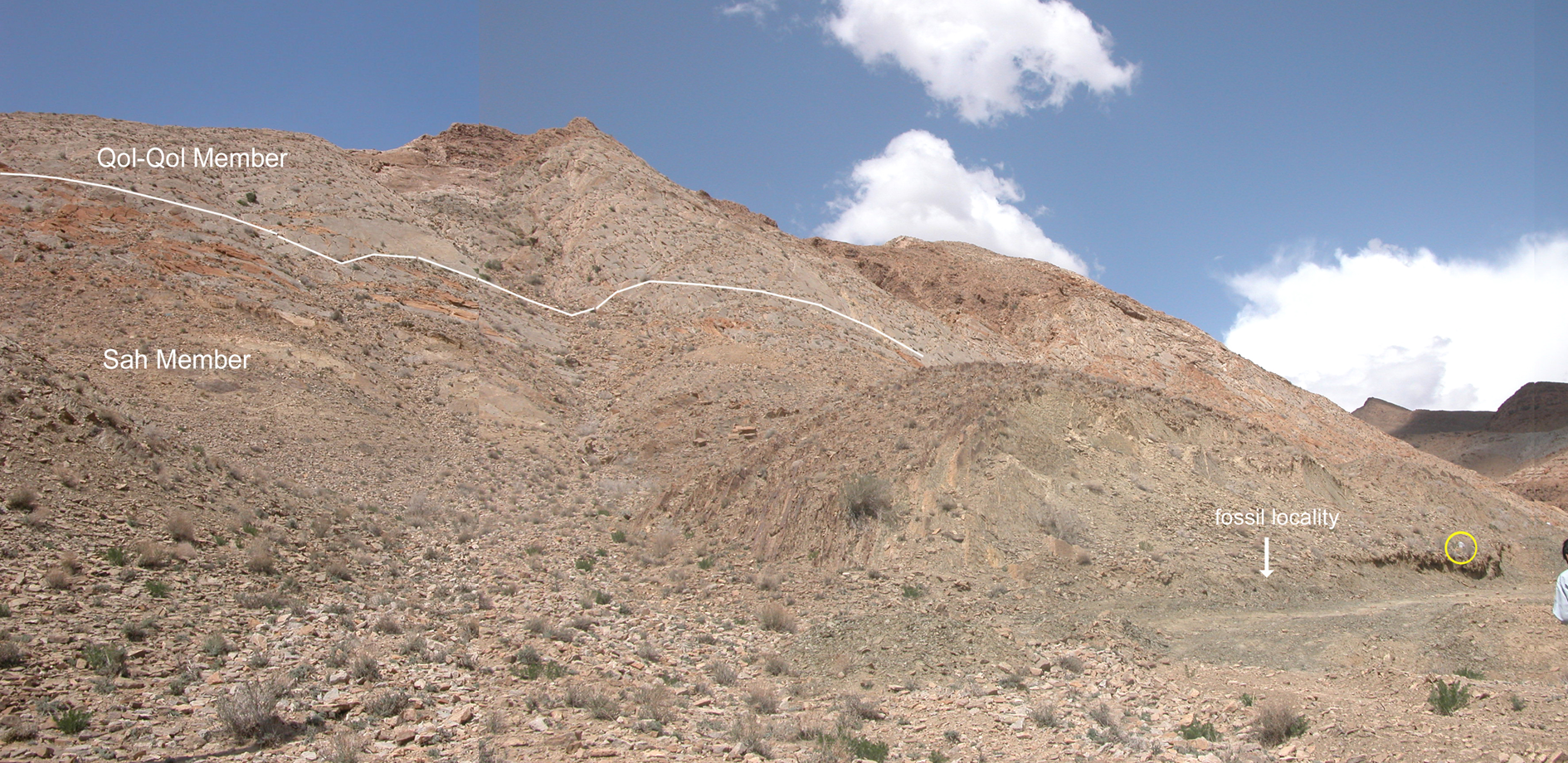
(5) up to 10 m of intercalated dark-gray shales and siltstones with an up to 3-m-thick trilobite-bearing shale bed at the top (Figs 2, 3, sample M4/4TD);
Figure 3.Northerly view of the exposure of the Furongian Qol-Qol and Sah members of the Mila Formation, north of Darvar village, showing the position of the trilobite locality (photo by M. Ghobadi Pour, 2006). Yellow circle shows a plastic bag (30–40 cm) as scale.

(6) up to 50 m of interbedded green argillites, siltstones, and subsidiary sandstones, which increase in proportion in the upper 20 m, and with a few dm-scale impure limestone bands, ~10- to 15-cm-thick bed of flat-pebble carbonate breccia in the upper part.

The succeeding Absharaf Member is generally eroded away and represented by lens-like bodies of coarse- to medium-grained sandstones containing the trace fossil Cruziana omanica Seilacher, Reference Seilacher, Crimes and Harper1970. The Cambrian succession in Tuyeh–Darvar is unconformably overlain by the Upper Devonian Geirud Formation.
The trilobite assemblage described here includes Leiagnostus bexelli Troedsson, Reference Troedsson1937, Micragnostus chiushuensis (Kobayashi, Reference Kobayashi1931), Agnostotes sp. aff. A. sulcatus Lin and Zhang in Zhu et al., Reference Zhu, Lin and Zhang1979, Parabolina (Neoparabolina) frequens, Niobella darvarensis new species, Macropyge (Promacropyge) sahensis new species, Alborsella stoecklini Kushan, Reference Kushan1973, and Indiligens sp. They were recovered mostly from a shallow pit made on the surface of the strongly weathered dark-gray shales in the upper part of unit 5 (Figs. 2, 3, sample M4/4TD). The specimens occur through a 3-m-thick fossiliferous interval. The trilobite sclerites are mostly disarticulated and partly decalcified; however, complete or partly disarticulated exoskeletons were also found. A dense trilobite mass-molt assemblage formed by Niobella darvarensis n. sp. (Fig. 6.2) was sampled from a single bedding surface. The taxonomical composition of the assemblage, which includes the olenid Parabolina (Neoparabolina) frequens and a sizeable proportion of the agnostoid taxa, suggests that it represents a local variety of the Parabolina Fauna (sensu Shergold, Reference Shergold1988, and Balseiro et al., Reference Balseiro, Waisfeld and Vaccari2011a), which was widespread in the late Furongian, mainly in outer shelf settings of the Central Andean Basin, Famatina, Oaxaquia, Avalonia, Baltica, and Łysogory.
As was pointed by Balseiro et al. (Reference Balseiro, Waisfeld and Vaccari2011a, p. 488), the observed features of taphonomy, characterized by a wide range of well- and poorly preserved trilobite sclerites strongly variable in size, may suggest slow background accumulation rates and a low-energy environment intermittently interrupted by storm-related burial, which is particularly characteristic of Parabolina Fauna associations in Argentina. The trilobite-bearing dark-gray shales of unit 5, deposited in the upper offshore environment, rest with a sharp contact on shallow marine carbonates with abundant brachiopods. Therefore, it is likely that the incursion of the Parabolina Fauna, which was highly atypical for the region, occurred during a major drowning event, while the overlying shallowing-upward siliciclastic succession of unit 6 may represent a high-stand systems tract (HST).
There are no data on the conodont biostratigraphy published for the Tuyeh–Darvar section; however, conodont data are documented for the Mila-Kuh section exposed 6.7 km to the west (Müller, Reference Müller1973; Jahangir et al., Reference Jahangir, Ghobadi Pour, Ashuri and Amini2016). Remarkably, at Mila-Kuh the first documented occurrence of Cordylodus proavus Müller, Reference Müller1959, is located 41 m above the base of the Sah Member. At Tuyeh–Darvar, the Parabolina trilobite assemblage was sampled at about the same level (Fig. 2). Similarly, in the Cordillera Oriental (Argentina), initial proliferation of the Parabolina Fauna and the base of the Parabolina (N.) frequens argentina Zone are closely correlated with a significant basin-wide transgression that commenced in the lower part of the Cordylodus proavus Zone (Buatois et al., Reference Buatois, Zeballo, Albanesi, Ortega, Vaccari and Mángano2006; Balseiro et al., Reference Balseiro, Waisfeld and Vaccari2011a). It may suggest the eustatic character of the transgression, which probably followed the Lange Ranch Lowstand of Miller et al. (Reference Miller, Evans, Freeman, Ripperdan and Taylor2011); however, the sedimentology of the Sah Member remains inadequately known for more detailed discussion.
Significance of the fauna
The late Furongian Parabolina Fauna of Argentina (Cordillera Oriental and Famatina) and south Mexico (Oxaquia) was discussed in detail by Balseiro et al. (Reference Balseiro, Waisfeld and Vaccari2011a). It represents a broad spectrum of olenid-dominated communities that include Parabolina (Neoparabolina) frequens as the most common taxon in Cordillera Oriental and shows increased relative abundance of the asaphid Asaphellus in Famatina correlated with a decrease in Parabolina (Balseiro et al., Reference Balseiro, Waisfeld and Vaccari2011a, fig. 12). In contrast, Parabolina (Neoparabolina) frequens in the Iranian Parabolina Association accounts for only 10%, while Asaphellus is replaced by another asaphid, Niobella (20%). The number of individuals in the sample are counted as the number of exoskeletons plus the maximal number cranidia + cephala or pygidia of a particular taxon. The presence of Alborsella suggests that dysoxic conditions above the sediment-water interface were rather unlikely. Alborsella stoecklini, with a long stratigraphical range and high environmental tolerance, also occurs in the brachiopod shell beds in the lower part of the Sah Member, which was deposited in a shoreface zone (Popov et al., Reference Popov, Ghobadi Pour, Kebria-ee Zadeh and Shahbeik2011); thus, it may be taken as a sign of an oxygenated environment. In Cordillera Oriental, the Parabolina Fauna ranges from the oxygen-deficient lower offshore to well-oxygenated shallow marine settings (Balseiro et al., Reference Balseiro, Waisfeld and Vaccari2011a; Mángano et al., Reference Mángano, Waisfeld, Buatois, Vaccari and Muñoz2023). The Parabolina Fauna from Iran recalls the atypical olenid biofacies sensu Balseiro et al. (Reference Balseiro, Waisfeld and Buatois2011b), which also comes from the upper offshore environment and places it in the middle of the environmental range documented from Argentina.
The olenid Parabolina (Neoparabolina) frequens is probably the most distinctive component of the trilobite assemblage recovered from the Sah Member. It was originally described from the presumably lower Tremadocian Leimitz Shale Formation of Bavaria (Sdzuy, Reference Sdzuy1955), which belongs to the Armorican Terrane Assemblage (Mediterranean Peri-Gondwana) according to Torsvik and Cocks (Reference Torsvik and Cocks2017) and Cocks and Popov (Reference Cocks and Popov2021). All other records of this species are late Furongian in age. In particular, P. (N.) frequens is common in the Klonówka Formation (Furongian, Acerocarina Zone) of the Holy Cross Mountains (Żylińska, Reference Żylińska2001). In the Cordillera Oriental (Jujuy and Salta Province) and Famatina (La Rioja Province) of Argentina and adjacent parts of Bolivia, similar trilobites are commonly assigned to the subspecies Parabolina frequens argentina (Kayser, Reference Kayser1876), which is the eponymous taxon for the trilobite biozone widely recognized below the first appearance of the earliest Ordovician trilobite Jujuyaspis keideli (Kobayashi, Reference Kobayashi1936) and the graptolite Rhabdinopora (Tortello and Clarkson, Reference Tortello and Clarkson2008, and references herein).
The agnostoids, represented by three taxa, form another distinctive component of the arthropod assemblage. Among them, only Micragnostus chiushuensis (Kobayashi, Reference Kobayashi1931) was previously reported from the Sah Member at Shahmirzad (Peng et al., Reference Peng, Geyer and Hamdi1999). According to Peng et al. (Reference Peng, Geyer and Hamdi1999), M. chiushuensis is a stratigraphically long-ranging species with a wide geographical distribution. In contrast, Agnostotes sp. aff. A. sulcatus Lin and Zhang in Zhu et al., Reference Zhu, Lin and Zhang1979, is closely similar to the species known only from the basal Taoyuanian (Furongian) of northeastern Qinghai Province, northwest China (Zhu et al., Reference Zhu, Lin and Zhang1979); however, the Iranian specimens are definitely younger (Cordylodus proavus Zone equivalent). Leiagnostus bexelli Troedsson, Reference Troedsson1937, is otherwise known from the Furongian of Tarim, where it occurs together with Lotagnostus hedini (Troedsson, Reference Troedsson1937). Leiagnostus cf. L. bexelli is reported from the Shenjiavan Formation Euloma (Archeuloma) taoyuanense–Leiagnostus cf. L. bexelli Zone of Hunan Province (South China), where it occurs together with conodonts of the Proconodontus muelleri Zone (Peng, Reference Peng1984). Leiagnostus bexelli was also illustrated by Apollonov et al. (Reference Apollonov, Chugaeva and Dubinina1984) from the Eoconodontus alisonae Zone of the Batyrbai Section at Kɪşɪ Qaratau (Karatau–Naryn terrane, south Kazakhstan).
Macropyge (Promacropyge) Lu in Lu and Chien, Reference Lu, Chien and Wang1964, is a short-ranging subgenus confined to Cambrian Stage 10. It includes a number of species with short stratigraphical ranges and restricted geographical distribution mainly confined to South China and Tarim (Troedsson, Reference Troedsson1937; Peng, Reference Peng1983, Reference Peng1984, Reference Peng1992), but it also occurs in Kɪşɪ Qaratau (Karatau–Naryn terrane of Kazakhstan) (Apollonov et al., Reference Apollonov, Chugaeva and Dubinina1984), Tasmania (Bao and Jago, Reference Bao and Jago2000), and rarely in Baltoscandia (Terfelt and Ahlgren, Reference Terfelt and Ahlgren2007). The Iranian specimens of Macropyge (Promacropyge) sahensis n. sp. apparently are conspecific with the cranidium illustrated by Apollonov et al. (Reference Apollonov, Chugaeva and Dubinina1984) from the Furongian Cordylodus “primitivus” Zone of the Batyrbai Section in the Kɪşɪ Qaratau Range.
Niobella darvarensis n. sp. is a local species of an almost cosmopolitan asaphide genus, which is a common component of Cambrian Stage 10—Tremadocian trilobite assemblages, inhabiting the outer shelves (Lisogor, Reference Lisogor1977; Nielsen, Reference Nielsen1995; Bao and Jago, Reference Bao and Jago2000).
Alborsella stoecklini Kushan, Reference Kushan1973, is a ubiquitous species, the most common in the Sah Member, and is the eponymous species of a local trilobite biozone (Kushan, Reference Kushan1973; Peng et al., Reference Peng, Geyer and Hamdi1999). Its geographical distribution is restricted to the Sah Member (Mila Formation) of the Alborz Mountains in north Iran, the Shirgesht Formation of the Derenjal Mountains in east-central Iran, and the Seidişehir Formation of the Central Taurides, southeast Turkey (Dean, Reference Dean1982).
Indiligens was first described from the Tremadocian of Britain (Stubblefield and Bulman, Reference Stubblefield and Bulman1927) and Bavaria (Sdzuy, Reference Sdzuy1955), but its first appearance is in the upper Furongian of Kazakhstan (Ergaliev, Reference Ergaliev1980; Apollonov et al., Reference Apollonov, Chugaeva and Dubinina1984) and China (Peng, Reference Peng1984). Thus, its presence in Alborz suggests a biogeographical link to South China during the Furongian (Ghobadi Pour and Popov, Reference Ghobadi Pour and Popov2022; Ghobadi Pour et al., Reference Ghobadi Pour, Popov, Álvaro, Amini, Hairapetian and Jahangir2022).
There are no published data on Furongian conodonts of the Tuyeh–Darvar section; however, they are well documented from the Mila-Kuh (Fig. 2) and Simeh-Kuh sections (Jahangir et al., Reference Jahangir, Ghobadi Pour, Ashuri and Amini2016), located in relative proximity. In both sections, the transition from the Qol-Qol Member to the Sah Member apparently occurs within the Proconodontus muelleri Zone, whereas the middle and upper parts of the Sah Member contain conodonts of the Eoconodontus notchpeakensis–Cordylodus proavus zones, which is in a good agreement with the trilobite-based correlation.
During the middle and late Cambrian, Alborz was mainly an area of shallow water carbonate deposition (Álvaro et al., Reference Álvaro, Ghobadi Pour, Sánchez-Garcíad, Kebria-ee Zadeh, Hairapetian and Popov2022). However, it was located in the area transitional between southern temperate latitudes and the subtropics, and therefore the observed changes in the taxonomical composition of the fauna were strongly affected by migration of climatic belts caused by secular climate changes (Ghobadi Pour et al., Reference Ghobadi Pour, Popov, Álvaro, Amini, Hairapetian and Jahangir2022, p. 522). A characteristic feature of the newly discovered trilobite fauna is the abundance of agnostoids and the olenid Parabolina, which are common in arthropod faunas that inhabited oxygen-deficient environments of outer shelves surrounding the temperate latitude Gondwana and Baltica paleocontinents. The incursion of these arthropods into Alborz was confined to a short-term sea-level rise that was associated with black shale deposition. At the same time, taxa such as Indiligens, Macropyge (Promacropyge), Agnostotes sp. aff. A. sulcatus, and Leiagnostus bexelli were most common in Tarim and South China, which were located in relative proximity at lower latitudes.
Materials and methods
After mechanical preparation and cleaning of the collected specimens in the lab, all illustrated specimens were lightly coated with ammonium chloride and then photographed using the digital camera Nikon D300S mounted on a Leitz Aristophot photomicrography stand.
The trilobite taxonomy adopted in this paper mainly follows the Treatise on Invertebrate Paleontology Part O (Revised) (Fortey, Reference Fortey and Kaesler1997), but also adopts the order Olenida designated by Adrain (Reference Adrain2011).
Abbreviations
L, length of exoskeleton; CEl, CEw, maximum cephalic length (without genal spines) and width; Cl, Cw, maximum cranidial length and width; CAl, CAw, cephalic acrolobe length and width; Gl, Gw, maximum glabellar length (including occipital ring) and width; PGl, length of preglabellar field; PLl, length of palpebral lobes; PLp, distance between posterior termination of palpebral lobes and posterior margin of cranidium; PLw, maximum distance between outer palpebral lobe margins; ORl, ORw, length (sag.) and width of occipital ring; Pl, Pw, maximum pygidial length and width; PAl, PAw, length and width of pygidial axis; sag., sagittal; exsag., exsagittal; tr., transverse. All measurements are in millimeters.
Repository and institutional abbreviation
The trilobite specimens illustrated and cited in the paper are housed in the National Museum Cardiff (NMW), UK.
Systematic paleontology
Order Agnostoida Salter, Reference Salter1864
Superfamily Agnostoidea M‘Coy, Reference M′Coy1849
Family Agnostoidae M'Coy, Reference M′Coy1849
Subfamily Agnostinae M'Coy, Reference M′Coy1849
Genus Leiagnostus Jaekel, Reference Jaekel1909
Type species
By original designation, Leiagnostus erraticus Jaekel, Reference Jaekel1909; Lower Ordovician, Darriwilian, Baltoscandia.
Remarks
The concept of Leiagnostus adopted here is that of Bao and Jago (Reference Bao and Jago2000) who pointed out the affinity of Leiagnostus to the family Agnostoidae. It is based on the study of the Cambrian (Furongian) species Leiagnostus inletensis Bao and Jago, Reference Bao and Jago2000, in which basic features of the pygidial axis can still be recognized.
Leiagnostus bexelli Troedsson, Reference Troedsson1937
Figure 4.9–4.16
- Reference Troedsson1937
Leiagnostus bexelli Troedsson, p. 32, pl. 5, fig. 14.
- Reference Peng1983
Leiagnostus bexelli; Peng, pl. 1, fig. 7.
- aff. Reference Peng1984
Leiagnostus aff. bexelli; Peng, p. 316, pl. 1, figs. 8–12.
- Reference Peng1984
Leiagnostus cf. bexelli; Apollonov et al., pl. 12, fig. 1.
- Reference Ahlberg1988
Leiagnostus bexelli; Ahlberg, p. 364, fig. 1.
Agnostoids, all from sample M4/4TD, Furongian Sah Member of Mila Formation, Tuyeh–Darvar section, eastern Alborz. (1–3) Agnostotes sp. aff. A. sulcatus Lin and Zhang in Zhu et al., Reference Zhu, Lin and Zhang1979: (1) NMW 2018.3G.96, inverted image of exterior of exoskeleton; (2) NMW 2018.3G.94, cephalon, (3) NMW 2018.3G.34, inverted image of exterior of pygidium. (4–8) Micragnostus chiushuensis (Kobayashi, Reference Kobayashi1931): (4, 5) NMW 2018.3G.4, incomplete disarticulated exoskeleton, (4) internal mold, (5) latex cast of exterior; (6) NMW 2018.3G.86, pygidium; (7) NMW 2018.3G.30b, pygidium; (8) NMW 2018.3G.84, incomplete exoskeleton. (9–16) Leiagnostus bexelli Troedsson, Reference Troedsson1937: (9) NMW 2018.3G.40, pygidium; (10) NMW 2018.3G.11, disarticulated exoskeleton; (11) NMW 2018.3G.31, pygidium; (12) NMW 2018.3G.39, pygidium; (13) NMW 2018.3G.30a, cephalon; (14) NMW 2018.3G.35, pygidium; (15) NMW 2018.3G.38, pygidium; (16) NMW 2018.3G.69, internal mold of cephalon. Scale bars = 1 mm (2–16), or 2 mm (1).

Holotype
Ar 47212a Swedish Museum of Natural History, Stockholm; pygidium, Cambrian, Furongian, western Quruqtagh, eastern Tien Shan, Xinjiang, China; re-illustrated by Ahlberg (Reference Ahlberg1988, fig. 1). Regarding age of the holotype, see remarks below.
Description
Cephalon almost completely effaced, subcircular to slightly elongate suboval, strongly and evenly convex (sag., tr.). Glabella barely outlined at the base by indistinct subparallel shallow depressions. Very weak glabellar node occasionally present at 0.3 cephalic length from the posterior margin. Thorax not well preserved.
Pygidium strongly effaced, convex, subparabolic, almost as long as wide. Pygidial axis occasionally visible as an indistinct swelling delineated by obscure depressions (Fig 4.15), about 70–80% as long and 40% as wide as the pygidium. Distinct axial node present at about one-third to one-fourth from the anterior pygidial margin. Faint terminal axial node recognizable in some specimens. Short (sag.) articulating half-ring delineated by a deep furrow. Shoulders slightly oblique, narrow, straight, separated from the acrolobe by narrow furrows. Border wide, convex in cross section, bounded by a broad and deep border furrow.
Material
Disarticulated exoskeleton: NMW 2018.3G.11 (Fig. 4.10; CEl = 5.0, CEw = 4.6, Pl = 4.8, Pw = 4.7); four cephala: NMW 2018.3G.30a (Fig. 4.13, CEl = 4.3, CEw = 4.6), NMW 2018.3G.69 (Fig. 4.16), NMW 2018.3G.70, NMW 2018.3G.97; 11 pygidia: NMW 2018.3G.28, NMW 2018.3G.31 (Fig. 4.11, Pl = 4.6, Pw = 4.7), NMW 2018.3G.35 (Fig. 4.14), NMW 2018.3G.39 (Fig. 4.12), NMW 2018.3G.38 (Fig. 4.15, Pl = 4.2, Pw = 4.2, PAl = 3.5, PAw = 1.8), NMW 2018.3G.40 (Fig. 4.9), NMW 2018.3G.41, NMW 2018.3G.57, NMW 2018.3G.60, NMW 2018.3G.61, NMW 2018.3G.83, NMW 2018.3G.98.
Remarks
In having vestigial axial furrows on the pygidium, a faint terminal pygidial node, and a wide pygidial border, the specimens from the Sah Member are closely comparable with the holotype of Leiagnostus bexelli described by Troedsson (Reference Troedsson1937) and re-illustrated by Ahlberg (Reference Ahlberg1988, fig. 1); so, they are considered here as conspecific. The Furongian (Taoyuanian) age of the Leiagnostus bexelli type was confirmed by Zhou and Zhen (Reference Zhou and Zhen2009). The pygidium illustrated by Apollonov et al. (Reference Apollonov, Chugaeva and Dubinina1984) from Kɪşɪ Qaratau (Karatau-Naryn terrane of Kazakhstan) as Leiagnostus cf. bexelli from the Furongian Eoconodontus alisonae Zone has no substantial differences from the Iranian specimens, and it is most probably conspecific.
Another approximately contemporaneous Furongian species is Leiagnostus inletensis Bao and Jago, Reference Bao and Jago2000, from western Tasmania. Unlike Leiagnostus bexelli, it has a well-defined cephalic border, a less effaced cephalon with a still recognizable outline of the glabella, and a narrow pygidial border.
Leiagnostus turgidulus Harrington and Leanza, Reference Harrington and Leanza1957, from the Parabolina frequens argentina Zone of the Salta Province in Argentina is also probably contemporaneous with the Iranian specimens. The latter clearly differs from Argentinian specimens in having a faint glabellar node, a wide pygidial border bounded by a well-impressed border furrow, and in the complete absence of vestiges of the axial furrows near the anterior pygidial margin.
Genus Micragnostus Howell, Reference Howell1935
Type species
By original designation Agnostus calvus Lake, Reference Lake1906; Lower Ordovician, Tremadocian, Wales.
Micragnostus chiushuensis (Kobayashi, Reference Kobayashi1931)
Figure 4.4–4.8
- Reference Kobayashi1931
Agnostus chiushuensis Kobayashi, p. 173, pl. 22, figs 1–4.
- Reference Peng, Geyer and Hamdi1999
Micragnostus chiushuensis; Peng et al., p. 13, fig. 3.1–3.18 (full synonymy).
Holotype
Cranidium illustrated by Kobayashi (Reference Kobayashi1931, pl. 22, fig. 1), Cambrian, Furongian, Fengshan Formation, Chiushukou Shale Member, vicinity of Huolianzhai, Liaoning Province, northeast China.
Material
Two disarticulated incomplete exoskeletons: NMW 2018.3G.4 (Fig. 4.4, 4.5), NMW 2018.3G.84 (Fig. 4.8); three pygidia: NMW 2018.3G.13, NMW 2018.3G.86 (Fig. 4.6), NMW 2018.3G.30b (Fig. 4.7).
Remarks
The specimens from the Tuyeh–Darvar area show distinctive similarity to the individuals of Micragnostus chiushuensis (Kobayashi, Reference Kobayashi1931) described by Peng et al. (Reference Peng, Geyer and Hamdi1999) from the Sah Member of the Mila Formation in the Shahmirzad section, located ~55 km west of Tuyeh–Darvar (Fig. 1). In particular, they are similar in pygidial morphology, which is characterized by an unconstrained acrolobe; a broad, parallel-sided pygidial axis evenly rounded posteriorly, slightly more than two-thirds as long as the pygidium; an anteroaxis somewhat more than half as long as the pygidial axis; a similarly placed, large and short axial node; a narrow and shallow border furrow; and a moderately wide border of uniform width. The cephalon (Fig. 4.4, 4.5) shows similar glabellar characters, for instance, about two-thirds as long as maximum cephalic length, gradually tapering anteriorly, with a characteristic subcircular posterior lobe about half glabellar length.
Subfamily Pseudagnostinae Whitehouse, Reference Whitehouse1936
Genus Agnostotes Öpik, Reference Öpik1963
Type species
By original designation Agnostotes inconstans Öpik, Reference Öpik1963 (=Agnostus [Ptychagnostus?] orientalis Kobayashi, Reference Kobayashi1935); Cambrian, Furongian, Machari Formation, Yeongwol area, Korea.
Agnostotes sp. aff. A. sulcatus Lin and Zhang in Zhu et al., Reference Zhu, Lin and Zhang1979
Figure 4.1–4.3
Description
Cephalon about 90% as long as wide with an unconstrained gently scrobiculate acrolobe. Glabella narrow, about two-thirds as long and 30% as wide as the cephalon. Anterior glabellar margin narrowly rounded, lateral sides gently convex outward. Axial furrows narrow, moderately deep. Anteroglabella about one-third as long (sag.) as the glabella. Transglabellar furrow weakly impressed and strongly curved forward in front of the glabellar node. Basal furrows shallow, straight, inclined less than 30° posteromedially. Basal lobes transverse, subtriangular. Scrobicules consist of short, slightly undulating furrows and a few pits radially arranged on the anterior part of the acrolobe and running obliquely at varying angles on the lateral sides of the acrolobe. Median preglabellar furrow shallow, about as faint as the surrounding scrobicules. Cephalic border narrow, bounded by a border furrow that is shallow anteriorly and becoming more prominent posteriorly.
Thoracic segments with indistinctly tripartite axial rings occupying two-thirds of thoracic width and constrained by narrow, deep axial furrows distinctly bent outwards.
Pygidium slightly transverse subrectangular, about 80–85% as long as wide, with a gently constrained and scrobiculate acrolobe. Pygidial axis clearly defined. Anteroaxis occupying about one-third of pygidial length, bordered by shallow axial furrows slightly tapering backwards. F1 not expressed, F2 shallow, curved backwards. Axial node prominent, continuing into a ridge and terminating at the anterior pygidial margin. Posteroaxis bounded laterally by broad shallow axial furrows. Faint terminal node, well defined at the posterior end of the posteroaxis near the posterior border furrow, gradually convergent posteriorly. Scrobicules developed as shallow pits and short irregular furrows. Pygidial border narrow, convex, separated from acrolobe by a narrow, yet well-defined border furrow. A pair of short posterolateral pygidial spines pointed posteriorly.
Material
Exterior of exoskeleton NMW 2018.3G.96 (Fig. 4.1; L = 11.6, CEl = 5.1, CEw = 5.8, CAl = 4.6, CAw = 5.2, Gl = 3.3, Gw = 1.6, Pl = 4.6, Pw = 5.4, PAl = 3.6, PAw = 2.1); cephalon NMW 2018.3G.94 (Fig. 4.2; CEl = 4.7, CEw = 5.1, CAl = 4.2, CAw = 5.2, Gl = 3.3, Gw = 1.6); exterior of pygidium NMW 2018.3G.34 (Fig. 4.3).
Remarks
The specimens from the Sah Member show distinct similarity to Agnostotes sulcatus Lin and Zhang in Zhu et al., Reference Zhu, Lin and Zhang1979, from the basal Taoyuanian (Furongian) of northeastern Qinghai Province, northwest China, in characters of the cephalic scrobiculae and the glabella, a weakly defined posteroaxis, and a prominent pygidial axial node continuing forward as a ridge. However, there are some differences, including a weakly impressed and strongly curved transglabellar furrow, and a relatively weakly impressed median preglabellar furrow in the Iranian material. The taxonomical significance of these differences is uncertain because the Iranian specimens are preserved in shales and strongly compressed; so at least in part, these differences may be caused by different preservation. Therefore, the species attribution of the Iranian scrobiculate agnostoids is considered as provisional.
Agnostotes sp. aff. A. sulcatus differs from Agnostotes orientalis (Kobayashi, Reference Kobayashi1935) in the absence of a frontal sulcus on the glabella and in having a relatively weakly scrobiculate cephalon and pygidium; a faint, strongly bent forwards transglabellar furrow; oblique basal furrows; a pygidial axis with F1 not expressed; and a prominent axial node running anteriorly into a ridge crossing the entire anteroaxis.
Order Olenida Adrain, Reference Adrain2011
Family Olenidae Burmeister, Reference Burmeister1843
Genus Parabolina Salter, Reference Salter1849
Subgenus Parabolina (Neoparabolina) Nikolaisen and Henningsmoen, Reference Nikolaisen and Henningsmoen1985
Type species
By original designation Olenus frequens Barrande, Reference Barrande1868; Lower Ordovician, Tremadocian, Leimitz Shale Formation, Bavaria, Germany.
Parabolina (Neoparabolina) frequens (Barrande, Reference Barrande1868)
Figure 5.1–5.9
- Reference Barrande1868
Olenus frequens Barrande, p. 79, figs 15–17, 19.
- Reference Żylińska2001
Parabolina (Neoparabolina) frequens; Żylińska, p. 351, text-fig. 11; pl. 5, figs 1–14 (full synonymy).
Trilobites, all from sample M4/4TD, Furongian Sah Member of Mila Formation, Tuyeh–Darvar section, eastern Alborz. (1–9) Parabolina (Neoparabolina) frequens (Barrande, Reference Barrande1868): (1) NMW 2018.3G.43, hypostome; (2) NMW 2018.3G.14, incomplete cephalothorax; (3) NMW 2018.3G.44, juvenile pygidium with marginal spines (white arrows); (4) NMW 2018.3G.59, cranidium; (5) NMW 2018.3G.15, incomplete cranidium; (6) NMW 2018.3G.100, inverted image of exterior of cranidium; (7) NMW 2018.3G.88, juvenile pygidium with traces of marginal spines (white arrows); (8) NMW 2018.3G.16, inverted image of exterior of thoracopygon; (9) NMW 2018.3G.58, cranidium. (10–15) Alborsella stoecklini Kushan, Reference Kushan1973: (10) NMW 2018.3G.93, incomplete cranidium; (11) NMW 2018.3G.91, exoskeleton; (12) NMW 2018.3G.19, internal mold of incomplete pygidium; (13) NMW 2018.3G.92, cephalon; (14) NMW 2018.3G.85, cephalothorax; (15) NMW 2018.3G.99, cranidium. Scale bars = 0.5 mm (1, 3), 1 mm (2, 4–10, 12, 13), or 2 mm (11, 14, 15).

Neotype
Senckenberg Research Institute and Natural History Museum, no. X 1802a, cranidium from the Ordovician (early Tremadocian) Leimitz Shale Formation of Bavaria, Germany.
Description
Cranidium transverse, about 50–60% as long as wide, with a very gently convex, subtrapezoidal glabella about 80–85% as long (including occipital ring) as the cranidium. Anterior glabellar margin almost transverse medially, evenly curved backwards abaxially. Axial furrows straight, narrow, moderately deep, slightly tapering forward. S1 and S2 moderately deep, transglabellar, curved backwards medially. S3 strongly effaced, expressed only in the largest individuals. Occipital ring occupying one-fifth of glabellar length and slightly wider than occipital glabella, bearing a small median tubercle. Occipital furrow deep, transverse. Preglabellar field narrow (sag., exsag.), slightly wider than anterior border. Anterior border furrow uniformly deep, almost transverse. Palpebral lobes situated between S1 and S3, their anterior terminations connected by faint, oblique eye ridges to the anterolateral corners of the glabella. Anterior branches of facial sutures gently bent inward towards the cephalic margin. Posterior branches of facial sutures almost straight, widely divergent towards the posterior cranidial angles. Posterior border narrow, convex in cross section. Posterior border furrow moderately deep, almost transverse, becoming curved forward near the lateral terminations. Librigena gently convex, with an almost semicircular visual surface and a narrow border of uniform width bounded by a deep border furrow. Genal spine long, grooved, almost confluent with the lateral genal margin.
Hypostome subtrapezoidal, longer than wide, with frontal margin slightly curved forward and small anterior wings. The middle body ovoid, convex, with the anterior border indistinct, merging with the frontal margin, middle furrow moderately shallow, narrow, strongly bent backwards separating the posterior lobe. Posterior margin semicircular.
Thoracic segments with a convex axis, bearing a median tubercle. Pleurae with narrow, straight, oblique pleural furrows. Thoracic segments with lateral terminations extended into long, sharp, medially grooved spines, curved posterolaterally. The posterior 12th segment with a thick, long spine, strongly inclined backwards.
Pygidium semioval, slightly more than half as long as wide with a conical axis narrowly rounded posteriorly, bearing four axial rings plus a terminal piece. Axial furrows straight, deep. Pleurae with three pairs of pleural ribs separated by oblique pleural furrows. Pygidial doublure narrow, of uniform width. About five pairs of pleural spines extended from the margin posterolaterally, which are thinner and longer in juveniles (Fig. 5.3), shorter and more robust in adults (Fig. 5.7).
Material
Cephalothorax NMW 2018.3G.14 (Fig. 5.2; Cl = 5.6, Cw = 9.5, Gl = 4.7, Gw = 4.6, ORl = 1.2, ORw = 4.6); five cranidia: NMW 2018.3G.59 (Fig. 5.4; Cl = 2.8, Cw = 5.3, Gl = 2.4, Gw = 1.9, ORl = 0.5, ORw = 1.9), NMW 2018.3G.15 (Fig. 5.5; Cl = 9.6, Gl = 7.7, Gw = 6.8, ORl = 1.6, ORw = 6.8), NMW 2018.3G.100 (Fig. 5.6; Cl = 2.9, Cw = 5.3, Gl = 2.4, Gw = 2.0, PLl = 0.8, PLp = 1.0, PLw = 3.2, ORl = 0.5, ORw = 2.0), NMW 2018.3G.58 (Fig. 5.9), NMW 2018.3G.63; thoracopygon NMW 2018.3G.16 (Fig. 5.8); two juvenile pygidia: NMW 2018.3G.88 (Fig. 5.7; Pl = 1.5, Pw = 2.7, PAl = 1.2, PAw = 1.0), NMW 2018.3G.44 (Fig. 5.3); hypostome NMW 2018.3G.43 (Fig. 5.1).
Remarks
Comparison of the Iranian specimens with the topotypes of Parabolina (Neoparabolina) frequens, including the neotype described and illustrated by Sdzuy (Reference Sdzuy1955) from the Leimitz Shale Formation of Bavaria, suggests that the Iranian specimens exhibit some minor, but constant differences, including gently tapering forward (not subparallel) glabellar margins, a longer (sag.) preglabellar field, which is slightly longer (sag.) than the cranidial anterior border, and a more transverse pygidium, which is one and one-half times wider than long. In addition, the Iranian specimens differ from the specimens of P. (N.) frequens described by Żylińska (2001) from the Klonówka Formation of the Holy Cross Mountains, Poland (Furongian, Acerocarina Superzone), in having a more transverse anterior glabellar margin and an almost transverse anterior cranidial margin.
Comparison with the Polish, Mediterranean, and Argentinian populations of Parabolina (Neoparabolina) frequens suggests that the Iranian specimens show closer similarity to the specimens from Poland in such features as a medially transverse preglabellar furrow, a relatively narrow preglabellar field, and narrow cranidial and librigenal borders. Żylińska (2001) suggested that because of considerable variations in cranidial morphology, the subdivision of Parabolina (Neoparabolina) frequens into three subspecies cannot be maintained. Subsequently, Tortello and Clarkson (2008) pointed out some minor, but consistent differences in the pygidial morphology that justify the separation of Parabolina (Neoparabolina) frequens argentina (Kayser, Reference Kayser1876) from Parabolina (Neoparabolina) frequens frequens (Barrande, Reference Barrande1868); however, the preservation of the few pygidia in our collection is inadequate to observe these differences.
Order Asaphida Salter, Reference Salter1864
Superfamily Asaphoidea Burmeister, Reference Burmeister1843
Family Asaphidae Burmeister, Reference Burmeister1843
Subfamily Niobinae Jaanusson, Reference Jaanusson and Moore1959
Genus Niobella Reed, Reference Reed1931
Type species
By original designation Niobe homfrayi Salter, Reference Salter1866; Lower Ordovician, Tremadoc Series, Wales.
Niobella darvarensis new species
Figure 6
Niobella darvarensis n. sp., sample M4/4TD, Furongian Sah Member of Mila Formation, Tuyeh–Darvar section, eastern Alborz: (1) NMW 2018.3G.1, exoskeleton, holotype; (2) NMW 2018.3G.54, concentration of variably preserved molted exoskeletons on bedding surface, paratype; (3) NMW 2018.3G.6, exoskeleton, paratype; (4) NMW 2018.3G.9, librigena, paratype; (5) NMW 2018.3G.33, cranidium, paratype; (6) NMW 2018.3G.12, internal mold of pygidium with one attached thoracic segment, paratype; (7) NMW 2018.3G.17, internal mold of pygidium showing terrace lines along doublure, paratype; (8) NMW 2018.3G.18, pygidium; (9) NMW 2018.3G.36, internal mold of pygidium, paratype; (10) NMW 2018.3G.2, disarticulated exoskeleton, paratype; (11) NMW 2018.3G.20, latex cast of exoskeleton; (12) NMW 2018.3G.3, latex cast of exoskeleton, showing indistinct muscle scars on glabella, paratype. Scale bars = 1 mm (1, 3, 5), 2 mm (2, 4, 6, 8–12), or 5 mm (7).

Holotype
NMW 2018.3G.1 (Fig. 6.1; L = 14.6, CEl = 5.7, CEw = 11.2, Cl = 5.7, Cw = 9.0, Gl = 4.6, Gw = 3.2, PGl = 1.1, PLl = 1.7, PLp = 2.0, PLw = 5.9, Pl = 4.7, Pw = 9.7, PAl = 4.0, PAw = 2.2), exoskeleton, from the Cambrian (Furongian) Sah Member of the Mila Formation, Tuyeh–Darvar area, eastern Alborz Mountains, Semnan Province, Iran.
Paratypes
Exoskeleton NMW 2018.3G.3 (Fig. 6.12; L = 10.9, CEl = 3.9, CEw = 7.8, Cl = 3.9, Cw = 6.1, Gl = 3.3, Gw = 2.6, PGl = 0.6, PLl = 0.7, PLp = 1.4, PLw = 3.6, Pl = 3.1, Pw = 6.5, PAl = 2.7, PAw = 1.4); three disarticulated exoskeletons: NMW 2018.3G.54 (Fig. 6.2; CEl = 5.6, CEw = 9.8, Cl = 5.6, Cw = 7.3, Gl = 4.9, Gw = 3.6, PGl = 0.7, PLl = 1.3, PLp = 1.6, PLw = 4.7), NMW 2018.3G.2 (Fig. 6.10; CEl = 5.2, CEw = 8.6, Cl = 5.2, Cw = 6.9, Gl = 4.5, Gw = 3.2, PGl = 0.7, PLl = 1.3, PLp = 1.7, PLw = 4.5, Pl = 4.4, PAl = 3.3, PAw = 2.0), NMW 2018.3G.6 (Fig. 6.3); incomplete exoskeleton NMW 2018.3G.7; external mold of disarticulated exoskeleton NMW 2018.3G.20 (Fig. 6.11); two disarticulated thoracopygons: NMW 2018.3G.2a, NMW 2018.3G.80; cephalothorax NMW 2018.3G.53; incomplete cephalothorax NMW 2018.3G.56; external mold of incomplete cephalon NMW 2018.3G.10; two cranidia: NMW 2018.3G.26, NMW 2018.3G.33 (Fig. 6.5); incomplete hypostome NMW 2018.3G.52; librigena NMW 2018.3G.9; three internal molds of pygidia: NMW 2018.3G.12 (Fig. 6.6; Pl = 2.6, Pw = 4.5, PAl = 2.2, PAw = 0.9), NMW 2018.3G.17 (Fig. 6.7), NMW 2018.3G.25; external mold of pygidium NMW 2018.3G.8; pygidium: NMW 2018.3G.18 (Fig. 6.8), and internal mold of pygidium NMW 2018.3G.36 (Fig. 6.9). Locality and unit as for holotype.
Diagnosis
Glabella effaced, without lateral furrows, occipital ring very narrow, palpebral lobes small, anteriorly placed with posterior termination situated at about two-fifths glabellar length from the posterior cephalic margin. Pygidium transverse, almost semicircular and strongly effaced, with up to eight axial rings and a single anterior pair of pleural ribs recognizable only on the internal mold. Pygidial doublure moderately wide, confined to the border.
Description
Cephalon gently convex, 0.5–0.6 as long as wide and occupying slightly more than one-third of the exoskeleton. Cranidium between one-third and one-fourth as long as wide, with a broadly rounded, medially pointed anterior margin. Glabella elongate, subrectangular, almost parallel-sided, indistinctly constrained medially, with a broadly rounded anterior margin, about 1.35–1.4 as long as wide and about 0.85 as long as the cranidial length. Lateral glabellar furrows absent. Occipital ring narrow, narrowing laterally. Up to six pairs of indistinct muscle scars present on the ventral side of the glabella (Fig. 6.12). Faint median glabellar node situated at one-third glabellar length from the posterior cephalic margin. Preglabellar and axial furrows shallow, yet well defined. Palpebral lobes small, anteriorly placed, almost semicircular, slightly exceeding one-quarter of glabellar length with the posterior termination situated at about two-fifths of glabellar length from the posterior cephalic margin. Anterior termination of the palpebral lobe touches the axial furrow near the outer margin of the preglabellar furrow. Posterolateral projections of fixigena large, subtriangular, width (tr.) almost equal to glabellar width. Posterior border transverse, gently convex in cross section, bounded by a broad and shallow posterior border furrow. Anterior branches of the fixigenae diverge forward to turn sharply inwards close to the anterior cephalic margin to meet at the cephalic margin in front of the glabella. Posterior branches of facial sutures widely divergent, gradually curved backwards distally to cross posterior cephalic margin at a sharp angle. Librigenae large, gently sloping outwards, with an acute genal angle, and poorly defined lateral borders.
A poorly preserved hypostome with an oval middle body and large anterior wings.
Thorax of eight segments, almost parallel-sided with a narrow axis gently tapering posteriorly and slightly exceeding one-quarter of the segment width. Thoracic pleurae with prominent facets sloping forward and pointed terminations slightly curving backwards. Pleural furrows broad and shallow.
Pygidium transverse, strongly effaced, almost semicircular, about half as long as wide and about one-third of the exoskeleton. Axis subconical, extended backwards to the pygidial border, with a bluntly rounded posterior termination. Up to eight axial rings and a terminal piece barely visible only on the internal mold. Pleurae strongly effaced with a single anterior pair of pleural ribs and a single pair of pleural and interpleural ribs clearly defined only on the internal mold. Pygidial border narrow to moderately wide, of uniform width, almost flat in cross-section, bounded by a weakly defined border furrow. Doublure moderately wide, confined to the pygidial border.
Etymology
After Darvar village, south of the type locality.
Remarks
Niobella is considered here as a separate genus following the concept of the taxon and the emended diagnosis proposed by Bao and Jago (Reference Bao and Jago2000). Alternative views on Niobella as a subgenus of Niobe can be found in the papers by Lisogor (Reference Lisogor1977) and Nielsen (Reference Nielsen1995), which contain comprehensive lists of the species assigned to Niobella, including several reported from Cambrian Stage 10, such as Niobella aurora Westergård, Reference Westergård1939, from the Alum Shale Formation of Scandinavia; Niobella baikonurensis (Ergaliev, Reference Ergaliev, Apollonov, Bandeletov and Ivshin1983) from the Karasuir Formation (Paraceratopyge asiatica Zone) of the Ulutau Range, Kazakhstan; Niobella birchensis Bao and Jago, Reference Bao and Jago2000, from the Furongian of Birch Inlet in southwestern Tasmania; Niobella yangjiawanensis Chien, Reference Chien1961, and, according to Bao and Jago (Reference Bao and Jago2000), the possibly synonymous Niobella sanduensis Chien, Reference Chien1961, from the Sandu Formation of Guizhou, and Shenjiawan Formation of northwestern Hunan, China; Niobella tianjiapingensis Liu, Reference Liu and Li1982, from the Shenjiawan Formation of northwestern Hunan, China.
Unlike all of these species, Niobella darvarensis n. sp. shows no traces of segmentation on the glabella; moreover, it has small, anteriorly placed eyes and a strongly effaced pygidium (Fig. 6.8) with up to eight axial rings and a single pair of pleural ribs, recognizable only on the internal mold (Fig. 6.7). In addition, the Iranian species differ from Niobella sanduensis in having a more transverse pygidium and a narrower pygidial doublure. Niobella darvarensis n. sp. differs from Niobella aurora in having a more transverse pygidium, a less-elongate exoskeleton, and a shorter thorax; Niobella birchensis has a longer axis and a shorter doublure. The syntype of Niobella homfrayi (Salter, Reference Salter1866), which is housed in the Sedgwick Museum of Earth Sciences, University of Cambridge under registration no. A 524, differs from Niobella darvarensis n. sp. in having a broad, slightly anteriorly divergent glabella, narrow posterolateral projections of fixigenae, well-defined axial rings, and pleural ribs on the pygidium.
Family Ceratopygidae Linnarsson, Reference Linnarsson1869
Genus Macropyge Stubblefield in Stubblefield and Bulman, Reference Stubblefield and Bulman1927
Subgenus Macropyge (Promacropyge) Lu in Lu and Chien, Reference Lu, Chien and Wang1964
Type species
By original designation Promacropyge carinata Lu in Lu and Chien, Reference Lu, Chien and Wang1964; Cambrian, Furongian, Guizhou, South China.
Macropyge (Promacropyge) sahensis new species
Figure 7.3–7.8
- ?Reference Apollonov, Chugaeva and Dubinina1984
Macropyge (Promacropyge) sp.; Apollonov et al., pl. 15, fig. 5.
Trilobites, all from sample M4/4TD, Sah Member of Mila Formation, Furongian, Tuyeh–Darvar section, eastern Alborz. (1) Alborsella stoecklini Kushan, Reference Kushan1973, NMW 2018.3G.45, cranidium. (2) Indiligens sp., NMW 2018.3G.68, cranidium. (3–8) Macropyge (Promacropyge) sahensis n. sp.: (3) NMW 2018.3G.27, cranidium, holotype; (4) NMW 2018.3G.50, incomplete cephalon with displaced partly preserved librigena, and a broken genal spine base, paratype; (5) NMW 2018.3G.42b Niobella darvarensis n. sp., incomplete thoracopygon (pygidium and two left-half thoracic segments shown by arrows), paratype; (6, 7) NMW 2018.3G.82, exterior of pygidium (6), and inverted image (7), paratype; (8) NMW 2018.3G.32a, b, two pygidia, paratypes. Scale bars = 0.5 mm (2), 1 mm (1), or 2 mm (3–8).

Holotype
NMW 2018.3G.27 (Fig. 7.3; Cl = 6.8, Cw = 6.9, Gl = 6.1, Gw = 3.7, PLl = 3.2, PLp = 1.0, PLw = 5.8, ORl = 0.8, ORw = 3.8), cranidium, from the Cambrian (Furongian) Sah Member of the Mila Formation, Tuyeh–Darvar area, eastern Alborz Mountains, Semnan Province, Iran.
Paratypes
Incomplete cephalon (cranidium with one displaced librigena) NMW 2018.3G.50 (Fig. 7.4); cranidium NMW 2018.3G.89; two librigenae: NMW 2018.3G.29, NMW 2018.3G.51; 19 pygidia: NMW 2018.3G.32a (Fig. 7.8), NMW 2018.3G.32b (Fig. 7.8), NMW 2018.3G.42a, NMW 2018.3G.42b (Fig. 7.5), NMW 2018.3G.64–66, NMW 2018.3G.67, NMW 2018.3G.71–79, NMW 2018.3G.82 (Fig. 7.6, 7.7), NMW 2018.3G.90. Locality and unit as for holotype.
Diagnosis
Cranidium almost as long as wide. Glabella elongate with a prominent anterior glabellar lobe. Four pairs of shallow lateral glabellar furrows clearly defined. L1 strongly curved backwards adaxially. Anterior glabellar margin gently and evenly rounded. Palpebral area about half as long as the glabella. Palpebral lobes narrow. Pygidium narrow, strongly elongate, subtriangular, with a narrow axis having a pointed posterior termination and bearing two poorly defined axial rings in the anterior part. Indistinct axial ridge extended into the posterior axial spine.
Description
Cranidium almost as long as wide. Glabella gently convex, elongate, subrectangular, about 90% as long as cranidium and slightly more than half as wide as maximum cranidial width across the center of the palpebral lobes. Anterior glabellar margin evenly rounded, bounded by a deep preglabellar furrow. Axial furrow narrow, subparallel, fading in front of a pair of small oblique bacculae at posterolateral corners of the glabella. Four pairs of lateral glabellar furrows weakly impressed and not merging with axial furrows, S1 most prominent, originating near the anterior termination of bacculae, then curving backwards adaxially to merge almost at a right angle, S2 originating at glabellar mid-length, straight, converge posteromedially, S3 and S4, shallowest, expressed as broad pits placed close to the anterior terminations of the palpebral lobes. Anterior glabellar lobe prominent, occupying about one-third of glabellar length. Occipital ring wide (sag., exsag.), convex in cross-section, curved backwards medially, covered by fine terrace lines. Occipital furrow uniformly deep, sharply bent backwards medially. A pair of small elongate bacculae located between posterior terminations of the palpebral lobes and posterolateral corners of the preoccipital glabella. Preglabellar field about one-tenth as wide as cranidium, sharply curved upwards anteriorly in cross-section, ornamented with faint, transverse terrace lines. Palpebral area large, semicircular, almost half glabellar length. Palpebral lobes narrow with constant width, occupying one-sixth of maximum width (tr.) of fixigenal field. Posterolateral projections of fixigenae not preserved, but apparently vestigial. Anterior branches of facial suture divergent, slightly bent abaxially anteriorly. Librigena with a moderately long genal spine, flattened border delimited by a shallow border furrow, bearing fine terrace lines confluent with outer margin, and a narrow genal field in front of the eye.
Thorax is known from two incomplete segments preserved attached to a pygidium (Fig. 7.5), bearing thick pleural spines, strongly bent backwards with tips directed posteriorly. Hypostome unknown.
Pygidium lanceolate, strongly elongate, more than four times longer than wide, with straight, posteriorly convergent lateral margins terminating posteriorly with an acute flattened spine. Axis long, convex, bordered laterally by shallow axial furrows. Two axial rings divided by a transverse axial furrow (Fig. 7.8). Small terminal piece merged with a weakly defined axial ridge extended into a posterior axial spine. Pleural areas effaced. Pygidial doublure covered by faint, dense terrace lines oriented almost parallel to the lateral pygidial margins.
Etymology
After the occurrence in the Sah Member of the Mila Formation.
Remarks
A cranidium illustrated by Apollonov et al. (Reference Apollonov, Chugaeva and Dubinina1984) from the Furongian Cordylodus “primitivus” Zone of the Batyrbai Section in the Kɪşɪ Qaratau Range is closely similar, and probably belongs to Macropyge (Promacropyge) sahensis n. sp., an assignment that is also suggested by study of the original specimens from Apollonov's collection.
The Iranian specimens are possibly close to Macropyge (Promacropyge) ambolti described and illustrated by Troedsson (Reference Troedsson1937) from the Cambrian (Furongian) of western Quruqtagh in eastern Tien Shan, Xinjiang, China; however, the latter taxon differs in having a more elongate cranidium, which is almost as long as wide, a glabella with a large frontal lobe occupying one-third of the glabella, and more prominent L1 strongly bent backwards adaxially.
Macropyge (Promacropyge) sahensis n. sp. has a narrow, strongly elongate pygidium with a narrow axis, unlike Furongian taxa such as M. (P.) scandinavica Terfelt and Ahlgren, Reference Terfelt and Ahlgren2007, from the Peltura acutidens–Ctenopyge tumida Zone of Kinnekulle (after Nielsen et al., Reference Nielsen, Høyberget and Ahlberg2020), south-central Sweden, M. (P.) pinguis Peng, Reference Peng1983, from the Lotagnostus americanus–Hedinaspis regalis Zone of southeast China, and M. (P.) ciliensis Peng, Reference Peng1984, from the Shenjiawan Formation (Lotagnostus americanus–Hedinaspis regalis Zone), Hunan Province, South China.
Macropyge sica Sdzuy, Reference Sdzuy1955, from the Leimitz Shale Formation, Bavaria, Germany, has a similarly narrow and strongly elongated pygidium, but M. (P.) sahensis n. sp. has a longer and narrower pygidial axis, almost parallel axial furrows and completely effaced pleurae. The cephalic morphology of Macropyge sica remains unknown.
The Iranian specimens differ from M. (P.) longa Lu and Lin, Reference Lu and Lin1984, from the Siyangshan Formation (Lotagnostus americanus Zone), Zhejiang Province, China, in having faint but clearly expressed lateral glabellar furrows, shorter eyes (exsag.) and smaller palpebral lobes.
Macropyge (Promacropyge) sahensis n. sp. can be distinguished from M. (P.) linearis Peng, Reference Peng1992, from the Shenjiawan Formation (Furongian, Cambrian Stage 10, Lotagnostus americanus–Hedinaspis regalis Zone) of Hunan Province, South China, in having a more elongate and less-effaced glabella with a rounded (not transverse) anterior glabellar margin, smaller palpebral lobes, a strongly elongated pygidium with a narrow axis bounded by almost straight axial furrows, and bearing two axial rings in the anterior part, very narrow, flat pygidial pleurae lacking visible segmentation.
The Iranian species differ from M. (P.) flexa Peng, Reference Peng1984, from the Shenjiawan Formation (Furongian, Cambrian Stage 10) of South China in having a more elongate glabella, better-defined glabellar lobes, a longer (sag. exsag.) occipital ring, and smaller palpebral lobes.
Superfamily Dikelokephaloidea Miller, Reference Miller1889
Family Ptychaspididae Raymond, Reference Raymond1924
Genus Alborsella Kushan, Reference Kushan1973
Type species
By original designation Alborsella stoecklini Kushan, Reference Kushan1973; Cambrian (Furongian), Mila Formation, Sah Member, Alborz Mountains, Iran.
Alborsella stoecklini Kushan, Reference Kushan1973
Figures 5.10–5.15, 7.1
- Reference Kushan1973
Alborsella stoecklini Kushan, p. 154, pl. 32, figs 6–9; pl. 33, figs 1–8, text-fig. 17.
- Reference Popov, Ghobadi Pour, Kebria-ee Zadeh and Shahbeik2011
Alborsella stoecklini; Popov et al., p. 194, fig. 9.
Holotype
Humboldt University, Berlin, Germany, MB 192, cranidium, from the Sah Member (Furongian) of the Mila Formation, Mila-Kuh, eastern Alborz Mountains, Iran.
Description
Exoskeleton elongated suboval, about one and one-half times as long as wide. Cephalon subsemicircular, slightly less than half as long as wide and about one-third of exoskeleton length. Glabella elongate, subrectangular, slightly constricted medially, about one-third longer than wide, about three-quarters as long as the cranidium, and about 0.5–0.6 as wide as cranidium width between centers of palpebral lobes. Anterior glabellar margin almost transverse medially, evenly bent posteriorly abaxially. Preglabellar furrow and axial furrows narrow, uniformly deep. L1 transglabellar, narrow, moderately deep, slightly shallowing adaxially in some individuals, very gently bent anteriorly medially. L2 moderately deep, short (tr.), slightly inclined posteriorly and rapidly shallowing adaxially. L3 weakly defined as a pair of pits merged with axial furrows. Occipital ring of uniform width, transverse to gently bent backwards, bounded by a narrow, moderately deep transverse occipital furrow. Preglabellar field relatively wide, gently convex (sag., exsag.), extended to evenly curved cranidial margin. Fixigena narrow (tr.), with very short (exsag.) posterolateral projections extended a considerable distance along the posterior margin and mainly confined to the transverse, posterior border and shallow, broad (exsag.) posterior border furrow. Palpebral lobes crescentic, between one-half and two-fifths as long as the glabella. Their relative size decreases in larger individuals. Anterior terminations placed opposite L3. Palpebral furrows prominent, gently curved outwards. Anterior branches of facial suture anteriorly divergent from the terminations of the palpebral lobes, then gently bent inwards to touch the cephalic margin, then following the cranidial margin. Posterior branches of an opisthoparian facial suture straight, widely divergent, sharply bend backwards near the posterior cranidial angles. Librigena almost quadrant-shaped, gently sloping outwards, with a narrow convex border of uniform width outlined by a shallow, wide border furrow. Genal spine long, grooved, following thoracic margin, terminated at the level of seventh thoracic segment. Visual field moderately high, arranged normally to the surface of fixigena. Cephalic surface ornamented with faint, transverse, undulating terrace lines.
Thorax of 12 segments. Axis narrow, bounded by deep axial furrows subparallel down to the seventh segment, then gently tapering posteriorly. Pleurae slightly inclined backwards, sharply bent downwards and backwards near distal end, and terminated with short, posterolaterally directed spines. Pleural furrows moderately deep, running obliquely to the segment margins, deepening outwards.
Pygidium transverse, semioval, about three-fifths as long as wide. Pygidial axis moderately convex, subconical, with six axial rings plus terminal piece connected by a plectrum to the posterior pygidial margin. Pleurae with five pleural ribs, deep pleural furrows and shallow interpleural furrows bent backwards abaxially. Border flattened, sloping downwards. Doublure following the border, ornamented with faint parallel terrace lines.
Material
Complete exoskeleton NMW 2018.3G.91 (Fig. 5.11; L = 18.6; Cl = 6.0, CEl = 6.0, CEw = 12.7, Gl = 4.7, Gw = 3.4, PGl = 1.7, PLl = 1.9, PLp = 1.0, PLw = 5.9, ORl = 0.9, ORW = 3.4, Pl = 3.9, Pw = 6.1, PAl = 2.3, PAw = 1.1); cephalothorax NMW 2018.3G.85 (Fig. 5.14; Cl = 5.2, Cw = 7.8, CEl = 5.2, CEw = 12.9, Gl = 4.0, Gw = 2.9, PGl = 1.4, PLl = 1.7, PLp = 0.8, PLw = 4.7, ORl = 0.8, ORW = 2.9); cephalon NMW 2018.3G.92 (Fig. 5.13, CEl = 3.5, CEw = 6.9, Cl = 3.5, Cw = 3.9, Gl = 2.6, Gw = 1.9, PGl = 0.8, PLl = 1.3, PLp = 0.6, PLw = 3.3, ORl = 0.4, ORW = 1.9); three cranidia: NMW 2018.3G.93 (Fig. 5.10; Cl = 6.3, Gl = 4.9, Gw = 3.1, PGl = 1.3, PLl = 2.2, PLp = 1.4, PLw = 5.9, ORl = 0.8), NMW 2018.3G.45 (Fig. 7.1; Cl = 2.7, Gl = 2.2, Gw = 1.3, PGl = 0.5, PLl = 1.2, PLp = 0.5, ORl = 0.5, ORW = 1.3), NMW 2018.3G.99 (Fig. 5.15); external mold of cranidium NMW 2018.3G.55; incomplete pygidium NMW 2018.3G.19 (Fig. 5.12); meraspid cephalon NMW 2018.3G.95.
Remarks
The specimens from the Sah Member of the Tuyeh–Darvar section agree in cephalic and pygidial morphology with the original description and illustrations of the species given by Kushan (Reference Kushan1973), but the cuticle and the faint surface ornament are not observed. Nevertheless, in other aspects, they are much better preserved, including a complete exoskeleton not previously known. The only minor difference is in the slightly more divergent pre-ocular facial sutures. The specimens of Alborsella n. sp. A, which were described by Peng et al. (Reference Peng, Geyer and Hamdi1999) from the Sah Member of the Shahmirzad Section, north of Semnan, north Iran, are characterized by a considerably shorter preglabellar field and narrower fixigenae, and subparallel, not anteriorly divergent anterior branches of the facial sutures. They probably belong to a different, not formally defined species.
Order and Family uncertain
Genus Indiligens Özdikmen, Reference Özdikmen2009
(=Hospes Stubblefield in Stubblefield and Bulman, Reference Stubblefield and Bulman1927)
Type species
Hospes clonograpti Stubblefield in Stubblefield and Bulman, Reference Stubblefield and Bulman1927; Ordovician, Tremadocian, Shineton Shale Formation, England.
Remarks
The generic name Indiligens was proposed by Özdikmen (Reference Özdikmen2009) as a replacement for Hospes, which was preoccupied.
Indiligens sp.
Figure 7.2
Material
NMW 2018.3G.68, cranidium.
Remarks
A single, poorly preserved cranidium, probably belonging to a meraspid stage, is characterized by a strongly elongate, cylindrical, parallel-sided glabella, with a pair of tiny tubercle-like anterolateral lobes and a transverse anterior glabellar margin, relatively narrow subtriangular, medially inflated fixigena sloping inwards and outwards. In these features, it resembles Indiligens guizhouensis (Zhou, Reference Zhou1981) from the Shenjiawan Formation (Furongian, Cambrian Stage 10) of South China (Peng, Reference Peng1984), but differs by having a more elongate cranidium, a shorter preglabellar field, and narrower fixigena. Owing to the limited material, precise species assignment cannot be made.
Acknowledgments
This work received logistical support from the Golestan University, Gorgan and the National Museum of Wales, Cardiff. The authors thank L. McCopp (National Museum Wales) for valuable suggestions helpful in improving the content and language of the manuscript. A. Żylińska (University of Warsaw, Poland) for helpful information on Parabolina frequens, H. Jahangir (Nanjing Institute of Geology and Palaeontology, China) and F. Sarai (Payame Noor University, Iran) for assistance in the field. Many thanks to B. Hunda (editor), P. Ahlberg (Lund University, Sweden), B. Waisfeld (Universidad Nacional de Córdoba, Argentina), A.T. Nielsen (University of Copenhagen, Denmark), and an anonymous reviewer, for constructive comments, which were very helpful in improving the manuscript. This paper is a contribution to IGCP Project No. 735: “Rocks and the Rise of Ordovician Life (Rocks n' ROL): Filling knowledge gaps in the Early Palaeozoic Biodiversification” of the IUGS–UNESCO.
Declaration of competing interests
The authors declare none.
Data availability statement
There are no supplementary data associated with this paper.