1. INTRODUCTION
Since the 1980s, corporate governance has become a topical subject, particularly in the aftermath of spectacular corporate collapses and scandals in the United States of America (US), the United Kingdom (UK), and Europe, as well as Asia. Clearly, this subject matter is of critical importance to the wider economic welfare of any country. Directors are corporate governors and agents of shareholders, and as such are responsible for monitoring management. To ensure directors conform to principles of good governance, many countries prescribe and proscribe a number of duties, out of which their core duty is a fiduciary one.Footnote 1 These rules were developed by the courts in the UK dating back to the eighteenth century, containing elements of both trusteeship and agency-like legal obligations.Footnote 2 If laws are culturally neutral, and since directors’ duties have worked well in the UK in terms of receptiveness of the regulated and the effectiveness of the laws, then it should perform equally well in other jurisdictions, like China. If not, this would suggest that what the law prescribes and the manner by which cultural values guide behaviour are different. This has serious implications for both the standards espoused by the law and those who contravene the law.
Over the last three decades, China had undergone tremendous changes in terms of economic, social, and legal transformation. The principal and first Chinese Company Law statute came into effect originally on 1 July 1994. The law was adapted from US, UK, and German company statutory provisions. A subsequently revised version became effective on 1 January 2006. Article 148 of the 2006 Chinese Company Law prescribes two core legal obligations that set out directors’ duties. They are the duty of loyalty and the duty of diligence. However, the text of this statutory provision offered no explanation on the meaning of those duties. Xu, Zhou, Zeng, and Shi argue that the duty of loyalty focuses on the conflict of interest between shareholders and directors. At the core of this duty is a requirement that a director must act only in the best interests of the company and its shareholders. In other words, the director needs to place the interests of the company and its shareholders above their own when these two interests are in conflict.Footnote 3 Some specific situations involving conflict of interests that will lead to violation of directors’ duties of loyalty are spelt out in Article 149. These situations include misappropriation of company funds;Footnote 4 depositing company funds in directors’ or others’ bank accounts;Footnote 5 lending company funds to others or putting up company assets as security for others in violation of the company’s articles of association or without approval of shareholders or the board of directors;Footnote 6 entering into contract or transaction with the company in violation of the company’s articles of association or without shareholders’ approval;Footnote 7 taking advantage of directors’ positions to obtain for their own or others’ benefit any company’s business opportunities or to engage in the same type of the company’s business for their own account or for the account of others without shareholders’ approval;Footnote 8 accepting commissions on transactions between others and the company and keeping such commissions as their own;Footnote 9 disclosing any company secrets without authorization;Footnote 10 and committing any other act that is in violation of their duty of loyalty to the company.Footnote 11 The last situation is an all-inclusive provision for other violations of directors’ duty of loyalty not prescribed in the previously mentioned seven situations, including but not limited to conducting related-party transactions without advance approval.
The second type of directors’ duties under Chinese Company Law is the duty of diligence. In general, this duty is equivalent to the duty of care, skill, and diligence under common law. However, the relevant provisions of the Chinese Company Law offer no explanation on this duty, nor do they list the specific situations in which this duty is considered to have been violated.
Under the “one country, two systems” after the handover of Hong Kong to Mainland China in 1997, Hong Kong is still adopting a common-law system transplanted from the UK during its colonial time. At present, Hong Kong has still not codified any directors’ duties into its Companies Ordinance.Footnote 12 The general duties of directors are mainly found in case-law, leaving aside certain specific obligations imposed by the Companies Ordinance, and by the memorandum and articles of association of a company. Directors’ duties can be classified into two broad categories: fiduciary duties, and duties of skill, care, and diligence. The fiduciary duties of directors mainly include the duty of acting in good faith in the interests of the company; the duty to exercise powers for proper purpose; and the duty to avoid conflicts of duty and interest. Duties of skill, care, and diligence require directors to exercise reasonable care and skill in the performance of their functions and the exercise of their powers. Overall, the general duties of directors in Hong Kong are rather similar to their counterparts in Mainland China. The duty of loyalty and the duty of diligence in Chinese Company Law are equivalent to the fiduciary duties and the duties of skill, care, and diligence in Hong Kong.
The objective of this paper is to investigate how cultural values affect Chinese business executives’ attitudes towards directors’ duties. This paper hypothesizes that Chinese value systems, which differ considerably from those in the West, have created a disconnection between law and values in China. To achieve this objective, we set out over a two-year period conducting surveys on a sample of business executives in China (both from Mainland China and Hong Kong) to ascertain whether cultural values are significant in the respondents’ views regarding directors’ duties. The reason for surveying business people from both territories is to make certain that the cultural gap is apparent in China, and not just based on subjective impressions. More importantly, although Hong Kong has a different set of laws from those in China, both sides of the borders share a common cultural heritage. In addition, Hong Kong is increasingly integrated with the economy of Southern China. Business interactions have become much more frequent between the two regions. Thus, the survey findings from Hong Kong business subjects will add to the external validity and robustness of the overall results.
This study contributes to knowledge by offering empirical research with a large sample of business executives about the effectiveness of transplanting laws. Such findings will caution China’s law-makers against failing to take into account Chinese cultural values when it comes to corporate governance reforms in the future.
China has been playing an important role in the world economies with her economy expanding rapidly at an average of eight percent growth in gross domestic product per annum in the last three decades. China is already the second largest economy after the US, and some analysts predict that China will become the largest economy in the world this century. With her government’s encouragement for inward foreign direct investments (FDI), China was the world’s third largest recipient of FDI after the European Union and the US in 2010.Footnote 13 In the recent global economic downturn, most Western companies are facing a difficult time in revitalizing their profitability. Many of them are considering entering the Chinese market. Companies are established in China to take up this opportunity and experienced local China business experts are invited to join their boards of directors. These companies expect that those locally appointed directors will perform their duties similarly to those of their home country counterparts. This study contributes to the understanding of the expectation gap between how Western companies think their local directors should perform in accordance with the standards of directors’ duties in Western countries, and what the local directors think they should do, which is driven by their Chinese cultural values.
The rest of this paper is organized into six sections. Section 2 discusses the links between culture, values, and the effectiveness of laws. Section 3 describes the research method adopted in this study and develops the proposed hypotheses to be tested by the surveyed data. Section 4 presents the results of the multiple regression analysis. Section 5 discusses the major findings from the analysis of the survey results. Finally, Section 6 concludes this study with recommendations for further legal reform in China.
2. CULTURE, VALUES, AND THE EFFECTIVENESS OF LAWS
Laws do not exist in a vacuum. From a sociological lens, laws are in a broader sense the “regulation of communities through institutionalized doctrine.”Footnote 14 They need to be in unison with the social practice of the regulated community. These practices are “one aspect of culture in which they belong.”Footnote 15 Legrand argues this with his contention that transplanting laws from one jurisdiction to another without considering the cultural suitability or compatibility of the recipient countries is doomed to failure.Footnote 16 As a result, a legal transplant without consideration of the compatibilities between the social settings of the donor and the recipient country may render the transplanted laws irrelevant.
Culture is important for law,Footnote 17 and accordingly drafting or transplanting laws without cultural considerations risks alienating the community from those rules intended to regulate it. However, it is important to acknowledge that the term “culture” is an imprecise concept. It is a general term used to describe symbolic and learned aspects of human society, which consists of values, beliefs, morals, laws, and customs.Footnote 18 Hofstede popularizes the use of value dimensions to measure culture from a cross-cultural context in business research. Therefore, values can be utilized as a measurement to identify and quantify cultural characteristics.Footnote 19
It is important to note that this research will not refer to the convergence and path-dependent debates. Whilst convergence theory is in favour of transplanting an Anglo-American model of governance,Footnote 20 the emphasis of this paper is not on whether convergence is desirable per se, but it instead questions the effectiveness of transplanted laws without due consideration of the cultural aspects. Even though the path-dependency model argues that history, politics, and culture issues hinder convergence, the key assumption of the model is that home-grown company law, and the above issues, prevented some countries from converging towards a universal system of governance.Footnote 21 However, this is not the case for China. Its first Company Laws were modelled after the US, the UK, and Germany.Footnote 22 Therefore, strictly speaking, China has never had an indigenous company law. They are all the product of transplantation.Footnote 23 Yet, the question of suitability of those laws had not been raised.Footnote 24
Empirical evidence is provided by two studies indicating that directors in Hong Kong had very low awareness of their legal duties. The most likely explanation of these directors’ legal ignorance is that family and cultural dimensions in Hong Kong dominated concerns about corporate governance.Footnote 25 This observation can be generalized to many other Asian jurisdictions as family businesses are widespread thereFootnote 26 and the influence of moral and social obligations espoused in cultures is so important that legal rules may be taken as a second order at best.Footnote 27 Recent publications have begun to consider this by addressing issues beyond the doctrinal into country-specific subject matters,Footnote 28 including political discourse, the reforms of legal institutions and professional practice, and cultural concerns.Footnote 29 However, the cultural facet remains in its infancy.Footnote 30 We argue that the gap in knowledge is acute and prominent in the regulation of directors in China.Footnote 31 This is because there is a “disconnection” between what the law prescribes and values that shape the behaviour of directors. To test this hypothesis, empirical evidence is necessary.
3. RESEARCH METHOD
3.1 Sample
As the aim of this study is to investigate whether culture is an important factor in determining the perception of directors’ duties in the business community, to achieve this we conducted questionnaire surveys in Hong Kong and Mainland China. The subjects were part-time students enrolling in postgraduate business programmes offered by a university in Hong Kong, funded by the government. Questionnaires were distributed during lectures to those students who volunteered to participate in the study. The final sample contained a total of 327 completed questionnaires. There were 192 from Hong Kong and 135 from Mainland China respondents.
Of these respondents, 60.7% were male and 39.3% were female. All of them were highly educated with at least a bachelor’s degree or a professional qualification. Their average age was 32.1 years. The most popular types of organization they were working for were local wholly owned private organizations (26.3%) and publicly listed companies (24.9%), followed by overseas wholly owned private organizations (17.7%) and publicly listed banking corporations (10.2%). Their organizations were mainly registered in Mainland China (48.0%) and Hong Kong (35.0%), with only a handful of them being registered in overseas countries, such as the US and the UK. The size of their organizations was relatively large with 43.6% of them employing over 1,000 people. Around half of the respondents held a managerial position (48.7%) and a small percentage of them were directors (6.7%). The majority of the respondents had been working in their current organizations for ten years or less (87.3%). Finally, most of them did not claim any religious affiliation (72.2%). Overall, the profiles of Hong Kong and Mainland China subsamples were quite similar, except perhaps Hong Kong respondents were slightly younger than their Mainland China counterparts on average.
3.2 Instruments
A self-administered questionnaire was used to collect the data for this study. The questionnaire was first prepared in English and translated into Chinese by one of the authors of this paper, and was then translated back into English by another author. The translated English version of the questionnaire was finally compared with the original English version by the remaining author who had not been involved in the translation. Some minor discrepancies were resolved. The revised questionnaires (both the English and Chinese versions) were then pre-tested by several bilingual senior business executives not involved in the survey.
The questionnaire comprises three sections. The first section is the Chinese Value Survey (CVS) developed by the Chinese Culture Connection (CCC) in 1987.Footnote 32 This instrument contains 40 items, each consisting of a word or phrase associated with a personal value. Respondents were asked to rate each item on the extent to which that item was important to them, using a 9-point Likert Scale, from 1 (of no importance at all) to 9 (of supreme importance). Although Hofstede’s value dimensions have been used widely in cultural studies, they were developed in the Western cultural context. Whether these value dimensions are also applicable to the Chinese is still debatable.Footnote 33 In contrast, the CVS was developed in the Chinese cultural context, and thus was more appropriate for measuring respondents’ responsiveness to Chinese values.Footnote 34 Given that our surveys were carried out in China (both Hong Kong and Mainland China), the CCC’s CVS was considered more appropriate than Hofstede’s cultural dimensions for measuring the cultural values of our respondents.Footnote 35 As CCC has provided both the English and Chinese versions of the instrument, there was no need for us to translate. As a result, the accuracy and equivalence of the two versions can be assumed.Footnote 36
The second section encompasses three independent vignettes which were designed specifically for this study. Vignettes are the descriptions of a person or a business situation, which contain precise information considered to be the most important factors in the judgment-making processes of the respondents.Footnote 37 The three vignettes in this section are related to the contraventions of different aspects of directors’ duties. These vignettes allow us to design realistic settings and to provide all the necessary details of the cases to the respondents, explicitly including the levels of a number of pertinent variables at one time.Footnote 38 By adding situational details, vignettes can channel more standardized stimuli to respondents and improve data quality.Footnote 39 This methodology has been employed extensively in business ethics research and its merits in soliciting respondents’ judgment and perception are widely recognized.Footnote 40 Some legal studies have also adopted this methodology to investigate jury decision-making and the attribution of fault in criminal assault.Footnote 41
Vignette 1 describes a situation in which the Chairman of a publicly listed company breaches his fiduciary duty by secretly transferring part of the company’s business to a private company set up by him and his friend. Xiao Wang is an employee of the listed company and has been recently elected to the company’s board of directors. In a conversation with an old client, Wang accidentally finds out that the Chairman has secretly transferred part of the listed company’s business to his private company. Wang understands that the Chairman’s behaviour is illegal but, at a personal level, he feels indebted to the Chairman for employing him.Footnote 42
Vignette 2 concerns a situation in which the Chairman of a publicly listed bank breaches his fiduciary duty by making a corporate decision to benefit himself. The Chairman controls the bank by appointing his family members and friends to its senior management. The bank lent a substantial amount of money to Babe Travel Co. Ltd. (Babe), a private company owned by the extended family members of the Chairman. However, there are rumours about the company’s precarious financial situation. So if Babe fails to repay the loan, the bank might be insolvent. Xiao Zhao is a member of the bank’s board of directors. He understands that the Chairman’s decision is illegal but, as a close friend of the Chairman, he feels obliged to keep quiet.Footnote 43
Vignette 3 deals with a situation in which the Chairman of a publicly listed company misappropriates company funds for personal use. The illegal act was devised by the Chairman with the Chief Financial Officer to use the company’s money to invest in the stock markets. The idea behind this scheme is to repay the money to the company within two or three days and to keep the profit for themselves. Xiao Li is an accountant and a member of the board of directors of the company. Li is a very traditional person and very loyal to the Chairman. Although Li understands that the Chairman’s behaviour was illegal, he remains silent.Footnote 44
Four questions followed immediately after each vignette. The first two questions ask the respondents to think about how their colleagues and the top management of their organizations would rate the Chairman’s behaviour. The other two questions ask the respondents to think about how their colleagues and the top management of their organizations would rate Xiao’s (Xiao Wang’s / Xiao Zhao’s / Xiao Li’s) failure to report the Chairman’s illegal activities. Respondents answer these questions by rating on a 7-point Likert Scale with 1 representing “not acceptable at all” and 7 representing “fully acceptable.” Respondents are asked to rate the Chairman’s and Xiao’s behaviour in accordance with how they think their colleagues and the top management of their organizations would rate the behaviour, rather than what they personally would do. This is considered a better approach to avoid the social desirability bias, a common problem in the data-gathering process where individuals are more inclined to respond in a socially acceptable manner.Footnote 45 Therefore, the acceptance judgments of the respondents’ co-workers and top management, rather than those of the respondents, should be used in the data analysis.Footnote 46 Also, as the respondents’ judgments of each vignette are assumed to be independent, the potential influence of the order of presentation—i.e. whether or not reading a vignette has an effect on the respondents’ subsequent judgment of the next vignetteFootnote 47—needs to be addressed in the survey design. Accordingly, the three vignettes were presented to the respondents in random order.
To investigate whether a social desirability bias exists among our respondents, two more questions were added following each vignette, asking the respondents how would they rate the Chairman’s and Xiao’s behaviour as described in the vignette. Statistical tests were conducted to see whether the respondents’ own ratings were different from those of their colleagues and the top management in their organizations. The results are discussed later in the empirical analysis.
The third section of the questionnaire intended to solicit the demographic information of the respondents, including gender, age, the type of organization they worked for, their current position and length of employment in the organization, the registration place of their organization, number of employees in their organization, and their religion. These data are incorporated into the regression analyses to control their effects when we investigate whether cultural values affect respondents’ acceptance judgments.
3.3 Data Analysis
As it is difficult to include the respondents’ perceived importance of all the 40 Chinese values contained in the CVS in one analysis, our first step in the data analysis is to reduce the number of these values to a manageable small number of dimensions to represent the information content of all the values. Factor analysis is one of the most popular statistical tools for this purpose. However, given the subjective nature of the interpretation of the CVS factors reported in previous studies,Footnote 48 exploratory factor analysis is first performed to identify the factors that explain most of the variance in the responses to the CVS item ratings. Multiple regression analysis is then conducted to investigate whether these factors are associated with the behaviour acceptance ratings by the respondents. With the above analysis plans, we now proceed to describe the results of the factor analysis and develop the hypotheses on the basis of this analysis.
3.4 Factor Analysis of the Chinese Value Survey and Hypotheses Development
We adopted the principal components method, commonly used in factor analysis, to identify representative factors for all the items in the CVS rated by the respondents. The eigenvalue larger than 1.0 criterion suggests eight factors. However, the scree plot of the eigenvalues indicates that four factors could be extracted, and this four-factor solution is adopted. The variances explained due to Factors 1, 2, 3, and 4 are 26.2%, 9.1%, 5.7%, and 4.3%, respectively. The components of all these identified factors are extracted by using the Varimax rotation method.
Component items in these factors with loadings above the minimum threshold of 0.40 are retained. As naming factors is a form of art, rather than an exact science,Footnote 49 we refer to the nature of the component items in each of these factors and the factors identified by previous studies in labelling the proper names of these factors. Factor 1 encompasses items such as “being conservative,” “having few desires,” “keeping oneself disinterested and pure,” “contendedness with one’s position in life,” “protecting your face,” “thrift,” “chastity in women,” and “non-competitiveness.” Most of these items are included in the first and the fourth factors in CCC’s study.Footnote 50 These items appear to be uniquely Chinese and represent the most fundamental conservative and conventional aspects of Confucian ideology. They represent traditional Chinese values preserved from the past 5,000 years of Chinese history. Therefore, we label this factor as “traditional Chinese values 1 (TCV1): moral discipline.”
Factor 2 contains items such as “persistence,” “adaptability,” “patience,” “trustworthiness,” “personal steadiness and stability,” “resistance to corruption,” “knowledge,” “sincerity,” and “self-cultivation.” Many of these items are included in the third factor—“advancement”—of Ho et al.’s study.Footnote 51 These items are considered highly favourably in a more modern, globalized Chinese work environment. The values of these items are also shared by Western societies as the key success factors for business people. We label this factor as “modern Chinese values (MCV): advancement.”
Factor 3 includes items such as “having a sense of shame,” “observation of rites and social rituals,” “repayment of both the good or evil that another person has caused you,” “courtesy,” “ordering relationships by status and observing others,” and “sense of righteousness.” Most of these component items are contained in the concept of “virtue ethics” described by Slingerland, which includes the sense of shame, kindness, righteousness, and obtaining social approval.Footnote 52 This concept also emphasizes the traditional cultural values in Confucianism. We name this factor “traditional Chinese values 2 (TCV2): virtue ethics.”
Factor 4, the last factor, contains items such as “tolerance of others,” “harmony with others,” “humbleness,” and “moderation.” The first two items relate directly to dealing with other people. The last two are also concerned about how to handle human relationships, but indirectly. We label this factor “traditional Chinese values 3 (TCV3): relationships with others.”
Previous business ethics studies suggest in general that respondents with higher traditional Chinese values are more likely to make relatively lenient ethical judgments. In contrast, respondents rated higher in modern Chinese values are relatively more ethical.Footnote 53 If we follow these general suggestions, respondents who subscribe to the three traditional Chinese values variables are expected to be more lenient to the Chairman breaching his director’s duties and the director failing to report the Chairman’s contravention of his director’s duties, whereas those respondents who identify with the modern Chinese values are expected to be less receptive to the Chairman’s misconduct and the director’s failing to report this conduct. However, we do not predict the direction of the relationships between respondents’ Chinese cultural values and their various acceptance judgments due to the fact that labelling the factors extracted from a factor analysis for the items contained in the CVS is rather subjective. The component items of these factors are not the same in different studies, although they may have been named similarly as traditional or modern Chinese values factors. This assumption is more conservative and will err on finding insignificant relationships as two-tailed tests are used. For this reason, we propose the following eight non-directional alternative hypotheses:
H1a: Respondents who subscribe to moral-discipline related traditional Chinese values are associated with their acceptance judgment ratings of the Chairman’s breaching of his director’s duty.
H1b: Respondents who identify with modern Chinese values are associated with their acceptance judgment ratings of the Chairman’s breaching of his director’s duty.
H1c: Respondents who subscribe to virtue-ethics related traditional Chinese values are associated with their acceptance judgment ratings of the Chairman’s breaching of his director’s duty.
H1d: Respondents who subscribe to relationships-with-others related traditional Chinese values are associated with their acceptance judgment ratings of the Chairman’s breaching of his director’s duty.
H2a: Respondents who subscribe to moral-discipline related traditional Chinese values are associated with their acceptance judgment ratings of the director failing to report the Chairman’s misbehaviour.
H2b: Respondents who identify with modern Chinese values are associated with their acceptance judgment ratings of the director failing to report the Chairman’s misbehaviour.
H2c: Respondents who subscribe to virtue-ethics related traditional Chinese values are associated with their acceptance judgment ratings of the director failing to report the Chairman’s misbehaviour.
H2d: Respondents who subscribe to relationships-with-others related traditional Chinese values are associated with their acceptance judgment ratings of the director failing to report the Chairman’s misbehaviour.
As we have already identified the above hypotheses, we now turn to testing these hypotheses by using multiple regression analysis to investigate the proposed relationships between the Chinese values factors and the respondents’ acceptance judgment ratings.
4. MULTIPLE REGRESSION ANALYSIS
Multiple regression analysis is performed to investigate how the four factors identified earlier affect the perceived acceptance of the Chairman’s and Xiao’s behaviour in the three vignettes after controlling for the respondents’ characteristics. For this reason, the following model is developed:
 $$\eqalignno{ {\rm AR= } \,{\rm \ralpha {\plus}\rbeta }_{{\rm 1}} {\rm TCV}_{{\rm 1}} {\rm {\plus} \rbeta }_{{\rm 2}} {\rm MCV {\plus} \rbeta }_{{\rm 3}} {\rm TCV}_{{\rm 2}} {\rm {\plus} \rbeta }_{{\rm 4}} {\rm TCV}_{{\rm 3}} {\rm {\plus} \rgamma }_{{\rm 1}} {\rm C}_{{\rm 1}} {\rm {\plus} \rgamma }_{{\rm 2}} {\rm C}_{{\rm 2}} {\rm {\plus} \rgamma }_{{\rm 3}} {\rm C}_{{\rm 3}} {\rm {\plus} \rgamma }_{{\rm 4}} {\rm C}_{{\rm 4}} \cr \qquad \ {\rm {\plus} \rgamma }_{{\rm 5}} {\rm China/HK {\plus} {\rvarepsilon},} $$
where the dependent variable is:
AR=the acceptance judgment ratings of the Chairman’s or Xiao’s behaviour.
The independent variables are:
TCV1=the factor score of the traditional Chinese values 1: moral discipline;
MCV=the factor score of the modern Chinese values: advancement;
TCV2=the factor score of the traditional Chinese values 2: virtue ethics;
TCV3=the factor score of the traditional Chinese values 3: relationships with others.
The control variables are:
C1=Gender, coded as 1 for female and 2 for male;
C2=Length of employment in current organization;
C3=Number of employees;
C4=Age; and
China/HK=a dummy variable set to one for Mainland China respondents and zero for Hong Kong respondents.
α, β, and γ are constants, and ε is the residue variable.
As suggested by the business ethics literature, when the vignette methodology is adopted, each ethics judgment question will be subject to personal interpretation with little or no consistency across circumstances, depending on how the cultural, organizational, or personal variables influence their perceptions. In line with this argument, many business ethics studies report relatively moderate correlations between respondents’ judgments for different ethics judgment questions in the same studies. Thus, perception of an ethical or unethical situation cannot be taken as an indication of likely agreement or disagreement with the behaviour described in another situation. Therefore, each question should be analyzed independently.Footnote 54 Following this argument, we also conduct separate regression analysis for each question under the vignettes.
Since all the proposed hypotheses are non-directional, we do not predict the expected signs for the four Chinese values factors in the regressions. For the control variables, some ethical judgment studies report that females are more ethical than males.Footnote 55 Therefore, the expected value of the coefficient on C1 (Gender) is predicted to be positive. The longer one has worked for a company, the more importance one may place on relationships with colleagues, especially direct supervisors. On the basis of this argument, we set the expected value for the coefficient on C2 (Length of employment in current organization) to be positive. The number of employees serves as a proxy for firm size. A large company is likely to have some written codes or rules for operations in place. Respondents who are working for large companies need to follow these codes or rules in their daily operations and are less likely to violate laws and regulations. For this reason, we predict the expected value of the coefficient on C3 (Number of employees) to be negative. Finally, younger business executives may care more about their future promotion opportunity and therefore would not ruin their relationship with their direct supervisors to a greater extent than the older ones. The expected value of the coefficient on C4 (Age) is negative as well. Since Hong Kong people are more Westernized, under the influence of the previous colonial period, than the Mainland people, the coefficient on the variable China/HK is expected to be positive.
To examine whether it is appropriate to use respondents’ ratings of the Chairman’s and Xiao’s behaviour in accordance with how they think their colleagues and the top management of their organizations would rate this behaviour, rather than how they would (i.e. the social desirability bias), we conduct pairwise t-tests on whether respondents’ own ratings are different from those of their colleagues and top management. With two respondents’ own ratings in each vignette, we have a total of 12 pairwise t-tests. Of these tests, ten are statistically significant, with respondents’ acceptance ratings lower than those of their colleagues and top management. The remaining two tests are statistically not significant. Therefore, we may conclude that a social desirability bias does exist among our respondents. The use of respondents’ ratings of the Chairman’s and Xiao’s behaviour, in accordance with how they think their colleagues and top management would rate this behaviour, is appropriate.
A Pearson correlation analysis is first performed on all the variables included in the above regression model. As expected, the bivariate correlation coefficients between dependent variables are all statistically significant at the 0.05 level (two-tailed). The largest correlation coefficient between colleagues’ and top management’s ratings of the Chairman’s behaviour in Vignette 3 is only 0.718. All others are in the range from 0.189 to 0.671. These results are in line with the argument in the business ethics literature that the correlations between judgments for different ethics questions are not very high, and provide support for separate regression analysis on each question in our study. Since the bivariate correlation coefficients of all the independent and control variables are below 0.6, and the largest variance inflation factor of these variables is only 1.549, far below the standard of 5, the problem of multicollinearity does not seem to be visible. We also observe some significant correlation coefficients between dependent variables and independent variables. These results provide some preliminary findings for our study, although they are not conclusive. For this reason, we need to refer to the results of multiple regressions, which are discussed next.
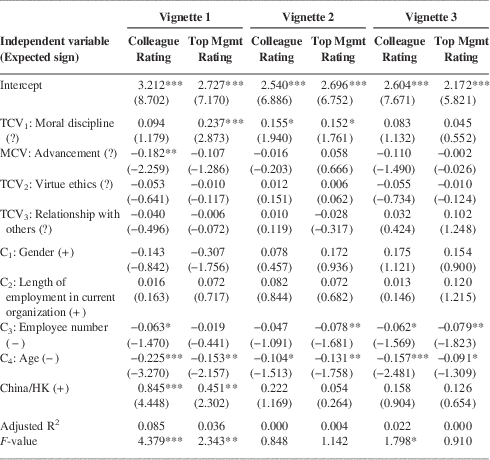
Table 1 shows the regression results for the acceptance judgment of the Chairman’s behaviour. Two regression analyses, with the acceptance judgments rated by colleagues and top management as dependent variables, are conducted for each vignette. Therefore, Table 1 contains a total of six regression results. Of these results, the coefficients on TCV1 are significant in three of them, all in a positive direction. The coefficient on MCV is significant in one regression only. These results suggest some support for H1a and H1b. TCV2 and TCV3 are not significant in any of these regressions; as a result, H1c and H1d are not supported. Of the control variables, C3 (Employee number) and C4 (Age) are relevant and significant in the expected negative direction. The dummy variable China/HK is also significant in both regressions under Vignette 1.
Regression analyses of acceptance of Chairman’s behaviour
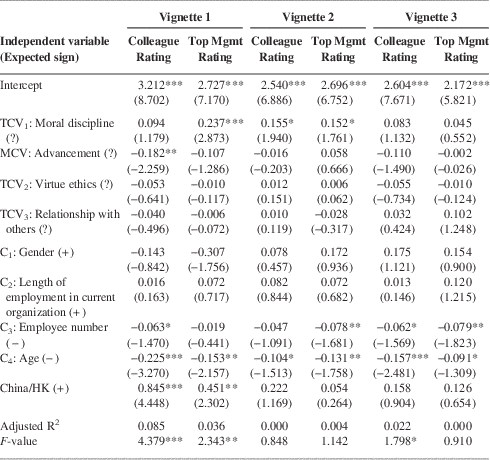
notes: TCV and MCV stand for “traditional Chinese values” and “modern Chinese values,” respectively. *p<.10; **p<.05; ***p<.01. Coefficients corresponding to the intercepts and independent and control variables are shown in the first row, and their corresponding t-values are enclosed in brackets immediately under the coefficients.
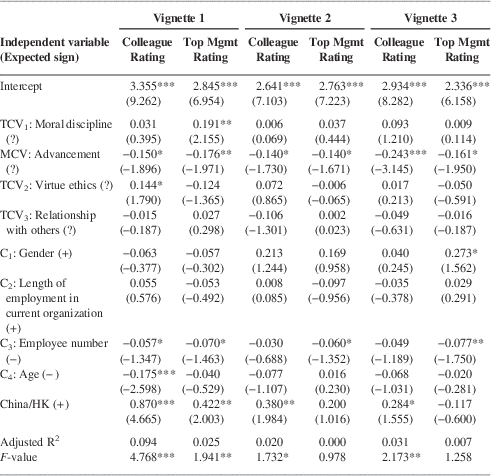
Table 2 shows the regression results for the acceptance judgment of Xiao’s failure to report the Chairman’s illegal activities. Similarly to Table 1, there are a total of six regressions reported in Table 2, two for each vignette corresponding to the acceptance judgments rated by respondents’ colleagues and top management. One clear result immediately identified from Table 2 is that MCV emerges as the most significant independent variable influencing respondents’ acceptance judgments. The coefficients on this variable are significantly negative in all the regressions, indicating that respondents who scored higher in modern Chinese values are less accepting of the failure of Xiao to blow the whistle to the company for the Chairman’s illegal behaviour. These results provide strong support for H2b. With respect to the traditional Chinese values variables, both TCV1 and TCV2 have only one coefficient found to be significantly positive in the regressions of Vignette 1. We may therefore say that there is only some minor support for H2a and H2c. Similar to the results in Table 1, TCV3 in Table 2 are insignificant in all the regressions. Therefore, H2d is not supported. Of the control variables, C3 (Employee number) seems to have the largest impact on the dependent variables, with four coefficients significantly negative in these regressions. Other than C3, we find only one coefficient on C1 (Gender) to be significantly positive, and one coefficient on C4 (Age) to be significantly negative, both in the predicted directions. The dummy variable China/HK is also found to be significantly positive in four regressions, spreading over all vignettes.
Regression analyses of acceptance of Xiao’s behaviour
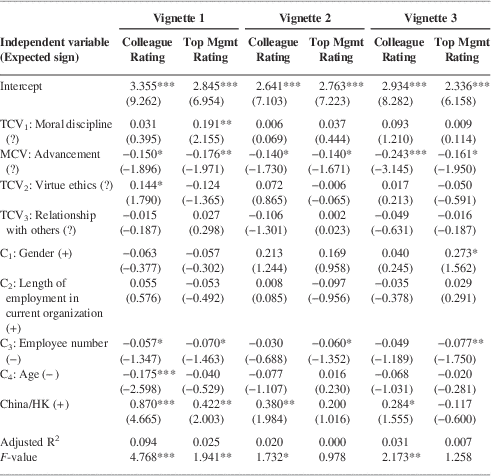
notes: TCV and MCV stand for “traditional Chinese values” and “modern Chinese values,” respectively. *p <.10; **p <.05; ***p <.01. Coefficients corresponding to the intercepts and independent and control variables are shown in the first row, and their corresponding t-values are enclosed in brackets immediately under the coefficients.
5. DISCUSSION
The results reported in Table 1 provide some support for the influence of Chinese values on business executives’ acceptance of the Chairman’s violation of his director’s duties. The traditional Chinese values of “moral discipline” are found to adversely affect our respondents’ judgments in three regressions covering Vignettes 1 and 2. Only one regression result related to Vignette 1 suggests that modern Chinese values render the respondents less accepting of the Chairman’s illegal behaviour. These results are consistent with those of the business ethics literature that Chinese business ethics are rooted in Confucianism. Cultural differences underpin what might be considered acceptable or unacceptable behaviour.Footnote 56 However, there is an intrinsic difference between those studies in the business ethics literature and ours. Judgments on what is acceptable and unacceptable business practice are subjective, with no absolute benchmark to determine what is right or wrong. Therefore, variation in these judgments is expected. Our study, however, is concerned about illegal business practices, which are all in contravention of the law. It is rather surprising to see variations in our respondents’ acceptance judgments of this illegal behaviour. Perhaps this is due to the fact that Confucianism de-emphasizes the role of laws and written codes, but emphasizes more harmony and relationships in building organizations.Footnote 57
Turning to the director’s failure to report the Chairman’s misbehaviour, the influence of Chinese values on the respondents’ acceptance judgments provides a clearer picture, as modern Chinese values are found to reduce the respondents’ acceptance of the director’s inactions in all the regressions. In other words, respondents who scored higher in the modern Chinese values are less receptive to the director’s failure to report the Chairman’s violation of his director’s duties. In contrast, traditional Chinese values seem to increase the respondents’ acceptance, but this is only observable in Vignette 1.
Another subtle point from the survey results is that both Xiao and the Chairman are directors, and under Article 148 of China’s Company Law, since Xiao knows of the Chairman’s breach of his director’s duties, if he fails to report it to the company board, he too would have breached his duty as a director. From the responses in the survey, we find differences in terms of acceptable behaviour between the two persons. Chinese cultural values could also help explain this discrepancy.
In recent years, many Western companies have established their companies in China in order to enter into its giant markets to promote their products or services and enjoy its low production costs. If these companies need to appoint local experts to their boards of directors, they should be careful of the potential pitfalls of the impact of Chinese cultural values on those locally appointed directors in performing their duties. Mechanisms such as introductory orientation and continuous training related to directors’ duties should be put in place to narrow down the expectation gaps of what the companies think these local directors should do and what the local directors think they can do in performing their duties. Similar problems may also occur in overseas Western companies acquired by Chinese companies if representatives from China are appointed to the boards of directors in these acquired companies.
Some scholars suggest that culture and ideology might be important factors in determining a country’s choice of its laws and regulations.Footnote 58 Eberle considers law and culture to be mutually dependent on each other. To get a complete understanding of law, we need to look fully at how law operates within a culture.Footnote 59 As Cotterrell puts it:
where law is seen as an expression or aspect of culture in the sense of shared traditions, values or beliefs (either of lawyers, of society generally or of some part of it), a legal transplant will be considered successful only if it proves consistent with the cultural presuppositions of the transplanted law.Footnote 60
Thus, a legal transplant without considering the compatibilities between the social settings of the donor and the recipient jurisdiction may render the result of the transplant unpredictable, as the meaning of legal ideas may change dramatically during the transfer. At an extreme, legal transplants can never successfully take root in recipient country’s soil.Footnote 61
Our results are in line with the argument for the important relation between law and culture and suggest that Chinese cultural values do matter to Chinese business executives in accepting corporate governance laws and regulations imported from Western developed countries. However, an alien set of these laws and regulations is often superimposed onto territories that do not share similar cultural values and norms for a variety of political and economic reasons. Thus, by transplanting Western laws to Asian countries, it exposes the startling differences between the cultures and the transplanted laws, and a counter-intuitive form of tension emerges from implementing these new laws.
Modern company law was first introduced into Mainland China in the mid 1990s, largely adopting the corresponding laws of Western developed countries such as the US, the UK, and Germany. Transplanting those foreign laws to China, without taking into consideration the differences in cultural values, may encounter strong resistance from regulatees. In our vignettes, for example, Xiao and the Chairman have developed mutual trust, which is an important element in interpersonal relationships and business interactions in the Chinese culture. If Xiao reports the misconduct of the Chairman to the company, this mutual trust can no longer be maintained. In China (both Mainland China and Hong Kong), a loss of trust puts businesses or individuals in a disadvantageous position. Acts that violate trust and loyalty to an organization or a close network are considered unacceptable among the Chinese.Footnote 62 Potter shares this view that:
(i)n China, compliance with imported law norms may depend not only on their accommodation of traditional norms and practices, but paradoxically on their displacing traditional norms with norms of formality and objectivity in response to new socioeconomic conditions and the perceived needs of members of society that results.Footnote 63
Caveats are given to apply our findings to other Chinese business executives. First, our respondents were not selected randomly. Instead, all of them were studying postgraduate business programmes at a Hong Kong university funded by the government with relatively high academic and/or professional qualifications. Their profiles might be significantly different from those of other Chinese business executives in the population. It remains an empirical issue whether differences in respondents’ profiles have an effect on the relationship between Chinese values and judgments on the breaches of directors’ duties and obligations. In our analysis, we have already controlled for respondents’ profiles and thus diminished some of these concerns. Future studies may draw other samples of different profiles and rerun the same analyses to test the robustness of our results.
6. CONCLUSIONS
Laws and cultural values are interlinked and often interdependent, and thus the effectiveness and receptiveness of laws could be dependent on value orientations.Footnote 64 However, some believe that laws are value-free regulatory instruments. Such insular mindsets fuel the idea that laws can be transplanted easily across cultures. They think that because those laws worked well in one jurisdiction, they should work equally well in others. These functionaries neglect the fact that cultural values cannot be overridden by a set of rules. This is why the relationship between law and culture has been the focus of many socio-legal enquiries.Footnote 65 However, without empirical evidence, such a proposition remains at best an intellectual debate. This paper has attempted to fill this gap in knowledge with empirical analysis by surveying a sample of Chinese business executives to investigate how cultural values affect these executives’ attitudes and understanding of directors’ duties.
Overall, our results support this contention and affirm the interrelations between laws and culture. Where law is seen as an expression or aspect of culture, a legal transplant will be considered successful only if it proves to be consistent with these matters of culture in the recipient environment or reshapes them in conformity with cultural representations of the transplanted law.Footnote 66 Therefore, if the law and the cultural values are at odds, this suggests that many will contravene or flout the law, leading to serious consequences.
There are two main findings to support such claims. First, Chinese business executives who score higher in moral-discipline related traditional Chinese values are more lenient of the Chairman’s breaches of his director’s duties. Second, those who relate more to modern Chinese values are less receptive to the director’s failure to report the Chairman’s contravention of his duties.
The results of this study generate two key observations. First, it is doubtful that Article 148 of China’s Company Law is effective in achieving its regulatory objectives. What this research has shown is that ignoring cultural values in law-making is a serious regulatory oversight. The consequence is clear; those who abide by their cultural values are blatantly breaching the law. Even if the explanation is culturally justifiable, it is not legally defensible. At a system level, it would give the wrong impression to the non-Chinese that Chinese people disregard the law. This leads to the second observation that there are two strands of cultural values—modern and traditional Chinese values—at play, suggesting that more than one regulatory regime for directors might be the most sensible regulatory solution. For example, the co-existence and development of mediation and the legal system for resolving disputes related to contravention of directors’ duties can be promoted in China. Mediation can be defined as “the process by which the participants together with the assistance of a neutral person or persons, systematically isolate disputed issues in order to develop options, consider alternatives, and reach a consensual settlement that will accommodate their needs.”Footnote 67 In general, trust and friendship are essential prerequisites for successful business negotiation in order to maintain a long-term business relationship in China. Direct confrontation in a courtroom not only jeopardizes friendship and trust but also risks losing face, particularly for the losers of the court judgment.Footnote 68 Accordingly, once a litigation process has commenced, the business relationship most probably would end.Footnote 69 Mediation can be particularly useful for those Chinese business people who subscribe to traditional Chinese values, whereas those identifying with modern Chinese values may prefer to resolve any legal disputes through the formal legal system. Therefore, the co-existence of two regulatory regimes for resolving issues related to directors’ duties can cater for the needs of different business people.