In Canada, 20.1% of the population speaks a language other than French or English at home, and 16 to 36% of 5- to 9-year-old children in large urban centers speak a language other than English or French as their first language (L1), and thus are attending school in a second language (L2; Statistics Canada, http://www.statcan.ca). In the predominantly French-speaking province of Québec, 35.8% of francophones also speak English, and 68.8% of anglophones also speak French; bilingualism among francophones in other regions of the country averages 83.6% (Statistics Canada, http://www.statcan.ca). The linguistically diverse Canadian context is not out of step with many other countries (e.g., Goldstein, Reference Goldstein and Goldstein2004; Organization for Economic Co-operation and Development, 2006), and it has been estimated that children who learn two languages before puberty are the majority worldwide (Tucker, Reference Tucker, Cenoz and Genesee1998). Therefore, research at the interface of bilingual development and child language disorders would be relevant to a significant number of children across the globe. However, until recently, bilingual development and child language disorders have been mainly investigated in isolation of each other. The purpose of this article is to review research in the past decade taking place at this interface. One area of investigation is concerned with the overlap in linguistic characteristics between bilingual children with typical language development (TLD) and monolingual children with specific language impairment (SLI) the same age. Another area of investigation is focused on documenting the linguistic characteristics of bilingual children with SLI, as referenced to their monolingual peers with SLI, and to their bilingual peers with TLD. It will be shown that these studies on bilingual children bring unique and important evidence to bear on theoretical debates regarding the nature of SLI, and contribute much needed information for the appropriate identification of SLI in linguistically diverse social contexts.
DEFINING BILINGUAL DEVELOPMENT AND SLI
Bilingual development
Although all bilingual children, by definition, learn two languages, there are differences in their exposure patterns to both languages and in the social contexts in which they are learning those languages that influence their development. Researchers often make a distinction between simultaneous and sequential bilinguals (L2 learners). Simultaneous bilinguals are children who learn both languages in the home or through early childcare experiences before the age of 3 years, 0 months (3;0), often from birth. Sequential bilingual/L2 children have the L1 fairly established (although not completely acquired) before they begin to learn the L2. Although the division between simultaneous and sequential bilingualism is most often set at 3;0 by researchers (Genesee, Paradis, & Crago, Reference Genesee, Paradis and Crago2004), it is common for sequential bilinguals to begin learning the L2 at school entry, for example, children from immigrant families who speak a minority language at home and learn the majority language at school. In addition, young bilingual children, both simultaneous and sequential, tend to be more proficient or dominant in one of their languages. The dominant language is usually the language for which they have received the greatest amount of exposure (Genesee et al., Reference Genesee, Paradis and Crago2004). The dominant language can shift over time such that sequential bilingual children often end up dominant in their L2 when the L2 is the majority language (Kohnert, Reference Kohnert and Goldstein2004). Therefore, a group of 7-year-old bilingual children who speak the same two languages could differ from each other in several respects: how much exposure they have had to each of their languages, their acquisition onset age for each language, and which of their languages is dominant. All of these factors could influence their linguistic performance in both languages.
The distinction between the majority/minority sociolinguistic status of a bilingual's two languages is another relevant distinction to make. Children who speak a majority language at home, like English in Canada, and learn French as an L2 through schooling, would have different projected language outcomes for their two languages than children whose L1 is a minority language, like Tagalog, and who learn English as an L2 at school (Genesee et al., Reference Genesee, Paradis and Crago2004). Most notably, the minority L1 children would be at risk for incomplete acquisition and/or loss of their L1, whereas the majority L1 children would not. In contrast, when the two languages of a bilingual child are majority languages, like French and English in Canada, whether the child learns them simultaneously or sequentially, successful bilingual outcomes are highly likely because both languages are widely spoken, valued by the society, and institutionally supported through government and the education system. The minority–majority status of languages is really a continuum, and is context dependent. Both Mandarin and Kurdish are minority languages in Canada, but Mandarin is more widely spoken, and in some regions, educational programs in this language are offered (Statistics Canada, http://www.stancan.ca; Edmonton Publish Schools, http://www.epsb.ca). Some languages are technically minority languages in a country as a whole, like Spanish in the United States, because of the proportional number of speakers countrywide, and lack of full institutional status. But in some regions of this country, like the city of Miami and surrounding districts, it could be construed as a majority language (Eilers, Oller, & Cobo-Lewis, Reference Eilers, Oller, Cobo-Lewis, Oller and Eilers2002).
SLI
SLI is a neurodevelopmental disorder that affects approximately 7% of the general population (Leonard, Reference Leonard1998; Rice, Reference Rice, Rice and Warren2004). SLI is typically diagnosed through a combination of inclusionary and exclusionary criteria. Children with SLI exhibit language abilities below age expectations on standardized test batteries, but they have hearing and intellectual abilities within the normal limits, no autism spectrum disorder, no motor problems in producing speech, and no acquired neurological damage (Leonard, Reference Leonard1998; Rice, Reference Rice, Rice and Warren2004). In essence, SLI is the presence of language impairment in a child that is not a consequence of deficits in other areas or of other syndromes.
Children affected with SLI typically are delayed in their onset of first words and first word combinations, followed by a protracted delay in their language development as a whole that extends into the school years. In other words, children with SLI usually start out as late talkers, but the initial delay in most late talkers gets resolved, whereas for children with SLI, it does not (Rice, Reference Rice, Rice and Warren2004). Children with SLI exhibit lexical, morphosyntactic, and discourse-pragmatic abilities below their typically developing (TD) age peers, and in the case of morphosyntax, they often exhibit abilities below younger TD children as well, signaling that morphosyntax is the most highly affected linguistic domain in SLI (Leonard, Reference Leonard1998; Rice, Reference Rice, Rice and Warren2004). Because of its prominence, morphosyntax has been a main focus of studies on children affected with SLI, and accordingly, this article focuses on morphosyntax in bilingual children.
Researchers agree that SLI is a neurodevelopmental disorder with inherited genetic components (Rice, Reference Rice, Rice and Warren2004); thus, SLI causes disruption in children's neurocognitive development that, in turn, causes difficulties with language learning. But researchers do not agree on the nature of the deficits caused by this disruption. In particular, theoretical perspectives are divided on whether they consider the deficits to be in domain-general cognitive–perceptual mechanisms only, or whether they consider domain-specific linguistic deficits also to be a component of this disorder. An objective of this article is to examine theoretical perspectives on SLI in terms of how consistent they are with data from bilingual children.
L2 AND SPECIFICALLY LANGUAGE IMPAIRED DEVELOPMENT: TWO OF A KIND?
One of the most documented morphosyntactic characteristics of English SLI is the difficulty affected children have in acquiring finite verb morphology, that is, the set of morphemes marking the grammatical feature tense, and in some cases, agreement as well: third person singular [-s] on the habitual present, he walks, past tense (regular [-ed] and irregular), he walked/he ran, BE (copula and auxiliary), he is happy/he is walking, and DO (auxiliary), does he walk to school?/he doesn't walk to school. This set of tense-marking morphemes is acquired late in younger TD English-speaking children (e.g., Brown, Reference Brown1973), but for children with SLI, the acquisition of tense morphemes is extraordinarily affected because these children's difficulties with them are worse than their overall language delay would predict. Rice and Wexler (Reference Rice and Wexler1996) described the development of finiteness/tense marking in children with SLI as an extended optional infinitive (EOI) profile, because in many respects, their developmental patterns are an extension of the OI profile displayed in TD children. The OI profile is characterized by the following: children variably omit tense-marking morphology, for example, *he walk instead of he walks, but make very few errors of commission (form choice) with them, for example, he is/*he are, and obey the syntactic distributional contingencies associated with them, for example, he is not walking/*he not is walking (Wexler, Reference Wexler, Lightfoot and Hornstein1994). Children with SLI also variably omit tense morphemes while producing few commission errors and obeying syntactic contingencies for them, but this stage persists until they are at least 9 years of age, and never fully resolves (Rice & Wexler, Reference Rice and Wexler1996; Rice, Wexler, & Cleave, Reference Rice, Wexler and Cleave1995; Rice, Wexler, & Hershberger, Reference Rice, Wexler and Hershberger1998). At the same time, errors with other grammatical morphemes not marking tense features, like plural [-s] or progressive [-ing], are much lower or nonexistent after the age of 5 years in children with SLI (Bedore & Leonard, Reference Bedore and Leonard1998; Rice, Reference Rice, Levy and Schaeffer2003; Rice, Wexler, & Cleave, Reference Rice, Wexler and Cleave1995). Some version of an (E)OI profile for finite verb morphology extends to numerous other languages, including French, and is thus not a consequence of superficial properties of English, but might arise from more abstract aspects of morphosyntactic development (Paradis & Crago, Reference Paradis and Crago2001; Wexler, Reference Wexler, Lightfoot and Hornstein1994, Reference Wexler1998).
Rice (Reference Rice, Rice and Warren2004) interprets the EOI profile within the context of a maturational model of language growth. Rice's model is founded on the assumption that language growth, like many other aspects of development, is guided in part by genetically determined timing mechanisms. The model is focused on characterizing and understanding the internal factors involved in language development, in particular where the locus of breakdown is in SLI and other neurodevelopmental disorders, but does not exclude the possible influence of external factors, and general learning mechanisms in the process (see Rice, Reference Rice, Rice and Warren2004, p. 231). According to Rice (Reference Rice, Rice and Warren2004), characterizing language growth and sources of possible breakdown entails consideration of the following components: onset timing, configuration of the linguistic system comprised of separable elements, acceleration rate, and points of change in acceleration. Typical development offers the benchmark with which onset time, configuration, and acceleration can be compared in affected populations. One source of breakdown in growth is in onset timing, characteristic of late talkers. Another source of breakdown is disruption within the linguistic system, meaning some elements develop in asynchrony or out of harmony with the rest. Delay, disruption, and variations in acceleration rates, can combine in different ways. Children can be affected by language delay, or by delay and disruption, the latter being the profile of children with SLI. Rice (Reference Rice, Rice and Warren2004) points out that the deficit children with SLI have with finiteness marking lies mainly in timing, late onset, and asynchrony, disrupted growth patterns between finiteness marking morphology, and other grammatical morphology. But, other aspects of finiteness growth, such as the shape of the trajectory and error patterns, are similar between unaffected and affected children. In sum, children with SLI do not have entirely different language acquisition mechanisms from unaffected children; instead, their language acquisition mechanisms are faulty in specific domains.
In this section, we examine the (E)OI profile in L2 learners with TLD compared to children with SLI, and ask what the implications are for this maturation model of SLI. Because maturational, internal mechanisms are assumed to guide finiteness growth in TD children and children with SLI, grosso modo, similarities could be evident in the developmental patterns between these groups in a target language whether it is being acquired as a L1 or L2. In contrast, because maturation and chronological age are linked in the model, some differences in the L2 context would be expected because these children first encounter the input in the target language when they are neurocognitively more mature, and already have another developing language. Furthermore, complete overlap in developmental patterns with finiteness between a TD population, like L2 learners, and an impaired population would not be felicitous for this model because its purpose is to delineate separate profiles for affected and unaffected populations.
Paradis and Crago (Reference Paradis and Crago2000) compared the use of tense-marking morphology in spontaneous speech between three groups of children: monolingual French-speaking children with TLD, monolingual French speaking children with SLI, and English L1–French L2 children with TLD, all approximately 7 years of age; the SLI and L2 groups were matched for mean length of utterance (MLU). The L2 children had 2 years of exposure to French in school. Children's spontaneous speech samples were analyzed for their accuracy in the use of tense-marking morphemes, subject–verb agreement, and the distributional contingencies associated with finite verbs and the negative marker. The aim of the study was to understand how closely related the acquisition patterns were between children with SLI and L2 children the same age. Prior to this study, research on L2 and SLI acquisition conducted in isolation suggested that both populations of children would make errors with tense morphemes. Existing studies bringing together the issue of bilingualism and language disorders cautioned about potential overlap between them (Guitérrez-Clellen, Reference Gutiérrez-Clellen, Cole, Dale and Thal1996; Juárez, Reference Juárez1983; Roseberry-McKibbin, Reference Roseberry-McKibbin1995), but except for Håkkasson and Nettelbladt (Reference Håkansson and Nettelbladt1993)'s study with Swedish-speaking children, direct comparisons had not been undertaken between the morphosyntactic abilities of L2 children and children with SLI. Paradis and Crago (Reference Paradis and Crago2000) found that the L2 and SLI groups had similar accuracy rates with auxiliary verbs, and both had lower accuracy rates than their monolingual age peers with TLD. Both the L2 and SLI groups also showed high levels of accuracy with subject–verb agreement (verb form choice), and with syntactic placement of finite verbs. Thus, highly parallel profiles between L2 and SLI were found, indicating that at a certain level of language development as measured by MLU, different populations of learners show highly similar profiles even though they have dissimilar input experiences and internal learning mechanisms. These striking similarities between L2 and SLI French morphosyntax prompted Crago and Paradis (Reference Crago, Paradis, Levy and Schaeffer2003) to ask if they are “two of a kind.”
Paradis and Crago (Reference Paradis, Crago, Prévost and Paradis2004) did a follow-up study on the same children's use of morphosyntax related to the determiner phrase, or nominal morphology. Both the L2 and SLI groups showed high and equal accuracy with most aspects of nominal morphology, including distributional contingencies, even though there was a reasonable possibility that the L2 children would have made errors distinct from the children with SLI because of transfer from their L1. The absence of errors with nominal morphology at the same time as the presence of omission errors with tense morphemes is part of the (E)OI profile in French, as well as in English. Therefore, both of these studies pointed to a significant overlap between French L2 and French SLI in terms of the (E)OI profile. Furthermore, Paradis (Reference Paradis2004) and Grüter (Reference Grüter2005) found parallels between L2 and SLI French in the acquisition of another structure, direct object clitics, which is known to be a clinical marker in French SLI.
Turning to studies on English acquisition, Paradis (Reference Paradis2005) examined the spontaneous and elicited production of tense marking morphemes (third person singular [-s], past tense [-ed], BE, and DO) and nontense-marking morphemes (progressive [-ing], prepositions in/on, plural [-s], and determiners) in children learning English as an L2 from a variety of L1 backgrounds, with the purpose of detecting an (E)OI profile. Children had a mean age of 5;7 and an average of 9.5 months of exposure to English. These English L2 children were less accurate with tense than nontense-marking morphemes, and the majority of their errors were of omission rather than commission. Paradis, Rice, Crago, and Marquis (Reference Paradis, Rice, Crago and Marquis2008) compared three groups of English-learning children: English L2 children, monolingual English speakers with SLI, and younger monolingual English speakers with TLD. All groups had equivalent mean MLUs, so they were at the same global level of language development. The L2 children were the same participants as in Paradis (Reference Paradis2005), but the measures examined were somewhat different between the two studies. For Paradis et al. (Reference Paradis, Rice, Crago and Marquis2008), the data consisted of the elicitation and grammaticality judgment probes for tense marking morphemes from the Test of Early Grammatical Impairment (TEGI; Rice & Wexler, Reference Rice and Wexler2001), but the probes were coded according to a different system than the one given in the examiner's manual. Paradis et al. (Reference Paradis, Rice, Crago and Marquis2008) found similar abilities between all three groups with elicited production of BE morphemes, and between the SLI and L2 groups for the ability to detect ungrammatical use of BE morphemes. All groups showed an overall predominance of omission over commission errors. Therefore, both Paradis (Reference Paradis2005) and Paradis et al. (Reference Paradis, Rice, Crago and Marquis2008) found English L2 learners' acquisition patterns to be largely consistent with the (E)OI profile. Two questions arose from these studies: do the parallels between L2 and SLI extend beyond the initial stages of L2 learning? Is the developmental relationship between TD learners and affected children similar in the L2 context to what has been documented for the L1 context?
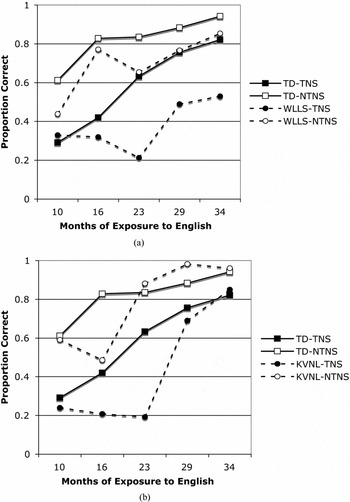
Paradis (Reference Paradis, Gavruseva and Haznedar2008) examined longitudinal data from two case studies of affected English L2 children: one who was a late talker (i.e., experienced language delay [LD] in his L1) and one who had SLI. These two L2 children with LD/SLI were compared to a group of nine English L2 learners with TLD. The data in this study are from a small sample of children, but nevertheless provide some tentative answers to the questions posed above. All the children spoke Mandarin or Cantonese as their L1s, and the TD children were from the same cohort of L2 children who participated in Paradis (Reference Paradis2005) and Paradis et al. (Reference Paradis, Rice, Crago and Marquis2008). Children's mean age was 5;4 at the outset and 7;1 at the completion of the study. Children had 10 months of exposure of English at the outset and 34 months of exposure at the completion of the study. Children's use of tense-marking and nontense-marking morphemes from spontaneous and elicited speech was documented every 6 months for 2 years. Figure 1 shows the mean scores from the L2 with TLD group at each round for a composite average correct score for nontense (NTNS) morphemes from spontaneous speech (progressive [-ing], prepositions in/on, plural [-s] and determiners), and for a composite average correct score for tense (TNS) morphemes from the TEGI (third person singular [-s], past [-ed], BE, and DO).Footnote 1Figure 1a provides the individual scores from the child with SLI, WLLS (dotted line with circle marker) alongside those from the L2 with TLD group. Figure 1b shows the individual scores from the child with LD, KVNL (dotted line with circle marker) alongside those from the L2 with TLD group. Looking at the L2 with TLD group, Figure 1 reveals that these children had higher scores with nontense than tense morphemes throughout the study and very low scores with tense marking morphemes until Round 3 (23 months of exposure, ~2 years). Thus, the data suggest that the OI profile in L2 acquisition continues on past the initial stages, and moreover, overlap with monolinguals with SLI for difficulties with tense morphemes continues for more than 2 years. It was only at Round 5, after 34 months of exposure (~3 years), that the L2 children with TLD achieved relatively high scores with tense morphemes. At around 5 or 7 years of age, their mean score was 0.82, which was higher than the mean score of the monolingual norming sample with SLI from the TEGI at this age (0.73), although not by a wide margin (Rice & Wexler, Reference Rice and Wexler2001, p. 65). Figure 1 also illustrates how the relationship between affected and unaffected children found in L1 acquisition is largely recapitulated in the L2 acquisition context. Even the child who experienced LD in his L1 appears to have experienced LD in his L2. There is an initial period of overlap between the affected and unaffected children at Rounds 1 and 2, which is understandable because they have both just begun to be exposed to English. However, after Round 3 at 23 months of exposure, parallels with the L1 profile emerge. Regarding WLLS in Figure 1a, his tense morpheme scores after Round 3 trail far behind his peers with TLD, whereas his scores for nontense morphemes are similar to those of his peers with TLD, thus exhibiting an EOI profile in his L2 development. Interestingly, WLLS's scores for tense morphemes at Round 5 (34 months of exposure) were close to the mean score for the monolingual children with SLI his age from the TEGI norming sample. KVNL also trailed behind the TD group for tense but not for nontense at Round 3 (23 months), but caught up for tense by Round 5 (34 months; Figure 1b). These case study data point to the possibility of robust longitudinal parallels between L1 and L2 profiles for the acquisition of finiteness.
Mean correct scores for tense-marking (TNS) and nontense-marking (NTNS) morphemes over time for the (a) TD L2 children and the L2 child with SLI (WLLS) and (b) TD L2 children and the L2 child with LD (KVNL).

Up to this point, findings from these studies showing similarities between L2 and SLI have been reviewed. We now turn to findings that reveal differences between the profile of L2 and SLI acquisition of finiteness. These differences are crucial to the consideration of a maturational model of finiteness acquisition. As mentioned above, some differences between L1 and L2 profiles would be expected, in particular, differences that could be related to neurocognitive maturity and dual-language experience. Profile differences have been found with respect to the distribution of error types and the differential timing of the acquisition of BE and inflectional tense morphemes. Taken together, these differences show how L2 acquisition patterns have characteristics distinct from the (E)OI profile, and thus, the (E)OI profile is not too broad and only applies in all its details to L1 acquisition.
In all the studies cited above, omission errors predominated for all groups of children: TD L1, L2, and SLI; however, some consistent differences regarding the relative proportion of commission errors emerged between L2 children and L1 children, with and without SLI. In French, the children with SLI omitted the auxiliary verb in the past and future periphrastic verb constructions, and the L2 children often substituted the verb stem/present indicative for a past or future construction; therefore, the L2 children made more commission errors than the children with SLI (Paradis & Crago, Reference Paradis and Crago2000). Similarly, in Paradis (Reference Paradis2005), the English L2 children also produced higher percentages of commission errors than has been reported in studies on English SLI. Paradis et al. (Reference Paradis, Rice, Crago and Marquis2008) found that for BE morphemes, the L2 children had significantly higher proportions of commission errors than the children with SLI that they were directly compared to. Finally, Paradis et al. (Reference Paradis, Rice, Crago and Marquis2008) documented the phenomenon of BE overgeneration (Ionin & Wexler, Reference Ionin and Wexler2002) in the L2 children's spontaneous speech, which was absent in the speech of the children with SLI and the younger TD L1 children. BE overgeneration occurs when L2 children insert a BE form in a sentence without an appropriate grammatical context for this morpheme, for example, “I want is a this.” (I want this one), “I'm got sevens.” (I got/have sevens [playing cards]), “yes, but if I was hurt my teeth . . .” (yes, but if I hurt[past] my teeth . . .; Paradis et al., Reference Paradis, Rice, Crago and Marquis2008, p. 712).
Both higher levels of commission errors and BE overgeneration signal a kind of creativity in L2 children's language use. It could be that when TD children encounter the input in a target language when neurocognitively more mature, and with another language system already developing, this situation produces more creativity in their learning patterns. Such creativity could be a hallmark characteristic of child L2 versus L1 acquisition. For example, an English L2 6-year-old knows implicitly that grammatical morphemes are a part of sentences, produces them in sentences in his/her L1, and has a more demanding communicative context, that is, school classroom, than his/her level of English can cope with. For all these reasons, an English L2 child might be likely to access an incorrect form of BE, or to use BE morphemes as a kind of general all purpose (GAP) finiteness marker to fill out their morphosyntactic expression any way they can. BE morphemes are likely to be chosen as GAP morphemes because they are far more frequent in the input than inflectional tense morphemes (Paradis et al., Reference Paradis, Rice, Crago and Marquis2008). In a similar vein, L2 children's use of semantically flexible, GAP verbs like do could be understood as stretching their meager lexical resources in a demanding communicative context (Golberg, Paradis, & Crago, Reference Golberg, Paradis and Crago2008). It is interesting that the GAP verb phenomenon has been documented in children with SLI (e.g., Rice & Bode, Reference Rice and Bode1993; Thordardottir & Ellis Weismer, Reference Thordardottir and Ellis Weismer2001), but GAP grammatical morphemes have not.
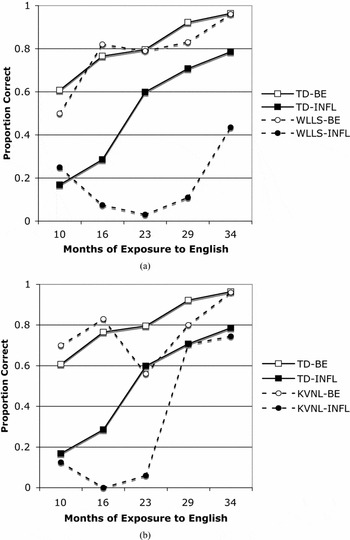
In addition to error type distribution, Paradis et al.'s study (Reference Paradis, Rice, Crago and Marquis2008) showed that L2 children display a sequence in their acquisition of tense morphemes in English that the monolingual children did not. L2 children were significantly more accurate in producing BE morphemes than they were in producing the inflectional morphemes, third person singular [-s] and past tense [-ed], but the younger TD L1 children and the age peers with SLI showed equal abilities for all tense morphemes. This precocious acquisition of BE morphemes has been noted elsewhere as a hallmark characteristic of English L2 learners (Ionin & Wexler, Reference Ionin and Wexler2002; for review, see Zobl & Liceras, Reference Zobl and Liceras1994). Paradis' (Reference Paradis, Gavruseva and Haznedar2008) longitudinal study also examined the children's developmental trajectories for BE and the inflectional tense morphemes separately. The data in Figure 2 are the scores for BE morphemes (auxiliary and copula) and inflectional morphemes (third singular [-s] and past tense [-ed]) for the L2 with TLD group, the child with SLI (Figure 2a), and the child with LD (Figure 2b). Figure 2 shows that the TD L2 children had higher mean scores for BE versus inflectional tense morphemes throughout the time period of the study, meaning that the L2 profile of precocious BE extends beyond the initial stages of L2 learning. Figure 2 also demonstrates that the precocious BE profile is shared by L2 children with SLI and LD. Furthermore, the two children with SLI/LD showed very similar abilities with BE as their peers with TLD. Therefore, the lower tense composite scores between the affected children and the TD group in Figure 1 were mainly because of the children's scores for the inflectional tense morphemes. In sum, BE morphemes seem to pattern more like nontense morphemes for all the English L2 children, in contrast to findings for English L1 children.
Mean correct scores for BE and inflectional tense (INFL) morphemes over time for the (a) TD L2 children and the L2 child with SLI (WLLS) and (b) TD L2 children and the L2 child with LD (KVNL).

What causes the precocious acquisition of BE in child L2 acquisition? Ionin and Wexler (Reference Ionin and Wexler2002) and Zobl and Liceras (Reference Zobl and Liceras1994) argued that the syntax of BE morphemes is less marked/complex than that of inflectional morphemes, which alternate with DO in questions and negation, and perhaps, this makes BE morphemes easier to learn. However, this explanation would apply to L1 and L2 acquisition equally, and precocious BE is not attested in L1 acquisition. Based on Wexler's (Reference Wexler1998) proposal for early maturational constraints on how the computational system processes grammatical features like tense in English, Paradis et al. (Reference Paradis, Rice, Crago and Marquis2008) and Paradis (Reference Paradis, Gavruseva and Haznedar2008) hypothesized that tense morphemes might be processed differently by TD L2 learners because they would have matured beyond this stage, and thus, patterns like precocious BE could emerge. A third possibility is that child L2 learners' sensitivity to frequent and syntactically unmarked grammatical morphemes like BE might be heightened, in any case, stronger than the sensitivity of L1 learners. This is because they are faced with learning two languages instead of one, and communicative demands on their L2 are often in excess of their abilities. Therefore, they do not acquire the set of finiteness marking morphemes as a group because these morphemes are not equally as accessible in the input. Whatever the explanation is for precocious BE acquisition, it would be important for a maturational model of TD and SLI development to be compatible with this explanation because young L2 children fall into similar age ranges as the L1 children the model was based on. In particular, because BE morphemes mark finiteness, a reasonable explanation needs to be developed for why affected L2 children the same age as affected L1 children would treat them differently.
Bilingual development with SLI: Double delay?
Limited processing capacity (LPC) theories hypothesize that the protracted language development exhibited by children with SLI is the result of deficits in domain-general cognitive and perceptual mechanisms used for learning language as well as for other cognitive operations. Researchers have found children with SLI to have deficits compared to their unaffected peers in working memory (Ellis Weismer, Evans, & Hesketh, Reference Ellis Weismer, Evans and Hesketh1999; Gathercole, Reference Gathercole2006), in speed of processing/reaction time (Miller, Kail, Leonard, & Tomblin, Reference Miller, Kail, Leonard and Tomblin2001), or both (Leonard et al., Reference Leonard, Ellis Weismer, Miller, Francis, Tomblin and Kail2007; Montgomery & Windsor, Reference Montgomery and Windsor2007). Of importance, Leonard et al. (Reference Leonard, Ellis Weismer, Miller, Francis, Tomblin and Kail2007) found that variations in affected children's working memory and processing speed were associated with their language outcomes to some extent. LPC theories seek to derive a wide range of linguistic and nonlinguistic outcomes of SLI from lower level, domain-general deficits alone, in contrast to the maturational model put forward by Rice (Reference Rice, Rice and Warren2004), which posits the presence of additional domain-specific deficits in SLI. In this section, the ability of LPC theories to explain the pronounced difficulties with grammatical morphology exhibited by children with SLI is examined through data from bilingual children with SLI.
LPC theories, for the most part, have not been conceived to explain the impaired acquisition of grammatical morphology in particular. However, Leonard and colleagues (Reference Leonard, Ellis Weismer, Miller, Francis, Tomblin and Kail2007) have focused some work on building explanatory accounts of grammatical morphology from a processing perspective, for example, the surface account (Leonard & Eyer, Reference Leonard, Eyer, Morgan and Demuth1996; Leonard, Bortolini, Caselli, McGregor, & Sabbadini, Reference Leonard, Bortolini, Caselli, McGregor and Sabbadini1992; Leonard, Eyer, Bedore, & Grela, Reference Leonard, Eyer, Bedore and Grela1997). The surface account is based on findings showing children with SLI to have difficulties in processing in-coming auditory/phonetic information that is of low substance, that is, brief or nonsalient. Because many grammatical morphemes across languages are of brief phonetic duration and/or nonsalient, these difficulties would make their acquisition exceptionally delayed for affected children. Honing in on the nature of these difficulties, Leonard (Reference Leonard1998) discusses how a combination of underlying deficits in working memory and speed of processing, combined with the prototypical phonetic properties of grammatical morphology, could explain their protracted acquisition by children with SLI (see also Leonard et al., Reference Leonard, Ellis Weismer, Miller, Francis, Tomblin and Kail2007):
If inflected words were typically heard in one-word sentences separated by pauses, there would be no problem. However, fast on the heels of the inflected word is the next word in the utterance that must be held in working memory and processed, and so on. Thus, processing is pressed from two directions; processing of a first item must be completed before the item fades from memory, and it must be processed in time for the next item. Given the reduced speed of processing assumed for children with SLI, sufficient processing of one item can't be completed before the next item appears. Consequently, some material is processed incompletely or not at all (Leonard, Reference Leonard1998, p. 251).
In sum, processing limitations coupled with input of low phonetic substance would conspire to create underspecified morphological paradigms. Notice that this proposal posits the root of the problem with grammatical morphology to be in processing incoming linguistic information, that is, intake, but the consequences are for representation.
A key assumption inherent in LPC theories of morphological acquisition is that children with SLI would need more exposure, more time on task, to fully acquire a morphological paradigm. This assumption is expressed in the following: “weaker representations due to occasional incomplete processing of encountered morphemes are usually thought to be the functional equivalent of infrequent exposure to these morphemes” (Leonard, Reference Leonard1998, p. 252, italics mine), and “. . . if children are unable to retain the phonological sequence that makes up the word, they will probably require multiple encounters with that word before it can be adequately learned” (Leonard et al., Reference Leonard, Ellis Weismer, Miller, Francis, Tomblin and Kail2007, p. 408, italics mine). Bilingual children with SLI are acquiring two languages, and thus, they would have less frequent exposure to each language anyway, in addition to having functionally less exposure because of their language disorder. Therefore, bilingual children with SLI are a kind of natural experiment for testing such processing-based accounts of SLI. LPC theories predict that bilingual children with SLI would exhibit extreme difficulty, perhaps “double delay,” in the acquisition of grammatical morphemes compared to their monolingual peers with SLI.
Paradis (Reference Paradis2007a) reviewed data from two studies on French–English simultaneous bilingual 7-year-olds with SLI compared to their monolingual peers with SLI in both languages (Paradis, Crago, & Genesee, Reference Paradis, Crago and Genesee2005/2006; Paradis, Crago, Genesee, & Rice, Reference Rice, Levy and Schaeffer2003) to evaluate the predictions of LPC theories of SLI. Taken together, these studies examined 10 different grammatical morphemes in the children's spontaneous speech production, among them morphemes noted to be clinical markers, such as tense-marking verbal morphology in English and French, and direct object clitics in French. The main findings were as follows: first, the bilingual children with SLI were as accurate with all the grammatical morphemes as their monolingual peers with SLI in both languages at this age. Second, bilingual children did not necessarily have higher accuracy scores in their dominant language. Third, low phonetic substance did not play a decisive role in the acquisition sequence because both monolingual and bilingual children had more difficulties with direct object clitics than definite articles in French, and yet these are homophonous and equally nonsalient morphemes. Paradis (Reference Paradis2007a) argued that these results were not consistent with the predictions of processing-based theories of SLI (see also Paradis et al., Reference Paradis, Crago and Genesee2005/2006).
Gutiérrez-Clellen, Simon-Cereijido, and Wagner (Reference Gutiérrez-Clellen, Simon-Cereijido and Wagner2008) examined accuracy in the production of English verb morphology on a narrative task by Spanish–English bilinguals, with and without SLI, and English monolinguals, with and without SLI, all 5.5 years old on average. The bilinguals and monolinguals with SLI displayed similar and low levels of accuracy with English verb morphology, distinct from their monolingual and bilingual peers with TLD. These children were 2 years younger than the children in the studies by Paradis and colleagues, which suggests that affected bilinguals can achieve similar levels of morphological acquisition to affected monolinguals early on in development. This study also suggests that the findings reported in the studies by Paradis and colleagues were not specific to one social context, or one cohort of bilingual children. In contrast, two studies of bilingual children from minority L1 backgrounds in The Netherlands (Orgassa & Weerman, Reference Orgassa and Weerman2008; Steenge, Reference Steenge2006) found significant differences in abilities with Dutch grammatical morphology between bilingual and monolingual children with SLI, and between bilingual children with SLI and with TLD. Orgassa and Weerman (Reference Orgassa and Weerman2008) examined children's abilities with marking gender in the determiner phrase. Among all the measures taken, the bilingual children with SLI had very low scores for adjectival gender inflection. To explain this exceptionally poor performance with adjectival gender inflection, Orgassa and Weerman (Reference Orgassa and Weerman2008) proposed that exposure to dual language input, coupled with the internal processing deficit caused by SLI, produce a cumulative effect in bilingual children with this disorder (cf. “additionally disadvantaged” in Steenge, Reference Steenge2006). Orgassa and Weerman (Reference Orgassa and Weerman2008) define the presence of cumulative effects using the following formula: for the same target structure, bilingual children with SLI < monolingual age peers with SLI, and < bilingual age peers with TLD. This cumulative effects proposal is consistent with the LPC perspective. What could be the explanation for the conflicting findings between the studies by Paradis and Guitérrez-Clellen versus Orgassa and Weerman (Reference Orgassa and Weerman2008) and Steenge (Reference Steenge2006)? Explanations can be found in the bilingual populations being examined, and in how cumulative effects are measured.
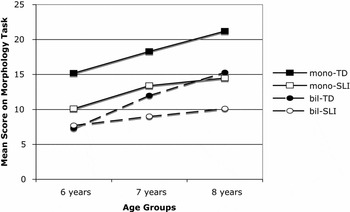
In the studies from The Netherlands, the children were sequential bilinguals, and in Orgassa and Weerman (Reference Orgassa and Weerman2008), they had an average of 5 years of exposure to Dutch (range = 3–6 years). Thus, even though their exposure to Dutch was extensive, these bilinguals would still have had less input than the monolingual age mates they were compared to, in addition to having less input because of dual language learning, which Orgassa and Weerman (Reference Orgassa and Weerman2008) point out as a potential confound. Similarly, in Steenge (Reference Steenge2006)'s study, the 8-year-old bilinguals with TLD had a mean score on her morphology elicitation task of 15.3 after about 4 years of exposure to Dutch in school, and this mean score was significantly below that of the monolinguals with TLD at 21.2, who had had double the exposure to Dutch; consequently, this makes interpreting the comparison between the monolinguals and bilinguals with SLI difficult. This raises the question about when sequential bilingual–monolingual comparisons can be meaningful for examining cumulative effects in bilingual children with SLI. Put simply, how much exposure to the L2 is sufficient? One possible criterion could be that when probing for cumulative effects, comparing bilinguals with SLI to monolinguals with SLI is meaningful when bilinguals with TLD with the same amount of exposure have reached similar levels of accuracy with a target morpheme as their monolingual age peers with TLD. In this case, if bilinguals with SLI are less accurate than monolinguals with SLI, this would constitute reasonable evidence for cumulative effects. However, the data from Steenge (Reference Steenge2006), as well as those from Paradis (Reference Paradis, Gavruseva and Haznedar2008), indicate that reaching sufficient exposure in the L2 as defined this way might take several years, which complicates the ability to evaluate the cumulative effects proposal.
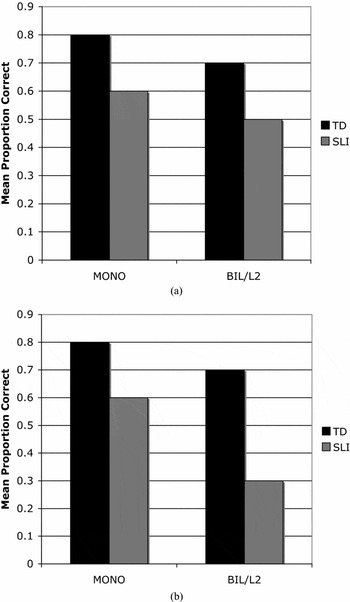
Let us pursue an alternative method for testing for cumulative effects with sequential bilinguals that might get around the problem of sufficient exposure. For instance, paired comparisons could be conducted between monolinguals with TLD and SLI, and between bilinguals with TLD and SLI, and then, the magnitude of the difference between the pairs could be examined. If the magnitude, or effect size, is larger for the bilingual group, this could be seen as evidence for cumulative effects. This method could be used when bilinguals with TLD still have somewhat lower scores than monolingual age peers with TLD. Figure 3a is an illustration of hypothetical results illustrating such a comparison where the magnitude of difference between the TD and SLI groups is the same for monolinguals and bilinguals. Figure 3b is also an illustration of hypothetical results, but the magnitude of the TD-SLI difference is larger for the bilinguals. Figure 3b therefore illustrates cumulative effects in bilingual acquisition with SLI.
A hypothetical distribution of scores (a) where there are no cumulative effects for bilinguals with SLI and (b) where there are cumulative effects for bilinguals with SLI.

To test this proposal, the morphological task data from Steenge (Reference Steenge2006) have been reanalyzed using effect size interpretation from Cohen (Reference Cohen1988), and the group means for the children at ages 6, 7, and 8 years old are presented in Figure 4. This study was cross-sectional in design, but some developmental trends can be inferred. For the 6-year-old groups, the monolingual mean comparison yielded a medium effect size (d = 1.17, r = .505), whereas the bilinguals had similar and very low scores, so that the effect size was negligible. For the 7-year-old groups, the monolingual differences also showed a medium effect size (d = 1.13, r = .401), and the bilingual differences showed a small effect size (d = 0.623, r = .297). For the 8-year-old groups, both monolingual and bilingual pair comparisons yielded medium effect sizes (d = 1.36, r = .562; d = 1.19, r = .512). What is observable from Figure 4 is that the bilinguals with SLI had lower scores than the monolinguals with SLI at all ages, but the differentials between their scores and those of the bilinguals with TLD changed with time/exposure to equal that of the differential between the monolingual groups. Two main points emerge from this analysis: first, even using an effect size approach, amount of exposure to the L2 matters for the bilingual comparisons to be interpretable. Second, the bilinguals did not display larger effect sizes than the monolinguals at any time period. Therefore, there is no evidence for cumulative effects for this measure in Dutch, and in turn, no clear support for the predictions of LPC theories.
Mean scores on a morphology task from monolingual and bilingual children, both TD and SLI, across age groups. Data are from Steenge (Reference Steenge2006, p. 41).

We now turn to a different genre of explanation for these conflicting findings: social factors. The psycholinguistic state of having to process dual language input needs to be interpreted within the context of both time on task and broader social factors. For example, the majority–minority language distinction mentioned above could alter a bilingual child's linguistic environment. Regardless of clinical status, it might take longer for bilinguals to catch up to their monolingual age peers in contexts where bilingual children come from nonintegrated, socioeconomically disadvantaged minority groups. Lack of integration would reduce the quantity of exposure to the majority language, and the variety of the majority language heard by children could be different from that of mainstream native speakers (Cornips & Hulk, Reference Cornips and Hulk2008). Social contexts like those for immigrants in The Netherlands might not promote additive bilingual development where L2 children acquire the majority language to the same degree of proficiency as their monolingual peers (Cornips & Hulk, Reference Cornips and Hulk2008; Organization for Economic Co-operation and Development, 2006), whereas the Canadian context for French–English bilingualism could be considered additive because of the high status and institutional support for both languages (Genesee et al., Reference Genesee, Paradis and Crago2004). This means that comparisons between bilinguals and monolinguals with SLI in nonadditive contexts must be approached with caution, especially if the monolingual children come from a higher socioeconomic group than the bilingual children in the study. Furthermore, even paired comparisons within monolingual and bilingual groups could yield different findings across different social contexts. It is possible that in additive contexts, cumulative effects as measured through effect size might emerge but very briefly, whereas in nonadditive contexts, cumulative effects might be longstanding, or even permanent, causing incomplete acquisition of some difficult structures. Therefore, social context considerations could account for the discrepancies in the findings between the Dutch and Canadian research, beyond considerations of sequential versus simultaneous bilingual development. However, it is important to keep in mind that if LPC theories are on the right track, cumulative effects, even small ones, should be visible even in additive contexts for bilingual development. This is because the theory posits deficits at the level of basic cognitive mechanisms that should be sensitive to reduced input to some extent, regardless of social context.
There is a great deal of evidence from the monolingual studies cited at the outset of this section that affected children have deficits in processing; however, this bilingual research raises the question of whether such processing limitations are the best or the only explanation for the extraordinary difficulties children with SLI have with grammatical morphology. If bilingual children with SLI were affected by an input processing deficit, and given that they have double the amount of input to process, would simultaneous bilingual children with SLI be expected to catch up to monolinguals for difficult morphemes by the ages of 5 to 7 years (Guitérrez-Clellen et al., Reference Gutiérrez-Clellen, Simon-Cereijido and Wagner2008; Paradis et al., Reference Paradis, Crago, Genesee and Rice2003, Reference Paradis, Crago and Genesee2005/2006)? Would it be likely that sequential bilingual 7-year-olds affected with LD or SLI could catch up to their monolingual peers after just 3 years of exposure (Paradis, Reference Paradis, Gavruseva and Haznedar2008)? Although Orgassa and Weerman (Reference Orgassa and Weerman2008) found cumulative effects for adjectival gender inflection, Orgassa and de Jong (Reference Orgassa and de Jong2008) did not find a cumulative effects pattern in the same children for another potential clinical marker in Dutch, subject–verb agreement. Thus, cumulative effects are not found across the board in nonadditive contexts for bilingual development. In short, it seems logical that if the source of the impairment with grammatical morphology were at a fundamental level of intake as LPC theories suggest, differences between bilinguals and monolinguals with SLI should be more widespread.
One possible conclusion from this discussion could be that other deficits, in addition to LPC, are responsible for affected children's difficulties with grammatical morphology. Leonard et al. (Reference Leonard, Ellis Weismer, Miller, Francis, Tomblin and Kail2007) note that although the processing abilities they examined accounted for 62% of the variance in children's comparative language scores, there is a sizeable amount of variance left to be explained, and moreover, children's morphological abilities were not examined in the model as a separate outcome variable predicted by processing abilities. Such a conclusion could be in line with the maturational model considered above. This is because one assumption in this model is that deficits in internal timing mechanisms are partially responsible for the protracted development of morphosyntax in SLI, and internal timing mechanisms might be less sensitive to variations in the input than processing-based, intake mechanisms.
Another possible conclusion would be to assume that bilingualism confers compensatory mechanisms on children with SLI that counteract the effects of limitations in processing abilities. Research has shown that bilingual children have some superior executive functions, one consequence of which is enhanced attentional control, which can be manifested in enhanced metalinguistic awareness (Bialystok, Reference Bialystok2007). One could speculate that the superior executive functions emerging from dual language learning could compensate to some extent for some of the processing deficits that come along with SLI. An interesting direction for future research would be to determine if bilingual children with SLI show evidence of enhanced executive functions like their peers with TLD, and whether these enhanced functions are associated with children's language outcomes, for morphosyntax in particular. In other words, it would be interesting to see research addressing the question of whether bilingualism can be viewed as a kind of “therapy” for SLI.
Another potential compensatory mechanism lies in the organization of dual linguistic systems in bilingual children. Much research has shown that bilinguals can lag behind their monolingual peers in rates of morphosyntactic acquisition in the early years, but it does not take them twice the amount to time to acquire any given structure, and furthermore, there is sometimes no observable lag in their dominant language/language of greater exposure (Gathercole, Reference Gathercole2007; Gutiérrez-Clellen, Restrepo, & Simon-Cereijido, Reference Gutiérrez-Clellen, Restrepo and Simón-Cereijido2006; Gutiérrez-Clellen & Simon-Cereijido, Reference Gutiérrez-Clellen and Simón-Cereijido2007; Paradis, in press; Paradis, Nicoladis, & Crago, Reference Paradis, Nicoladis, Crago, Caunt-Nulton, Kulatilake and Woo2007; Thordardottir, Rothenberg, Rivard, & Naves, Reference Thordardottir, Rothenberg, Rivard and Naves2006). This raises the question of whether learning one language bootstraps the learning of a second one in early childhood. For example, it is reasonable to assume that once the basic infrastructure of a lexicon and grammatical rule system has been established, some of this information, on an abstract level, would not have to be learned over again from the start the second time around. If such interdependence results in bilingual children with TLD closing the gap with monolinguals relatively efficiently, then it is also reasonable to expect that interdependence would benefit bilingual children with SLI by diminishing the burden of dual input on their limited processing capacities. Cummins (Reference Cummins2000) proposed that facilitative interdependence between the two languages of a bilingual child is apparent for domains in which there could be common underlying proficiency; however, these mainly pertain to literacy-embedded language skills (cf. Cobo-Lewis, Eilers, Pearson, & Umbel, Reference Cobo-Lewis, Eilers, Pearson, Umbel, Oller and Eilers2002). Studies of bilingual morphosyntactic acquisition in preschoolers have shown that interaction in the form of crosslinguistic transfer between their two languages is a robust phenomenon (for a review, see Paradis, Reference Paradis, Auer and Wei2007b). Although such crosslinguistic transfer is seldom viewed as facilitative to development over time, it has not been studied with this purpose in mind. Therefore, another interesting direction for future research would be to investigate the possibility of facilitative crosslinguistic interactions in the morphosyntactic development of bilingual children, with and without SLI (cf. Rothweiler, Reference Rothweiler2009).
Clinical perspectives on bilingual development and SLI
Overrepresentation of bilingual children in special education, including speech–language therapy services, is a recognized problem (Cummins, Reference Cummins2000; Donovan & Cross, Reference Donovan and Cross2002; Klinger & Artiles, Reference Klingner and Artiles2003). Overidentification of SLI in bilinguals could happen, in part, because of the overlap in linguistic characteristics between TD L2 children and monolingual children with SLI, and between TD bilingual children and bilingual children with SLI, as shown in the studies discussed above. These overlaps are particularly prominent in the early stages of dual language learning, within the first 2 years in particular. The misidentification of SLI is possibly more of a concern than misidentification of other neurodevelopmental disorders because, by definition, this disorder is not diagnosed on the basis of deficits in nonlinguistic domains, unlike Down syndrome or autism. Both young L2 children with TLD and children with SLI have normal range intellectual and social–emotional competence, and both have incompletely learned, errorful language. Researchers have cautioned against using standardized tests normed with monolinguals for assessment with bilinguals because of the risk of overidentification (in particular, see Gutiérrez-Clellen, Reference Gutiérrez-Clellen, Cole, Dale and Thal1996). However, until recently, there has been little research aimed at directly measuring how TD bilinguals perform on standardized tests created for monolinguals to see whether their performance would fall below the normal range of TD monolingual children.
Can the overlap in linguistic characteristics between L2 and SLI acquisition actually result in misidentification based on test performance? Paradis (Reference Paradis2005) compared the English L2 children's scores on the tense–morpheme elicitation probe to the criterion scores from the TEGI based on their chronological age and found that only 3 of 24 children (12.5%) met the criterion score, meaning that 21 children (87.5%) scored in the range of monolinguals with SLI. As mentioned above, Paradis (Reference Paradis, Gavruseva and Haznedar2008) found that for the TD L2 children followed in that study, their mean score on the TEGI elicitation probe became higher than the mean for monolinguals with SLI only at Round 5, after roughly 3 years of exposure. When the individual scores of these TD L2 children at Round 5 are compared to the age-expected criterion scores from the TEGI, just 4 of 9 children (44.4%) had a score at or above the criterion. However, if only the criterion for the BE probe from the TEGI is considered, rather than for the probe including both BE and inflectional morphemes, 7 of 9 children (77.8%) met the age-expected criterion at Round 5. Thus, overidentification of SLI through the use of standardized tests with English L2 children is a risk factor extending past the early stages of children's exposure to English, at least, when inflectional tense morphology is being measured.
Because simultaneous bilinguals have had exposure to both their languages from a very early age, unlike sequential bilinguals, it is relevant to ask separately whether these children would also score below the normal range on standardized tests normed with monolinguals. Thordardottir et al. (Reference Thordardottir, Rothenberg, Rivard and Naves2006) found that French–English bilingual 2.5-year-olds had scores lower than monolingual-based expectations on measures of vocabulary and syntactic development in both languages, although scores were more consistently lower in English than in French. Patterson and Pearson (Reference Patterson, Pearson and Goldstein2004) reviewed similar findings for lexical development in Spanish–English toddlers; however, they noted that in terms of total conceptual vocabulary, bilinguals do not lag behind monolinguals. Even if there is a lag in the early stages, simultaneous bilinguals can catch up quickly in terms of their performance on tests normed with monolinguals. Paradis et al. (Reference Paradis, Nicoladis, Crago, Caunt-Nulton, Kulatilake and Woo2007) and Paradis (in press) showed that French–English bilingual children aged 4 to 6 years old can perform similarly to their monolingual peers in their dominant language on the TEGI. Paradis (in press) examined the results of the TEGI production and grammaticality judgment probes for 43 French–English bilingual children. The children who received mainly English or balanced French and English input at home easily met the criterion scores for all TEGI probes at 6 years of age. Gutiérrez-Clellen et al. (Reference Gutiérrez-Clellen, Restrepo and Simón-Cereijido2006) and Gutiérrez-Clellen and Simon-Cereijido (Reference Gutiérrez-Clellen and Simón-Cereijido2007) found parallel results using a measure of morphosyntactic development in English and in Spanish with children aged 4 to 7 years old. This measure is a component of a standardized test currently under development. They found that in Spanish, monolingual and Spanish-dominant bilinguals performed similarly, and in English, monolingual and English-dominant bilinguals performed similarly. However, bilinguals might lag behind monolinguals longer for vocabulary-based measures (Oller, Pearson, & Cobo-Lewis, Reference Oller, Pearson and Cobo-Lewis2007).
These studies with sequential and simultaneous bilinguals point to the need for tools available to clinicians for determining the language exposure patterns of bilingual children. Minimally, clinicians need to be able to identify how long a child has been exposed to the L2 in the case of sequential bilinguals, and which language is the dominant language or language of greater exposure in simultaneous bilinguals. This information is vital to appropriately interpreting standardized test results or even results of informal measures of language development. Researchers often state that they have used parental questionnaires to determine exposure patterns, but they do not typically make questionnaires with scoring rubrics available in their published work so that they can be used by clinicians (except see Gutiérrez-Clellen & Kreiter, Reference Gutiérrez-Clellen and Kreiter2003).
Another issue to consider about the use of standardized tests with bilinguals is that these children do not approach monolingual norms in synchrony across all linguistic subdomains. Oller et al. (Reference Oller, Pearson and Cobo-Lewis2007) showed that Spanish–English bilingual children's scores on standardized tests of basic phonics skills were within the normal range of monolinguals, whereas their scores for tests of receptive and productive vocabulary fell below the normal range, a pattern they referred to as “profile effects.” Golberg et al. (Reference Golberg, Paradis and Crago2008) examined 19 TD English L2 children's scores on the Peabody Picture Vocabulary Test (PPVT; Dunn & Dunn, Reference Dunn and Dunn1997) over 2 years. These children were the larger group from which the 9 TD children in Paradis (Reference Paradis, Gavruseva and Haznedar2008) were selected. By Round 5, after roughly 3 years of exposure, the children's mean standard score on the PPVT was 97, very close to the monolingual population mean of 100 on this test. On an individual level, 15 of 19 or 78.9% of the children had a score above 85 on the PPVT at Round 5, a considerably larger percentage of children than those who met the TEGI criterion scores for all the tense morphemes in Paradis (Reference Paradis, Gavruseva and Haznedar2008): 44.4%. Paradis and Schneider (Reference Paradis and Schneider2008) compared these 19 English L2 children to monolingual peers with and without SLI on a standardized test of narrative abilities, the Edmonton Narrative Norms Instrument (Schneider, Dubé, & Hayward, Reference Schneider, Dubé and Hayward2004) at Round 5. Scores for children's use of story grammar units and their mean lengths of communicative unit were examined. A linear discriminant function analysis revealed that high scores on story grammar units combined with low scores on mean length of communicative unit constituted the unique L2 profile, and 80% of the L2 children were correctly classified as TD based on this profile.
A frequently asked question is how long does it take for bilingual children to become like their monolingual peers? This question is often asked with the intention of determining an age when standardized tests normed with monolinguals can be used with bilingual children without the risk of overidentification. The presence of profile effects complicates the answer to this question. The presence of profile effects also suggests that norms for standardized tests in a particular language should be collected for monolingual and bilingual children separately, and such norms need to be organized in function of both chronological age and target language exposure time.
Besides test interpretation, there is another clinical implication brought forward by the studies discussed in this article. What advice should clinicians give to parents about raising children bilingually when they have SLI? Recall that the French–English bilingual children with SLI studied in Paradis et al. (Reference Paradis, Crago, Genesee and Rice2003) and Paradis et al. (Reference Paradis, Crago and Genesee2005/2006) showed morphosyntactic abilities on par with their monolingual peers with SLI in both languages (see also Gutiérrez-Clellen et al., Reference Gutiérrez-Clellen, Simon-Cereijido and Wagner2008). This research indicates that simultaneous bilingualism does not necessarily exacerbate the language development of children with SLI, and therefore, parents of simultaneous bilinguals should not be discouraged from continuing to raise their children bilingually if they are diagnosed with SLI. Regarding sequential bilinguals, the two children with LD/SLI followed in Paradis (Reference Paradis, Gavruseva and Haznedar2008) exhibited the ability to acquire nontense-marking morphemes and BE morphemes in English very well. They also showed progress in their abilities with inflectional tense morphemes toward the end of the study; the child with LD caught up to his L2 peers with TLD and the child with SLI caught up to his peers with SLI. In contrast, in Steenge's (Reference Steenge2006) study, the scores on her morphology test increased very slowly across each age group of bilingual children with SLI, and their mean score did not reach the mean score of the monolinguals with SLI by the end of the study (Figure 4). Orgassa and Weerman (Reference Orgassa and Weerman2008) found that after 5 years of exposure to Dutch in school, the bilingual children with SLI had essentially failed to acquire adjectival gender inflection. It is possible that social context differences are an explanation for this contrast, and this raises the question of whether full bilingualism is an attainable goal for children with SLI in all contexts (cf. Cornips & Hulk, Reference Cornips and Hulk2008). Although there is no “one size fits all” advice to give parents, most evidence to date leans toward a positive attitude toward dual language learning for children with SLI who are in a supportive context for bilingualism. Finally, it is always important to keep in mind when giving advice that in some cases bilingualism is not a choice, for example, in L1 minority–L2 majority immigrant families. Giving advice like switching to the majority language at home can have negative consequences for the family as a whole, and probably will not have a beneficial effect on the child's development of the majority language anyway (for details, see Genesee et al., Reference Genesee, Paradis and Crago2004).
CONCLUSION
Studies at the interface of bilingual development and SLI pose some interesting challenges to explanatory theories of the deficit underlying this disorder from both a domain-specific and domain-general perspective. Parallels between TD L2 children and monolingual children with SLI raise issues for maturational models of SLI, and at the same time, parallels between monolinguals and bilinguals with SLI raise issues for limited processing capacities theories. It is hoped that incorporating more studies with bilingual children into theoretically based research will enable us to come to a better understanding of the deficits causing SLI. Studies at this interface are also directly relevant to issues faced by speech–language pathologists in multilingual settings. They contribute much-needed information about how and when bilingual language development can be referenced to monolingual development, and what can be expected of children with SLI who are dual language learners.
ACKNOWLEDGMENTS
The article draws heavily on much research conducted with my colleagues Martha Crago, Fred Genesee, and Mabel Rice. I express my appreciation to all of them for their contributions to my development as a researcher. I thank Martha Crago in particular for our long-standing and fruitful collaboration. The many studies cited in this article would never have been possible without the dedicated work of numerous research assistants and students in Montréal and Edmonton, and I express my gratitude to all of them. Finally, this research was also made possible by the generous support of the following agencies: Alberta Heritage Foundation for Medical Research, Canadian Language and Literacy Research Network, Hospital for Sick Children Foundation, and Social Sciences and Humanities Research Council of Canada.