Implications
This economic characterization of the links between sheep markets organization and demand for genetic improvement provides information for national sheep improvement strategies. The present market structure, through its failures, shows compatibility with the promotion of the small-framed indigenous sheep by the public sector, to be supported through a dedicated straight-breeding programme, for the inclusive development of the sector. At present, a genetic improvement directed towards most rewarded sheep traits would more serve export and seasonal markets, thus bring a distinct contribution to economic development, rather involving a commercially oriented private sector that is better endowed with capital.
Introduction
The diversity of farm animal genetic resources is an important component of agricultural system’s sustainability (Food and Agriculture Organization of the United Nations (FAO), 2015). Their threat at the global level is therefore a main concern in the challenge of meeting the future needs in animal products and services (FAO, 2015). In his thorough analysis of the causes of farm animal biodiversity loss, Tisdell (Reference Tisdell2003) crucially pointed to the role of markets extension and economic globalization. Although the participation of smallholders to markets is often seen as a major way out of poverty (Barrett, Reference Barrett2008), this interaction between genetic resources and markets needs to be more carefully studied in the diversity of situation met worldwide.
In Burkina Faso, as in most countries in West Africa, sheep contribute significantly to households’ economy as a source of income, insurance, savings and food safety (Dossa et al., Reference Dossa, Sangaré, Buerkert and Schlecht2015). Beyond this economic contribution, mutton is of major cultural importance, as it is involved in several traditional and religious rites in the region, as well as in maintaining social bonds and solidarity networks (Amadou et al., Reference Amadou, Dossa, Lompo, Abdulkadir and Schlecht2012; Dossa et al., Reference Dossa, Sangaré, Buerkert and Schlecht2015). Along with Mali and Niger, Burkina Faso is a Sahelian traditional sheep-breeding basin, supplying animals to coastal countries of the sub region (Renard, Reference Tadesse, Negesse and Abebe2003). As a result, to Burkina Faso, sheep farming is an opportunity to develop an effective value chain, for domestic and export demands, which would benefit all its stakeholders. This requires, however, a functional market with profitable and equitable commercialization circuits, and thus a coordinated supply chain that reduces transaction costs between actors along the chain (Kassa et al., Reference Kocho, Abebe, Tegegne and Gebremedhin2011). Animal genetic resource diversity plays a central part in the pursuit of such a value chain. Genetic resources are indeed the basis for efficient and sustainable production systems as well as the basis of a product’s quality and thus the ability to respond to the diverse consumers’ preferences and purchase power. Consumers in the region of Ouagadougou show a significant cultural and socio-economic diversity, with various ethnic and religious groups represented, entailing a diversity of sheep roles. Income diversity is much more observed in cities, like Ouagadougou, where wealth and poverty coexist: the Gini index in 2014 was 38.4% in urban areas, against 27.3% in rural Burkina Faso (Institut national de la statistique et de la démographie, 2015). How individual characteristics of animals determine their value is linked to both the economic and socio-cultural dimensions as cited above. For example, for the yearly Eid al-Adha, the mutton sacrifice feast, in addition to the overall physical condition, the consumer often gives importance to characteristics such as coat colour, nose profile, height or horn presence (Brisebarre et al., Reference Brisebarre, Fall and Kane2009). Therefore, this demand represents a strong driver of ovine genetic resource management in the region (Kassa et al., Reference Kocho, Abebe, Tegegne and Gebremedhin2011; Terfa et al., Reference Tindano, Moula, Traoré, Leroy and Antoine-Moussiaux2013; Tadesse et al., Reference Terfa, Haile, Baker and Kassie2015). Understanding demand characteristics and dynamics may help in analysing the value of indigenous genetic resources, as considered by the stakeholders involved, understanding the trade-offs between conservation and improvement of animal genetic resources, and finding a way for sustainable livelihoods (Hamadou et al., Reference Hamadou, Moula, Siddo, Marichatou, Issa, Leroy and Antoine-Moussiaux2015).
This paper aims to characterize the ovine markets of Ouagadougou as well as the influence of animals’ attributes and other factors in the determination of price paid by buyers. That is in order to understand how markets may influence the management of ovine genetic resources in Burkina Faso and hence the sustainability of the livestock sector in the region.
Material and methods
Study area
Ouagadougou, capital of Burkina Faso, has a northern Sudanese climate with annual rainfall of between 600 and 800 mm/year. Temperatures vary between 16°C and 45°C, with an average of around 30°C. The present study included a butchers’ and exporters’ survey and a monitoring of transactions between local traders or brokers and buyers. The survey of butchers took place on their sales sites, whereas the survey of exporters took place in livestock markets. The monitoring of transactions which took place during three different periods had as site the central market of small ruminants of Tanghin in Ouagadougou. This central market is located in Borough 4, in Tanghin district (Supplementary Figure S1).
The infrastructure is fenced by a wall. It includes sheds along the wall, a loading dock, a safety post office and sanitary installations. Animals are tethered within the course to pegs, set up by traders. The market takes place every day and opens in the morning at about 0500 h and closes between 1800 and 1900 h. The main players in this market are local livestock traders, brokers, buyers, sellers of livestock feed and various other small shopkeepers. Here, brokers are middlemen between traders (owner of animal) and buyers. They try to attract customers to specific traders and then try to convince them to buy at a price on which they will perceive a commission. Purchasing is done by visual appreciation, followed by bargaining between the buyer and the seller (trader or brokers) to reach an agreed price.
Data collection
Monitoring of transactions
Data were collected from 338 transactions during three different periods: Eid al-Adha (September 2015, 128 transactions), Christmas and New Year period (December 2015, 147 transactions) and a neutral period (March 2016, 63 transactions). The neutral period is understood as a period not close to any event likely to influence the demand for sheep. For Eid al-Adha, data collection began 2 weeks before the feast day itself. For the year-end holidays, it started 2 weeks before Christmas and continued until 31 December.
The survey team was composed of a livestock technician, a livestock market broker (recruited and trained) and the first author of this paper.
The buyers were approached once the bargaining had concluded, and the purpose of the study was explained to them and their participation requested. All available buyers were approached. Upon receiving informed consent, buyer and the animal were conducted at our installations and there, the weight and height at the withers of the purchased animals were measured using, respectively, an electronic balance (KERN HCB 99K50, KERN & SOHN GmbH, Balingen, Germany) and a tape measure (100 cm). Other phenotypic characteristics such as coat colour (white or bicolour), the presence or absence of horns, and breed were recorded. The breed of the animal was defined, ascribing the animal to one of three classes, purebred Fulani, purebred Mossi and crossbred Fulani×Mossi. These classes were defined by traders and correspond to those usually given by livestock keepers. It is based on the following combined criteria: height at withers, fur type (hair length) and ear size, with purebred Fulani being tall with long ear and short hair, by opposition to purebred Mossi. By its nature, the category ‘crossbred’ gathered animals that showed very diverse characteristics but were unanimously recognized by traders as not belonging to any of the purebred categories. The broker in the team obtained this information in the absence of the buyer. Animals were designated as bicolour, even if the second coat colour consisted only of a few spots, as buyers took these into consideration. Finally, the buyer was asked the price paid and the purpose of the purchase.
Information on the origin of the animals sold at this market was also collected with livestock traders.
Exporter and butcher survey
This survey was conducted among 25 exporters and 15 butchers, both specialized in sheep. In both cases we started from an interviewee who was introduced to us by a key informant and then to each respondent we asked to introduce us to other potential interviewees (an approach known as ‘snowball sampling’). The questionnaire consisted of open-ended questions and tackled their supply markets, the various actors in these markets, their preferences regarding the characteristics of the quested animals, the circuits followed by these animals and constraints in their activity.
Statistical analysis
All statistical analyses were performed with R (version 3.0.1). A total of 338 animals were included in the analyses. First, proportions relative to characteristics such as coat colour, genotype and purchase objectives were calculated for each of the three periods. An explanatory price model was then developed. The explanatory variables included were weight, height at withers, coat colour and period, as well as interactions between these variables. Quantitative variables (weight and height at withers) were centred on the means.
The choice of the linear model was based on the Akaike information criterion (AIC). A saturated model integrating all variables (weight, height at withers, coat colour, breed, period, and interactions between weight and other variables) has been introduced. Choice was based on the relevant model with the lowest AIC, following the principle of parsimony. A model including breed showed that this variable had not a significant effect on price, thus a model without this variable was retained. There is an overlap and thus confounding effect between the variables ‘period’ and ‘reason for purchase’. This confounding effect reflects the social reality at stake and cannot be handled through sampling strategies. Therefore, the variable ‘reason for purchase’ was not included as such in the general model but the model substituting the variable ‘motives’ to the variable ‘period’ was also tested. For the weight, a quadratic term was added to the model. The interest in adding this quadratic term was tested by F-test, comparing the sum of squared deviations of two models (one with the quadratic term and another without) with the sum of squared residuals of the model with the quadratic term (function ANOVA (model1, model2) in R). This test has shown a highly significant difference (P<0.001) in favour of the model including the quadratic term.
The model retained can be written as follows:
 $$\eqalignno{ P\,{\equals}\,b_{0} {\plus}b_{1} w^{2} {\plus}b_{2} w{\plus}b_{3} h{\plus}b_{4} c{\plus}b_{5} (w.c){\plus} \cr \mathop{\sum}\limits_{i\,{\equals}\,1}^2 {b_{i} p_{i} } {\plus}\mathop{\sum}\limits_i^2 {b_{i} (w.p_{i} ){\plus}e_{i} } $$
where P is the sheep prices in euros, w the weight in kilograms, h the height at withers in centimetres, c and p the categorical variables meaning, respectively, coat colour (white and bicolour) and period (Eid al-Adha, Christmas and New Year, and neutral period), b 0 the intercept, b 1, b 2, b 3, b 4 and b 5 are, respectively, the coefficients of the squared weight, the weight, the height at withers, coat colour and the interaction between weight and coat colour, and e the residual error.
Results
Markets and their actors
Collection markets
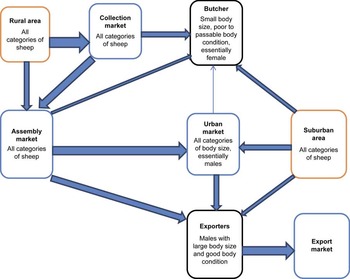
These markets are mainly frequented by collectors, butchers and some traders from urban terminal markets. Purchases are made directly from farmers or through middlemen. The markets in this category cited by respondents are mainly Korsimoro, Yilou and Titao, respectively, located 70, 76 and 230 km from Ouagadougou (Figure 1).
Sheep market channels in Burkina Faso. Width of arrows is indicative of the relative importance of the flow.

Assembly markets
They are located in accessible areas, near the production basins, for example, Kaya, Djibo or Dori, respectively, 100, 210 and 270 km from Ouagadougou. In these markets, sellers are collectors (who resell animals purchased at the collection market) and livestock keepers. These two actors are often helped by middlemen. The main interlocutors of interviewed buyers are people they call their ‘gaansoaba’ (meaning ‘guardians’). These are local livestock traders or middlemen. They have multiple roles, as listed by interviewees: purchase of animals in peripheral markets for resale to buyers; purchase, assembling and surveillance of animals on behalf of purchasers; acting as an intermediary in the selection and purchase of animals from other sellers; supply of animal feed; and providing information on the market. The relationships between these partners are essentially based on trust, tacit contracts and sometimes on kinship.
Urban markets of Ouagadougou
In these markets, traders, their representatives or brokers sell animals (purchased essentially at the assembly market) to end-consumers or exporters. Suburban livestock keepers also come to sell their animals but are not allowed to sell directly to consumers. Only traders, recognized as such by market managers, are allowed to buy and resell. In these markets, brokers are paid by traders for each animal they sell. The amount of this compensation is decided by traders, and varies according to the final sale price. It also happens that traders sell to brokers at a fixed total price, and allow the broker the possibility of creating the margin freely through their bargaining with end-buyers.
Export markets
The main destinations are Ivory Coast and Ghana. Benin is less important as a destination. Exporters from other countries, such as Mali and Niger, sell their animals at these same export terminal markets. Here also, there are ‘gaansoaba’. They help traders to watch and sell animals. They are also used as informants, by telephone, on market prices. Relationships are essentially also based on trust, tacit agreement and/or family bonds. In all the markets where they intervene, the ‘gaansoaba’ receives fees based on transaction price.
Circuits and characteristics of export sheep
Exporters buy their sheep mainly at assembly markets, urban markets and suburban farms (Figure 1). The animals purchased are exported alive and are generally collected in Ouagadougou before being loaded into trailer trucks (usually hired by several traders) to the destination country. The number of sheep, by convoy and by trader, varies between 20 and 400 depending on the period and the trader. The time required for collecting them varies from 1 to 2 weeks.
The main characteristics taken into account in the selection of animals are body size, body condition and sex, with male and large animals with a good body condition being most highly sought. Urban and suburban livestock keepers, according to exporters, provide the best animals (large and with good body condition). Breed is not directly mentioned, but the small-size breeds (Djallonké and Mossi sheep) are virtually absent from export. Coat colour is not a selection criterion but can influence the price of animals, according to the interviewees. The white coat colour is likely to reach the highest prices on the different markets (domestic and export).
The most cited constraints for exporters are the poor access by road to certain markets (e.g. Djibo), price instability and illegal taxation along roads. All actors (exporters, traders and butchers on domestic markets) financed their activities with their own funds. The actors explained this by stating that price volatility prevented access to credit.
Characteristics of sheep for local slaughter (butchers)
Local butchers state that their preferences for animals are small body size and poor to fair body condition. These animals include more culled females than males. The purchase places are also targeted, consisting mainly of collection markets around Ouagadougou, assembly markets and directly with suburban livestock keepers. The urban market is seldom frequented by sheep and goat butchers. The aim of such selection, according to interviewees, is to reduce the costs in order to offer meat to consumers with weak purchasing power.
Purchase characteristics at the urban market
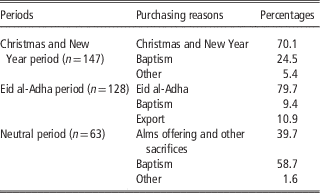
Almost all registered purchases (99.11%) have concerned entire males with horns. Purchase objectives are shown in Table 1. Purchases in festive periods may be aimed at slaughtering for households’ needs or offering as a gift outside of the household. During Christmas and New Year celebrations, making gifts was the main motive for sheep purchase. Animals bought for slaughtering inside the household tended to be poultry or goats. Purchases for alms offering and other sacrifice were almost not observed during Eid al-Adha, Christmas and New Year periods. From information gleaned from traders and brokers as well as observations made during the survey periods, it appears that white rams are mainly sold on Thursdays. The reason is that sacrifices or alms, which make use of these white rams, take place traditionally on Fridays.
Sheep purchases objectives in small ruminant markets at the study periods

Purchased animal characteristics
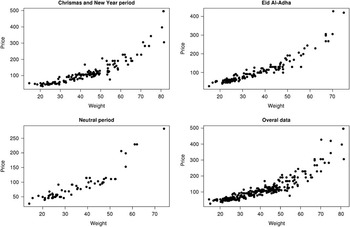
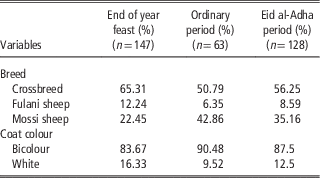
Table 2 shows the percentages of different breeds and coat colours depending on the period. Crossbreed and bicoloured sheep are more frequent in all three periods. Scatter plots for prices based on weight, for the three periods and for all data, are shown in Figure 2. These scatter plots show a not strictly linear relationship, as explained here above in the model description (the ‘Statistical analysis’ section).
Scatter plots of sheep prices based on their weights, for the different periods and for overall data.

Distribution of sheep breeds and coat colours in observed transactions depending on the period

Factors affecting sheep prices
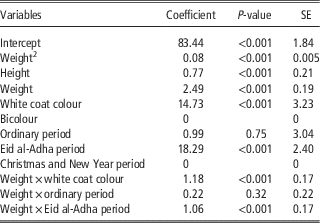
Table 3 shows the results of the linear model analysis. The model was statistically highly significant (F-test, P<0.001). For each categorical variable, one modality is taken as reference. Weight and height at withers both have a positive and highly significant influence on sheep price. In addition, it is noted that the influence of weight is not constant and varies positively with this weight (positive and highly significant coefficient of quadratic term). Except for the ordinary period, all other modalities for categorical variables have positive and highly significant coefficients. Lastly, the weight interacts positively and highly significantly with these modalities.
Quadratic model of factors affecting sheep prices during study period (n=338)

Adjusted R 2: 0.9284.
In the model including the variable ‘objectives for purchases’, only the objectives ‘exportation’ and ‘Eid al-Adha’ showed significant coefficients, of 20.29 (P<0.05) and 16.70 (P<0.001), respectively.
Discussion
The circuit analysis shows that, from livestock keeper to domestic consumer, animals usually go through three markets (collection, assembly and urban markets) with middlemen at each level. This organization of the livestock market, with several levels, is observed in other African countries (Kassa et al., Reference Kocho, Abebe, Tegegne and Gebremedhin2011; Kocho et al., Reference Marshall, Mtimet, Wanyoike, Ndiwa, Ghebremariam, Mugunieri and Costagli2011). It offers employment opportunities, and in Burkina Faso, 60 000 to 90 000 people derive income directly from marketing activities, as middlemen, conveyors or truck loaders (Renard, Reference Tadesse, Negesse and Abebe2003). However, these levels of market and the middlemen contribute together to raise transaction costs and, for a given terminal price, to reduce margins shared between different actors from farmers to the final sellers (Kocho et al., Reference Marshall, Mtimet, Wanyoike, Ndiwa, Ghebremariam, Mugunieri and Costagli2011). In a context of low purchasing power, price instability and livestock keepers complaining of low profit margins (Tindano et al., Reference Tisdell2015), this makes the entire sector vulnerable. There is a relational contract strategy with fees for middlemen varying according to prices at the market. This practice transfers partly the transaction risk to collaborators of traders (gaansoaba, middlemen) and allows the activities to continue.
Due to the quasi-absence of a cold chain, exporting is still mainly done in the form of live animal trading. The relatively long time needed to collect a sufficient number of animals to send a convoy, that is, up to 2 weeks, implies additional costs for the maintenance of animals (feeding, watering), which also contributes to reducing margins. The more the exporter targets high-value animals, which are more difficult to find, the more this selection and maintenance phase will represent a significant part of the operating costs. This strategy, consisting in selecting the best animals for export and relatively less valuable animals for domestic markets, has also been reported in cattle in Burkina Faso (Hoffmann and Bernhard, Reference Hoffmann and Bernhard2007) and in other countries like Ethiopia and Somalia for small ruminants (Ayele et al., Reference Ayele, Jabbar, Teklewold, Mulugeta and Kebede2006; Marshall et al., Reference Brisebarre, Fall and Kane2016). The higher purchasing powers in destination countries explain this market characteristic. This means that the genetic improvement of the body size of animals is first an export development strategy, contributing to national development through export earnings (a common currency is used in Burkina Faso and Ivory Coast but not Ghana). One should note, nevertheless, that for occasional slaughter (feast, baptism, sacrifices or alms), the best animals can be used locally.
The production of animals with better body size and condition by urban and suburban farmers is in line with their better access to inputs (proximity to the market, higher income) and to technical information (health and production).
Butchers, unlike exporters, target small-framed animals. This can be understandable when one take into account the fact that the consumer has low purchasing power. Hence, the consumer has a constant daily amount for the purchase of meat and is much more attached to quantity than quality (Renard, Reference Tadesse, Negesse and Abebe2003; Hoffmann and Bernhard, Reference Hoffmann and Bernhard2007). A sudden rise in prices, which would prevent him having his daily quantity, will move him towards alternative products, such as fish. As meat is perishable and the cold chain for conservation almost non-existent, butchers are exposed to poor sales and product deterioration. To prevent this, butchers, anticipating consumers’ behaviour, play on the quality (by selecting the body condition of animals) and quantity of meat by focussing on the number and body size of the animals slaughtered, in order to maintain their customers, and to ensure all flow out on the same day. This context may also explain the choice of markets. This means that at the butcher level, large body size animals have a better value alive than slaughtered: due to poor conservation facilities and weak outlet capacities, the processing of animals into meat decreases the products’ value. These explanations, deduced from interview narratives, seem moreover in agreement with the fact that they also target poor to fair body condition or culled females. Other plausible explanations for the choice of small-framed animals are their higher carcass yield and/or the better meat quality, which is indeed renowned and much appreciated by the consumer.
The scatter plots, as well as the sign of the quadratic term coefficient, show that the influence of weight on price is not constant and gradually grows as the weight increases. In other words, every additional kilogram taken by the animal is paid more than the last. Our results are in line with findings of Kassa et al. (Reference Kocho, Abebe, Tegegne and Gebremedhin2011) from Ethiopia. This can contribute to the understanding of butchers’ choices, as they have no interest in paying more expensive, the average live weight kilogram. The height at the withers also positively influences prices. These results are consistent with the objective of improving body size shown by livestock keepers in the Ouagadougou suburban area (Tindano et al., Reference Tisdell2015). However, as farmers do not keep exploitation accountancy, it is unclear whether this extra income compensates or goes beyond the extra feed needed for the growth and maintenance of these large-size animals.
Although it is easy to understand the preference of farmers for large-size animals, consumers’ preference for these animals is more difficult to grasp. Indeed, the present study clearly shows the greater willingness to pay per kilogram of BW in larger animals. The first element of the answer could lie in the prestige of slaughtering or offering an animal that is not accessible to everyone. This explanation is reinforced by the fact that white coat colour, which also improves prices for cultural motives (Terfa et al., Reference Tindano, Moula, Traoré, Leroy and Antoine-Moussiaux2013; Dossa et al., Reference Dossa, Sangaré, Buerkert and Schlecht2015), shows an even higher effect on the price for high-weight animals (positive effect of interaction term). Nevertheless, a second element may be found in the expectation for better meat quality in high-weight animals, due to expected good health status and sufficient fat, which has organoleptic advantages.
The feast of Eid al-Adha showed a positive and highly significant difference in prices, compared with other periods. Here again there is a positive interaction with weight. The strong domestic demand, coupled with the exportone, particularly directed at animals with better weight during this period, could explain this significant increase in prices. The results of model with the variable ‘objectives of purchases’ were consistent with this statement. Indeed, only objectives ‘exportation’ and ‘Eid al-Adha’ have shown an effect on prices. Christmas and New Year period is also characterized by a higher demand but did not show any significant impact on price compared with the neutral period. The cultural possibility of consumers using cheaper alternative goods for these feasts, such as goats and poultry, could explain this fact. This also explains why buyers purchase sheep in this period essentially for gift-making purposes, with family needs being oriented around goats and poultry. Indeed, for reasons of prestige, poultry and goats are not generally accepted locally as a good alternative to sheep. In accordance with the comment made above and earlier, the effects of period and purchase motive are confounded and are to conceive as truly intertwined in reality. To this we can add that traders and brokers are well informed on markets fluctuations, are well organized and anticipate the opportunities represented by feasts and social occasions. Therefore, the final pricing is to consider as a complex dynamic social phenomenon, of which the present model proposes a workable simplification.
In this regard, the absence of purchase for alms and other sacrifices during festive periods can be understood as an adaptive reaction of buyers, postponing anything that can be postponed to avoid high market prices on these periods. As baptism among Muslims is compulsory on the 7th day of birth, purchase for it is observed at all periods.
Although the physical characteristics attached to breeds (small framed for purebred Mossi and large body size for purebred Fulani) have shown an influence on prices, breed itself has not been significant. This is in line with exporters’ statements, according to which, breed is not a selection criterion for them. So, despite the cultural importance of sheep in the region and the cultural environment of their consumption, there is no signal from consumers to farmers indicating that they should raise a particular breed. Rather, the characteristics of weight and coat colour act as pressure towards the wider use of Fulani sheep as purebreds or for cross-breeding.
On analysing all these results, we note a heterogeneous market structure. In particular, it is noted that the best-framed rams (large body size and good body condition) are mainly for export, and partly for feasts, gifts, sacrifices, baptism and alms. The remaining animals are destined for domestic markets (local butchers, but also feasts and gifts). White rams are more particularly used in religious sacrifices. From this clearly emerges the need for genetic diversity to meet different markets (domestic, export). Any breeding programme should therefore take this into account, to allow sheep to continue to fulfill their different roles and to maintain the diversity of products.
Conclusion
The distribution channels have shown long circuits that involve high transaction costs, thereby limiting their effectiveness. Vertical integration between groups of farmers and livestock traders would shorten these circuits and also save time. This would allow for an extra margin for the different actors. Phenotypic characteristics such as weight, height at withers and coat colour had a highly significant influence on the prices of sheep. The influence of coat colour and the growing influence of weight show that consumers, as well as the amount of meat, are also looking for other areas of satisfaction in these purchases. Buyers showed no particular preference for a breed, leaving to breeders the possibility of raising a breed(s) that suits them. However, the characteristics of weight and coat colour act as pressure towards a wider use of Fulani sheep as purebreds or for cross-breeding. The diversity of consumers requires the maintenance of genetic diversity. Indeed, it is through this diversity that distribution channels can provide a variety of animals based on consumers.
Acknowledgements
The authors gratefully acknowledge Wallonie-Bruxelles International (WBI) for providing research and travel funding to the first author of this work.
Supplementary Material
To view supplementary material for this article, please visit https://doi.org/10.1017/S1751731117000477