If I would happen to hit myself with a hammer the words coming out of my mouth would definitely be Finnish.
An excerpt from participant, Kevin, whose first language was Finnish, second language English, third language Swedish, and fourth language German (Dewaele, Reference Dewaele2004a).
It is generally accepted that one's mother tongue is the language for expressing feelings and emotions, especially if the topic is personally significant to the speaker (Dewaele, Reference Dewaele2011; Marian & Kaushanskaya, Reference Marian and Kaushanskaya2004; Pavlenko, Reference Pavlenko2005). For instance, a large web questionnaire study by Dewaele (Reference Dewaele2004b) revealed that first language words lead to higher emotional arousal, and, if asked to read out a list of taboo words, people report feeling more anxious when the words are in their native language rather than a second language (Gonzalez-Regiosa, Reference Gonzalez-Regiosa, Spielberger and Diaz-Guerrero1976). Bilinguals also prefer to use their native language when asked to talk about positive events in their lives (Javier, Barroso, & Munoz, Reference Javier, Barroso and Munoz1993). In contrast, later-learned languages are often believed to offer emotional distance, which is illustrated by the finding that bilinguals often feel it is easier to discuss embarrassing topics in their second language rather than in their native language, in which they would be more fluent (Bond & Lai, Reference Bond and Lai1986). This phenomenon of code-switching to the nonnative language can distance the speaker from an uncomfortable situation (Javier & Marcos, Reference Javier and Marcos1989), which has frequently been noted in the psychoanalytic literature (Gonzalez-Regiosa, Reference Gonzalez-Regiosa, Spielberger and Diaz-Guerrero1976; Schrauf, Reference Schrauf2000). Anxiety-arousing words are also more easily expressed in the nonnative language (Dewaele, Reference Dewaele2004a, Reference Dewaele2004b).
Self-report measures can be highly distorted and biased, however. There have therefore been attempts to conduct controlled experiments to reveal the differential emotionality of languages. One interesting approach has been to study memory for different types of words in bilinguals. Research using monolingual samples has consistently found the so-called emotion-word memory advantage, which means that people's memory tends to be better for emotion (e.g., “happy,” “sad”) and emotion-laden (e.g., “cancer,” “spider”) words compared to emotionally neutral words (e.g., “chair,” “letter”; Altarriba & Bauer, Reference Altarriba and Bauer2004; Jay, Caldwell-Harris, & King, Reference Jay, Caldwell-Harris and King2008; Kensinger & Corkin, Reference Kensinger and Corkin2003; Rubin & Friendly, Reference Rubin and Friendly1986; Talmi & Moscovitch, Reference Talmi and Moscovitch2004). Negative and taboo words, in particular, benefit from superior recall, which is not surprising because these words are believed to involve more complex representations and deeper processing than other types of words because of their attention-grabbing properties (MacKay & Ahmetzanov, Reference MacKay and Ahmetzanov2005; Peeters & Czapinski, Reference Peeters and Czapinski1990). Taboo words, in particular, tend to generate very strong responses in people (Jay, Reference Jay2000). When this emotion-word memory advantage is combined with self-reports that the native language is perceived as more emotional, it can be hypothesized that the emotion-word memory advantage should be restricted to words presented in one's mother tongue and not seen in later-learned languages.
Anooshian and Hertel's (Reference Anooshian and Hertel1994) pioneering study showed that the emotion-word memory advantage applied only to the first language. They employed an unexpected free recall procedure, and their results were the same for both balanced English–Spanish and balanced Spanish–English bilinguals living in a bilingual community, and who had started to acquire the second language at the age of 8 years or later. This finding indicated that the emotionality effects did not depend on the languages themselves, but that they were visible only in the mother tongue. Anooshian and Hertel also found that when participants rated the words for emotional intensity, subsequent recall was higher than when the words were rated for ease of pronunciation, but this effect was only visible in the native language. These results seem to fit neatly with the qualitative evidence showing that the native language is perceived as more emotional. The authors proposed that first language words are more likely to be associated with emotional episodes and other emotional exchanges in infancy and early childhood than later-learned languages, and thus, only first language words tend to have emotional connotations.
However, later-learned languages might not be as unemotional as they are usually thought to be. Using unbalanced Turkish–English bilinguals living in America who had acquired their second language after the age of 12, Aycicegi and Harris (Reference Aycicegi and Harris2004) found that emotionality effects could also be seen in the second language and that the recall of taboo words and reprimands was actually better when they were presented in the nonnative language. Furthermore, positive words were recalled significantly better than neutral words but only in the second language. In the recognition test, more negative words were observed in the second language, which further suggested that the second language benefitted more from the emotionality of the words.
The finding that participants had better memory and recognition for negative words presented in the second language compared to the native language (Aycicegi & Harris, Reference Harris2004) could be explained by a so-called mood change. This means that processing anxiety-provoking stimuli, such as negative words, leads people to experience negative emotions. Negative words presented in the native language are thought to have more emotional associations because early language learning coincides with the socialization of emotions (Cervantes, Reference Cervantes2002) and concept development as well as emotional regulation (Bloom & Beckwith, Reference Bloom and Beckwith1989). In order not to feel anxious, people will then try to avoid the processing of the aversive stimuli (Foa & Kozak, Reference Foa and Kozak1986), in which case the stimulus, for instance, the negative word, will be less deeply processed and hence not so accurately recalled. By contrast, negative words in languages learned after early childhood do not possess similar kinds of emotional connotations, and therefore there is no need to minimize their processing. This could then lead to better memory for negative words in a nonnative language. The reason why Anooshian and Hertel's (Reference Anooshian and Hertel1994) study failed to find any emotionality effects in the second language might be that their word list was biased toward positive words, because 13 out of 18 emotional words were positive. Aycicegi and Harris (Reference Aycicegi and Harris2004), in contrast, had an equal number of words in each word type category. However, their stimuli were predominantly negative words because they employed taboo words and childhood reprimands as two additional categories in addition to negative words. Furthermore, the presentation of the words in their study was mixed, and this could have made the nonnative language words seem unusual and novel, which may also have facilitated memory for those words. That participants were living in the second language environment may also have enhanced memory for words in that language.
To explore the topic further, Aycicegi-Dinn and Caldwell-Harris (Reference Aycicegi-Dinn and Caldwell-Harris2009) recently ran a study with late Turkish–English unbalanced bilinguals to see whether there were any effects of different processing tasks on memory. Using the same stimuli as in Aycicegi and Harris (Reference Aycicegi and Harris2004), they compared participants’ recall performance after they had completed either a shallow or deep processing task. The results showed that, across the different processing tasks, emotionality effects were equally strong in the first and the second language. An exception to this was the reprimands, which were better recalled in the second language than in the first. This, the authors argued, was due to a novelty effect, because reprimands in the second language could have been interpreted as being more unusual. However, although the emotionality effects did not differ overall in the first and second language, the specific pattern of results did vary depending on the exact task. For instance, when the words were rated for their emotional intensity, which was a deep processing task, emotion-memory effects were visible only in the first language, providing support for the traditional view that only the native language can have emotional connotations. In contrast, in a shallow processing task involving letter counting, no language differences were observed, but taboo words had superior recall in both the first and the second language. These results suggest that emotionality effects may depend on the task that is used and how the word stimuli are processed. Furthermore, there was no emotion-memory effect for negative words over neutral words in any of the tasks employed, which was quite surprising. The authors argued that this was because the negative words used (e.g., “poison,” “crime”) were more likely to have a later age of acquisition than the positive words used (e.g., “mother,” “father”).
Another recent unexpected free recall study by Ferre, Garcia, Fraga, Sanchez-Casas, and Molero (Reference Ferre, Garcia, Fraga, Sanchez-Casas and Molero2010) tested both early and late proficient bilinguals in order to see whether age and context of second language acquisition had any effect on memory for emotional words. Perhaps it is surprising that both groups of bilinguals showed similar emotionality effects in both of their languages: a superior recall for positive and negative words over neutral words was observed for both the first and the second language regardless of the age or context of acquisition. The authors concluded that proficiency was the main factor influencing the emotion-memory effects, because the emotionality effects in the first and the second language were equally strong regardless of whether the second language was learned early in an immersion context or in a school setting. It must be noted, however, that the authors used filler words as well as a filler task prior to the unexpected memory test in order to reduce any primacy and recency effects, which was not done in previous free recall studies. Thus, these methodological differences may account for the rather unexpected results that age and context of acquisition had no effect on the emotion-memory advantage.
Overall, very few studies have looked at emotion-word memory advantage in bilinguals, and results are still somewhat contradictory as to the extent of emotionality effects in nonnative languages. The two most recent studies by Aycicegi-Dinn and Caldwell-Harris (Reference Aycicegi-Dinn and Caldwell-Harris2009) and Ferre et al. (Reference Ferre, Garcia, Fraga, Sanchez-Casas and Molero2010) do certainly suggest that emotionality effects can be observed in a later-learned language, and that they can be as strong as in the first language. Other quantitative measures have provided more evidence that emotionality effects are not restricted to the native language. For instance, studies using the emotional Stroop paradigm, which is perhaps the paradigm used most frequently to investigate emotional processing at the single word level, have shown that the level of interference from negative and taboo words is similar in native and nonnative languages in both late and early bilinguals (Eilola, Havelka, & Sharma, Reference Eilola, Havelka and Sharma2007; Sutton, Altarriba, Gianico, & Basnight-Brown, Reference Sutton, Altarriba, Gianico and Basnight-Brown2007). Similar levels of interference have been detected also in native and nonnative speakers of English (Eilola & Havelka, Reference Eilola and Havelka2011). These behavioral tasks imply that (automatic) emotional activation occurs in both the first and the second language, and that threatening words are processed similarly across languages. However, others have found that Stroop interference is stronger for the dominant language (Zied et al., Reference Zied, Phillipe, Pinon, Havet-Thomassin, Aubin and Roy2004), although it is visible in the second language as well. Note that Zied at al. (Reference Zied, Phillipe, Pinon, Havet-Thomassin, Aubin and Roy2004) employed the classic Stroop task rather than an emotional version of the task, which is thought to involve different cognitive mechanisms (Algom, Chajut, & Lev, Reference Algom, Chajut and Lev2004). Therefore, the findings from these two tasks may not be directly comparable. When looking at the emotional Stroop task, it is interesting that response times to positive words are usually not significantly different from neutral words (Eilola et al., Reference Eilola, Havelka and Sharma2007; McKenna & Sharma, Reference McKenna and Sharma1995), which further suggests that negatively valenced words are processed differently from emotionally positive and neutral words.
However, physiological evidence regarding the emotionality of languages tends to support the proposal that emotionality effects are confined to the mother tongue. A skin conductance study by Harris, Aycicegi and Gleason (Reference Harris, Aycicegi and Gleason2003) using unbalanced Turkish–English bilinguals living in the second language environment showed that the response to aurally presented taboo words, and aurally or visually presented childhood reprimands, was lower in the second language, which would imply that taboo words in the native language elicit stronger autonomic responses, at least when they are listened to. It was suggested that aurally presented words might result in more emotional activation, because speech is usually very interpersonal in its context and hence provides more emotional associations. However, the authors failed to find any significant differences between native and nonnative languages when the participants were either listening to or looking at printed negative and positive words, or when the taboo words were presented visually. Follow-up experiments (Harris, Reference Harris2004; Harris, Gleason & Aycicegi, Reference Harris, Gleason, Aycicegi and Pavlenko2006) showed that the differences in skin conductance activity were reduced in early bilinguals when they were presented with childhood reprimands or emotion words, which led them to propose that the emotionality of languages depends on the age at which they are acquired and how proficient the speaker is. Recently, Caldwell-Harris and Aycicegi-Dinn (Reference Caldwell-Harris and Aycicegi-Dinn2009) extended their earlier finding (Harris et al., Reference Harris, Aycicegi and Gleason2003) that skin conductance response to reprimands was greatest in the native language to late unbalanced bilinguals living in their native-language environment. It is interesting that Eilola and Havelka (Reference Eilola and Havelka2011) did not detect any differences in performance by native and nonnative English speakers during emotional and taboo Stroop tasks, but they did find significantly higher skin conductance responses to taboo and negative words in native speakers. These studies seem to suggest that although the meanings of the second language words may well be activated and accessed during these different tasks, they do not result in increases in autonomic activation as they seem to do in the native language.
Combining the above studies, it would seem that the issue of the emotionality of first and later languages is not as clearcut as has been thought traditionally. The age and context of acquisition as well as proficiency are likely to be among the most critical factors determining the degree of emotionality of the languages in speakers of more than one language. The acquisition age and context can also be seen as reflecting the amount and type of exposure to a language: the earlier a language is acquired, the more likely the acquisition is to happen in a naturalistic setting as opposed to at school. Proficiency would also be expected to be greater if a language was acquired early in life in multiple, social contexts. Dewaele's (Reference Dewaele2004b; see also Dewaele, Reference Dewaele2008) web questionnaire study with more than 1,000 participants showed that the most important factors affecting the perceived emotionality of languages were the age at which later-learned languages were acquired, and whether they were learned in purely educational settings, or by living in a foreign language environment, or both. Other significant factors were the perceived fluency and the frequency of use of the language. It is important to note that so far experimental studies on memory and the multilingual lexicon in general have looked at only two languages at a time, and often used participants living either in the second language environment or in a bilingual community. This can easily result in findings such as those of Aycicegi and Harris (Reference Aycicegi and Harris2004), in which the nonnative language has apparently the same, or even stronger, emotional connotations than the mother tongue. However, if emotionality effects depend on the amount and type of exposure to a particular language, one would expect to see a graded difference in the degree of the emotionality, with the effects being largest in the native and most fluent language and progressively smaller in later-learned languages, depending on the type and amount of exposure to these languages. This issue may be best studied using unbalanced speakers of more than two languages living in their native-language environment, as this would control for exposure to the nonnative languages.
The current study aimed to examine the possibility that there is a graded emotionality effect across languages. It was decided that the study would be conducted in Finland because of the country's interesting linguistic situation. To summarize, Finland was ruled by Sweden from approximately 1155 to 1809, when the country was invaded by Russia. Despite Finnish having always been used by the majority, Swedish was the language of prestige and the only official language until 1863 (Engman, Reference Engman and Tägil1995). Now, Swedish remains as one of the official languages in Finland. However, as of 2008, 90.9% of the population have Finnish as their native language, compared to only 5.4% who speak Swedish as their first language (Tilastokeskus, 2009). Nevertheless, Swedish is still a mandatory language in Finland, but it is generally regarded as a burden or a relic from earlier times. English is also mandatory, but it is seen as useful and universal, and it is usually learned earlier than Swedish, with more than 90% of school-aged children learning English as their first foreign language (Sajavaara, Reference Sajavaara2006). The aim of the current study was to use this situation in Finland to test the idea that emotionality effects are graded across the languages known by the speaker, rather than being an all-or-none phenomenon visible only in the native language.
There are at least three advantages to investigating the emotionality effects of languages using a sample from Finland. First, because a typical Finn is trilingual with Finnish as the first, English as the second, and Swedish as the third language, it is possible to examine the potentially graded nature of emotionality effects across these three languages. Second, as Finnish people generally do not start to learn foreign languages until the age of 9, most of them can be considered to be late learners of English and Swedish. This makes it possible to look at the effect of age on emotionality effects to see whether languages learned after early childhood will have emotional connotations similar to the native language. Third, there is a clear pattern of dominance in how fluent a typical Finn is in his or her languages, with Finnish being the native language, and English and Swedish learned only after early childhood, in that particular order. This makes it possible to predict that any emotionality effects will be strongest in Finnish, weaker in English, and weakest or possibly nonexistent in Swedish.
To summarize, the current study was designed to investigate the processing of emotion-laden words in multilinguals to see whether emotionality effects are restricted to the first language or also seen in later-learned languages. Because it has been well established that deeper processing of the stimuli leads to better recall (e.g., Craik & Lockhart, Reference Craik and Lockhart1972), the current study also employed either a deep or shallow processing task before the free recall in order to see whether the recall of words across languages and different word categories would be affected by the depth of processing of the stimuli. As shown in the study by Aycicegi-Dinn and Caldwell-Harris (Reference Aycicegi-Dinn and Caldwell-Harris2009), the nature of the processing task can have an effect on emotion-memory effects. Native speakers of Finnish with knowledge of English and Swedish were chosen as the target population. In a mixed design, young adults (N = 41) completed an orienting word-rating task (deep or shallow processing) on 36 words: 12 negative/taboo, 12 positive, and 12 neutral presented in the three languages. Participants were then given an unexpected free recall test. It was hypothesized that there would be a clear emotion-word memory advantage for words presented in the mother tongue Finnish and that it would also be visible in English, but to a lesser degree. For Swedish words, the emotion-word memory advantage was expected to be very small, or nonexistent. Because of the differential processing of negative information, the memory advantage was anticipated to apply especially to negative/taboo words. Additional self-report measures regarding the subjective emotionality of participants’ later-learned languages and the extent to which they used these languages in everyday life were also collected to see whether participants regarded English as more emotional and more widely used than Swedish.
METHOD
Participants
The total number of the participants was 41 (66% females), and their mean age was 20.17 (SD = 3.17, range = 17–25 years). Participants were required to be native Finnish speakers with at least a fair knowledge of English and Swedish, and they were recruited from eastern Finland. They were considered to be late, unbalanced multilinguals because they had learned their later languages after early childhood. Opportunistic sampling was employed, which meant that those who consented to participate perceived themselves to be at least fairly competent in English and Swedish. The vast majority (88%) had started to learn English before Swedish, and for 5%, Swedish was a fourth- or later-learned language. Thus, most of the participants had started to learn English at the age of 9 and Swedish at the age of 13. On average, the participants had been learning English for 11 years and Swedish for 7 years. Most of the participants (61%) had never been abroad in a situation where they would have had to use Swedish as the main means of communication. As for English, 27% stated that they had never used English as the only language of communication. All participants reported being more fluent in English than in Swedish.
Design and materials
A mixed design with three independent variables was used, and this study generally adopted an approach similar to that of Anooshian and Hertel (Reference Anooshian and Hertel1994). However, the present study was more quasiexperimental in nature as no attempt was made to control for participants’ language skills except for the requirement that they were native Finnish speakers and late learners of English and Swedish (i.e., learning of nonnative languages started after the age of 7). The independent variables were the language of presentation (Finnish, English, Swedish), the word category (negative/taboo, positive, neutral), and the rating task (deep processing, shallow processing). The dependent measure for the main analysis was the percentage of different word types correctly recalled across these three factors.
Participants were shown a list of words (one word at a time) and asked to complete an orienting word-rating task. This was then followed by an unexpected free recall test in which participants were asked to write down as many words as they could remember. The words used in the present study (Appendix A) were randomly selected from those used and validated by Eilola et al. (Reference Eilola, Havelka and Sharma2007), who investigated emotionality effects in English and Finnish using an emotional Stroop task. The selected words were translated into Swedish by a native Swedish speaker and then checked by another Swede. Normative ratings for Finnish and English words were obtained from Eilola and Havelka's (Reference Eilola and Havelka2010) recent study, which is currently the only collection of normative emotional ratings for Finnish words. No similar database for Swedish words exists to date. Therefore, it was not possible to examine if any differences existed between the word categories with regard to their familiarity, emotional valence, arousal, and offensiveness.
There were 108 words used in the study: 36 from each language (Finnish, English, Swedish) and 12 words in each word category (negative/taboo, positive, neutral). The negative/taboo category consisted of five taboo words and eight negative words. The word presentation was blocked, which meant that participants were always presented with words in one language followed by the other two languages, and in order to eliminate possible primacy and recency effects, six different word lists were constructed to account for each possible order combination (i.e., first Finnish, second English, third Swedish; first Finnish, second Swedish, third English; first English, second Finnish, third Swedish). Each participant was randomly assigned to one of the six word lists. Each word list contained 12 different words presented in each language, and these words consisted of four words in each of the negative/taboo, positive, and neutral categories. Thus, each participant was presented with only four words from each word category in each language in order not to repeat the translation equivalents within a single experiment. Each participant was presented with either two or one taboo word in each language. The order of words within each language block was randomized. Although the words were otherwise randomly assigned to one of the six word lists, in order to control for semantic relatedness, which has been identified as a potentially confounding factor in memory research (Talmi & Moscovitch, Reference Talmi and Moscovitch2004), the word lists were constructed so that semantically related words such as “funeral” and “death” did not appear in the same language block.
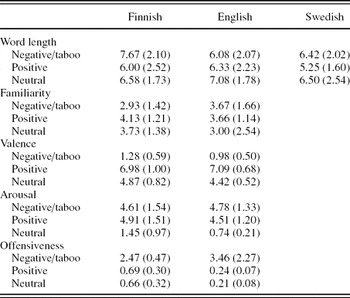
Table 1 shows the length of the words, as well as the mean normative ratings of familiarity, emotional valence, arousal, and offensiveness for the Finnish and English words as reported by Eilola and Havelka (Reference Eilola and Havelka2010). The words did not differ significantly in their word length across the three languages, F (2, 66) = 1.43, p = .247, partial η2 = 0.04, or the word categories, F (1, 33) = 1.30, p = .287, partial η2 = 0.07. There were also no differences in familiarity ratings across Finnish and English words, F (1, 33) = 0.51, p = .480, partial η2 = 0.06, nor the word categories, F (2, 33) = 0.80, p = .459, partial η2 = 0.05. Furthermore, no differences in familiarity existed within the languages.
Mean word length of the words and the mean normative ratings of familiarity, emotional valence, arousal, and offensiveness for the Finnish and English words as reported by Eilola and Havelka (Reference Eilola and Havelka2010)

As for emotional valence, significant language differences were detected across Finnish and English F (1, 33) = 5.98, p = .020, partial η2 = 0.15. Post hoc tests revealed that Finnish words were rated as slightly more emotional than English words. Furthermore, significant differences were found between the word categories, F (1, 33) = 245.35, p < .001, partial η2 = 0.94. This reflected that negative/taboo, positive, and neutral words differed significantly from each other in both Finnish and English (p < .001 for all comparisons).
For emotional arousal, significant language differences were detected, F (1, 33) = 8.74, p = .006, partial η2 = 0.21: English words were rated slightly less arousing than Finnish words. Moreover, there were significant differences across the word categories, F (2, 33) = 38.05, p < .001, partial η2 = 0.70: neutral words were rated as less arousing than negative/taboo and positive words (p < .001 for both comparisons). In both languages, neutral words were rated as significantly less arousing than negative/taboo and positive words (p < .001 for all comparisons).
As for offensiveness, no significant language differences were found in the ratings F (1, 33) = 0.02, p = .888, partial η2 = 0.001. However, significant differences were found across the word categories F (2, 33) = 42.19, p < .001 partial η2 = 0.72: negative/taboo words were rated as significantly more offensive than positive and neutral words (p < .001 for both comparisons). Furthermore, in both Finnish and English, negative/taboo words were rated as significantly more offensive than any other word types (p < .001 for all comparisons).
Other materials consisted of the word-rating sheet, and the emotionality and the frequency of everyday use of language questionnaires. In the orienting word-rating task, participants either rated the words for how emotionally intense they considered the words to be, or how easily they could pronounce the word aloud on a 7-point Likert scale. These rating tasks were included in order to prevent the participants from explicitly trying to memorize the words, and to see if recall would be differentially affected by deep (emotionality rating) and shallow (pronunciation rating) processing tasks. Within each word list, each language block was assigned one of the two rating tasks, and because there were three language blocks within each word list, participants completed either two emotionality ratings and one ease of pronunciation rating, or one emotionality rating and two ease of pronunciation ratings. This ensured that each word was rated for its emotionality and ease of pronunciation in each language across participants. The emotionality questionnaire had 12 questions adapted from the web questionnaire by Dewaele (Reference Dewaele2004b), and included questions such as “How difficult is it for you to talk about emotional topics in English/Swedish?” rated on a 5-point Likert scale. The frequency of everyday use questionnaire was similar to that of Eilola et al. (Reference Eilola, Havelka and Sharma2007). The native language Finnish was not included in the questionnaires, as it was participants’ dominant language, and participants were living in a native-language environment. Participants would therefore be expected to rate Finnish as very emotional and very frequently used. The summary results of the frequency of everyday use questionnaire are provided in Appendix B.
Procedure
Participants completed the experiment individually. Oral instructions were given in Finnish, but the questionnaires were in English. Participants were given an opportunity to ask advice from the experimenter if they did not understand the questions asked. It was not expected that the findings would be affected by having the questionnaires in English, as the participants were living in their native-language environment, and were highly unbalanced multilinguals with the native-language Finnish as the dominant language. For the orienting rating task, participants were told to either decide how emotional the word was, or how easy or difficult the word's pronunciation was on a 7-point Likert scale. The instructions for the ratings were first provided orally before the beginning of the experiment, and on the rating sheet. For the emotionality rating task, the question was, “How would you rate the intensity of the emotion associated with the meaning of the word?” For the ease of pronunciation task, the question was, “How easily or with how much difficulty could you pronounce the word aloud?” The 7-point scales went from unemotional to emotional and easy to say to hard to say, respectively.
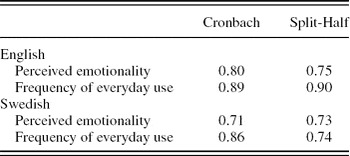
The words were then presented one by one on a 17-in. laptop screen (HP 6730) using Microsoft Powerpoint 2007. Each word was written in black on a white background (66-point Calibri) and was visible on the screen for 11 s. Immediately after all the words had been presented, participants were given an unexpected free recall test. They were simply asked to recall and write down the words they had just rated. They were reminded that the correct spelling was not important, but they should try to write down all of the words that they could remember. Finally, participants completed the perceived emotionality and frequency of everyday use of language questionnaires, the order of which was counterbalanced across participants, after which they were debriefed. The experiment took 15–20 min to complete. Both the perceived emotionality and the use of language questionnaires were analyzed for reliability using the Cronbach alpha and the split-half test. These demonstrated satisfactory reliability for the scales (see Table 2).
The reliability analysis of the perceived emotionality and use of the language questionnaires

RESULTS
Perceived emotionality and the everyday use of English and Swedish
As the scores for the perceived emotionality and frequency of everyday use of Swedish were not normally distributed, the nonparametric Wilcoxon signed-rank test was used to compare the scores for English and Swedish. This analysis revealed that English (Mdn = 39.00) was perceived to be more emotional than Swedish (Mdn = 20.00; z = −5.38, p < .001). The strength of this difference was r = −.59, which represents a large-sized effect. Moreover, participants reported using English (Mdn = 33.00) significantly more often in everyday life than Swedish (Mdn = 15.00; z = −5.58, p < .001, r = −.61), suggesting a greater exposure to English than Swedish.
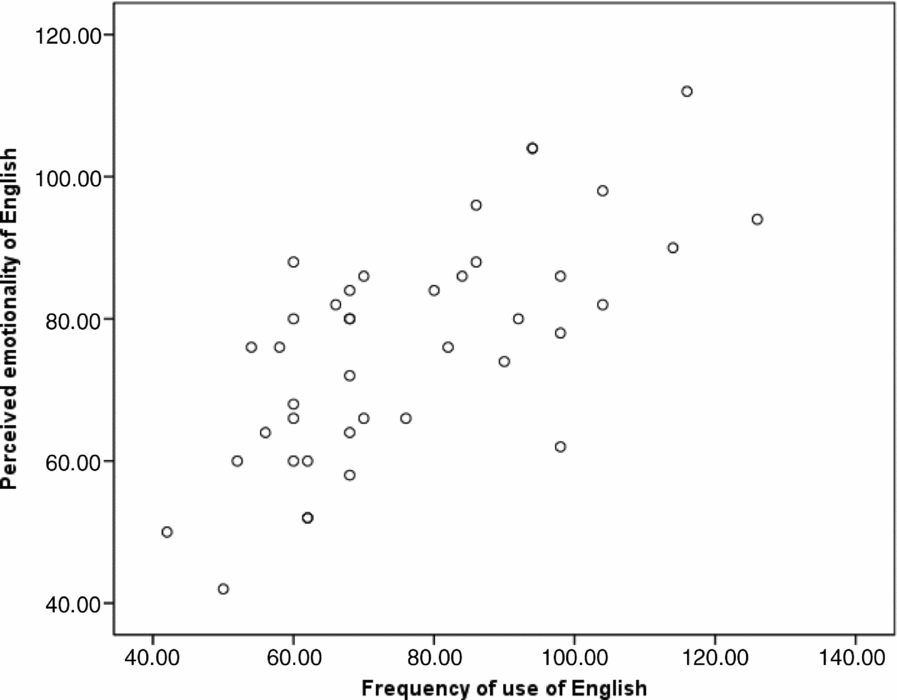
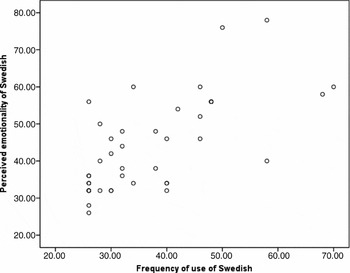
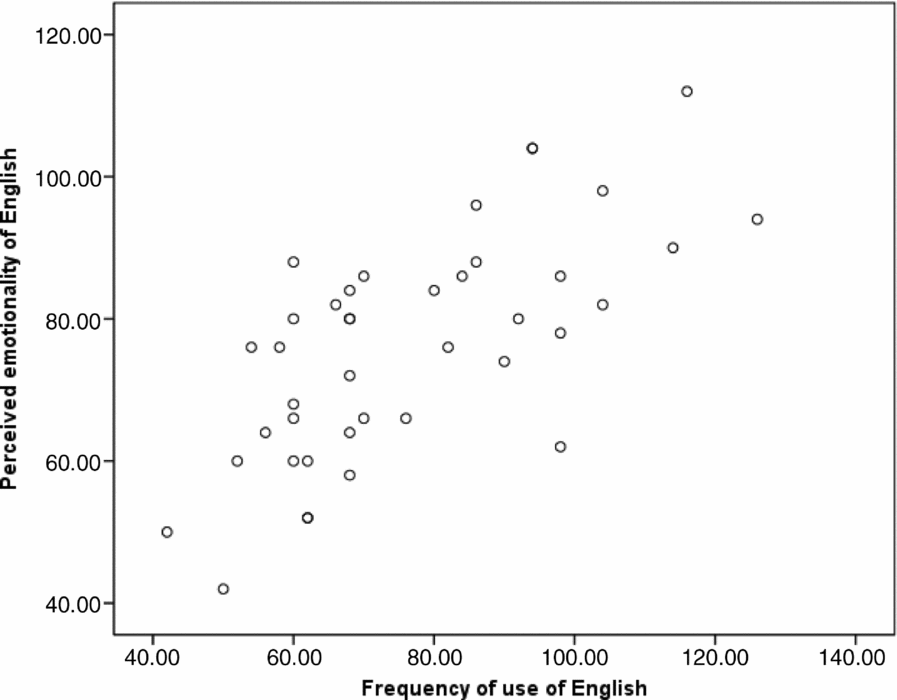
Analysis using Pearson's correlation coefficient revealed that perceived emotionality of English and the extent to which English was used in everyday life were significantly correlated (r = .69, p < .001, two tailed). The Pearson correlation between the everyday use of Swedish and its perceived emotionality was also significant (r = .66, p < .001, two tailed). These correlations suggest that the frequency of everyday use of a language is significantly related to the perceived emotionality of that language, which is consistent with previous research (e.g., Dewaele, Reference Dewaele2004b). The relationship between these two variables is illustrated in Figure 1 and Figure 2.
The correlation between frequency of use and perceived emotionality of English.
The correlation between frequency of use and perceived emotionality of Swedish.

Word ratings
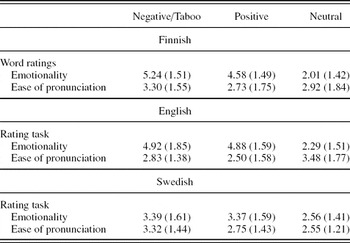
In the orienting word-rating tasks, participants rated each word presented to them on a 7-point Likert scale for its emotionality (1 = unemotional; 7 = emotional) or ease of pronunciation (1 = easy to say; 7 = hard to say). Table 3 shows the mean ratings for these two rating tasks across languages and word categories. To see if there were any significant differences in emotionality ratings between languages and word categories, a 3 × 3 (Language × Word Category) analysis of variance (ANOVA) was conducted. This revealed a significant main effect of language, F (2, 142) = 13.20, p < .001, partial η2 = 0.16. Post hoc comparisons (all comparisons made using Bonferroni adjustments) indicated that, on average, Finnish words (M = 3.94, SE = 0.13) were rated as significantly more emotional than Swedish words (M = 3.23, SE = 0.13; p = .001). The emotionality ratings for English words (M = 4.03, SE = 0.12) did not differ from the ratings for Finnish words (p = 1.00), but they were significantly higher than the ratings for Swedish words (p < .001).
Mean (standard deviation) emotionality and ease of pronunciation ratings across languages and word categories

Furthermore, a significant main effect of word category was found, F (2, 142) = 158.75, p < .001, partial η2 = 0.69. In post hoc tests, it was revealed that higher emotionality ratings were given to negative/taboo (M = 4.51, SE = 0.13) and positive (M = 4.40, SE = 0.11) words as opposed to neutral words (M = 2.29, SE = 0.11; p < .001 for both comparisons).
Finally, the ANOVA revealed a significant Language × Word Category interaction, F (4, 284) = 16.69, p < .001, partial η2 = 0.19. Post hoc analyses revealed that, in Finnish, negative/taboo words (M = 5.24, SE = 0.18) were rated as being significantly more emotional than positive (M = 4.58, SE = 0.18) and neutral (M = 2.01, SE = 0.17) words (p < .001 for both comparisons). Furthermore, positive words were rated as more emotional than neutral words (p = .007). Similarly for English, neutral words (M = 2.29, SE = 0.18) were rated as significantly less emotional than negative/taboo (M = 4.92, SE = 0.22) and positive words (M = 4.88, SE = 0.19; p < .001 for both comparisons), but no significant difference was found between negative/taboo and positive words. As for Swedish, a similar pattern emerged: neutral words (M = 2.56, SE = 0.19) were rated as less emotional than negative/taboo (M = 3.75, SE = 0.19) and positive words (M = 3.39, SE = 0.19; p < .001 for both comparisons). Furthermore, negative/taboo words in Swedish were rated as less emotional than negative/taboo words in Finnish (p < .001) and English (p < .001). Similarly, positive words in Swedish were rated as less emotional than positive words in Finnish (p = .013) and English (p < .001). No differences were found in the emotionality ratings of neutral words across the three different languages.
Another 3 × 3 (Language × Word Category) was conducted to look at the differences in ease of pronunciation ratings between languages and word categories. This ANOVA revealed that there was no main effect of language, F (2, 118) = 0.16, p = .852, partial η2 = 0.03. Thus, there were no differences in how difficult to pronounce the participants perceived the words to be in Finnish (M = 2.98, SE = 0.16), English (M = 2.94, SE = 0.13), and Swedish (M = 2.87, SE = 0.13).
However, there was a significant main effect of word category, F (2, 118) = 6.32, p = .002, partial η2 = 0.10. Positive words (M = 2.66, SE = 0.12) were rated as being significantly easier to pronounce than negative/taboo (M = 3.15, SE = 0.12) and neutral (M = 2.98, SE = 0.11; p = .001 and .047, respectively). Negative/taboo words were rated as being most difficult to say out loud, but they differed significantly only from the ratings of positive words.
There was also a significant interaction between language and word category, F (4, 236) = 4.72, p = .001, partial η2 = 0.07. Pairwise comparisons revealed that in Finnish, negative/taboo words were rated as being most difficult to pronounce (M = 3.32, SE = 0.19), although this difference was only marginally significantly different from positive words (M = 2.73, SE = 0.23; p = .051). In English, positive words (M = 2.50, SE = 0.20) were rated as significantly easier to say out loud than neutral words (M = 3.48, SE = 0.23; p < .001). In Swedish, negative words (M = 3.32, SE = 0.19) were rated as significantly more difficult to pronounce than positive (M = 2.75, SE = 0.19) and neutral (M = 2.55, SE = 0.16; p = .043 and p = .002, respectively). In addition, neutral words were rated as being significantly more difficult to pronounce in Swedish (M = 3.32, SE = 0.19) than in English (M = 2.83, SE = 0.18; p = .006).
Unexpected free recall
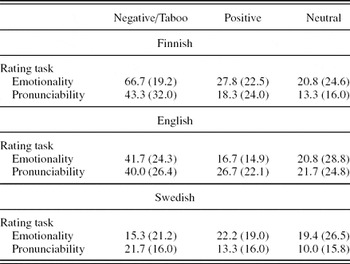
In order to test whether there were any emotionality effects within and between the first- and later-learned languages, and across the two rating tasks, the unexpected free recall data were analyzed. The mean percentage of words recalled across languages, word categories, and rating tasks was 25.5% (SD = 1.5%). Preliminary analysis indicated that a similar pattern of recall emerged for all the six word lists. Very few recall errors were made (N = 3), suggesting that recall of words is language-specific, which is consistent with previous memory studies (e.g., Aycicegi-Dinn & Caldwell-Harris, Reference Aycicegi-Dinn and Caldwell-Harris2009). The three incorrectly recalled words were all from the neutral word category, and they were Finnish translation equivalents of English target words. Table 4 displays the mean correct recall percentages and their standard deviations for each language/word category/rating task combination. It is clear from Table 4 that the emotion-word memory advantage was different across the three languages. Although the distribution of some of the data was somewhat skewed, nonparametric inferential tests resulted in similar conclusions to the equivalent parametric tests; therefore, only the parametric tests are reported below.
Mean (standard deviation) recall percentages by language, word category, and rating task

To test for effects of language, word category, and rating task on the recall of words, a mixed-design 3 × 3 × 2 (Language × Word Category × Rating Task) ANOVA was conducted. All post hoc tests were adjusted using Bonferroni corrections.
No significant differences in recall between the two rating tasks were found in the ANOVA. Thus, there was no main effect of rating task, F (1, 31) = 2.57, p = .12, partial η2 = 0.08, nor any significant interactions between Rating Task × Language, F (2, 62) = 2.70, p = .075, partial η2 = 0.08; Rating Task × Word Category, F (2, 62) = 0.17, p = .84, partial η2 = 0.006; or Rating Task × Language × Word Category, F (4, 124) = 1.73, p = .15, partial η2 = 0.05. However, the Rating Task × Language Interaction was not far from being significant, and from Table 2, it can be seen that the highest recall rate was for Finnish negative/taboo words when they were rated for their emotionality.
A significant main effect for language was found, F (2, 62) = 9.22, p < .001, partial η2 = 0.23. Post hoc tests revealed that the participants recalled significantly more Finnish (M = 31.7%, SE = 2.9%) than Swedish words (M = 17.0%, SE = 1.7%; p = .001), and significantly more English words (M = 27.9%, SE = 2.8%) than Swedish words (p = .01).
The main effect of word category was also significant, F (2, 62) = 26.33, p < .001, partial η2 = 0.46. The percentage of negative/taboo words recalled (M = 38.1%, SE = 2.3%) was significantly higher (p < .001) than the percentage of neutral words recalled (M = 17.7%, SE = 2.5%). Furthermore, fewer positive words (M = 20.8%, SE = 2.0%) were recalled than negative words (p < .001).
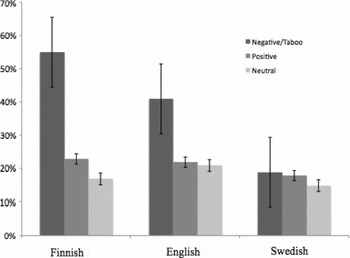
In addition to these significant main effects, a significant interaction between language and word category was found, F (4, 124) = 6.88, p < .001, partial η2 = 0.18, which suggests that emotionality effects were different depending on the language in which the words were presented. This interaction is illustrated in Figure 3. The error bars show the standard errors of the mean, and overlapping bars are likely to differ from each other only by chance.
The interaction between language of presentation and word category.

Paired comparisons revealed that, for words presented in Finnish, significantly more negative/taboo words were recalled than neutral or positive words (p < .001). The difference between positive and neutral words was also significant (p = .019), with more positive words being recalled.
For words presented in English, a similar pattern emerged: negative/taboo words had the highest recall rate, and this was significantly higher than the number of positive (p = .001) and neutral (p = .010) words recalled.
However, for the third language, Swedish, all the comparisons between the different word categories were nonsignificant, which suggests that there were no emotionality effects in Swedish.
Furthermore, significantly more negative/taboo words were recalled in Finnish than in English (p = .016) or Swedish (p < .001). Moreover, the recall of English negative/taboo words was significantly better than that of Swedish negative/taboo words (p < .001), which provides further evidence for the graded nature of emotionality effects, with the effect being greatest in Finnish, smaller in English, and smallest in Swedish.
To summarize, participants recalled significantly more words overall in Finnish and English than in Swedish. Across languages, significantly more emotionally negative/taboo words were recalled compared to positive and neutral words. This provides support for the view that negative/taboo words are processed differently than positive or emotionally neutral words. These two language and word category factors interacted so that, in Finnish, participants recalled significantly more negative/taboo than positive or neutral words. Moreover, the recall of positive words was significantly better than the recall of neutral words. Participants had superior recall in English of negative/taboo words compared to positive and neutral words. No significant emotionality effects could be detected for words presented in Swedish. Furthermore, recall of negative/taboo words was significantly better in Finnish than in English and Swedish, and significantly more negative/taboo words were recalled in English than in Swedish. These results provide support for the idea that emotionality effects are graded rather than an all-or-none phenomenon. Such effects do not seem to be completely restricted to the first language but can also be seen in languages learned after early childhood. However, they seem to become less strong the later the language is acquired and the less it is used.
Additional analyses: Taboo words as a separate category
Because previous research has indicated that taboo words may be processed differently compared to other negatively valenced words, an additional 3 × 4 × 2 (Language × Word Category × Rating Task) ANOVA was conducted in which negative and taboo words were treated as two separate categories. As in the main analyses, a significant main effect of language was found, F (2, 62) = 10.58, p < .001, partial η2 = 0.26, with significantly more Finnish and English words recalled than Swedish words (p < .001 and p = .003, respectively). The main effect of word category was also significant, F (3, 93) = 10.78, p < .001, partial η2 = 0.26. Post hoc tests revealed that taboo words elicited the highest recall rate, which was significantly different from both neutral and positive words (p < .001 and .008, respectively). The percentage of negative words recalled was significantly higher (p = .001) than the percentage of neutral words recalled. Furthermore, fewer positive words were recalled than negative words, although this difference was only marginally significant (p = .077).
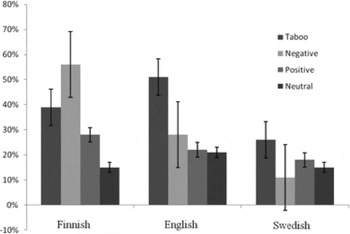
In addition to the main effects, a significant interaction between language and word category was found, F (3.50, 108.37) = 4.25, p = .005, partial η2 = 0.12, which suggests that emotionality effects were different depending on the language in which the words were presented. This interaction is illustrated in Figure 4. The error bars show the standard errors of the mean, and overlapping bars are likely to differ from each other only by chance.
The interaction between language of presentation and word category (taboo words as a separate category).

Paired comparisons revealed that, for words presented in Finnish, significantly more negative words were recalled than neutral or positive words (p < .001). Significantly fewer neutral words than taboo words were recalled (p = .002), and the difference between positive and neutral words was also significant (p = .019), with more positive words being recalled.
For words presented in English, a slightly different pattern emerged: taboo words had the highest recall rate, and this was significantly higher than the number of negative (p = .035), positive (p = .001) or neutral words (p = .002) recalled. For Swedish, no significant differences were found between the different word categories.
To summarize the results of the additional analyses, participants recalled significantly more words overall in Finnish and English than in Swedish. Across languages, significantly more taboo words were recalled compared to positive and neutral words, and the recall of negative words was also significantly higher than the recall of neutral words. This provides support for the view that taboo and negative words are processed differently than positive or emotionally neutral words. Language and word category interacted so that participants recalled significantly more negative than positive or neutral words in Finnish. Moreover, the recall of taboo and positive words was significantly better than the recall of neutral words. In English, taboo words had superior recall compared to negative, positive, and neutral words. No emotionality effects could be detected for words presented in Swedish. Furthermore, recall of negative words was significantly better in Finnish than in English and Swedish and significantly more negative words were recalled in English than in Swedish.
DISCUSSION
This study was designed to investigate whether emotionality effects are graded across languages rather than being restricted to the native language, and whether these emotionality effects are affected by the level of processing. In a mixed design, 41 native Finnish speakers with knowledge of English and Swedish completed an orienting word-rating task in which they were presented with emotionally negative/taboo, positive, and neutral words in Finnish, English, and Swedish while rating these words for their emotionality (deep processing) or ease of pronunciation (shallow processing). Immediately after completing the word ratings, they were given an unexpected free recall test with instructions to write down all the words they could remember. The results provided support for the hypothesis that the emotionality of languages is graded rather than an all-or-none phenomenon, but no differences were found between the two processing tasks. The emotion-word memory advantage, which was restricted to negative/taboo words, was visible in both the native language, Finnish, as well as the second language, English, whereas the recall of all the Swedish words was very poor with emotional words having no significant recall advantage over neutral words. The finding that the recall of negative/taboo words was highest in Finnish, intermediate in English, and lowest in Swedish further supports the hypothesis that the emotionality effects are not restricted to the first language but can also be seen in later-learned languages (Aycicegi-Dinn & Caldwell-Harris, Reference Aycicegi-Dinn and Caldwell-Harris2009; Eilola et al., Reference Eilola, Havelka and Sharma2007; Ferre et al., Reference Ferre, Garcia, Fraga, Sanchez-Casas and Molero2010; Sutton et al., Reference Sutton, Altarriba, Gianico and Basnight-Brown2007). However, note that because no information was collected regarding participants’ knowledge of the words used in the present study, it is unclear whether the lack of emotionality effects in the weakest language (Swedish) was because the participants did not know many of the words that were used. Additional self-report measures indicated that English was perceived as more emotional and more frequently used in everyday life than Swedish, and for English and Swedish the frequency of everyday use correlated significantly with the perceived emotionality, suggesting that the active use of the language in several contexts was an important factor contributing to the emotionality effects of languages acquired after early childhood.
The present results, showing that emotionality effects were largest and most significant in the first language, are in accordance with studies employing physiological recordings of skin conductance. These have showed that negative/taboo words and phrases do show less activation in the second language in unbalanced and late bilinguals (Caldwell-Harris & Aycicegi-Dinn, Reference Caldwell-Harris and Aycicegi-Dinn2009; Harris et al., Reference Harris, Aycicegi and Gleason2003), as well as in the second language of nonnative speakers (Eilola & Havelka, Reference Eilola and Havelka2011). Although it may seem plausible to argue that, as the context of first language acquisition coincides with concept development (Bloom & Beckwith, Reference Bloom and Beckwith1989) and the socialization of emotions (Cervantes, Reference Cervantes2002), there may be a “critical period” for the acquisition of the emotional force of language, the graded emotionality effects across the three languages found in the present study challenge this simplistic and anecdotal view. The quantitative differences in the emotionality of the first, second, and third languages strongly suggest that emotionality effects are not restricted to the language(s) acquired during early childhood but that languages learned later in life can also be associated with particularly negative emotional valence, as has been suggested by several researchers (Aycicegi-Dinn & Caldwell-Harris, Reference Aycicegi-Dinn and Caldwell-Harris2009; Eilola et al., Reference Eilola, Havelka and Sharma2007; Ferre et al., Reference Ferre, Garcia, Fraga, Sanchez-Casas and Molero2010; Sutton et al., Reference Sutton, Altarriba, Gianico and Basnight-Brown2007). Thus, although the finding that emotionally negative/taboo and positive words were recalled better (in that order) than emotionally neutral words in the mother tongue Finnish could possibly be explained by some kind of critical period effect, accounting for emotionality effects in the second language English would be much more problematic for the critical period hypothesis because this language was not learned during early childhood. The additional analyses, in which taboo and negative words were broken into two separate categories, revealed that the recall of taboo words was higher in English than in the native Finnish. Otherwise, the emotionality effects were noticeably smaller in the second language, which contradicts the previous studies on bilingual memory for emotional words (Anooshian & Hertel, Reference Anooshian and Hertel1994; Aycicegi & Harris, Reference Harris2004; Aycicegi-Dinn & Caldwell-Harris, Reference Aycicegi-Dinn and Caldwell-Harris2009; Ferre et al., Reference Ferre, Garcia, Fraga, Sanchez-Casas and Molero2010).
An explanation for emotionality effects in the second language is offered by Aycicegi and Harris (Reference Aycicegi and Harris2004) who suggested that participants in their study recalled more negative and taboo words in their nonnative language because these aversive words produced a mood change when they were presented in the mother tongue. However, the current study found that the highest number of negative/taboo words was recalled in the native language, which is inconsistent with the mood change hypothesis. However, additional analyses indicated that more taboo words were recalled in the second language than in the first language. In the second language (English), more taboo words were recalled than any other word types, and a similar but nonsignificant pattern was observed for the third language, Swedish. It is interesting that this pattern of results is consistent with Aycicegi and Harris (Reference Aycicegi and Harris2004) who found that reprimands and taboo words elicited greater recall in the second language than in the first. The authors argued that this was due to novelty and unusualness of encountering foreign reprimands and taboo words. Similarly, Aycicegi-Dinn and Caldwell-Harris (Reference Aycicegi-Dinn and Caldwell-Harris2009) reported that reprimands were best recalled in the second language. No reprimands were used in the present study, but it may well be that the high recall of taboo words in English and Swedish in the present study was also influenced by a novelty effect rather than being a pure emotion-memory effect (McDaniel, Einstein, DeLosh, May, & Brady, Reference McDaniel, Einstein, DeLosh, May and Brady1995). Thus, because the present study treated negative and taboo words as one category, it is possible that the negativity effect found in the main analyses could have been affected to some extent by tabooness, particularly in English, in which taboo words elicited the greatest recall when looked at separately from negative words.
The Finnish negative/taboo words were normatively rated (Eilola & Havelka, Reference Eilola and Havelka2010) as being most offensive and negatively valenced, and they also elicited the highest recall rates in the present study. Similarly, the English negative/taboo words were rated as being most offensive and negatively valenced, and negative/taboo words were best recalled in English as well. Thus, the negative valence and offensiveness of the negative/taboo words could have influenced the recall by automatically enhancing it in the first language and, to a lesser degree, in the second language. Negative/taboo words in both Finnish and English were also rated as more arousing than neutral words, and arousing words have been shown to be better recalled than words that are nonarousing (Kensinger & Corkin, Reference Kensinger and Corkin2003; LaBar & Phelps, Reference LaBar and Phelps1998). Emotion-related enhancement in early cortical response has been suggested to be attributable to arousal, not valence of the words (Kissler, Herbert, Peyk, & Junghofer, Reference Kissler, Herbert, Peyk and Junghofer2007). There were no significant differences in arousal ratings between negative/taboo and positive words in either Finnish or English, and this arousal could perhaps explain the finding that in the first language, Finnish, significantly more positive than neutral words were recalled. However, a recent study by Kousta, Vinson, and Vigliocco (Reference Kousta, Vinson and Vigliocco2009) found that valence of the words only, not arousal, facilitated word processing; therefore, it could well be the positive valence of the positive words that enhanced the memory of those words in the native language. It would have been interesting to see how the Swedish words were rated for their valence, arousal, and offensiveness; but to date no normative ratings exist for Swedish words. The lack of normalized stimulus word databases has been highlighted as an important limitation of emotional word research, for instance, by Eilola and Havelka (Reference Eilola and Havelka2010) and Ferre et al. (Reference Ferre, Garcia, Fraga, Sanchez-Casas and Molero2010), because having different criteria for word selection makes comparison across studies difficult.
At first glance, the results of the present study appear to be inconsistent with the recent memory study by Aycicegi-Dinn and Caldwell-Harris (Reference Aycicegi-Dinn and Caldwell-Harris2009) who found that, when averaging over four different tasks, emotionality effects were equally strong in the first and the second language in late unbalanced bilinguals. However, when Aycicegi-Dinn and Caldwell-Harris looked separately at the pattern of recall in different tasks, it was revealed that in a deep processing task, in which participants rated the words for their emotional intensity, emotion-memory effects were restricted to the first language. In the present study, no effect of word-rating task was found on memory, but the recall pattern was similar across the deep processing (emotionality rating) and shallow processing (ease of pronunciation rating) tasks, with the emotionality effects being strongest and clearest in the first language. It could well be that the participants in the present study rated the words for their “emotional” ease of pronunciation rather than phonological ease, and thus, processed the words deeply in both of the tasks. No main effect of language was found in the ease of pronunciation ratings, although one might have expected that the words presented in the first language, Finnish, would be rated as the easiest to pronounce overall. By contrast, a significant main effect of word category indicated that participants rated positive words as easiest to pronounce across the three languages. The shallow processing task used by Aycicegi-Dinn and Caldwell-Harris (Reference Aycicegi-Dinn and Caldwell-Harris2009) consisted of letter counting, and thus, it was less ambiguous than the shallow processing task used in the present study. Thus, the present results would suggest that first language words, particularly those that are negative, may benefit more from elaborative processing than words in later-learned languages in late, unbalanced speakers. It does seem that emotionality effects may be sometimes restricted to the native language. However, because each of the 41 participants rated four words per word category in each language in only one of the two rating tasks, only six or seven participants rated each word on average. Thus, because of this limitation, the lack of statistical power may also explain why no significant differences between the two processing tasks were detected.
Inconsistent with the present findings are the results of Ferre et al.'s (Reference Ferre, Garcia, Fraga, Sanchez-Casas and Molero2010) memory study that found neither age and context of the second language acquisition nor language dominance had any influence on emotionality effects, but they were equally strong in the first and the second language. This rather unexpected finding, the authors suggested, was due to the level of language proficiency: both the late and early bilinguals who participated in the study were highly proficient in their second language. However, the authors used both filler words as well as a filler task prior to the free recall test, and this may have affected the results. Furthermore, the participants in the present study were more unbalanced, and their first language was their dominant language and the language of their current environment. It is possible that as proficiency increases, languages become associated with more emotion, and therefore Ferre et al. (Reference Ferre, Garcia, Fraga, Sanchez-Casas and Molero2010) were unable to find any differences between the two groups of bilinguals. Similar conclusions have been drawn from studies involving emotional Stroop tasks, as these have reported emotional interference as being of the same magnitude in both early (Sutton et al., Reference Sutton, Altarriba, Gianico and Basnight-Brown2007) and late (proficient) bilinguals’ (Eilola et al., Reference Eilola, Havelka and Sharma2007) first and second languages. It would be worth looking at the performance of unbalanced trilinguals, such as those used in the present study, on an emotional Stroop task in order to see if any differences could be detected between the three languages. However, different studies may be tapping different aspects of language processing in speakers of more than one language, and therefore, comparing them is difficult (Eilola et al., Reference Eilola, Havelka and Sharma2007). In an emotional Stroop task, the stimulus words are processed quickly and automatically, and they are unlikely to be deeply processed; whereas in recall studies the participants are often asked explicitly to think about the meaning of the word and to rate it for its unpleasantness (e.g., Aycicegi & Harris, Reference Harris2004; Ferre et al., Reference Ferre, Garcia, Fraga, Sanchez-Casas and Molero2010) or emotional intensity (e.g., Anooshian & Hertel, Reference Anooshian and Hertel1994, and the present study). Aycicegi-Dinn and Caldwell-Harris (Reference Aycicegi-Dinn and Caldwell-Harris2009) showed that even when the dependent measure was the same (free recall), emotionality effects varied greatly across languages depending on the level of processing of the words. The present study found no differences between deep and shallow word-rating tasks, but it is possible that both tasks allowed participants to access the word meanings and thus, encode them more deeply.
The finding that participants perceived English to be more emotional and more frequently used in everyday life than the second official language, Swedish, is consistent with previous research showing that Finns generally report being exposed to English to a greater extent outside the school environment, and they also have very positive attitudes toward the language (Forsman, Reference Forsman, Sjöholm and Ostern2000; Sjöholm, Reference Sjöholm, Sjöholm and Ostern2000). Positive attitudes are likely to encourage greater use of the language. However, Finnish students strongly agree that the current teaching approach at Finnish schools is too grammar based (Shepherd, Reference Shepherd2000), and the English lessons at upper-secondary schools mainly concentrate on language structure and written skills (Pietilä, Reference Pietilä, Gill, Johnson, Koski, Sell and Wårvik2001). As the frequency of everyday use of the language was positively and significantly correlated with the perceived emotionality of both English and Swedish, it can be speculated that the amount of exposure to a particular language in an everyday context rather than in educational settings is an important factor determining the emotional associations that a language has for the speaker. Dewaele's (Reference Dewaele2004b) web questionnaire study revealed that later-learned languages were perceived to be emotional when they had been learned at a young age and preferably in a foreign language environment. These two different factors can be seen as reflecting the amount and type of exposure to a language, and foreign language teaching methods could be changed accordingly to involve more authentic, everyday material to aid language acquisition.
Although several recent studies, including the present one, have demonstrated using different methodologies that emotional activation does occur in a nonnative language (e.g., Aycicegi & Harris, Reference Harris2004; Aycicegi-Dinn & Caldwell-Harris, Reference Aycicegi-Dinn and Caldwell-Harris2009; Dewaele, Reference Dewaele2004b; Eilola et al., Reference Eilola, Havelka and Sharma2007; Ferre et al., Reference Ferre, Garcia, Fraga, Sanchez-Casas and Molero2010; Harris, Reference Harris2004; Harris, Gleason, & Aycicegi, Reference Harris, Gleason, Aycicegi and Pavlenko2006), it is still unclear why emotionality effects are sometimes found to be equally strong in the first and second language, sometimes stronger in the first language, and sometimes stronger in the second language. Thus, future research should be aimed at investigating in more detail the variables that influence these emotionality effects. The results of the current study strongly suggest that exposure to everyday language is a very important factor in addition to age of acquisition. Note that age of acquisition and exposure to everyday language are likely to be correlated, as languages learned early in life tend to be learned naturalistically as opposed to school settings. Another important issue is the question of how the amount of exposure allows later-learned language to take on emotional connotations for the speaker. When one starts to acquire a new language, the words have initially no meaning or emotion attached to them. It would therefore be worth investigating whether words become emotional for the speaker when he or she has had exposure to real-life contexts in which such words have been used, such as someone yelling at them in that language, or if simple growth in and elaboration of knowledge of the language, which strengthens connections within that language, could help to build the deeper emotional connections for those words. The latter process has already been suggested by Ferre et al. (Reference Ferre, Garcia, Fraga, Sanchez-Casas and Molero2010), whose memory study revealed that in proficient early and late bilinguals there were no differences in the emotionality of their two languages. It does seem plausible that emotional associations would develop and get stronger with repeated use and growing proficiency. Equally plausible, though, is the possibility that one learns word meanings and their emotional connotations from contexts in which they are used. Harris et al. (Reference Harris, Gleason, Aycicegi and Pavlenko2006), in their emotional contexts of learning theory, combine both of these factors by suggesting that differences in emotionality between native and nonnative languages depend on the age of acquisition and proficiency of the speaker. Thus, languages become emotional when they are used and acquired in emotional contexts, and therefore, later-learned languages can also become as emotional as the first language if they are learned in contexts that allow emotional associations to be developed. An important implication of this concept for foreign language teaching in school is that teaching methods should shift from grammar-based lessons to the use of more authentic materials from the target language culture, including taboo words and expressions. The Finnish Ministry of Education is currently planning to make it compulsory for all university students to spend a period of their studies abroad (Virkkunen, Reference Virkkunen2009), which can be seen as a practical attempt to enhance students’ language skills by exposing them to a naturalistic learning context. It has been shown that exposure to words in real-life contexts is likely to help in the learning of word meanings (Kinginger, Reference Kinginger2008, Reference Kinginger2009).
To conclude, the results of this study provide support for the view that emotionality effects are not restricted to the native language but can also be seen in languages learned after early childhood. This was illustrated by the finding that especially negatively valenced emotional words had a recall advantage over neutral words, and this advantage was greatest in the native language, Finnish; smaller in the second language, English; and not detected at all in the weakest language, Swedish. Additional analyses indicated that when separated from negative words, taboo words were best recalled in English, which could have been attributable to a combination of novelty and familiarity effects, rather than a pure emotionality effect. The amount and frequency of everyday exposure to a particular language seem to be two critical factors affecting the degree of emotionality of that language, and it remains for future research to determine exactly what kind of exposure is most important and how type of exposure might interact with factors such as attitudes toward the language.
APPENDIX A
Words used in the experiment

APPENDIX B
Questionnaire on the exposure to English in everyday life: Summary of the results

Time spent abroad using English as main means of communication

Questionnaire on the exposure to Swedish in everyday life: Summary of the results

Time spent abroad using Swedish as main means of communication