INTRODUCTION
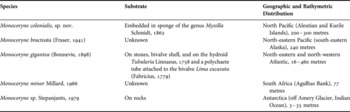
The genus Monocoryne Broch, Reference Broch1910 comprises a small number of hydroid species known from a few localities in the North Atlantic, North Pacific, Antarctica, and South Africa (Table 1; see also Broch, Reference Broch1910, Reference Broch1916; Calder, Reference Calder1972; Stepanjants et al., Reference Stepanjants, Svoboda and Anokhin2002, Reference Stepanjants, Christiansen, Svoboda and Anokhin2003). These species have been described on the basis of solitary polyps, but Swenander (Reference Swenander1904) and Johannesen (Reference Johannesen1924) reported that polyps of Monocoryne gigantea (Bonnevie, Reference Bonnevie1898) may also have small young polyps attached to their bases. More recently, Stepanjants et al. (Reference Stepanjants, Svoboda and Anokhin2002, Reference Stepanjants, Christiansen, Svoboda and Anokhin2003) reported a small colony, identified as Monocoryne bracteata (Fraser, Reference Fraser1941), with about ten loosely connected polyps. Despite the small number of polyps, this finding indicates that some species of Monocoryne may be colonial.
Species of Monocoryne and their substrates and distribution. For details on substrates, distribution, and taxonomy, see Stepanjants et al. (Reference Stepanjants, Christiansen, Svoboda and Anokhin2003).

In this study, we report the first observations of a large living colony of Monocoryne, collected using a manned submersible off the Aleutians Islands, Alaska, in 2002. We show that the polyps are connected to each other and that the species is distinct from Monocoryne bracteata, previously reported from the North Pacific, and Monocoryne gigantea, known from the North Atlantic. Since no additional specimens became available since its discovery, this new species is described herein based on the single specimen collected in 2002.
MATERIALS AND METHODS
A colony of Monocoryne colonialis sp. nov. was collected by Anne Simpson on board the submersible ‘Delta’ during a survey off the Aleutian Islands, Alaska, organized by the United States National Oceanic and Atmospheric Organization, Auke Bay Laboratory, in 2002 (Station 5626: 176º50.1605′W 51º57.6257′N, off Cape Moffet, Adak Island, Aleutian Islands, Alaska, USA, depth 200 m). After collection, the specimen was immediately transferred to clean seawater on board the RV ‘Velero IV’ and examined alive. The colony (holotype) was subsequently preserved in 4% formaldehyde solution for cnidome and additional morphological observations. A polyp (paratype) of this colony was also removed and preserved in ethanol 100%. The abbreviations used are: MHNG: Natural History Museum of Geneva, Switzerland; ROM: Royal Ontario Museum, Toronto, Ontario, Canada; and USNM: National Museum of Natural History, Smithsonian Institution, Washington, DC, USA.
SYSTEMATICS
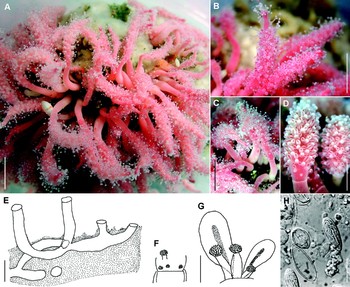
Monocoryne colonialis, sp. nov.: (A) holotype colony; (B) hydranth with relaxed tentacles and gonad-free distal part with rounded hypostome; (C) hydranths, showing pedicel and hydranth body; (D) detail of hydranth; (E) stolon system embedded in sponge Myxilla sp. (dotted); (F) detail of terminal part of pedicel and basal portion of hydranth, showing constriction between hydranth and stem and three developing tentacles above perisarc constriction; (G) group of three tentacles and two adjacent male gonophores in axil between tentacles and outer wall of hydranth; (H) nematocysts, from left to right: discharged microbasic mastigophore, un-discharged stenotele, un-discharged microbasic mastigophore. (A–H: Holotype, USNM2027434). Scale bars: A–C, 1 cm; D, E, 0.5 cm; F, G, 0.2 cm; H, 20 µm.

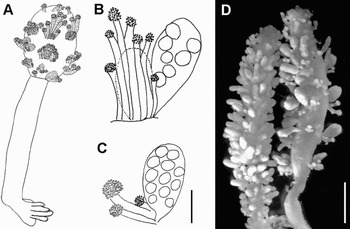
(A) Monocoryne bracteata (Fraser, Reference Fraser1941), original drawing based on the three pieces of the holotype; (B) Monocoryne bracteata (Fraser, Reference Fraser1941), holotype, detail showing seven tentacles fused in a bract-like structure, and adjacent gonophore; (C) Monocoryne colonialis, identified as M. bracteata in Stepanjants et al. (Reference Stepanjants, Christiansen, Svoboda and Anokhin2003), detail of colonial specimen from Kurile Islands, showing a group of three tentacles with adjacent gonophore; (D) Monocoryne colonialis (left) and Monocoryne colonialis (identified as M. bracteata by Stepanjants et al., Reference Stepanjants, Christiansen, Svoboda and Anokhin2003) (right), showing similarity in size and shape of hydranth. (A, B: Holotype of Monocoryne bracteata, USNM43450; C, D (right): Monocoryne colonialis, identified as M. bracteata by Stepanjants et al., Reference Stepanjants, Christiansen, Svoboda and Anokhin2003, from Kurile Islands, ROMIZ B3646; D (left): Monocoryne colonialis, paratype, ROMIZ B3645). Scale bars: B, C, 0.1 mm; D, 0.5 cm.

? Monocoryne bracteata: Stepanjants, Svoboda & Anokhin, Reference Stepanjants, Svoboda and Anokhin2002: 146, figure 3a,b; Stepanjants, Christiansen, Svoboda & Anokhin, Reference Stepanjants, Christiansen, Svoboda and Anokhin2003: 101–102 (part: specimens from Kurile Islands), figures 2B, 3A,B.
Not Symplectanea bracteata Fraser, Reference Fraser1941: 78–79, pl. 13, figure 1.
Type material
Holotype: male colony, originally preserved in 4% formaldehyde solution, subsequently transferred to 75% ethanol (176º50.1605′W 51º57.6257′N, off Cape Moffet, Adak Island, Aleutian Islands, Alaska, USA; water depth 200 m) [USNM 2027434]. Collected by Anne Simpson, 25 July 2002.
Paratypes: male polyps (part of holotype), preserved in 4% formaldehyde solution and in 100% ethanol (176º50.1605′W 51º57.6257′N, off Cape Moffet, Adak Island, Aleutian Islands, Alaska, USA; water depth 200 m). [ROMIZ B3645 and MHNG INVE35467]. Collected by Anne Simpson, 25 July 2002.
Comparative material examined
Monocoryne bracteata (Fraser, Reference Fraser1941). Holotype (Albatross Station 4253; 133º40′46″W 57º40′19″N, Thistle Ledge, Stephens Pass, south-eastern Alaska, water depth 240–344 m) [USNM43450]. Collected 14 July 1903.
? Monocoryne colonialis (identified as Monocoryne bracteata in Stepanjants et al., Reference Stepanjants, Svoboda and Anokhin2002, Reference Stepanjants, Christiansen, Svoboda and Anokhin2003, Urup Island, Kurile Islands, Russia; water depth 300 m) [ROMIZ B3646]. Collected in 1987 and illustrated by Stepanjants et al. (Reference Stepanjants, Svoboda and Anokhin2002: 145; Reference Stepanjants, Christiansen, Svoboda and Anokhin2003: 100–101).
Etymology
The specific name colonialis refers to the large colonial growth form of the species.
Diagnosis
Monocoryne colonialis is distinguished from its congeners (Table 1) by having a colonial growth form with polyps connected to each other through a stolonal system (instead of solitary or growing from a basal plate), by having a large number of hydranths per colony, by lacking chitinized anchoring filaments, and by having tentacles only partly fused and not as broad bract-like structures as described for M. bracteata (Fraser, Reference Fraser1941; Rees, Reference Rees1956, Reference Rees1957; Stepanjants et al., Reference Stepanjants, Christiansen, Svoboda and Anokhin2003).
Description
Colony stolonal, with anastomosing stolons embedded in a sponge of the genus Myxilla Schmidt, Reference Schmidt1862 (class Demospongiae Sollas, Reference Sollas1885) growing on an unidentified clam shell (Figure 1). Stolons growing within and partly outside the sponge and not attached to a hard substrate. Stolons and stems (i.e. hydrocauli) similar in structure and about equal in diameter. Stems un-branched, upright or slightly bent in living specimens, each terminating in a large hydranth with up to 100 tentacles and 120 gonophores, creating a flower bunch effect of the whole colony (Figure 1). Stolons and stems enclosed by a thin, flexible perisarcal tube, which ends at a thin but marked constriction between hydrocaulus and hydranth (Figure 1). In vivo, stems and hydranths up to ~3 cm long each. After fixation, hydranths and stems 1.9–2.5 cm long each, and 2–3 mm wide, with stems slightly thicker in their proximal part. Hydranths clavate, narrowing distally but with thicker hypostome (Figure 1B,C). Tentacles capitate, either single (particularly around the mouth and on proximal part of hydranth) or in groups of up to three, distributed over whole hydranth body. Gonophores simple sporosacs of styloid type, either in upper axil of tentacles or independent of tentacle(s) (Figure 1G). Distal quarter of hydranths without gonophores (Figure 1B). Only male sporosacs seen, female or hermaphroditic gonophores (as in Monocoryne gigantea), not observed. Hydranths and stems bright pink in colour (live specimen), spadix of gonophores a darker pink and tentacles with white terminal cluster of nematocysts.
Cnidome (measurements based on un-discharged capsules in 4% formaldehyde solution preserved specimen): stenoteles 15–21 µm long and 11–15 µm wide (N = 10), desmonemes 10–12 µm long and 7–9 µm wide (N = 6), and microbasic mastigophores 22–31 µm long and 8–12 µm wide (N = 8; Figure 1H). Discharged microbasic mastigophores with clearly distinguished shaft, wider than tubule; shaft about twice the length of capsule; tubule 4–5 times as long as capsule. Microbasic euryteles not observed.
DISCUSSION
Although a number of hydrozoans are known solely as solitary hydroids, it has been suggested that at least some of these species may form small colonies (Stepanjants et al., Reference Stepanjants, Svoboda and Anokhin2002). In the genus Monocoryne, for example, a small colony with about ten loosely connected polyps has recently been reported for the Kurile Islands (Stepanjants et al., Reference Stepanjants, Svoboda and Anokhin2002, Reference Stepanjants, Christiansen, Svoboda and Anokhin2003). Our observations of Monocoryne colonialis sp. nov. not only confirm that species of Monocoryne may be colonial, but show that species assigned to this genus may form large colonies with more than 50 polyps and having anastomosing stolons covered by perisarc.
Our observations also show that the stolons of Monocoryne colonialis do not form a differentiated hydrorhiza attached to a hard substratum. This indicates that the anastomosing stolons of M. colonialis may be the basal portions of the polyps (stems), which remain connected to each other after budding. This stolonal system is more complex than that reported for the candelabrid Candelabrum fritchmanii Hewitt & Goddard, Reference Hewitt and Goddard2001 (which may form groups of two or three connected polyps) and for the North Atlantic Monocoryne gigantea (Bonnevie, Reference Bonnevie1898), which may have two or three small polyps growing from a basal plate (Stepanjants et al., Reference Stepanjants, Christiansen, Svoboda and Anokhin2003 and references therein). Although most records of M. gigantea refer to solitary hydroids (Stepanjants et al., Reference Stepanjants, Christiansen, Svoboda and Anokhin2003), the species is similar to M. colonialis in having groups of tentacles on the hydranth body formed by only 2 or 3 tentacles that are not fused into bract-like structures. However, the species differ in that the hydranths of M. gigantea are only 0.2–1.5 cm long (Stepanjants et al., Reference Stepanjants, Christiansen, Svoboda and Anokhin2003). These hydranths are much smaller than those of M. colonialis (up to 3.0 cm when living and 2.5 cm when preserved in formalin). In addition, polyps of M. gigantea bear anchoring filaments, a feature commonly observed in solitary candelabrids, but absent in M. colonialis.
Monocoryne colonialis is also similar to M. bracteata (Fraser, Reference Fraser1941), a species described for south-eastern Alaska and having large hydranths, the holotype being 3.3 cm long (Figure 2A,B; Fraser, Reference Fraser1941; Rees, Reference Rees1957). The two species differ in that M. bracteata has groups of tentacles on the hydranth body formed by 3, 5, or 7 tentacles (Figure 2B; Fraser, Reference Fraser1941), instead of 2 or 3, as in M. colonialis (Figure 1G). Observation of the holotype (Figure 2A) shows that M. bracteata has mostly 6 or 7 tentacles per tentacle group. As previously reported, these tentacles are fused into bract-like structures diagnostic of M. bracteata (Figure 2B; Fraser, Reference Fraser1941; Rees, Reference Rees1956, Reference Rees1957; Stepanjants et al., Reference Stepanjants, Christiansen, Svoboda and Anokhin2003). Hydranths of M. bracteata also have chitinized anchoring filaments characteristic of other solitary candelabrids, but not observed in M. colonialis. Additionally, the microbasic mastigophore nematocysts of M. bracteata are much smaller (16–20 µm long and 6–7 µm wide) than those of M. colonialis (22–31 µm long and 8–12 µm wide; all measurements in preserved material). Finally, there is no evidence for coloniality in the holotype of M. bracteata.
Although M. colonialis and M. bracteata differ in a number of characters, a specimen reported as M. bracteata from the Kurile Islands (Stepanjants et al., Reference Stepanjants, Svoboda and Anokhin2002, Reference Stepanjants, Christiansen, Svoboda and Anokhin2003) is remarkably similar to M. colonialis (Figure 2C,D). Hydranths of the two specimens are large: up to 1.9–2.5 cm long (M. colonialis) and 2.5–3.6 cm long (Kurile specimen) (measurements in preserved material). Moreover, the bract-like tentacle groups diagnostic of Monocoryne bracteata (and not seen in M. colonialis) were observed in only one fragment of the specimen from the Kurile Islands (Stepanjants et al., Reference Stepanjants, Christiansen, Svoboda and Anokhin2003), further suggesting that this specimen is more similar to M. colonialis than M. bracteata. Specimens from the Kurile Islands also form small colonies with up to ten polyps, and the only major difference between M. colonialis and the Kurile specimens (referred to as M. bracteata), is that microbasic euryteles were observed in the latter species (Stepanjants et al., Reference Stepanjants, Christiansen, Svoboda and Anokhin2003), but not in the former. Until additional specimens from the Kurile Islands become available for study, we consider the Kurile specimens reported as M. bracteata (Figure 2C,D; Stepanjants et al., Reference Stepanjants, Christiansen, Svoboda and Anokhin2003) tentatively conspecific with M. colonialis.
The discovery of M. colonialis adds to a diverse marine fauna being uncovered off the Aleutian Islands, in Alaska. This fauna consists of sponges, cnidarians, and other organisms that may form diverse ‘gardens’ with high densities of fish and other associated fauna (Stone, Reference Stone2006). Further studies on these habitats may result in the discovery of additional new species, that may shed further light on the diversity and abundance of the benthic marine fauna in the North Pacific.
ACKNOWLEDGEMENTS
We thank Anne Simpson for collecting the holotype of Monocoryne colonialis and Robert P. Stone and Bruce L. Wing (Auke Bay Laboratory) for support. We also thank Henry Reiswig for the sponge identification, Alvaro E. Migotto for critically reading the manuscript, and Delta Oceanographics and the crew of RV ‘Velero IV’ for field assistance. We are very grateful to Sophia Stepanjants for providing part of a Monocoryne colony from the Kurile Islands. Examination of this specimen helped us clarify the taxonomic status of this species. We also thank Stephen D. Cairns and Kelly Sendall for arranging for the examination of the type of Monocoryne bracteata. Alberto Lindner had logistic and financial support from the Auke Bay Laboratory, CAPES (Fundação Coordenação de Aperfeiçoamento de Pessoal de Nível Superior; BEX0917/01-0), FAPESP (Fundação de Amparo à Pesquisa do Estado de São Paulo; 06/02960-8/05821-9/60327-0) and PEET (Partnerships for Enhancing Expertise in Taxonomy, United States National Science Foundation; DEB-9978086).