1. Introduction
The eastern termination of the Variscan belt of central Europe exposed in the Sudetes of SW Poland remains largely enigmatic, despite nearly two centuries of close study (Zimmermann, Reference Zimmermann1932; Teisseyre, Reference Teisseyre1963; Baranowski et al. Reference Baranowski, Haydukiewicz, Kryza, Lorenc, Muszyński, Solecki and Urbanek1990; Kryza & Muszyński, Reference Kryza, Mazur, Aleksandrowski, Zalasiewicz, Sergeev and Presnyakov1992; Kryza, Mazur & Oberc-Dziedzic, Reference Kryza, Mazur and Oberc-Dziedzic2004; Mazur et al. Reference Mazur, Aleksandrowski, Kryza and Oberc-Dziedzic2006; and references therein). The component rock masses are mostly poorly exposed, tectonically dismembered and variably metamorphosed up to granulite grade. Even the lower-grade, (anchi-/epizone) sedimentary successions are pervasively sheared, rendering most searches for macro- and microfossils futile and seriously hindering attempts to determine depositional age and to construct stratigraphic successions.
These difficulties have created sufficient uncertainty in geological interpretation to lead to serious debate, even in recent years, over whether this region is indeed Variscan in construction, or is Caledonian with a minor Variscan overprint (Oliver, Corfu & Krogh, Reference Oliver, Corfu and Krogh1993, Aleksandrowski et al. Reference Aleksandrowski, Kryza, Mazur, Pin and Zalasiewicz2000). Its Variscan nature has recently been confirmed by combining detailed field studies with the application of modern geochronological techniques, including SIMS dating. This has allowed elucidation of a generalized history for the region of Cambro-Ordovician rifting and continental break-up, Silurian–early Devonian ocean opening, and ocean closure in late Devonian to early Carboniferous times culminating in continent–continent collision (e.g. Baranowski et al. Reference Baranowski, Haydukiewicz, Kryza, Lorenc, Muszyński, Solecki and Urbanek1990; Furnes et al. Reference Furnes, Kryza, Muszyński, Pin and Garmann1994; Collins, Kryza & Zalasiewicz, Reference Collins, Kryza and Zalasiewicz2000; Seston et al. Reference Seston, Winchester, Piasecki, Crowley and Floyd2000; Kryza & Muszyński, Reference Kryza, Muszyński, Ciężkowski, Wojewoda and Żelaźniewicz2003; Kryza, Mazur & Oberc-Dziedzic, Reference Kryza, Zalasiewicz, Mazur, Aleksandrowski, Sergeev and Larionov2004; Mazur et al. Reference Mazur, Aleksandrowski, Kryza and Oberc-Dziedzic2006).
While this broad regional framework now seems to be commonly accepted, there remain many substantial questions related to extensively outcropping rock units whose position within this framework, and hence whose contribution to the geological picture, is unknown.
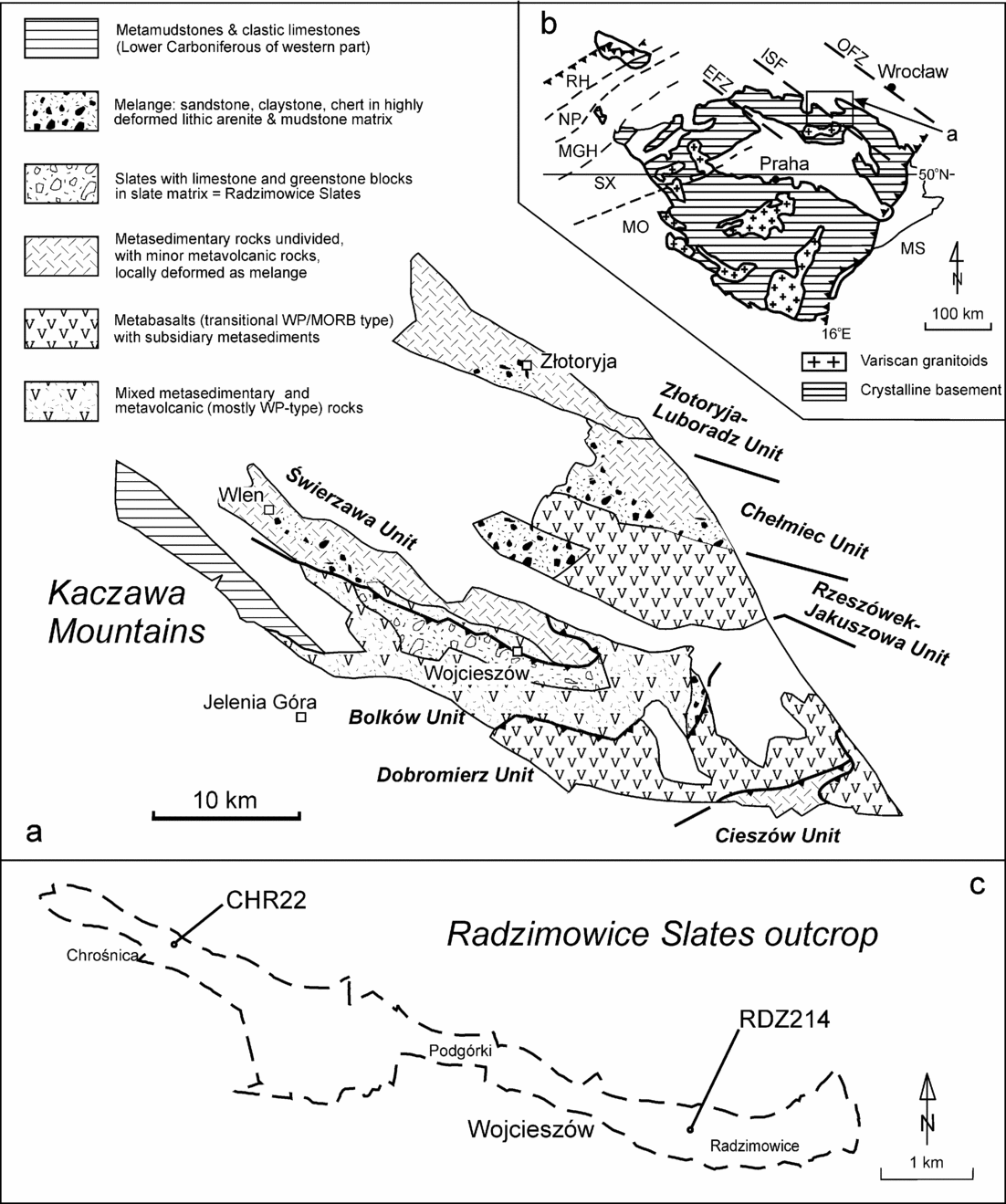
One notable example has been the Radzimowice Slates of the Kaczawa Complex in the West Sudetes (Fig. 1), a northeastern part of the Bohemian Massif. The Radzimowice Slates have been attributed variously to the Neoproterozoic (Teisseyre, Reference Teisseyre1963) and early Palaeozoic, the latter assignation being based on sparse and low-resolution conodont evidence (Urbanek & Baranowski, Reference Urbanek and Baranowski1986), while a sedimentological analysis (Baranowski, Reference Baranowski1988) inferred a trench-fill setting, suggesting a further alternative of possible late Palaeozoic deposition during ocean closure.
Geological sketch map of the Kaczawa Mountains (a) showing major lithological subdivisions, tectonic units and location of the study area and sampling sites (c). Inset map (b) shows the location of the area in the Bohemian Massif; EFZ – Elbe Fault Zone; ISF– Intra-Sudetic Fault; MGH – Mid-German Crystalline High; MO – Moldanubian Zone; MS – Moravo-Silesian Zone; NP – Northern Phyllite Zone; OFZ – Odra Fault Zone; RH – Rhenohercynian Zone; SX – Saxothuringian Zone. The Radzimowice Slates outcrop (c) based on Zimmermann (Reference Zimmermann1932) and Baranowski (Reference Baranowski1988).

In this report we present new results of SHRIMP dating of detrital zircons from the Radzimowice Slates. These give useful constraints on approximate deposi-tional age and local stratigraphic context, and additionally provide important insights into contemporaneous palaeogeography, helping place the Sudetan region into its global palaeogeographic context.
2. Geological setting
The Radzimowice Slates form an outcrop up to 3 km wide and 20 km long in the central southern Kaczawa Mountains (Fig. 1). Formerly, on the basis of regional lithological correlations, they were assigned to the latest Proterozoic and considered as the lowermost part of the Bolków Unit, thrust over the (para)auto-chthonous Świerzawa Unit (Teisseyre, Reference Teisseyre1963; Fig. 1). More recently their age was revised to not older than Ordovician, based on sparse and low-resolution conodont findings (Urbanek & Baranowski, Reference Urbanek and Baranowski1986), and they were re-interpreted as a separate tectonic unit, the Radzimowice Unit (Kryza & Muszyński, Reference Kryza and Muszyński1992).
The Radzimowice Slates comprise a set of variably deformed rocks, locally mylonitic, but with low-strain domains preserving primary sedimentary features. Strongly foliated, white-mica-rich varieties could be termed phyllites or even mylonites, but here we prefer to use the local traditional term ‘slates’ for this rock assemblage. The metamorphic grade corresponds to the epizone (greenschist facies) as shown by their fabric and mineral composition, as well as by the white mica characteristics (Baranowski, Reference Baranowski1988, Kryza & Muszyński, 2003).
Baranowski (Reference Baranowski1988) recognized relict sedimentary structures and distinguished a range of lithofacies, including: mudstones that are variably siliceous, graphitic or silt-laminated; siltstones; fine-grained sandstones (quartz wackes); medium- and coarse-grained sandstones (lithic wackes with volcanic component); chaotic deposits (sedimentary breccias and olistoliths of mafic volcanics and limestones); and mafic tuffites. He interpreted this suite as representing turbidites and hemipelagites/pelagites with intercalated slide to debris flow deposits. The lithic wackes were interpreted as sourced from a magmatic arc, and the quartz wackes from a continental block. The facies association and the petrographic composition of the lithic wackes were ascribed to deposition in an oceanic trench or an immature slope basin.
Seston et al. (Reference Seston, Winchester, Piasecki, Crowley and Floyd2000) suggested that the Radzimowice Slates represent a high-strain zone sandwiched between the low-strain Świerzawa Unit and the moderate-strain Bolków Unit (Fig. 1). In such a structural position, the slates could incorporate a range of rocks of various ages, including those seen in the neighbouring units. However, the lithological association of the Radzimowice Slates is distinct and represents an internally consistent sedimentary succession markedly different from those exposed in the neighbouring units. For instance, they include negligible volcanic rocks other than a few probable olistoliths.
Thus, the primary nature, age and tectonic position of the Radzimowice Slates have remained controversial, and their resolution is critical to constructing wider regional geological interpretations.
3. Methods
Two samples were selected for SIMS zircon dating (Fig. 1c):
(1) Sample CHR22 is a dark grey, fine-grained slate, composed of quartz, white K-mica, and minor albite, K-feldspar and black carbon-rich matrix; it comes from a small gorge, 300 m NW of the church at Chrośnica, in the western part of the Radzimowice Slates outcrop.
(2) Sample RDZ214 is a pale grey to greenish grey, fine-grained slate, composed of quartz, white K-mica, and subordinate K-feldspar and chlorite (± altered biotite); it was collected in a small exposure, 1.5 km east of Wojcieszów Górny (eastern part of the Radzimowice Slates outcrop).
Both the samples represent a facies of thinly laminated mudstones with silt laminae, as defined by Baranowski (Reference Baranowski1988); in the former exposure they are associated with siliceous and graphitic slates. The relative stratigraphic position of both the samples is unknown.
The samples, each about 3 kg in weight, were crushed, and heavy minerals separated by a conventional heavy liquid (sodium polytungstate, d 3.0 g cm−1) method. Hand-picked zircon grains representing various morphological and structural types were studied by optical microscope and afterwards mounted in Buehler Epoquick® resin, ground and polished for CL imaging and in situ U–Pb dating. The analyses were performed on the SHRIMP II at VSEGEI, St Petersburg. The analytical conditions and data treatment pro-cedures were as described in Larionov, Andreichev & Gee (Reference Larionov, Andreichev, Gee, Gee and Pease2004). The results were processed using SQUID v1.12 (Ludwig, Reference Ludwig2005a) and ISOPLOT/Ex 3.22 (Ludwig, Reference Ludwig2005b).
4. Results
4.a. Sample CHR22
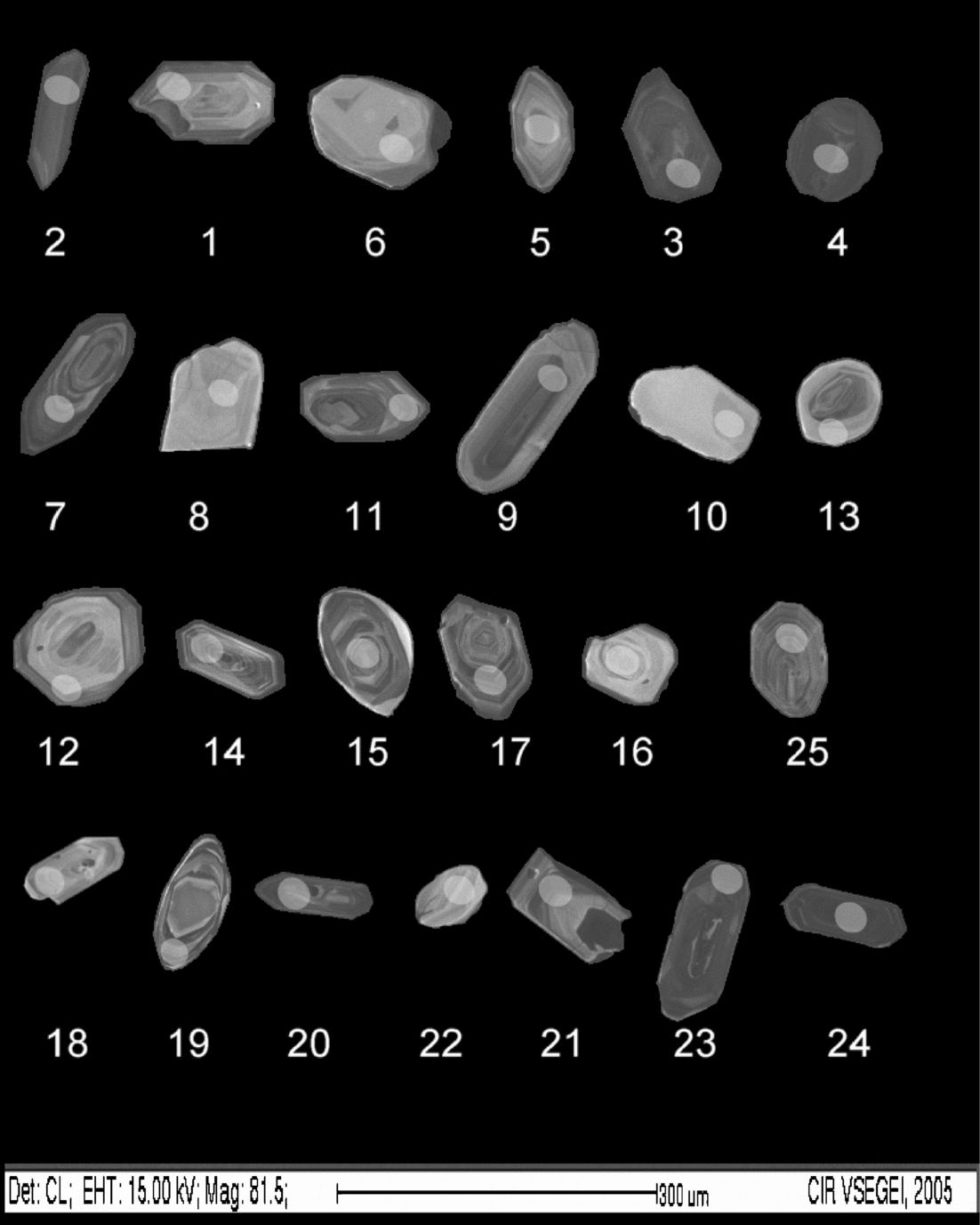
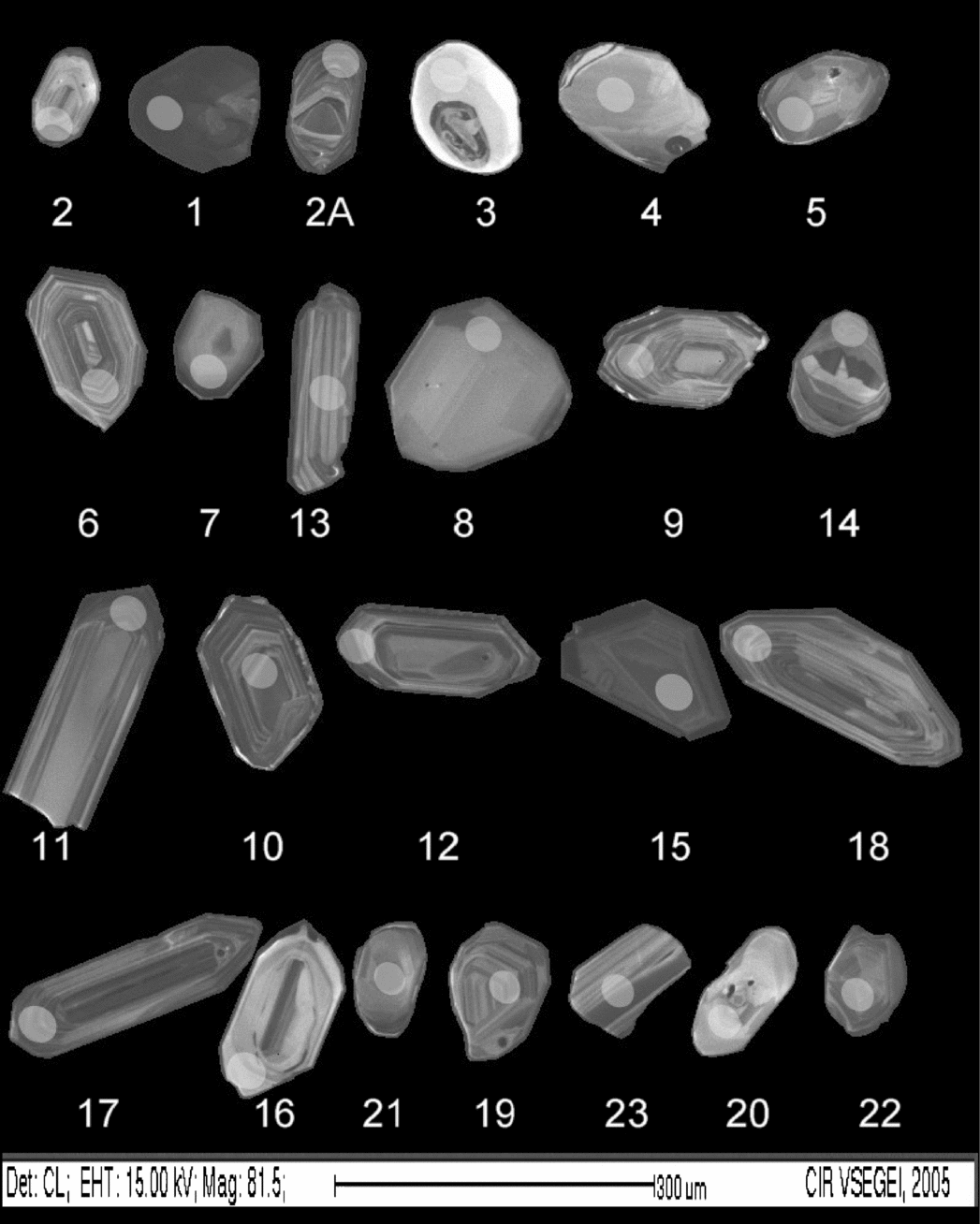
The zircons in this sample have diverse morphology and internal features, most of the grains being prismatic to subrounded (Fig. 2). Most of the grains are colourless, but pale yellow and rose-coloured transparent crystals were found, as well as subordinate brownish semi-transparent grains. Distinct cores are moderately common and many grains display simple or complex and regular (‘magmatic’) zoning. They differ also in their brightness in CL, from very bright to dark.
CL images of selected zircons of sample CHR22. Analytical points indicated by brighter ovals; their symbols correspond to those given in Table 1.

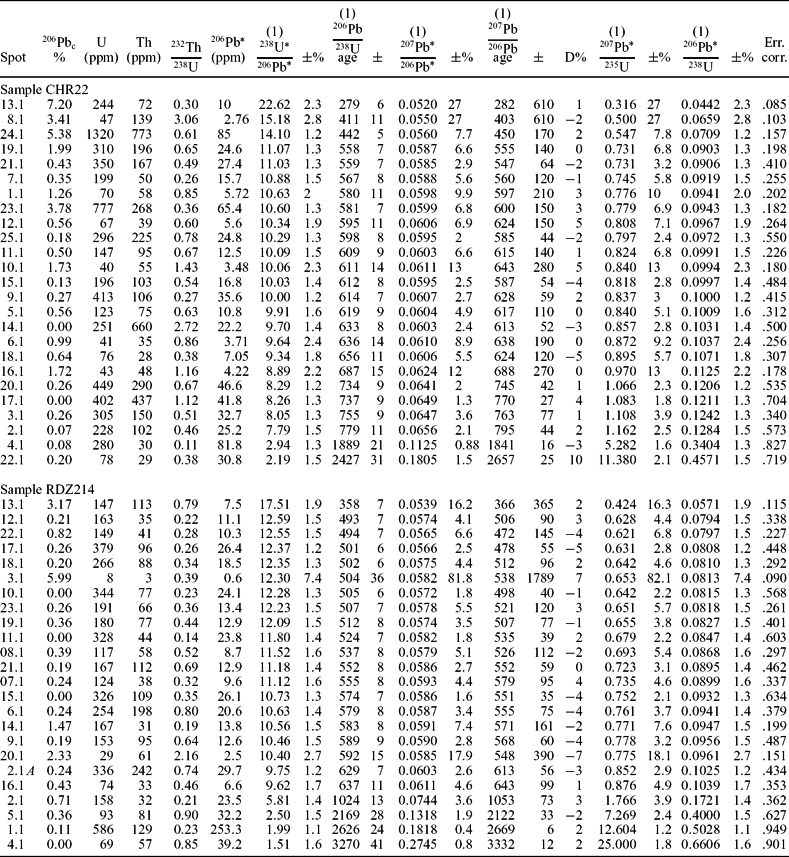
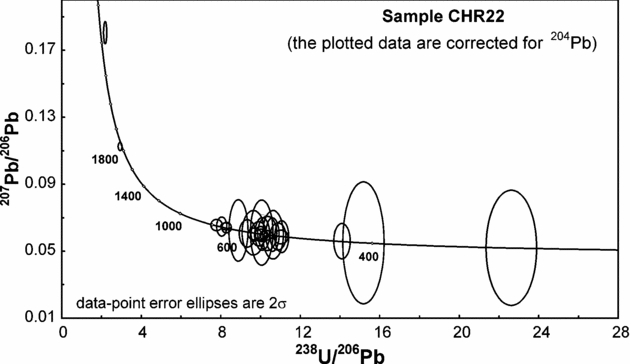
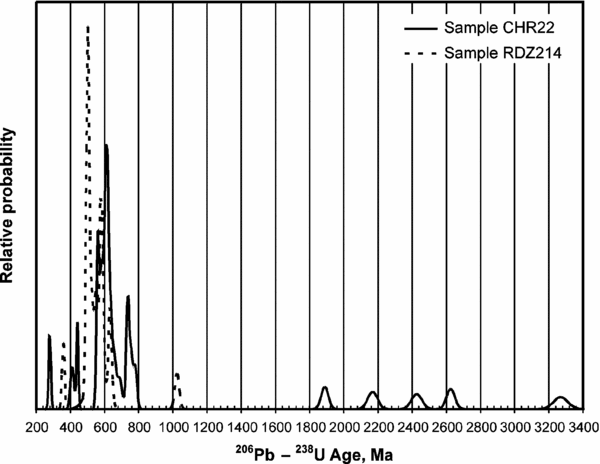
The 206Pb–238U age spectrum is widely dispersed between 279 and 2427 Ma (Table 1, Fig. 3). Most of the ages are Precambrian, and older than 558±7 Ma. Indistinct age clusters occur around 560 (see peak in Fig. 6), 580–600, 610–620 (another peak in Fig. 6), 630–656 and 734–780 Ma. The two oldest grains are 1889±21 and 2427±31 Ma.
Results of in situ U–Pb analysis of the Radzimowice Slates detrital zircons

Errors are 1σ; Pbc and Pb* indicate the common and radiogenic portions, respectively.
(1) Common Pb corrected using measured 204Pb.
Error in standard (Temora zircon) calibration 0.66% (1σ) calculated on 14 out of 15 measurements.
D% – Discordancy, %; Err. corr. – error correlation.
Terra-Wasserburg plot showing results of SHRIMP II zircon analyses from sample CHR22.

The three youngest 206Pb–238U dates obtained are 279±6 (grain 13.1), 411±11 (grain 8.1) and 442±5 Ma (grain 24.1) (Table 1, Fig. 3). These grains contain much common Pb (this roughly increasing with decreasing age) and possess tiny fractures, barely visible under gold coating. The youngest date of c. 279 Ma is less than the minimum age of the regional metamorphism in this area, which is constrained by a magmatic zircon age of 317±1 Ma from a non-metamorphosed rhyolite cutting the Radzimowice Slates (Muszyński et al. Reference Muszyński, Machowiak, Kryza and Armstrong2002). On these grounds, we reject these three youngest ages as geologically unreliable (although they are shown in Table 1 and Fig. 3).
4.b. Sample RDZ214
The zircons in this sample also vary widely, from idiomorphic to rounded, mostly colourless and transparent grains; some contain more or less distinct cores, and most crystals display zoning (Fig. 4). A minor portion (about 5%) is represented by brownish semi-transparent grains. In CL the zircons of this sample range from mostly dark to less common bright grains.
CL images of selected zircons of sample RDZ214. Analytical points indicated by brighter ovals: their symbols correspond to those given in Table 1.

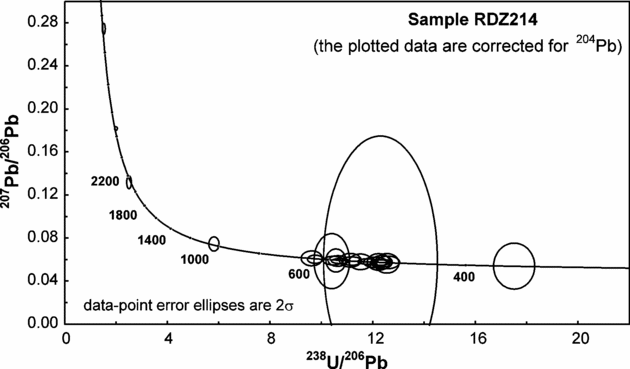
The main zircon populations are older than c. 490 Ma, and they cluster around 493–512, 524–592 (peak at c. 570 Ma) and 630 Ma. Four analyses yielded considerably older ages of 1024±13, 2169±28, 2626±24 and 3271±41 Ma.
The youngest calculated 206Pb–238U date of 358±7 Ma (Table 1, Fig. 5) from a single grain is high in common Pb. This date (and also those of two other grains with high Pbc, 3.1 and 20.1) is unreliable and should be rejected (see Section 4.a).
Terra-Wasserburg plot showing results of SHRIMP II zircon analyses from sample RDZ214.

5. Discussion
The detrital zircon ages obtained show that the Radzimowice Slates are indeed Palaeozoic in depositional age (Fig. 6), as Urbanek & Baranowski (Reference Urbanek and Baranowski1986) had suggested on the basis of poor conodont evidence, the maximum age reliably indicated (493–512 Ma) being latest Cambrian (cf. Gradstein, Ogg & Smith, Reference Gradstein, Ogg and Smith2005).
Probability density plot of 206Pb–238U ages of zircons from the Radzimowice Slates, samples CHR22 and RDZ214.

Thus, the Radzimowice Slates cannot form the base of the Kaczawa succession (Teisseyre, Reference Teisseyre1963) or of a major component of this, the Bolków Unit (Fig. 1), but must be at least synchronous with, and most likely post-date, acid igneous rocks in the middle of the Bolków Unit succession recently dated at c. 500 Ma (Kryza et al. 2007a,b).
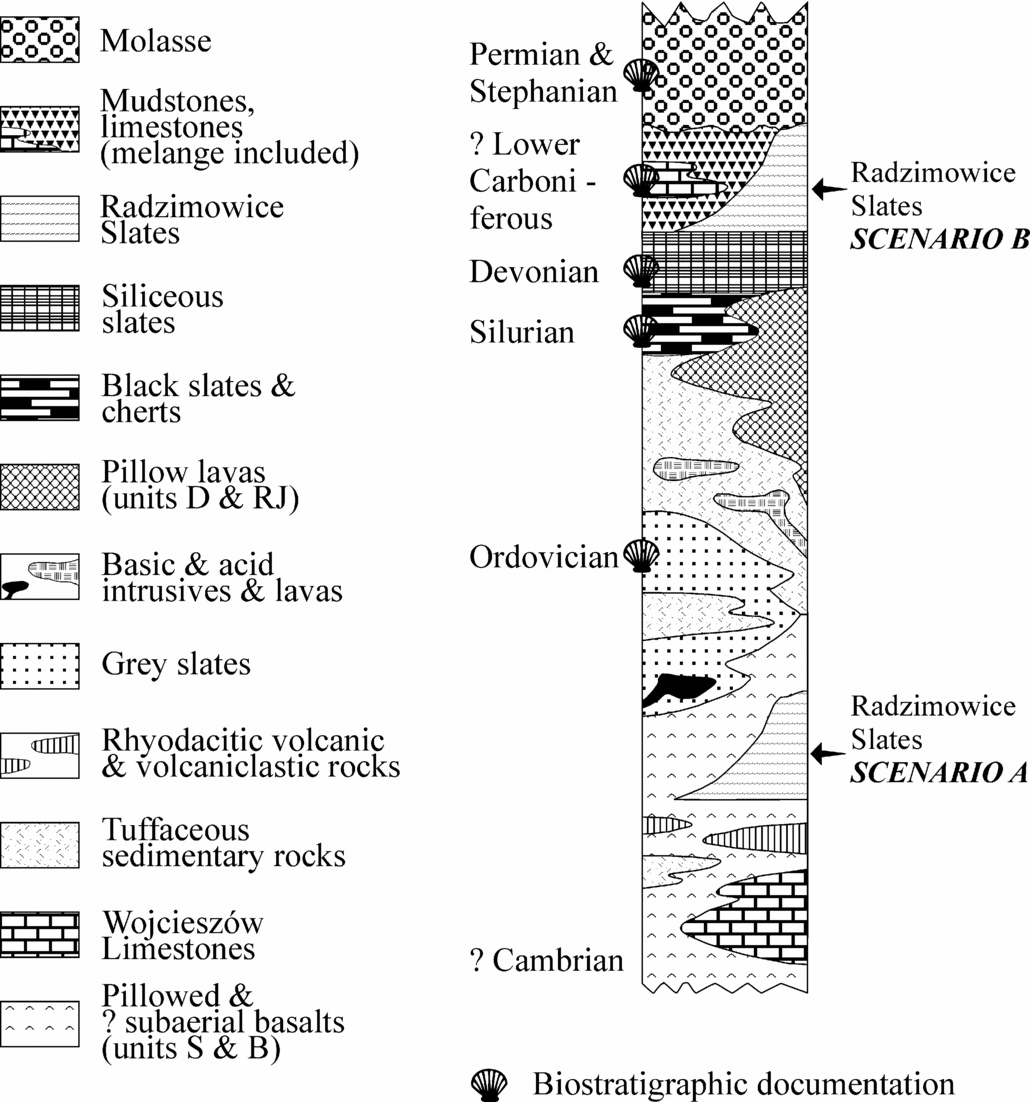
The minimum age of sedimentation is uncertain. Baranowski (Reference Baranowski1988) suggested deposition in an ocean trench environment, which would imply association with ocean closure. The combination of our new dates and current understanding of the geological evolution of the Sudetes (Franke & Żelaźniewicz, Reference Franke, Żelaźniewicz, Franke, Haak, Oncken and Tanner2000; Seston et al. Reference Seston, Winchester, Piasecki, Crowley and Floyd2000; Crowley et al. Reference Crowley, Floyd, Winchester, Franke and Holland2001; Aleksandrowski & Mazur, Reference Aleksandrowski, Mazur, Winchester, Pharaoh and Verniers2002; Kryza, Mazur & Oberc-Dziedzic, 2004; Mazur et al. Reference Mazur, Aleksandrowski, Kryza and Oberc-Dziedzic2006) imply that, if so, this contractional phase, following the protracted extensional regime (Cambrian to late Devonian), would be the late Devonian to early Carboniferous subduction that preceded final Variscan orogenesis in this region. In such an interpretation, the Radzimowice Slates would effectively form part of the mudrock-dominated mélange deposits of this age that are widespread in the region (Baranowski et al. Reference Baranowski, Haydukiewicz, Kryza, Lorenc, Muszyński, Solecki and Urbanek1990; Collins, Kryza & Zalasiewicz, Reference Collins, Kryza and Zalasiewicz2000; Kryza & Muszyński, 2003; J. Kostylew, unpub. Ph.D. thesis, Wrocław Univ. 2006; Fig. 7, scenario B).
Alternative stratigraphic correlations of the Radzimowice Slates with the regional successions of the Kaczawa Complex. Generalized stratigraphic log adapted from Kryza & Muszyński (2003). Scenario A is considered to be the most likely correlation.

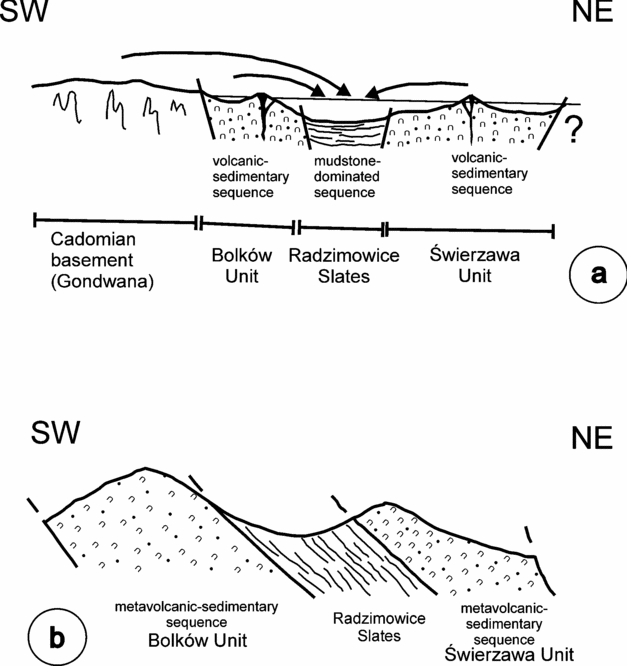
However, we consider it likely that the Radzimowice Slates provenance ages are more consistent with rift-related deposition following the break-up of Gondwana, associated magmatism occurring at c. 500 Ma (Pereira et al. Reference Pereira, Chichorro, Linnemann, Eguiluz and Silva2006, and references therein). Thus, the depositional environment would not be an ocean trench, as Baranowski (Reference Baranowski1988) suggested, but rather a turbidite-fed extensional basin, with which the sedimentary facies seem, in our opinion, to be equally consistent (Fig. 7, scenario A).
Given the maximum age we establish for the Radzimowice Slates, its extensive outcrop, isolated from the main Kaczawa successions (e.g. in the Świerzawa and Bolków units; Fig. 1), needs explanation. We consider as most likely an origin in a restricted basin, adjacent to and sourced from a combination of older Precambrian crust and early Palaeozoic volcanic–sedimentary successions (Fig. 8).
Cartoon showing our interpretation of the palaeogeographic and depositional setting of the Radzimowice Slates (a) and their recent tectonic position (b).

The age spectra of the two samples differ somewhat in detail with, for instance, only one sample yielding a clear late Cambrian/early Ordovician assemblage (Fig. 6). This most likely reflects the sourcing of different parts of the Radzimowice Slates from different parts of a geologically diverse hinterland, the nature of which is discussed below.
Both the samples studied have major populations of zircons with ages dispersed within the ‘Cadomian range’, roughly between 550 and 650 Ma. The ages are evenly distributed within that 100 Ma interval, suggesting that the source rocks comprised magmatic protoliths of various ages. The dates reflect a shared history between the Bohemian Massif, of which the Radzimowice Slates forms a part, and that part of Gondwana affected by intense Cadomian magmatism between 700 and 540 Ma (e.g. Pereira et al. Reference Pereira, Chichorro, Linnemann, Eguiluz and Silva2006).
The Radzimowice Slates also contain a variety of older components of c. 750 Ma, 1050 Ma, 1900 Ma, 2150 Ma, 2450 Ma, 2650 Ma, the oldest date recorded being 3271±41 Ma (Fig. 6). Similar zircon ages have been reported from North Africa, which formed a part of Gondwana (Linnemann et al. Reference Linnemann, Gehmlich, Tichomirova, Buschmann, Nasdala, Jonas, Lützner, Bombach, Franke, Haak, Oncken and Tanner2000, Reference Linnemann, McNaughton, Romer, Gehmlich, Drost and Tonk2004; Nance, Murphy & Keppie, Reference Nance, Murphy and Keppie2002; Von Raumer, Stampfli & Bussy, Reference Von Raumer, Stampfli and Bussy2003; Friedl et al. Reference Friedl, Finger, Paquette, Von Quadt, McNaughton and Fletcher2004; Inglis et al. Reference Inglis, Samson, D'lemos and Miller2005; Samson et al. Reference Samson, D'Lemos, Miller and Hamilton2005). Thus, our new data support a close similarity in zircon ages and, consequently, genetic links between this part of the Bohemian Massif and the North African part of Gondwana (Kryza et al. 2007b).
6. Conclusions
(1) SHRIMP-dated detrital zircon ages from the Radzimowice Slates of the Kaczawa Complex, part of the Bohemian Massif, include a clear late Cambrian to early Ordovician component, thus constraining a maximum depositional age for this unit. They are consistent with derivation from local continental rift-related acid volcanic rocks and deposition in a restricted extensional basin during the break-up of Gondwana.
(2) The Radzimowice Slates also include major populations of zircons of Cadomian age, more or less continuously dispersed between 550 and 650 Ma. This suggests derivation from a wide range of the igneous (considering Th/U above 0.20) rocks of that age that were widespread throughout that part of Gondwana.
(3) Smaller populations of older zircons range through the Proterozoic and Archaean to a maximum of 3.3 Ga. This pattern closely resembles zircon age spectra recovered from North Africa, and emphasizes the close genetic links between this part of the Bohemian Massif and the North African segment of Gondwana.
Acknowledgements
The study was supported by the KBN research project 2P04D 015 27, and internal Wrocław University grants 1017/S/ING, and 2022/W/ING. Quentin Crowley and John Winchester are thanked for their constructive reviews.