Introduction
Throughout western society, the increase in the number of people aged 65 and over and the expectation that this population will continue to grow in coming years (World Health Organisation 2002) requires scholars to take an in-depth look at the ageing process in order to identify the protective factors that contribute to maintaining satisfactory physical and psychological health in older people. Specifically, there is a lack of studies that explore the potential protective role of physical activity with respect to the psychological health of people aged 65 or more years and no longer living independently. Among older people, it is those that no longer live independently that are increasing in number most rapidly and that pose serious difficulties for health services and social policies because of the high costs associated with their care.
This study investigated the effects of a physical activity programme on the perceived health and the psychological wellbeing of older people living in residential care facilities in south Europe. There are still relatively few residential care facilities in southern European countries, including Italy where this study was conducted. One reason is that it has traditionally been the family which acts as the primary care providers of older people. However, the numbers of residential care facilities in southern Europe are expected to increase rapidly (Bettio and Plantenga Reference Bettio and Plantenga2004). Currently, residential care facilities are targeted at older people with intermediate and high levels of psychological and social frailty. Older people who enter these residential care facilities are most likely to have lost their partners, or lack the children or other relatives who are able to provide them with the support they need to meet the demands of daily life. People tend to seek residential care facilities because they offer the care of specialised nurses and other personnel as well as general housekeeping services. Despite the clear advantages offered by residential care facilities, there are also some important risks. The older people living in residential care tend to be removed from the daily life of their communities and are more likely to become disengaged and depressed. Thus, they risk becoming even less capable of taking care of themselves than their current state allows. All of these potential consequences of living in residential care, if not adequately prevented, may result in serious negative physical and psychological health consequences.
Physical and psychological advantages of physical activity in the elderly
Ageing is usually associated with reduced aerobic power, muscle strength, and physical fitness. A large number of older people fall below, or barely above, the ‘threshold’ of minimum physical ability and even a minor illness may render them completely dependent (Astrand Reference Astrand1992; Mor et al. Reference Mor, Murphy, Masterson-Allen, Willey, Razmpour, Jackson, Greer and Katz1989). Three fitness components (cardio-respiratory, morphologic and strength) involved in the performance of the activities of daily living were found to be primary mediators in the causal pathway from disease to disability in a sample of elderly adults around the age of 72.5 (Morey, Pieper and Cornoni-Huntley Reference Morey, Pieper and Cornoni-Huntley1998). It has also been found that participation in some form of regular exercise, especially aerobic exercise and resistance training, reduces the risk of disabilities and produces significant physical and psychological health benefits (Daley and Spinks Reference Daley and Spinks2000). Regular exercise results in improvements in functional capacity, reduced risk of developing type II diabetes (Albright et al. Reference Albright, Franz, Hornsby, Kriska, Marrero, Ullrich and Verity2000; Evans Reference Evans1999), reductions in the decline of musculoskeletal function, and reduced risk of fractures (Bravo et al. Reference Evans1996 b; Galloway and Jokl Reference Galloway and Jokl2000; O' Connor, Aenchbacher and Dishman Reference O' Connor, Aenchbacher and Dishman1993), even among the very old. Conversely, we know that in people over the age of 50 a lack of physical inactivity is an important risk factor for many chronic health problems such as cardiovascular diseases, hypertension, obesity, osteoporosis, diabetes mellitus, and mental health conditions (van der Bij, Laurant and Wensing Reference van der Bij, Laurant and Wensing2002).
Most research on the topic has focused on people that are relatively old and still living independently. We found just one study by Galloway and Jokl (Reference Galloway and Jokl2000) on the effects of physical activity programmes for very old people living in residential care facilities. The study involved 100 randomly assigned nursing home residents in a high-intensity strength-training programme. The application of the training programme resulted in significant gains in strength and functional status. In addition, spontaneous basic activity, such as dressing and washing themselves without assistance, increased significantly in those participating in the exercise programme, whereas there was no change in the sedentary control group. Thus, exercise may minimise or reverse the syndrome of physical frailty, which is prevalent among the very old. According to Galloway and Jokl (Reference Galloway and Jokl2000), there is no segment of the population that can benefit more from exercise than older people, because of their low functional status and high incidence of chronic disease. Furthermore, the need for regular exercise can be satisfied through regular participation in many common activities of daily living (e.g. walking, gardening, housekeeping) in order to avoid musculoskeletal injuries, which are especially debilitating for older individuals (Owen and Bauman Reference Owen and Bauman1992).
Physical activity may also promote psychological wellbeing (Brown Reference Brown1992). McMurdo and Rennie (Reference McMurdo and Rennie1993) showed that low-intensity strength activity decreased depression in nursing home residents, and Perrig-Chiello et al. (Reference Perrig-Chiello, Perrig, Ehrsam, Staehelin and Krings1998) found that resistance training was associated with a significant decrease in anxiety and a modest increase in cognitive functioning. Reviews by McAuley and Rudolph (Reference McAuley and Rudolph1995) and Rejeski and Mihalko (Reference Rejeski and Mihalko2001) showed the overwhelmingly positive influence of exercise and physical activity on the psychological wellbeing of older people, with longer programmes consistently reporting more positive results. Participation in physical activity is likely to result in more successful ageing through its effects on perceived competence and control (Kerschner and Pegues Reference Kerschner and Pegues1998; McAuley and Katula Reference McAuley, Katula, Shulz, Maddox and Lawton1998). Being able to perform moderate physical activities related to activities of daily living, such as walking short distances, climbing a flight of stairs or dressing oneself, can positively influence self-perception, emotional wellbeing and happiness (Cantor and Sanderson Reference Cantor, Sanderson, Kahneman, Diener and Schwartz1999; Hayes and Ross Reference Hayes and Ross1986).
Furthermore, engaging in exercise programmes may affect subsequent behaviour through its impact on perceptions of personal capabilities and self-efficacy (Bandura Reference Bandura1997), as well as on the perception of pain involved in certain movements and the fear of falling (Scheffer et al. Reference Scheffer, Schuurmans, van Dijk, van der Hooft and De Rooij2008), independently from general changes in physical performance and achievement (McAuley et al. Reference McAuley, Marquez, Jerome, Blissmer and Katula2002; Rejeski et al. Reference Rejeski, Ettinger, Martin and Morgan1998). Finally, improvements in functioning might give way to decreases in apathy, which often affect the ability to perform routine activities in older people living alone and/or in residential facilities (Oishi et al. Reference Oishi, Diener, Suh and Lucas1999; Yamashita, Iijima and Kobayashi Reference Yamashita, Iijima and Kobayashi1999).
Designing and evaluating a physical activity programme for older people
In order to promote the active participation of older people, establishing goals that are motivating, valued by the programme participants and relevant to their daily lives is critical. In addition to the importance of individual goals, established as a function of outcome expectations, and the development of other self-regulatory skills, it is important to create an environment that is conducive to behaviour change and is able to enhance quality of life (Turner, Rejeski and Brawley Reference Turner, Rejeski and Brawley1997). This process has to empower the individual with feelings of control and, ultimately, increased satisfaction within a particular life domain. In addition, the changes in perception appear to be strongly facilitated by a social environment that also makes the activities enjoyable (Peppers Reference Peppers1976). Bravo et al. (Reference Bravo, Gauthier, Roy, Payette, Dubois, Harvey and Gaulin1996a) reported that group-based exercise had greater positive effects than did home-based exercise, and Booth et al. (Reference Booth, Bauman, Owen and Gore1997, Reference Booth, Owen, Bauman, Clavisi and Leslie2000) found that regularity of involvement is also important. Ideally, for older people as well as at earlier ages, physical activity should demand concentration, be interesting, and yet not exceed one's capacity (Csikszentmihalyi Reference Csikszentmihalyi1975). Of all the various types of exercise programmes, a recent meta-analysis by Netz et al. (Reference Netz, Wu, Becker and Tenenbaum2005) showed that aerobic training and moderate activity levels were most beneficial. The meta-analysis also showed a small, but significant, effect of exercise on wellbeing in elderly adults without clinical disorders, especially on self-efficacy, overall and emotional wellbeing, and self-perception. Physical activity can therefore provide an experience of mastering for older people whose physical self-efficacy may be deteriorating along with their functional abilities. The significant moderating effects of improvement in cardiovascular capacity and strength, specifically in daily functioning, further support that mastery experience. However, Netz et al. (Reference Netz, Wu, Becker and Tenenbaum2005) found a gradual decrease in the effect size of physical activity on wellbeing with increased age. There are several possible explanations for this decrease, for instance that the activity may not reach a sufficient level of intensity and that psychological wellbeing may be overwhelmed by functional and social losses as people age.
It is worth noting that the majority of the studies that have analysed the effect of physical activity in old age share some conceptual and methodological limitations (Rejeski, Brawley and Shumaker Reference Rejeski, Brawley and Shumaker1996). The most important is that quality of life is often inferred from positive changes in endpoints, such as physical functioning or symptom reporting. Very few attempts have been made to assess whether these changes were actually perceived by the participants and, if so, whether they were reflected in increased satisfaction with their newly acquired levels of functioning. Functional status is, in fact, not the most appropriate index for quality of life, as there are many examples of people who report high quality of life despite significant functional deficits. Furthermore, most published studies have lacked experimental and control groups, which would allow one to distinguish between the previous condition of the participants and the effects of the intervention (Hayes and Ross, Reference Hayes and Ross1986; Howze, Smith and DiGilio Reference Howze, Smith and DiGilio1989). Without a control group, we may learn that anaerobic exercise is negatively related to depression, but we cannot explore the direction of this relationship, because exercise may decrease depression, but depressed people may also be less likely to exercise.
Aims and research questions
The aim of this study was to investigate the effects of the implementation of an aerobic programme of physical activity in a sample of older people in residential care facilities in Italy. Specifically, we looked at the effects this programme would have on general health perception, the perception that one's health represents a limitation for moderate and heavy physical activity, and positive and negative self-perceptions.
Based on the cited literature, it was hypothesised that the aerobic intervention would have greater effects on the perception that one's health represents a limitation for moderate and heavy physical activity, over health perception in general and self-perception. More specifically, we expected that the older people who participated in the intervention would be less likely to perceive that their health limits their physical activity, especially moderate activity, because the exercise programme would be specifically tailored to increase their ability to carry out the activities of daily living. Furthermore, it was expected that the intervention would also have a positive, although weak, effect on the perception of health in general and on positive self-esteem. This expectation was based on the idea (seeMcAuley and Katula Reference McAuley, Katula, Shulz, Maddox and Lawton1998) that the improved movement capability gained by older people through their participation in the intervention would generally improve their judgement and evaluation of themselves.
Finally, we did not expect a strong influence of participation in the exercise programme on negative self-perception. This was because the intervention programme was short, with relatively few intense sessions. There are several issues that may lead to a negative self-perception for people in residential care facilities, such as anticipated loss of previous life context, daily habits, and social networks, and the perception of having little if any control over their lives. More precisely the study addressed the following research questions:
1. Does the intervention improve the general health perception of older people?
2. Does the intervention decrease older people's perception that their health limits moderate and heavy physical activity?
3. Does the intervention increase the positive self-perception of older people?
4. Does the intervention decrease negative self-perception in older people?
This experimental study is a new contribution to the field because a structured intervention of physical activity for older people was applied in residential care facilities; the effects of the intervention on psychological characteristics of the elderly people were considered; and the study was conducted in Italy, a Mediterranean country where institutional care for older people is still relatively rare (Bettio and Plantenga Reference Bettio and Plantenga2004).
Study design and methods
The intervention was introduced into a residential care home in northern Italy. It is a private institution but linked to the public health service with a funding agreement. This facility houses both self-sufficient residents (that is, they can still walk, eat and go to the bathroom by themselves) and dependent older people (requiring assistance with essential activities of daily living); it also provides a daily physiotherapy session for the self-sufficient residents.
Description of the intervention
The intervention consisted of two sessions (lasting 45 minutes each) each week for 13 weeks over about five months. The intervention was provided for the self-sufficient residents. The sessions were conducted by six instructors, all of whom had university degrees in physical education and sport-related fields and were specialised in physical fitness training for older people (Ciairano et al. Reference Ciairano, Musella, Gemelli, Liubicich, Rabaglietti and Roggero2006). The intervention was tailored to engage gradually and interest older people in various activities, by using both conventional and unconventional instruments (such as stools, sticks, clubs, hoops, balloons, foam balls, towels, paper cups, pins, bowls, paper tissues, scarves, and trays) and by stressing playful qualities. In addition, the instructors were daily informed by the other personnel about the condition of each older person, also in terms of minor physical problems, and they avoided directing potentially dangerous movements. Furthermore, special care was taken to provide the participants with plenty of time to execute each movement, avoiding activities that could have been perceived as too intense, embarrassing or difficult. The aerobic programme aimed to achieve five main goals:
• to improve respiratory function through deep breathing techniques;
• to promote the awareness of incorrect or compensative posture and to learn to modify these problems on their own;
• to execute movements addressed to the various joints, trying to reach the maximum possible exertion, without exceeding personal limitations;
• to reach a correct perception of one's body in various conditions of static and dynamic equilibrium;
• to strengthen interpersonal relationships and rediscover the joys of ‘playing’ and using abilities that may have been perceived as lost, by exercising in pairs or small groups.
The participants
The older people in both the intervention and the control groups were selected by the director of the residential care facility, who is a trained physician. The three criteria for inclusion were: (a) self-sufficiency (defined as above), (b) absence of serious chronic and/or acute diseases, and (c) intact cognitive capacities, which were verified directly by the researchers. The Mini Mental Test was used to evaluate cognitive capacity (Folstein, Folstein and McHugh Reference Folstein, Folstein and McHugh1975); all the older people reached or exceeded a score of 24. The participants were informed that participation in the study was voluntary and confidential and all gave informed consent, in accordance with Italian law and the Association of Italian Psychologists' Ethical Code (Associazione Italiana di Psicologia 1997).
The initial sample comprised 24 people (14 women and 10 men). We randomly extracted half of the women and half of the men for the intervention group and the other half for the control group. Thus, both the intervention and the control groups were made up of five men and seven women. Unfortunately we lost two men in the control group through serious illness around the time of the pre-test and we were unable to replace them as the facility did not have two other residents who met all three criteria for inclusion. While the intervention group participated in the structured physical activity programme described above, the control group participated in the usual kind of recreational activities organised by the personnel of the residential care facility, namely reading newspapers and watching television.
The final sample comprised 22 people, of whom eight (36%) were men (three in the control group and five in the intervention group) and 14 (64%) women (seven in the control and seven in the intervention groups). The mean age was 80.6 years (standard deviation (SD)=9.9; range 60–94). The people in the control group were younger (mean age 74.9, SD=10.2) than those in the intervention group (mean age 85.3, SD=7.0; t-test=−2.82, degrees of freedom (df)=20, p<0.01). The age difference was partly because of the unexpected lost of two participants, who were older than the other members of the control group.
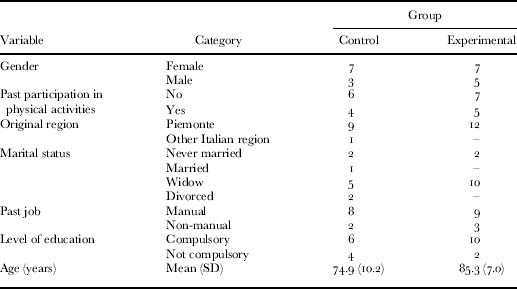
All the participants lived in the residential care facility permanently. All except one, who was born in Sicily, were from the local region. With regard to marriage status, the majority (N=15) were widows, while others had never been married (N=4), or were divorced (N=2). Only one was currently married. In terms of education, two levels were considered: ‘low’, corresponding to compulsory education (primary and secondary school) and ‘high’, corresponding to additional non-compulsory education (including high school and university). The average level of education for both men and women in the sample was lower than in the national age-matched population (Costa, Migliardi and Gnavi Reference Costa, Migliardi and Gnavi2006; National Institute of Statistics (ISTAT) 2006). Among the participants, 80 per cent had received only compulsory education, compared to about 70 per cent in the national population. Former occupations were dichotomised into manual (N=17) and non-manual (N=5). This ratio closely reflects the national population. The majority (N=13) had never participated in organised exercise or sport activities. Of those who had, the preferred sports were bowls, gymnastics, soccer, walking, and skiing. We found no differences between the intervention and control groups with respect to these aspects. The main characteristics of the participants are arrayed in Table 1.
Characteristics of the participants
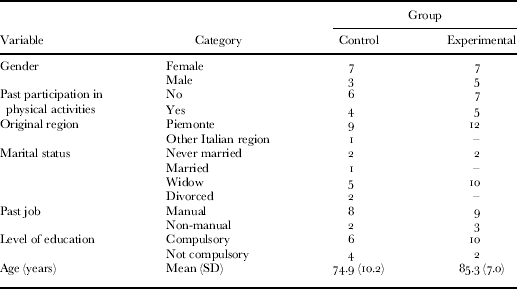
Note: SD: standard deviation.
Procedure
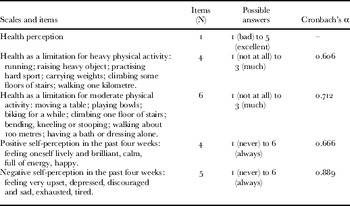
The Italian version of the 36-item Short Form Health Survey Questionnaire (SF-36; Ware and Sherbourne Reference Ware and Sherbourne1992) was administered to the sample both pre-test and post-test by trained researchers. This questionnaire consists of 20 items that capture the general perception of health, the perception that one's health may limit moderate and heavy physical activity, and also positive and negative self-perception. We analysed the reliability of each component through Cronbach's alpha. The psychometric properties are described in Table 2.
Psychometric properties of the scales used in the research

We ran repeated-measures analyses of variance for each of the five aspects considered in the present study. In every model, we examined one between-factor experimental condition (intervention and control group) and one within-factor time (pre- and post-test). In addition, we examined the interaction term between the experimental condition and the time.
Results
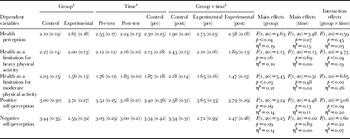
In general, the intervention and the control groups differed with respect to both the general perception of health and the perception that one's health limits moderate physical activity (Table 3). General health perception was higher in the intervention group (2.67 versus 2.10) and the perception that one's health limits moderate physical activity was higher in the control group (2.10 versus 1.56). With respect to the effects of the intervention, general health perception decreased between the pre-test and the post-test in the control group (from 2.30 to 1.90), while it remained relatively stable for the experimental group (from 2.75 to 2.58). However, this relationship was not significant.
Health perception, health as a limitation for heavy and moderate physical activity, positive and negative perception of the self by group and time

Note: 1. Values are given as mean (standard error).
Statistically significant relationships were found, as expected, between the intervention and the perception that one's health may limit both heavy and moderate physical activity (Table 3). In both cases, older people in the experimental group significantly decreased their perception of health as a limitation for physical activity. More precisely, in the experimental group we registered a decrease in the perception that health represents a limitation for both ‘heavy’ (from 2.10 to 1.89) and ‘moderate’ (from 1.65 to 1.47) physical activity, while the older people in the control group showed an increase in these scores (heavy: from 2.10 to 2.43; moderate: from 1.87 to 2.18). In addition, a significant effect of the intervention was also found with respect to positive self-perception (Table 3). Positive self-perception decreased among the older people in the control group (from 3.40 to 2.58), while an increase was found in the intervention group (from 3.65 to 3.79). In general, the effect of the intervention explained a proportion of variance – around 20–25 per cent – which can be considered reasonably high considering the small sample size of the present study. The relationship between the intervention and negative self-perception was not significant. In the control group it increased from 3.34 to 3.54, while in the intervention group it decreased from 2.72 to 2.47, though the effect was not statistically significant (Table 3). Finally, no direct effect of time was found; in other words, there were no changes in the patterns of health and self-perception over time.
Discussion and conclusions
This study has investigated the effects of an intervention that promoted physical activity among the residents of a residential care facility in Italy. More specifically, this study analysed whether the intervention had a positive influence on some aspects of psychological adjustment, namely general health perception, the perception that one's health represents a limitation for moderate and heavy physical activity, and finally positive and negative self-perception.
Two main outcomes were found. First, the older people who participated in the intervention showed a sharp decrease in the perception that their health represents a limitation for both moderate and heavy physical activity, while the control group showed an increase. In other words, after the intervention the older people who had participated in the intervention began to feel that they were again capable of the activities of daily living, such as moving objects and going up or down one or two flights of stairs. In contrast, the older people who did not participate at the programme showed an increase in the perception that their health limited their physical activity. Second, a slight increase in positive self-perception was found among those who participated in the intervention. There was a sharp decrease in positive self-perception among those who did not participate in the intervention. As highlighted by other authors (for instance, McAuley and Katula Reference McAuley, Katula, Shulz, Maddox and Lawton1998), our findings imply that reacquiring the ability to carry out the activities of daily living represents not only a gain per se but also has positive benefits for self-perception, especially in the particularly fragile condition of the older people living in residential care homes.
We feel that these findings are important not only because they provide further confirmation of the importance of maintaining the ability to carry out the activities of daily living for as long as possible (Cantor and Sanderson Reference Cantor, Sanderson, Kahneman, Diener and Schwartz1999). They also extend previous findings about the wellbeing of the residents of care facilities, where there is an increased risk of apathy and depression. However, the generalisability of our findings is limited given that the study was conducted in only one residential care facility. Nevertheless, the similarities between our findings and those of previous studies (Galloway and Jokl Reference Galloway and Jokl2000) regarding the positive influence of physical activity on the psycho-social adjustment of older people are interesting and merit further investigation.
The findings suggest that if these types of programmes are not introduced in institutional care facilities, there is a greater risk of rapid increases in older people's perception that their movement capabilities are limited by their health. This type of perception may mean that even a minor illness can render a resident more dependent (Astrand Reference Astrand1992; Mor et al. Reference Mor, Murphy, Masterson-Allen, Willey, Razmpour, Jackson, Greer and Katz1989). The findings suggest that there is an increased risk that older people may cross the ‘threshold’ from general discomfort to disability without carefully planned and structured exercise interventions.
Contrary to our expectations, the effect of the intervention on general health perception did not reach significance, though health perception decreased more in the control group than in the intervention group. The higher health perception scores found at pre-test in the members of the intervention group remained relatively stable, while the lower health perception scores at pre-test of those in the control group decreased even further. A number of limitations prevent us from generalising this finding. It is unknown whether the decrease in health perception found in the control group can be generalised to different situations and different samples, or whether the decline is constant or if it occurs seasonally (for instance, seasonal changes, in terms of both lower temperatures and fewer hours of daylight might possibly affect health perception), or if it is related to the duration of residence. The small size of our sample did not allow us to control for any of these important attributes.
Finally, as expected, the intervention did not produce a significant change with respect to negative self-perception. As mentioned previously, older people in residential care facilities are at high risk of developing psychological distress for a variety of reasons: they may feel abandoned by their relatives, they are likely to have lost their life partner (most of the people in our sample were widows), and they have lost their previous life context, daily habits and social networks. These are all potential sources of stress and negative psychological reactions for older people (Forbes Reference Forbes2001). In these conditions of psycho-social vulnerability, the intervention we introduced played a part in reducing the negative self-perception of the older people in the intervention group, and while the effect was non-significant, the sample was very small. These findings are encouraging and underline the importance of continuing this line of research with a larger sample.
Limitations and strengths of the study
This study has several limitations, the most important of which are the limited sample size and the short duration of the intervention. The small sample prevented us from evaluating whether the effects of the intervention differed by education, gender and age. We are unaware of studies investigating the effects of physical activity programmes in relation to education level, but inactivity is known to be more common among the less educated (Owen and Bauman Reference Owen and Bauman1992), and more educated people are likely to have had a higher quality of life in association with their higher social and economic status (Lundberg Reference Lundberg1997). People with more education are more likely to perceive reality as meaningful and to believe life's challenges to be worth facing (Ciairano et al. Reference Ciairano, Rabaglietti, De Martini and Giletta2008). It would be interesting to explore further the link between gains in movement capability and the older people's perception following the intervention that they were able to master better the activities of daily living and to exert more control over their lives. Gender was another aspect we could not investigate because of the small sample size; previous studies have had mixed findings regarding gender-specific effects and it would be interesting to take a closer look at this aspect. It would also be worthwhile to investigate the role of age, especially in order to separate cohort and age effects. In Italy, as in the other western countries, the current generation of older people is likely to have been more active and to have lived in far better social and economic conditions than their predecessors (see ISTAT 2006). This has the potential to affect the relationship between physical activity and adjustment.
The effect of different types of interventions should also be explored since it is important to discover whether alternative forms of physical activity have similar effects. As underlined previously (Mihalko and McAuley Reference Mihalko and McAuley1996; van der Bij, Laurant and Wensing Reference van der Bij, Laurant and Wensing2002), the duration, frequency and intensity of exercise required to achieve meaningful effects in older people is still unknown.
Despite these limitations, the study has its merits. First, it investigated the effectiveness of an intervention for the promotion of physical activity in an experimental study and in a sample of very old people in a residential care facility in a Mediterranean country. This contrasts with the majority of previous studies in this area which have investigated much younger samples mainly in northern European or non-European countries. Future research should examine larger samples and different social and cultural contexts to raise understanding of whether or not physical activity has a universal positive influence on optimal adjustment during old age.
Second, our findings showed that at least some aspects of adjustment in old age are likely to improve, or at least to remain stable, when a short term yet fairly intensive physical activity programme is applied by trained instructors. More specifically, the findings suggest that participation in such a programme may be especially important for the maintenance of specific components of adjustment, such as the perception of successfully mastering some common activities of daily living, like walking or climbing a few flights of stairs. We argue that the relative ease of application of this kind of programme must be considered carefully for the promotion of positive attitudes in old age. This is an especially important point for policy makers, who must understand the importance for older people of remaining fully integrated in normal daily life for as long as possible in order to maintain physical and psychological health. Finally, the study has demonstrated the value of a multi-disciplinary approach. Collaboration among experts from different disciplines, such as sports science, psychology and medicine, allowed us to develop and apply an exercise programme that would prove to be both interesting for the older people and helpful in maintaining the perception of being able to accomplish successfully the activities of daily living, while allowing the researchers to evaluate the effects of the intervention.
Acknowledgements
The first author gratefully acknowledges the contribution of Regione Piemonte, Direzione Sanità, Settore Igiene e Sanità Pubbica to this study.