

%20--%3e%3c!DOCTYPE%20svg%20PUBLIC%20'-//W3C//DTD%20SVG%201.0//EN'%20'http://www.w3.org/TR/2001/REC-SVG-20010904/DTD/svg10.dtd'%3e%3csvg%20version='1.0'%20id='Layer_1'%20xmlns='http://www.w3.org/2000/svg'%20xmlns:xlink='http://www.w3.org/1999/xlink'%20x='0px'%20y='0px'%20width='64px'%20height='64px'%20viewBox='5.5%20-3.5%2064%2064'%20enable-background='new%205.5%20-3.5%2064%2064'%20xml:space='preserve'%3e%3cg%3e%3ccircle%20fill='%23FFFFFF'%20fill-opacity='0'%20cx='37.785'%20cy='28.501'%20r='28.836'/%3e%3cpath%20fill='%23595959'%20d='M37.441-3.5c8.951,0,16.572,3.125,22.857,9.372c3.008,3.009,5.295,6.448,6.857,10.314%20c1.561,3.867,2.344,7.971,2.344,12.314c0,4.381-0.773,8.486-2.314,12.313c-1.543,3.828-3.82,7.21-6.828,10.143%20c-3.123,3.085-6.666,5.448-10.629,7.086c-3.961,1.638-8.057,2.457-12.285,2.457s-8.276-0.808-12.143-2.429%20c-3.866-1.618-7.333-3.961-10.4-7.027c-3.067-3.066-5.4-6.524-7-10.372S5.5,32.767,5.5,28.5c0-4.229,0.809-8.295,2.428-12.2%20c1.619-3.905,3.972-7.4,7.057-10.486C21.08-0.394,28.565-3.5,37.441-3.5z%20M37.557,2.272c-7.314,0-13.467,2.553-18.458,7.657%20c-2.515,2.553-4.448,5.419-5.8,8.6c-1.354,3.181-2.029,6.505-2.029,9.972c0,3.429,0.675,6.734,2.029,9.913%20c1.353,3.183,3.285,6.021,5.8,8.516c2.514,2.496,5.351,4.399,8.515,5.715c3.161,1.314,6.476,1.971,9.943,1.971%20c3.428,0,6.75-0.665,9.973-1.999c3.219-1.335,6.121-3.257,8.713-5.771c4.99-4.876,7.484-10.99,7.484-18.344%20c0-3.543-0.648-6.895-1.943-10.057c-1.293-3.162-3.18-5.98-5.654-8.458C50.984,4.844,44.795,2.272,37.557,2.272z%20M37.156,23.187%20l-4.287,2.229c-0.458-0.951-1.019-1.619-1.685-2c-0.667-0.38-1.286-0.571-1.858-0.571c-2.856,0-4.286,1.885-4.286,5.657%20c0,1.714,0.362,3.084,1.085,4.113c0.724,1.029,1.791,1.544,3.201,1.544c1.867,0,3.181-0.915,3.944-2.743l3.942,2%20c-0.838,1.563-2,2.791-3.486,3.686c-1.484,0.896-3.123,1.343-4.914,1.343c-2.857,0-5.163-0.875-6.915-2.629%20c-1.752-1.752-2.628-4.19-2.628-7.313c0-3.048,0.886-5.466,2.657-7.257c1.771-1.79,4.009-2.686,6.715-2.686%20C32.604,18.558,35.441,20.101,37.156,23.187z%20M55.613,23.187l-4.229,2.229c-0.457-0.951-1.02-1.619-1.686-2%20c-0.668-0.38-1.307-0.571-1.914-0.571c-2.857,0-4.287,1.885-4.287,5.657c0,1.714,0.363,3.084,1.086,4.113%20c0.723,1.029,1.789,1.544,3.201,1.544c1.865,0,3.18-0.915,3.941-2.743l4,2c-0.875,1.563-2.057,2.791-3.541,3.686%20c-1.486,0.896-3.105,1.343-4.857,1.343c-2.896,0-5.209-0.875-6.941-2.629c-1.736-1.752-2.602-4.19-2.602-7.313%20c0-3.048,0.885-5.466,2.658-7.257c1.77-1.79,4.008-2.686,6.713-2.686C51.117,18.558,53.938,20.101,55.613,23.187z'/%3e%3c/g%3e%3c/svg%3e)
%20--%3e%3c!DOCTYPE%20svg%20PUBLIC%20'-//W3C//DTD%20SVG%201.0//EN'%20'http://www.w3.org/TR/2001/REC-SVG-20010904/DTD/svg10.dtd'%3e%3csvg%20version='1.0'%20id='Layer_1'%20xmlns='http://www.w3.org/2000/svg'%20xmlns:xlink='http://www.w3.org/1999/xlink'%20x='0px'%20y='0px'%20width='64px'%20height='64px'%20viewBox='5.5%20-3.5%2064%2064'%20enable-background='new%205.5%20-3.5%2064%2064'%20xml:space='preserve'%3e%3cg%3e%3ccircle%20fill='%23FFFFFF'%20fill-opacity='0'%20cx='37.637'%20cy='28.806'%20r='28.276'/%3e%3cg%3e%3cpath%20fill='%23595959'%20d='M37.443-3.5c8.988,0,16.57,3.085,22.742,9.257C66.393,11.967,69.5,19.548,69.5,28.5c0,8.991-3.049,16.476-9.145,22.456%20C53.879,57.319,46.242,60.5,37.443,60.5c-8.649,0-16.153-3.144-22.514-9.43C8.644,44.784,5.5,37.262,5.5,28.5%20c0-8.761,3.144-16.342,9.429-22.742C21.101-0.415,28.604-3.5,37.443-3.5z%20M37.557,2.272c-7.276,0-13.428,2.553-18.457,7.657%20c-5.22,5.334-7.829,11.525-7.829,18.572c0,7.086,2.59,13.22,7.77,18.398c5.181,5.182,11.352,7.771,18.514,7.771%20c7.123,0,13.334-2.607,18.629-7.828c5.029-4.838,7.543-10.952,7.543-18.343c0-7.276-2.553-13.465-7.656-18.571%20C50.967,4.824,44.795,2.272,37.557,2.272z%20M46.129,20.557v13.085h-3.656v15.542h-9.944V33.643h-3.656V20.557%20c0-0.572,0.2-1.057,0.599-1.457c0.401-0.399,0.887-0.6,1.457-0.6h13.144c0.533,0,1.01,0.2,1.428,0.6%20C45.918,19.5,46.129,19.986,46.129,20.557z%20M33.042,12.329c0-3.008,1.485-4.514,4.458-4.514s4.457,1.504,4.457,4.514%20c0,2.971-1.486,4.457-4.457,4.457S33.042,15.3,33.042,12.329z'/%3e%3c/g%3e%3c/g%3e%3c/svg%3e)
%20--%3e%3c!DOCTYPE%20svg%20PUBLIC%20'-//W3C//DTD%20SVG%201.0//EN'%20'http://www.w3.org/TR/2001/REC-SVG-20010904/DTD/svg10.dtd'%3e%3csvg%20version='1.0'%20id='Layer_1'%20xmlns='http://www.w3.org/2000/svg'%20xmlns:xlink='http://www.w3.org/1999/xlink'%20x='0px'%20y='0px'%20width='64px'%20height='64px'%20viewBox='5.5%20-3.5%2064%2064'%20enable-background='new%205.5%20-3.5%2064%2064'%20xml:space='preserve'%3e%3cg%3e%3ccircle%20fill='%23FFFFFF'%20fill-opacity='0'%20cx='36.924'%20cy='28.403'%20r='28.895'/%3e%3cpath%20fill='%23595959'%20d='M37.442-3.5c8.99,0,16.571,3.085,22.743,9.256C66.393,11.928,69.5,19.509,69.5,28.5c0,8.992-3.048,16.476-9.145,22.458%20C53.88,57.32,46.241,60.5,37.442,60.5c-8.686,0-16.19-3.162-22.513-9.485C8.644,44.728,5.5,37.225,5.5,28.5%20c0-8.762,3.144-16.343,9.429-22.743C21.1-0.414,28.604-3.5,37.442-3.5z%20M12.7,19.872c-0.952,2.628-1.429,5.505-1.429,8.629%20c0,7.086,2.59,13.22,7.77,18.4c5.219,5.144,11.391,7.715,18.514,7.715c7.201,0,13.409-2.608,18.63-7.829%20c1.867-1.79,3.332-3.657,4.398-5.602l-12.056-5.371c-0.421,2.02-1.439,3.667-3.057,4.942c-1.622,1.276-3.535,2.011-5.744,2.2%20v4.915h-3.714v-4.915c-3.543-0.036-6.782-1.312-9.714-3.827l4.4-4.457c2.094,1.942,4.476,2.913,7.143,2.913%20c1.104,0,2.048-0.246,2.83-0.743c0.78-0.494,1.172-1.312,1.172-2.457c0-0.801-0.287-1.448-0.858-1.943l-3.085-1.315l-3.771-1.715%20l-5.086-2.229L12.7,19.872z%20M37.557,2.214c-7.276,0-13.428,2.571-18.457,7.714c-1.258,1.258-2.439,2.686-3.543,4.287L27.786,19.7%20c0.533-1.676,1.542-3.019,3.029-4.028c1.484-1.009,3.218-1.571,5.2-1.686V9.071h3.715v4.915c2.934,0.153,5.6,1.143,8,2.971%20l-4.172,4.286c-1.793-1.257-3.619-1.885-5.486-1.885c-0.991,0-1.876,0.191-2.656,0.571c-0.781,0.381-1.172,1.029-1.172,1.943%20c0,0.267,0.095,0.533,0.285,0.8l4.057,1.83l2.8,1.257l5.144,2.285l16.397,7.314c0.535-2.248,0.801-4.533,0.801-6.857%20c0-7.353-2.552-13.543-7.656-18.573C51.005,4.785,44.831,2.214,37.557,2.214z'/%3e%3c/g%3e%3c/svg%3e)
%20--%3e%3c!DOCTYPE%20svg%20PUBLIC%20'-//W3C//DTD%20SVG%201.1//EN'%20'http://www.w3.org/Graphics/SVG/1.1/DTD/svg11.dtd'%3e%3csvg%20version='1.1'%20id='Layer_1'%20xmlns='http://www.w3.org/2000/svg'%20xmlns:xlink='http://www.w3.org/1999/xlink'%20x='0px'%20y='0px'%20width='64.000977px'%20height='64px'%20viewBox='0%200%2064.000977%2064'%20enable-background='new%200%200%2064.000977%2064'%20xml:space='preserve'%3e%3cg%3e%3ccircle%20fill='%23FFFFFF'%20fill-opacity='0'%20cx='32.064453'%20cy='31.788086'%20r='29.012695'/%3e%3cg%3e%3cpath%20fill='%23595959'%20d='M31.943848,0C40.896484,0,48.476562,3.105469,54.6875,9.314453C60.894531,15.486328,64.000977,23.045898,64.000977,32%20s-3.048828,16.457031-9.145508,22.513672C48.417969,60.837891,40.779297,64,31.942871,64%20c-8.648926,0-16.152832-3.142578-22.513672-9.429688C3.144043,48.286133,0,40.761719,0,32.000977%20c0-8.723633,3.144043-16.285156,9.429199-22.68457C15.640137,3.105469,23.14502,0,31.943848,0z%20M32.060547,5.771484%20c-7.275391,0-13.429688,2.570312-18.458496,7.714844C8.381836,18.783203,5.772949,24.954102,5.772949,32%20c0,7.125,2.589844,13.256836,7.77002,18.400391c5.181152,5.181641,11.352051,7.770508,18.515625,7.770508%20c7.123047,0,13.332031-2.608398,18.626953-7.828125C55.713867,45.466797,58.228516,39.353516,58.228516,32%20c0-7.3125-2.553711-13.484375-7.65625-18.513672C45.504883,8.341797,39.333984,5.771484,32.060547,5.771484z%20M44.117188,24.456055%20v5.485352H20.859863v-5.485352H44.117188z%20M44.117188,34.743164v5.481445H20.859863v-5.481445H44.117188z'/%3e%3c/g%3e%3c/g%3e%3c/svg%3e)
‘What do you think you are doing here’ ‘Go home you shameless Korean hag and prostitute.’
8.1 Introduction
A crowd of young men shouted out these and numerable other profanities at an elderly Korean comfort woman as she arrived to testify in Tokyo in 2010. I was watching clips of the film ApologyFootnote 1 (2018) made by Canadian Taiwanese director Tiffany Hsuing for my lecture on Apology for my third-year undergraduate module. Released in 2018, the film traces the lives of three “comfort women” who were among the 200,000 girls and young women who were deceived into going for a job and thereafter forced into military sexual slavery by the Japanese army during World War II.Footnote 2 Comfort women prefer to refer to themselves as Japanese rape victims, a name through which the perpetrators and their brutality are not hidden. In 1991, they decided to testify about their horrendous experiences after seventy years of not divulging their accounts. They also demanded an apology from the Japanese government. That these profanities were being hurled at the elderly Japanese rape victims from Korea by a group of young men only a decade ago is shocking. It also shows that this topic is one of national and inter-generational concern – if not shame – in Japan. The use of the term prostitutesFootnote 3 by these young men toward these elderly women also showed that these youths were fearful that the women’s testimonies would serve as powerful evidence of how Japan had perpetrated sexual slavery during World War II.
Survivors of sexual violence during conflict commonly become categorized as sex workers in post-conflict contexts, even within one’s own community and nation. Hearing these profanities in the video immediately took me back to my own research among the survivors of wartime sexual violence of the Bangladesh War of 1971 (Mookherjee Reference Mookherjee2006, Reference Mookherjee2015). Since the 1990s, many of the survivors of wartime sexual violence have been talking publicly about their violent experiences in Bangladesh. However, four of the survivors I worked with were confronted by sanctions and khota (sarcastic/censorious remark which reminds one of an unpleasant event) after testifying in various public forums in the capital city of Dhaka or in local towns. These events were organized by different members of the civil society as well as feminist and human rights activists. The activists would often give survivors some meagre financial and material (a bag of rice, lentils, a saree, blanket, or towel) support for being present at these events. The survivors and their families were subjected to varieties of khota, predominantly through everyday squabbles. Whenever there were any arguments arising from children fighting, disputes over the share of the harvest, if one’s goat strayed into another’s courtyard and started eating the grains set out to dry, or when any other difference arose, the disagreeing party (usually extended family members, neighbors, villagers, and other acquaintances) would raise the issue of the rapes. Their main reason for khota was the worthiness of talking about something which was a public secret all these years. What had happened to the women is not unknown to the villagers, as many have testified as to the state of the women after their rapes and recognize this could have happened to anyone in the area. Nonetheless, khota is evoked on the assumption that the women are getting enormous material and financial compensation at these civil society events in exchange of their public testimony.
The giving of testimonies of the survivors is thus often deemed by their communities to be doing babsha (doing business akin to sex work), that “they are selling their words.” This highlights the social ramifications of testimony and how such testimonial accounts are received according to various historical, political, social conventions, and relations of power. These profanities, however, need to be set in the context of the relative poverty of these communities and the economy of envy that has emerged as a result of the national attention received by the testimony of the survivors.
The birangonas would explain that the main reason for scorn is jealousy. “After all, everyone here is in a state of obhab (destitution),” reasoned Rohima. The fact that raped women might be receiving material benefits is difficult for the villagers and local, poor liberation fighters to accept, within the “violence of inequality” (Harvey and Gow Reference Harvey and Gow1994), characterized by the villager’s struggle to have access to resources in the context of devastation caused by cyclones, floods, loss of lands by river erosion, and disease. The villagers compare their relative deprivation – the gap arising from their actual life conditions with their legitimate expectations – which is exacerbated by corrupt, local leaders. Poor liberation fighters and their responses should be contextualized in the atmosphere of intense competition and claims for rehabilitation that predominantly falls on deaf ears or fills the pockets of powerful, rich local leaders and liberation fighters. Community members (local leaders, extended family members, neighbors, villagers, and other acquaintances of the survivors and their families) sometimes also assert that, since the Pakistani army, as the perpetrators, cannot be tried for their atrocities, the survivors should not talk about their public secrets, their experiences, after all these years. A survivor narrated: “They say we should not put our words in newspapers as we have grown-up children, married daughters and kutumb who would come to know these things. My sister-in-law warned me that because of this publicity I would have no place in behest (heaven) and would go to dojok (hell).”
My ethnographic research (Mookherjee Reference Mookherjee2015) has also highlighted that the stigma and shame that are inflicted on the survivors through the attribution of babsha/prostitution are not given concepts of the community. Rather, the process and contexts in which these concepts are evoked need to be understood through attention to various economic, political, and historical circumstances. Hence, the survivor I just cited explained to me that since all the neighbors are poor, they are assuming she is becoming rich. Also, she realizes that using khota/scorn of her rape against her is a way to belittle and humiliate her in the context of the land disputes that exist between the families.Footnote 4 These ethnographic insights show how the political–historical and socio-economic contexts of silence, honor, shame, and stigma are significant for understanding the post-conflict context of survivors; one should not assume that these concepts are inherent in “Muslim” societies.
The codes of secrecy vis-à-vis the perceived intentionality on the part of the women who talk publicly about their experience of rape influences the construction of their varied subjectivities as victims, liberation fighters, or birangonas. Some of the younger men in the village have expressed disbelief as to whether the women were actually raped. The key paradox here is that these youths reason that someone who has “truly” been raped would “attempt to conceal it.” For the young men, a raped woman who refuses to acknowledge and speak about her account of sexual violence indicates her shame, and this makes her authentically raped.
Local liberation fighters have similarly disbelieved the women. To them, the yardstick of being authentically raped is based on hiding one’s history and masking it through marriage. They explained that raped but unmarried women hid the rape so as to get married, while already-married women who had been raped kept quiet about their wartime experience to avoid familial rejection. Here, “silence is of all signs the one regarded as most indicative of full intention” (Gilsenan Reference Gilsenan and Kapferer1976, 216) and is the marker of an authentically raped woman and a moral being.
The community seems to suggest, in line with Taussig, that “truth is a revelation which does justice to it” (Taussig Reference Taussig1999, 2) or, in other words, truth is only worth evoking if one can seek justice through it. To community members, it is fruitless for the women to reveal the truth of rape, as they cannot punish the rapist. The action of the women in talking about the rape, particularly for the purpose of receiving money in exchange, is therefore “sinful.” The “rightful” action of the victim, weak and tabooed, is to be quiet, to remain covered and invisible, and not to protest against the wrongs done to her. Community leaders have also claimed to me that it is okay for the nation to talk of rape but not in society as it is not socially progressive.Footnote 5 This highlights the complex dynamics within which sexual violence is articulated by one’s community and collective and how these readings are projected onto the figure of a “traitor.”
This chapter seeks to engage with the figure of the traitor and the relationship to the women raped during 1971 to go beyond the binary of victim and perpetrator with the attempt to map its implications in “transitional justice” settings of the mass violence of 1971 in contemporary Bangladesh. It examines the construction of the survivors of sexual violence as sex workers, akin to being traitors and collaborators with the enemy forces. An identification of traitors allows us to go beyond the blurring of the boundaries of the binaries of being a victim and perpetrator. If supporting long-term positive peace requires understanding the narrative dynamics within and between groups (Federman and Niezen, Introduction), then we need to understand the narrative dynamics not only through the binaries of perpetrator and victim. The figure of the collaborator/traitor through the image of the survivor of sexual violence does not only allow a greater acknowledgment of the overlapping roles of the perpetrator and survivors. Instead, the seething ambiguity and suspicion toward the raped woman also allows us to interrogate the processes of “peacebuilding.” In this, I follow Zizek’s (Reference Žižek1989, 127) analysis of how “the block” is projected onto the figure of the “Jew” and want to explore here how this block is applied to the figure of the survivor of sexual violence about whom there is a constant suspicion of being a traitor. I also draw on the theorizations from the excellent volume on treason edited by Toby Kelly and Sharika Thiranagama (Reference Kelly and Thiranagama2010: 3). In this, they argue that the relationship between treason and the fragile nature of state-building as nation states rely on various intimate relationships to draw the moral boundaries of the people and the state. In fact, their point that betrayal is the ever-present dark side of intimacy resonates with the traitorous constructions of the birangonas.
This chapter is based on two decades of research on the public memories of sexual violence during the Bangladesh war of 1971. It outlines the sexualities of war by exploring the juxtaposition of sexual violence and discourses of prostitution. A further examination of the historical context in Bangladesh allows us to explore the constitutive performativity of the public discourses surrounding the figure of the raped woman as a traitor. Here, I refer to constitutive performativity in the strict Butlerian sense, which I would paraphrase as naturalization through stylized and exclusive repetition – how the idea of a traitor has been “made” in order to be “found.” I will attempt to highlight the various “natural” connotations of “traitors.” By discursively engaging with the three life trajectories of the “enemy within,” through the speculation and rumors of the raped woman as a traitor (as explored in a graphic novel [Mookherjee and Keya Reference Mookherjee and Keya2019]), “we understand, story, and then respond” to how the idea of the traitor straddles the positions of victim and perpetrator. Through this, the themes of citizenship, belonging, and exclusion are explored in the context of the fifty years of “transitional” justice in Bangladesh. In Section 8.2, I turn to a discussion on the sexuality of war which is foundational to understanding the interpretation of perceiving and linking survivors of wartime rape to prostitution and in the process to image them as traitors.
8.2 The Sexuality of War
In her insightful essays, “The Prostitute, the Colonel and the Nationalist” and “When Soldiers Rape,” the feminist political theorist Cynthia Enloe describes the entire sex industry (Enloe Reference Enloe2000) created with every military operation. The significance of the sex industry to the modalities of war is important to understand in order to contextualize the development of the comfort stations in Japan and also why survivors of sexual violence are given the label of prostitutes and hence of traitors. Brothels and the sex industry in spaces of conflict are meant to serve as a source of entertainment for soldiers who are away from home. Brothels in areas of conflict are also apparently meant to reduce instances of sexual violence during wars. During the World War II, in the Comfort Stations of the Japanese troops, rape became a metaphor for Japan’s occupation and establishment of racial and economic superiority in the world and Asian politics.Footnote 6 Enloe also shows how, in the case of the Vietnam War, there were different brothels for US soldiers of different races, thereby retaining in Vietnam the racial divisions prevalent in the United States. In 1991, when Japanese rape victims started speaking about their horrific experiences in the comfort stations, the movement gathered momentum to demand an apology from Japan. Soon, in the UN Beijing Declaration of 1995, rape during war was declared a war crime. The Japanese Government also apologized to the comfort women, with the aim that Japan would not be criticized anymore on this issue.Footnote 7 In 2016, Japan and South Korea agreed to no longer contest the issue and to stop future generations of Japanese leaders from having to apologize. However, this agreement fell through in 2018 due to Japan’s insistence on removing the Peace statue – a memorial dedicated to Comfort women across the world. Japan also objected to the latest statue unveiled in Berlin in September 2020.Footnote 8
The continued prevalence of sexual violence alongside the persistence of sex work in spaces of conflict also reminds us to think through Catharine MacKinnon’s (Reference MacKinnon1987, 127–154) conception of sexuality as a set of practices that inscribes gender as unequal in social life. Thus, rape may not just be a matter of individual lust but also an affirmation of women as objects of pleasure and thereby underlining the power of men. If women as a gender are defined as sexual beings and violence is eroticized, then men violating women has a sexual component. I have also written about the silence relating to violation of men (Mookherjee Reference Mookherjee2012) and how it is easier for states to talk about the rape of women than of men. Thus, sex work in contexts of conflict as well as sexual violence show how sexuality is intrinsically tied up with the modalities of conflict. That the transgressions of sexuality are of continued significance in post-conflict contexts highlights the need to examine the figure of the traitor through the experiences of survivors of wartime sexual violence. It allows us to examine the dynamics of peacebuilding in the contexts of suspicion toward the survivors of sexual violence and to go beyond the overlapping binaries of perpetrators and victims. In Section 8.3 I turn to the context of Bangladesh and its “war at home” to explore these issues in more detail.
8.3 The War at Home (Grihojuddho)
In 1947, the independence of India from British colonial rule resulted in the creation of a new homeland for the Muslims of India by carving out the eastern and north-western corners of the country, which came to be known as East and West Pakistan, respectively. In the formation of Pakistan, Islam was the sole principle of nationhood unifying two widely disparate units, separated not only geographically but by sharp cultural and linguistic differences. The practice of Islam in Bengal was also conceived as too “Bengali/Hinduized.” Thus, reluctant to rely on religious allegiance, West Pakistan’s administrative, “military,” civil, and economic control over the years led to the nine-month long liberation war in 1971. The war was triggered when West Pakistani authorities refused to accept the overwhelming electoral victory of the East Pakistani leader Sheikh Mujibur Rahman in the elections in December 1970 and it became clear that he would lead Pakistan. The Pakistani Government refused to transfer power to the newly-elected representatives. In response to Sheikh Mujib’s Non-Cooperation movement, a premeditated Pakistani military crackdown ensued from March 25, 1971. Over the subsequent nine months, the Pakistani army, with the assistance of Bengali and non-Bengali collaborators, raped women and killed Bangladeshi men and women from all walks of life and social classes, ranging from intellectuals, journalists, students, workers, and villagers. India also provided support (for varied interests) to the Bengali guerilla fighters and formally joined the war in December 1971. Thereafter, East Pakistan became independent from West Pakistan and Bangladesh was formed based on the ideals of democracy, secularism, nationalism, and socialism. Formed in the midst of various cold war geopolitics, the Bangladesh war of 1971 has not been recognized as a genocide in any international forum. With the end of the Liberation War, Bangladesh was faced with the staggering number of 3,000,000 dead and 200,000 women (contested official numbers)Footnote 9 raped by members of the Pakistani army and by the Razakars (local Bengali collaborators), all in a span of nine months. Recent scholarship (Saikia Reference Saikia2011) has also highlighted how the non-Bengali “Bihari” communities (who are considered to be collaborators) were killed and Bihari women were raped by liberation fighters during and after the war.
In an unprecedented move, the Bangladesh government attempted to reduce social ostracism of the raped women through a public policy of referring to them as birangonas (war-heroines). Rehabilitation centers were set up for the women by the government with a four-pronged program to enable abortions, adoptions, marry off women, as well as provide them with jobs. This overt government policy had various intended and unintended consequences (see Mookherjee Reference Mookherjee2015). There exists a public memory of the history of rape through government announcements, photographs, advertisements, rickshaw art, films, rehabilitation center photographs, and government documents. While being the focus of press and government speeches in the early 1970s, the issue of rape during the war was relegated to oblivion through the latter half of the 1970s and 1980s, only to re-emerge again in the 1990s. The process of historicizing narratives of sexual violence of 1971 took place again in the 1990s within the international context of the declaration of rape as a war-crime and varied historical and political contingencies in Bangladesh.
In the meantime, since 1975, Bangladesh had been under a military government and in the 1990s following democratic elections, a government led by the Bangladesh National Party (BNP – deemed to be more Islamicist, right wing, and militaristic) came to power and in 1996 an Awami League (AL – deemed to be more secular, more pro “people” and left-liberal) government came to power. In 2008 again, AL won the elections on the promise of setting up the aforementioned war crimes tribunal to bring to justice those who collaborated with the Pakistani Army in 1971 and have had political impunity under military and BNP governments for the last forty years in Bangladesh.
After forty years of Bangladeshi independence, this national tribunal (Shaon Reference Shaon2018) charged seventeen individuals for their role in the Bangladesh war of 1971, arrested and detained fourteen, charged two in absentia, and executed six. An International Crimes Tribunal was formed on March 25, 2010, which delivered judgments in thirty-four cases against eighty-three war criminals. Among them, fifty-two were sentenced to death. Many of these individuals were linked to Jamaat e Islami party and the opposition Bangladesh National Party and all were deemed to be collaborators with the Pakistani army in 1971.Footnote 10 The situation of partisan influence on justice has been exacerbated by the Pakistani National Assembly, which passed a resolution on December 17, 2013, saluting one of the collaborators as a “friend of Pakistan,” condemning his execution, and warning Bangladesh against “resurrecting 1971.” This in turn has led to fresh demands to try the Pakistani army personnel for their roles as perpetrators in 1971.
As we see in the case of Bangladesh, the issue of transitional justice and reconciliation has not been seen as relevant, particularly given that the issues relating to the genocide in 1971 have not been addressed by Pakistan or at the international level. While the war crimes tribunal has had enormous support among Bangladeshis and has strengthened the government, it has also opened “a can of worms,” created a grihojuddho based on unresolved issues from the past. Bangladeshis would often ask “Peace for whom?,” “Reconciliation for whom?” While my earlier work dealt with the public memories of sexual violence during the Bangladesh war of 1971 (Mookherjee Reference Mookherjee2015), in this chapter, I am exploring the figure of the birangona as a collaborator within Bangladesh’s post-atrocity trajectory.
8.4 The Birangona as a Traitor
In examining the figure of the birangona as a traitor, I attempt to highlight the various “natural” connotations of “traitors.” The naturalization in the context of Razakars is highlighted in Bangladesh through their relationality to Islam (marked by his beard and cap) and Pakistan (marked by the moon and crescent on the cap). I have written at length about the figure of the Razakar as a collaborator (Mookherjee Reference Mookherjee, Kelly and Thiranagama2009). It is this naturalization of the collaborator through the stylized and exclusive repetition of their link to Islam and Pakistan, the constitutive performativity of the public discourses surrounding the collaborators, that shows how the Razakars have been made in order to be found. The presence of the collaborator is on one hand a sign of weakness and an attack on the sovereignty of Bangladeshi nation-state. By exploring this in various socio-historical moments, ideas of belonging, citizenship, and exclusion are traced. On the other hand, central to the affective interstices of mistrust, suspicion, hate, and loss, stands the figure of the raped woman and her womb, which became the traitor in the first place.
I came across the following account of rape in nearly all parts of Bangladesh: A Razakar, who used to provide women to the Pakistani army, falls prey to his own deeds. On a day when there were no available women, the Razakar’s own daughter gets raped by the Pakistani general. Another sequence of events narrates how the Pakistani general on visiting the Razakar’s home avails himself not only of the collaborator’s hospitality, but also rapes his daughter. The daughter commits suicide in both accounts after disclosing her father’s role to the villagers. This account of rape reoccurs as a local narrative in almost all the places in Bangladesh I have been. I first heard it narrated in Enayetpur, a village in western Bangladesh, where I did some of my fieldwork, in the nearest sub-town of Bhashkhal, in Sylhet (a north eastern province), Dinajpur (a northern province), and also among human rights lawyers in Dhaka. In each of the cases, the narrative of rape is claimed as part of the local account of the atrocities of the war. I found the same account in books published in the 1990s documenting the narratives of torture and genocide.Footnote 11 Syed Shamsul Haq’s famous play, Payer Aoaj Paoa Jai (footsteps can be heard), written in 1976,Footnote 12 also focuses on this account of rape, which I found to be the content of various dramatized plays on stage and televised serials. The uniformity with which this account of rape emerges in different spaces might suggest that this account enables people to suggest ideas through which a collaborator might have been punished. The nature of the audience in these accounts varies from that of the urban, suburban, rural literate, middle class or economically well off as well as the urban or rural poor. This highlights how the idea of the collaborator and the search for justice is based on the circulation of these local events as well as accounts in newspapers, word of mouth, television serialization of well-known plays, poetry reading session on television (which are watched collectively by poorer men in Enayetpur), and the spectacle of literature and films.
In various representations, particularly in films, the encounters in 1971 between the Pakistani army and the Bengali women are often portrayed with an “erotic” subtext of the experience of rape and direct us to the perceptions of ambiguity toward the sexuality of the war-heroines. This highlights how the erotic modality and sexuality of the birangona are intrinsic to the bulwark of nationalism. That there exists an ambiguity toward the birangona in Bangladesh is evident if we revisit the earlier-mentioned anecdote of the rape of the collaborators’ daughter. The “come-uppance” of the Razakar is that they offer other women to be raped, and then in the end punishment against them occurs when the amoral Pakistani soldier rapes their daughter too. Sexual violation of their daughters here seems to be the appropriate punishment for their activities, even when it is told by people condemning the rape of women. Treason, sexuality, and betrayal are intrinsically imprinted on bodies of the birangonas. They are invested with an ambivalent combination of emotions. Beyond the conceptual domain of the birangona as a national signifier of loss and victimhood, I explore in Section 8.5 how identification with the birangona as an intriguing unknown is caught in the double helix of attraction and repulsion – the war-heroine is deemed to be a traitor and is always suspect. In the film Bagha Bangali (1972), the collaborator is the Chairman and his daughter Keya tries to stop him from helping the Pakistani army. When she is unable to do so, she shoots and kills him. Thereafter, the Pakistani soldier visits her and the scene ends with him looking at her lustfully, suggesting a possible encounter of rape to follow. The punishment for a collaborator (whether alive or dead) is only feasible through the rape of his daughter. In one of my rural field sites, there were similar rumors about the commander of the Liberation Fighters Council of Bangladesh in 1998: that his father-in-law was a collaborator and his daughter, the commander’s wife, was raped. That the raped woman also provided a source of entertainment for the Pakistani officers (Bagha Bangali 1972; Roktakto Bangla 1972) through provocative dancing, drinking alcohol, wearing “revealing” clothes, as portrayed in many of the films in the 1970s, further reiterates the suspicion toward the birangonas as traitors and the possibility of rape as an erotic encounter.
That rumor becomes the site of activation of popular memory in the making of history is evident in the speculations about the possibility of having been raped during the war, particularly in the case of young, attractive women. Central to the ambiguous feelings of mistrust, suspicion, pain, and loss toward the birangona stands the figure of the raped woman and her womb, which became a traitor in the first place. The women, however, needed to be absorbed back in the nation as their motherhood arising out of legitimate sexual congresses had to be made available to the nation-state.
The emotional policing of the raped women by those assisting the women in the processes of abortion and adoption, namely the social workers and doctors, became particularly significant. Various social workers were involved in the rehabilitation center in the post-conflict context. Their main responsibility was to enable the rehabilitation of the birangonas dependent on the condition of the survivors. This rehabilitation involved processes of abortion, adoption, marrying off the survivors, and also helping them with securing jobs. Many of the birangonas were refusing marriage and demanding jobs which the government had promised. To the social workers, abortion and adoption were necessary to “protect women from the emotions of motherhood and return them to society.”Footnote 13 This disciplining of sentiments alone can enable their citizenship in the new nation and is pivotal to state making. Protection from their own maternal emotions further ensures that the birangonas can be married off and instituted in motherhood within an acceptable sexual congress.
This state-sanctioned care, however, does not stop the rumors as to who was where during the war and how long they were staying “away” at an “uncle’s” place, since their womb itself had become a traitor. This is also evident in the urgency with which abortion and adoption were carried out. The rumors were such that if the women were away for a considerable time, it was widely assumed that they were raped, had become pregnant, and then had to give birth to the baby. Further, women’s absence from their communities of origin is linked to the kind of professions various women took up after the war. Professions like film actor and air stewardess are stereotypically considered jobs that require women to be “promiscuous.” Often, the rumor of rape surrounding a woman and the profession that she took up after the war would be cited as inevitably interconnected. The argument runs as follows: not only did women who joined such professions have to be promiscuous, but women who were raped during the war were destined for these professions, as if being raped makes one susceptible to promiscuity. Establishing this link between the experience of sexual violence and promiscuity itself suggests the slippage that exists in the popular understanding of the violence of rape and the ambivalence and desire of the forced encounter. Here, sexuality represents the precise point at which the disciplinary and regulatory, the body and the population, are articulated. Here the pregnant, raped women can be a traitor not only against the family but also against the sovereignty of the state. So, she needs to be hastily absorbed.
8.5 Traitorous Lives
After the publication of my book, The Spectral Wound: Sexual Violence, Public Memories and Bangladesh War of 1971 in 2015 and of its South Asian version in 2016, I was invited to have a book launch event at the Centre for Women, Peace and Security at London School of Economics (LSE) in October 2016. The panelists for the launch included academics as well as NGO leaders and government officials. I was also invited to speak at the Dhaka Literary Festival in November 2016 about the book and also launch the South Asian edition of the book. Spectral Wound was written in the context of a worldwide focus on recording testimonies of sexual violence during conflict that started in the 1990s. However, my research in Bangladesh highlighted that the conditions under which statements were recorded showed that many survivors consider the testimonial process to be retraumatizing, with negative consequences. I took this invitation to the Dhaka Literary Festival to be an opportunity to initiate the first collaborative workshop (among five others) with my partners Research Initiatives Bangladesh (RIB) as well as invited participants, who included survivors who were in the public eye, academics, researchers, government officials, policy-makers, NGO representatives, feminists and human rights activists, journalists, filmmakers, and photographers. The aim of this workshop was to co-develop a set of survivor-led guidelines for those seeking to record testimonies of wartime sexual violence. The ten guidelines co-developed through these workshops include a list of ethical practices, visualized with various illustrations in the graphic novel format to make it more accessible. Before the first workshop, I started developing story boards and was collaborating with Najmunnahar Keya (a Bangladeshi visual artist) to develop this graphic novel. Before the November 2016 workshop, I pre-distributed a set of guidelines based on my monograph and this was developed further, based on feedback from participants in the workshop. In the second half of the workshop, the initial plans for the graphic novel were developed.
Over a span of two and a half years, with support from the UK’s Economic and Social Research Council’s Impact Acceleration Account, Durham University’s Research Impact Fund, and after five consultative workshops in Research Initiatives Bangladesh (RIB) and the UK (Centre for Women, Peace and Security, LSE), we co-produced the guidelines, graphic novel, and an animated film, in collaboration with various stakeholders in Bangladesh and the UK and with support and participation by the Ministry of Liberation War Affairs of the Government of Bangladesh and the Foreign and Commonwealth Office’s Prevent Sexual Violence Initiative (PSVI). The graphic novel, film, and guidelines can be used by those who record testimonies of sexual violence in conflict (researchers, human rights activists, feminists, lawyers, filmmakers, photographers, journalists, writers) and future researchers and activists. It would also generate interest in sexual violence during conflict and enable sensitization of these issues among children (twelve-years old and above). The guidelines and graphic novel were launched by survivors, their families, and the Ministry of Liberation War of the Government of Bangladesh in August 2018 and April 2019, respectively.
Drawing on the research in my book, the graphic novel also portrays the ambivalences captured in the life trajectories of three birangonas whom I profile next. I highlight here the speculations and rumors about the possibility of being a traitor as brought out in our graphic novel (Mookherjee and Keya Reference Mookherjee and Keya2019). In 1998, when the sculptor Ferdousy Priyobhashini (Figure 8.1) acknowledged her violent experience of rape during the war, there was scant mention that, in 1971, a relationship with a Pakistani general stopped her ongoing rape by other Pakistani generals and local collaborators. Her complicated history during the war and as a single woman are considered by her extended family as indications of prostitution. They have continued to dissociate themselves from her over the years, particularly after her disclosure in 1998.
Birangona Ferdousy Priyobhashini.

A similar rumor exists about Khaleda Zia, the leader of the opposition, the past Prime Minister of Bangladesh, and the widow of General Zia. Significantly, those in the Awami League do not highlight Priyobhashini’s relationship with the Pakistani general (though it is widely known) as she has become one of the foremost voices among the left-liberal activists demanding the trial of collaborators. On the other hand, the rumor about Khaleda Zia has been repeated to me, predominantly by members of the Awami League. All over Bangladesh, various pro-Awami League individuals would whisper, nudge, or tell me aloud that I should go and talk to Khaleda Zia as she had been “taken” to the cantonment during 1971 by the Pakistani army, alluding to rape.Footnote 14
People would say that, on Sheikh Mujib’s insistence, Zia accepted her back. Again, many suggested that Khaleda Zia had “gone off” to the cantonments with a Pakistani General during 1971, a point also raised by Sheikh Hasina during parliamentary debate in January 2000. These jokes and gossip about Khaleda Zia, on the one hand, would refer to the possibility of rape in an attempt to deride and shame her. On the other hand, her complicity with a Pakistani general implies that she was a collaborator and harbors “anti-Liberation” emotions. Her inclusion of collaborators within her cabinet is considered proof of her relationship with the Pakistani general and her role as a traitor during 1971.
The collapsing of the distinction between collaborator and war-heroine is made possible in all these instances. There are similar instances in the case of World War II. At the end of World War II over 20,000 French people who were accused of collaboration with Germany endured a particularly humiliating act of revenge: Their heads were shaved in public, which was referred to as tonte (shearing) and epuration (purging). Nearly all those violently visibilized by this form of expiatory punishment for their romantic involvements during the occupation were women. Here collaboration was judged according to how visible the relationships were, variedly referred to as “relationships with Germans,” “sexual relationships,” “amorous,” or “sleeping” relationships, commonly known as “horizontal collaboration” (Virgili Reference Virgili2002: 15). Instances of French male sexual relations with a German man or woman remained unpunished and a matter of silence.
Often the rumor of rape surrounding a woman and the profession that she takes up after the war would be cited as inevitable. The argument is that: Not only women who joined these professions had to be promiscuous, but women who were raped during the war were bound to be so within these professions. This assumes being raped makes one susceptible to promiscuity. Professions like film actors and air stewardesses are stereotypically considered jobs which require women to be promiscuous. Priyabhashini’s profession as a sculptor is, however, not stereotyped with “immoral” sexual promiscuity as in the case of a birangona who is a prostitute, film actress, singer, or an air-stewardess, professions that might likely lead to a different construction of a woman’s subjectivity. I refer to an air-stewardess in view of the comment made by an upper middle-class woman who was interested in the issue of war-babies. While referring to her friend who was raped during 1971, she said to me during a phone conversation that her friend, an air-stewardess, is continuing to do professionally what she did in 1971. This points to the professional stereotype about sexual promiscuity among air-stewardesses in South Asia and also expresses her ambiguity about rape as coercion or an erotic encounter. Similarly, a famous photographer referred to a well-known singer who was given a lifetime achievement award by the Pakistani authorities. He had taken various photographs of her at her place and knew she was intimate with the Pakistani authorities. While feminist activists would conclude that more women were to be seen in public places after the war, the photographer, Naibuddin Ahmed, linked the rise of prostitution and the presence of “public women” in Dhaka to those women raped during 1971. Establishing this link between the experience of sexual violence and promiscuity itself suggests the slippage that exists in the understanding of the violence of rape and the ambivalence and desire in that encounter.
It is important to note that the word baran-gona is also a term for women who are always outside and carries the connotation of prostitution. Nehal Adel argues (Banglabajar January 12, 2000) that the term birangona refers to a woman who does not stand by her liberation fighter husband. Instead, she provides pleasure in the enemy camp, a seditious crime. So, she should not be called a birangona and sent back to her husband. Here, sexuality is central to the collapsing of the collaborator in the raped woman. In this section, I outline the narratives of two women who encountered the violence of wartime rape: Chaya, the sex worker, and Morjina, the “collaborator.” In each of their accounts, the absence of family members who can protect them determines their life trajectory leading up to the war time rape and the events thereafter. Yet it is these absent patriarchal protections that police them in a post-conflict context and casts them as traitors and prostitutes.
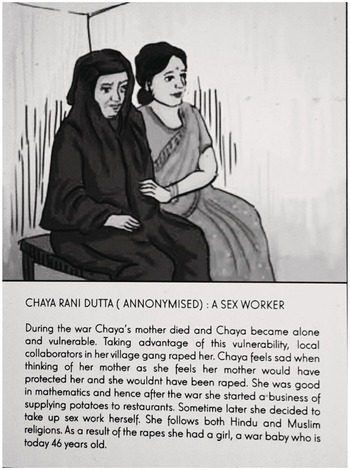
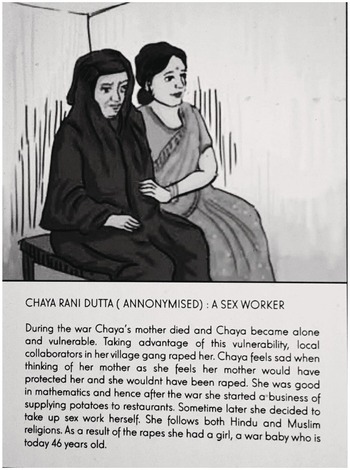
The experience of Chaya Rani Datta (Figure 8.2), a sex worker, is worth elaborating here. I met her at a time when she was the “madam” of minor girls in the red-light district. Introduced to me via an NGO that worked with the sex workers in the red-light district, Chaya narrated how she became alone and vulnerable when her mother died during the war. Taking advantage of this vulnerability, local collaborators in her village gang raped her. She started crying when speaking about her mother’s death, as she feels her mother would have protected her and she wouldn’t have been raped. She was skilled in mathematics and, hence, after the war she started a business supplying potatoes to restaurants. Sometime later, she decided to take up sex work herself. She follows both Hindu and Muslim religions. As a result of the rapes, she gave birth to a girl, a war baby, who is today 50 years old. Chaya says: "I feel the incident of rape during '71 is totally responsible for where I am today.” This is because, since she was alone in the village with no family and since everyone knew that she had been “made noshto” (spoilt) by the Razakars, nobody took any effort or cared to marry her off and she had to then fend for herself. Here, the transgression of her sexuality become what Zizek has referred to as the block, whereby Chaya is excluded from the possibilities of marriage and having a household in the post-conflict context.
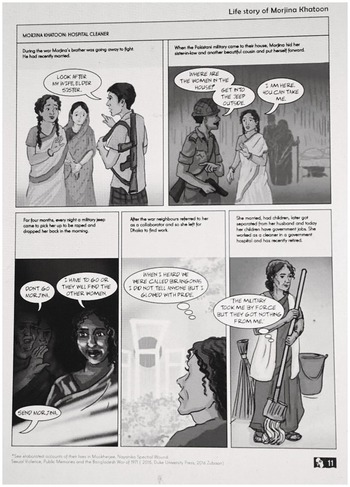
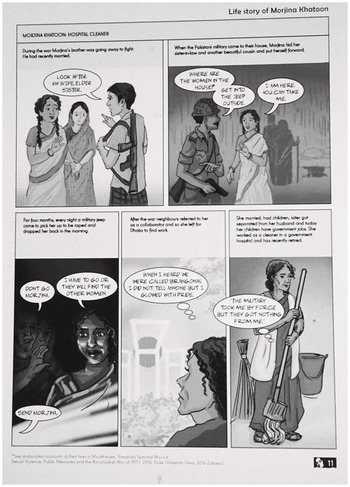
A similar block is applied to the life trajectories of the hospital cleaner Morjina Khatoon (Figure 8.3). During the war, Morjina’s brother went away to fight. Since he had recently married, he asked his sister to look after his newlywed wife. As a result, when the Pakistani military came to their house, Morjina hid her sister-in-law and another beautiful cousin and put herself forward. For four months, every night a military jeep came and picked her up to be raped and dropped her back in the morning. Her parents cried for her every night she was picked up but also knew she was protecting the other women in the family. Nonetheless, like Ferdousy’s experience, after the war, neighbours referred to her as a collaborator and so she left for Dhaka to find work. When she heard that she was being called birangonas she did not tell anyone but she glowed with pride. Eventually, she married, had children, later got separated from her husband. Today her children have government jobs. She worked as a cleaner in a government hospital and has recently retired. As she poignantly and powerfully says: “The military took me by force but they got nothing from me.” While Morjina’s continuous rape enabled the protection of other women, this protection and nurturance was not extended to her after the war. Ferdousy, Chaya, and Morjina all fended for themselves and those dependent on them in the immediate post-conflict life world of Bangladesh. This precisely becomes an identifier – the constitutive performativity of the birangona becomes coded through the increased number of single working women in the immediate aftermath of the war. Here, the suspicion about the birangona is constructed through finding her in these kinds of life trajectories: those of being away from the family after the war and the professional choices. It is true that not only moral boundaries of failed patriarchies are drawn in ways that exclude birangonas. It is also resonant that the more communities personally knew the birangonas, the more they suspected the women of betrayal – betrayal being the ever present dark side of intimacy (Kelly and Thiranagama Reference Kelly and Thiranagama2010, 3).
8.6 Conclusion
The non-recognition of the Bangladesh war as genocide, the UN declaration of rape as a war crime in 1995, and the offer of an apology by the Japanese government to the comfort women – these interconnected events led various Bangladeshi feminist and human rights activists to document histories of sexual violation committed during the 1971 war so as to provide supporting evidence and enable the trials of the collaborators.Footnote 15 Examining the seething ambiguity and suspicion that exists toward the raped woman and the narrative dynamics that construct her as a traitor and prostitute allows a greater acknowledgement of the overlapping roles of the perpetrator and survivors – a complexity that fails to be captured by the transitional justice framework.
This chapter has explored the constitutive performativity (in the strict Butlerian sense), which I would paraphrase as naturalization through stylized and exclusive repetition – how the idea of a traitor has been “made” in order to be “found” through rumors about their whereabouts after the war, how the women looked, their professional choices, and their life trajectories as single working women in the immediately independent Bangladesh. The attempt I am making is to highlight the various “natural” connotations of the traitorous birangonas. By discursively engaging with the three life trajectories of the “enemy within,” through the narrative dynamics of speculation and rumors of the raped woman as a traitor (as explored in my graphic novel), “we understand, story, and then respond” to how the idea of the traitor straddles the positions of victim and perpetrator. The chapter has followed Zizek’s (Reference Žižek1989, 127) analysis of how “the block” is projected onto the figure of the “Jew,” which I extend to examine how this concept of the block can be applied to the figure of the survivor of sexual violence, about whom there is constant suspicion of being a traitor. Zizek shows how society is prevented from achieving its full identity by its own antagonistic nature, by its own immanent blockage. In the cases I examine here, the block is a powerful obstacle in the lives of survivors of sexual violence. Conceptions of survivor of sexual violence as traitorous help to map out not only the boundaries of the collective subject, they also lay claim to a moral and political certainty, the fantasy of a full Bangladeshi identity in the face of wartime complicity. I also elaborate an argument about exclusion through language in this chapter as it allows us to unpack the semantic dynamics of exclusion and inclusion when the survivors are referred to as prostitutes and as traitors. The emphasis on the need for justice highlights the legitimate inheritance through which the nation’s wound is to be kept alive. But the wound is also kept open through the figure of the raped woman – the illegitimate presence of other – who has to be evoked for the reiteration of legitimate inheritances.
The raped woman as the collaborator, as the prostitute, however, places desire and sexuality at the center of the making of traitors. The rumors about young women during the war make them potential conspirators who were “attracted” to the Pakistani army. Her citizenship is guaranteed under the Bangladeshi state, although through her absent presence. The Islamic collaborator who is granted citizenship under military governments poses a threat to the potential of secular nationalism of the left-liberal community. The raped woman is thereby actively evoked to highlight the continued presence of the Islamic collaborator on the political landscape of Bangladesh. The subtext of justice in terms of making the Razakars accountable through the rape of the collaborator’s daughter seem interlocked in various webs of complicity from all fronts. The various roles of the birangonas – as mothers, lovers, and professional women – come to be viewed through suspicion, speculation, a poisonous knowledge, and a burden of distrust that the women always carry.


 Open access