1. Introduction
If John Locke (Reference Locke and Nidditch1690/1975) is right, color might not be a feature of things as they are in themselves, but shape is a feature of those things. If I see a cube in normal conditions and rightly judge that it is a cube, then by gum there really is a mind-independent cubical thing out there, the shape of which in some important way resembles my experience of its shape. If Immanuel Kant (Reference Kant and Smith1781/1787/1929) is right, then John Locke is wrong about this. Things in themselves are not cubical—or at least we have no good reason to think they are cubical. They are not laid out in space. There is nothing independent of the human mind that has cubical properties that resemble the properties of my visual experience of cubes.
I would like to know whether Locke is right or Kant is right. Do things as they are in themselves have shapes that resemble, in some important way, my experience of those shapes, or not? Are things, really, like this [here I gesture, through an act of attention, at my own visual experience]? Or is this just a sheen, a convenient interface experience, a human construction atop a radically different reality?
This might seem to be a hard question to answer.
I do not have an answer. But I do have a thought about a way in. My thought is this. Suppose it is the case that there are multiple different ways of veridically visually experiencing the same object, so that we cannot say “this way is right and this way is wrong” or “this way is preferred over this other way.” And then suppose further that sometimes it is also the case that there is no good reason to think that one of those two experiences more closely resembles how the experienced object is in itself. From these suppositions, it would seem to follow that there is a kind of looseness between the features of experience and the features of things in themselves. Things in themselves might be more like this, or they might be more like that. They might more closely resemble experience A, or they might more closely resemble experience B. Or they might really resemble neither experience very well. Thus, we get at least some bracketing parameters: we can no longer say we know that things in themselves are like this, at least in whatever respect this differs from that—a miniature Kantian victory over Locke.
To clarify what I have in mind here, I focus on two examples.
2. “Objects in Mirror Are Closer Than They Appear”
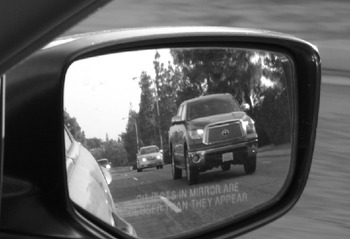
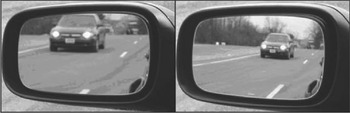
According to the US Code of Federal Regulations, Title 49, Chap. 5, §571.111, S5.4.2, pertaining to convex mirrors on passenger vehicles, “Each convex mirror shall have permanently and indelibly marked at the lower edge of the mirror’s reflective surface, in letters not less than 4.8 mm nor more than 6.4 mm high the words ‘Objects in Mirror Are Closer Than They Appear’” (GPO.gov, accessed July 13, 2011). Figure 1 provides an illustration of this. Further, figure 2 provides an illustration that contrasts how things look in a convex mirror with how they look in a flat mirror.
Objects in mirror are closer than they appear.

The view in flat (left) versus convex (right) driver-side mirrors. Image detail from Wierwille et al. (Reference Wierwille, Schaudt, Gupta, Spaulding, Bowman, Fitch, Wiegand and Hanowski2008).

So consider: are objects in the convex mirror closer than they appear? Here are three possible answers:
1. Why yes, they are!
2. No, objects in the mirror are not closer than they appear, but that is because rather than being closer than they appear they are larger than they appear. The convex mirror distorts size rather than distance.
3. No, objects in the mirror are not closer than they appear, nor are they larger than they appear; if you’re a skilled driver, the car behind you, as seen with the aid of the convex passenger-side mirror, is just where it looks to be and just the size it looks to be.
Answer 3 is the one I am drawn to. One reason to favor answer 3 is that there seem to be no good grounds to privilege saying that objects are closer than they appear in the convex mirror over saying that they are larger than they appear. It could be a 3-foot-tall car 30 feet away or a 6-foot-tall car 60 feet away. Nothing obvious about its appearance, as distorted by the mirror, decides between these two interpretations. The car might look illusorily distant in the mirror in something like the way that we sometimes think things viewed through the wrong end of a telescope look misleadingly far away, or it might look illusorily small in something like the way that we sometimes think things viewed through a magnifying glass look artificially large. It is not clear what would compel the choice between these alternatives, but it also seems odd to just split the difference between views 1 and 2 and say that the car in the mirror looks 4.5 feet tall and 45 feet away. If answers 1 and 2 each problematize each other, that might give us reason to favor answer 3.
Another reason to favor answer 3 over answer 1 or answer 2 is that skilled drivers are undeceived. Decades of auto safety research show that practiced drivers do not misjudge the distance of cars in convex passenger-side mirrors. They do not misjudge when they are asked oral questions about the distance, nor do they misjudge when they make lane-shifting decisions in actual driving. Instead, they seem to skillfully and spontaneously use the mirror accurately to gauge the real distance of the cars behind them (e.g., de Vos Reference de Vos2000; Wierwille et al. Reference Wierwille, Schaudt, Gupta, Spaulding, Bowman, Fitch, Wiegand and Hanowski2008). This is not by itself a compelling reason to favor answer 3; presumably, anyone generally predisposed to think that the objects in the mirror are closer than they appear will allow that people familiar enough with the illusion might be entirely undeceived by it. But I hope you will agree that there is something a bit happier about a position that avoids the proliferation of such undeceiving illusions, if an alternative theory is available.
A third kind of evidence for answer 3 over answer 1 or answer 2 is introspective: Get in a car. Drive. Think about how the cars behind you look, in both the driver-side and the passenger-side mirrors. Try adjusting the two mirrors so that they both point at the same car behind you when your head is centrally positioned in the cabin. Does the car look closer when your eyes are pointing toward the flat driver-side mirror than when they are pointing toward the convex passenger-side mirror? Based on my own messing around, I am inclined to say no, the cars look the same distance in the two mirrors. I am inclined toward what I will call the Multiple Veridicalities view. There is more than one way in which a car can look like it is 6 feet tall and 60 feet behind you. There is a flat-driver-side-mirror way, and there is a convex-passenger-side-mirror way. And both ways are equally veridical. Flat mirrors are not inherently more veridical; convex mirrors are not inherently distortive. It is a matter of what we are used to. This is one way to think about what possibility 3, if true, might amount to.
Anyhow, Multiple Veridicalities is the view I am inclined toward, partly on introspective grounds, partly on grounds of theoretical elegance: in whatever sense it is that things seen in mirrors look, to skilled and undeceived users, like they have the size and position that they do in fact have—and I do not pretend that I can fully analyze that sense of “look” here—objects in both the driver-side and the passenger-side mirrors, despite occupying different proportions of visual arc and differing phenomenologically as a result, look to be their true sizes and in their true positions.
Now if the Multiple Veridicalities view can be sustained, we can consider other cases of multiple veridicalities too: how things look through my new progressive-lens spectacles versus how things look through my older single-correction prescription glasses; how the moon looks when it is near the horizon versus how it looks at zenith; how the oar looks when partly immersed in water versus how it looks in plain air. Is there more than one way in which the oar can “look straight”?
I do have a bit of trouble in good conscience acquiescing to the Multiple Veridicalities view in the oar case. What I would like to be able to say is that to the truly skilled oar-in-water perceiver, the oar partly submerged in water no longer looks crooked. It looks straight. It looks just the way a straight oar should look when partly submerged in water. There are now just two different and equally good ways in which an oar can look straight, the plain-air way and the half-submerged way, and neither experience more closely resembles the straightness of the oar as it is in itself. Maybe if we are inclined to think otherwise, that is only an accident of what is more common in our experience and what is less common. If there were, perhaps, a world in which every straight thing were always seen half submerged in a refracting medium, we would say, “That looks straight, straight, straight!” and when finally for the first time an oar was pulled into plain air, we would say, “Oh, how crooked it looks; what an illusion!” As I said, that is what I would like to say. It would be cool if it were true. But I am not sure that I know that it is true.
If we treat the convex mirror case as I would like to, then it seems we can construct a garden path to the oar case, via intermediate cases such as hypothetical windshields that contain a refractive portion to allow a broader field of view, skilled spearfishers who never aim wrong, corrective eyeglasses that habitually slip down the nose, and head-mounted cameras. We could consider jewelers with fish-eye lenses surgically installed, gods whose eyes are giant spheres in which we dwell, all kinds of hypothetical creatures to whom a square object might look very different than it looks to us (for some examples see Schwitzgebel Reference Schwitzgebel2012). It would be delightful if we could treat all these cases in a unified way.
3. Inverting Lenses
Let us consider a famous case from the history of psychology, the case of the inverting lenses.
Inverting lenses were first tried by George Stratton in the late nineteenth century (Reference Stratton1896, Reference Stratton1897a, Reference Stratton1897b). Stratton covered one eye and then presented to the other eye a field of view rotated 180 degrees, so that top was bottom and right was left. In his primary experiment, he wore this lens for the bulk of the day over the course of 8 days, and he gives detailed introspective reports about his experience. Stratton adapted to his inverting lenses, as do others who wear the lenses for an extended period. But what does adapting consist in?
The simplest possibility to conceptualize, perhaps, is this: after adaptation, everything goes back to looking just the way it did before one donned the inverting lens. Let us say that preexperiment one looks out at the world—at, say, a lamp. Let us call the way things look, the way the lamp looks, before you put on the lens “teavy.” Now you put on the lens and everything seems to have rotated 180 degrees. Let us call that visual experience, that way the lamp looks to you now, “toovy.” Over the course of adaptation, then, what happens on this view is that things go back—perhaps at first slowly, unstably, and disjointedly—to looking “teavy.” After adaptation they look the same way they would have looked if you had never donned the inverting lens in the first place. This is the way adaptation to inverting lenses is often described (e.g., Taylor Reference Taylor1962; Hurley and Noë Reference Hurley and Noë2003).
But there is another possibility—I think a more interesting one. That is the possibility that things remain toovy throughout. They never go back to teavy, but you get used to their looking toovy, so that you lose the normative sense that that is a wrong or misleading way for things to look. The lamp no longer looks “upside-down” in the normative sense of looking like the wrong side is on top, but it retains its “upside-down” look in the nonnormative sense that the visual experience is the reverse of what it was before you put on the inverting lenses. To the adapted mind, there would now be two ways in which a lamp might look to be right-side up—the pre-lens teavy way and the post-lens toovy way. (Maybe toovy changes, too, as one accommodates—becoming toovy-prime, say, more richly and accurately layered with meaning and affordances; the important thing here is that it does not go back to teavy.) Just like with my favored way of understanding possibility 3 in the convex mirror case, there would be multiple veridicalities—two ways of something’s looking to have the same objective set of spatial properties and position and orientation relative to you.
Now it is an empirical question whether the Multiple Veridicalities view is correct about inverting lenses or whether things really do just go back to looking teavy after adaptation. And it is a tricky empirical question—one that requires, I think, a fairly subtle sense of what the possibilities are, a subtle sense of the different things one might mean by saying that something “looks like it is to the right” or “upside-down.” As one might expect, the introspective reports of people who have tried inverting lenses are not entirely consistent or unequivocal. However, my assessment of the evidence is that the experimenters with the best nose for this sort of nuance—Stratton himself and then later Charles Harris (Reference Harris1965, Reference Harris and Harris1980)—favor the Multiple Veridicalities view (see also Linden et al. Reference Linden, Kallenbach, Heinecke, Singer and Goebel1999; Klein Reference Klein2007). If so, there is more than one way for a lamp to look right-side up.
4. Conclusion
I look out now upon the world; I imagine looking out upon it, just as veridically, through a fish-eye lens; I imagine looking out upon it, just as veridically, through increasingly weird assemblies that I would have said, the first time I gazed through them, made some distant things too large and some nearby things too small, that presented twists and gaps—maybe even that doubled some things while keeping others single—and to which I grow skillfully accustomed. I try to imagine my phenomenology not shifting back to what it was before, but remaining very different, while losing its sense of wrongness, so that I am no longer tempted to say that things in themselves are more like this than like that. I imagine extending this exercise to my other senses.
I am not sure how far I can push this way of thinking, but the farther I can push it, the looser the relationship would seem to be between my experience of things and things as they are in themselves. My hunch is that numerosity and contiguity are the anti-Kantian’s best hope for resemblance between things in themselves and one’s experience of them—that a “toovy” (or “toovy-prime”) visual experience from a visual array pieced up and multiplied would lack some dimension of resemblance to things in themselves that ordinary visual experience has and that is still preserved in inversions and convex reflections.
Maybe Kant or some other philosopher has presented a sound a priori argument that our experiences cannot really resemble things as they are in themselves in any useful sense of “resemble.” I am exploring, instead, an empirical path that might lead at least partway toward the Kantian conclusion, grounded on introspective observation of variability among different seemingly equally veridical sensory experiences.