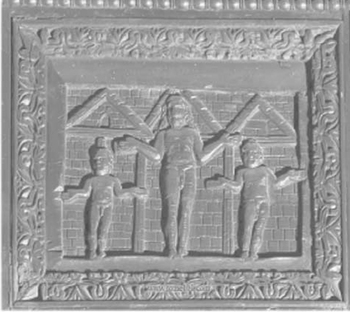
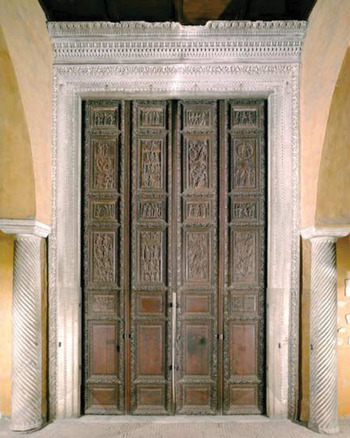
The earliest extant public image of the crucifixion of Christ appears on a single relief panel on the early-fifth-century wooden doors of the Church of Santa Sabina on the Aventine Hill in Rome (figs. 1 and 2). General scholarly consensus dates the construction of the church to the pontificate of Pope Celestine I (422–433 c.e.) as stated in the surviving inscription on the church's interior west wall.Footnote 1 Construction probably continued into the pontificate of Sixtus III (432–440 c.e.) when the church was formally consecrated.Footnote 2 Although in the ensuing centuries the image of the Crucified Christ—the Crucifix—attained canonical status, scholars seeking precedents for Santa Sabina's crucifixion scene have failed to determine its pedigree satisfactorily within the Christian artistic tradition. We propose that broadening our understanding of artistic prototypes for the Santa Sabina crucifixion image to include both formal and theological elements allows for a more nuanced and promising investigation.
Crucifixion panel on the wooden doors of the Basilica of Santa Sabina, Rome 28 × 40 cm, ca. 420–430 c.e.Photo credit: William Storage and Laura Maish

The scarcity of crucifixion images before the early fifth century has generally been attributed to Christian embarrassment over the shameful circumstances of Jesus’ death on a cross.Footnote 3 Nevertheless, the Santa Sabina crucifixion could scarcely have materialized out of nowhere, and art historians have employed various strategies to identify a supposedly lost Christian iconographic prototype for later images of Christ on the cross. Dina Tumminello, for example, in her 2003 monographFootnote 4 looks at slightly later crucifixion images and extrapolates backward to the Santa Sabina panel. On the basis of early-seventh-century pilgrim ampullae from Palestine,Footnote 5 a painted sixth-century pilgrim's reliquary box,Footnote 6 the crucifixion painting in the Rabulla Gospels (586 c.e.),Footnote 7 and a hypothetical image in the Church of the Holy Sepulchre in Jerusalem,Footnote 8 Tumminello has suggested that the Santa Sabina panel derives from an Eastern, possibly monastic, Christian artistic prototype, earlier examples of which are now lost.Footnote 9 Her suggestions, however, remain speculative, and in any case, the composition of her proposed parallels include more symbolic and narrative elements than the relatively stark Santa Sabina scene.
Wooden Doors: Basilica of Santa Sabina, Rome 5.35 × 3.35 m, 420–430 c.e.Photo credit: Scala/Art Resource, N.Y.

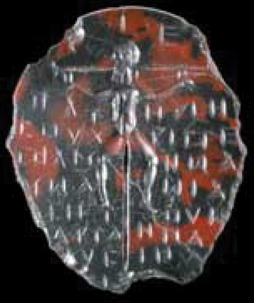
Magical Amulet with Crucifixion Eastern Mediterranean (Syria?) late 2nd–3rd century c.e. Bloodstone, 3 × 2.5 × 0.58 cm British Museum, Department of Prehistory and Europe London (MME 1986.05-01.1) Photo credit: Trustees of the British Museum

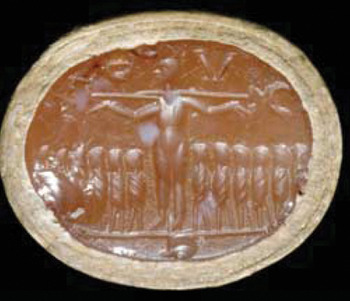
Engraved Gem: Crucifixion with Apostles Syrian (?), mid-fourth century c.e. Carnelian 1.05 × 1.35 cm British Museum, Department of Prehistory and Europe (MME 1895.11–13.1) Photo Credit: Trustees of the British Museum

In the catalog to a recent exhibition of Christian art,Footnote 10 Felicity Harley and Jeffrey Spier also struggle with the puzzling “rarity of depictions of the crucifixion in Christian art.”Footnote 11 They consider the crucifixion conundrum especially in relation to three early crucifixion representations in miniature from the Roman East: a magical amulet of the late second/early third century with Jesus on the cross (fig. 3)Footnote 12 and two fourth-century engraved gemsFootnote 13 on which the crucified Jesus is flanked by six disciples on either side (fig. 4). Harley and Spier identify the amulet as the “earliest surviving representation of Jesus on the cross,” and speculate that “pictures of the subject (now lost) may have been widespread even in the late second or early third century, most likely in conventional Christian contexts.”Footnote 14
The amulet, however, is also inscribed with a multitude of occult names: not only “Son, Father, Jesus Christ,” but also the Egyptian derived Badetophoth and Satraperkmephthe, among others. The catalog entry concedes that the amulet could reflect the activity of a pagan magician who, like the family of Jewish exorcists in Acts 19:13–17, included Jesus’ name in his repertory of magical powers.Footnote 15 The amulet might equally come from a Jewish or—given the period's fluid religious boundaries—Jewish-Christian occult practitioner.Footnote 16 For the origin of the engraved gems, Harley, not unlike Tumminello, looks to the East and suggests that the gems provide “rare evidence for the existence of unconventional Christian images … at a relatively early date in the Eastern part of the Roman Empire (Syria?).”Footnote 17
With regard to the amulet, it is important to recognize that magic in the Greco-Roman world often depended on an underlying transgressive element involving demons and danger-laden materials and images.Footnote 18 Precisely because of its innate ghastliness, crucifixion had a role in Greco-Roman magic, which may explain the motivation behind the amulet image here.Footnote 19 In the Golden Ass, a witch's potion requires nails covered with the flesh of crucified men,Footnote 20 and Pliny cites a cross nail and a rope from a cross in a list of ingredients for amulets and spells.Footnote 21 From Paul on, church leaders condemned, or at least were uncomfortable with, the use of amulets by Christians despite the fact that this practice was widespread before and after Constantine.Footnote 22
Furthermore, unlike the Santa Sabina panel, amulets (and gemsFootnote 23) are private art. Amulets were created throughout the Roman world by artists/practitioners who often may have been responding to local needs and assumptions. As in the case of the British Museum amulet, the frequently eclectic mixture of Jewish, Christian, Greco-Roman, and Egyptian divine names on magical amulets obscures the religious affiliation(s) of an amulet maker or consumer or, perhaps more to the point, suggests fluid religious boundaries.Footnote 24 In some cases at least, the amulet artists may have been challenged to create an unprecedented image with no extant visual prototype.Footnote 25 One problem with Harley's contention (above) that these earlier images suggest the existence of “unconventional” Christian imagery is that despite the best efforts of heresiologists like Irenaeus of Lyons, “conventional” Christianity, let alone “conventional” Christian imagery, did not yet exist.Footnote 26 Furthermore, because so much surviving Christian art comes from Rome, it is easy to forget that Christians occupied the entire empire throughout which they, too, were creating images. As Christian patronage evolved beyond an interpretatio christiana of available “pagan” imagery to explicitly Christian images,Footnote 27 a variety of “bespoke” Christian images in miniature could have been created independently and in diverse locations across the vast Roman Empire with only a few, if any, making a lasting impact on what, after 314 c.e., would become “official” Christian art.Footnote 28
Paul Corby Finney has observed that there is no evidence for Christian art before the third century.Footnote 29 Nor is there any evidence at all for a public representation of the crucifixion of Christ before Santa Sabina's fifth-century panel—despite the fact that crucifixion had been banned by Constantine a century earlier.Footnote 30 The “traditional” explanation for this absence seems correct to us: Christian artists avoided representing Christ on the cross because it was shameful.Footnote 31 Non-Christian allusions to crucifixion bear this out. Cicero, in his defense of Gaius Rabirius asserted that
the very word “cross” should be far removed not only from the person of a Roman citizen but his thoughts, his eyes, and his ears. For it is not only the actual occurrence of these things but the very mention of them that is unworthy of a Roman citizen and a free man.Footnote 32
Among the Roman underclass, Crux! was a common profanity,Footnote 33 and clearly a reflex of the dynamic underlying Cicero's admonition.
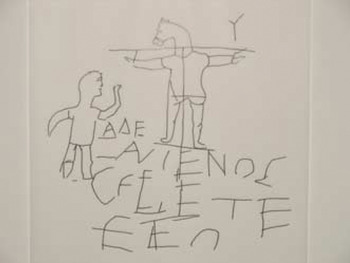
Squeamishness at the idea of crucifixion apparently extended to imperial Roman reliefs on triumphal arches and columns depicting military victories, even though Roman armies crucified their opponents during sieges and rebellions.Footnote 34 The Romans may have crucified some 500 Jewish rebels during the siege of Jerusalem,Footnote 35 but crucifixions do not appear among the images of General Titus's victory on his triumphal arch overlooking the Roman Forum. Hengel observes, “Crucifixion was widespread and frequent, above all in Roman times, but the cultured literary world wanted to have nothing to do with it, and as a rule kept quiet about it.”Footnote 36 Without a full awareness of the crucifixion taboo in Roman society,Footnote 37 the malice behind the well-known second-century donkey-headed crucifixion victim on the Alexamenos graffitoFootnote 38 (fig. 5) or the way in which the British Museum crucifixion amulet participates in Greco-Roman society's “rich vocabulary of alterity”Footnote 39 cannot be fully grasped.
While acknowledging the stigma associated with crucifixion, Harley sees a contradiction between Christians’ “putatively conscious refusal to depict the Crucifixion” and “the internal focus of the early church, where the preaching of Christ crucified was central.”Footnote 40 However, pace Paul's defiant assertion that Christians “proclaim Christ crucified, a stumbling block to Jews and foolishness to Gentiles” (1 Cor 1:23), a palpable tension exists between text and image, between Paul's advocacy of the “wisdom of Christ crucified” and the developing Christian iconographical tradition, which could not afford to associate the culturally offensive image of crucifixion with the Jesus movement. Clement of Alexandria (b. ca. 150 c.e.), for example, never refers to the cross in his catalog of devices suitable for Christian seal rings.Footnote 41 In the visual record even into the fifth century the crucified Christ is all but invisible,Footnote 42 whereas Christian writers discussed the cross and Christ's crucifixion in a variety of contexts.Footnote 43
Line drawing after the Alexamenos Grafitto From the wall of the Imperial Palace on the Palatine Hill, Rome Second/third century? c.e.Drawing Courtesy of Amy Bartlett-Wright, www.AmyBartlettWright.com

Crucifixion, in fact, was not the only mode of public humiliation and torture that Christians avoided representing in visual media. While early Christian martyrologies described in gruesome, if loving, detail the torments of Christians in the arena, correspondingly graphic images of torture do not seem to appear until the fourth century at the earliest.Footnote 44 Christian writers, according to Elizabeth A. Castelli, privileged memory and words over the “idolatry” of material representations.Footnote 45 Eusebius and Augustine typically call for Christians to create, in Eusebius's words, “an imperishable monument” to sainted martyrs not “by statues of stone, nor by pictures of mingled pigments, nor by colors or images of lifeless terrestrial things, but by the true word uttered before God.”Footnote 46
Even images of the cross on its own do not make a significant appearance in Christian contexts until Constantine's adoption of the Chi-Rho as his imperial insignia,Footnote 47 and notably, under Constantine the first formulation of the Nicene Creed (325 c.e.) affirms only that Christ suffered and died, not that he died on the cross.Footnote 48 However, Justin Martyr, writing in the second century, did not hesitate to draw a parallel between the imperial tropaeum and the cross of Christ.Footnote 49 In an ironic turn of affairs, Tertullian (ca. 160–240 c.e.) and Minucius Felix (fl. 200–240 c.e.) are at pains to provide a palatable interpretatio graeca for the cross by drawing analogies to cross-like images and objects with positive connotations in Greco-Roman culture: a ship's mast or an oared ship, a tropaeum, a person praying, even pagan statues of gods.Footnote 50 Another palliating strategy was to divert the focus from Christ's crucifixion to Old Testament “prophetic” type-scenes such as the stories of Moses’ upraised arms in the battle against Amalek (Exod 17:11–12) and the brazen serpent of Moses (Num 21:6–9).Footnote 51 Also attractive was the docetic/gnostic idea that Jesus only seemed to suffer on the cross or even that the cross was a symbol for something else.Footnote 52 While the church fathers, despite their various, even contradictory, theological agendas, viewed the cross as a symbol of salvific power, in the words of Jean-Marc Prieur, “the apologetic preoccupation is never far, and their concern is to make the cross comprehensible and, if possible, acceptable to the detractors of Christianity, whether Jewish or Pagan.”Footnote 53
An additional explanation for this disjunction between the early Christian textual and visual record regarding crucifixion lies in the Greco-Roman rhetoric of masculinity, in which crucifixion constituted a primary signifier of passivity and emasculation.Footnote 54 Colleen M. Conway has observed that, barring the passion accounts, the much-vaunted focus on the cross in the New Testament has been exaggerated. For example, she observes of Paul that outside Galatians and 1–2 Corinthians “direct references to the cross are not as ubiquitous as the strong hermeneutical tradition of his ‘theology of the cross’ would suggest.”Footnote 55 When Paul speaks explicitly of the cross in Galatians and 1–2 Corinthians, he is defending himself against accusations of weakness or lack of authority.Footnote 56 He parries these charges by resorting to a philosophical ideal popularized in Hellenistic Stoicism, that the highest degree of manliness accrues to one who willingly suffers and dies on behalf of others.Footnote 57 Accordingly, Paul asserts that while extrinsically Jesus’ death on the cross might appear humiliating, in actuality his suffering and vicarious death demonstrated the heroic self-sacrifice of a true man.Footnote 58 In these letters Paul aligns his own apparent weakness (the feminine quality par excellence) with the nobility of Christ's passive endurance.
Tellingly for our argument, Conway asserts that the “concept of the noble, manly death and the emasculating crucifixion are not ideas that are easily held together in the gendered ideology of the first century. The gendered implications of both images are like similar poles of a magnet, repelling rather than attracting one another.”Footnote 59 Early Christian writers could control the discourse of the cross by providing any number of culturally acceptable interpretations for the crucifixion of Christ. Visual representations, on the other hand, like movies today, were fair game for interpretation by anyone with eyes to see. Early Christians could not risk associating themselves with an image from which the majority of their neighbors would avert their eyes.
Any attempt to understand the background to the Santa Sabina panel requires a willingness to work with, rather than against, this tension between text and image. Our research supports Robin Jensen's proposal that “there is, in fact, a complete absence of crucifixion imagery in early Christianity.”Footnote 60 We are interested in following up on her admonition that “if narrative subjects functioned symbolically or metaphorically in addition to broadly illustrating particular narratives, new possibilities emerge—some of which might be subtle or veiled references to the cross.”Footnote 61 It is with this perspective in mind that we should reconsider the Santa Sabina crucifixion.
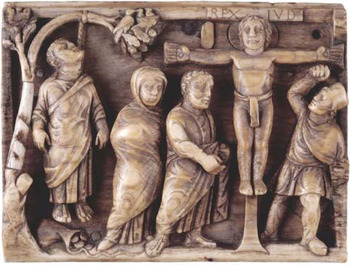
Panel from an Ivory Casket: The Crucifixion of Christ (“Maskell Ivories”) ca. 420-430 c.e., Rome, Italy; 7.5 × 9.8 cm Photo Credit: Trustees of the British Museum

The Santa Sabina Panel and Roman Christian Iconography
First, because the Santa Sabina crucifixion relief hails from Rome, it is important to consider it within its Roman Christian context. Whereas the nationality of the Santa Sabina sculptor is not relevant to our question of the formal model for this image, art produced in Rome during the fourth and fifth centuries is. The only Roman crucifixion scene contemporary with the Santa Sabina doors appears on one of four narrative panels of the so-called Maskell ivories (420–430 c.e.) in the British Museum (fig. 6).Footnote 62 Of particular interest on this privately commissioned Roman pyxis is the narrative ivory relief of the crucifixion, which clearly shows both the entire cross and Christ. While both the Santa Sabina wooden relief and the ivory relief depict crucifixions, however, many differences are apparent. The Santa Sabina panel is public whereas the ivory casket is a private work of art; the ivory shows both the full cross and Christ hanging on it, while on the wooden door panel Christ seems to stand on the ground with the cross itself barely visible. In addition, unlike the stark Santa Sabina panel, the ivory has a complex narrative composition involving not only the crucifixion but the suicide of Judas and, more importantly, the Virgin Mary and John, as well as the centurion.
Both images do show compositional innovations, albeit different ones. The ivory juxtaposes the ignominiously dead and hanging Judas with an open-eyed Christ triumphantly alive on the cross; the wooden door panel, on the other hand, shows a frontal Christ alive between the two thieves with only the barest hint of a cross visible behind each of the three figures. In fact, all three figures appear to be standing sturdily rather than hanging. In both works, the artists are grappling with a new scene, the crucifixion, and have brought two very different solutions to the compositional problem. On the ivory relief the artist has chosen to omit the two thieves and instead has juxtaposed two separate narrative moments of the passion. Here the cross is a fully articulated part of the scene; the viewer is in no doubt that this is Christ's crucifixion and is encouraged to meditate on the irony of Judas hanging dead on a living tree while the living Christ hanging on a “dead tree” triumphs over death.
If the Santa Sabina panel has no visual precedents in earlier Christian representations of the crucifixion, where then should one turn to find a model for its crucifixion composition? Because the panel is a Roman work of art, it makes sense to examine Christian Roman art from the preceding two centuries,Footnote 63 and the two most fruitful sources of Christian art from the third and fourth centuries are catacomb paintings and sarcophagi. In our search for a theoretical prototype for the Santa Sabina scene, we developed a basic template consisting of:
three standing frontal male figures
figures with outstretched arms
an iconographic context of salvation.
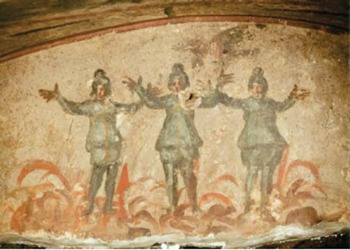
With this template in hand, it was a relatively simple matter to find a familiar scene with all the necessary characteristics, and that scene appears both in catacomb paintings and on sarcophagus reliefs: the Three Boys in the Fiery Furnace from Daniel 3. These images exactly matched all the requisite formal and iconographic criteria. For example, the Three Boys fresco in the early-fourth-century Velatio chamber of the Catacomb of Santa PriscillaFootnote 64 provides a striking parallel to the Santa Sabina crucifixion (figs. 7a, 7b). This scene remained popular in both catacomb decoration and Christian sarcophagi throughout the fourth century c.e.Footnote 65
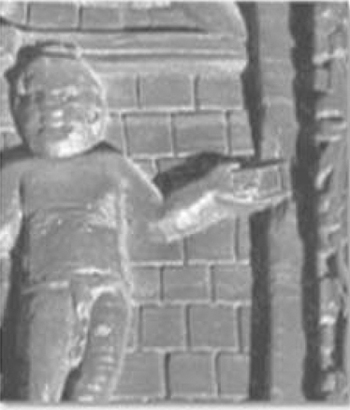
Before turning to a detailed comparison between the Three Boys images and the Santa Sabina crucifixion panel, it is important to consider the panel's composition. The Santa Sabina crucifixion panel shows the larger standing frontal Christ figure in the center flanked by the two smaller thieves who are similarly frontal and standing. The facial features of all three figures are rudimentary at best, although their eyes are manifestly open. Christ, however, has long hair and a beard, while the two thieves appear short-haired and clean shaven. All three figures have outstretched arms and wear identical loincloths. Behind the figures is a wall of rectangular stones. Each figure is separated from the other by a vertical wooden pier that supports a wooden triangular pediment above his head. Both thieves’ heads are below the pediment while Christ's head extends into and is framed by the triangular pediment. In the pediment above the thief on Christ's proper right is a small arched window.
While this is clearly a crucifixion scene, the only indications of a cross are small rectangular blocks behind the hands of the figures, the nails in the hands, and a bit of the cross barely extending above each thief's head. All three figures stand squarely on the bottom edge of the panel with only the suggestion of a suppedaneum sculpted in the center of each figure's feet. Except for his height and his long hair, Christ and the two thieves are almost identical.
A comparison of the Santa Sabina panel with the Three Boys fresco from the Santa Priscilla Velatio chamber reveals striking similarities. For instance, the general composition of both images contains three standing, identically-clothed male figures with arms stretched out in the horizontal orant position. A prominent difference between the images is the greater size accorded on the Santa Sabina panel to the central figure of Christ, which creates a visual disruption across the image, especially because the arms and hands of the figures are now at different levels; even so, as noted above, all three figures in the crucifixion scene look remarkably alike. Located in the dark upper-left corner of the door and with no actual cross distinguishable in the scene, the Santa Sabina crucifixion panel can easily be mistaken for a Three Boys in the Fiery Furnace image until one notices the lack of flames.Footnote 66
Three Youths in the Fiery Furnace Catacomb of Santa Priscilla, Velatio Cubiculum Fourth century c.e., Rome, Italy Photo Credit: Erich Lessing/Art Resource, N.Y.

Santa Sabina Crucifixion Panel Photo Credit: William Storage and Laura Maish

Both the catacomb artist and the sculptor of the door panel chose not to include additional narrative attributes that would more easily identify the story in question. For example, while some other contemporary images of the Three Boys include a prominent furnace (an example of which is found in the same Santa Priscilla Catacomb),Footnote 67 the Velatio chamber image does not include a furnace (only flames), so that the three boys stand on the ground. So, too, does the sculptor of the Santa Sabina panel downplay the crosses because, similarly, Christ and the two thieves stand on the ground line.
For both the Santa Priscilla Velatio chamber image of the Three Boys and the Santa Sabina crucifixion relief the artists followed the biblical text to illustrate the Old and New Testament stories. The Velatio chamber Three Boys image shows three fully-clothed male figures standing in flames, the essentials of the story in Daniel 3. Similarly, the Santa Sabina crucifixion image also relies on the biblical text for its visual iconography. All three of the synoptic gospels describe Jesus crucified between two criminals (Matt 27:44; Mark 15:32; Luke 23:39–43). In the panel, however, the artist simply shows two crucified men flanking the crucified central figure of Jesus. At this early point in time, the artist has no interest in depicting narrative details such as the distinction between the good and bad thief,Footnote 68 the centurion, Mary and John at the foot of the cross, or other bystanders.
The translation of the three orant figures in the fiery furnace into the three crucified figures has its roots in early Christian theological typology. As early as the mid-second-century letter concerning the martyrs of Lyons and Vienne, Christian writers perceived a parallel between orant prayer and crucifixion.Footnote 69 In the third century Tertullian of Carthage wrote of the orant gesture: “We, however, not only raise our hands, but even expand them; and taking our model from the Lord's passion, even in prayer we confess to Christ.”Footnote 70 Likewise Minucius Felix (also third century) describes the cross: “We assuredly see the sign of a cross, naturally, in the ship when it is carried along with swelling sails, when it glides forward with expanded oars; and when the military yoke is lifted up, it is the sign of a cross; and when a man adores God with a pure mind, with hands outstretched.”Footnote 71 In view of such conscious comparisons of orant figures to Christ on the cross, the borrowing of the Three Boys image as a prototype for the first public Roman crucifixion scene is not surprising.
Moreover, considered thematically, the Three Boys motif, like the crucifixion scene, is an image of salvation and thus the reliance on the Three Boys composition for the first public image of Christ's crucifixion makes sense both formally and iconographically. The earlier painting has all the elements necessary for a crucifixion scene: a torture motif (flames), three male figures standing and facing forward, and orant arms. In addition, both images are based on the biblical text, and we know that the early church fathers used the image of the Three Boys as a basic type of Christian martyrdom and salvation.
The Three Boys as a type scene of Christian martyrdom appears first in 1 Clement (late first century), where the author describes the ordeal of the Three Boys in the context of God's saving power.Footnote 72 Tertullian follows this trend in the third century when he describes the Three Boys’ refusal to worship the idol of King Nebuchadnezzar: “There is no necessity for our making answer to this command of yours. For our God whom we worship is able to deliver us from the furnace of fire and from your hands.”Footnote 73 Indeed, in the representation of the Three Boys from the Velatio chamber of Santa Priscilla, the inclusion of a dove with a piece of foliage in its beak confirms, according to Marilyn Stokstad, that the flames are incapable of harming believers.Footnote 74 On Christian sarcophagi, the frequent pairing of the Three Boys with Noah heightens the significance of salvation for both images. Robin Jensen suggests that both scenes emphasize “rescue as resurrection, rather than the salvation of the righteous alone. … The story of the three children in the furnace is a demonstration of the preservation or resurrection of the physical body and seen along with Noah in his ark, both images serve as typologies of baptism (which itself contains the promise of physical resurrection).”Footnote 75
These themes of salvation come together in an extraordinary example: the sarcophagus of Junius Bassus, securely dated by its inscription to 359 c.e. In the spandrels of the lower register are small biblical scenes (badly damaged, unfortunately) in which lambs surprisingly substitute for human actors. The “three lambs in the fiery furnace” appear on the outer left spandrel and are matched with the spandrel scene on the outer right, the raising of Lazarus.Footnote 76 Because this sarcophagus dates after 312 c.e., we can surmise that the lambs are a symbol of Christ, the Lamb of God, and may also stand for the Christian community.Footnote 77 On the sarcophagus the pairing of the three youths/lambs with the resurrection of Lazarus communicates salvation themes and ultimately leads the viewer to understand the scenes as types of Christ's resurrection.Footnote 78 According to Malbon, the three youths and the raising of Lazarus symbolize for Christians the “salvation from the flames that threaten life [and] prefigure salvation from the tomb that marks the end of life.”Footnote 79 Surely, then, the Three Boys images effectively serve as a prototype for the ultimate Christian scene of martyrdom and salvation, Christ's crucifixion.
Technical Similarities
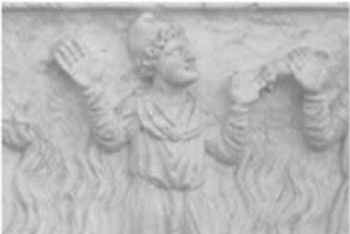
Another similarity between some of the Three Boys sarcophagus reliefs and the Santa Sabina crucifixion panel lies outside the formal, iconographic, and theological ties already discussed. It is, instead, a technical or functional link. When examining the crucifixion panel, we understood the abbreviated, almost shorthand, wooden squares behind the hands of all three figures as simply a result of the artist's reluctance to show an entire cross. While this is probably true, a close inspection of several of the Roman sarcophagus reliefs (fig. 8a) suggested to us a technical reason for the strange Santa Sabina wooden blocks. The sculptors of the sarcophagus reliefs solved the problem of bringing the boys’ raised hands forward to the same plane as their fuller bodies by leaving a small stone block behind the hands.Footnote 80 Braced in this manner, the hands were less likely to break off, and they were more realistically in line with the figures’ bodies.
This technical solution to a sculptural problem found on some of the Three Boys sarcophagi has perhaps been grafted onto the Santa Sabina crucifixion panel. In other words, the sarcophagus brace has become the indication for the cross (fig. 8b). Perhaps the sculptor of the crucifixion relief also sculpted sarcophagi. Even if he did not, he was surely familiar with the Three Boys sarcophagus scenes that used this technical method to brace the figures’ hands.
Detail: The Three Youths in the Fiery Furnace Relief on a marble sarcophagus, Sarcophagus 31471 Fourth century c.e. Museo Pio Cristiano, Vatican Museums, Vatican State Photo Credit: Vanni/Art Resource, N.Y.

Detail: Santa Sabina Crucifixion Panel Photo Credit: Bill Storage and Laura Maish

Papal Patronage?
Not only are there formal, theological, and technical reasons for the use of the Three Boys as a template for the Santa Sabina crucifixion panel, but it is worth considering the question of patronage as well. Pope Celestine, during whose pontificate Santa Sabina was constructed, had close ties to the cemeterial basilica erected by Pope Sylvester I (reigned 314–335 c.e.) over the catacomb of Santa Priscilla.Footnote 81 In fact, Celestine, like Sylvester and three later pontiffs (Liberius, 352–366 c.e.; Siricius, 385–399 c.e.; and Vigilius, 537–555 c.e.), was originally buried at Santa Priscilla.Footnote 82 The sacredness of the Santa Priscilla location predates even the erection of Pope Sylvester's cemeterial basilica at Santa Priscilla because two earlier popes, Marcellinus (296–304 c.e.) and Marcellus (308–309 c.e.) were already buried here.Footnote 83 Because so many early pontiffs chose burial here, the early excavators proposed that Santa Priscilla had a connection to the place where St. Peter, traditionally the first pope, was known to have preached and baptized, making this cemetery a suitable resting place for later pontiffs.Footnote 84
Additional visual evidence of the papal connection to Santa Priscilla and, presumably, its decoration, is a now-lost mid-fourth-century fresco in the Santa Priscilla catacomb that depicted the apostolic succession, the traditio legis, Christ giving the law to Peter and Paul. This fresco was often cited as visual evidence for St. Peter's early ties with this location.Footnote 85 In a recent study Linda Sue Galate mentions the lost fresco and then suggests that the fresco scenes in the Velatio chamber in Santa Priscilla illustrate episodes from the second-century Acts of Peter.Footnote 86 Whether the seated male figure in the Velatio fresco is St. Peter or not, the figure is shown in a position of authority, seated on a throne-like chair. This is the same chamber that contains the Three Boys image discussed above, which so strikingly resembles the composition of the Santa Sabina crucifixion. It is certainly conceivable that Celestine, a pope who chose to be buried in the same sacred location—Santa Priscilla—where previous pontiffs were interred, would have been familiar with the images in the catacomb.Footnote 87 Although no archaeological or archival evidence exists to substantiate this proposal, it is not unreasonable to imagine that Celestine himself—intimately familiar with both the catacomb of Santa Priscilla and the Church of Santa Sabina—chose the iconographical prototype of the Three Boys for the Santa Sabina crucifixion panel.
Conclusion
The search for a single iconographic prototype behind the various, and quite different, representations of the crucifixion of Christ—whether on a magical amulet from Egypt, a door panel of the Church of Santa Sabina in Rome, a small ivory box, or the Syrian Rabula Gospels—is essentially based on the false premise of a homogeneous Christianity, a seductive ideal dating back to the earliest Christian centuries, with which New Testament and church historians have only begun to come to terms in recent decades. There was, of course, a general trajectory toward a Christian textual canon, a constant alertness on the part of each Christian faction for what they would consider heresy in others, and, with the Peace of the Church in the fourth century, an imperial policy to organize the church and bring its various factions into line. Nevertheless, if we include, as we surely must, visual representations of the crucifixion in the body of what Averil Cameron has called “Christian discourse,” then, to paraphrase Cameron, we must avoid giving a false impression of Christian unanimity if we wish to do justice to the spread of that discourse.Footnote 88
The fact that the earliest surviving Christian art is concentrated in Rome can also create a distorting lens through which to contemplate Christian imagery when artistic traditions in other areas of the empire have not survived to any great extent. In other words, there were probably a number of different “inspirations,” rather than some single “lost” tradition, for the images of the crucifixion that start to appear in the early fifth century, including the Santa Sabina crucifixion.Footnote 89 Even in Rome, as we have seen, two fifth-century crucifixion scenes have different inspirations. The Maskell Ivory version probably reflects learned theological rhetoric about the crucifixion, perhaps a homily that drew a parallel between Jesus’ good death and Judas's bad one. On the other hand, the prototype for the Santa Sabina panel was a widely known, popular image of salvation, the Three Boys in the Fiery Furnace. With no established “convention” for the crucifixion scene, artists and patrons were faced with the challenge of creating a new composition almost—but not quite—from scratch.Footnote 90