Implications
The ability of cattle to transform fibrous material inedible to humans, such as roughage and by-products from the food industry, into milk and meat justifies their role in food production. Protein supplied to humans through cattle is superior to plant protein, particularly in areas where forage production is more viable than grain production. However, intensive beef production based on offspring from dairy cows gives less human-edible protein than is fed. Comparisons between plant and animal protein must consider the digestibility and amino acid profiles, thus using human-digestible essential amino acids (HDEAA) as a measure.
Introduction
Protein is an important part of the human diet, and the essential amino acids (EAA) (histidine, isoleucine, leucine, lysine, methionine (+cystine), phenylalanine (+tyrosine), threonine, tryptophan and valine), which cannot be synthesised de novo, need to be supplied through the diet. The Food and Agricultural Organization (FAO) of the United Nations recommends that amino acids be treated as individual nutrients and that adjustments for digestibility be made when designing dietary guidelines or evaluating actual diets (Food and Agriculture Organization of the United Nations (FAO), 2013). Animal protein sometimes contains more EAA, and is of slightly higher human intestinal digestibility, thus increasing the availability of amino acids for human protein synthesis compared with plant proteins (Food and Agriculture Organization of the United Nations (FAO), 2012; United States Department of Agriculture (USDA), 2014). Livestock species differ in their efficiency of converting feed to meat, milk or eggs. Monogastrics, such as pigs and poultry, are generally considered to be more efficient per kg input of feed to kg output of milk or meat, that is higher feed efficiency, than ruminants. However, a study by Wilkinson (Reference Wilkinson2011) comparing the efficiency of protein production between animal species on the basis of human-edible feeds re-defined the general view on efficiency by concluding that producing milk mainly on forage diets and upland beef was more efficient than producing eggs and pork, due to the large amount of human-edible feeds in monogastric animal diets. In contrast, cattle production systems are characterised by great diversity and a wide variety of feeds and feed ration composition, largely due to ruminants’ ability to digest fibrous materials inedible to humans.
A number of studies show positive effects on food security, public health and climate impacts of reducing consumption of red meat and dairy products (Gonzalez et al., Reference Gonzalez, Frostell and Carlsson-Kanyama2011; Hallström et al., Reference Hallström, Carlsson-Kanyama and Börjesson2015). However, these studies do not take into account the fact that ruminants can utilise feeds that are not suitable for human consumption, such as forage and fibrous by-products. Forage leys on arable land can often be replaced by grain or pulse crops, but the agronomic effects of removing perennials from the crop rotation are hitherto rarely included in analyses of environmental impacts from changed diets. Moreover, in many areas forage is the only option for food production due to climatic conditions. Furthermore, permanent grassland used for grazing provides valuable ecosystem services such as maintained biodiversity and carbon sequestration (Soussana et al., Reference Soussana, Allard, Pilegaard, Ambus, Amman, Campbell, Ceschia, Clifton-Brown, Czobel, Domingues, Flechard, Fuhrer, Hensen, Horvath, Jones, Kasper, Martin, Nagy, Neftel, Raschi, Baronti, Rees, Skiba, Stefani, Manca, Sutton, Tubaf and Valentini2007; Kremen and Miles, Reference Kremen and Miles2012).
In Sweden, most dairy production systems are intensively managed and yield is 9500 kg energy-corrected milk (ECM) on average per cow and year, with a milk fat concentration of 4.2% and a protein concentration of 3.4% (Växa Sverige, 2014). Swedish dairy cow diets contain ~50/50 forage and concentrate on a dry matter basis, in order to sustain the high yield level. There is also an effect of climate, with a high proportion of silage used during the winter season and high building costs in northerly regions. It has been shown that the proportion of forage can be increased up to at least 60% without any adverse effects on milk production (Patel, Reference Patel2012), and can thus be used to lower the dependency of dairy cows on feeds edible to humans. However, replacement dairy heifers and beef cattle in Sweden today are already fed a rather high proportion of forage (Hessle et al., Reference Hessle, Nadeau and Svensson2004; Mogensen et al., Reference Mogensen, Kristensen, Nielsen, Spleth, Henriksson, Swensson, Hessle and Vestergaard2015).
The present study took as its starting point the results reported by Wilkinson (Reference Wilkinson2011), with the aim of quantifying the upgrading of protein quality for human nutrition through cattle production. Specific objectives were to determine the quantity of HDEAA in feeds and animal products and to compare the results of different production systems for milk and beef. The hypothesis was that production systems that use less human-edible feeds would result in higher net quantities of EAA when the input of HDEAA in the feeds were subtracted from the output of HDEAA in the products.
Material and methods
The study examined primary production systems both for milk and beef and their different inputs and outputs of CP and EAA in feeds and products.
Studied systems
Four types of systems for milk and beef production were designed; a reference (R) system similar to the typical Swedish system of today and three alternative systems generalised to Northern Europe or elsewhere where high-quality forage is available and the cattle are high yielding: (i) intensive cattle production based on maize silage (M); (ii) intensive systems based on food industry by-products for dairy cows and on high-quality forage for beef cattle (F); and (iii) extensive systems based on forage and pasture with only small amounts of concentrate (E). Feed ration formulations have been improved and for beef, also pure-bred dairy calves were replaced by dairy-beef breed calves in the new systems. To further improve the output from the three new systems, the mortality of calves and cows was assumed to be decreased due to improved management practices, from average levels in R to levels corresponding to the quartile of herds with the lowest mortality reported by Torsein et al. (Reference Torsein, Lindberg, Sandgren, Waller, Törnquist and Svensson2011) and Alvåsen et al. (Reference Alvåsen, Mörk, Sandgren, Thomsen and Emanuelson2012) in M, F and E.
The four different milk producing systems had different annual ECM yield: R: 9000 kg; M and F: 11 000 kg; E: 7000 kg. Cattle breed also differed between the systems: R: 42% Nordic Red and 58% Holstein, corresponding to the average Swedish cow population (Växa Sverige, 2014); F and M: 100% Holstein; E: 100% Flechvieh. The current Swedish average replacement rate was used in R (38%), whereas a higher (44%) replacement rate was assumed in the high-intensity systems (M and F) and a lower replacement rate (20%) in the extensive systems (E) (Växa Sverige, 2014; GeneticAUSTRIA, 2015). Heifers not used for replacement and bull calves were assumed to be reared for meat. Carcass weight of dairy cows was 305 kg in R, 310 kg in M and F and 330 kg in E (Taurus, 2013).
For beef, calculations were performed on the four different systems assuming several production models with finishing cattle on varying feed rations and weight gain values and on dams and sires in suckler production (Supplementary Table S1). Calves from dairy cows and beef calves from suckler production and of varying gender were included. Calves from dairy cows were pure-bred dairy breeds (D) in R, but dairy×beef cross-breeds (D×B) in M, F and E. The beef suckler calves were cross-bred beef breeds (B) in all systems. Production model either included grazing in addition to the suckling period (G) or not (I, indoor). The D×B calves in system E were assumed to be born in summer (S) and winter (W). Literature data were used for carcass weight and slaughter age (Taurus, 2013), amount of bone-free meat (Hansson, Reference Hansson1989), amount of offal (Runemark, Reference Runemark1983) and additional factors (Växa Sverige, 2014).
Feeds and feed consumption
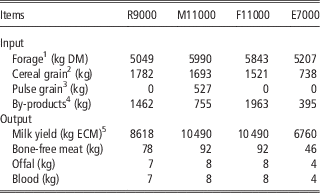
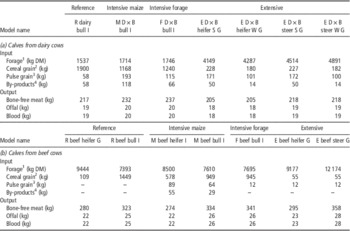
Feed consumption was calculated according to recommendations by Spörndly (Reference Spörndly2003) for dairy cows (Table 1), suckler cows and breeding bulls. Feed consumption data for dairy replacement heifers were taken from Berglund et al. (Reference Berglund, Clason, Bååth Jacobsson, Bergström Nilsson and Sund2013), whereas feed consumption values for growing cattle in beef production (Table 2) were calculated using the NorFor Nordic Feed Evaluation System (Volden, Reference Volden2011). For details on feed consumption and chemical composition of feeds, see Supplementary Tables S2 to S7.
Annual inputs and outputs per head in the different dairy systems: reference, R9000; intensive maize, M11000; intensive food industry by-products, F11000; extensive, E7000

DM=dry matter; ECM=energy-corrected milk.
Feed consumption for replacement heifers during 27 months of rearing corrected for replacement rate is included.
1 Grass/clover silage, maize silage, herbage grass.
2 Cereal grain (1/3 each of barley, wheat and oats) and mineral supplements (kg fresh weight).
3 Field beans (kg fresh weight).
4 Beet fibre, wheat bran, distiller’s grain, rapeseed cake and rapeseed meal. The commercial concentrate in R9000 contained 50% rapeseed meal, 30% wheat middlings and 20% beet fibre.
5 ECM (3.4% protein and 4.2% fat) delivered to the processing plant.
Inputs and outputs per head of cattle in different beef production models from (a) calves from dairy cows and (b) calves from beef cows in the four systems

For (b), inputs and outputs from culled parents are included.
R=reference; M=intensive maize; F=intensive forage; E=extensive; D×B=dairy×beef cross-bred; S=summer; W=winter (season of birth); G=grazing; I=indoor; DM=dry matter.
1 Grass/clover silage, maize silage, herbage grass.
2 Cereal grain (1/3 each of barley, wheat and oats) (kg fresh weight).
3 Field beans, for R dairy bull I soya bean meal (kg fresh weight).
4 Rapeseed cake (kg fresh weight).
Calculations of protein input and output
Calculations of protein input and output for dairy cows were performed on total CP (N×6.25) on an annual basis. The feed consumed by the dairy replacement heifers was added to the dairy cow diet by multiplying total feed consumed per heifer by the replacement rate in each production system. Annual milk yield was multiplied by a factor of 0.93 to adjust for low-quality milk not delivered to dairies (Agriwise, 2014). Whole milk (250 kg/head) to calves during their first 8 weeks of life was credited to the cow and accounted as protein input in rearing of calves destined for beef production. In addition to annual milk yield, the output for one culled cow (bone-free meat, offal and blood) was multiplied by the replacement rate to obtain the annual quantity of animal product output (Table 1).
Protein input and output for beef cattle were calculated per slaughtered animal (Table 2). Feeds to suckler cow, breeding bull and replacement heifer were added proportionally to the feed consumption of the finishing animals, based on number of calves born per cow and mortality in the system (Supplementary Tables S8 to S9). Dead calves from dairy cows were assumed to die during their 1st weeks of life (Swedish Board of Agriculture, 2012), and no extra solid feed consumption was added for these calves. In the beef production models for beef suckler calves, carcasses from dams and sires were included in proportion to their carcass weight, culling rate and mortality.
The amount of human-edible protein in the systems studied was calculated using edible proportions (ranging from 0.2 for rapeseed meal and beet fibre to 0.8 for cereal and pulses grains) according to the Council for Agricultural Science and Technology (CAST, 1999) The efficiency of protein was expressed as the ratio of output/input. In addition, amino acid concentrations and their true ileal digestibility in pigs (CVB Feed Table, 2011) were included in the calculations in order to determine the human-edible proportion of individual EAA in the feeds. According to FAO (2013), if determination of true ileal digestibility in humans is not possible, values based on determinations in pigs can be used. Cereal grains was a mix of 1/3 each of barley, wheat and oats in all calculations. All roughages, such as grass, clover and maize silage and pasture herbage were considered to be completely inedible to humans due to their high fibre and silica concentrations. In addition, maize has low CP concentration and the varieties used for feed are not the same as those used for human consumption. The input of digestible EAA in the feed rations was determined by multiplication of the amount of each feed by the individual EAA concentration in that feed and by the factor of ileal digestibility (CVB Feed Table, 2011) (Supplementary Tables S10 to S11).
The protein output in animal products was calculated similarly based on product output, amino acid concentration and ileal digestibility of the amino acids (Supplementary Tables S12 to S13). The concentration of amino acids in milk, bone-free meat and offal was calculated from the nutritional database of USDA (2014), whereas data on the composition of blood were obtained from CVB Feed Table (2011). Composition of the parts included in bone-free meat was chosen to reflect carcass data from Hansson (Reference Hansson1989), whereas the composition of offal reflected data from Runemark (Reference Runemark1983) (Supplementary Table S14). As no actual values on digestibility of the products were available for single amino acids, true ileal amino acid digestibility values in pigs according to CVB Feed Table (2011) for whole milk powder and blood meal were used. Values for digestibility in blood meal were similar to assessed ileal digestibility of protein in cooked meat in humans, 90% to 94% (Oberli et al., Reference Oberli, Marsset-Baglieri, Airinei, Sante-Lhoutellier, Khodorova, Remond, Foucault-Simonin, Piedcoq, Tome, Fromentin, Benamouzig and Gaudichon2015) and blood meal was therefore considered to be the best estimate of single amino acid digestibility in blood, bone-free meat and offal. To determine the level of upgrading for each amino acid, the input of amino acids was subtracted from the output (net quantities). Methionine and cystine (MetCys) as well as phenylalanine and tyrosine (PheTyr) are summed in the calculations due to the sparing effect of cystine on methionine and the ability of phenylalanine to substitute for tyrosine (Ball et al., Reference Ball, Courtney-Martin and Pencharz2006; Matthews, Reference Matthews2007). An explanatory table of how the calculations of EAA efficiency were performed is found in the Supplementary Table S15. The robustness of the results were tested in a sensitivity analysis to ±10% variation in digestibility of the human-edible EAA in the feed and the digestibility of EAA in milk and meat. Feed consumption was originally included as a parameter, but excluded as it showed the same results as feed digestibility. A range of the systems, not all, were included in the sensitivity analyses to show the variety: the F11000 and E7000 dairy production systems and four of the beef production systems (F D×B bull I, E D×B heifer W G, M beef bull I and E beef heifer G).
Results
Human-edible protein efficiency
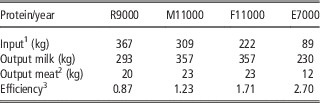
In milk production, the amount of human-edible protein in the feed rations of the different systems was largest in R9000 and smallest in E7000 (Table 3). Calculated protein efficiency showed a similar pattern, with the lowest efficiency in R9000 (<1), which means that the input of human-edible protein was higher than the output. In contrast, all other systems showed values >1, that is protein upgrading, with higher output than input. In the intensive systems, which produced the same amounts of outputs, feeding clover silage and by-products in F11000 instead of grass, pulses grains and maize silage in M11000 resulted in higher efficiency.
Human-edible protein input in feed rations for dairy cows, including replacement heifer, outputs in the form of milk and meat and protein efficiency in four different milk production systems: reference, R9000; intensive maize, M11000; intensive food industry by-products, F11000; and extensive, E7000

1 Calculated according to CAST (1999).
2 Meat protein includes bone-free meat, blood and offal from the culled dairy cow, calculated per year based on replacement rate and carcass weight.
3 kg protein in animal product/kg human-edible protein in feeds.
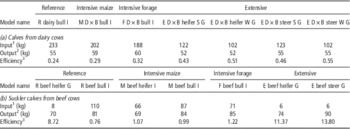
In beef production, the input of human-edible protein was higher in systems with calves from dairy cows compared with suckler calves (Table 4). From the most efficient dairy calves, in the E system, only half the human-edible protein fed was recovered in the animal products. The forage-based feed rations in E generally resulted in low protein input compared with the intensive systems with maize and forage and, accordingly, the E system had higher protein efficiency than the F and M systems. Beef suckler calves in the E system had hardly any input of human-edible protein at all, resulting in >10-fold higher human-edible protein recovery in the animal products compared with the feed. All three improved systems for male calves had higher efficiency than the corresponding R system (0.24 v. 0.29 – 13.80, respectively). However, changing the grazing R beef heifer model to an intensified M heifer model resulted in lower efficiency (8.72 v. 1.07).
Human-edible protein input from feed, output as meat and efficiency in human-edible protein efficiency in beef production using calves from (a) dairy cows and (b) beef cows in different production models in four systems, including input and output for dam and sire in suckler production

R=reference; M=intensive maize; F=intensive forage; E=extensive; D×B=dairy×beef cross-bred; S=summer; W=winter (season of birth); G=grazing; I=indoor.
1 Calculated according to CAST (1999).
2 Output includes protein from bone-free meat, blood and offal.
3 kg protein in animal product/kg human-edible protein in feeds.
Digestible essential amino acids
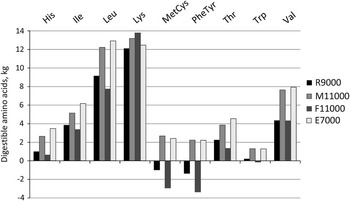
In all four milk production systems, the quantity of digestible EAA in the products (milk and meat) was generally higher than the quantity of human-edible digestible EAA in the feeds, except for MetCys and PheTyr in the reference system R9000 and the intensive system F11000 (Figure 1). Values above 0 indicate a balance for higher net quantity of digestible EAA in the product compared with the feed. The extensive system E7000, based mainly on forage, and the intensive system M11000, based on grass and maize silage, showed the highest net quantities of digestible EAA. The smallest net quantities were found in the intensive system F11000 except for lysine, for which the highest quantity was found in F11000. A detailed description of digestible amino acid efficiency in the dairy systems is presented in Supplementary Table S16.
Calculated balance of net quantities of digestible essential amino acids in human-edible feeds and in milk and meat per year in different dairy production systems: reference, R9000; intensive maize, M11000; intensive by-products from food, F11000; extensive, E7000. Values above 0 indicate higher output than input, that is higher quantity of a particular amino acid in food than in human-edible feed consumed by the animal. His=histidine; Ile=Isoleucine; Leu=leucine; Lys=lysine; MetCys=methionine+cystine; PheTyr=phenylalanine+tyrosine; Thr=threonine; Trp=tryptophan; Val=valine. Results of methionine/phenylalanine alone were 2.40/4.30, 4.96/6.77, 2.22/3.33 and 3.45/6.83 for the systems R9000, M11000, F11000 and E7000, respectively.

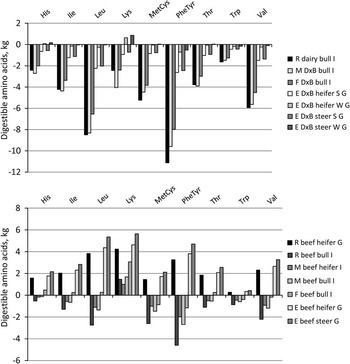
In beef production with calves originating from dairy cows, the intensive rearing models resulted in lower output than input of digestible EAA, similar to the findings for human-edible protein presented above (Figure 2; Table 4). For the extensive models, however, the amounts of digestible amino acids in meat were of the same magnitude as the amounts in feeds, highest for lysine. A detailed description of digestible amino acid efficiency in the beef systems from dairy cows is presented in Supplementary Table S17. The extensive models of beef production with calves from suckler cows resulted in higher output in meat than input in feeds for all digestible EAA (Figure 2). The intensive production models for beef calves generally resulted in an output of the same magnitude as the input for most EAA. However, for lysine, the output in meat was higher than the input in feeds. A detailed description of digestible amino acid efficiency in the beef systems from suckler production is presented in Supplementary Table S18.
Calculated balance of net quantities of digestible essential amino acids in human-edible feeds and in meat per slaughtered animal in different beef production systems, where R, M, F and E are reference, intensive maize, intensive forage and extensive systems, respectively; dairy, beef and D×B (dairy×breed cross-bred) indicate the breed of the calf; bull, heifer and steer are gender; S for summer and W for winter is season of birth; G is grazing; and I is indoor in offspring from (a) dairy cows and (b) beef cows. Values above 0 indicate higher output than input, that is higher quantity of a particular amino acid in food than in human-edible feed consumed by the animal. For calves from beef cows, inputs and outputs from culled parents are included. His=histidine; Ile=Isoleucine; Leu=leucine; Lys=lysine; MetCys=methionine+cystine; PheTyr=phenylalanine+tyrosine; Thr=threonine; Trp=tryptophan; Val=valine. Results of methionine/phenylalanine alone were in (a) −1.87/−6.46, −1.52/−5.71, −1.21/−4.81, −0.04/−1.49, 0.32/−0.39, 0.03/−1.39 and 0.38/−0.28 for the systems R dairy bull I, M D×B bull I, F D×B bull I, E D×B heifer SG, E D×B heifer WG, E D×B steer SG and E D×B steer WG, respectively. In (b) 1.21/1.81, −0.37/−3.02, 0.14/−1.29, 0.10/−1.79, 0.39/−0.93, 1.35/2.14 and 1.66/2.64 for the systems R beef heifer G, R beef bull I, M beef heifer I, M beef bull I, F beef bull I, E beef heifer G and E beef steer G, respectively.

The results of the sensitivity analysis revealed that in the intensive systems, variation in digestibility of the human-edible EAA in the feed was the main factor affecting the net quantities of EAA, whereas in the extensive systems variation in digestibility of the EAA in milk and meat had a relative higher impact (Supplementary Tables S19 to S21).
Discussion
All milk production systems studied, not only the optimised future systems but also the present Swedish average system, R9000, gave a higher quantity of HDEAA in the products (milk and meat) than were present in the feeds consumed by the animals. Intensive beef production with calves originating from dairy cows resulted in a lower output than input of both human-edible protein and digestible EAA, mainly due to the calves’ need for a high-protein diet during their first 6 months. The milk they consume is partly produced from human-edible protein and so are the concentrates. However, by choosing a forage-based extensive rearing model, the amounts of digestible EAA in feeds can be reduced to the same magnitude as the amounts in the meat produced for the lifetime as a whole. The extensive models of beef production with calves from suckler cows resulted in higher output in meat than input in feeds for all EAA. These calves suckle a forage-fed dam whose feed ration contains scarcely any human-edible protein. Carcasses from cows and breeding bulls contribute to even higher meat protein output, and hence higher protein efficiency, in beef calves from suckler production than in calves from dairy production. The intensive production models for beef calves generally resulted in an output of the same magnitude as the input for most EAA. Forage-based models generally resulted in higher efficiency than models based on maize silage. This is probably due to the need for extra protein feed, that is rumen available nitrogen, in addition to the starch-rich, but protein-poor, maize in the latter. All improved systems had higher efficiency than the corresponding R system largely due to target-orientated feed rations and decreased mortality.
In both dairy and beef production, there was a proportional switch from non-EAA to EAA when converting the feed into milk and meat (Supplementary Tables S16 to S18). Lysine in particular increased and, for milk, also leucine.
Human-edible protein v. digestible essential amino acids
CP is merely calculated from N content×6.25. Monogastrics, such as humans, are however not dependent on a specific amount of nitrogen, but on specific amounts of each EAA and these are mostly not interchangeable with each other. For correct comparisons between plant and animal protein, their respective digestibility and amino acid profiles, therefore, should be taken into account. In this study, we fine-tuned the measurement of human-edible protein defined by Wilkinson (Reference Wilkinson2011) into comparisons of HDEAA. Wilkinson (Reference Wilkinson2011) calculated efficiency in output/input of human-edible protein in livestock production and defined the edible feed conversion ratio as human-edible input per human-edible output. Thus values <1 indicate higher output of protein in products than input of protein in feeds. Ertl et al. (Reference Ertl, Klocker, Hortenhuber, Knaus and Zollitsch2015a) suggested that the efficiency should be calculated as output/input and results from their study showed higher efficiency on a forage/by-product-based dairy cow diet (4.27) compared with the F11000 system used in the present study (1.71). However, Ertl et al. (Reference Ertl, Klocker, Hortenhuber, Knaus and Zollitsch2015a) did not include input of feed to replacement heifers, feed during the dry period or output of meat from culled cows, but concluded that the most important factor for the results obtained was determination of the human-edible fraction in the feeds. This point was clearly shown in the present study, where F11000 was expected to result in higher net quantities of EAA than shown in the results (Figure 1.), especially since the total amount of human-edible protein calculated according to CAST (1999) was lower in F11000 than in M11000 and the output was the same. This result is due to the different assumptions used in estimating human-edible proportion of by-products in the CAST report (1999) v. the ileal digestibility of the feeds (CVB Feed Table, 2011) used for the calculations in the present study. In the sensitivity analyses performed in the present study, it was clearly shown that the digestibility of the HDEAA was the main factor affecting the results in the intensive production systems where a large proportion of the ration consisted of by-products or cereals. Examples of different results in human-edible feed conversion efficiencies depending on the assumptions of the human-edible fraction were also shown by Ertl et al. (Reference Ertl, Zebeli, Zollitsch and Knaus2015b). Most of the by-products used in the feed ration in F11000 were estimated to have a human-edible fraction of 0.2, based on CAST (1999), whereas the ileal digestibility of amino acids reported in CVB Feed Table (2011) for the same feeds ranges from 0.5 to 0.9. Likewise, the reference system R9000, which showed the lowest human-edible protein efficiency, gave higher net quantities of EAA compared with F11000. The feed ration in R9000 contained a large amount of cereal grain and purchased concentrate based on by-products, similar to the ration in F11000, although F11000 contained less cereal grain and more by-products. As the estimated EAA digestibility in the by-products was quite high (0.5 to 0.9), it had a large impact on the results. These results are evidence of the need for a common approach to determine what is edible or inedible to humans. In beef production, the efficiency of the different models was in the same order regardless of whether the calculation was based on human-edible protein or digestible EAA. In general, the efficiency is much higher when comparisons of input and output are based on digestible EAA, as this method takes into consideration both the true amino acids (not nitrogen only) and the higher digestibility in animal protein compared with plant protein.
Extensive models are most protein-efficient
In this study, cattle production systems based on large dietary proportions of forage not only resulted in higher conversion of human-edible protein, but also in higher conversion of digestible EAA, compared with production systems based on cereal grains and other concentrates. The system E7000 was found to have the highest efficiency of both protein and EAA, despite being a low-yielding system. The amounts of all EAA except for lysine and methionine+cystine were highest in E7000 when net quantities were calculated, this result was mainly an effect of the lower production yield and similar intake of rapeseed as in the 11 000 systems. Similarly, the extensive beef production models with slow-gaining heifers and steers had higher amino acid efficiency than the intensive models. The large forage proportion was of course the main reason for this result, but as it is challenging to match human-inedible feeds to the nutritional requirements of high-yielding dairy cows, a lower production level may be an option in the future in order to decrease the reliance on human-edible feeds. However, this reasoning runs counter to the established increase in enteric methane production associated with large proportions of forage, both per unit product and per day (Aguerre et al., Reference Aguerre, Wattiaux, Powell, Broderick and Arndt2011). The environmental impact from livestock is generally high and cultivation of food crops has been shown in several studies to be a more efficient use of arable land (where there are options to cultivate crops other than grass), with a lower environmental impact compared with cultivation of feeds for animals refined into, for example, milk and meat (Carlsson-Kanyama and Gonzalez, Reference Carlsson-Kanyama and Gonzalez2009; Scarborough et al., Reference Scarborough, Appleby, Mizdrak, Briggs, Travis, Bradbury and Key2014).
In this study, we assumed that human-edible protein and digestible amino acids were absent from all forages, which biased the results towards decreased competition between human food production and animal feeds, especially in the forage-dominated systems. It can be argued that arable land in these systems is used for production of forages, when it could be used for cultivation of grain for human consumption. However, cultivation of leys is an important part of the crop rotation and increases carbon sequestration in the soil (Soussana et al., Reference Soussana, Allard, Pilegaard, Ambus, Amman, Campbell, Ceschia, Clifton-Brown, Czobel, Domingues, Flechard, Fuhrer, Hensen, Horvath, Jones, Kasper, Martin, Nagy, Neftel, Raschi, Baronti, Rees, Skiba, Stefani, Manca, Sutton, Tubaf and Valentini2007). Furthermore, in areas with poor conditions for grain cropping, forage is often not only the sole realistic alternative agricultural use of land, but also superior from a protein efficiency perspective.
In the competition for land for food or feed, livestock production accounts for 70% of agricultural land area globally and grasslands occupy 26% of the ice-free terrestrial surface on earth (Steinfeld et al., Reference Steinfeld, Gerber, Wassenaar, Castel, Rosales and Haan2006). However, permanent grasslands are not always convertible to arable land (Jerrentrup et al., Reference Jerrentrup, Wrage-Monnig, Rover and Isselstein2014). Furthermore, grazed semi-natural grasslands often are of great importance for preserving a varied agricultural landscape with high cultural values, biodiversity and other ecosystem services (Ihse and Norderhaug, Reference Ihse and Norderhaug1995; Jerrentrup et al., Reference Jerrentrup, Wrage-Monnig, Rover and Isselstein2014). If grazing management ceases, all these values are lost. In Sweden, the governmental Swedish Environmental Objectives Council (2008) has therefore established a target of preserving the area of managed semi-natural pastures, currently 421 000 ha (Statistics Sweden, 2015). Loss of biodiversity has recently been identified as one of the major environmental challenges on a global level (Rockström et al., Reference Rockström, Steffen, Noone, Persson, Chapin, Lambin, Lenton, Scheffer, Folke, Schellnhuber, Nykvist, de Wit, Hughes, van der Leeuw, Rodhe, Sorlin, Snyder, Costanza, Svedin, Falkenmark, Karlberg, Corell, Fabry, Hansen, Walker, Liverman, Richardson, Crutzen and Foley2009). Maintaining semi-natural pastures by grazing livestock is therefore not only an issue of producing feed without competing with food production, but also an advantage for humanity. Using such land for cattle in regions where forage production has comparative benefits over food production, for instance by having abundant precipitation, a short vegetation period and land at a low cost, seems to be an effective way of producing food on a global level. In general, using human-inedible feeds is crucial in future animal production systems and ruminants’ extraordinary ability to digest and thrive on fibrous feeds makes them especially important in a resource-efficient perspective.
In both milk and beef production systems in this study, conversion of human-edible protein and digestible EAA was much lower in the R system than in all corresponding improved systems except for milk EAA in F11000 and the alternative of converting the R grazing beef heifer system to an intensive maize-based rearing system. The R bull models would enhance their protein efficiency by 20% to 40% with a change to the improved intensive systems. Dairy bulls changing to E systems would double their output in relation to input. Hence, better precision in feed production, feed ration formulation, animal performance and survival rate would result in increased amino acid efficiency. At present, the E7000 dairy systems is not an economically viable option due to the high building and labour costs in Sweden, which are result of the northerly climate and high animal welfare standards and the high wage level in Sweden. These fixed costs become high per kg of milk at low yields per cow (Agriwise, 2014).
In Sweden today, two-thirds of the beef supply originates from dairy cattle (Statistics Sweden, 2015). In the present study, the models with calves from dairy cows in general had lower protein efficiency than the models with beef suckler calves, due to the need for a high-protein diet for the former during their first 6 months. From a strict protein utilisation perspective, it could therefore be argued that new-born dairy calves should be killed and replaced by increased suckler calf production. However, there are ethical considerations about wasting this resource and animal life, besides the obvious in that a prerequisite for the dairy cow to give milk is to give birth of a calf. Furthermore, there are concerns about the impact on climate change of such an alternative, as replacing dairy calves with beef suckler calves can double the amount of greenhouse gases emitted per kg meat (Mogensen et al., Reference Mogensen, Kristensen, Nielsen, Spleth, Henriksson, Swensson, Hessle and Vestergaard2015).
Conclusions
Forage- and pasture-based production models for milk and beef and inclusion of by-products in the diet may result in upgrading of both the quantity and quality of human-edible protein compared with using the plant materials directly as human foods. This is especially important to consider in areas where grain cultivation is not an option. Hence, the key to efficiency is the utilisation of human-inedible protein by cattle. Calves from dairy cows reared in intensive beef production systems require more human-edible protein than they produce, whereas suckler systems generally generate more human-edible protein than they consume. By estimating the efficiency in HDEAA, comparisons of different sources of protein production may be more complete and the level of upgrading of amino acids in plants through cattle in forage- and pasture-based production systems even more obvious.
Acknowledgements
The authors wish to acknowledge Dr. Ulrika Brunn at the Technical Research Institute of Sweden and Professor Cornelia Witthöft at Linnæus University for valuable discussions, and Professor Jan Bertilsson at the Swedish University of Agricultural Sciences for his contribution to developing the feed rations for dairy cows. The study was part of the multidisciplinary research programme for food (Tvärlivs) and was mainly funded by the Swedish innovation agency Vinnova, together with the Federation of Swedish Farmers (LRF), the Swedish Retail Federation, Arla Foods and Lantmännen.
Supplementary material
For supplementary material/s referred to in this article, please visit http://dx.doi.org/10.1017/S1751731116001610