Introduction
Domestic violence is a major public health issue worldwide (WHO, 2010), and has been estimated to account for up to 7% of the overall burden of disease among women, mostly due to its impact on mental ill health (Vos et al. Reference Vos, Astbury, Piers, Magnus, Heenan, Stanley, Walker and Webster2006). Much of this violence is at the hands of partners, often referred to as intimate partner violence (IPV) (Povey et al. Reference Povey, Coleman, Kaiza, Hoare and Jansson2008). Although similar numbers of men and women report experiencing at least one episode of IPV, women are at greater risk of being a victim of repeated coercive, sexual and severe physical violence (Tjaden & Thoennes, Reference Tjaden and Thoennes2000; Howard et al. Reference Howard, Trevillion and Agnew-Davies2010a , Reference Howard, Trevillion, Khalifeh, Woodall, Agnew-Davies and Feder b ).
Increasingly, psychological or emotional IPV have been recognized as part of the pattern of IPV. Emotional IPV can include recurring criticism, verbal aggression, jealous behaviour or accusations of infidelity, threats of violence, threats to end the relationship, hostile withdrawal of affection and destruction of property (Follingstad et al. Reference Follingstad, Rutledge and Berg1990). Indeed, some authors suggest that coercive control rather than physical violence is the key feature of IPV (Dutton & Goodman, Reference Dutton and Goodman2005; Johnson, Reference Johnson2006). IPV is highly prevalent – the British Crime Survey 2010–11 (BCS), interviewed 40,000 respondents, reporting a rate of being a victim of (current or former) partner abuse – defined as physical force, emotional or financial abuse or threats to hurt the respondent or someone close to them – of 24% in women and 12% in men since the age of 16 (Smith et al. Reference Smith, Osborne, Lau and Britton2012).
Being a victim of IPV is associated with a wide range of psychiatric disorders in women (Golding, Reference Golding1999; Howard et al. Reference Howard, Trevillion and Agnew-Davies2010a , Reference Howard, Trevillion, Khalifeh, Woodall, Agnew-Davies and Feder b ; Trevillion et al. Reference Trevillion, Oram, Feder and Howard2012), while there are limited data on this relationship for men (Trevillion et al. Reference Trevillion, Oram, Feder and Howard2012). The association is complex: there is evidence from prospective studies that IPV contributes to the emergence and exacerbation of mental symptoms (Ehrensaft et al. Reference Ehrensaft, Moffitt and Caspi2006; Zlotnick et al. Reference Zlotnick, Johnson and Kohn2006). Moreover, rates of depression appear to decline once the abuse stops (Golding, Reference Golding1999). Potential mechanisms include mentally intrusive reminders of the experience, psychological processes involving attitudes and beliefs, an increased propensity towards mood disturbance in the face of subsequent experience, styles of coping, particularly avoidant coping, which impair processing of the original abuse, and modification of physiological stress response in deleterious ways (Driessen et al. Reference Driessen, Herrmann, Stahl, Zwaan, Meier, Hill, Osterheider and Petersen2000; Heim et al. Reference Heim, Newport, Miller and Nemeroff2000; Read et al. Reference Read, van Os, Morrison and Ross2005). However, psychiatric disorders may render people insufficiently wary of unsafe environments and relationships (McHugo et al. Reference McHugo, Kammerer, Jackson, Markoff, Gatz, Larson, Mazelis and Hennigan2005), and may also compound the subjective impact of violence (Briere & Jordan, Reference Briere and Jordan2004). Finally, abusive experiences may create vulnerabilities to later damaging exploitation.
Most studies on IPV and psychiatric disorders are based on samples of people recruited in healthcare settings. Few population-based studies have used valid measures of both experiencing IPV and psychiatric disorders, in both men and women (Trevillion et al. Reference Trevillion, Oram, Feder and Howard2012). One longitudinal study of IPV experienced by young people reported psychiatric disorders in women but not men (Ehrensaft et al. Reference Ehrensaft, Moffitt and Caspi2006). Similarly, a recent analysis of data from the US National Co-morbidity Survey Replication found experiences of IPV were associated with anxiety disorders only in women, whereas both men and women were at increased risk of disruptive behaviour disorders and substance use disorders (Afifi et al. Reference Afifi, MacMillan, Cox, Asmundson, Stein and Sareen2009). Two other studies have examined gender differences in particularly violent contexts – a study in South Africa found that alcohol abuse/dependence and intermittent explosive disorder (but no other psychiatric disorders) were associated with being a victim of IPV, but only in women (Gass et al. Reference Gass, Stein, Williams and Seedat2011), whereas a study in the Ukraine reported IPV was associated with alcohol abuse in both men and women, and with intermittent explosive disorders in men (O'Leary et al. Reference O'Leary, Tintle, Bromet and Gluzman2008). None of these studies have investigated gender differences in associations between emotional IPV and psychiatric disorders, only physical violence, and no studies examine disorders across the diagnostic spectrum, with researchers usually focusing on common mental disorders (CMDs) and substance misuse.
We have accordingly used the third Adult Psychiatric Morbidity Survey (Jenkins et al. Reference Jenkins, Meltzer, Bebbington, Brugha, Farrell, McManus and Singleton2009; McManus et al. Reference McManus, Meltzer, Brugha, Bebbington and Jenkins2009) to investigate the relationship between IPV and adult psychiatric disorders in both men and women. This has the advantage of using the same questions to assess IPV as the BCS. As women are more likely than men to respond to life-threatening stress by developing post-traumatic stress disorder (PTSD) (Olff et al. Reference Olff, Langeland, Draijer and Gersons2007), we expected this enhanced reactivity would similarly be seen in their response to IPV, and that this would also be the case for other psychiatric disorders. We also wanted to examine whether IPV involving actual physical assault would generally be regarded as having greater effect than that limited to threats or control through bullying and whether this differed by gender, in view of the greater severity of physical violence experienced by women.
Our primary hypothesis was therefore that being a victim of IPV would be more strongly associated with psychiatric disorder in women than in men, and our secondary hypothesis was that the relationship between disorder and IPV involving physical abuse would be stronger than that involving only emotional IPV in women but not in men.
Method
The third national APMS in England was carried out in 2007 (McManus et al. Reference McManus, Meltzer, Brugha, Bebbington and Jenkins2009). It used a stratified, multistage random sampling design. Unlike previous surveys in this programme (Meltzer et al. Reference Meltzer, Gill, Petticrew and Hinds1995; Singleton et al. Reference Singleton, Bumpstead, O'Brien, Lee and Meltzer2001), it only covered England, and had no upper age limit. The sample was designed to be representative of the adult population living in private households. The sampling frame was the small user Postcode Address File – this consists of those mail delivery points which receive fewer than 50 items of mail each day. Therefore, most large institutions and businesses are excluded from the sample but some small businesses and institutions may receive fewer than 50 items each day and thus be sampled. Once the interviewer has verified that an address does not contain a private household, such addresses are recorded as ineligible. The very small proportion of households living at addresses not on the Postcode Address File (<1%) were not covered by the sample frame.
One adult aged 16 years or over was selected for interview in each household using the Kish grid method (Kish, Reference Kish1965), a tool developed to enable interviewers to select people within households with equal probability. At the initial assessment, 31% of people selected from eligible households refused to participate, and others could not be contacted, such that 57% of the selected sample finally took part in interviews. Fieldwork was carried out by the National Centre for Social Research. Full details of design, methods, procedures and quality control have been provided by McManus et al. Reference McManus, Meltzer, Brugha, Bebbington and Jenkins2009. Full interviews were successfully carried out with 7403 people, of whom 7047 completed the section covering IPV. A total of 139 people who said they had never been in an intimate relationship were included in the base population.
Procedure
An advance letter was sent to each sampled address. This introduced the survey, and stated that an interviewer would be calling to seek permission to interview. At initial contact, the interviewer established the number of households at the address (a household is defined as either one person living alone or a group of people, who may or may not be related, living in the same dwelling unit, who either share at least one meal a day or share common living accommodation). Where an interviewer found an address that consisted of more than one household (e.g. apartments in a house), one household and one individual per household was selected at random for participation in the study. The interviewer then invited that person to be interviewed. Interviewers had copies of a leaflet outlining the purpose of the study, which they could use on the doorstep and leave with respondents. The advance letter did not mention IPV. Interviewers were instructed to interview people on their own, but the presence of others in the house or room could not be discounted; interviews did not always take place in the home, but could be carried out wherever the respondent felt most comfortable and secure. A helpline was provided at the end of the interview which included details of the National Domestic Violence Helpline.
Phase-one interview involved computer-assisted personal interviewing (CAPI). Standardized questions provided information about demographic characteristics. In addition, sensitive information was collected by self-completion (computer assisted self-completion interview (CASI)), again using the laptop. The respondent knew beforehand that the interviewer was unable to see the results of the self-completed parts of the interview.
Assessment of abusive experience
The CASI section incorporated a domestic violence and abuse module, including questions about IPV in adulthood (i.e. occurring after the age of 16 years). IPV is a sensitive topic; the APMS involved deliberate and strenuous efforts to maintain the quality of information in sensitive areas of the interview. We used a computer-assisted interview, which is known to increase detection rates compared with interviewer-based reporting: in the national BCS, prevalence rates of domestic violence obtained via this method were around five times higher than those obtained from face-to-face interviewing (Walby & Allen Reference Walby and Allen2004). Respondents were asked about different types of partner abuse, ranging from being prevented from seeing friends to assault with a weapon. The questions, based on those in the BCS (Walby et al. Reference Walby and Allen2004), but with the follow-up items (e.g. about number of occasions) dropped due to limited time and space in this survey are listed in Appendix 1. From this, we could distinguish experiences involving actual physical violence (‘physical IPV’: a positive answer to one or more of questions 4, 5, 6, 9 and 10) from those that involved only emotional violence or control (‘emotional IPV’: positive answers only to questions 1, 2, 3, 6, 7 and 8). We were also able to differentiate people exposed to current abuse (i.e. in the last year) from those who had only been abused earlier in adulthood.
Assessment of psychiatric conditions
In the phase-one interview, non-psychotic psychiatric disorders were assessed in relation to the past week, using the Clinical Interview Schedule Revised (CIS-R) (Lewis et al. Reference Lewis, Pelosi, Araya and Dunn1992) – a face-to-face computerized interview. This provides diagnoses of six CMDs – depressive episode, mixed anxiety/depression, generalized anxiety disorder (GAD), panic disorder, phobic disorder, and obsessive compulsive disorder (OCD). These disorders are united by the central relevance of affective change, there are grounds for thinking their experiential antecedents overlap, and their identification was based on the use of a single instrument. We therefore opted to use an overall category of CMD in order to reduce the number of analyses.
Possible cases of current PTSD were identified with the Trauma Screening Questionnaire (TSQ) (Brewin et al. Reference Brewin, Rose, Andrews, Green, Tata, McEvedy, Turner and Foa2002). This covers the re-experiencing and arousal features of PTSD, but not criteria related to avoidance and numbing. Respondents were first asked whether they had experienced a traumatic event at some time in their life after the age of 16. If so, they rated ten PTSD items in relation to the past 2 weeks. Endorsement of six or more of these was taken to indicate a positive screen for PTSD.
In APMS 2007, eating disorders were identified using the SCOFF (Morgan et al. Reference Morgan, Reid and Lacey1999). Again, this is a screening tool, not a diagnostic instrument, so the obtained prevalence probably overestimates the rates of eating disorder that would be determined by full clinical investigation. Our category of potential eating disorders included participants with a SCOFF score of two or more, who also reported that their feelings about food had a significant negative impact on their life. Although for the sake of brevity we refer to PTSD and eating disorders in the text and tables, our categories comprise participants identified only by screening tests, and are therefore not equivalent to diagnostic categories.
Alcohol dependence in relation to the last 6 months was derived from responses to two questionnaires, the alcohol use disorders identification test (AUDIT) (Saunders et al. Reference Saunders, Aasland, Babor, Dela Fuente and Grant1993) and the community version of the Severity of Alcohol Dependence Questionnaire (SADQ-C) (Stockwell et al. Reference Stockwell, Sitharthan, McGrath and Lang1994). All respondents with an AUDIT score of ten or more were subsequently interviewed with the SADQ-C. A score of four or more is taken to indicate at least mild dependence: this was our threshold for dependence.
Questions about drug use were located in the CASI part of the interview. Participants who in the past year had used cannabis, amphetamines, crack, cocaine, ecstasy, tranquillisers, opiates or volatile substances were asked five questions for each drug type reported, designed to assess drug dependence based on the Diagnostic Interview Schedule (Malgady et al. Reference Malgady, Rogler and Tryon1992). These questions covered level of use, sense of dependence, inability to abstain, increased tolerance and withdrawal symptoms. Endorsement of any item in the past year was used to indicate drug dependence.
The time frames for identifying psychiatric disorder differed. Thus, CMDs related to the past week, screening for PTSD to the past 2 weeks, alcohol dependence to the past 6 months, and eating disorders and drug dependence to the past year.
The procedure for identifying cases of psychosis involved two phases: in phase-one, respondents were screened for psychosis using the Psychosis Screening Questionnaire (PSQ) (Bebbington & Nayani, Reference Bebbington and Nayani1995) together with other criteria indicative of a psychotic episode (such as use of antipsychotic medication, receipt of a diagnosis and a stay in a psychiatric ward or hospital). Screen positive individuals were invited for a phase-two assessment, and interviewed with the Schedules for Clinical Assessment in Neuropsychiatry (SCAN) (World Health Organization, 1992) conducted by clinically trained research interviewers from the University of Leicester.
In the analyses presented here, we used a measure of ‘probable psychosis’. This category included the 23 SCAN positive cases, together with a further 20 participants who were not interviewed with SCAN, but who met at least two of the phase-one psychosis screening criteria (Sadler & Bebbington, Reference Sadler, Bebbington, McManus, Meltzer, Brugha, Bebbington and Jenkins2009).
Analysis
Our primary exposure was an adulthood lifetime history of IPV. Secondary exposures comprised IPV within the past year, lifetime physical IPV and lifetime emotional IPV. Our key outcomes comprised six groups of psychiatric disorder: CMDs, dependence on alcohol or drugs, PTSD, eating disorders and psychosis. Interaction tests and stratification by gender enabled us to test our hypotheses.
Apart from gender, the major influences on the prevalence of IPV are age, social class, ethnicity, marital status and the presence of children in the household. All analyses were adjusted for potential confounding by these variables. For the main analysis, we estimated the crude and adjusted odds ratios (ORs) for the association between lifetime IPV and each of the six disorder categories (the reference group for each analysis comprised participants without the disorder in question). Hypothesis 2 was tested by comparing the ORs for the association of physical abuse and emotional abuse with psychiatric disorders by gender. Finally, we estimated the Population Attributable Fraction (PAF) for the various disorders.
The survey data were weighted to take account of survey design and non-response, so that the results were representative of the household population aged 16 years and over. Weighting was necessarily complex, and full details are available in the main report (McManus et al. Reference McManus, Meltzer, Brugha, Bebbington and Jenkins2009). We used the ‘survey’ commands in STATA 10.0 (Statacorp, 2008), which allow for the use of clustered data modified by probability weights, and provide robust estimates of variance.
The calculation of PAFs allows some estimate of public health implications. By combining the frequency of IPV with its impact at the individual level, PAFs represents the proportion of psychiatric disorders potentially ascribable to exposure to IPV, based on the assumption of causality.
Results
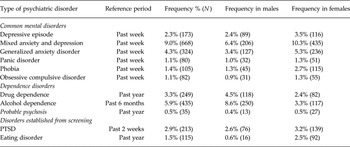
To provide context for the subsequent analyses, we list the weighted prevalence of each disorder, overall and by gender, in Table 1.
Frequency of psychiatric morbidity in the sample

N = 7047; weighted percentages, true count.
Of the 7047 participants included in this study, 23.4% (95% CI 22.2–24.5; n = 1822) gave a positive response to at least one type of IPV, while 17.4% (95% CI 16.4–18.4; n = 1374) reported physical violence from a partner, and 5.9% (95% CI 5.4–6.5; n = 439) reported emotional abuse. Almost 6% (5.9; 95% CI 5.0–6.2; n = 374) of the general population had experienced at least one instance of IPV in the past year. The lifetime prevalence of the individual items varied from 1.8% of the population who had been subject to partner violence with a weapon, to 14.2% who had been pushed, slapped, held or pinned down.
For every individual question, the prevalence in women was significantly higher than in men. Nevertheless, 18.7% (95% CI 17.1–20.4; n = 595 of 3197) of men had experienced some form of IPV compared with 27.8% of women (95% CI 26.2–29.4; n = 1227 of 4206; p < 0.001). Twelve percent of men (95% CI 11.2–13.8; n = 391) and 22% (95% CI 20.7–23.6; n = 983) of women had been subjected to physical violence (p < 0.001), whereas 6.3% (95% CI 5.4–7.2) and 5.6% (95% CI 4.0–6.5) had been emotionally abused.
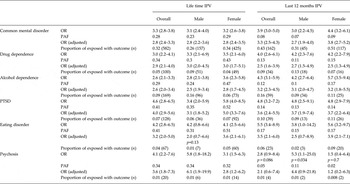
In Table 2, we present the association between the experience of IPV in relation to different periods, and each of the identified psychiatric disorders. For lifetime IPV (i.e. any experience of IPV since the age of 16), the association was significant in each sex for all disorders, with the exception of eating disorders in men, a rare condition. The ORs were sizeable, generally around 3, but somewhat more for PTSD, eating disorders and psychosis. The effect of controlling for socio-demographic variables, in all conditions except psychosis in males, was to reduce ORs by a relatively small amount. The ORs were generally similar in the two sexes, and where differences did exist, the confidence limits overlapped, and interaction tests were non-significant. Thus, our first hypothesis (that IPV would be more strongly associated with mental disorder in women than in men) was refuted. The greatest discrepancy involved relatively high ORs in women for PTSD and alcohol dependence, and in men for psychosis. The PAFs were also striking, ranging from 23% to 52%. As would be expected from their greater experience of IPV, the PAFs were larger in women than in men, with the exception of psychosis.
The association between psychiatric disorders and IPV

Adjusted odds ratios and 95% confidence intervals; adjusted for ethnicity, social class, age, marital status and presence of children in household.
Where no p values are shown, the significance level is <0.0001.
Similar results are found for the ORs for IPV in the 12 months before interview. The results were uniformly significant, with the exception of psychosis, in which neither the overall rate nor the female rate was significant. Adjustment for socio-demographic variables led to some reduction in the ORs, and in the case of psychosis, this rendered the results non-significant in both sexes and for eating disorders, only in males. Otherwise, the associations with recent IPV remained significant, and interaction tests for gender were not significant.
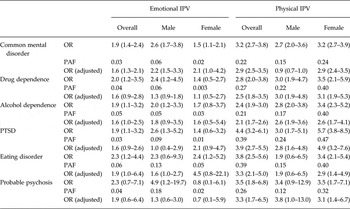
Table 3 demonstrates the association of psychiatric disorder with physical and with emotional IPV occurring any time after the age of 16 years. The ORs were greater for physical than for emotional IPV for most disorders. Interaction tests for gender were not significant, but in the stratified adjusted analyses, physical IPV was significantly associated with CMDs, eating disorders and PTSD only in women, whereas the associations of physical IPV with psychosis, and with substance and alcohol disorders were significant in each sex. Emotional IPV was significantly associated with CMDs in both men and women, but most other associations were non-significant, probably due to small numbers in each cell.
Psychiatric disorders and emotional and physical IPV: lifetime

Adjusted odds ratios and 95% confidence intervals; adjusted for ethnicity, social class, age, marital status and presence of children in household.
Discussion
Key findings
This is the first study, to our knowledge, to investigate, in a representative population, gender differences in the risk of all psychiatric disorders associated with partner violence. We found being a victim of IPV is strongly associated with a wide range of psychiatric disorders: CMDs, PTSD, eating disorders, alcohol and drug misuse and psychosis, in both men and women, with the rates of IPV being significantly higher in women than in men. These findings are in accord with other studies in the literature which focus on clinical populations or CMDs and substance misuse (Golding, Reference Golding1999; Trevillion et al. Reference Trevillion, Oram, Feder and Howard2012), and are consistent with the notably high rates of IPV experienced by patients with more severe mental disorders in contact with secondary psychiatric services (Oram et al. Reference Oram, Trevillion, Feder and Howard2013). However, there were gender differences in the association between experiencing IPV and psychiatric disorders when specific types of IPV were examined. Physical IPV was significantly associated with CMDs, eating disorders and PTSD in women but not men, whereas there were significant associations for both men and women between physical IPV, and substance and alcohol disorders and psychosis. Emotional IPV was significantly associated with CMDs in both men and women (with small numbers possibly being the reason for no such finding for the rarer disorders of psychosis and eating disorders).
PAFs were substantial for all disorders. We have found a similar PAF estimate for IPV and postnatal depression (Howard et al. Reference Howard, Oram, Galley, Trevillion and Feder2013). Our study therefore confirms the public health consequences of this societal problem. Indeed it may underestimate the impact of IPV on psychiatric morbidity as we did not include sexual violence in the context of intimate relationships.
Mechanisms linking IPV to mental health difficulties
Several processes might be adduced to explain the association between IPV and mental disorders. The most plausible is of a direct effect of IPV on mental dispositions (fear, hopelessness and low self-esteem) that confer vulnerability to psychiatric consequences. However, IPV might itself be secondary to the psychiatric disorder, for instance where depressed mood or alcohol abuse makes relationships difficult to maintain (Miller et al. Reference Miller, Breslau, Petukhova, Fayyad, Green, Kola, Seedat, Stein, Tsang, Viana, Andrade, Demyttenaere, de Girolamo, Haro, Hu, Karam, Kovess-Masfety, Tomov and Kessler2011). Moreover, psychiatric disorder, particularly if severe, renders patients more vulnerable to unsafe environments and relationships (Howard et al. Reference Howard, Trevillion and Agnew-Davies2010a , Reference Howard, Trevillion, Khalifeh, Woodall, Agnew-Davies and Feder b ). Intimate relationships do not occur entirely at random – conduct-disordered men and women are more likely to enter into abusive relationships as adults, but also have higher rates of disorders such as depression, substance abuse and anxiety (Capaldi & Clark, Reference Capaldi and Clark1998; Andrews et al. Reference Andrews, Foster, Capaldi and Hops2000; Costello et al. Reference Costello, Mustillo, Erkanli, Keeler and Angold2003; Ehrensaft et al. Reference Ehrensaft, Cohen, Brown, Smailes, Chen and Johnson2003), depressed women are more likely to have antisocial partners (Kim-Cohen et al. Reference Kim-Cohen, Caspi, Moffitt, Harrington, Milne and Poulton2004), and substance abuse is linked to male perpetration of IPV (Dutton, Reference Dutton1994; O'Farrell et al. Reference O'Farrell, Murphy, Stephan, Fals-Stewart and Murphy2004).
Potential pathways linking IPV and psychiatric disorder also include the association of IPV with other factors associated with mental health difficulties. It seems unlikely that demographic factors would be more proximal to disorder than an experiential variable like IPV. However, previous physical and sexual abuse, or witnessing domestic violence as a child could be responsible for a spurious association between adult IPV and psychiatric disorder (although current IPV might also mediate the effects of such experiences). The highest prevalence of IPV is in the young (16–24 years) (Howard et al. Reference Howard, Trevillion and Agnew-Davies2010a , Reference Howard, Trevillion, Khalifeh, Woodall, Agnew-Davies and Feder b ) so it is often experienced early in adult life, potentially inducing changes in the cognitions of victims such as reduced self-esteem and self-image. Trauma-induced intrusive thoughts may also modify coping styles, thus leading to maladaptive choices that bring about re-traumatization. This may relate to the increased rates of childhood sexual and physical abuse seen in the victims of IPV (Howard et al. Reference Howard, Trevillion and Agnew-Davies2010a , Reference Howard, Trevillion, Khalifeh, Woodall, Agnew-Davies and Feder b ).
The gender difference in the association between physical IPV and psychiatric disorders, with IPV being significantly associated with CMDs, eating disorders and PTSD in women but not men, may reflect the difference in the nature and severity of physical IPV experienced. Women are more likely to experience severe, prolonged controlling physical violence (Howard et al. Reference Howard, Trevillion and Agnew-Davies2010a , Reference Howard, Trevillion, Khalifeh, Woodall, Agnew-Davies and Feder b ), are more likely to be victims of sexual abuse than men, both as children and as adults, with higher odds of psychiatric disorders (Bebbington et al. Reference Bebbington, Jonas, Brugha, Meltzer, Jenkins, Cooper, King and McManus2011; Jonas et al. Reference Jonas, Bebbington, McManus, Meltzer, Jenkins, Kuipers, Cooper, King and Brugha2011), and may appraise abuse differently (Dobash et al. Reference Dobash, Dobash, Wilson and Daly1992). PTSD could have resulted from IPV as the source of trauma (although any index trauma was included). We confirmed previous reports of no gender differences in the increased prevalence of alcohol problems in people reporting IPV victimization (Mirlees-Black, Reference Mirlees-Black1999; Roberts et al. Reference Roberts, Lawrence, O'Toole and Raphael1997).
Strengths and limitations
This study uses a nationally representative sample to investigate the links between both physical and emotional IPV and psychiatric disorders in men and women. We used validated evidence-based measures of psychiatric disorders and IPV, using the World Health Organization recommendations (Garcia-Moreno et al. Reference Garcia-Moreno, Jansen, Ellsberg, Heise and Watts2005) for the measurement of IPV. The prevalence of partner violence found in this survey (28% in women and 19% in men) is comparable to the prevalence found in BCS reports (26% and 17% respectively, Walby & Allen Reference Walby and Allen2004; 24% and 12%, Smith et al. Reference Smith, Osborne, Lau and Britton2012).
The overall participation rate in the APMS survey was relatively low, at 57%. We accordingly weighted the data to correct for non-response on a range of socio-demographic and area characteristics. This non-response weighting had little effect on the results, showing that for the variables for which we have data, non-responders seem to be similar to responders. Socio-demographic factors known to be independently associated with both IPV and mental disorders were controlled in the analysis, but this too made very little difference.
Other limitations include non-participation bias, non-recruitment of people living in women's refuges, those living in institutional settings (including those with severe mental illness) and the potential for reporting or recall bias. IPV may also be more readily recalled or reported by those experiencing mental health problems, particularly if they attribute their mental ill health to their abusive experiences. However, past research using collateral history to verify self-reported violent victimization found that patients with severe mental illness actually tended to under-report abusive experience (Goodman et al. Reference Goodman, Thompson, Weinfurt, Corl, Acker, Mueser and Rosenberg1999).
We did not establish whether the relationship was homosexual or heterosexual, and minority sexual orientations are known to be associated with higher risks of partner violence and mental health consequences (Roberts et al. Reference Roberts, Austin, Corliss, Vandermorris and Koenen2010). We also lacked data on the frequency and severity of individual types of IPV, and whether it resulted in injury, and enquiry about sexual violence in APMS2007 did not include whether it had occurred in the context of partner relationships. Moreover, although our measure of IPV included data on controlling behaviour, it is not possible to firmly differentiate situational couple violence from the intimate terrorism and violent resistance types of IPV (Johnson, Reference Johnson2006); nevertheless our emotional abuse variable did include controlling behaviours, and we have shown that it is clearly detrimental to both men and women's mental health.
This cross-sectional study also had limited information about the relative timing of onset of IPV and psychiatric disorder, constraining the plausibility of causal inference, as mental disorder could have predated IPV. While we have used the PAF to illustrate the potential public health impact, this assumes that the association between IPV and psychiatric disorder is valid and only longitudinal studies with detailed information could determine the PAF accurately.
The establishment of the different psychiatric disorders was over different time periods, with CMDs established over the last week, PTSD in the last 2 weeks, alcohol dependence over the last 6 months and drug dependence, probable psychosis and eating disorders over the last year. Current IPV was measured over the last year. Thus, the inferences about the effect of current IPV are limited as the definition varies in relation to the disorder. In addition, a distinction must be made between the other disorders and PTSD and eating disorders as the last two were based on screening scores as described above. Moreover, some of the gender differences in the significance of association between physical IPV and eating disorders and CMD might have been caused by the low numbers in men due to the gender distribution of the disorder.
Finally, multiple statistical tests were carried out to investigate the association between IPV and different disorders in men and women, and we are not able to exclude the possibility of residual and unmeasured confounding these results; however the hypotheses were made a priori and the direction of effects were consistently found across disorders.
Implications
The large PAFs seen in this study imply that IPV may contribute significantly to the psychiatric disorder burden. Indeed, this may be underestimated because of the omission of sexual violence from our analyses. The sheer prevalence of IPV and the strength of the association therefore suggests that enquiry about IPV (both current and past) in patients with mental disorders is important in identifying something that is potentially both a risk factor and a maintenance factor for mental disorder, and to ascertain safety in relationships and implement interventions that promote safety.
Service providers should not only consider physical IPV: emotional IPV likewise has health consequences, and should also be asked about. In addition, while IPV is less common in men, it is still a significant problem and has as much impact on men's mental health problems as on women. The low threshold recommended in current guidelines both for enquiry in primary care and for routine questioning in mental health services is thus appropriate. However, before this can be expected to improve morbidity, the many barriers to enquiry in mental health services (Rose et al. Reference Rose, Trevillion, Woodall, Morgan, Feder and Howard2011) and primary care (Feder et al. Reference Feder, Ramsay, Dunne, Rose, Arsene, Norman, Kuntze, Spencer, Bacchus, Hague, Warburton and Taket2009) need to be addressed by improvements in training (Howard et al. Reference Howard, Trevillion and Agnew-Davies2010a , Reference Howard, Trevillion, Khalifeh, Woodall, Agnew-Davies and Feder b ) and the development of relevant care pathways, which could include training interventions and referrals to domestic violence advocacy (Trevillion et al. Reference Trevillion, Byford, Cary, Rose, Oram, Feder, Agnew-Davies and Howard2013).
Financial Support
NatCen and the University of Leicester were commissioned by the NHS Information Centre for Health and Social Care, with funds from the Department of Health, to conduct the APMS 2007 (to SM and TSB). Louise Howard is supported by the National Institute for Health Research (NIHR) Mental Health Biomedical Research Centre, South London and Maudsley NHS Foundation Trust and King's College London.
Conflict of Interest
Louise Howard is a Professional member of the Public Health Programme Development Group for the NICE/SCIE guidance on Preventing and Reducing Domestic Violence between Intimate Partners (2012–2014) and the Guideline Development Group for World Health Organization Guideline: Policy and Clinical practice guidelines for responding to violence against women 2013.
Ethical Standards
The authors assert that all procedures contributing to this work comply with the ethical standards of the relevant national and institutional committees on human experimentation and with the Helsinki Declaration of 1975, as revised in 2008. Ethical approval for APMS 2007 was obtained from Royal Free Medical School Research Ethics Committee, London, England.
Acknowledgements
Our co-author, colleague and friend Professor Howard Meltzer died on 17 January 2013.
Appendix 1 Intimate partner violence questionnaire items
Has a current or previous partner ever…
-
1 … prevented you from having your fair share of the household money?
-
2 … stopped you from seeing friends and (or) relatives?
-
3 … frightened you, by threatening to hurt you or someone close to you?
-
4 … pushed you, held or pinned you down or slapped you?
-
5 … kicked you, bit you, or hit you with a fist or something else, or threw something at you that hurt you?
-
6 … choked or tried to strangle you?
-
7 … threatened you with a weapon, such as a stick or a knife?
-
8 … threatened to kill you?
-
9 … used a weapon against you e.g. a knife?
-
10 … ever used some other kind of force against you?