INTRODUCTION
In the late 1950s to early 1960s, the radiocarbon content in the atmosphere increased dramatically as a result of atmospheric nuclear weapons testing. This artificial rapid increase in the 14C content is called the bomb effect. Bomb-produced 14C atoms were oxidized to form carbon dioxide (CO2), and were incorporated into plants by photosynthesis. Living on plants or animals that have eaten these plants means that the 14C content in the human body reflects the 14C content of atmospheric CO2 at the time. Hua and Barbetti (Reference Hua and Barbetti2004, Reference Hua and Barbetti2007) summarized the high 14C content of contemporary materials affected by the bomb effect. The formation ages of contemporary living materials can be commonly estimated by using bomb-produced 14C. An important task in forensic science is identifying victims of accidents or crime. The 14C contained in human tooth enamel provides the most accurate estimates of the birth year, one the most important data points to identify the victims. In fact, recent studies (Spalding et al. Reference Spalding, Buchholz, Bergman, Druid and Frisén2005; Alkass et al. Reference Alkass, Buchholz, Druid and Spalding2011, Reference Alkass, Satoh, Buchholz, Bernard, Holmlund, Senn, Spalding and Druid2013) have revealed that bomb-produced 14C atoms can be successfully used to estimate the age of a victim by using 14C variation in the hydroxyapatite fraction of the tooth enamel. Although the applications of 14C technique in odontology have been validated in Europe and the USA, similar systematic studies have not been performed yet in Japan. To realize this project, it was necessary to examine the differences in the duration of tooth formation in Japanese people compared with other nationalities, to determine the zonal effect on the temporal variations of 14C content in the atmosphere, and also to take into account the Japanese diet, which may change the 14C content of the human teeth.
Tooth enamel is the hardest part of the human body and it is most resistant to destruction by natural processes. The most important aspect of tooth enamel is that no turnover of enamel occurs after its formation is completed. Although there are several studies that have estimated the date of birth (DOB) of individuals from the 14C content in tooth enamel, these teeth are mainly from high latitudes in the Northern Hemisphere, from countries such as Sweden, Scotland, and North America (Spalding et al. Reference Spalding, Buchholz, Bergman, Druid and Frisén2005; Cook et al. Reference Cook, Dunbar, Black and Xu2006; Alkass et al. Reference Alkass, Buchholz, Ohtani, Yamamoto, Druid and Spalding2010, Reference Alkass, Buchholz, Druid and Spalding2011, Reference Alkass, Satoh, Buchholz, Bernard, Holmlund, Senn, Spalding and Druid2013). On the other hand, systematic studies on teeth from the mid-latitudes are quite limited (Wang et al. Reference Wang, Shen, Ding, Yi, Sun, Liu, Ding, Fu, Yuan, Yang and Zhou2010; Alkass et al. Reference Alkass, Buchholz, Druid and Spalding2011). The precision of age estimation by using tooth enamel apatite is determined by the enamel formation time, depending on nationalities as well as temporal and spatial variations of atmospheric 14C contents. As for a genetic factor, for example, the tooth formation age of Japanese (Mongolian) people is different from that of Caucasians. We needed to compile all available data concerning the formation ages for tooth enamel as well as tooth root at the different tooth positions for Japanese.
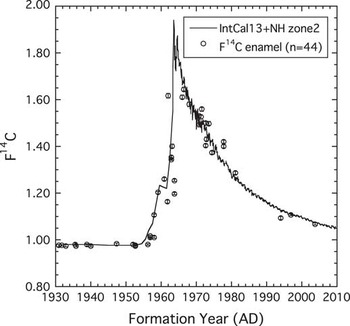
As an environmental factor, 14C variations in the atmosphere can be divided into five zones from north to south, according to the different 14C peaks from nuclear weapons tests: NH zone 1, NH zone 2, NH zone 3, SH zone 3, and SH zone 1–2 (Hua et al. Reference Hua, Barbetti and Rakowski2013). Previous works using tooth enamel 14C mainly focused on samples from NH zone 1, but rarely from NH zone 2. Japanese tooth enamel, which could provide a typical example from NH zone 2 (Figure 1), has not been studied sufficiently. In addition, there may be some other effects from diet. Japanese people tend to some extent to eat seafood that is depleted in 14C. The problems of the Japanese diet as well as the Suess effect in CO2 production by fossil fuel consumption influence the 14C contents in tooth carbonaceous components, which may disturb precise estimation of human DOB, as will be discussed with sample F14C values below. In this study, we aimed to confirm that age estimation from Japanese tooth enamel can determine the precise DOB of individuals and to establish a forensic method for Japanese teeth.
F14C value vs. formation year of crown enamel apatite. The formation year of enamel apatite fraction was estimated from the true date of birth (DOB) of the tooth owner and average enamel formation age estimated in the previous studies (see Table 4). Solid line indicates F14C values of IntCal13 (<1950) and NH zone 2 (>1950) calibration data sets.

Alkass et al. (Reference Alkass, Buchholz, Druid and Spalding2011) reported a possibility that the δ13C value of tooth enamel might provide information about the geographical origin of individuals. We describe the δ13C value of Japanese tooth enamel apatite to study a possible trend peculiar to the diet of Japanese people.
SAMPLE MATERIAL
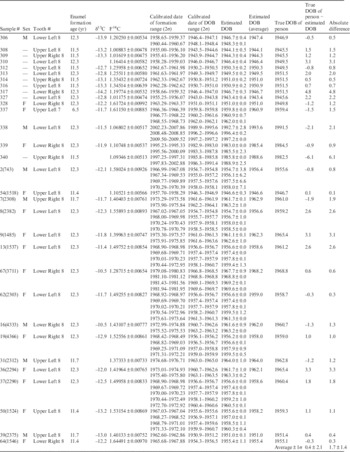
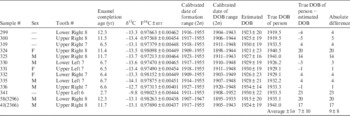
Forty-five tooth samples were selected for 14C analysis from various human teeth supplied by the Faculty of Dentistry, Aichi Gakuin University, Nagoya, Aichi Prefecture, Japan. The tooth samples were collected from patients who lived in and around Nagoya. The year of birth and the types of the selected teeth are shown in Tables 1– 3. The year of birth ranges from 1919 to 1991 for 13 males, 18 females, and 14 unknowns.
List of tooth enamel samples whose F14C values were greater than 1.00, including details of tooth samples, δ13C and F14C values, estimated formation ages of teeth, and estimated date of birth (DOB) of person.

List of tooth enamel samples whose F14C values were less than 1.00, including details of tooth samples, δ13C and F14C values, estimated formation ages of teeth, and estimated date of birth (DOB) of person.

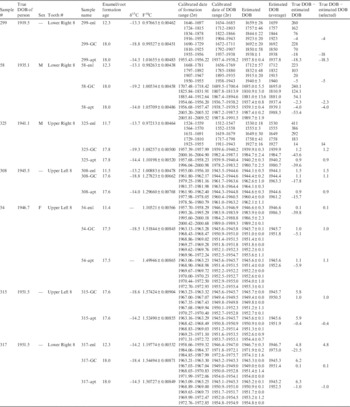
List of enamel (enl) separated from tooth crowns, gelatin collagen (GC), and apatite (apt) separated from tooth root samples, including details of tooth samples, δ13C and F14C values, estimated formation ages of teeth, and estimated date of birth (DOB) of person.

As seen in Tables 1– 3, we analyzed mainly the third molar. The third molar is often extracted even from young patients at the dental clinic, in some cases, even though it is not carious. The third molar is considered useless in daily life, but it is prone to become carious, so it is extracted more often. As a result, we have collected third molar samples easily from participating dentists. We also intended to investigate one type of tooth systematically.
Precise estimation of tooth formation age is based on systematic variation of 14C content in atmospheric CO2. The atmospheric 14C variation mainly resulted from atmospheric nuclear-bomb testing in the late 1950s to early 1960s and is formed by two leading trends as shown in Figure 1: a rising trend from 1955 to 1963 and a falling trend from 1963 and afterwards. Therefore, 14C content of the single carbonaceous fraction from a human tooth offers two possibilities about formation age of the tooth, one belonging to the period from 1955 to 1963 and the other from 1963 and onward. Our major study concentrated on verifying the effectiveness for estimation of human DOB by tooth enamel bioapatite fraction, but also to collect secondary additive information for the more precise and convincing age estimation by using other carbonaceous fractions from the same tooth, which possess information of different formation ages. As for the candidates for the secondary information, we decided to use bioapatite and gelatin-collagen fractions separated from the root part of the same tooth. It has been confirmed by dentists that the crown part is formed first and the root part is completed in a few years after crown formation. Alternatively, another tooth at a different position in the same individual that was formed at a period different from the first tooth can be analyzed. In this study, 14C analyses of bioapatite and collagen extracted from the root portion of the same tooth were performed.
METHOD
Carbon Isotope Ratio Analysis
Physical Separation of Tooth
A tooth was divided into the crown and the root portions with a dental cutting tool. The separated samples were cleaned in distilled water (dH2O) in an ultrasonic bath for several hours and dried.
Chemical Treatment
CO2 Extraction from Enamel Apatite of Tooth Crown
The crown enamel fraction was separated chemically according to Spalding et al. (Reference Spalding, Buchholz, Bergman, Druid and Frisén2005) as described briefly in the following. The crown fragments were weighed and samples (400–700 mg) were placed in a vial with 10N NaOH solution for 2–3 hr, and then treated ultrasonically for about 5–6 hr. The NaOH solution was removed and the samples were rinsed with dH2O three times. Next, the samples were immersed in 10N NaOH again and treated at 70°C on a block heater overnight. This process was repeated every 24 hr for 2–3 weeks until the sample color suggested that all dentin fractions were dissolved and removed. After the pure enamel fraction was obtained, it was washed 10 times with dH2O until the solution reached pH 7, and then it was stored in a clean vial.
Tooth enamel is composed of approximately 96% hydroxyapatite (Ca10(PO4)6(OH)2) and 4% other inorganic materials. Its carbon content is about 0.4–0.7% w/w. To collect CO2, the enamel samples were hydrolyzed with 105% orthophosphoric acid (H3PO4) pretreated in advance. The samples were immersed in 0.25N HCl for about 1 hr to remove any carbonaceous materials on their surfaces. The samples were rinsed three times with dH2O and dried on a heating block at 95°C overnight. A portion of each enamel sample (220–250 mg) was crushed and acidified with 105% H3PO4 at 90°C in an evacuated forked test tube with a block heater to extract CO2 from the enamel apatite fraction.
CO2 Extraction from Bioapatite Portion of Tooth Root
Seven root samples given in Table 3 were halved vertically. One half was used to extract CO2 from bioapatite component and the other half for collagen separation. Following the process used by Alkass et al. (Reference Alkass, Satoh, Buchholz, Bernard, Holmlund, Senn, Spalding and Druid2013), CO2 was extracted by decomposing the apatite fraction. Root samples were immersed in 2% NaClO in a vial for 24 hr, and then they were rinsed 10 times with dH2O. The samples were pretreated in 0.1N HCl for about 30 min, washed 10 times with dH2O, and dried on a heating block at 95°C. Following a procedure similar to that used for enamel apatite, the samples with bioapatite component were treated with 105% H3PO4 in a forked test tube, and CO2 was collected from a pulverized portion of the sample.
Collagen Extraction from Tooth Root
Collagen extraction from root samples was performed according to Longin (Reference Longin1971) and Minami et al. (Reference Minami, Muto and Nakamura2004). Root samples were powdered, placed in cellulose tubes, and treated with 0.4–0.6N HCl in beakers. The HCl solution was stirred magnetically, and the samples were decalcified in a refrigerator at 4°C for 24 hr. The HCl solution was removed, and the beakers were filled with dH2O. The dH2O was changed once an hour more than five times until the solution pH was around 7. Next, the acid-treated samples were centrifuged and divided into the solution and solid content fractions. The solution was freeze-dried to obtain the acid-soluble collagen fraction. The solid content was rinsed with dH2O, and then treated with 0.1N NaOH (2–3 mL) for 2 hr. The solid residue was rinsed with 0.1N HCl, and then treated with a weak HCl solution of pH 3 in a block heater at 90°C overnight to solubilize the solid collagen. The liquid fraction was collected and freeze-dried to obtain solid gelatin collagen. The collagen (5–7 mg) was put in evacuated quartz tubes with CuO (500 mg) and reduced Cu (400 mg), and heated at 850°C for 2 hr to generate CO2.
Separation of Carbon Dioxide, Graphitization, and Carbon Isotope Analysis
The CO2 generated was purified with a glass vacuum system. The separated CO2 was divided into two streams: one for 13C/12C ratio analysis with an isotope ratio mass spectrometer (IRMS) and the other for 14C analysis by accelerator mass spectrometry (AMS). Part of the CO2 was reduced to graphite on an iron catalyst under a hydrogen atmosphere (Nakamura et al. Reference Nakamura, Niu, Oda, Ikeda, Minami, Ohta and Oda2004). All three carbon isotopes in the graphite material prepared from the tooth samples, a NIST HOxII standard, and 14C blank material (limestone No. 57952, Kishida Chemical Co. Ltd., Japan) were measured by AMS (Tandetron 4130, HVE, the Netherlands) at Nagoya University, Japan (Nakamura et al. Reference Nakamura, Niu, Oda, Ikeda, Minami, Ohta and Oda2004, Reference Nakamura, Nishida, Takada, Okuno, Minami and Oda2007). The resulting 14C/12C and 13C/12C ratios were then used to calculate the 14C contents of the samples as follows: F14C=(1.00/0.7459)×[(14C/12C)spl/(14C/12C)HOxII], with correction for carbon isotopic fractionation (Tables 1– 3) (Stuiver and Polach Reference Stuiver and Polach1977; Mook and van der Plicht Reference Mook and van der Plicht1999; Reimer et al. Reference Reimer, Brown and Reimer2004).
Data of Tooth Formation Age
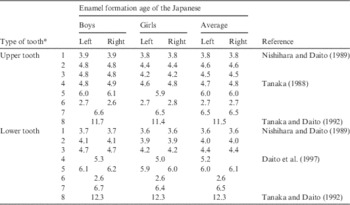
It is necessary to obtain both enamel and tooth root formation ages for precise estimation of human DOB, as discussed previously. The process of tooth formation has been examined in previous odontology studies. For example, Nolla (Reference Nolla1960) checked 3402 X-ray photos of North American young persons aged between 25 and 279 months. Both the age and duration of tooth formation were determined by the sex of the person and the types of teeth. Smith (Reference Smith1991) reported that the tooth formation age of North Americans is different from that of people from other countries. Therefore, it is important to know the accurate completion age and maturing duration of tooth for Japanese people to estimate his/her birth year from tooth information. Many studies on tooth formation in Japanese people have been published, and these data were used in this study. Tanaka (Reference Tanaka1988), Nishihara and Daito (Reference Nishihara and Daito1989), Tanaka and Daito (Reference Tanaka and Daito1992), and Daito et al. (Reference Daito, Sonomoto, Kimura, Mimura, Katoh and Daito1997) published data on the enamel formation age in Japanese people. They discussed molar, central, wisdom, and lower molar teeth. We compiled the data for the enamel formation age from these four studies (Table 4). However, since the tooth root completion ages for the Japanese have not published yet, we had to use the data for North Americans summarized by Nolla (Reference Nolla1960).
Enamel formation age of each type of tooth, upper or lower, male or female, or averaged, for Japanese teeth.

* Type of tooth: 1–2: incisor, 3: canine, 4–5: premolar, 6–8: molar.
Determination of the DOB Using 14C Data
The 14C content in each carbonaceous fraction of the tooth reflects that of the atmospheric CO2 at the time of tooth formation. The following procedure was used to estimate the DOB of individuals from the F14C value in each fraction:
(1) The F14C values of carbonaceous fractions were calibrated to calendar dates with the CALIBomb program developed by the Center for Climate, the Environment, and Chronology at Queen’s University, Belfast, UK (http://www.calib.qub.ac.uk/CALIBomb/), using the IntCal13 data set in the period before 1950 and the bomb 14C data set (NH zone 2) after 1950. Since we used original 14C data sets, instead of smoothed ones, calibration results offered us candidates of multiple nearby ranges as the possible ages for most of the tooth samples. We thus averaged them as given in Table 1, with errors covering full possible age ranges. Also, the calibration program inevitably produced two possible age ranges, one in the rising part and the other in the falling part of the bomb curve. We selected the possible age ranges in one part of the bomb curve that is consistent with the real DOB of the tooth owner, as given in Tables 1– 3.
(2) The formation age of relevant carbonaceous fraction separated from the tooth that was compiled from the previous studies is subtracted from the formation year of each carbonaceous fraction evaluated above to estimate the DOB.
RESULTS
Carbon Stable Isotope Ratios
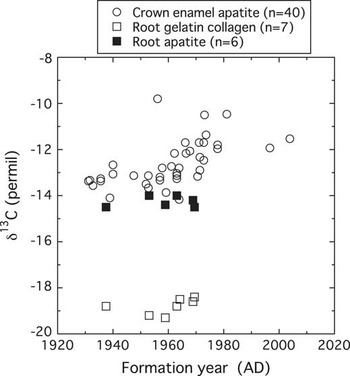
Figure 2 shows the δ13C values of the tooth enamel apatite, the root collagen, and the root apatite. The enamel δ13C value ranged from –14.2‰ to –9.8‰, with an average value of –12.6±1.0‰ for 40 teeth. The root δ13C values were from –19.3‰ to –18.4‰ (average: –18.8±0.3‰) for gelatin collagen from seven tooth roots, and from –14.5‰ to –14.0‰ (average: –14.3±0.2‰) for root bioapatite from six tooth roots. The exact values are given in Tables 1– 3.
δ13C values of crown enamel apatite, gelatin collage, and apatite of tooth root vs. formation year of each tooth fraction. The formation year was calculated from the true date of birth (DOB) of the tooth owner and average formation age for the relevant tooth fraction evaluated from data compiled from the previous studies (see text in detail).

F14C Values of Tooth Enamel Apatite
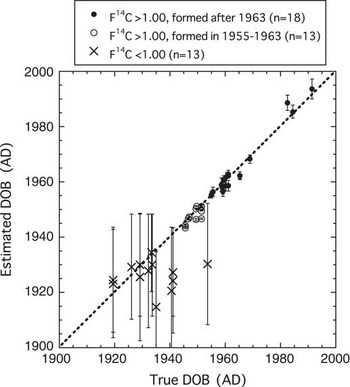
Tables 1 and 2 list the experimental results and detailed information about the samples. Figure 1 shows F14C values obtained for enamel apatite components. For the samples whose enamel fractions were formed after 1955 with F14C values greater than 1.00, precise enamel formation ages were obtained. The average systematic deviation of the estimated age from the real age was –0.4±2.1 yr, and the average of the absolute deviation between them was 1.7±1.4 yr. The correlation coefficient between the true DOB and the estimated DOB was excellent (R 2=0.976; Figure 3). However, enamel fractions of 13 tooth samples were formed before the bomb-testing period (~1955), and they all showed the pre-bomb F14C values of less than 1.00 (Figure 1). The formation age estimation by 14C analysis of tooth enamel for the pre-bomb period showed large errors, and the estimation of DOB did as well. The correlation was low between the true DOB and the estimated DOB for the 13 samples (R 2=0.024, Figure 3).
Estimated DOB vs. true DOB for crown enamel apatite. DOB of the tooth owner was estimated from enamel formation year deduced from its F14C value by comparison with IntCal13 and NH zone 2 atmospheric 14C data sets covering post-bomb period, and average tooth enamel formation age evaluated in the previous studies (Table 3, see text in detail). The dotted line indicates expected DOB=true DOB.

F14C values of the teeth from Japanese people may be lower than the accepted calibration data sets of IntCal13 and NH zone 2, since Japanese people eat seafood more abundantly than other nationalities. F14C values of seafood normally lower by about 5% than F14C values of atmospheric CO2. However, no signal of such offset can be seen in Figure 1 that shows the relation of F14C value and formation year of tooth enamel, including 13 tooth enamel samples whose F14C values less than 1.00. F14C values (<1.00) of the 13 tooth enamel samples were quite consistent with IntCal13 data sets with 1σ errors of about ±0.0040 to ±0.0047. Thus, we can conclude that the seafood intake by Japanese people does not show any evident offsets in the F14C values of tooth carbonaceous fractions. In addition, our experimental results also suggest that the Suess effect, which refers to the 14C depletion in atmospheric CO2 as the result of dead CO2 release in the atmosphere by fossil fuel combustion, is negligible in the evaluation of DOB values from relevant F14C values of tooth samples. In fact, the calibration data set NH zone 2 includes the Suess effect, since the NH zone 2 data is composed of atmospheric CO2 from the 20th and 21st centuries (Hua et al. Reference Hua, Barbetti and Rakowski2013).
F14C Values of Tooth Roots
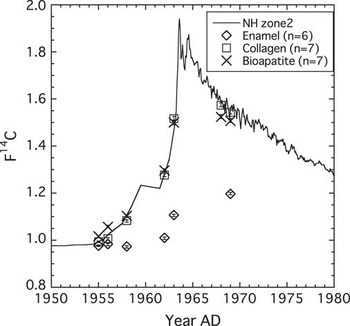
Figure 4 shows the results of F14C values obtained from seven pairs of collagen and bioapatite components in the same tooth roots. Figure 4 also includes F14C value for the tooth enamel fraction from the relevant tooth. In Figure 4, the F14C values were plotted against the formation year of tooth roots. This figure clearly suggests the difference in timing for completing tooth crown formation and tooth root formation of the same tooth. The F14C values of gelatin collagen and those of bioapatite were almost consistent with each other and showed a similar temporal trend, with the correlation coefficient as high as R 2=0.837. However, a detailed comparison suggested systematic differences between the two carbon components, as discussed in the next section.
Annual variations of F14C values for three kinds of carbonaceous fractions separated from the same tooth, and F14C values of atmospheric CO2 (NH zone 2) vs. the year of tooth root completion. Seven teeth with different formation years were analyzed. The three types of fractions were gelatin collagen, bioapatite separated from tooth roots, and tooth crown enamel apatite.

DISCUSSION
δ13C Value of Tooth Enamel Apatite
The δ13C values of –14.2‰ to –9.8‰ were obtained for 40 enamel apatite samples from Japanese teeth as shown in Figure 2. Alkass et al. (Reference Alkass, Buchholz, Druid and Spalding2011) reported that the δ13C values of tooth enamel apatite samples were –15.4‰ to –13.9‰ for Swedish teeth, –11.8‰ to –10.1‰ for Uruguayan teeth, and –13.4‰ to –12.0‰ for Middle Eastern teeth. Alkass et al. (Reference Alkass, Satoh, Buchholz, Bernard, Holmlund, Senn, Spalding and Druid2013) also reported that the values were –10.2‰ to –8.4‰ for North American (Texas) teeth, and –7.8‰ to +0.1‰ for Mexican teeth. Thus, the δ13C values for Japanese teeth are slightly higher than those for Swedish teeth, and lower than those for North American teeth. The variations in δ13C values can be caused by the diet. For example, rather low δ13C values of –15.4‰ to –13.9‰ for Swedish teeth can be explained by the Swedish diet containing large amounts of potato with δ13C value of around –26‰. On the other hand, the values of –10.2‰ to –8.4‰ for North American (Texas) teeth can be by the American diet containing corn with its δ13C value of about –10‰. The δ13C values of –14.2‰ to –9.8‰ for Japanese tooth enamel may be affected by the Japanese diet of seafood with δ13C values of –16‰ to –13‰. Thus, it is acceptable that the δ13C result for Japanese teeth is intermediate between the δ13C values for Swedish and North American teeth.
Figure 2 suggests the possibility that the Japanese diet has changed over time. The δ13C values ranged from –14‰ to –13‰, except for tooth 341 (–9.8‰), for the samples that were formed before around 1960, whereas the samples formed from 1960 to 1975 showed the more variable δ13C values from –14‰ to –11‰. Finally, the samples formed after 1975 showed the δ13C values higher than –12.5‰. Warinner and Tuross (Reference Warinner and Tuross2009) and Froehle et al. (Reference Froehle, Kellner and Schoeninger2010) report a strong relationship between animal bone collagen and diet δ13C values. van der Sluis et al. (Reference van der Sluis, Reimer and Lynnerup2015) addressed the effects of diet on δ13C values of human teeth. Due to fossil fuel combustion, CO2 concentration is increasing by 0.3–0.4% per year in the later half of 20th century, as observed at Mauna Loa Observatory, at Hawaii Island (http://www.esri.noaa.gov/gmd/obop/mlo/). The δ13C value of the emitted CO2 is about –26‰, lowering the δ13C value of atmospheric CO2 (–7‰ to –9‰). The δ13C value of teeth showed an opposite temporal trend (increase in δ13C value with time), so the diet effect for the Japanese tooth could be stronger. However, we need to analyze more teeth to confirm this tendency in the δ13C values. If the tendency is confirmed, the δ13C of tooth samples will provide additional information to select the periods of tooth formation precisely.
Sample 341, the first molar, showed a higher δ13C value (–9.8‰). Formation of the first molar starts at the age of zero or before birth and is completed at the age of around 2–3 yr old (Table 4). Fuller et al. (Reference Fuller, Fuller, Harris and Hedges2006) studied δ13C of hairs and nails of infants, and argued that there was an isotopic enrichment in the 13C level during the breastfeeding age. Eerkens et al. (Reference Eerkens, Berget and Bartelink2011) also reported a similar result by using tooth collagen samples. Therefore, the high δ13C value can be explained by the enrichment of nutrition in early childhood. Only one first molar was analyzed in this research, and we should analyze more first molar samples to confirm this speculation.
As shown in Figure 2, the average δ13C values of apatite and gelatin collagen fractions separated from the same Japanese tooth roots were –14.3±0.2‰ and –18.8±0.3‰, respectively. This tendency in δ13C value between the apatite and gelatin collagen fractions is similar to that reported by Sullivan and Kruger (Reference Sullivan and Krueger1981). The difference in the two average values was 4.6±0.5‰ for six tooth root samples. The δ13C values of root apatite were about 1% lower than those of enamel apatite for the tooth formation years older than 1960.
F14C Values for Collagen and Bioapatite from Tooth Roots
Figure 4 shows the variation in atmospheric F14C values (NH zone 2 data set) and the F14C results of root analysis. The F14C values of the root collagen were consistently lower than those of the root bioapatite when the roots were formed before the bomb peak (1963) except for the youngest one (sample #54), and the opposite was observed when the roots were formed after 1963. This means that the formation age of root apatite is later than that of root collagen.
Generally, the formation age of tooth is possibly determined by using F14C values of root apatite and root collagen without knowing the F14C value of tooth enamel. The time difference of the formation ages of root apatite and root collagen discussed above can be used to assign the F14C value belonging to rising part or falling part of the 14C variation curve, without temporal information by tooth enamel analysis. However, sample #54 (real DOB: 1946.7, Tables 1 and 3) has offered an example that it is difficult to determine correctly the formation age of tooth by using only the pair of F14C values for root apatite and root collagen. For sample #54, the DOB estimated from root collagen was 1945.6–1946.8 or 1950.9–1954.7, and that from the root apatite was 1945.6–1945.7 or 1951.4–1955.4 (Table 3). Because the root collagen was formed earlier than the root apatite, it is mistakenly concluded that the DOB was 1952±2, whereas the real DOB was 1946.7. The time gap between the formation of root collagen and root apatite is considerably shorter than that between the enamel and the root, and it is difficult to estimate the age using only two carbonaceous fractions from the root. Thus, the analysis of the tooth formation age including both tooth enamel and tooth root portions is preferable. In fact, Kawanishi (Reference Kawanishi1959) showed that there is a large variation in root formation age among individuals. In addition, Cook et al. (Reference Cook, Dunbar, Black and Xu2006) reported that there is possible secondary dentition in the tooth root. Therefore, age estimation using only tooth roots may lead to incorrect conclusions. The F14C values for tooth root components should be used to support the accurate age estimation by means of tooth enamel analyses.
Age Estimation by Combination of Tooth Enamel and Root Bioapatite
Age estimation using the F14C values measured for both tooth enamel apatite and root bioapatite was examined for six tooth samples, as summarized in Table 3. For sample #299 (real DOB: 1919.5), the F14C value of tooth enamel was 0.9766±0.0046, and the estimated DOB values were 1659±26, 1757±46, 1844±22, and 1923±20. Considering the F14C value of bioapatite (1.0166±0.0048, and the estimated DOB is 1937.8±0.4), the DOB expected from tooth enamel was in the period 1923±20 and was consistent with the true DOB of 1919, though the estimation error is large.
For sample #58 (real DOB: 1935.1), the tooth enamel F14C value was 0.9826±0.0044, and the estimated DOB values were 1712±57, 1832±48, 1915±20, and 1940±3. The F14C value of root apatite was 1.0571±0.0049, and the estimated DOB values were 1939.1±0.4, 1987.4±0.2, and 1989.7±1.9. Thus, it is more likely that the DOB was 1940±3 estimated from enamel and 1939.1±0.4 from the tooth root.
For sample #325 (real DOB: 1941.1), the tooth enamel F14C value was 0.9721±0.0046, and the estimated DOB values were 1530±18, 1555±3, 1649±30, 1758±41, and 1927±16. However, the F14C value of root bioapatite was 1.1020±0.0052 and the estimated DOB values were 1940.2±0.3 and 1980.7±2.5. Hence, the DOB of 1927±16 from tooth enamel and that of 1940.2±0.3 from the root were likely.
For samples #308 (real DOB: 1945.5), #54 (real DOB: 1946.7), and #317 (real DOB: 1951.5), F14C values for both tooth enamel and root bioapatite showed a clear bomb effect (F14C > 1.00) and the expected DOB values and corresponding real DOB values were almost consistent with each other, as summarized in Table 3.
The estimated DOB ranges may not always include the real DOB of individuals. In particular, the root bioapatite may not show the actual DOB because of the variations in root formation periods and possible secondary dentine. However, in many cases, the estimated DOB of tooth enamel can be narrowed to a single range by the assistance of the F14C values from tooth root data.
Age Estimation by Tooth Enamel Apatite
Teeth with Enamel Apatite Fractions Whose F14C Values Were Less Than 1.00
The F14C values between atmospheric and 13 pre-bomb tooth enamel values did not show good agreement (Figure 3). This may be mainly because of the temporally flat pattern of atmospheric 14C variation, compared with the bomb-pulse 14C pattern. There were only slight temporal changes in the atmospheric 14C; thus, the estimated DOB values of samples had wide age ranges possible. For these 13 samples, the errors for age estimations were so large that it was impossible to determine a short DOB period. It is expected that among the teeth with F14C values less than 1.00 in the tooth enamel, a fair estimate of DOB would be given if the tooth root showed levels exceeding 1.00. However, for samples #299 (real DOB: 1919.5) and #58 (1935.1), the estimated DOB values from the F14C value of the tooth root did not show acceptable agreement with the real DOB (Table 3). Therefore, for pre-bomb samples, it is normally necessary to combine 14C data and information obtained from other forensic investigation methods.
For tooth #341 (real DOB: 1953.5, first molar), the F14C value of tooth enamel was measured as 0.9802±0.0044. Since the first molar normally completes enamel formation at the age of 2.7 yr old, enamel formation should have ended in 1956.2. Thus, tooth #341 should have some effects from bomb-produced 14C. However, its F14C value denied the influence from the bomb 14C. The expected enamel completion year of 1956.2 is on the border for the presence of bomb influence, and we should analyze more first molar samples to confirm this trend.
Teeth with Enamel Apatite Fractions Whose F14C Values Were Greater Than 1.00
The average systematic deviation of the estimated DOB value from the correct value was −0.4±2.1 yr for 31 tooth enamel samples with F14C values >1.00 (Figure 3), and the average of the deviations (i.e. the absolute distance of the estimated DOB value and the correct value) was 1.7±1.4 yr. This accuracy of the DOB estimation for Japanese samples is similar to the previous studies in foreign countries. The absolute deviation for Swedish teeth (Spalding et al. Reference Spalding, Buchholz, Bergman, Druid and Frisén2005) was 1.6±1.3 yr, and that of North American teeth (Alkass et al. Reference Alkass, Satoh, Buchholz, Bernard, Holmlund, Senn, Spalding and Druid2013) was 1.8±1.3 yr. There were no significant differences between the results from our tooth samples and those from previous studies. Consequently, there were no specific local or regional effects that influenced the 14C content in Japanese teeth, and age estimation by Japanese teeth is as accurate as that in previous studies in other countries if we use the appropriate tooth formation age for Japanese teeth.
To discuss the age estimation results by teeth in more detail, post-bomb samples were divided into pre-bomb-peak teeth, formed between 1955 and 1963, and post-bomb-peak teeth, formed after 1963.
Teeth with Enamel Formation Ages between 1955 and 1963
A variation of F14C values was relatively large for 13 tooth enamel samples formed during 1955–1963. In this period, the correlation coefficient, R 2, was 0.667 (n=13, Figure 3), though the absolute deviation between the estimated DOB and the real DOB was not so large as 1.5±1.3 yr on average. The low correlation coefficient may be caused by the quick increase in atmospheric 14C. Similar changes in F14C values have been reported previously. The rapid changes in F14C values of atmospheric CO2 caused large fluctuations in the F14C values in plants and animals (Alkass et al. Reference Alkass, Buchholz, Druid and Spalding2011). Their results showed that the average deviation was 1.9±1.2 yr with a R 2 value of 0.751 (n=10) for tooth enamel samples formed during the rising part of the bomb 14C curve.
Teeth with Enamel Formation Ages after 1963
During the declining part of the bomb 14C curve, F14C values of 18 tooth enamel samples were similar to those of atmospheric CO2, and the average absolute deviation in the estimation was 1.8±1.4 yr. The estimated DOB values for all post-bomb-peak teeth showed excellent agreement with the true DOB with R 2 of 0.969 (n=18). The true DOB and the estimated DOB are compared in Figure 3. No local effect was observed because there was no specific change in the variation of the F14C values of tooth enamels compared with atmospheric 14C change.
CONCLUSION
F14C values greater than 1.0 (the sample is obviously influenced by bomb-produced 14C) of tooth enamel apatite can be used to obtain the DOB of individuals accurately. To select and confirm one correct DOB value among several possible age ranges suggested by the F14C value of tooth enamel, the carbon fractions in the root portion of the same tooth should be utilized. Gelatin collagen and bioapatite from the tooth root are suitable because they both were formed 6–8 yr after the enamel completion, although the root bioapatite seems to be formed a bit later than the root collagen. It is preferable to use tooth enamel apatite and root bioapatite because these tissues are resistant to natural weathering.
The average absolute deviation between the estimated DOB and the real DOB in age estimation using Japanese tooth enamel is 1.7±1.4 yr, which is similar to those obtained in previous studies conducted in other countries. In the case of Japanese teeth, samples formed after the bomb peak (1963) may be affected by the change in diet, as suggested by the small but evident increase of δ13C values, although this effect on 14C content of the tooth is small and negligible in the DOB estimation when looking at the 14C variations in the tooth samples. On the contrary, for age estimation from Japanese teeth formed in the post-bomb period, the δ13C value of the tooth enamel fraction may be at least applicable as a guide to discriminate between tooth formation during the rising and the falling part of the bomb-effect curve. In conclusion, age estimation using Japanese teeth is accurate, and the results reported herein will assist with criminal investigations and forensic work to identify cadavers.
ACKNOWLEDGMENTS
The authors thank Yuichi Taguchi and Fumihiko Nakamura of Aichi Gakuin University, and Dr Kunihide Nishizawa, professor emeritus of Nagoya University, for providing us with tooth samples and useful suggestions. This work was supported partly by a Grant-in-aid for Scientific Research of the Japan Society of the Promotion of Science (JSPS) (subject no. 26284120).