As we approach the fourth quarter of fiscal 2006, the American Political
Science Association is financially sound, able to support a wide range of
professional programs and projects to serve the membership. This strong
condition arises from a solidly positive balance of assets against
liabilities, and an operating budget well-matched to APSA's current scope
and activities.
Balancing Our Budget, Year after Year
Our recently completed auditor's report for the year ended June 30, 2005,
shows that APSA's accounts were balanced last year. So you can see where
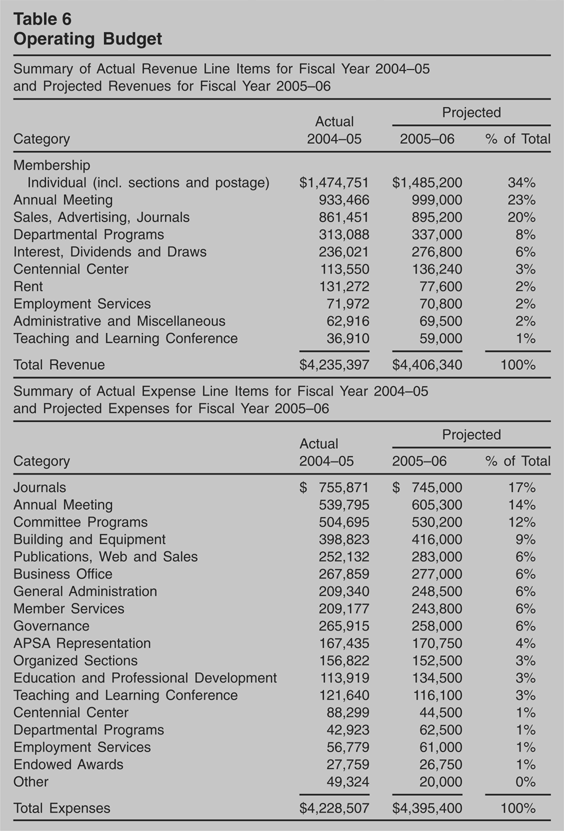
our money comes from, and where it's going, the budget we're currently
using, as approved by the Council in 2005, appears in Table 6—Operating Budget—below. Our mid-year analysis shows
we are on track to again balance our books on this budget, for the year
ending June 30, 2006. This year's budget estimates total revenue at
$4.406 million, and total expenditures at $4.395 million. Our largest
income sources are membership dues and fees ($1.485 million), Annual
Meeting revenue ($999,000), and publications ($945,000). Our largest
expenditure areas are publications ($1.03 million), membership services
and programs ($1.02 million), and the Annual Meeting ($606,000).
Detailed Discussion
In the remainder of this report (jointly authored with APSA Director of
Finance and Administration Robin Smith), we provide more detailed
discussion and statements regarding the Association's activities and
financial condition. We report that despite a broadening of our mission,
even while budgets are tightening, APSA has continued to operate
efficiently and responsibly. Fiscal year 2005 ended within the operating
budget, with growth in the value of our holdings.
APSA Investments
For the fiscal year ending June 30, 2005, APSA's audited financial
statements, which also include the figures for operations,
investments, endowed programs, and grant-funded activities, show an
increase in total net assets of $372,411 for the fiscal year. This
performance compares to an increase of $3.2 million in fiscal year
2004, and declines in total net assets of $763,433 and $3.2 million
for fiscal years 2003 and 2002.
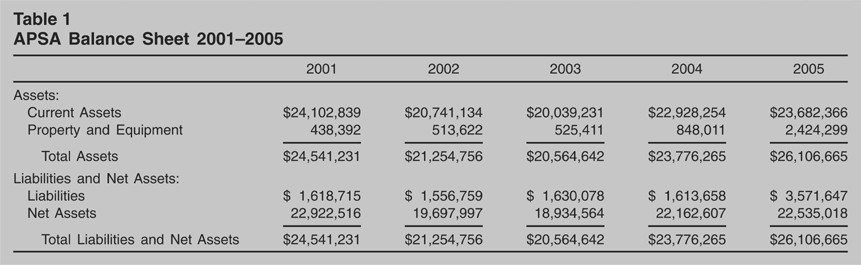
The gain in net assets in the current fiscal period was due chiefly
to a favorable investment climate. The Association's overall
financial position continues to be strong, with assets of over $26
million, a headquarters building and adjacent property that continue
to appreciate in value, and a stable operating budget (please refer
to Table 1 for the APSA Balance
Sheet).
APSA Balance Sheet 2001–2005
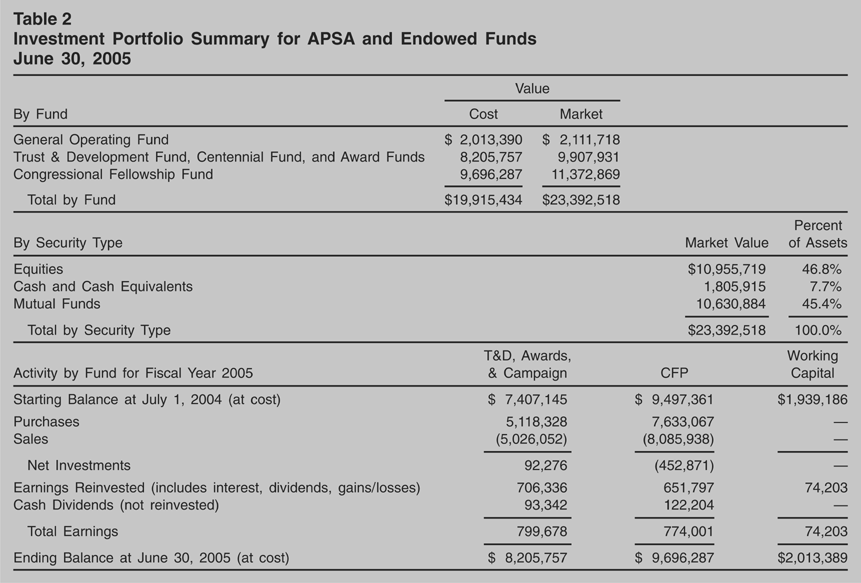
APSA's investment advisor, Cedarpoint Capital Management, Inc.,
reported that the value of the Trust and Development Fund
investments (which include the Centennial Campaign and Award funds)
earned 5.4% for the fiscal year, and the Congressional Fellowship
Fund investments earned 8.0%. By way of comparison, the S&P 500
earned 6.3% for the same period. This strong investment performance
for 2005 allowed APSA to continue our recovery from losses sustained
in recent fiscal years. APSA's portfolios have historically
outperformed the S&P 500 (please refer to Table 2 for more information on APSA's investment
portfolio).
Investment Portfolio Summary for APSA and Endowed Funds
Overall, APSA ended fiscal year 2005 with assets of $26.1 million and
liabilities of $3.6 million, resulting in a net worth of $22.5
million. Of this amount, $9.1 million is restricted as to its use
and $13.4 million is unrestricted.
The net assets may also be viewed as keyed to the funds: $11.4
million in the Congressional Fellowship Program endowment; $4.1
million in Trust and Development; $4.6 million in Centennial
Campaign; $2.1 million in general operating funds; and $1.1 million
in Endowed Award funds (all at market value as of June 30,
2005).
Operations and Budget in Review: Fiscal Year
2004–2005
Several senior staff developments helped the Association meet
programming goals last year. Michael Brintnall served his third full
year as executive director. Under his guidance, three
directors—Polly Karpowicz (Publications), Christina Marmor
(Conventions), and Sean Twombly (Membership)—each performed well in
their first full year at senior leadership positions. The overall
staff, at every level, responded well to new responsibilities, as
the Association pursued Council-directed projects to enhance APSA's
public presence and international outreach.
In fact, this was a year of successful initiatives in several areas:
APSA kicked off its fiscal year in July 2004 with the purchase of a
townhouse office building adjacent to the Association headquarters.
The 2004 Annual Meeting in Chicago was a hugely successful event. In
February 2005, the APSA held its second Teaching and Learning
Conference, with an expanded program and nearly 300 attendees.
The new APSA web site content management system was implemented to
simplify staff updates to web content, extend content management to
our external audiences, and support collaborative workspaces for
committees and members. APSA's online resources—Annual Meeting
programming, myAPSA, PROceedings, and departmental services—afforded
APSA members expansive opportunities to enjoy direct access to and
control of Association services and membership renewal.
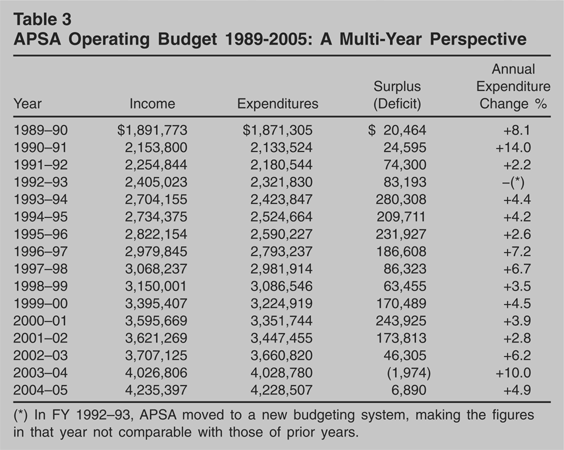
In terms of earned revenue and program expenses, the outcome for the
year was within budget expectations. APSA earned approximately
$4.235 million in operating revenues and incurred operating expenses
of $4.228 million. Actual operating revenue increased during this
fiscal year by slightly more than $208,000 over the prior year, and
expenses increased by less than $200,000. Realized operating revenue
was just over budget by roughly $15,000, while total operating
expense came in just under budget by $11,000.
In 2004–2005, APSA realized the benefit of the third full year of its
journal publishing agreement with Cambridge University Press and the
second full publication year of Perspectives on Politics.
The Cambridge agreement effectively increased both revenue and
expense for APSA by shifting the bulk of the publishing operation to
the publisher.
Cambridge has direct responsibility for collection of institutional
(library) dues, the sale of journal advertisements, and the
management of royalties and permissions, as well as the PROceedings
project and other electronic services. APSA receives a royalty, or
share of the revenue that Cambridge brings in, from each of these
areas. In addition, Cambridge provides funding for all three of the
editorial offices (APSR, PS, and Perspectives on
Politics). On the expense side, Cambridge is responsible
for marketing, producing, printing, and distributing all three
journals.
Under this arrangement, APSA was able to streamline its operations,
reduce costs in several areas, and enhance capacity to establish a
third journal, Perspectives on Politics, without having
members bear additional expense.
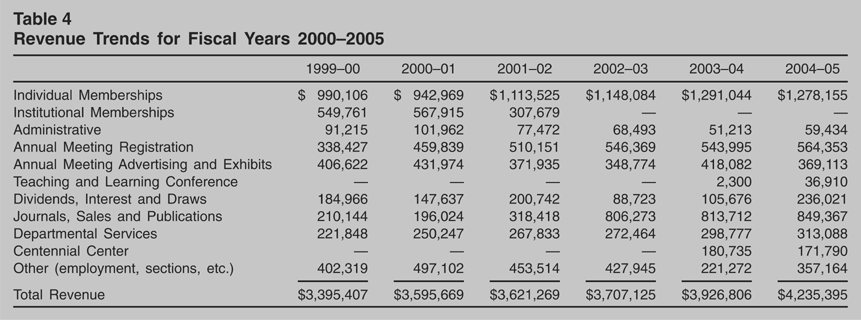
Compared to the prior year, total revenue realized from individual
membership dues during 2004–2005 decreased by less than 1%, due
largely to a change in accounting that resulted in increased
reported revenue in the prior year. In contrast to the small drop in
dues revenue, APSA's individual membership actually increased
slightly, up 26 members from July 2004 to June 2005, to a total of
14,723 members.
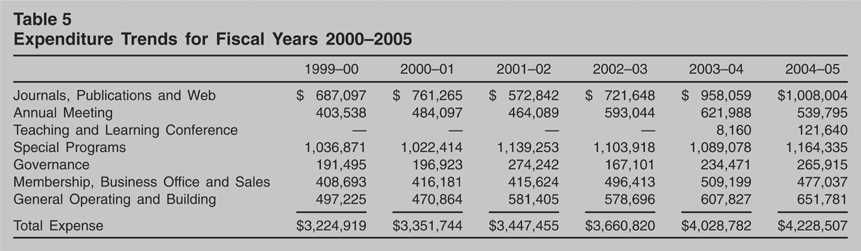
The cost to deliver key services in major program areas—journals,
committees, departments, representation, Annual Meeting, Teaching
and Learning Conference, Centennial Center, publications, organized
sections, education and professional development, employment, and
awards—increased by $187,933, or 6.4%, over the prior year.
Supporting these major program areas, the costs for core operations
(membership services, general administration, building and
equipment, business office, and depreciation) increased by only
$11,792, or 1% in 2004–2005 (please see Tables 3, 4, and 5 for multi-year comparisons).
APSA Operating Budget 1989-2005: A Multi-Year Perspective
Revenue Trends for Fiscal Years 2000–2005
Expenditure Trends for Fiscal Years 2000–2005
APSA Operations in 2005–2006
The current fiscal year also promises many important achievements.
The Council has enthusiastically endorsed a wide range of
significant programs to serve APSA's members. These include
initiatives on public presence, international membership, the
Teaching and Learning Conference, and graduate education, among
others.
For the current fiscal year, ending June 30, 2006, the operating
budget anticipates revenues of $4.406 million and expenses of $4.395
million. The Council approved a modest dues increase that went into
effect on July 1, 2005, for individual membership. This resulted in
an increase of one dollar for students and increases ranging from
two to six dollars for professional members. Student dues are now
$38 per year; professional dues range from $80 (for those earning
less than $40,000 per year) to $196 (for those earning more than
$100,000). Please see Table 6 for a
detailed comparison of fiscal year 2004–2005 revenue and expenses
compared to the 2005–2006 budget.
The fiscal year 2005–2006 budget projects a revenue increase of 4.0%
over the prior year and an increase in expenses of 3.9%. This stable
budget forecasts that 34% of total revenue will come from individual
memberships, 23% from the Annual Meeting, and 20% from journals,
sales, and advertising revenue streams. The remaining 23% will
derive from investments and administrative sources.
On the expense side of the ledger, costs for the three journals are
expected to account for 17% of all operating expenses in fiscal year
2005–2006, followed by the Annual Meeting and Teaching and Learning
Conference at 14%, committee programs at 12%, and building and
equipment (including depreciation costs) at 9%. Each of the
following programs will constitute 6% of operating costs:
publications, web and sales, governance, business office, general
administration, and member services. At 4% or less are costs related
to departmental programs, organized sections, representation,
education and professional development, employment services, the
Centennial Center, program review, and endowed awards.