INTRODUCTION
Conduct disorder (CD) in girls is recognized as a serious concern (Zoccolillo, Reference Zoccolillo1993; Pajer et al. Reference Pajer, Kazmi, Gardner and Wang2007). Although there is some dispute regarding the appropriate case definition for CD among females (Zoccolillo, Reference Zoccolillo1993), a nationally representative study reported the estimated lifetime prevalence of CD in females using DSM-IV criteria to be 7·1% (Nock et al. Reference Nock, Kazdin, Hiripi and Kessler2006). Girls with CD are at increased risk for many adverse outcomes (Robins, Reference Robins, Olweus, Block and Radke-Yarrow1986; Zoccolillo, Reference Zoccolillo1993; Keenan et al. Reference Keenan, Loeber and Green1999). For example, in-patient adolescent girls with CD were found to be at high risk for arrest, adolescent pregnancy, and academic failure (Zoccolillo & Rogers, Reference Zoccolillo and Rogers1991). Girls with CD are also at risk for antisocial personality disorder (ASPD) in adulthood (Zoccolillo et al. Reference Zoccolillo, Pickles, Quinton and Rutter1992). Pajer et al. (Reference Pajer, Kazmi, Gardner and Wang2007) reported that adolescent girls with CD exhibited fewer healthy behaviors, more pregnancies, and a lower level of global health compared to controls. The relatively small number of longitudinal studies examining CD in girls suggests that the onset of CD is delayed compared to males, beginning in adolescence (Loeber & Stouthamer-Loeber, Reference Loeber and Stouthamer-Loeber1998; Silverthorn & Frick, Reference Silverthorn and Frick1999). For instance, in a prospective study of adolescents, females were more likely to comprise an adolescent-onset CD group (Marmorstein & Iacono, Reference Marmorstein and Iacono2005).
Several risk factors for CD in girls have been identified, such as physical abuse (Ilomaki et al. Reference Ilomaki, Viilo, Hakko, Marttunen, Makikyro and Rasanen2006), familial instability (Ilomaki et al. Reference Ilomaki, Viilo, Hakko, Marttunen, Makikyro and Rasanen2006), family history of antisocial behavior and psychopathology (Keenan et al. Reference Keenan, Loeber and Green1999) and hyperactivity (Cote et al. Reference Cote, Tremblay, Nagin, Zoccolillo and Vitaro2002). Our group documented an association between attention-deficit/hyperactivity disorder (ADHD) and CD (Biederman et al. Reference Biederman, Faraone, Mick, Williamson, Wilens, Spencer, Weber, Jetton, Kraus, Pert and Zallen1999), consistent with previous reports from both clinical and non-clinical samples of girls with ADHD (Faraone et al. Reference Faraone, Biederman, Keenan and Tsuang1991; Neuman et al. Reference Neuman, Heath, Reich, Bucholz, Madden, Sun, Todd and Hudziak2001; Hinshaw, Reference Hinshaw2002; Mikami & Hinshaw, Reference Mikami and Hinshaw2003). However, because previous studies of CD in girls with ADHD have been cross-sectional, there are few longitudinal studies of CD in girls with ADHD.
There is compelling evidence demonstrating that CD in the context of ADHD among males is a powerful predictor of impaired functioning, persistent course, and a poor long-term outcome (Moffitt, Reference Moffitt1990; Hinshaw et al. Reference Hinshaw, Lahey and Hart1993; Mannuzza et al. Reference Mannuzza, Klein, Bessler, Malloy and LaPadula1993; Loeber et al. Reference Loeber, Burke, Lahey, Winters and Zera2000). There have been suggestions of defining subtypes of CD by co-morbidity with ADHD (Loeber et al. Reference Loeber, Burke, Lahey, Winters and Zera2000), similar to hyperkinetic conduct disorder endorsed by the ICD-10 (WHO, 1986). This view is supported by work showing ADHD with CD to be a distinct familial subtype (Faraone et al. Reference Faraone, Biederman, Garcia Jetton and Tsuang1997, Reference Faraone, Biederman and Monuteaux2000; Smalley et al. Reference Smalley, McGough, Del'Homme, NewDelman, Gordon, Kim, Liu and McCracken2000). However, it is unknown how these findings extend to females with ADHD and CD.
Mapping out the predictors, clinical characteristics, and outcome of CD in girls with ADHD has major scientific, public health and clinical implications. Scientifically, knowledge about risk factors and clinical characteristics of CD in girls with ADHD should help to refine theories of causal mechanisms. Clinically, the ability to predict the onset of CD in girls with ADHD would assist clinicians in forecasting prognosis and planning treatment. From a public health perspective, this information can inform and guide screening, intervention and prevention efforts.
The main aim of this study was to assess the antecedents, clinical characteristics, and correlates of CD in a longitudinal sample of girls with and without ADHD. We tested the following hypotheses: (1) ADHD would predict an increased risk for CD over time; (2) among girls with CD, ADHD would predict more severe clinical characteristics of CD; (3) parental history of psychopathology and measures of familial adversity would predict the onset of CD within ADHD girls; and (4) CD would predict impaired functional outcomes, independent of ADHD.
METHOD
Subjects
At baseline, we studied female subjects aged 6–18 years with (n=140) and without (n=122) ADHD. Potential subjects were excluded if they had been adopted, if their nuclear family was not available, if they had major sensorimotor handicaps (paralysis, deafness, blindness), psychosis, autism, inadequate command of the English language, or a full-scale IQ less than 80. All ADHD subjects met full DSM-III-R diagnostic criteria for ADHD at the time of the clinical referral; at the time of recruitment they had active symptoms of the disorder. The present study reports on the 5-year follow-up (subjects aged 10–25 at follow-up). The oldest subjects at follow-up (two subjects aged 25) are older than expected, given their ages at baseline (17 and 18). Although every effort was made to contact each subject 5 years after their baseline assessment, difficulties in recruitment and scheduling delayed the follow-up for these subjects.
Parents and adult offspring provided written informed consent to participate, and parents also provided consent for offspring under the age of 18. Children and adolescents provided written assent. The human research committee at Massachusetts General Hospital approved this study.
Two independent sources provided the index children. The ‘psychiatric referral source’ was an academic medical center, where we selected ADHD subjects from consecutive referrals to its pediatric psychopharmacology clinic. We selected controls from out-patients receiving routine physical examinations at its pediatric medical clinics. The ‘pediatric referral source’ was a Health Maintenance Organization (HMO), where we selected ADHD subjects from consecutively ascertained pediatric out-patients, identified from their records as having ADHD. We selected controls from out-patients receiving routine physical examinations at its pediatric medical clinics, identified from their records as not having ADHD. The ADHD sample comprised 63 subjects referred by psychiatric sources and 77 by pediatric sources. The control group comprised 55 hospital-based subjects and 67 HMO-based subjects. We previously demonstrated no statistically significant differences between ADHD subjects ascertained from these two sources on baseline measures of psychopathology, cognition or psychosocial functioning (Busch et al. Reference Busch, Biederman, Cohen, Faraone, Sayer, Monuteaux, Mick and Zallen2002).
A three-stage ascertainment procedure was used to select subjects (Faraone & Tsuang, Reference Faraone, Tsuang, Tohen, Tsuang and Zahner1995). For ADHD subjects, the first stage was their referral resulting in a diagnosis of ADHD by a child psychiatrist or pediatrician. The second stage confirmed the diagnosis by administering a telephone questionnaire to their mothers. Eligible children received the third stage, a diagnostic assessment with a structured interview, the Schedule for Affective Disorders and Schizophrenia for School-Aged Children – Epidemiologic Version (K-SADS-E; Orvaschel, Reference Orvaschel1994). Only patients who received a positive diagnosis at all three stages were included.
We also screened non-ADHD controls in three stages. First, we ascertained them from out-patients receiving routine physical examinations. In stage two, the control mothers responded to the DSM-III-R ADHD telephone questionnaire. Eligible controls received the third stage, a diagnostic assessment with a structured interview (the K-SADS-E; Orvaschel, Reference Orvaschel1994). Only subjects classified as not having ADHD at all three stages were included in the analysis.
Assessment of psychopathology
Psychopathology was measured at both the baseline and follow-up assessments for probands, and baseline only for parents. Because this study began prior to the finalization of DSM-IV, our baseline assessment used DSM-III-R-based structured interviews, supplemented with questions that would allow DSM-IV diagnoses. We used the K-SADS-E (Orvaschel, Reference Orvaschel1994) for subjects younger than 18 years of age and the Structured Clinical Interview for DSM-IV (SCID; Spitzer et al. Reference Spitzer, Williams, Gibbon and First1990) (supplemented with modules from the K-SADS-E to assess childhood diagnoses) for subjects 18 years of age and older. We conducted direct interviews with each subject and indirect interviews with their mothers (i.e. indirect K-SADS-E for subjects less than 18 years of age and indirect SCIDs for subjects 18 years of age and older). We considered a disorder positive if DSM-IV diagnostic criteria were met unequivocally in either interview. For individual symptoms, we considered a symptom positive if it was endorsed in either interview. For each disorder endorsed, we collected age of onset and age of offset.
A committee of child and adult psychiatrists, blinded to the subject's ADHD status, referral source and all other data resolved diagnostic uncertainties. Diagnoses presented for review were considered positive only if a consensus was achieved that criteria were met to a degree that would be considered clinically meaningful.
The raters were blind to the clinical status of the subject, the ascertainment site and all prior assessments. The raters had undergraduate degrees in psychology and were trained to high levels of inter-rater reliability. First, they learned interview mechanics, diagnostic criteria and coding algorithms. Then, they observed interviews conducted by experienced raters. They subsequently conducted at least six practice (non-study) interviews and at least two study interviews while being observed by senior raters. The principal investigator (J.B.) supervised the raters throughout the study. We computed κ coefficients by having child and adult psychiatrists and licensed clinical psychologists diagnose subjects from audio-taped interviews, assigning one of two possible classifications: no diagnosis or full diagnosis. Based on 500 assessments from interviews of children and adults, the median κ coefficient was 0·98. For individual diagnoses, κ coefficients included: ADHD (0·88), CD (1·0), and major depression (1·0).
As suggested by others (Gershon et al. Reference Gershon, Hamovit, Guroff, Dibble, Leckman, Sceery, Targum, Nurnberger, Goldin and Bunney1982; Weissman et al. Reference Weissman, Leckman, Merikangas, Gammon and Prusoff1984), the diagnosis of major depression was made only if associated with marked impairment. As there are many anxiety disorders measured by our structured interviews, we aggregated them into a binary measure coded positive if two or more anxiety disorders were endorsed, and negative otherwise. We previously found this variable to measure a meaningful anxiety syndrome (Mennin et al. Reference Mennin, Biederman, Mick and Faraone2000), and we have used it in previous publications of this sample (Biederman et al. Reference Biederman, Faraone, Mick, Williamson, Wilens, Spencer, Weber, Jetton, Kraus, Pert and Zallen1999, Reference Biederman, Monuteaux, Mick, Spencer, Wilens, Klein, Price and Faraone2006a). In addition, using the reported age of onset, we derived the 12-month prevalence at the follow-up assessment of each disorder, as we have done previously with this (Biederman et al. Reference Biederman, Monuteaux, Mick, Spencer, Wilens, Klein, Price and Faraone2006a) and other samples (Biederman et al. Reference Biederman, Monuteaux, Mick, Spencer, Wilens, Silva, Snyder and Faraone2006b).
Assessment of functional outcomes, familial adversity and other social risk factors
Socio-economic status (SES) was measured using the five-point Hollingshead scale (Hollingshead, Reference Hollingshead1975). As a measure of overall functioning, we used the DSM-IV Global Assessment of Functioning (GAF; Orvaschel, Reference Orvaschel1994). We used the Moos Family Environment Scale (FES; Moos & Moos, Reference Moos and Moos1974; Moos, Reference Moos and Mitchell1985) to assess the family environment at baseline. The FES has high internal and test–retest reliability and availability of norms and measures the quality of family relationships along three dimensions: Cohesion, Expressiveness and Conflict. We obtained two ratings for each scale, one referring to the last month and one summarizing the entire past, for a total of six FES scaled scores. For each of the three domains, we defined persistent adversity as present if both the entire past and last month ratings exceeded 1·5 standard deviations of the controls (Biederman et al. Reference Biederman, Milberger, Faraone, Kiely, Guite, Mick, Ablon, Warburton and Reed1995). We created a summary index of family conflict using a straightforward additive approach suggested by Luthar (Reference Luthar1993). Details of this procedure have been described previously (Biederman et al. Reference Biederman, Milberger, Faraone, Kiely, Guite, Mick, Ablon, Warburton and Reed1995) and the resulting summary measure has been used in our previous work (Biederman et al. Reference Biederman, Milberger, Faraone, Kiely, Guite, Mick, Ablon, Warburton and Reed1995, Reference Biederman, Faraone and Monuteaux2002). In brief, we defined our summary measure as a linear combination of the three FES persistence ratings and the six FES scale scores. We used the median in the normal control population as the cut-point to dichotomize this variable.
We used the following baseline measures of parental psychopathology and familial adversity, which have been shown to be associated with CD: family conflict, low SES, parental ASPD, and maternal psychopathology. We used our summary FES score as a measure of family conflict. Low SES was defined as the lowest two SES groups in our population (SES III and SES IV). Large family size was defined as families with three or more children. We defined sibships of greater than two as ‘large’ because two was the modal sibship size. Parental history of ASPD was measured by assessing the parents at the baseline assessment. Maternal psychopathology was defined as the mother having at least two psychiatric disorders during the child's lifetime.
We also collected information about academic functioning, legal problems and sexual history at the follow-up assessment. We created the following binary variables: ever expelled from school, suspended from school more than once, greater than five detentions, ever arrested, ever convicted, ever had sexual intercourse, sexual intercourse before age 16, more than two sexual partners, and ever pregnant.
Assessment of CD
DSM-III-R and DSM-IV CD symptoms were used to make the CD diagnosis at baseline and the 5-year follow-up respectively. Based on extensive factor analyses (Loeber & Schmaling, Reference Loeber and Schmaling1985; Frick et al. Reference Frick, Lahey, Loeber, Tannenbaum, Horn, Christ, Hart and Hanson1993), we divided the DSM-III-R CD symptoms into two classes, overt behavior and covert behavior. We excluded symptoms that document status offenses (i.e. is often truant, ran away from home overnight), as in our previous work (Monuteaux et al. Reference Monuteaux, Fitzmaurice, Blacker, Buka and Biederman2004). This decision was motivated by a meta-analysis of factor analyses suggesting that status offense CD symptoms, overt CD symptoms and covert CD symptoms aggregate in three distinct domains (Frick et al. Reference Frick, Lahey, Loeber, Tannenbaum, Horn, Christ, Hart and Hanson1993).
To increase the sensitivity of case identification, a subject was classified as having CD if full (three or more symptoms) or subthreshold (two symptoms) criteria were met. We adopted this method because of the uncertainty of only using DSM symptoms to define CD in girls (Zoccolillo, Reference Zoccolillo1993; Zoccolillo et al. Reference Zoccolillo, Tremblay and Vitaro1996). There is also evidence indicating that youth with subthreshold CD symptoms are significantly impaired (Loeber et al. Reference Loeber, Keenan, Lahey, Green and Thomas1993). Whether girls endorsing two CD symptoms should be diagnosed with full CD is an empirical question. Nevertheless, we considered the loss of precision that may result from assuming that subthreshold cases are equivalent to full cases to be less than the loss resulting from the conservative approach of relying on strict DSM criteria, assuming that subthreshold cases can be grouped with non-CD girls.
Statistical analysis
We compared the baseline characteristics of subjects who were and were not reassessed. Among subjects who were followed up, we compared four groups, ADHD with and without CD and control subjects with and without CD, on demographic factors. Analyses of demographic factors relied on Pearson's χ2 tests and t tests for binary and dimensional variables respectively.
Assessment of Aim 1
We estimated the incidence of lifetime CD (i.e. CD identified at either assessment) using Cox proportional hazards survival models. We coded a subject as a non-case if CD was absent at both time points. The models used age 1 as the start of surveillance, the earliest age at onset reported at either wave as the survival time for cases, and the age at most recent interview as the time of censoring for non-cases.
Assessment of Aim 2
We compared the prevalence, age of onset, duration, impairment, and symptom counts of CD between controls with CD and ADHD subjects with CD using t tests and χ2 tests, where appropriate.
Assessment of Aim 3
We estimated a survival model with age to lifetime CD onset as the outcome and the baseline familial risk factors described above as the independent variables. To further evaluate this aim, we stratified the CD group by age of CD onset, creating two subgroups, childhood-onset (onset <12 years) and adolescent-onset CD (onset ⩾12 years), and evaluated the association between the independent variables and these subgroups. We chose this approach to achieve an adequate sample size in each subgroup because there were so few cases that began before age 10. Although this cut-point is not consistent with the DSM-IV (i.e. 10 years of age), it is consistent with the theoretical conceptualization of life-course persistent and adolescent limited antisocial subtypes proposed by Moffitt (Reference Moffitt1993) and with the approach taken by others (Loeber et al. Reference Loeber, Green, Keenan and Lahey1995; Aguilar et al. Reference Aguilar, Sroufe, Egeland and Carlson2000) to analyze age of CD onset.
Assessment of Aim 4
We estimated the effect of ADHD status and lifetime CD diagnosis on the functional outcomes measured at the follow-up assessment. We presented the adjusted test statistics and p values for the ADHD term and the CD term from each model. We used linear regression for continuous variables and logistic regression for binary variables. All statistical tests were two-tailed, and α was set at 0·05.
RESULTS
Attrition and demographic characteristics
Of the 140 ADHD and 122 control subjects recruited at baseline, 123 (88%; age range 10–25 years) and 112 (92%; age range 10–25 years) respectively were successfully reassessed at the 5-year follow-up. The rate of successful follow-up did not differ between groups [χ2(1)=1·1, p=0·30]. There were no significant differences between those successfully followed up and those lost to follow-up on SES, age, GAF score, familial intactness, ascertainment source, or psychiatric co-morbidity.
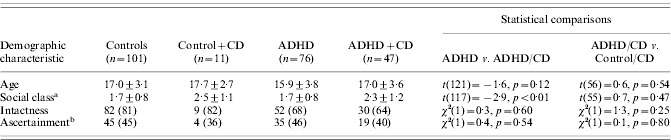
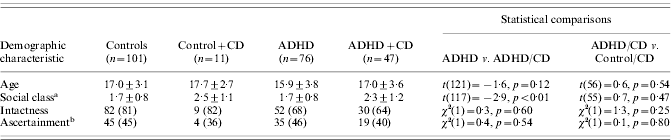
Table 1 displays demographic characteristics among the ADHD and control subjects who returned for the 5-year follow-up, stratified by lifetime CD status. There were no significant differences between ADHD subjects with and without CD on age, familial intactness, or ascertainment source. However, ADHD girls with CD had a significantly lower SES compared to ADHD girls without CD. There were no significant differences between ADHD girls with CD and control girls with CD.
Demographic characteristics in ADHD and control girls at follow-up stratified by CD status
ADHD, Attention-deficit/hyperactivity disorder; CD, conduct disorder.
Values are mean±standard deviation or frequency (%).
a Social class measurement ranges from 1 (most affluent) to 5 (least affluent).
b Ascertained at baseline from the major medical center (Massachusetts General Hospital).
Comparing ADHD to control subjects irrespective of CD status, there were no differences between ADHD and control subjects respectively on mean SES [1·9±1·0 v. 1·8±0·9, t(229)=−1·1, p=0·27], mean age in years [16·4±3·7 v. 17·1±3·0, t(233)=1·6, p=0·11] or the proportion ascertained from the psychiatric referral source [44% v. 44%, χ2(1)=0·0, p=0·98]. However, ADHD subjects had a significantly lower rate of familial intactness (67%) compared to control subjects [81%, χ2(1)=6·4, p=0·01]. At the 5-year follow-up, 90% of ADHD subjects had received some form of lifetime treatment for the disorder.
Aim 1: ADHD would predict an increased risk for CD
Among subjects reascertained at follow-up, the proportion with CD was 38% (n=47) and 10% (n=11) among ADHD and control subjects respectively. A survival model adjusted for baseline age and SES indicated that ADHD females were 5·8 times more likely to meet lifetime criteria for CD compared to controls [hazard ratio (HR) 5·8, 95% confidence interval (CI) 2·9–11·5, p<0·001]. Additional adjustment for intactness did not alter the results. We also compared the risk for CD during the follow-up period among subjects who did not report CD at baseline. ADHD females without a lifetime history of CD at baseline were 3·9 times more likely to meet criteria for CD during the follow-up period compared to controls without a lifetime history of CD at baseline (HR 3·9, 95% CI 1·9–7·9, p<0·001), adjusted for baseline age and SES. Additional adjustment for intactness did not alter the results.
Aim 2: ADHD would predict more severe clinical characteristics of CD
The mean age of onset of CD was significantly lower in ADHD girls relative to controls [10·2±4·4 v. 13·9±1·6 years, t(56)=2·6, p=0·011]. The duration of CD was significantly longer among ADHD girls compared to controls [4·1±3·2 v. 2·1±1·6 years, t(58)=−2·0, p=0·045]. The mean number of lifetime DSM-IV CD symptoms was greater among ADHD compared to control girls [4·5±2·1 v. 3·0±1·2, t(58)=−2·3, p=0·025].
Aim 3: Parental psychopathology and familial adversity would predict the onset of CD
To address our third aim, we predicted the onset of lifetime CD among ADHD girls in a survival model using baseline measures of familial adversity and parental psychopathology as independent variables (i.e. low SES, parental history of ADHD, paternal history of ASPD, maternal history of ASPD, family conflict, large sibship, and maternal psychopathology). The only significant predictor of CD was paternal ASPD; ADHD girls with a paternal history of ASPD were 2·5 times more likely to meet criteria for CD throughout the follow-up period (HR 2·45, 95% CI 1·0–5·7, Z=2·07, p=0·039).
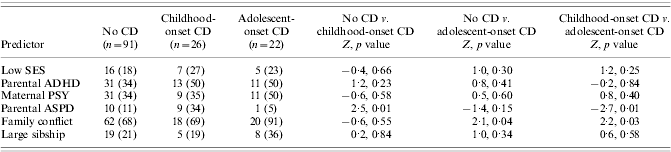
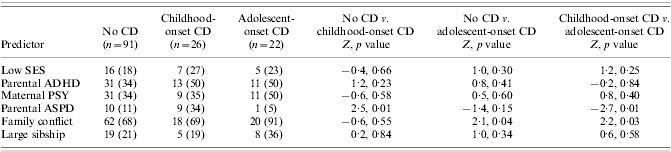
To evaluate whether age of onset of CD distinguished meaningful subgroups of CD, we stratified the ADHD sample by age of onset of CD, yielding three groups: No CD (n=91), childhood-onset CD (onset<12, n=26) and adolescent-onset CD (onset⩾12, n=22). We then estimated the effect of low SES, parental history of ADHD, parental history of ASPD, family conflict, large sibship, and maternal psychopathology on group membership using multinomial logistic regression models (we used a composite parental history of ASPD variable because the maternal history of ASPD variable dropped out of the models due to sparse data). As shown in Table 2, parental ASPD significantly distinguished the No CD group from the childhood-onset CD group, independent of other risk factors. In comparing the No CD group to the adolescent-onset CD group, family conflict was the sole significant predictor. Parental ASPD and family conflict significantly distinguished the childhood-onset CD group from the adolescent-onset CD group, with childhood-onset CD cases having greater levels of parental ASPD and adolescent-onset CD cases having more family conflict.
Multinomial logistic regression models of risk factors predicting early-onset versus late-onset CD in girls with ADHD
CD, Conduct disorder; SES, socio-economic status; ADHD, attention-deficit/hyperactivity disorder; PSY, psychopathology; ASPD, antisocial personality disorder.
Early onset=before age 12; late onset=age 12 or after; maternal ASPD dropped out of the models due to sparse data.
Values are frequency (%); Z statistics refer to the statistical comparison between the two groups listed in a given column on the risk factor of a given row.
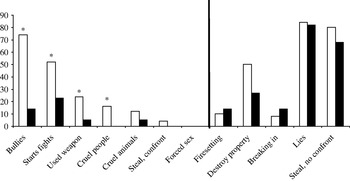
We also compared the subtypes of CD on lifetime CD symptoms. As shown in Fig. 1, childhood-onset CD was associated with significantly higher rates of four symptoms: often bullies, starts physical fights, used a weapon, and physically cruel to people. The childhood-onset CD group also had a significantly greater mean number of overt symptoms than the adolescent-onset group, adjusted for age at last assessment [2·4±1·4 v. 0·9±1·1, t(47)=−3·7, p=0·001]. We detected no difference in the mean number of lifetime covert symptoms [3·0±1·3 v. 2·6±1·5, t(47)=0·3, p=0·749].
Lifetime prevalence of conduct disorder (CD) symptoms in girls with attention-deficit/hyperactivity disorder, stratified by age of onset of CD. □, Childhood onset; ■, adolescent onset (* p<0·05).

Aim 4: CD would predict impaired functional outcomes, independent of ADHD
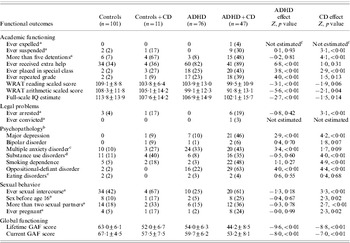
To assess our fourth aim, we estimated the independent effects of ADHD and CD on functional outcomes at follow-up, adjusted for age and SES. As shown in Table 3, lifetime CD was an independent predictor of school behavior problems, placement in special classes and lower Wide Range Achievement Test (WRAT) arithmetic scores, while ADHD was significantly associated with measures of academic dysfunction, and lower WRAT and full-scale IQ scores. Lifetime CD was also associated with more arrests, independent of ADHD. The 1-year prevalence of major depression, substance use disorders, smoking dependence and oppositional-defiant disorder were independently associated with CD, while major depression, multiple anxiety disorder and oppositional-defiant disorder were independently associated with ADHD. The rates of lifetime sexual intercourse, sexual intercourse before age 16, a lifetime history of three or more sexual partners and a lifetime history of pregnancy were significantly predicted by lifetime CD, irrespective of ADHD. Both ADHD and CD were independently associated with lower lifetime and current GAF scores.
Functional outcomes at the 5-year follow-up in girls stratified by ADHD and CD status, adjusted for age and social class

ADHD, Attention-deficit/hyperactivity disorder; CD, conduct disorder; WRAT, Wide Range Achievement Test; GAF, Global Assessment of Functioning.
Values are frequency (%) or mean±standard deviation.
a Because only 88, 45 and 33 subjects from the Control, ADHD and ADHD+CD groups respectively contributed at least one data point across these functional outcomes, the analyses were restricted to these subsamples.
b Rates of psychiatric disorders reported as the 1-year prevalence at the follow-up assessment.
c At least two anxiety disorders.
d Alcohol or drug abuse or dependence.
e Anorexia or bulimia.
f Not estimated because of sparse data.
DISCUSSION
In a large sample of girls with and without ADHD followed prospectively for 5 years, we found a strong and statistically significant association between ADHD and CD, consistent with a growing literature (Faraone et al. Reference Faraone, Biederman, Keenan and Tsuang1991; Neuman et al. Reference Neuman, Heath, Reich, Bucholz, Madden, Sun, Todd and Hudziak2001; Hinshaw, Reference Hinshaw2002; Mikami & Hinshaw, Reference Mikami and Hinshaw2003; Biederman et al. Reference Biederman, Faraone, Monuteaux, Spencer, Wilens, Bober and Cadogan2004). CD was associated with more academic, legal and sexual behavior problems, independent of ADHD. Among all girls with CD, ADHD was associated with an earlier onset of CD, a longer duration of CD and more CD symptoms. Childhood-onset CD was predicted by paternal ASPD, while adolescent-onset CD was predicted by family conflict. This study highlights the importance of early identification and intervention for CD in girls with ADHD.
Our results documenting specific associations between paternal ASPD and childhood-onset CD are consistent with findings from a mixed-gender sample (Lahey et al. Reference Lahey, Loeber, Quay, Applegate, Shaffer, Waldman, Hart, McBurnett, Frick, Jensen, Dulcan, Canino and Bird1998). Our finding that family conflict was specifically associated with adolescent-onset CD are also consistent with studies of female delinquents, who are likely to have non-intact families (Calhoun et al. Reference Calhoun, Jurgens and Chen1993) or families marked by abuse and neglect (Widom, Reference Widom1989). These results support the hypothesis that family-genetic risk factors play a stronger role in the occurrence of childhood-onset CD, while family-environmental risk factors are more salient in the incidence of adolescent-onset CD, and extend to females the heuristic value of stratifying CD by age of CD onset as proposed in the DSM-IV (APA, 1994). However, we found that the majority of our ADHD girls with CD (54%) had an onset in childhood, which is not consistent with the proposed ‘delayed-onset’ pathway proposed by Silverthorn and Frick (Reference Silverthorn and Frick1999). This discrepancy may be due to our use of an ADHD sample. In support of this notion, the vast majority (90%) of our control girls with CD had an onset in adolescence. Further research is needed to evaluate the ‘delayed-onset’ pathway in subgroups of girls with CD.
The association between CD and academic, legal and sexual behavior problems are consistent with several studies (Zoccolillo & Rogers, Reference Zoccolillo and Rogers1991; Kovacs et al. Reference Kovacs, Krol and Voti1994; Pajer et al. Reference Pajer, Kazmi, Gardner and Wang2007). However, evidence of dysfunction in ADHD girls independent of CD was confined to academic functioning measures and a few psychiatric co-morbidities, suggesting that ADHD without CD in girls is associated with academic troubles and moderate psychiatric dysfunction, while girls with ADHD plus CD suffer from the same academic troubles as well as pervasive psychiatric co-morbidity and high-risk sexual behavior. It is also possible that ADHD girls with CD have impairments in other domains that we did not assess such as overall health outcomes (Pajer et al. Reference Pajer, Kazmi, Gardner and Wang2007). However, caution should be taken in the interpretation of these findings, as certain outcomes (e.g. rates of psychopathology) may not necessarily be a consequence of CD, and the relationship between some problems (e.g. sexual behavior, substance use) and CD may be reciprocal.
Similar to results in male samples, our findings document that CD in the context of ADHD is a salient predictor of impaired functioning across a variety of domains. This congruence, in tandem with our previous finding in this sample showing ADHD with CD to be a distinct familial subtype (Faraone et al. Reference Faraone, Biederman and Monuteaux2000), supports the extension of the proposal to define subtypes of CD by co-morbidity with ADHD (WHO, 1986; Loeber et al. Reference Loeber, Burke, Lahey, Winters and Zera2000) to females.
These results should be considered in the light of some methodological limitations. Because our sample was primarily Caucasian and entirely referred, the findings may not generalize to other racial/ethnic groups and community samples. Because of limited statistical power, we could not fully evaluate rare functional outcomes such as expulsions and criminal convictions. In addition, we used age 12 to delineate the childhood and adolescent CD categories, which is different than the cut-off used in the DSM-IV. Because there were so few cases that began before age 10, we adopted this approach to achieve an adequate sample size in each subgroup. While this may limit the generalizability of our findings, there are few data documenting the validity of the DSM-IV cut-point in female cases of CD. Because this was a naturalistic study, we could not collect information on the efficacy of ADHD treatment, and how such changes may have influenced the rate, predictors or correlates of CD. Future randomized, controlled treatment studies of ADHD girls with CD could shed light on this. Finally, the sample was not entirely through the period of risk for CD; the youngest girls may still develop late-onset CD.
Despite these considerations, we found that CD is common in girls with ADHD. Although subtypes of CD based on age of onset are informative in ADHD girls with respect to antecedent risk factors, regardless of the age of onset, the co-morbidity with CD in girls with ADHD increases the risk for serious academic, legal and behavioral problems. These findings suggest that the nosological proposal to define the overlap between ADHD and CD as a single disorder may be salient in females, and underscore the importance of developing and testing intervention and prevention programs for CD tailored for ADHD girls.
ACKNOWLEDGMENTS
This work was supported, in part, by a grant from USPHS (National Institute of Child Health and Human Development), 5RO1 HD-36317-07 (J.B.).
DECLARATION OF INTEREST
None.