Mast seeding is the synchronous and massive crop production by some plant species at supra-annual intervals which can result in a significant increase in seedling establishment probability (Kelly & Sork Reference KELLY and SORK2002). The proposed mechanism for the selective advantage of masting is the predation satiation hypothesis (Janzen Reference JANZEN1971, Kelly & Sork Reference KELLY and SORK2002). It posits that seed predators (both invertebrate and vertebrate species) are unable to eat all the produced seeds during the fruit peak, seeds therefore escaping the predator pressure and having increased chances of establishment (Kelly & Sork Reference KELLY and SORK2002).
Not only seed predators but also seed dispersers could be satiated with abundant seed crops, consequently dispersing only a part of the available seed pool (Hampe Reference HAMPE2008, Kelly & Sork Reference KELLY and SORK2002, van Schaik et al. Reference VAN SCHAIK, TERBORGH and WRIGHT1993). This would imply that negative density-dependent processes associated with large seed crops would limit dispersal by frugivores (Wright et al. Reference WRIGHT, MULLER-LANDAU, CALDERON and HERNANDEZ2005). According to this hypothesis, Herrera et al. (Reference HERRERA, JORDANO, GUITIAN and TRAVESET1998) found that plants dispersed by frugivore mutualists were less variable in inter-annual seed production than plants dispersed by other means. However, the majority of evidence of a negative effect of masting for animal seed dispersal comes from temperate ecosystems (Kelly & Sork Reference KELLY and SORK2002) or for dry-fruited species (Levey & Benkman Reference LEVEY and BENKMAN1999). Albeit masting is a well-known phenomenon in some tropical cases such as Dipterocarpaceae forests in South-East Asia (Sakai Reference SAKAI2002) or in Amazonian forest of French Guiana (Norden et al. Reference NORDEN, CHAVE, BELBENOIT, CAUBERE, CHATELET, FORGET and THEBAUD2007), there is very little knowledge of the interaction between massive crops of fleshy-fruited species and seed dispersal by frugivores in the tropics.
Satiation of seed dispersers might be highly dependent on the community-wide fruiting context (Ratiarison & Forget Reference RATIARISON and FORGET2011). Fruit availability is determined by the phenological patterns and floristic composition of the community, which can vary in time and space (Polansky & Boesch Reference POLANSKY and BOESCH2013, Sabatier Reference SABATIER1985). In addition, habitat characteristics are influencing the spatio-temporal variation of the community of frugivores and their diet (Peres Reference PERES1994, Stevenson et al. Reference STEVENSON, QUINONES and AHUMADA2000). Although spatio-temporal variability in fruit production and habitat characteristics might be affecting satiation of consuming animals, previous studies have addressed them separately, and mainly from the viewpoint of seed-predator satiation (Ratiarison & Forget Reference RATIARISON and FORGET2011). Considering the working hypothesis that masting results in satiation of seed dispersers, the aim of this study was to establish the influence of spatio-temporal variability of fruit production on disperser satiation. We thus compared seed dispersal rates of two species of the genus Manilkara among different masting events, taking into account the variability of habitats and the diversity of fruiting crop at the community level.
We chose the tree species Manilkara bidentata (DC.) A. Chev. and M. huberi (Ducke) Standl. (Sapotaceae) as study case given their known masting behaviour, fleshy fruit and frugivore coterie (Norden et al. Reference NORDEN, CHAVE, BELBENOIT, CAUBERE, CHATELET, FORGET and THEBAUD2007, Ratiarison & Forget Reference RATIARISON and FORGET2011). The study area was the Nouragues Biological Station (French Guiana; 4º05′N, 52º40′W), where a phenology monitoring programme has been conducted between February 2001 and February 2011.
Sampling protocol consisted in 160 litter traps (0.5 m2 each) hung at 1.5 m above the ground and composed of a nylon mesh (Norden et al. Reference NORDEN, CHAVE, BELBENOIT, CAUBERE, CHATELET, FORGET and THEBAUD2007, Mendoza et al. unpubl. data). Traps were set in two forests differing in soil composition and tree community structure: Petit Plateau (PP), with sandy granitic-derived soil, and Grand Plateau (GP), with clay soil on metamorphic substrate and a higher cover percentage of lianas (Norden et al. Reference NORDEN, CHAVE, BELBENOIT, CAUBERE, CHATELET, FORGET and THEBAUD2007, Poncy et al. Reference PONCY, SABATIER, PRÉVOST, HARDY, Bongers, Charles-Dominique, Forget and Théry2001). We set 100 seed traps in GP and 60 in PP. Traps were established randomly along parallel trails (five in GP and four in PP), with a minimum distance between neighbours of 15 m. Trap content was emptied every 2 wk, sieved and dried. All the collected seeds, fruits and fragments > 5 mm were determined to species or morphospecies by a skilled assistant (A. Caubère). The two species of Manilkara have an uneven adult distribution between the two plateaux (Ratiarison & Forget Reference RATIARISON and FORGET2011): M. huberi and M. bidentata grow in relatively high density at PP (3 indiv. ha−1), whereas the density at GP is much lower (0.65 indiv ha−1), and is mostly composed of M. bidentata (Ratiarison & Forget Reference RATIARISON and FORGET2011).
Fifty-eight out of the total 160 traps collected fruits and/or seeds of Manilkara during the 10-y census. This reproductive material was used to test a satiation effect of seed dispersers (literally, how many of the available fruits were not eaten by frugivores). Fruits are drupes containing up to five seeds (mean number of seeds per fruit is 1.1 ± 0.1 for M. bidentata and 1.6 ± 0.1 for M. huberi, n = 107 and 93 fresh fruits, respectively; Ratiarison Reference RATIARISON2003) embedded in a fleshy pulp rich in sugar and latex. Fruits are mainly dispersed by primates that swallow the fruit content but do not consume the pericarp, which falls to the ground after being opened with teeth and emptied (Ratiarison Reference RATIARISON2003, Ratiarison & Forget Reference RATIARISON and FORGET2011). Each sample collected per census and seed trap could contain a different combination of entire fruits, entire free seeds, and remains of fruit as debris or pedicels of Manilkara spp. We calculated first the actual number of collected (non-dispersed) seeds as the sum of the free seeds and the entire fruits multiplied by the mean number of seeds per fruit (1.1 or 1.6). Secondly, we conservatively estimated the original number of seeds using fruit debris and the number of pedicels. This was achieved dividing the weight of debris found in the traps by the mean dry fruit biomass per species (M. huberi: 5.23 ± 2.18 g, n = 129 dry fruits; M. bidentata: 3.39 ± 0.76 g, n = 80 dry fruits). We are aware that this measure might be under-estimating the original number of fruits, given that not all the debris was collected in the traps beneath adult trees and that debris could belong to different fruits. For this reason, when the number of free fruit pedicels found in traps was higher than the estimates of fruit based on debris, we also included this difference as fruit estimates. Fruit estimates were then converted to seed estimates using the mean values of seeds per fruit. We calculated the proportion of seeds dispersed (Ds) per each trap and census combination using the following formula:
 \begin{eqnarray*}
\left\{
\begin{array}{l}
{\hbox{\it if estimated seeds}} > {\hbox{\it collected seeds}},\\[6pt]
\quad Ds = \frac{estimated\ seeds - collected\ seeds}{estimated\ seeds} \times 100\\[6pt]
{\hbox{\it if estimated seeds}} \le {\hbox{\it collected seeds}}, Ds = 0
\end{array}\right.
\end{eqnarray*}
Counts of estimated seeds were analysed with a Chi-square test that predicts a theoretical homogeneous distribution between habitats and years. The proportion of seeds dispersed was analysed with a logistic regression model (generalized linear model with a binomial distribution) with a logit link function, because the individual probability of each collected seed being dispersed was binary. We tested the null hypothesis of homogeneous distribution between habitats and years. We constructed first a full model (including an interaction between habitat and year) using Ds as dependent variable and compared it with alternative models with less predictor variables, retaining the one with the lowest value of AIC (Zuur et al. Reference ZUUR, IENO, WALKER, SAVELIEV and SMITH2009). Data of both species were pooled due to the lack of M. huberi at GP. The diversity of seed production at the community level was calculated with the Shannon–Weaver diversity index (H’) and the Simpson valuation index (1-D; Magurran Reference MAGURRAN2004), only using data on primate-dispersed species, retrieved from seed traps. All statistical analyses and graphs were performed with the software R, version 3.1.2.
The 58 traps sampled a total of 237 entire seeds, 210 free pedicels, 64 entire fruits, and 700 g of dry mass of remains, the equivalent of 152 consumed fruits, during the 10-y monitoring. Although immature or aborted fruits were present during all study years, viable fruits and seeds only appeared during three years (2001, 2006 and 2010), therefore considered the three masting events of the species. Immature fruits were easily distinguishable from mature ones given their smaller size, attached pedicel, and poor development of the mesocarp.
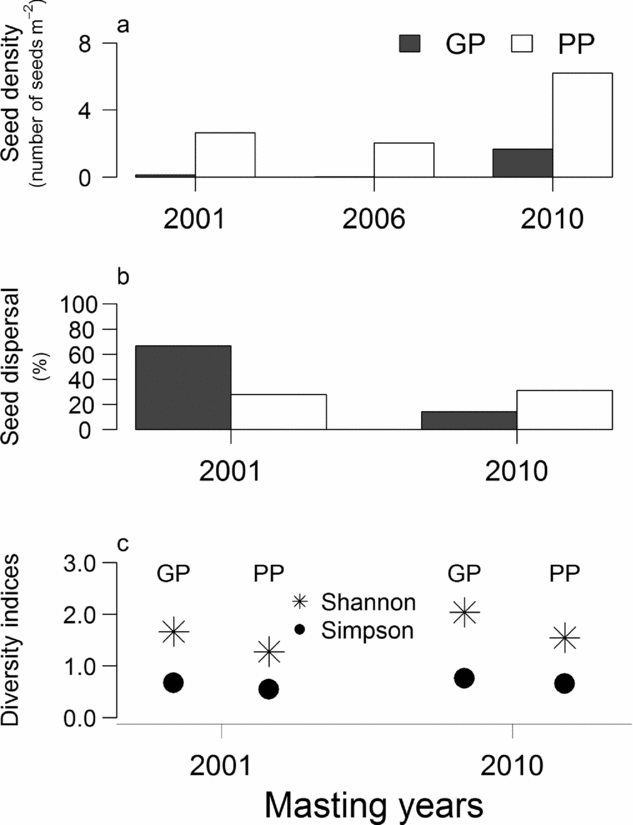
There was a significant variability of seed production among masting events; the estimated number of Manilkara seeds was greater in 2010 (3.37 seeds m−2) than in 2001 (1.06 seeds m−2) and 2006 (0.78 seeds m−2; χ2 = 187, df = 2, P < 0.001; Figure 1). During the three masting events, seed production was overwhelmingly larger at PP than at GP (Figure 1), presumably a direct consequence of contrasting Manilkara adult density on the plateaux.
Barplots represent seed density (number of seeds m−2) of Manilkara estimated from seeds, fruits and remains retrieved in seed traps (a) and the proportion of seeds dispersed (Ds) (b) per masting year and habitat studied (GP = Grand Plateau¸ dark bars; PP = Petit Plateau, light bars). Diversity indices (* = Shannon–Weaver index; ● = Simpson valuation index) calculated per habitat and study year using values of fruit production found in seed traps. We only included primate-consumed species (c).

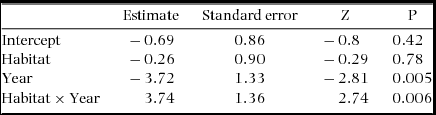
Due to low sampling of Manilkara seeds in 2006 (only 1 seed at GP), we removed this year for consequent analyses. In 2001, dispersal proportion of Manilkara seeds (Ds) was higher at GP (66.7%) than at PP (27.8%; Figure 1), whereas the pattern was the opposite in 2010, when Ds was significantly greater at PP (35.9%) than at GP (14.3%). The minimum adequate model for Ds retained three parameters: habitat, year and the interaction between habitat and year (Table 1). According to our two diversity indices, GP showed the highest values of diversity for primate-preferred species compared with PP in both years (Figure 1): 2001 (H’ = 1.66; 1-D = 0.67 for GP vs. H’ = 1.28, 1-D = 0.55 for PP) and 2010 (H’= 2.04; 1-D= 0.76 for GP vs. H’ = 1.55, 1-D = 0.66 for PP).
Minimum adequate model for explaining the proportion of seeds dispersed (Ds) in relation to habitat and year. We fitted a Generalized Linear Model with a binomial distribution and a logit link. Model was estimated using a restricted maximum likelihood (REML). AIC = 190.17; Total df= 41; Residual deviance = 153.9 on 38 df. Total number of estimated seeds were included as weights in the model.

Our results showed that seed dispersal proportion was greater in 2001 compared with 2010, the year of higher seed production, which is consistent with our initial hypothesis of frugivore satiation. However, there was a spatio-temporal effect in the pattern of satiation that relates to the community context. First, the two study areas differed in Manilkara tree density, lower at GP than at PP for both species. Second, the composition of primate-dispersed seed rain was more diverse at GP than at PP during both years (see Ratiarison & Forget Reference RATIARISON and FORGET2011 for similar results), possibly a result of overall contrasting tree composition and drainage between plateaux (Poncy et al. Reference PONCY, SABATIER, PRÉVOST, HARDY, Bongers, Charles-Dominique, Forget and Théry2001), and differences in foraging of primates across the landscapes (Simmen & Sabatier Reference SIMMEN and SABATIER1996).
Manilkara tree species had a major contribution in the community fruit production during each mast seeding event (16% in 2001 and 39% in 2010 of the total number of seeds retrieved in traps each year; Mendoza et al. unpubl. data). This might explain that, despite relatively low density of adult trees, massive crops of Manilkara seem to be able to affect predators and dispersers. At GP, in a relatively poor year in terms of fruit production (2001), the proportion of Manilkara seeds dispersed was greater than in a year with an overall context of higher diversity of primate-dispersed fruit production (2010). Seed dispersal proportions were similar at PP between both years.
Massive fruit production of Manilkara therefore resulted in seed waste (sensu Howe Reference HOWE1980) during the year with the largest crop (2010). However, seed dispersal is a multi-stage process (Schupp et al. Reference SCHUPP, JORDANO and GOMEZ2010) and satiation of frugivores might not necessary lead to final reduced establishment (Herrera et al. Reference HERRERA, JORDANO, GUITIAN and TRAVESET1998). Seed predation by rodents ranged 36–68% in M. huberi in 2001 (Chauvet et al. Reference CHAUVET, FEER and FORGET2004), but predation proportion could be lower when the availability of undispersed seeds is higher (e.g. 2010), as observed by Nyiramana et al. (Reference NYIRAMANA, MENDOZA, KAPLIN and FORGET2011).
In conclusion, our initial hypothesis that seed masting would satiate frugivores was not generally supported, but rather depended on spatio-temporal variability of fruit production at the community level. Factors such as the composition of the frugivore guild, the community diversity of seed production and tree densities seem to affect the satiation phenomenon. Recommended future directions should include further experiments on the effect of climate variability on fruit availability and frugivore satiation, seed establishment and the recruitment of plants in the longer term.
ACKNOWLEDGEMENTS
IM was funded a postdoctoral fellowship at the MNHN in France by Fundación Caja Madrid and Ministerio de Educación (reference EX2009-0711) in Spain. GM was supported by the M2 program of the Université Pierre & Marie Curie (UPMC). IM and GM contributed equally to the study. UMR 7179 CNRS-MNHN and CNRS-INEE in France gave the financial support to the long-term monitoring in Nouragues. We thank the reviewers for the suggestions and edits to improve previous versions of this manuscript.