Introduction
Unintended pregnancy and sexually transmitted infections (STIs) pose a huge public health problem in the United States. Efforts towards reducing unintended pregnancies have previously focused on women; however, the role of men in family planning and preventing unwanted pregnancy is becoming clearer. One of the goals of the Healthy People 2020 is to increase men’s participation in sexual and reproductive health programmes, including family planning (US Department of Health and Human Services, 2014). This stems from the need to improve men’s reproductive and sexual health by increasing their access to, and utilization of, reproductive health services.
Sexual and reproductive health care providers, as well as researchers, have typically served women and the male subgroup of men who have sex with men (MSM), neglecting heterosexual men (Finer & Henshaw, Reference Finer and Henshaw2006; Kalmuss & Tatum, Reference Kalmuss and Tatum2007). The inclusion of MSM stems from the high incidence and prevalence of HIV/AIDs among this population. However, heterosexual men also have unmet needs for reproductive health services, including family planning, STI care and HIV care. The prevalence of sexual risk behaviours and unprotected sex among men has remained high in the US, indicating the need for increased access to, and utilization of, family planning services by men.
Previous research on the use of reproductive health services among US men in the US is sparse, despite growing evidence of men’s increased engagement in risky behaviours and their huge influence on women’s contraception (Chabot et al., Reference Chabot, Lewis, de Bocanegra and Darney2011). Men become sexually active up to 10 years before they marry, indicating a long period of time in which they may be at increased risk of contracting STIs or fathering a child earlier than planned (Finer & Philbin, Reference Finer and Philbin2014). A study examining the patterns of utilization of reproductive health services by men found that 32–63% were engaged in sexual risk behaviours but were not receiving any form reproductive health service (Kalmuss & Tatum, Reference Kalmuss and Tatum2007). Other researchers have found that the time between the median age at first sex and the median age at first birth has increased among men in recent years (Finer & Philbin, Reference Finer and Philbin2014). Although this finding seems positive, the longer period of time between first sex and first birth indicates an increased chance for unintended pregnancy, abortion and STIs and presents a unique opportunity to improve young men’s access to, and utilization of, family planning services to maintain optimal reproductive health.
Contraceptive use among men in the US
The use of contraceptives among men in the US was fairly common before the introduction of oral contraceptives in the late 1900s. In 1955, the use of condoms and the withdrawal method among men accounted for 32% of all contraceptive use among married white women between the ages of 18 and 39, while 21% of couples used periodic abstinence – a method involving male participation (Darroch et al., Reference Darroch, Singh and Nadeau2008). The invention of modern oral contraceptives, long-acting reversible contraception (intrauterine device, injectable contraceptive or contraceptive implant) and other types of contraception for females had an impact on the role of men in contraception, shifting the focus of family planning services towards improving women’s access to, and utilization of, contraception. Most forms of contraception require women to see a health care professional, keeping them in close contact with reproductive health care service providers. For men, the interaction differs given that the most commonly used method of contraception, the condom, does not require a medical visit or consultation with a health care provider. This has further separated men from sources of sexual and reproductive health services (Darroch et al., Reference Darroch, Singh and Nadeau2008). Although there has been an increase in condom use by men in recent years, early initiation of sexual activity among men remains the norm, making both access to, and utilization of, reproductive health services among men a concern (Lindberg et al., Reference Lindberg, Sonfield and Gemmill2008).
Disparities in family planning service utilization
In the US, subgroup differences exist in the use of contraceptives and family planning services among men. For example, a study examining racial differences in knowledge of contraceptives among men found that Black and Hispanic men were less likely than their White counterparts to have heard about modern contraceptives, including female and male sterilization (Borrero et al., Reference Borrero, Farkas, Dehlendorf and Rocca2013). In another study, Black and Hispanic men were found to be more likely than their White counterparts to receive STI and birth control services and less likely to receive testicular examinations only (Kalmuss & Tatum, Reference Kalmuss and Tatum2007). The study also found that Black men were more likely than their Hispanic peers to receive STI and birth control services. One possible explanation may be a result of insurance type. Men with public health insurance tend to be seen in a clinic setting where the clinic is required to provide certain types of examination, which include STI and birth control services. Men with private health insurance are typically seen in a doctor’s office and may not be mandated to provide these types of services to all their patients. Since there are more Black men with public insurance compared with White men, the finding that more Black men receive non-testicular sexual and family planning services compared with their White counterparts may be unsurprising.
Number of sexual partners and men’s utilization of family planning services
Having multiple sexual partners is a risky sexual behaviour and a major determinant of HIV/AIDs and other STIs. Men who have multiple sexual partners and who have unprotected sex are an important target for family planning services and are considered to be in need for care. A recent study reported that disproportionately high number of men in the US engage in high-risk sexual behaviours such as not using condoms during their last casual sexual encounter (31–51%), and a huge subset of these men (32–63%) had not received any sort of reproductive health services in the last year (Abma et al., Reference Abma, Martinez, Mosher and Dawson2004; Finer & Henshaw, Reference Finer and Henshaw2006; Kalmuss & Tatum, Reference Kalmuss and Tatum2007). In fact, the study found that about 42% of men who had multiple sexual partners reported not using condoms at last sex and almost 50% had unmet need for sexual and reproductive health services. It is pertinent to enquire whether men in the US who engage in such high-risk behaviours are actually utilizing family planning services as needed. This has serious public health implications as their contact with such services may help reduce risky behaviours through health education, promote the use of condoms and other preventive measures and stop the onset, progression and hence the transmission of STIs.
Factors undermining men’s use of family planning services
Women have always been the main target for the delivery of reproductive health services (Boyer et al., Reference Boyer, Shafer, Shaffer, Brodine, Pollack, Betsinger and Schachter2005; Jemmott et al., Reference Jemmott, Jemmott, Braverman and Fong2005; Finer & Philbin, Reference Finer and Philbin2014). Attempts to provide these services to men are exacerbated by the fact that men are poor consumers of preventive health care services (Chabot et al., Reference Chabot, Lewis, de Bocanegra and Darney2011). Men are less likely to attend their scheduled preventive care services than women, further alienating them from the health care system and reducing opportunities to provide other services, including sexual and family planning services. These gender differences in utilization are more pronounced in the 15- to 44-year age bracket, where women are over 4 times more likely than their male counterparts to attend their annual preventive health care appointments. This difference in utilization is mainly due to the fact that these women are at the peak of their reproductive age, and hence require more consultation with their health care providers regarding issues related to contraceptives and pregnancy (Chabot et al., Reference Chabot, Lewis, de Bocanegra and Darney2011).
In the US, men face barriers including lack of health insurance, low-paying jobs, lack of transportation, feelings of embarrassment and fear of the pain associated with laboratory tests in accessing reproductive health services (Buzi & Smith, Reference Buzi and Smith2014). Studies have found that about 23% of men aged 15–49 have no health insurance, and even among men with cover, the insurance usually does not compensate clients or providers for the sexual and reproductive health services that men need (Kalmuss & Tatum, Reference Kalmuss and Tatum2007). A study revealed that sexually experienced men who had health insurance coverage in the past 12 months had a higher chance of receiving reproductive health service compared with those without insurance coverage (Tyler et al., Reference Tyler, Warner, Gavin and Barfield2014).
Furthermore, there are no standard guidelines for providing reproductive health care services for men, as there is for women. When men receive reproductive health services, services tend to be very fragmented with more men receiving only testicular care as compared to non-testicular care (Kalmuss & Tatum, Reference Kalmuss and Tatum2007). The problem with receiving only testicular care services is that these do not incude services such as STI/ HIV care and birth control, which are essential services given the high prevalence of unwanted pregnancy, STIs and unmet need for family planning among men. There is therefore a need for a more comprehensive reproductive health service delivery model consisting of both testicular and non-testicular services for men. Before this can be developed, it is imperative to understand the factors that determine the utilization of reproductive health services and the current pattern and characteristics of men who utilize them. This is crucial given the fact that many men are not utilizing these services and are attending their annual physical exams much less than their female counterparts. Understanding utilization of family planning services by men will help identify gaps and areas of need, including identifying high-risk groups and interventions.
This study aimed to fully examine the utilization of family planning services, as well as determine whether factors such as health insurance type and number of sexual partners influence the utilization and receipt of family planning services by men in the US. This information will guide the development and implementation of tailored comprehensive family planning services for men. In addition, it will provide more understanding of ways by which sexual and family planning services may be successfully integrated into existing routine health programmes for men.
The study comprised three parts. First, the demographic, socioeconomic and behavioural characteristics of a sample of men aged 15–44 who had ever had sex were described. Second, the proportions of the sample men who utilized family planning and STI-related health services in the 12 months prior to the interview were determined. Finally, unadjusted and adjusted binomial logistic regression analyses were used to examine the relationship between number of sexual partners in the past 12 months and (1) the utilization of family planning services and (2) the utilization of STI-related health services among the sample men.
The study research questions were: (1) Does engaging in risky sexual behavior, such as having multiple female sex partners, increase the utilization of family planning services? (2) Does engaging in risky sexual behaviour such as having multiple female sex partners increase the utilization of STI-related health services? (3) Does having public health insurance increase the utilization of family planning services? (4) Does having public insurance increase the utilization of STI-related health services? The study hypotheses were:
H1: Having multiple female sex partners will be associated with increased utilization of family planning services in the past 12 months among the sample men.
H2: Having multiple female sex partners will be associated with increased utilization of STI-related health services in the past 12 months among the sample men.
H3: Having public health insurance will be associated with the increased utilization of family planning services in past 12 months among the sample men.
H4: Having public health insurance will be associated with the increased utilization of STI-related health services in past 12 months among the sample men.
Methods
Data
The data for the study came from National Survey on Family Growth (NSFG) 2006–2010, designed and conducted by the National Center for Health Statistics (NCHS). This was based on 22,682 face-to-face interviews with 12,279 women and 10,403 men aged 15–44 years in the household population of the United States. Men and women living on military bases or in institutions were not included in the survey (Lepkowski et al., Reference Lepkowski, Mosher, Davis, Groves and Van Hoewyk2010). The interviews were administered in person by trained female interviewers primarily in the respondents’ homes. The NSFG 2006–2010 sample was a nationally representative multistage area probability sample drawn from 110 primary sampling units (PSUs) across the United States. Persons aged 15–19 years and Black and Hispanic adults were sampled at higher rates than others.
The NSFG 2006–2010 included data for 8630 men aged 15–44 years who had ever had sex. Those who reported never having had sexual intercourse with any female were excluded from the analysis. Those who reported that they did not have any sexual partners in the past 12 months were also excluded from the analysis. Hence, the final sample for the analysis comprised 7686 men aged 15–44 who had ever had sex and who had had at least one sexual partner in the 12 months before the survey.
Dependent variable
The dependent variable was ‘men’s utilization of family planning and STI-related health services’. This variable was constructed by summarizing items from two sections of the NSFG 2006–2010: ‘Use of family planning clinic’ and ‘Health Services’. The NSFG 2006–10 includes an array of questions exploring sexual and reproductive behaviour, use of contraceptives and receipt of general and reproductive health services. Respondents were asked a structural set of questions designed to elicit recall of which, if any, contraceptive methods were used, and which health and family planning services were received in the 12 months prior to the survey. Men who reported receiving birth control counselling or any method of birth control such as condoms, including counselling on female birth control methods and male sterilization in the past 12 months, were considered to have received family planning services. Men who reported having received these services more than 12 months ago were considered not to have received family planning services. Likewise, receipt of STI services was considered to occur if men reported receiving STI-related health services, including STI advice or counselling, and testing and treatment for STIs other than HIV. Men who reported receiving a testicular examination were excluded from the sample because the NSFG did not ask the reason why men received this service. Given that such examination is often conducted when STIs are suspected, it was not possible to ascertain that they were received as part of reproductive health care or as regular physical/general health care.
Independent variables
The primary variables of interest were sexual and reproductive behavioural factors (number of sexual partners in last 12 months, categorized as one, two and three or more) and health insurance coverage. A range of additional individual attributes (social, demographic and economic factors) were included as controls in the analysis. These included age (categorized as 15–19, 20–24, 25–29, 30–34, 35–39 and 40–44 years), race (categorized as non-Hispanic White, non-Hispanic Black, Hispanic and non-Hispanic other), marital status (categorized as currently married, currently cohabiting, formerly married and never married), education (categorized as incomplete high school, high school, some college and bachelor’s degree and above), biologically fathered a child (categorized as yes or no), religiosity (constructed from three questions on religion – affiliation, perception of the importance of religion and frequency of attendance of religious activities) and family income (categorized as 0–100%, 100%–200%, 201%–300%, 301%–400% and >400% of the poverty level). A factor analysis was performed and a factor score of religiosity was created (categorized using quintiles low, medium and high). Finally, access to health care was measured by health insurance status (private, public or no insurance).
Analysis
Data were analysed using STATA version 14.1 (StataCorp, 2015). All univariate analyses were conducted on weighted data to yield nationally representative estimates. An adjusted Wald test was performed to determine differences in proportions across the subgroups. All results were considered significant at p < 0.001. Considering the complex nature of the NSFG’s sampling design, the svy command in STATA was used in all bivariate and multivariate logistic regression analyses in order to get corrected variance estimates for significance tests. This employs the Taylor series linearization method to estimate the variances. Odds ratios and 95% confidence intervals (95% CIs) were derived for all independent variables from bivariate (unadjusted) and multivariate (adjusted) logistic regression from within the complex samples design. A Hosmer–Lemeshow goodness-fit-test was performed for the multivariate (adjusted) logistic regression model. This is widely used to answer the question ‘How well does my model fit the data?’ (Hosmer & Lemeshow, Reference Hosmer and Lemeshow2000).
Results
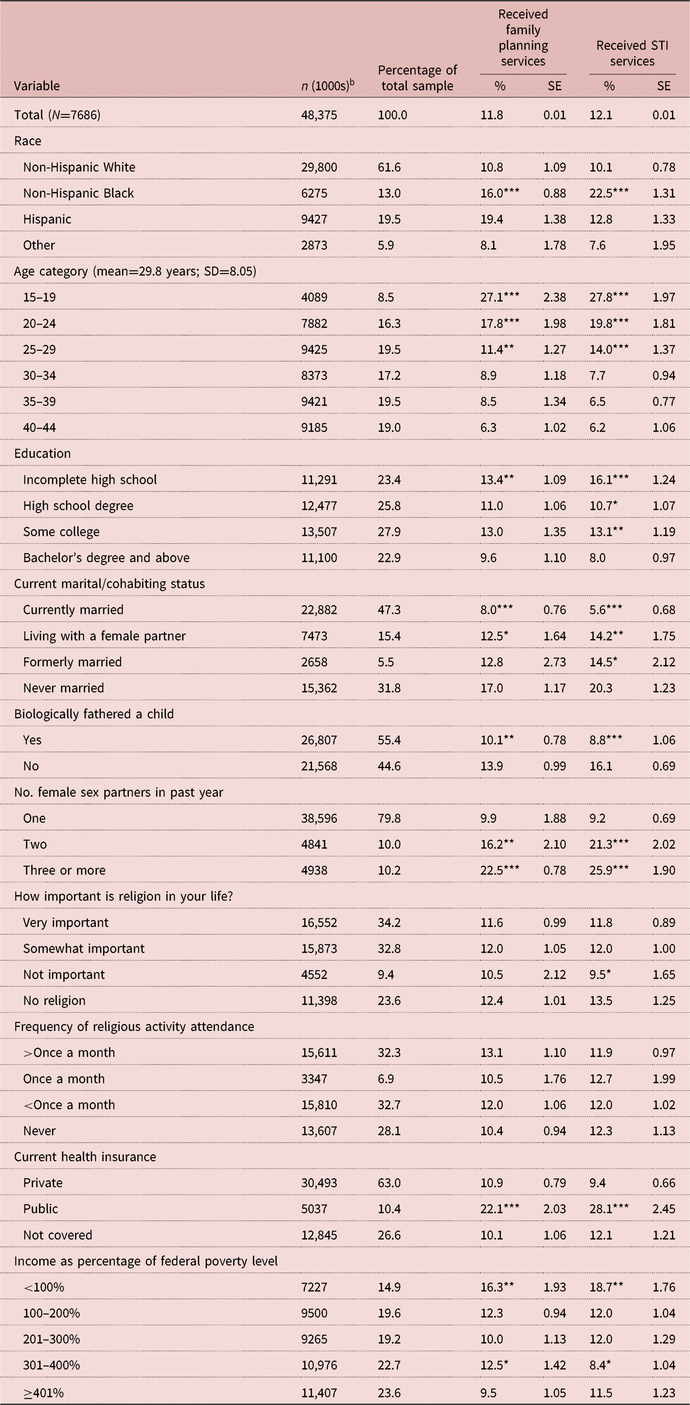
Table 1 shows the demographic characteristics of the study sample by utilization of family planning and STI-related health services in the previous 12 months. About 11.8% and 12.1% of the men, respectively, reported receipt of family planning and STI-related health services. About 62% were non-Hispanic White men, followed by Hispanics, who made up 19.5% of the sample, non-Hispanic Blacks (13.0%) and those of other races (5.9%). A significantly higher percentage of non-Hispanic Black men received both family planning and STI services (16.0% and 22.5% respectively) compared with non-Hispanic White men (10.8% and 10.1% respectively). A significantly higher percentage of men younger than 20 years received both family planning and STI services than men between the ages of 40 and 44 years, with men aged between 15 and 19 years being the group with the highest levels of receipt of these services (27.1% and 27.8% respectively). The percentage of men with incomplete high school education that received family planning and STI services was significantly higher than that of men with a college degree or higher. A significantly lower percentage of currently married men received both family planning services and STI services (8.0% and 5.6% respectively) than never-married men (17.0% and 20.3% respectively). Furthermore, a significantly higher percentage of men reporting having three or more female sex partners received both family planning services and STI services (22.5% and 25.9% respectively) than men who reported having only one partner in the past year (9.9% and 9.2% respectively). Similarly, a significantly higher percentage of men with public health insurance received family planning and STI services than men without health insurance (22.2% and 28.2% respectively).
Percentage distribution of sample men by receipt of family planning and STI-related health services in the past 12 months, by selected socio-demographic, economic and behavioural characteristics, NSFG 2006–2010a

a All results are weighted percentages.
b US population size under study.
SE: linearized standard error of the percentages.
*p < 0.05; **p < 0.01; ***p < 0.001.
Receipt of family planning services
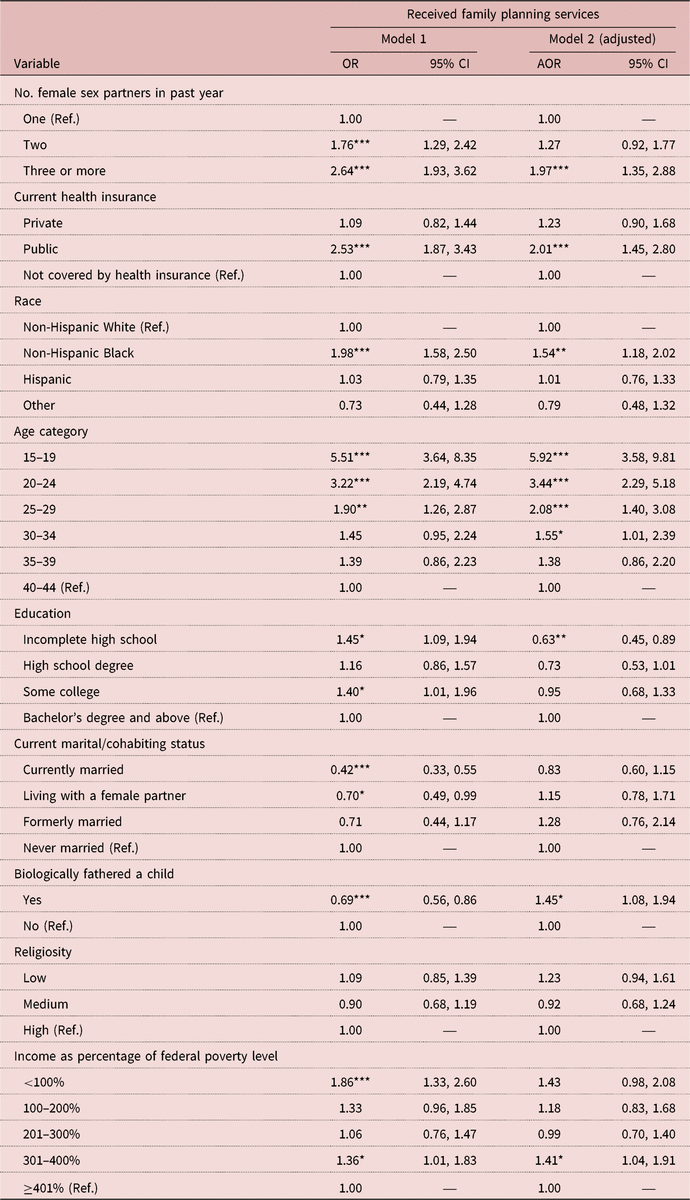
Table 2 shows the unadjusted (Model 1) and adjusted (Model 2) regression models for the association between number of sexual partners and health insurance type and receipt of family planning services. Men who reported having three or more female sex partners in the past year were significantly more likely to receive family planning services than men who reported only one female sex partner in the past year, after controlling for important confounders (OR = 1.97, 95% CI = 1.35, 2.88, p < 0.001). Men who had public health insurance were 2 times more likely to receive family planning services than their peers without health insurance (OR = 2.01, 95% CI = 1.45, 2.80, p < 0.001). Significantly higher odds of receiving family planning services were observed for men aged 15–19 years (OR = 5.92, 95% CI = 3.58, 9.81, p < 0.001), 20–24 years (OR = 3.44, 95% CI = 2.29, 5.18, p < 0.001), 25–29 years (OR = 2.08, 95% CI = 1.40, 3.08, p < 0.001) and 30–34 years (OR = 1.55, 95% CI = 1.01, 2.39, p < 0.05) compared with for men aged 40–44 years. In addition, non-Hispanic Blacks, men whose incomes were at 301–400% of the federal poverty level and those that had biologically fathered a child had higher odds of receiving family planning services than non-Hispanic Whites, men whose incomes were at 401% or more of the federal poverty level and those who had not biologically fathered a child (OR = 1.54, 95% CI = 1.18, 2.02, p < 0.01; OR = 1.41, 95% CI = 1.04, 1.91, p < 0.05; and OR = 1.45, 95% CI = 1.08, 1.94, p < 0.05, respectively). However, the association between biologically fathering a child with the receipt of family planning services remained significant when adjusted for the effect of age and other covariates, but the direction changed. This may have been due to the confounding effect of age. Finally, men with incomplete high school education were significantly less likely to receive family planning services compared with men with a college degree or more (OR = 0.63, 95% CI = 0.45, 0.89, p < 0.01). However, the association was positive and significant (OR = 1.45, 95% CI = 1.09, 1.94, p < 0.05) when adjusted for the effect of age and other covariates in the model. This may be due to the confounding effect of age.
Logistic regression analysis of the relationship between the sample men’s number of sexual partners in the past 12 months and their receipt of family planning services in the past 12 months, NSFG 2006–2010

Ref.: reference category; OR: odds ratio; AOR: adjusted odds ratio; CI: confidence interval.
*p < 0.05; **p < 0.01; ***p < 0.001.
Receipt of STI-related health services
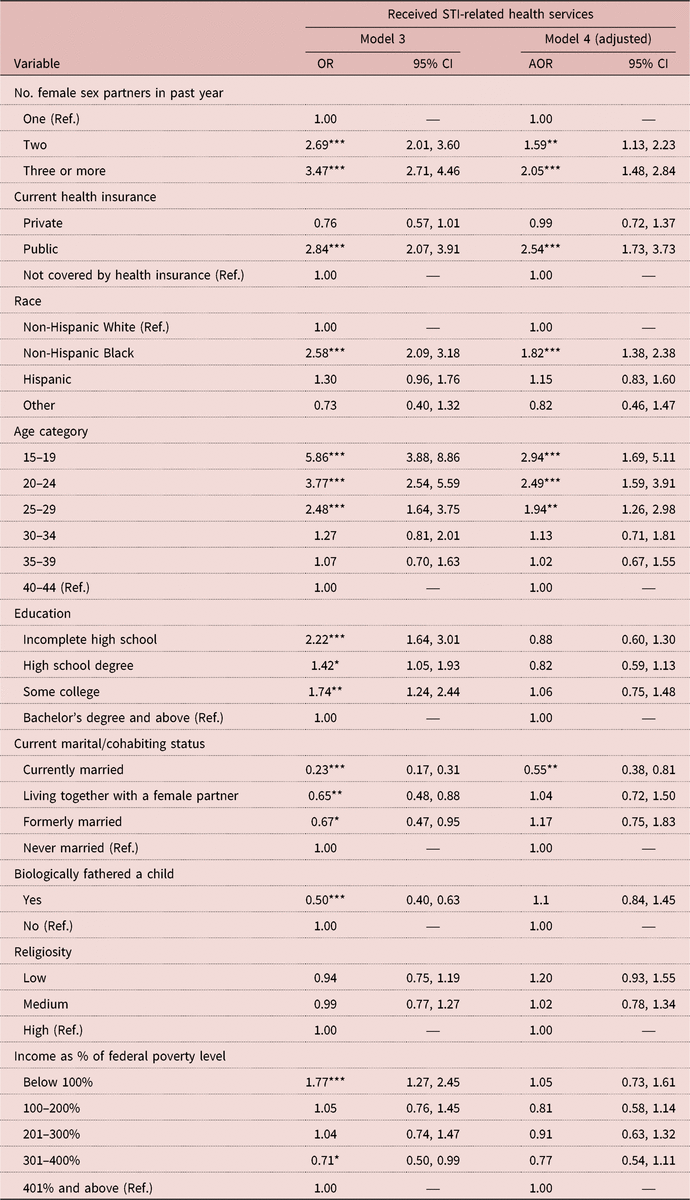
The crude (Model 3) and adjusted (Model 4) regression models for the association between number of sexual partners and health insurance type and receipt of STI-related health services is shown in Table 3. Non-Hispanic Black men were almost 2 times more likely to receive STI services (OR = 1.82, 95% CI = 1.38, 2.38, p < 0.001) than their non-Hispanic White counterparts. Men with public health insurance were almost 3 times more likely to receive STI services (OR=2.54, 95% CI=1.73, 3.73, p < 0.001) than men with no health insurance cover. Furthermore, men who reported having more than one female partner in the past year were more likely to receive STI services than men who reported having only one female sex partner in the past year. The same held true for younger men. A significantly higher receipt of STI services was observed for men aged 15–19 years (OR = 2.94, 95% CI = 1.69, 5.11, p < 0.001), 20–24 years (OR = 2.49, 95% CI = 1.59, 3.91, p < 0.001) and 25–29 years (OR=1.94, 95% CI=1.26, 2.98, p < 0.01).
Logistic regression analysis of the relationship between sample men’s number of sexual partners in the past 12 months and their receipt of STI-related health services in the past 12 months, NSFG 2006–2010
Ref.: reference category; OR: odds ratio; AOR: adjusted odds ratio; CI: confidence interval.
*p < 0.05; **p < 0.01; ***p < 0.001.
Discussion
This study found that the number of female sexual partners a man had was significantly associated with their use of family planning and STI-related services. Men who reported having had more than one female sexual partner in the past year were significantly more likely to receive both family planning services and STI-related health services. Men reporting multiple female sexual partners may have sought birth control services to avoid unintended pregnancies. Furthermore, recognizing their risk for STIs, they may have either sought STI counselling services or treatment for STI symptoms. A study found that having experienced STI symptoms in the past year was significantly associated with the use of STI-related health services in the US (Porter & Ku, Reference Porter and Ku2000; Lindberg et al., Reference Lindberg, Sonfield and Gemmill2008). The results show that men with public health insurance were more likely to receive family planning and STI-related health services than men without any form of health insurance coverage, which agrees with the findings of Chabot et al. (Reference Chabot, Lewis, de Bocanegra and Darney2011). This underscores the need for similar integrated services for men covered by private health policies.
The study found that non-Hispanic Black men were more likely to receive family planning and STI-related services than Hispanic and non-Hispanic White males. Given that non-Hispanic Black men are disproportionately affected by STIs and are a high-risk group, this finding is a positive step towards reducing the disproportionately high prevalence of STIs in this population (Sutton et al., Reference Sutton, Jones, Wolitski, Cleveland, Dean and Fenton2009; Centers for Disease Control and Prevention, 2013; Holtgrave, Reference Holtgrave2014). However, this finding contradicts previous findings that Black men experience more barriers to health care and hence have less access to care compared with their White peers (Cook et al., Reference Cook, McGuire and Zaslavsky2012; Moonesinghe et al., Reference Moonesinghe, Chang and Truman2013). Indicators of low socioeconomic status, including low educational attainment, have previously been shown to be associated with condom non-use, STIs and unintended pregnancy (Dehlendorf et al., Reference Dehlendorf, Rodriguez, Levy, Borrero and Steinauer2010). This study’s finding that men with incomplete high school education were significantly less likely to receive reproductive health services has serious public health implications as this group have been shown to engage more in high-risk behaviours and thus be at higher risk for STIs (Anderson & Portner, Reference Anderson and Portner2014). This finding underscores the need for more targeted approaches to reaching this population. Community-based outreach and engagement, including health education, has been found to be associated with increased use of reproductive health services among socially disconnected young men (Jackson et al., Reference Jackson, Karasz and Gold2011).
The study found that age was inversely associated with the receipt of both family planning and STI-related health services with decreasing odds of utilization of these services as age increased. A similar study conducted among Native American men found that participants were less likely to seek family planning services for birth control as their age increased (Rink et al., Reference Rink, Four Star, Elk, Dick, Jewett and Gesink2012). Chabot and colleagues also found an inverse association between age and receipt of both birth control and STD/HIV services using data from the 2006–2008 NSFG survey (Chabot et al., Reference Chabot, Lewis, de Bocanegra and Darney2011). Although risk factors for STIs reduce with age, men who continue to engage in risky behaviours continue to be at risk and should have access to, and utilize, family planning and STI-related health services.
The study has its limitations. The study design was cross-sectional in nature and utilized secondary data, limiting the scope of the variables of interest. Additionally, most of the information collected was self-reported by participants. Participants may not have accurately recalled their past year utilization of family planning and STI-related health services, and hence may have either over-estimated or under-estimated this. However, the study findings provide important information on correlates of the utilization of family planning services and STI-related health services among men in the US.
In summary, this study found that health insurance type and number of sexual partners were significantly associated with receipt of both family planning services and STI-related health services among males in the United States. In addition, race, age, level of education and relationship status were significantly associated with the receipt these services. There is therefore a need for more integrated and expanded primary care service to include family planning services and STI-related health services for men. The Affordable Care Act provides a unique opportunity to achieve this given that it provides affordable health plans including preventive health services at no cost. Furthermore, strategies to appropriately engage high-risk men who do not utilize these services are needed.
Acknowledgments
The authors would like to thank the Centers for Disease Control and Prevention’s (CDC) National Center for Health Statistics (NCHS) for conducting the 2006–2010 National Survey of Family Growth (NSFG) study and for providing the data for this study.
Funding
This study was funded by a grant (grant number R40MC25691) from Health Resources and Services Administration (HRSA).
Conflict of Interest
The authors have no conflicts of interest to declare.
Ethical Approval
The authors assert that all procedures contributing to this work comply with the ethical standards of the relevant national and institutional committees on the human experimentation and with the Helsinki Declaration of 1975, as revised in 2008.