1. Introduction
“That's what you get for trespassing.” Leesa Stanley, a non-Indigenous woman, spoke those words on August 9, 2016 (Friesen, Reference Friesen2016). Moments before, Colten Boushie, 22 years old and a member of the Red Pheasant Cree First Nation, suffered a fatal gunshot wound to the back of the head. Leesa Stanley was with her family on their farm near Biggar, Saskatchewan, when the deadly bullet fired from the gun of her husband, Gerald Stanley, a non-Indigenous man who was 54 years old at the time. The Royal Canadian Mounted Police (RCMP) arrested Gerald Stanley the same day he killed Colten Boushie. Nine days later Gerald Stanley pleaded not guilty to a charge of second-degree murder and was released on bail.
What Leesa Stanley said became part of the judicial record when Belinda Jackson, one of four friends who were with Colten Boushie when he died, testified during Gerald Stanley's April 2017 preliminary hearing. The judge presiding over the hearing committed Gerald Stanley to stand trial. R v. Stanley began on January 29, 2018. On February 9, 2018, the clerk of the Court of Queen's Bench announced the jury, all members of which were non-Indigenous, had reached a verdict to acquit.
The events surrounding Colten's Boushie's killing and subsequent legal proceedings were widely covered by news media not only in Saskatchewan but also nationally and internationally. On social media, commentary was toxic (Nunn, Reference Nunn2018) and polarized (Roach, Reference Roach2019), particularly in debates over whether Colten Boushie and his friends drove onto the Stanley farm to get help with a tire or as trespassers intending to steal. Stereotypes associating Indigenous people with rural crime were invoked in extensive pretrial publicity (Roach, Reference Roach2019). At trial, defence lawyers’ arguments rested squarely on the status of Colten Boushie and his friends as trespassers and on the right of Gerald Stanley to respond to the mere fear of rural crime with a gun (Flynn and Van Wagner, Reference Flynn and Van Wagner2020). The verdict, dehumanizing in its prioritization of private property over human life (Lindberg, Reference Lindberg2018), devastated the Boushie family. It also fuelled the family's activismFootnote 1 for justice for the loved one they had lost and against the systemic racism of a criminal “injustice” system that chronically fails First Nations and other Indigenous people (Borrows, Reference Borrows and Roach2019).
Just over a month after R v. Stanley, rural landowners represented by the Saskatchewan Association of Rural Municipalities (SARM), a powerful organization representing 296 rural municipalities, pressed the Government of Saskatchewan to amend provincial trespass legislation. This article's central concern is the subsequent enactment of the Trespass to Property Amendment Act, 2019. The act, impossible to separate from the verdict to acquit Gerald Stanley (Mandryk, Reference Mandryk2022), was proclaimed January 1, 2022. In strengthening the right of rural landowners to control who sets foot on land they deem their private property, the act is discriminatory and further dispossesses, or deprives, First Nations people of access to their land for purposes such as hunting and fishing.
Precursor legislation put the onus on rural landowners to deter access by taking steps such as putting up fences and “No Trespassing” signs. The legislation now in force reverses the onus and requires anyone wishing to access land to get rural landowners’ advance permission. Called into question by the analysis presented in this article is the Government of Saskatchewan's claim that the Trespass to Property Amendment Act, 2019 “better balances” (Government of Saskatchewan, Ministry of Justice, 2019: para. 1) the rights of rural landowners and members of the public. Instead, by tipping the balance decidedly in favour of rural landowners, it is argued here that the act tramples on Indigenous and treaty rights, making it even more difficult than it already is for First Nations people to hunt and fish on their traditional territories.
Certainly, for the Federation of Sovereign Indigenous Nations (FSIN), legislation deeming First Nations people as trespassers on land they have inhabited for over 11,000 years (Stonechild, Reference Stonechild2007) and that their forebears who signed numbered treaties agreed to share but not cede or surrender (Starblanket, Reference Starblanket, Long and Dickason2020) goes too far. On behalf of 74 First Nations it represents, the FSIN's position is that a legal requirement for advance permission to access land is unconstitutional and likely to further inflame racial tensions stoked by R v. Stanley (CBC Radio, 2018). Chiefs of the FSIN Assembly have also resolved “to explore all political and legal options to challenge the . . . legislative changes, and if necessary, mount a legal challenge” (FSIN, n.d.: para. 9).
Research reported in this article has a twofold purpose. The first is to trace the material ways in which political developments after R v. Stanley are linked to enactment of the Trespass to Property Amendment Act, 2019. The second is to explicate what the act accomplishes for its main proponents (rural landowners seeking stronger property rights) at the ongoing expense of its main opponents (First Nations people for whom legislative restrictions on land access are an abrogation of Indigenous and treaty rights). With respect to Saskatchewan's new trespass legislation, First Nations’ Indigenous and treaty rights to hunt and fish are of principal interest.Footnote 2
The twofold purpose of the research is fulfilled by bringing social relations leading to enactment of the new trespass legislation into view. Social relations, or sequences of actions people participate in “to get certain things done” (Deveau, Reference Deveau2008: 13), organize racism in our everyday lives (Smith, Reference Smith2005). In this article, racism refers to “systems of domination and subordination that have developed over time as taken-for-granted societal features” (Ng, Reference Ng, McCarthy and Critchlow1993: 51). The system of domination and subordination central to this article is constituted by the legal regime in which so-called private property is seemingly sacrosanct (Borrows, Reference Borrows2015). This system originated with the arrival of European colonizers on Indigenous lands approximately 500 years ago, has endured over time and is sustained today in ruling relations, or “the total complex of activities . . . by which . . . society is ruled, managed and administered” (Smith, Reference Smith1990b: 14).
Texts (material and replicable artifacts in print, electronic or other forms) and talk (words spoken, written, heard, read or formulated as thoughts in peoples’ heads) both constitute and are constituents of social relations. For researchers employing the method of inquiry known as institutional ethnography (IE), which was pioneered by the late Canadian sociologist Dorothy E. Smith, social relations are explored by studying the ways in which texts and talk coordinate people's activities with and within ruling relations.
Section 2 of the article provides background information both to orient readers to contrasting understandings of treaties as the basis of the relationship between First Nations and non-Indigenous people in Saskatchewan and to explain terminology used in the article. In section 3, I discuss my positionality and how it influenced my empirical approach. Section 4 reviews the small body of primarily juridical academic literature on Colten Boushie's death and Gerald Stanley's acquittal. Scholars have tended not to extend their analyses much beyond the verdict in R v. Stanley. The analysis presented in this article, focused on social relations organizing racism in the activities of lawmaking after R v. Stanley, represents a significant departure from what has been published to date. Section 5 summarizes five core ideas that informed the IE research on which this article is based and provides an overview of how the research was conducted. Section 6 presents key research findings, emphasizing how, after the verdict in R v. Stanley, (1) SARM opportunistically used its political power to lobby for trespass legislation amendments making advance permission a prerequisite to rural land access, (2) the Government of Saskatchewan used a questionnaire to manufacture a base of support to justify proceeding with trespass legislation amendments as SARM advocated, and (3) trespass legislation amendments introduced and then enacted were promoted as if the Government of Saskatchewan is free to do as it pleases with land that First Nations people have never ceded or surrendered to its authority. Section 7 discusses the Trespass to Property Amendment Act, 2019 as a recent example of a law that discriminates against First Nations people because it ignores the numbered treaties. It also recommends IE to political scientists who share the author's interest in exploring the ruling relations of lawmaking in relation to First Nations and other Indigenous peoples.
2. On Terminology and Treaties
The Trespass to Property Amendment Act, 2019 is in force in Saskatchewan, the territory in which 7 of 11 numbered treaties between First Nations and Canadian government authorities were signed between 1871 and 1921. These treaties opened regions west of Lake of the Woods to European settlement and development according to laws privileging so-called private property. While Treaty 2 and Treaty 7 cover small parts of Saskatchewan, the main numbered treaties are Treaty 4, 5, 6, 8 and 10.
The term First Nations will continue to be used in this article to refer to Indigenous peoples who are not Inuit or MétisFootnote 3 and whose forebears were signatories to the numbered treaties. When First Nations is not used, it is usually because a quoted or cited author used different terminology. The term non-Indigenous people will also continue to be used to refer to people not part of the collective of Indigenous peoples that includes First Nations, Inuit and Métis.
First Nations people hold constitutionally protected Indigenous and treaty rights. Indigenous rights are inherent and original because they predate European colonization, whereas treaty rights flow from agreements made between First Nations and Canadian government authorities. In Saskatchewan, these agreements are the numbered treaties listed above.
First Nations understand the numbered treaties as nation-to-nation agreements meant to guide signatories to them in building a sustainable future for generations to come (Cardinal and Hildebrandt, Reference Cardinal and Hildebrandt2000). A relationship based on sharing rather than alienating land and the benefits therefrom (Little Bear, Reference Little Bear and Ponting1986) is key to this future. In contrast, Canadian government authorities understand treaties as agreements under which First Nations “ceded and surrendered title to the land . . . in exchange for a fixed spectrum of rights and entitlements” (Starblanket, Reference Starblanket, Long and Dickason2020: 19).
The Canadian government authorities’ track record of implementing numbered treaties is far from stellar. As Gina Starblanket writes, these agreements “have not just been broken or dishonoured but . . . selectively invoked and employed over time” (Reference Starblanket2019: 445). As section 6 reveals, this historical pattern extends to the Trespass to Property Amendment Act, 2019.
3. The Author's Positionality
I am a non-Indigenous white woman who uses IE to conduct research. In this position, I am “an interested and invested knower rather than a disinterested, neutral and ‘objective’ one” (Ng, Reference Ng, Frampton, Kinsman, Thompson and Tilleczek2006: 179). As such a knower, I am keenly aware that I do not go about everyday life as a First Nations person. My experience is not marred by racism. I have not had to grieve a violent, tragic and needless death of a family member. My participation in everyday life is preferential because of my white privilege. I take for granted that individuals and institutions will treat me fairly. Even though I was born on Treaty 6 territory and raised on Treaty 4 territory, it was not until midlife that I had an inkling that my family's ability to make a home on Indigenous lands can be traced back to treaties.
In light of the above, I follow the advice of Verna St. Denis (Reference St. Denis2014), who urges non-Indigenous people to do the critical work of looking at their own history before they can begin to understand their relationship with First Nations people today. There is much about this history that I recognize I need to unlearn because of how entrenched in me are colonial ways of being, knowing and doing.
The IE research reported in this article is a step in my unlearning. The unlearning happened as empirical connections were made between the brief history after R v. Stanley and up to enactment of the Trespass to Property Amendment Act, 2019 and the much longer history of the relationship between First Nations and non-Indigenous people forged by numbered treaties.
When doing the research reported in this article, I corresponded by email with Jade Tootoosis, Colten Boushie's sister/cousin. Jade Tootoosis knows very well that Saskatchewan's new trespass legislation is an assertion of “racist and colonial practices” (Tootoosis and McLean, Reference Tootoosis and Sheelahn.d.) after R v. Stanley. I am grateful to Jade Tootoosis for encouraging the research that resulted in this article, at the same time as I acknowledge that the responsibility for what is written is mine alone.
4. Looking At and Beyond the Juridical Academic Literature
A prominent stream in the small body of academic literatureFootnote 4 on Colten Boushie's killing and Gerald Stanley's trial explores dimensions of criminal law. Vital questions about whether justice was served were top of mind for many scholars. Kent Roach's (Reference Roach2019) Canadian Justice, Indigenous Injustice: The Gerald Stanley and Colten Boushie Case delves deeply into these questions. His book places Colten Boushie's death and R v. Stanley in context: legally, historically, politically and socially.
Jury representativeness and the use of peremptory challengesFootnote 5 to exclude visibly Indigenous people from the jury were dimensions of criminal law that attracted considerable scholarly interest (Adams, Reference Adams2019; Bertrand et al., Reference Bertrand, Jochelson, Ireland, Kerr-Donohue, Christianson and Walker2020; Roach, Reference Roach2020; Welch, Reference Welch2019).
Other scholars examine racism in relation to R v. Stanley. Cunliffe (Reference Cunliffe2020) looks at unconscious and anti-Indigenous bias in the RCMP investigation into Colten Boushie's death and the handling of forensic evidence at trial. For Starblanket and Hunt (Reference Starblanket and Hunt2020), R v. Stanley provides a backdrop for recounting how discourses of white superiority and Indigenous inferiority have historically shaped the relationship between First Nations and non-Indigenous people on the Canadian prairies and continue to shape their relationship today. Their book stands out because it is not written mainly or only in juridical terms. Storying Violence: Unravelling Colonial Narratives in the Stanley Trial examines “the structure and operations of colonialism in the prairies” (Starblanket and Hunt, Reference Starblanket and Hunt2020: 24). The authors show how Colten Boushie's death and Gerald Stanley's trial are symptomatic (and arguably emblematic) of historical patterns of dispossession manifesting as natural and normal in the present. Institutional ethnographers proceed on a similar understanding of how pasts and presents intersect (Ng, Reference Ng, McCarthy and Critchlow1993).
Several other pieces of academic literature examine how property and non-Indigenous understandings of property rights were taken up in R v. Stanley in prejudicial ways. Flynn and Van Wagner assert that defence lawyers’ repeated courtroom references to trespassing and rural crime helped them craft “a racist, anti-Indigenous-tinged narrative to try and justify, if not excuse, Stanley's use of a deadly gun” (Reference Flynn and Van Wagner2020: 358). Similarly, Weisbord argues R v. Stanley serves as a warning that self-defence law in Canada “is vulnerable to biased or unprincipled application” (Reference Weisbord2018: 349).
Sapic argues that property law is “one of the leading framing devices” (Reference Sapic2020: 97) in R v. Stanley. She also claims that the concept of defending one's property exculpated Gerald Stanley and tacitly justified Colten Boushie's killing. Morton connects R v. Stanley to “white fears of Indigenous ‘trespass’ and ‘theft’ and fatal gun violence in the name of protecting white property” (Morton, Reference Morton2019: 441). Nunn (Reference Nunn2018) problematizes and historicizes Colten Boushie's killing. An initial focus on how race and white supremacy surfaced in the mainstream and on social media widens to include their manifestation in the institutions of everyday life. Thielen-Wilson (Reference Thielen-Wilson2018) draws upon three recent killings of Indigenous people, Colten Boushie's among them, to support a claim that non-Indigenous peoples’ misrecognition of Indigenous people as either trespassing upon or stealing from their private property was central to the perpetrated violence. Finally, MacDonald contextualizes R v. Stanley in terms of settler silencing, defined as “a process of suppressing Indigenous peoples and histories, lands, languages, cultures, and laws” (Reference MacDonald2020: 3). The author gives several examples of settler silencing associated with Colten Boushie's killing and his killer's trial.
In summary, the small body of academic literature on Colten Boushie's killing and Gerald Stanley's acquittal is primarily juridical. With few exceptions, the books and articles that constitute this literature have been written by legal scholars. Racism (generally but not exclusively tied to the workings of the criminal injustice system) and property (especially how non-Indigenous interests in it stand over and against First Nations and other Indigenous peoples) also provided fertile ground to explore.
With respect to trespass to property and post-trial enactment of stronger legislation to deter it, the academic literature is scant. Roach (Reference Roach2019) briefly mentions the prospect of new trespass legislation for Saskatchewan near the end of his book. Flynn and Van Wagner's unravelling of “the presumptive story of trespass” (Reference Flynn and Van Wagner2020: 361) woven into R v. Stanley includes discussion of the regulation of trespass under Saskatchewan law at the time of the trial and as provided for under the Trespass to Property Amendment Act, 2019. While Flynn and Van Wagner posit a connection between R v. Stanley and the act, their main purpose is to analyze the former rather than the enactment of the latter.
Thus, while 2 of 14 pieces of academic literature reviewed in this section skirt the terrain covered by this article, no scholars, to my knowledge, have made enactment of stronger trespass legislation in Saskatchewan after R v. Stanley their primary empirical concern. In its explication of social relations prefacing and paving the way for the Trespass to Property Amendment Act, 2019, this article contributes to the academic literature in two significant ways. First, it reveals the strengthening of trespass legislation after R v. Stanley as a political response to the mobilization of racially motivated concerns about trespass and rural crime by a constituency of electoral importance to the Government of Saskatchewan. Second, it shows how texts and talk served as tools supporting the enactment and promotion of a law that imposes yet another limitation on the ability of First Nations’ people to exercise Indigenous and treaty rights to hunt and fish on their land.
5. Researching Talk and Texts Using IE
Five core ideas informed the conduct of the IE research reported in this article. The first is that people “generate the world they live in, know and experience” (Campbell, Reference Campbell2016: 249) through social relations. The second is that social relations organizing racism do not pertain only to the past; they continue to operate in contemporary life (Ng, Reference Ng, McCarthy and Critchlow1993). The third is that texts as “components of social relations” (Campbell and Gregor, Reference Campbell and Gregor2002: 32) have “organizing power” (DeVault, Reference DeVault2006: 295). This organizing power manifests itself when the consciousnesses and actions of people who read, interpret, respond to or act on texts become aligned with messages inscribed in the texts (whether they are aware of this alignment or not). The fourth is that words—whether spoken, written or that form thoughts in people's heads—also organize social relations (Smith, Reference Smith, Luken and Vaughan2021). The fifth is that in social relations mediated by texts and talk, what people think and do is “brought into an active relationship with intentions originating beyond the local” (Smith, Reference Smith2001: 164). These extralocal intentions are foundational to ruling relations as defined earlier.
Data was collected by “botanizing” (Smith, Reference Smith1990a: 165) specimens of talk and text from publicly available sources. Dorothy E. Smith adopts the term botanizing from plant science, where it refers to collecting flowers and leaves for examination in a laboratory. In IE, botanizing analogously refers to collecting texts for examination of ways in which they shape social relations. Sources of specimens included news releases, news media reports, websites, speeches, Hansard, reports, and other texts produced by government and nongovernment organizations.
Analysis was guided by advice from Alison Griffith, Didi Khayatt, Roxana Ng (as cited in DeVault and McCoy, Reference DeVault, McCoy, Gubrium and Holstein2002) and Liz Stanley (Reference Stanley2017). Each botanized specimen was read and reread with five goals in mind. The first was to understand the message or messages carried by the specimen. The second was to understand the tone and character of ideas and arguments expressed by the specimen. The third was to consider the interests served by peoples’ participation in the social relations of which the specimen was a part. The fourth was to understand the context in which the specimen was produced or circulated. The fifth was to understand what new context arose because of the specimen's production or circulation.
Fulfilling the first analytic goal mentioned above did not typically require more botanizing. Fulfilling the others sometimes did. For example, when a particular specimen referred to other text- or talk-based social relations, additional specimens were botanized and included in the corpus that was compiled for analysis.
6. Talk and Texts as Tools of Dispossessive Lawmaking
In the following subsections, three sequences of actions are analyzed. Central to the first sequence are actions in which SARM pressed the Government of Saskatchewan to amend provincial trespass legislation. Central to the second sequence are actions in which the Government of Saskatchewan used a questionnaire to avail itself of evidence to justify its decision to proceed with trespass legislation amendments as advocated by SARM. Central to the third sequence are actions in which the Government of Saskatchewan enlisted the media to spread the news about trespass legislation amendments it ultimately made.
6.1 Advocating for trespass legislation change
On its homepage, SARM styles itself as the “voice of rural Saskatchewan.” An important way SARM makes its voice heard on issues of concern to its members is at conventions usually held twice a year. SARM conventions are well attended and “highly political events” (Garcea and Gilchrist, Reference Garcea, Gilchrist, Young and Sancton2009: 354) that “receive extensive media attention, especially when controversial issues arise” (Garcea, Reference Garcea and Leeson2008: 287).
Just over a month after Gerald Stanley's acquittal, SARM members gathered for their first convention of 2018. The controversial issue of rural crime “generated a notable portion of the conversation” (Baxter, Reference Baxter2018), just as it had at SARM's first convention of 2017. At SARM's first convention of 2017, held seven months after Colten Boushie was killed, 93 per cent of delegates backed a resolution directing SARM to lobby the federal government “to expand the rights and justification for an individual to defend or protect himself, herself, and person [sic] under their care and their property” (SARM, 2017). The resolution, which mimicked moves by some American states to make it legal for people to use force to protect their property, did not gain political traction. It was swiftly denounced by the federal minister of public safety (MacPherson, Reference MacPherson2017: para. 3), by the provincial minister of justice (CBC News, 2017) and by prominent organizations such as the FSIN, which expressed shock and disgust over the violent intentions behind the resolution. In a similar vein, Colten Boushie's mother, Debbie Baptiste, expressed sadness as well as fear that the resolution would escalate racial tensions in Saskatchewan (Friesen, Reference Friesen2017).
At its first convention of 2018, SARM took a different approach, directing its advocacy at the provincial rather than federal government. During the always popular bear pit session when SARM members grill provincial politicians about issues of concern to them, a delegate criticized the province's trespass laws as being weak and in need of strengthening by amendments requiring anyone wishing to access private rural land to get the rural landowner's advance permission (Fraser, Reference Fraser2018). As reporters subsequently reported (for example, Briere, Reference Briere2018), pressure applied during the bear pit session led the premier and minister of justice to agree to further discuss trespass legislation amendments along the lines the SARM member advocated. With rural crime still top of mind for SARM members and with rural seats in the Legislature representing a stronghold for the governing Saskatchewan Party (Briere, Reference Briere, Berdahl, Eisler, Farney and Rasmussen2020), the political calculus added up.
Thus, through talk with provincial politicians during the 2018 annual convention, SARM pressed a case that gained enough cogency for the Government of Saskatchewan to open the door to considering trespass legislation amendments. SARM declared this accomplishment a win for rural Saskatchewan (SARM, Reference )2018).
The win SARM declared was earned in advocacy work that successfully recontextualized concerns about trespassing and rural crime from the courtroom in which R v. Stanley was heard to SARM's convention floor. In making this claim, I follow Colin Hastings (Reference Hastings2020), an institutional ethnographer who has taken up the notion of recontextualization in his research. Recontextualization involves “the extrication of some part or aspect from a text or discourse, or from a genre of texts or discourses, and the fitting of this part or aspect into another context” (Linnel, Reference Linnel1998: 145). Put another way, taking up the notion of recontextualization illuminates how textual and discursive content “travel[s] across situations” (Linnel, Reference Linnel1998: 144).
In social relations explicated in this subsection, SARM member concerns about trespassing and rural crime widely expressed in situations surrounding Colten Boushie's killing and the trial of his killer travelled across and successfully fit into later situations in which SARM's advocacy work led provincial politicians to agree to discuss trespass legislation change.
In the next subsection, the focus of analysis shifts to a questionnaire that the Government of Saskatchewan used to encourage people, in addition to SARM members, to share their views on trespass legislation amendments.
6.2 Manufacturing a documentary reality to enable dispossessive lawmaking
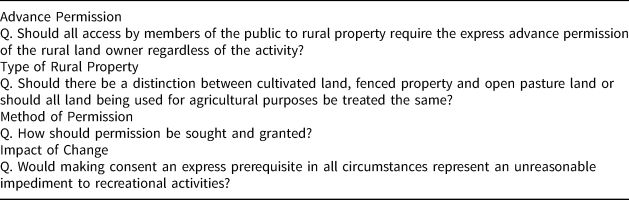
This subsection analyzes text of a questionnaire that the Government of Saskatchewan administered from August to October 2018 to gather public input (Government of Saskatchewan, Ministry of Justice, 2018a) on trespass legislation amendments. References in the questionnaire's preamble to “reported abuses that landowners see by those accessing their property” (para. 2) and to rural crime as a key reason why rural landowner support for public access to private land had been “significantly undermined” (para. 10) portend a “significant weighting” (Mandryk, Reference Mandryk2019: para. 10) of the questionnaire toward rural landowners. The four questions included in the questionnaire are reproduced in Table 1.
Questions in the Review of Trespass Legislation Questionnaire

The quartet of questions is striking in its resonance with SARM's preference for trespass legislation amendments requiring advance permission from rural landowners as a prerequisite to land access. There are no questions about any other option. Other options may have been considered over the six months between SARM's 2018 convention and the questionnaire's launch. This analysis does not foreclose that possibility but asserts alternatively that the Government of Saskatchewan was deliberate in giving SARM's preference pride of place in the questionnaire. This assertion is based on the IE notion that questions to elicit information or data in interrogatory devices (Smith, Reference Smith2005) such as the questionnaire generate a determinate structure in their answers in quite powerful ways (Smith, Reference Smith1974). The quartet of questions legitimizes SARM's preference as the one to be considered and invites public input in relation to that preference alone.
First Nations’ hunting and fishing rights are not mentioned until near the end of the questionnaire. The relevant two-paragraph passage, declarative but unaccompanied by a question, is reproduced below. Analytical points about the constitutive sentences of each paragraph then follow.
It should be noted that First Nations hunting and fishing rights are Constitutional rights that are set out in the Treaties and are protected by the Natural Resources Transfer Agreement of 1930. Whether First Nations people have a right of access to any particular lands will continue to be governed by the Treaties, the Natural Resources Transfer Agreement, and the court decisions that have interpreted those rights.
Government's view is that the current Trespass to Property Act does not affect Treaty hunting and fishing rights as it neither creates a right of access to privately owned land nor takes those rights away. This will in no way change with any of the possible amendments discussed in this [questionnaire].
(Government of Saskatchewan, Ministry of Justice, 2018a)
The first sentence of the first paragraph of the passage orients respondents to the configuration of the non-Indigenous legal regimeFootnote 6 that governs First Nations’ hunting and fishing rights from the Government of Saskatchewan's standpoint. Its enumeration of treaties, the Natural Resources Transfer Agreement (NRTA)Footnote 7 and court decisionsFootnote 8 interpreting First Nations’ hunting and fishing rights as constitutive of the regime is inscribed commonsensically and even reassuringly, given the beginning note on the constitutional status of First Nations’ hunting and fishing rights. Nothing in the first sentence alerts respondents that the Government of Saskatchewan is inscriptively doing anything but summarizing its legal position.
The second sentence of the first paragraph of the passage conveys the message that First Nations’ right of access will continue to be governed by the non-Indigenous legal regime. The existence and operation of the regime are taken for granted and communicated as just “how it is” and just “how it should be” (Ng, Reference Ng, Campbell and Manicom1995). This commonsensical manner of expression is at the same time, however, blind to a “racist history” throughout which property laws, such as those to deter trespassing, have been used to “disqualify Indigenous peoples’ rights to their land” (Sapic, Reference Sapic2020: 98). In Saskatchewan today—where land below the tree line is overwhelmingly owned privately and a minuscule amount of reserve land (2 per cent of the total provincial land base) is insufficient to sustain First Nations’ traditional ways of life that include hunting and fishing (Treaty Land Sharing Network, n.d.)—disqualification is pervasive.
Furthermore, the facticity of the second sentence of the first paragraph belies the view of First Nations people whose treaty-making ancestors “sought assurances that [their] traditional ways of life would not be interfered with” (Starblanket, Reference Starblanket, Long and Dickason2020: 23) in the implementation of numbered treaties. Over time, the preponderance of narrow, doctrinal and overly restrictive interpretations of both the treaties and the NRTA by politicians, government officials and the courts (Calliou Reference Calliou2007; Gunn Reference Gunn2019) have progressively restricted, rather than safeguarded, First Nations peoples’ ongoing use of land within their traditional territories as promised by the numbered treaties (Pitawanakwat, Reference Pitawanakwat2007; Cuthand, Reference Cuthand2019).
In the only sentence of the second paragraph of the passage, the Government of Saskatchewan expresses its view that trespass legislation has a benign and neutral effect on First Nations’ hunting and fishing rights, because it neither creates a right of access nor takes rights away. This paragraph thus provides inscriptive reinforcement for the one preceding it. It does so by stating that any possible amendments to trespass legislation, as it was then in force, will have no bearing on First Nations’ hunting and fishing rights.
As noted above, the passage on First Nations hunting and fishing rights included in the questionnaire was not accompanied by a question. By design, the questionnaire was confined to canvassing opinion on trespass legislation amendments in line with SARM's preference for a legislated advance permission seeking requirement. Sixty-five per cent of 1,061 questionnaire respondents favoured such a requirement, 32 per cent were opposed and 3 per cent answered inconclusively (Government of Saskatchewan, Ministry of Justice, 2018b).
Overall, the questionnaire allowed the Government of Saskatchewan to gather and tabulate respondent-supplied data to manufacture a documentary reality (Smith, Reference Smith1974). This documentary reality provided an evidence base upon which the Government of Saskatchewan could then rely to shift from being willing to discuss trespass legislation amendments as of the close of the 2018 SARM convention to announcing its intention to introduce trespass legislation amendments in the third session of the 28th Legislature. Put another way, the questionnaire was successful in generating a base of support beyond SARM members, which the Government of Saskatchewan could then point to as providing “clear direction” (Government of Saskatchewan, Ministry of Justice, 2018b: para. 3) on how to amend provincial trespass legislation.
6.3 Textually framing the news about new trespass legislation
On November 27, 2018, the minister of justice introduced the Trespass to Property Amendment Act, 2019 into Saskatchewan's Legislature. A news release disseminated the same day facilitated the coordination of that part of the Government of Saskatchewan's work that involves informing reporters about its lawmaking activities with reporters’ newswork or “the diverse everyday activities that reporters do to produce news content” (Hastings, Reference Hastings2020: 35).
Recognizing that reporters do not typically interact with legislative texts (in other words, they are not legislative draftspersons, lawyers or public officials whose job it is to administer or enforce legislation), news releases provide a convenient way for them to come to know about laws in the making. In this subsection, the news release is analyzed as a text containing ready-to-use information practical to the task of influencing reporters’ newswork in relation to trespass legislation amendments. The analysis draws generally on IE understandings of the structuring effects of language on readers’ interpretations, responses and actions in relation to texts they take up in the work they do. Specifically, analysis proceeds on the basis that the news release “intends methods and schemata of interpretation and that these can be recovered through analysis” (Smith, Reference Smith1990a: 121).
The first paragraph of the news release, or its lede (lines 1–3), summarizes the objective met by the trespass legislation amendments according to the Government of Saskatchewan. (While the amendments mentioned in line 3 align two other pieces of provincial legislation with trespass legislation amendments, these pieces of legislation are not analyzed here.)
01 Government of Saskatchewan introduced legislation today to better balance the rights of rural land owners and
02 members of the public. The legislation will make amendments to The Trespass to Property Act, The
03 Snowmobile Act, and The Wildlife Act, 1998.
Reading the lede transports reporters from their locally organized world of newswork into a “theoretical province of meaning” (Smith, Reference Smith1990b: 58) where they find that a textual foundation (Hastings, Reference Hastings2020) for their news stories has been inscribed for them. The lede conveys the message that trespass legislation amendments will better balance the rights of rural landowners and members of the public. In a straightforward manner, the lede frames trespass legislation amendments as restorative because they will make the balance of rights better. The lede also cues reporters to lock into textual positions of subjectivity that foreground whom the new trespass legislation primarily concerns—rural landowners and members of the public. Two things are noteworthy about these textual positions of subjectivity. The first is that rural landowners are privileged as a category of people distinguishable from everyone else in Saskatchewan. The second is that despite the existence of numbered treaties, First Nations people are lumped in with everyone in Saskatchewan but rural landowners.
The notion of a better balance of rights and the textual positions foregrounded by the lede are contested on the grounds that both ignore the status of Indigenous and treaty rights as sui generis or in a class of their own. Sui generis rights neither originate in laws passed by Canadian government authorities nor derive their authority from Canadian sovereignty (Rollo, Reference Rollo2019). As such, they should not be subordinated to common law or statutory rights (Henderson, Reference Henderson2002). Accordingly, the assertion that the legislation will establish a better balance of rights is spurious. What makes it so is the homogenization of First Nations people as members of the public lumped in to be treated the same under provisions of trespass legislation amendments as other members of the public who are not First Nations people. This not only marginalizes First Nations people on the periphery of the public conversation (Livesey, Reference Livesey2019) that news content based on the news release would generate but also more fundamentally communicates the erasure of the Indigenous and treaty-based interests of First Nations people in the activities of lawmaking launched by the introduction of the Trespass to Property Act, 2019 into the Legislature. In short, the balance of rights is not made better; it is tipped decidedly in favour of rural landowners. Legislating for them the right to decide who sets foot on land they consider their private property supersedes the responsibility of the Government of Saskatchewan “to scrutinize and control the extent of legislative or regulatory impact” (Henderson, Reference Henderson2002: 427) on Indigenous and treaty rights.
The news release's second paragraph is composed of a single sentence.
04 This legislation will clarify and ensure consistency in the rules regarding trespassing, and will move the onus of
05 responsibility from rural land owners to individuals seeking to access their property.
Following a lede that is assimilative in establishing a singular position of subjectivity for First Nations and non-Indigenous people, the first part of the sentence promotes conformity in applying the proposed legislation's provisions to everyone deemed to occupy that position.
In the second part of the sentence, the news release draws attention to the Government of Saskatchewan's legislative manoeuvre to require those wishing land access to obtain advance permission from rural landowners. While discussed earlier in this article, here this reversal of onus is highlighted for what it paradoxically accomplishes. The right to exclude, “often characterized as the most important element of property” (Singer, Reference Singer1992: 724), is strengthened by the reversal of onus, even though what rural landowners are required to do to avail themselves of its protection is lessened. Furthermore, the reversal of onus provided for legislatively makes it even harder for First Nations people to exercise their hunting and fishing rights and criminalizes them when doing so. To underscore this point, penalties stiffer than those initially included in the trespass legislation amendments heralded by the news release that is the focus of this subsection, including the possibility of incarceration, were introduced by the Government of Saskatchewan just two months before the Trespass to Property Amendment Act, 2019 was proclaimed (Government of Saskatchewan, Ministry of Justice, 2021). These stiffer penalties are now in force.
The news release's third paragraph attributes two quotes to the minister of justice, the only speaking subject in the news release (Good Gingrich, Reference Good Gingrich2002).
06 “There have been concerns raised over the years that the current legislation unfairly places the onus on rural
07 land owners to post their land to legally deny access,” Justice Minister and Attorney General Don Morgan said.
08 “This legislation shifts that responsibility to those wishing to access the land, by requiring them to obtain prior
09 permission from the land owner or occupier.”
The inscription of quotes in news releases is common practice. Quotes provide a shortcut. Instead of interviewing the minister of justice themselves, reporters can simply incorporate the quotes supplied by the news release into their news stories. In response to the intensification of the scope and pace of newswork in the digital age, reporters have come to “rely extensively” (Hastings, Reference Hastings2020: 83) on news releases as sources of news. Thus, every time a reporter takes the shortcut, the news content that is a product of their newswork is more likely to repeat the story as the Government of Saskatchewan authored and authorized it to be told. While verbatim replication is rare but not without precedent, standardized messages fixed in news releases are usually and uncritically repeated by reporters (Akpabio, Reference Akpabio2005).
In the first quote (lines 6 and 7), the minister of justice links the present trespass legislation amendments to past concerns about the unfairness of posting requirements. Use of the passive voice hides the identity of the people who raised the concerns. Even though the news release connects no one to these concerns, analysis in subsection 6.1 revealed SARM to be a principal advocate for trespass legislation change.
In the second quote (lines 8 and 9), the words attributed to the minister of justice highlight the requirement for advance permission. The shift in onus is thereby framed virtuously as government responsiveness to a significant segment of the Saskatchewan population.
The fourth paragraph adds further details, and all of them promote how amendments will benefit rural landowners.
10 This requirement for improved communication will help ensure that land owners and occupiers are aware of
11 the presence of others on their property. The legislation provides legal protection to land owners and
12 occupiers against property damage and the risk of agricultural diseases, and limits any liability that may arise
13 from a trespasser's presence on their property.
The fifth and final paragraph recycles old news, instructing reporters to recall the most politically significant result of the questionnaire analyzed in subsection 6.2.
14 Government gathered opinions on this issue through an online questionnaire from August 9 to October 2. The
15 results of that questionnaire indicated that a large majority (65 per cent) of respondents were in favour of
16 requiring those who wish to access rural land to gain prior permission beforehand.
Thus, the final message of the news release is that a sizable majority of the people of Saskatchewan are getting just what they told the Government of Saskatchewan they wanted.
As a text, the news release exerts “significant control” (Smith, Reference Smith2005: 108) over reporters’ newswork. Different interpretations are possible, but the empirical point being underscored to conclude this subsection is that the news release instructs reporters “what to find and orient to” (Turner, Reference Turner2003: 89) when they read it. This does not mean that reporters’ reading precludes them from finding and paying attention to other things but rather acknowledges the news release's organizing power to bring reporters’ newswork under its jurisdiction (DeVault, Reference DeVault2006).
7. Conclusion
The numbered treaties did not matter in the sequences of actions analyzed in section 6. The only time they were invoked and employed was selectively in the questionnaire passage that inscriptively organized their removal from the process of gathering public input on the form trespass legislation amendments should take. This removal is not idiosyncratic but rather emblematic of a historical pattern. As Gina Starblanket (Reference Starblanket, Long and Dickason2020) explains, even though the numbered treaties figure prominently in narratives of the settlement and development of places like Saskatchewan, they have played a relatively insignificant role in informing the direction of non-Indigenous law and policy.
In enacting the Trespass to Property Amendment Act, 2019, the interests of a constituency of electoral importance to the Government of Saskatchewan superseded the interests of First Nations people as holders of Indigenous and treaty rights such as those to hunt and fish. Like the legal construction of trespassing in Canadian law generally, the construction of an advance permission requirement in the law now in force in Saskatchewan fails to acknowledge treaty rights and relationships (Flynn and Van Wagner, Reference Flynn and Van Wagner2020). This recent failure is nothing new to First Nations people who have at least since the second half of the nineteenth century been maleficiaries in what Mathias and Yabsley refer to as a “conspiracy of legislation” to suppress Indigenous and treaty rights (Reference Mathias and Yabsley1991: 34). The Trespass to Property Amendment Act, 2019 is now in the company of other conspiratorial laws, the most egregious being the Indian Act, which has been regulating and controlling the everyday lives of First Nations people since 1876.
This article also responds to the call Kiera Ladner made in this journal for more research on the “Canadian problem” (Reference Ladner2017: 176). It does so by focusing generally on lawmaking as one of the main activities of government and specifically on Saskatchewan's new trespass legislation, the main legal effect of which is to shore up rural landowners’ so-called private property rights by trampling on the constitutionally protected Indigenous and treaty rights of First Nations people. Crafty is the way in which these rights are trod upon. To solve the “Indian problem” (Ladner, Reference Ladner2017: 176) constructed in the courtroom as concerns about trespassing by First Nations people presumed to be intent on committing rural crime, SARM lobbyists and provincial lawmakers active in the political arena after R v. Stanley found common ground. The new trespass legislation subsequently enacted in line with SARM's preference is purportedly better balanced because it imposes the advance permission requirement on First Nations and non-Indigenous people alike. The alleged nondiscriminatory application of the advance permission requirement disguises discrimination manifested by failure to honour the numbered treaties in the activities of lobbying and lawmaking. The Government of Saskatchewan's treaty responsibilities to ensure First Nations people can hunt and fish on their traditional territories were cast aside by the political decision to back trespass legislation amendments advocated by SARM. Instead, because Colten Boushie and his friends were deemed to be trespassers on the Stanley family farm and Colten Boushie lost his life because of it, all First Nations people in Saskatchewan are now subject to provincial legislation that perpetuates their collective dispossession and the colonial status quo.
Finally, this article responds to a suggestion of Marjorie DeVault, a longstanding and well-respected member of the international community of IE scholars. In tracing and reviewing IE's development over approximately 60 years, DeVault (Reference DeVault, Luken and Vaughan2021) shares her view that there is more room for scholarship that attends in detail to the histories of Indigenous peoples and ruling relations. Part of the room is filled by this article, which shows how colonial history is repeating itself in the Trespass to Property Amendment Act, 2019. In addition to exhorting scholars to reject the notion that racism and colonialism have no influence on what happens in the present, I echo DeVault's call.
Texts and talk are as ubiquitous in political life as they are in everyday life, and taking them up as IE researchers do can contribute a great deal to scholarship directed at revealing how lawmaking and other activities of government “continue to regulate Indigenous peoples’ lives and communities in insidious ways” (Ninomiya et al., Reference Ninomiya, Hurley and Penashue2020: 228).
Acknowledgments
This article is dedicated to the memory of Alison I. Griffith, the author's mentor in institutional ethnography. For comments on an earlier version, the author owes Marjorie DeVault and Colin Hastings a debt of gratitude. Sincere thanks are also extended to three anonymous peer reviewers for helpful feedback prior to publication.