I. INTRODUCTION
Shape-memory polymers (SMPs) are a group of smart polymers that can assume a temporary shape and then recover to its permanent shape upon application of an external stimulus, such as temperature, water, light, electric field, or magnetic field.Reference Ware, Hearon, Lonnecker, Wooley, Maitland and Voit1–Reference Gong, Li, Chen, Wang, Shao and Zhou7 Since polyethylene had been found to possess shape-memory effect in 1950s, many other kinds of SMPs, such as polycaprolactone, polyurethane, styrene, and epoxy have been reported.Reference Pandini, Passera, Messori, Paderni, Toselli, Gianoncelli, Bontempi and Ricco8–Reference Fabrizio, Loredana and Anna16 Among these SMPs, shape-memory epoxy possesses superior mechanical and thermal properties and excellent shape-memory performance. More importantly, the formulation of the shape-memory epoxy resin system can be easily tuned to meet different requirements.
Several researchers have studied molecular structure–property relationships in the shape-memory epoxy resin system. Xie and RousseauReference Xie and Rousseau17 found that varying the crosslink density by substituting the diamine curing agent with a monoamine could tune T g of epoxy-based SMPs. They also found that T g of epoxy-based SMPs could be tuned by varying the chain flexibility of the systems. Liu et al.Reference Liu, Han, Tan and Du18 investigated the molecular structure–property relationships in epoxy-based SMPs with different curing degrees. They found that epoxy-based SMPs with different curing degrees have excellent shape-memory performances and a wide range of well-separated transition temperatures. However, the rule of relationship between molecular and shape memory behavior has not been revealed clearly. In this study, the shape-memory hydro-epoxy resin system is prepared by using hydro-epoxy, menthane diamine(MDA), and poly(propylene glycol) diglycidyl ether (PPGDGE) with different molecular weights. By keeping the PPGDGE content constant, the crosslink density of the shape-memory hydro-epoxy network can be changed by varying the molecular weight of PPGDGE. Fundamental trends are established between the crosslink density, glass transition temperature, rubbery modulus, flexural strength, and shape-memory properties. This approach differs from many previous studies. A similar study is rarely mentioned in the literature. We believed that the work would be helpful for a better understanding of the relationships between the molecular structure and the shape-memory property of the epoxy resin system.
II. EXPERIMENTAL
A. Materials
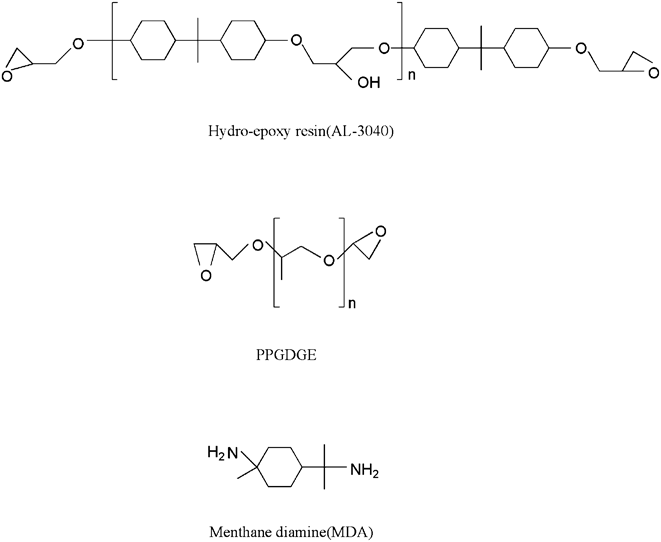
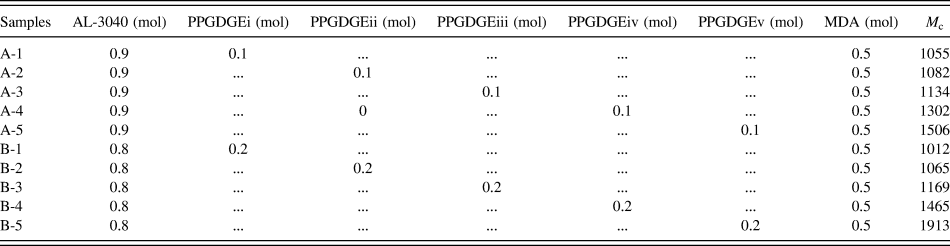
The chemical structures of reactants are shown in Fig. 1. Hydro-epoxy resin (AL-3040, epoxy value = 0.43 eq/100 g) was manufactured by Yantai Aolifu Chemical Industry Co., Ltd. (Yantai, Shandong, P.R.China). Dipropyleneglycol diglycidyl ether (PPGDGEi, molecular weight = 246.3 g/mol) and poly(propylene glycol) diglycidyl ether (average molecular weight = 380, 640, 1380, and 2500 g/mol, respectively for PPGDGEii, PPGDGEiii, PPGDGEiv, and PPGDGEv) were purchased from Dow Chemical Co. (Midland, MI) and Aldrich (St. Louis, MO), respectively. The curing agent MDA was purchased from WuXi Kaimike Electronic Materials Co., Ltd. (Wuxi, Jiangsu, P.R. China). By keeping the PPGDGE content constant, the crosslink density of the shape-memory hydro-epoxy network can be changed by varying the molecular weight of PPGDGE. Based on this approach, two series of epoxy polymers were synthesized: A series with low PPGDGE content (A-1 through A-5) and B series with high PPGDGE content (B-1 through B-5). The detailed formulations of the shape-memory hydro-epoxy are summarized in Table I. After mixing the three-part epoxy (AL-3040, MDA, PPGDGE), degassing was carried out at 40 °C in a 25-inch Hg vacuum oven to obtain a bubble-free prepolymer. After degassing, the prepolymer solution was then placed between two teflon-covered glass plates using a 4-mm thickness rubber spacer. A thermal curing program was performed at 100 °C for 5 h, 130 °C for 5 h and then at 150 °C for 2 h. Upon the completion of the cure, the epoxy samples were demolded and cut into rectangular shapes for DMA, flexural test, and deformation-recovery tests.
Chemical structures of hydro-epoxy resin, PPGDGE and MDA.

Compositions of the shape-memory epoxy samples.
M c is the average molecular weight between crosslink points of the epoxy samples, which is calculated using M c = (n Al-3040·M Al-3040 + n PPGDGE·M PPGDGE + n MDA·M MDA)/n MDA, where n and M represent the molarity and molar mass of the corresponding component in the epoxy formulations.
B. Methods
1. DSC
The thermal properties of the shape-memory hydro-epoxy resin were characterized using differential scanning calorimetry (DSC). DSC measurements were made under nitrogen using an MDSC 2910 system (TA Instruments, New Castle, DE) from −40 to 150 °C at a heating rate of 10 °C/min.
2. DMA
The thermo-mechanical properties of the shape-memory hydro-epoxy resin were investigated using a DMA Q800 system (TA Instruments) in multifrequency-strain mode from −10 to 150 °C. The sample dimensions were 28 × 13 × 3.5 mm3. The samples were heated at a rate of 3 °C/min, and an applied strain of 0.1% was oscillated at a constant frequency of 1 Hz.
3. Flexural test
Three-point flexural tests were carried out using a universal testing machine (Instron 4467, London, UK) with rectangular specimens at room temperature. The span was 56 mm, and the crosshead speed was 2 mm/min. The sample dimensions were 85 × 15 × 3.5 mm3, and the flexural strength under fixed deflection (1.5 × 3.5 mm) was measured.
4. U-type shape-memory test
Rectangular specimens (85 × 15 × 3.5 mm3) were used to evaluate the shape-memory properties of the hydro-epoxy resin. Five specimens were measured under each condition. A shape-memory test was performed according to the following steps: (i) the specimens were heated up to a certain temperature in an oven and held for 10 min for full heating. The temperatures used were T g, T g + 5 °C, and T g + 10 °C, (ii) the specimens were bent into U shapes, circling a center axis with a 10-mm diameter. The bending angle was recorded as θ1. The U-shaped specimens were then quickly removed from the oven and dipped into a cold water bath (20 °C) with a constant external force. Afterward the U-shaped specimens were left at room temperature (20 °C) for 2 h. The bending angle was recorded as θ2 at this moment. (iii) To quantify shape-memory properties, the U-shaped specimens were placed into an oven set to the temperature at which they were deformed, and the shape recovery process was observed. When the specimens did not change, the recovery time was recorded. This recovery time was designated as the shape recovery time for that temperature. The bending angle was then recorded as θ3. The shape fixity ratio (R f) and shape recovery ratio (R r) were calculated using Eqs. (1) and (2).
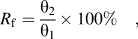 $${R_{\rm{f}}} = {{{{\rm{\theta }}_2}} \over {{{\rm{\theta }}_1}}} \times 100\% \quad ,$$
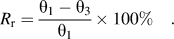 $${R_{\rm{r}}} = {{{{\rm{\theta }}_1} - {{\rm{\theta }}_3}} \over {{{\rm{\theta }}_1}}} \times 100\% \quad .$$
III. RESULTS AND DISCUSSION
A. Thermal and dynamic mechanical analyses
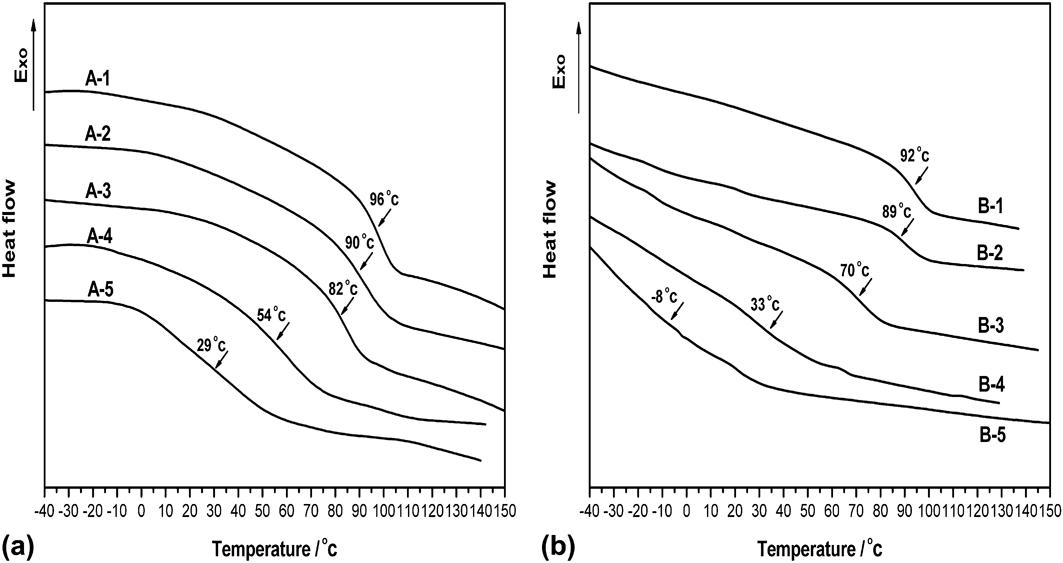
The DSC curves of the A series and B series are shown in Fig. 2. The T g values obtained from DSC analysis are also marked in Fig. 2. As shown in Fig. 2(a), all polymers show distinct T g values ranging from 96 to 29 °C, and T g values gradually decrease with the decrease of the crosslink density. T g is the essential transition temperature from freezing to free-motion states of segments in a polymer network. In the shape-memory hydro-epoxy resin network, the decrease of the cross-link density improves the mobility of the segments and thus results in the decrease of T g. Figure 2(b) shows DSC curves of the B series. The figure also reveals that T g values gradually decrease as the crosslink density decreases. B-5, for which T g is too low to be used as an SMP, is abandoned in the subsequent experiments.
DSC curves for the A series (a) and B series (b).
A closer examination of Fig. 2 reveals that T g of the samples with the same PPGDGE decreases as the PPGDGE content increases. For instance, T g of sample A-3 is 82 °C, whereas that of sample B-3 is just 70 °C. Because of the high flexibility of PPGDGE, the chain flexibility of the polymer network improves as PPGDGE content increases; this would lead to the decrease of the corresponding T g. This experimental result has also been observed many times.Reference Wei, Zhu, Tang, Tian and Xie19,Reference Leng, Wu and Liu20
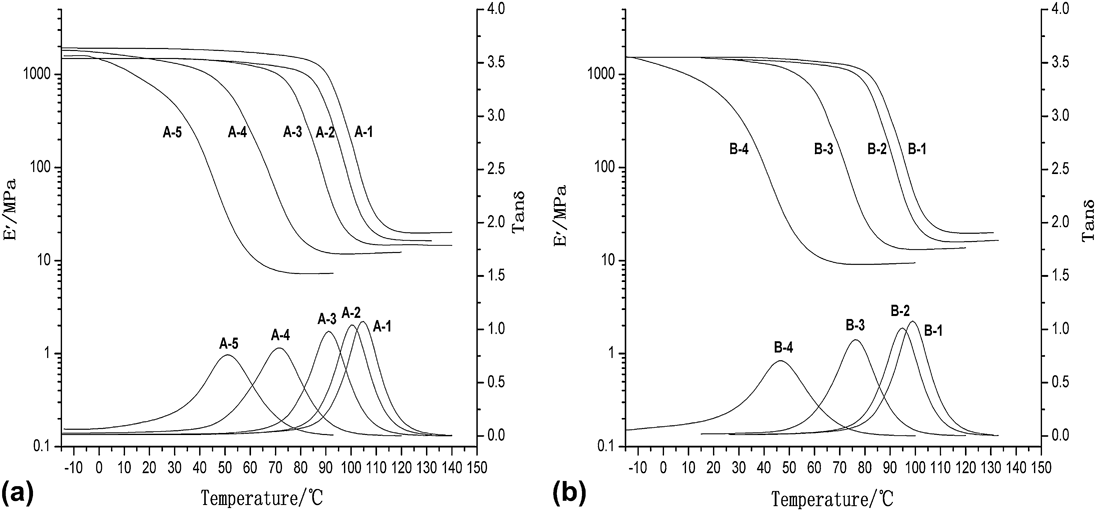
These polymers are further characterized using DMA, and the curves are shown in Fig. 3. The glass/rubber modulus ratio is defined as the elastic ratio, and higher elastic ratios would be beneficial for SMP shape retention. Figure 3(a) shows that all polymers undergo a change in storage modulus (E′) two magnitudes below and above T g, which is beneficial for exhibiting good shape-memory capability. Figure 3(a) reveals that the rubbery modulus of samples gradually decreases with decreasing crosslink density. According to the rubbery elasticity theory, the rubber modulus is proportional to its cross-link density. This observation is consistent with the theory of rubber elasticity. Figure 3(a) also reveals that T g values obtained from DMA (tanδ) gradually decline with the decrease in the crosslink density. A closer examination of Fig. 3(a) reveals that T g values obtained from DMA (tanδ) are lower than those obtained from DSC. This difference can be explained by the frequency effect in the DMA test. Figure 3(a) also indicates that the relaxation peak height of samples decreases as the crosslink density decreases. The height of the relaxation peak is proportional to the energy dissipation of segment movement. Therefore, as the crosslink density decreases, the hindering of the segment movement is decreased, thus decreasing the height of the relaxation peak. The same trend between the crosslink density, rubbery modulus, glass transition temperature, and relaxation peak height can be observed in the B series [Fig. 3(b)].
DMA curves for the A series (a) and B series (b).
Compared with other samples, as seen in Fig. 3, the full width at half maximum for samples A-1 and B-1 in tanδ peaks is narrower, which means that samples A-1 and B-1 have a relatively narrow glass transition temperature range. It also means that the freezing segment will be activated only when the temperature is close to T g. This should be attributed to the well-defined chain length of the dipropyleneglycol diglycidyl ether (PPGDGEi).
B. Mechanical property analysis
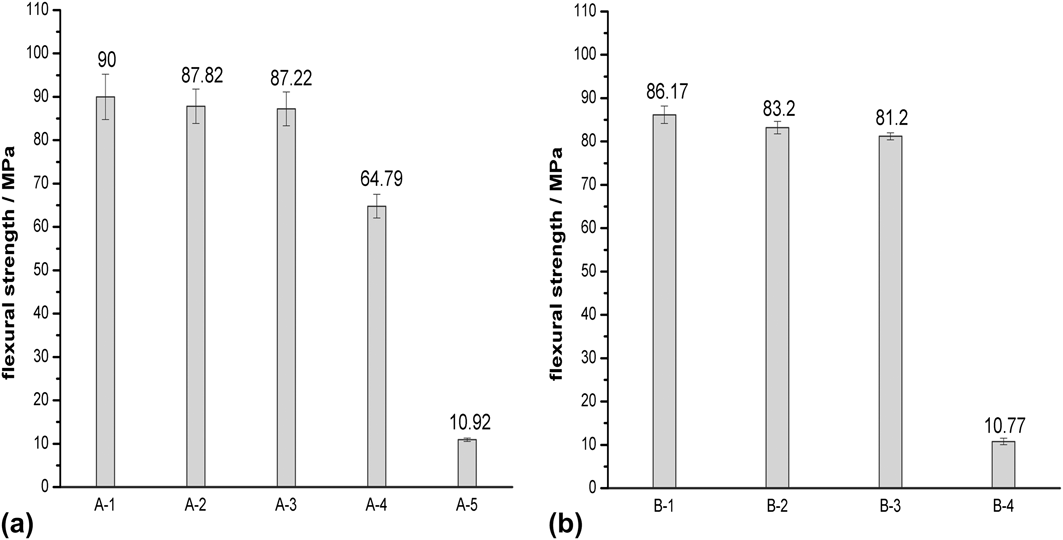
Figure 4(a) shows that, in the A series, the flexural strength gradually decreases as the crosslink density decreases. Crosslink points are responsible for carrying the load, thus, the decrease in flexural strength is expected on decreasing crosslink density. The same trend between the crosslink density and flexural strength can be observed in the B series [Fig. 4(b)].
Flexural strength of the A series (a) and B series (b) at room temperature.
A closer examination of Fig. 4 reveals the flexural strength of the samples with the same PPGDGE decrease as the PPGDGE content increases. For instance, flexural strength of sample A-3 is 87.22 MPa, whereas that of sample B-3 is just 81.2 MPa. This should be attributed to the influence of chain flexibility. Because of the high flexibility of PPGDGE, the chain flexibility of the polymer network improves as the PPGDGE content increases; this would weaken the interaction between the segments. Therefore, the flexural strength decreases as the PPGDGE content increases.
C. Shape-memory properties
Figure 5 shows a sequence of photographs of the shape recovery process of sample A-4 in an 80 °C water bath. The U-shaped specimen is obtained by the vacuum casting method. The U-shaped specimen is heated up to 80 °C in an oven and held for 10 min for full heating. Then, the specimen is deformed into straight shape through bending. Upon cooling under load, the deformed temporary shape is fixed. When the specimen is placed into an 80 °C water bath, full recovery can be observed after only 79 s.
The shape recovery process of sample A-4 in an 80 °C water bath.
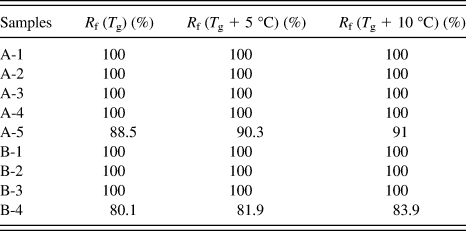
The shape fixity ratio of the sample is obtained using the U-type shape-memory test. The shape fixity ratios of A series and B series are shown in Table II. It can be seen that the shape fixity ratios of samples A-5 and B-4 did not reach 100% when the samples are deformed at T g, T g + 5 °C, and T g + 10 °C. The T g values are obtained from DMA (tanδ). However, the shape fixity ratios of other samples can reach 100% no matter what deformation temperature used. As can be seen in Fig. 3, samples A-5 and B-4 have relatively low T g and wide glass transition temperature range. This means that partial freezing segments of the polymer network could be activated when the samples A-5 and B-4 are left at room temperature (20 °C). So the shape fixity ratios of the samples A-5 and B-4 could not reach 100%. A closer examination of Table II reveals that the shape fixity ratios of the samples A-5 and B-4 gradually increase as the deformation temperature increases. For instance, the shape fixity ratio of sample B-4 is 80.1% when the sample is deformed at T g, whereas that of sample B-4 reaches 83.9% when the sample is deformed at T g + 10 °C. In the U-type shape-memory test, the strain energy is stored in the form of internal stress in a temporary shape. Upon subsequent heating, the stored strain energy is released in the form of a recovery force, which would unbend the samples into their original shapes. From Fig. 3, it can be seen that the storage modulus (E′) decreases as the temperature increases, which means that there is less strain energy stored as the deformation temperature increases, during which the specimen is deformed. Thus, the shape fixity ratios of samples A-5 and B-4 gradually increase as the deformation temperature increases.
The shape fixity ratios of the A series and B series.
According to the result of the U-shaped test, full recovery can be observed after only several minutes at T g, T g + 5 °C, and T g + 10 °C; hence, the shape recovery ratio (R r) of the A series and B series can reach 100%. This indicates that, in the A series and B series, the crosslink density has little influence on material shape recovery ratio (R r).
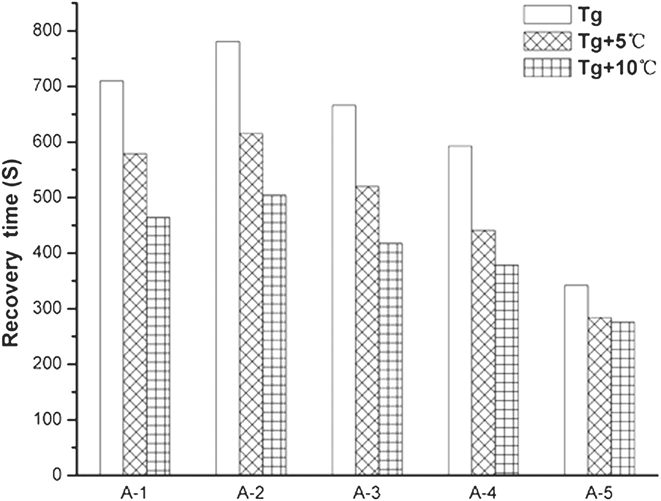
Figure 6 shows the shape recovery times of the A series at T g, T g + 5 °C, and T g + 10 °C. Figure 6 reveals that it costs less time to complete the shape recovery process at higher temperature for the same sample. The free volume of the polymer increases with the increase in temperature; thus, the hindering of the segment movement is decreased. Therefore, the shape recovery time decreases as the temperature increases. As seen in Fig. 6, in the A series, when the temperature remains the same, the shape recovery time increases first and then decreases as the crosslink density decreases. The strain energy is stored in the form of internal stress in a temporary shape. From Fig. 3(a), the storage modulus (E′) decreases as the crosslink density decreases, which means that there is less strain energy stored as the crosslink density decreases, during which the specimen is deformed. Thus, the shape recovery time would increase as the crosslink density decreases. However, with a decrease in the crosslink density, the hindering of the segment movement is also decreased. Thus, the shape recovery time would decrease as the crosslink density decreases. Based on the relationship of these two factors, the shape recovery time first increases and then decreases as the crosslink density decreases. This experimental result has also been reported for epoxy-based SMPs with different curing degrees.Reference Liu, Han, Tan and Du18
The shape recovery time of the A series at T g, T g + 5 °C, and T g + 10 °C.
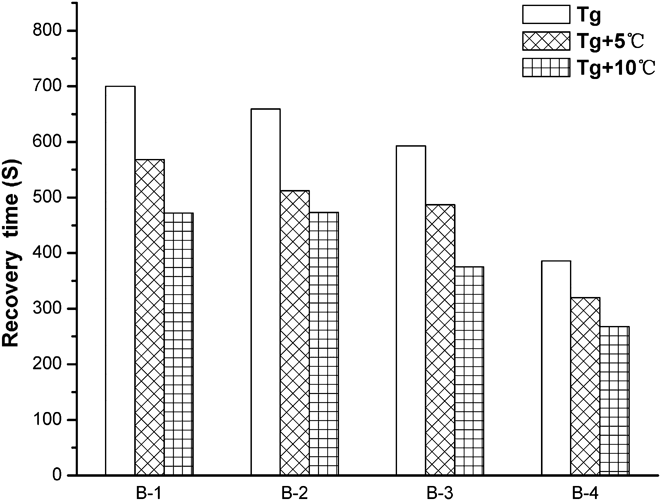
The shape recovery time of the B series at T g, T g + 5 °C, and T g + 10 °C is shown in Fig. 7. It reveals that, in the B series, the shape recovery time gradually decreases with a decrease in crosslink density. This means that, with increasing PPGDGE content, the crosslink density is the major factor that influences the shape recovery time of the material.
The shape recovery time of the B series at T g, T g + 5 °C, and T g + 10 °C.
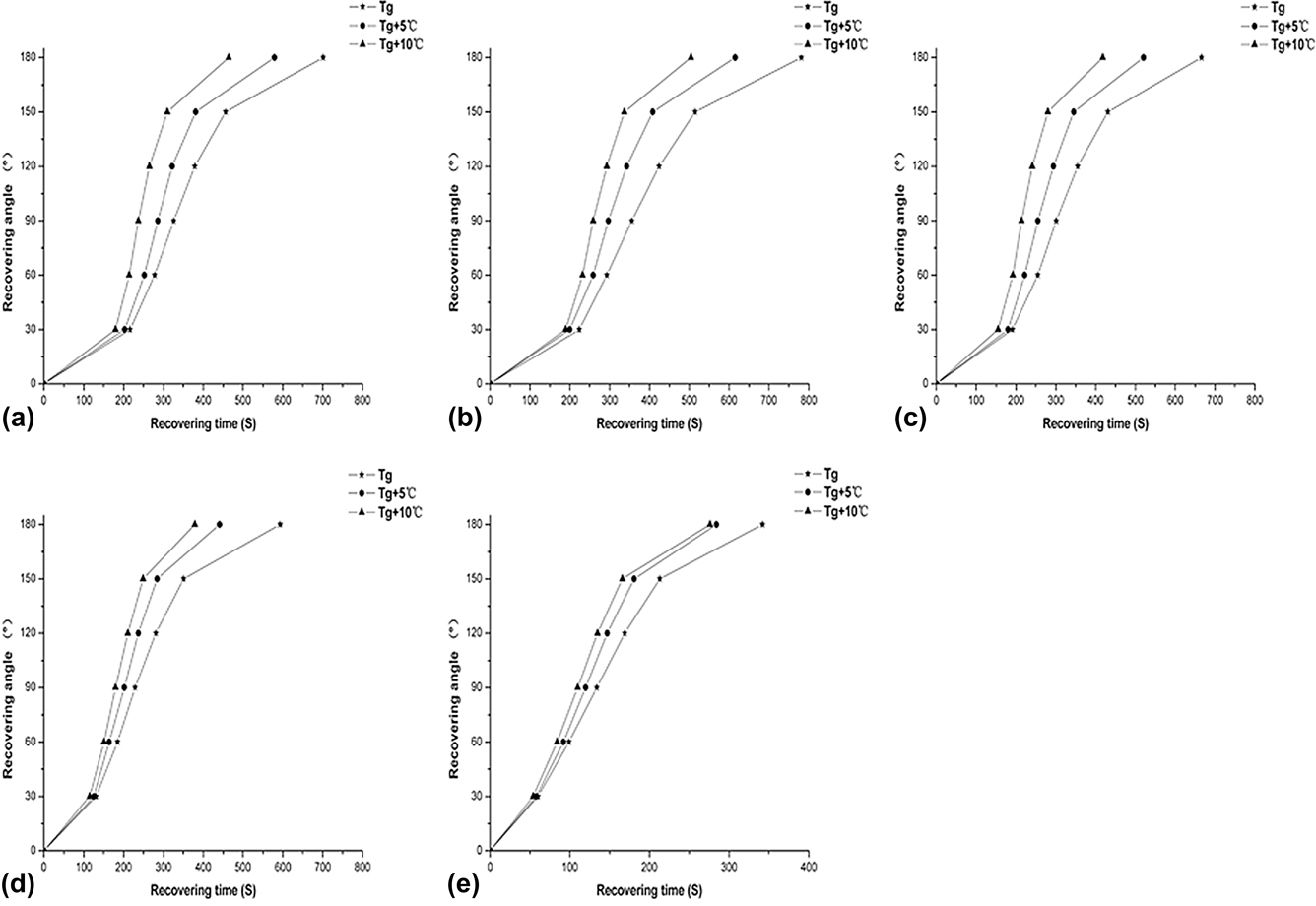
The relationship between recovering angle and recovering time of the A series at T g, T g + 5 °C, and T g + 10 °C is shown in Fig. 8. Figure 8 reveals that the slope of the curve is generally higher from 30 to 150°. This means that it has a relative low recovery rate at the start and terminal stage. At the start stage, the release of the internal stress is followed by relatively strong friction between the segments, thus decreasing the recovery rate. At the last stage, the stored strain energy has been released largely at the incipient stage, so the recovery rate becomes slow. The same trend of the shape recovery rate has been reported in the literature.Reference Liu, Han, Tan and Du18,Reference Lan, Liu, Leng and Du21,Reference Castro, Westbrook, Hermiller, Ahn, Ding and Qi22 In the B series, the same trend between the recovering angle and the recovering time at T g, T g + 5 °C, and T g + 10 °C has been observed (data not shown).
Relationship between recovering angle and recovering time of the sample A-1 (a), sample A-2 (b), sample A-3 (c), sample A-4 (d), and sample A-5 (e).
IV. CONCLUSION
By keeping the PPGDGE content constant, the crosslink density of shape-memory hydro-epoxy network can be changed by varying the molecular weight of PPGDGE. Based on this approach, two series of epoxy polymers with different PPGDGE contents are fabricated. DSC and DMA measurements on the shape-memory hydro-epoxy resins show that the glass transition temperature and rubber modulus gradually decrease as the crosslink density decreases. The room temperature flexural strength of the material also gradually decreases as the crosslink density decreases. The U-type shape-memory test shows that the crosslink density has little influence on material shape recovery ratio. Full recovery can be observed after only several minutes when the temperature is equal to or above T g. However, the crosslink density has a profound effect on the shape fixity ratio (R f). If the crosslink density is too low, the shape fixity ratio of the shape-memory hydro-epoxy resin would not reach 100%. The U-type shape-memory test also shows that the shape recovery time of the shape-memory hydro-epoxy resin system with low PPGDGE content increases first and then decreases as the crosslink density decreases. However, with the increase of PPGDGE content, the crosslink density would be the major factor that influences the shape recovery time of the material. The shape recovery time of the shape-memory hydro-epoxy resin system with high PPGDGE content decreases as the crosslink density decreases.
ACKNOWLEDGMENTS
This work was supported by the Doctorate Foundation of Northwestern Polytechnical University (Grant No. CX201234), the Northwestern Polytechnical University Foundation for Fundamental Research (Grant No. NPU-FFR-201047), and the National Natural Science Foundation of China (NSFC) (Grant No. 51208043).