


1. INTRODUCTION
The propagation of ultra-high intensity laser beams in plasmas has recently received significant attention, mainly due to their potential applications in the development of X-ray lasers (Faenov et al., Reference Faenov, Magunov, Pikuz, Skobelev, Gasilov, Stagira, Calegari, Nisoli, De Silvestri, Poletto, Villoresi and Andreev2007; Svanberg & Wahlstrom, Reference Svanberg and Wahlstrom1995), plasma-based accelerators (Joshi et al., Reference Joshi, Malka, Darrow, Danson, Neely and Walsh2002; Tajima & Dawson, Reference Tajima and Dawson1979; Nakajima et al., Reference Nakajima, Fisher, Kawakubo, Nakanishi, Ogata, Kato, Kitagawa, Kodama, Mima, Shiraga, Suzuki, Yamakawa, Zhang, Sakawa, Shoji, Nishida, Yugami, Downer and Tajima1995; Modena et al., 2002; Gordon et al., Reference Gordon, Tzeng, Clayton, Dangor, Malka, Marsh, Modena, Mori, Muggli, Najmudin, Neely, Danson and Joshi1998; Malka et al., Reference Malka, Fritzler, Lefebvre, Aleonard, Burgy, Chambaret, Chemin, Krushelnick, Malka, Mangles, Najmudin, Pittman, Rousseau, Scheurer, Walton and Dangor2002; Geddes et al., Reference Geddes, Toth, Van Tilborg, Esarey, Schroeder, Bruhwiler, Nieter, Cary and Leemans2004; Faure et al., Reference Faure, Glinec, Pukhov, Kiselev, Gordienko, Lefebvre, Rousseau, Burgy and Malka2004; Mangles et al., Reference Mangles, Murphy, Najmudin, Thomas, Collier, Dangor, Divall, Foster, Gallacher, Hooker, Jaroszynski, Langley, Mori, Norreys, Tsung, Viskup, Walton and Krushelnick2004; Lifschitz et al., Reference Lifschitz, Faure, Glinec, Malka and Mora2006; Singh et al., Reference Singh, Sharma and Tripathi2010), and fast-ignition schemes for inertial confinement thermonuclear fusion (Deutsch et al., Reference Deutsch, Bret, Firpo, Gremillet, Lefebvre and Lifschitz2008; Hora, Reference Hora2007; Kline et al., Reference Kline, Montgomery, Rousseaux, Baton, Tassin, Hardin, Flippo, Johnson, Shimada, Yin, Albright, Rose and Amiranoff2009; Tabak et al., Reference Tabak, Hammer, Glinsky, Kruer, Wilks, Woodworth, Campbell, Perry and Mason1994; Romagnani et al., Reference Romagnani, Borghesi, Cecchetti, Kar, Antici, Audebert, Bandhoupadjay, Ceccherini, Cowan, Fuchs, Galimberti, Gizzi, Grismayer, Heathcote, Jung, Liseykina, Macchi, Mora, Neely, Notley, Osterholtz, Pipahl, Pretzler, Schiavi, Schurtz, Toncian, Wilson and Will2008; Roth et al., Reference Roth, Cowan, Key, Hatchett, Brown, Fountain, Johnson, Pennington, Snavely, Wilks, Yasuike, Ruhl, Pegoraro, Bulanov, Campbell, Perry and Powell2001; Seifter et al., Reference Seifter, Kyrala, Goldman, Hoffman, Kline and Batha2009). In all of these applications, it is necessary for a high intensity laser beam to propagate in a controllable manner over a long distance with high directionality. If the laser peak power is high enough, a laser beam can overcome the natural limit of refraction, and undergo a focusing effect in the plasma due to non-linear self-interaction (Askaryan, Reference Askaryan1962; Litvak, Reference Litvak1969; Max et al., Reference Max, Arons and Langdon1974; Borisov et al., Reference Borisov, Borovskiy, Shiryaev, Korobkin, Prokhorov, Solem, Luk, Boyer and Rhodes1992; Monot et al., Reference Modena, Najmudin, Dangor, Clayton, Marsh, Monot, Auguste, Gibbon, Jakober, Mainfray, Dulieu, Louis-Jacquet, Malka and Miquel1995). The balance between self-focusing and diffraction can provide a condition for long-distance propagation of beams with peak intensity higher than otherwise achievable in vacuum. Beam self-focusing is strongly affected by the transverse distribution of beam irradiance (Sodha & Faisal, Reference Sodha and Faisal2008; Sodha et al., Reference Sodha, Ghatak and Tripathi1976; Sodha et al., Reference Sodha, Ghatak and Tripathi1974). In a recent series of investigations, Sodha et al. (Reference Sodha, Mishra and Misra2009a, Reference Sodha, Mishra and Misra2009b) have presented a modified paraxial-like approach to analyze the propagation characteristics of a hollow Gaussian beam (HGB) in the vicinity of its irradiance maximum in the plasma by taking note of the saturating character of the nonlinearities (i.e., ponderomotive, collisional, and relativistic). In continuation of previous investigations (Sodha et al., Reference Sodha, Mishra and Misra2009a, Reference Sodha, Mishra and Misra2009b) Misra and Mishra (Reference Misra and Mishra2009) modeled the propagation of a hollow Gaussian electro-magnetic beam in a plasma, considering the combined effect of relativistic and ponderomotive nonlinearity. It is shown that the critical curves and self focusing depend strongly on the order of the HGB; the propagation of the HGB follows the characteristic three regimes in the vicinity of the maximum irradiance. To our best knowledge, earlier theoretical investigations have tacitly considered beams with a Gaussian intensity distribution along the wavefront, implying that the laser is operated in the TEM00 mode. The aim of this article is to investigate, for the first time, the effect of a deviation from an initial Gaussian beam spot assumption on the actual evolution of the beam profile.
The physics of laser plasma interaction in the relativistic regime has been identified as an emerging area in the recent few years, and is often referred to as high-field science. The high electric field associated with the propagation of extremely intense laser beams leads to a quiver speed of electrons on the order of the speed of light in vacuum, causing significant increase in the mass of electrons and a consequent increase in the dielectric constant of the plasma; this is one of the typical mechanisms resulting in the self-focusing of beam (Hora, Reference Hora1975). Relativistic effects are dominant for a pulse duration shorter than the time needed for the manifestation of ponderomotive nonlinearity. Under the action of the ponderomotive force, electrons and ions move together at the ion sound speed c s; thus, the characteristic time for the manifestation of the ponderomotive nonlinearity is r 0/c s, where r 0 is the beam width. Additional phenomena contributing to the (de)focusing of an electromagnetic beam in a plasma are multiphoton (tunnel) ionization (Annou et al., Reference Annou, Tripathi and Srivastava1996), avalanche ionization (Stuart et al., Reference Stuart, Feit, Herman, Rubenchik, Shore and Perry1996; Derenzo et al., Reference Derenzo, Mast, Zaklad and Muller1974), harmonic generation (Sodha & Kaw, Reference Sodha and Kaw1969), modification (Gurevich, Reference Gurevich1978) of electron density, and nonlinear absorption (Sharma et al., Reference Sharma, Verma and Sodha2004). All these forms of nonlinearity are present and operate in various relative strengths in different regimes in terms of the irradiance, electron density, electron collision frequency, and duration of the pulse of the beam.
A laser beam is usually assumed to be characterized by a Gaussian intensity distribution function (df) along its wavefront. In contrast to this picture, Patel et al. (Reference Patel, Key, Mackinnon, Berry, Borghesi, Chambers, Chen, Clarke, Damian, Eagleton, Freeman, Glenzer, Gregori, Heathcote, Hey, Izumi, Kar, King, Nikroo, Niles, Park, Pasley, Patel, Shepherd, Snavely, Steinman, Stoeckl, Storm, Theobald, Town, Van Maren, Wilks and Zhang2005) measured the intensity profile for the Vulcan petawatt laser and found that only 20% of the energy was contained within the full-width-at-half-maximum (FWHM) of 6.9 μm and 50% within 16 μm. For comparison, a Gaussian df would contain 50% of the energy within the FWHM and 97.6% within 16 μm. Nakatsutsumi et al. (Reference Nakatsutsumi, Davies, Kodama, Green, Lancaster, Akli, Beg, Chen, Clark, Freeman, Gregory, Habaral, Heathcote, Hey, Highbarger, Jaanimagi, Key, Krushelnick, Ma, Macphee, Mackinnon, Nakamura, Stephens, Storm, Tampo, Theobald, Van. Woerkom, Weber, Wei, Woolsey and Norreys2008) recently suggested a q-Gaussian distribution function (Tsallis, Reference Tsallis1988), namely:

(see Fig. 1), to reproduce this behavior (here r is the spatial coordinate in the radial direction, and f(0) is a real constant, to be determined by normalization requirements). Further investigations of the laser beam spot profile on the Vulcan laser in Rutherford Appleton laboratories (Davies, J.R. (2010). Private communication) seem to suggest that the beam intensity is characterized by a function of the form

– cf. (1) above – or by a combination of such functions, where the values of the relevant parameters (q and r 0 here) can be obtained by fitting experimental data. Inspired by these challenging findings, we have here undertaken a thorough investigation of the spatial beam profile dynamics of a q-Gaussian laser beam propagating in relativistic plasma.
(Color online) Image of focal spot in vacuo at low energy taken with a 16-bit CCD camera (left). Radial lineout of focal spot intensity showing 20% and 50% encircled energy boundaries (right). Adapted from (Patel et al., Reference Patel, Key, Mackinnon, Berry, Borghesi, Chambers, Chen, Clarke, Damian, Eagleton, Freeman, Glenzer, Gregori, Heathcote, Hey, Izumi, Kar, King, Nikroo, Niles, Park, Pasley, Patel, Shepherd, Snavely, Steinman, Stoeckl, Storm, Theobald, Town, Van Maren, Wilks and Zhang2005)

A few comments on nonthermal distributions appear to be in order here, for the sake of rigor and completeness. In fact, Ex. (1) is structurally reminiscent of the κ distribution (Vasyliunas, Reference Vasyliunas1968; Hellberg et al., Reference Hellberg, Mace, Baluku, Kourakis and Saini2009). (Various forms of the κ distribution have appeared in the past; we refer the reader to the discussion in the references by Hellberg et al. (Reference Hellberg, Mace, Baluku, Kourakis and Saini2009) and Livadiotis and McComas (Reference Livadiotis and Mccomas2009).) As pointed out above, it is also inspired by the Tsallis (“q-Gaussian”) distribution (Tsallis, Reference Tsallis1988), which lies in the foundation of non-extensive thermodynamics. Despite a number of works that have addressed the apparent ubiquity of the former (kappa) distributions in various plasma contexts (Treumann, Reference Treumann2001; Treumann et al., Reference Treumann, Jaroschek and Scholer2004; Collier, Reference Collier2004), there is at this stage no comprehensive theory relating this family of distributions to the fundamental underlying physics. Quite remarkably, a recent study (Livadiotis & McComas, Reference Livadiotis and Mccomas2009) claims to establish a rigorous link between the κ (family of) distribution(s) and the Tsallis distribution. This analogy is however certainly not algebraically straightforward, and still appears to be a controversial topic.
2. ANALYTICAL MODEL
The effective dielectric constant of a homogeneous plasma in the presence of a electromagnetic beam can be formally expressed as (Sodha et al., Reference Sodha, Ghatak and Tripathi1976)

where ωp is the plasma frequency, ω is the frequency, and E is the electric field associated with the laser beam. The explicit dependence of the function ϕ on |E|2 = EE* (the star here denoting the complex conjugate) needs to be determined in terms of the physical system considered. By increasing the beam power, the dielectric constant tends to reach its saturation value. The nonlinear character of the dielectric constant thus affects the dynamics of the laser beam and has naturally been attracting significant attention among researchers for well over 30 years. Some challenging aspects of the beam propagation characteristics are revealed by considering non-Gaussian beam behavior, as shown and discussed in the following. We shall investigate here the non-paraxial propagation characteristics of a petawatt (1015 W) laser beam with power 0.32 PW and intensity 1.37 × 10¹⁸ W/cm2 with spatial and temporal resolution of 30 μm and 17 ps, respectively. The intensity distribution profile of the beam is considered to be given by a q-Gaussian function, in fact given by (1) above.
Let us consider a circularly polarized laser beam propagating in the axial (z-)direction:

where e x and e y are the unit vectors along the x and y axes, respectively. The amplitude A is a slowly varying function of space (r, z) and time t. The electric field E satisfies the wave equation

which can be directly derived from Maxwell's equations. For a transverse field E

k here being the propagation vector. We note that ∇(∇.E) has been neglected in deriving Eq. (5) (even if E has a longitudinal component, the term ∇(∇·E) can be neglected provided that  , a condition satisfied in most cases of interest). We need to stress that (5) is a nonlinear equation, since ε depends on |E| via (3).
The initial intensity profile of the q-Gaussian laser pulse can be written as,

where a = eA/mωc is the normalized laser field and a 00 is the initial normalized laser field amplitude. We note that  , where I is expressed in W/cm2 and λ is expressed in μm. We assume the temporal profile of the pulse—see F(t) in Eq. (7)—to be Gaussian, viz.,

where τ0 is the initial pulse width. The deviation from the Gaussian profile is measured by the real parameter q, which acquires smaller (finite) values for a strongly non-Gaussian profile. The usual Gaussian distribution is recovered for q → ∞. Note that the steady state dynamics is implicitly considered in order to explore the spatial evolution of a q-Gaussian beam profile.
Figure 2 illustrates the normalized intensity profile of the laser beam for different values of q. Small values of q are characterized by a long tail, while as q increases toward higher values, the distribution gradually converges to a Gaussian profile, attained at infinity.
(Color online) Initial intensity profile of the q-Gaussian laser pulse for q = 1.4748, 1.714, 3, and ∞; from (Eqs. 8 and 7). The radial distance (r) and time (t) are normalized by the initial beam width and initial pulse width respectively. Panels (a)–(d) show the normalized 3D intensity initial snapshots of a q-Gaussian laser pulse whose spatial beam radius (r 0) is 30 μm and temporal pulse duration (τ0) is 17 ps, respectively. Figure 2e shows the spatial intensity profiles of q-Gaussian beam. The color bar represents the variation of the initial intensity. The long tail associated with small q is clearly visible.

The laser pulse propagates at the group velocity v g = c 2k/ω, where k is the wave number given by the plasma dispersion relation, c 2k 2 = ω2 − ωp2. We shall introduce the coordinate transformation τ = t − (z/v g) and z → z. Now using Eq. (4), the wave Eq. (5) can be written as,

Eq. (9) is the equation of evolution for the field envelope, and includes the effects of diffraction, transverse focusing and nonlinearity. The last term represents the nonlinearity effect, which arises due to the dependence of the dielectric constant on the intense laser field.
The nonlinear dielectric constant appearing in Eqs. (5) and (9) may be expressed (in the non-paraxial approximation) as

where ε1(z, t) and ε2(z, t) express the radial spot profile dependence (vanishing at r = 0). The exact expansion for ε(r, z, t) will be obtained later; refer to Eqs. (21)–(24) below.
The solution of Eq. (9) can be expressed as

where both amplitude (a 0) and eikonal (S) are real quantities; eikonal S is related with the curvature of wavefront. Substituting for a from Eq. (11) in Eq. (9) and separating the real from the imaginary parts, one obtains

and

Adopting the higher order paraxial theory (Liu & Tripathi, Reference Liu and Tripathi2001; Sodha & Faisal, Reference Sodha and Faisal2008; Sodha et al., Reference Sodha, Ghatak and Tripathi1976, Reference Sodha, Ghatak and Tripathi1974), we anticipate a solution for Eqs. (12) and (13) in the form
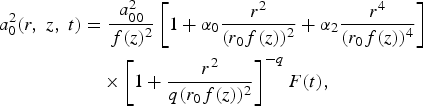
and

where α0, α2, S 2 and the beam width parameter f are functions of z. Identifying the components of the eikonal (S) in the latter expression, the first term above is indicative of the spherical curvature of the wavefront, while S 2 represents its departure from the spherical nature. The parameters α0, and α2 characterize the off-axis contribution to the beam intensity; these higher order terms play a crucial role in the dynamics of a q-Gaussian beam, as we shall show below. The latter two Eqs. (14) and (15) have also been employed by Liu & Tripathi (Reference Liu and Tripathi2001) and Sodha & Faisal (Reference Sodha and Faisal2008) for non-paraxial Gaussian beam propagation.
Using Eqs. (11), (14), and (15), the intensity profile of a q-Gaussian laser pulse can be expressed as
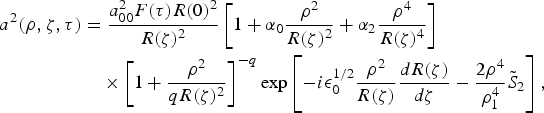
where R(ζ) = ρ1f(ζ) is the beam width (in the radial direction), R(0) = ρ1 = r 0ω/c is the initial dimensionless beam width [viz. f(ζ = 0) = 1], ζ = ωz/c, ρ = rω/c and  . The laser pulse profile in plasma can be obtained by solving the following four coupled second order ordinary differential Eqs. (ODEs):


and

where p = a 002 F(τ)/f(ζ)2. At ζ = 0 and τ = 0, p = a 002 is the initial normalized laser field amplitude.
We have obtained Eqs. (17) and (18) by substituting (14), (15) [along with (10)] into (13), and then equating the coefficients of r 2 and r 4, respectively. In a similar fashion, Eqs. (19) and (20) were obtained by substituting (14) and (15) into (12). At this stage, knowing ε0 and ε1, one can solve the first three among the equations above and then integrate the latter one numerically, to obtain the beam width parameter (f) as a function of z. If the functional form of ε1 is known, one can easily evaluate ε0 and ε1. Note that their form depends on (and reflects the physical features of) the beam-plasma model considered (Sodha & Faisal, Reference Sodha and Faisal2008; Sodha et al., Reference Sodha, Ghatak and Tripathi1976, Reference Sodha, Ghatak and Tripathi1974).
The index of refraction for a small-amplitude electro-magnetic wave (a weak laser beam) propagating in plasma with density n e is given by n = ck/ω = (1−ωp2/ω2)1/2. As the laser intensity increases, the effect of the transverse quiver motion of plasma electrons becomes stronger and the electron mass is modified by the relativistic effect, viz. ωp2 → ωp2/γ, which eventually affects the expression for n. The conservation of transverse canonical momentum imposes a = γβ, where β = v/c is the normalized velocity of the plasma electrons, and the Lorentz factor γ (for the electrons) is given by γ≈(1+a 2)1/2 for a circularly polarized laser [read (1+a 2/2)1/2 for linear polarization]. Thus, the relativistic refractive index of plasma can be written as n = [1−(ωp02 /ω2)(1+a 2)−1/2]1/2, where ωp0 is the unperturbed plasma frequency (in the absence of the electromagnetic field).
If the radial profile of γ attains a maximum on the axis, i.e., for a laser beam intensity profile peaked on the axis, or γ(0) > γ(r), then the index of refraction n(r) can reach a maximum on the axis. This causes the wavefront to curve inwards and the laser beam to converge, which may result in optical guiding of the laser light. Since the laser phase velocity v ph depends on the index of refraction, v ph = c/n, it will then depend on the laser intensity. Local variation in the phase velocity will modify the shape of the laser pulse, and, consequently, the spatial and temporal profile of the laser intensity. Relativistic self-focusing occurs when the laser power exceeds a critical power, given by P c = 17(ω/ωp)2 GW. On the other hand, photo-ionization can defocus light and thus increase the self-focusing threshold, by increasing the on-axis density and refractive index. When this focusing effect just balances the defocusing due to diffraction, the laser pulse can be self-guided, and thus propagate over a long distance with high intensity. For a laser with peak intensity along the axis, this requires the relationships ∂ (a 2)/∂r < 0 and ∂n/∂r < 0 to be satisfied for relativistic guiding. In the following, a circularly polarized laser is assumed (it is nevertheless straightforward to extend the formalism to a linearly polarized beam).
A general expression of the relativistic dielectric constant (ε = n 2) of plasma for a large amplitude electromagnetic wave can be written as

Introducing a q-dependent field distribution (as given by Eq. (16)) in the latter Eq. (21), one obtains the components of the dielectric constant in (10) as

and

and
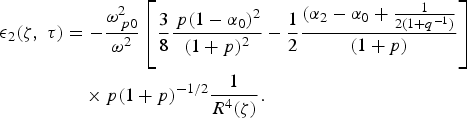
The critical relation relating the beam width and the beam power, as can be derived from Eqs. (17) and (23), will feature a parametric dependence on q. For d 2f/dζ2 = 0 at ζ = 0, τ = 0, (α0 = 0 and α2 = 0) one obtains

which for infinite q recovers the expression derived earlier for a Gaussian beam in non-absorbing collisional plasma (Sharma et al., Reference Sharma, Prakash, Verma and Sodha2003). Eq. (25) expresses the dimensionless beam width ρ1 (at f = 1) as a function of the (reduced) laser field amplitude a 00 and thus related to the initial beam power. The function can be depicted on the (a 00, ρ0) plane and is generally referred to as the critical power curve or, simply, the critical curve. If the initial values of a 00 and ρ1 of a laser beam are such that the point (a 00, ρ0) lies on the critical curve, the value of d 2f/dζ2 will vanish at ξ = 0 (z = 0). Since the initial value of df/dζ (in case the wave front is plane) is zero, the value of df/dζ continues to be zero as the beam propagates through the plasma. Hence, the initial value of f, which is unity (at z = 0), will remain unchanged. The beam thus propagates without any change in its beam width. This regime is known as uniform waveguide propagation. If an initial point (a 00, ρ0), corresponding to the initial (z = 0) normalized laser field amplitude and beam radius, lies below the critical curve (that is, on the same side of the curve as the origin) then d 2f/dζ2 > 0, while if a point lies on the other side of the critical curve then d 2f/dζ2 < 0. We retain that, when the initial point lies below (above) the critical curve, the beam width parameter will increase (decrease, respectively) at (z, f) = (0, 1).
Figure 3 illustrates the dependence of the critical curves on the value of q. The critical curves are down-shifted as q increases because of enhanced nonlinearity. The critical curves for the homogeneous and inhomogeneous cases remain the same, since these are dependent on the magnitude of the parameters at z = 0; since α0 =α2 = 0 at z = 0, the higher order terms do not affect the critical curves. As a matter of fact, the critical curves (at z = 0) are not relevant in inhomogeneous plasma, in which case the inhomogeneity parameters increase with the value of z. To see this, we recall that the higher order terms (α0, α2 and S 2) in the non-paraxial beam propagation are functions of z and in fact vary as the beam propagates in the plasma. Physically, these higher order terms represent the medium inhomogeneity in z; however, the critical relation is derived at z = 0, where these terms vanish.
(Color online) The initial (at ζ = 0) dimensionless beam width (ρ1) is depicted versus the normalized laser field (a 00) for different values of the q-parameter. The relation between the (ρ1) and (a 00) is expressed by Eq. (25). The beam propagation corresponding to points (a 00, ρ1) which lie on these curves (critical curve) leads to relativistic guided uniform beam propagation.

The critical curves remain the same as in paraxial beam propagation (Sharma et al., Reference Sharma, Kourakis and Sodha2008) as z increases, due to the plasma parameter variation (higher order terms or inhomogeneity parameters). The critical beam power and beam width relation (as given by Eq. (25)) shows the inverse dependence of the initial beam radius on the q-factor. This relationship between the critical beam power and the beam width explains clearly the beam convergence (or divergence) of a q-Gaussian electromagnetic beam. We also see from Figure 3 that the minimum value of ρ1 is higher for lower q-values (i.e., for a larger deviation from the Gaussian). It is thus predicted that larger spot-size beams with lower q-values can be relativistically guided in a plasma, in comparison with smaller spot-size Gaussian beams (or, e.g., q-Gaussian ones with large q value).
3. NUMERICAL INVESTIGATION
The evolution of a q-Gaussian beam profile can be analyzed by numerically by solving the ODE (17) coupled with Eqs. (18–20). Eqs. (17) can be numerically integrated using appropriate boundary conditions to evaluate the beam width parameter f as a function of z. For an unperturbed initial plane wave, the boundary conditions on Eq. (17) were taken as: f = g = 1, and d f/dζ = 0 at ζ = 0. We have performed a numerical computation for the following laser plasma parameters a 00 = 0.1 (I 0 = 1.37 × 10¹⁶ W/cm2, λ = 1 μm), r 0 = 30 μm, n 0 = 4 × 1020 cm−3 and ω = 1015 rad sec−1.
We have numerically obtained the normalized q-Gaussian beam intensity profile a 2(ρ, ζ, τ), as given by Eq. (16), initially (at T 1 = 0) and then at given propagation time (equivalent to a given propagation distance), as the beam propagates in the plasma. The results are shown in Figure 4 at propagation time instants T 2 = 2 ns, T 3 = 5 ns, and T 4 = 9 ns, for various values of q. The propagation time T = ζ/c (proportional to the propagation distance z or ζ) advances from left to right (within a given row, for given q). The top row (see Figs. 4a to 4d) depicts the intensity profile for a q-Gaussian beam (for q = 1.4748) propagating through relativistic plasma, in the nonparaxial region, at instants T 1, T 2 and T 3. The second, third, and bottom rows (see Figs. 4a to 4d, 4e to 4h, and 4i to 4l, respectively) show the variation of the normalized intensity for higher q values (closer to a Gaussian df) at the same time instants as the top column. We witness a fast focusing of the laser beam in the nonparaxial region. Transverse focusing of the beam dominates over diffraction, due to the nonlinear effect of relativistic mass variation. The difference in focusing/defocusing of the axial and off-axial rays leads to the beam profile maximum actually splitting on the plane transverse to propagation.
(Color online) Spatial evolution of a q-Gaussian circularly polarized laser beam: the variation of the normalized intensity, as obtained from Eqs. (8) and (16), with radial distance r and time t is shown at different propagation time (equivalent to fixed propagation distance): at T 1 = 0 (first column); T 2 = 3 fs (second column); T 3 = 7 fs (third column); T 4 = 10 fs (fourth column) (corresponding to propagation distance ζ = 0, 18 μm, 45 μ and 81 μm). The radial distance (r) and time (t) are normalized by the initial beam width and initial pulse width respectively. The results are shown for different q values: q = 1.4748 (value as in Patel et al. (Reference Patel, Key, Mackinnon, Berry, Borghesi, Chambers, Chen, Clarke, Damian, Eagleton, Freeman, Glenzer, Gregori, Heathcote, Hey, Izumi, Kar, King, Nikroo, Niles, Park, Pasley, Patel, Shepherd, Snavely, Steinman, Stoeckl, Storm, Theobald, Town, Van Maren, Wilks and Zhang2005); top row); 3 (second row); 10 (third row); 20 (practically Gaussian; bottom row). The laser plasma parameters used in the computation are: a 00 = 0.1 (I 0 = 1.37 × 10¹⁶ W/cm2, λ = 1 μm), r 0 = 30 μm, τ0 = 17 ps, n 0 = 4 × 1020 cm−3 and ω = 1015 rad sec−1. The color bar represents the variation of the normalized intensity.

It is obvious that in the paraxial region, the intensity of the laser beam is maximum at r = 0 along the distance of propagation as α0 = α2 = 0. While in the nonparaxial region the laser intensity becomes minimum at r = 0, it assumes a ring structure or a split beam-maximum profile (Sodha & Faisal, Reference Sodha and Faisal2008). In Eq. 18 at z = 0, dS 2/dζ is positive and α0 starts decreasing, while α2 increases sharply with the increase in z. Due to the combined effect of α0 and α2 the laser intensity acquires a minimum on the axis and the intensity of the nonparaxial region increases. Focusing becomes faster in the nonparaxial case in comparison to the paraxial case due to the participation of the off-axis components (α2≠α2≠0). For higher q (see the bottom row in Fig. 4), the behavior is essentially tantamount to that of a Gaussian beam (Liu & Tripathi, Reference Liu and Tripathi2001; Sodha & Faisal, Reference Sodha and Faisal2008; Sharma & Chauhan, Reference Sharma and Chauhan2008). Comparing the right-end panels—cf. Figs. 4(d, h, l, p)—we see that the focused beam intensity decreases as the value of q increases (top to bottom row, in the plot). The simulation results clearly suggest an intensity amplification by a factor 80 or higher, for a q-Gaussian (for q = 1.4748) petawatt laser beam in femtosecond time duration, compared to a Gaussian beam of the same other characteristics.
We see in Figure 4 that the divergence of the axial rays is stronger than that of the off-axial ones. The intensity distribution thus acquires a ring or split beam-maximum shape. The coefficients α0 and α2 characterizing the non-Gaussian shape start to grow with time (or propagation distance). Considering (in Fig. 4) a laser intensity I 0 = 1.37 × 10¹⁶ W/cm2 and an electron density n 0 = 4 × 1020 cm−3, at T 4 = 9 ns (equivalent to z = 81 μm), α2 > 1, we see that the laser pulse intensity becomes minimal on the axis and acquires a ring-like structure at some time (distance). This ring formation or beam splitting effect was earlier pointed out (Liu & Tripathi, Reference Liu and Tripathi2001; Sodha & Faisal, Reference Sodha and Faisal2008; Sharma & Chauchan, 2008). This effect has been observed experimentally by Chessa et al. (Reference Chessa, Wispelaere, Dorchies, Malka, Marques, Hamoniaux, Mora and Amiranoff1999), who observed a ring-shaped distribution of the Gaussian laser pulse for intensity I 0 = 6 × 10¹⁷ W/cm2, and electron density n 0 ~ 1020 cm3, at z ~ 280 μm. Most interestingly, this effect appears in fact to be intensified for non-Gaussian beams, in comparison to Gaussian ones (compare the upper three panels to the bottom one, in Fig. 4.)
We have numerically solved the coupled Eqs. (17)–(20) for the beam width parameter f, the eikonal component S 2, and the nonparaxial parameters (a 0 and a 2), to evaluate the focusing length of the beam. The numerical computation depicts the dependence of the focusing length on the non-Gaussianity parameter q. In Figure 5, the normalized self-focusing length is plotted over a range of q values. Here we have scaled the focusing length ( ) by the diffraction length (kr 02). The self-focusing length in the plasma (i.e., the minimum propagation length in the plasma where the beam becomes focused and the beam radius attains its minimum value (cf. Fig. 1b in Sharma et al., Reference Sharma, Kourakis and Sodha2008)), increases linearly for lower q values, as illustrated in Figure 5a. Figure 5b shows the dependence of the normalized focusing length on higher q-values. The simulation results demonstrate a saturating nature, as q increases toward ∞. It can be seen from Figure 2 that the higher the value of q, the narrower the beam becomes.
(Color online) The dependence of the normalized focusing length on the non-Gaussianity parameter q is depicted. The focusing length ( ) is normalized by the diffraction length (kr 02). The laser-plasma parameters used for the numerical computation are the same as in Figure 4.

In order to demonstrate the temporal dependence of the beam irradiance, we have evaluated the axial intensity (a 2(ρ = 0, ζ, τ)) as a function of ζ (distance of propagation). We have numerically solved Eq. (16) along ρ = 0, together with Eqs. (17)–(20) for the typical values of laser-plasma parameters as used in Figure 4. The dependence of the axial intensity on the propagation distance (ζ) is shown in Figure 6. Parts 6a, 6c show the variation of the axial intensity with ζ for different values of the non-Gaussian parameter (q) at τ/τ0 = 0 and at τ/τ0 = 1 respectively. Figures 6b, 6d depict the variation of the axial intensity along ζ at various time instants, for high and low values of the non-Gaussian parameter (q), respectively. These results (6a-6d)) predict a very small variation in axial intensity of beam at temporal axis (at τ/τ0 = 0) as well as at off-temporal axis (at τ/τ0 ≠ 0) for a range of q values. Figure 6 also confirms our earlier result (as shown by Fig. 4) that there is no significant variation of axial intensity (at τ/τ0≠0).
(Color online) Dependence of axial intensity a 2(ρ = 0, ζ, τ) on the propagation distance (ζ). Panels (a) and (c) show the variation of the axial intensity with ζ for different values of the non-Gaussian parameter (q) at τ/τ0 = 0 and τ/τ0 = 1. Panels (b) and (d) show the variation in the axial intensity along ζ at various values of time, for high and low values of the non-Gaussian parameter q. The laser-plasma parameters used for the numerical computation are the same as in Figure 4.

4. CONCLUSIONS
In conclusion, we have investigated the spatial evolution of a non-Gaussian circularly polarized beam propagating through relativistic plasma. A q-Gaussian distribution function was adopted for the beam spot profile. We have shown that the beam intensity profile converges toward a split profile due to the off-axis field contribution to relativistic nonlinear terms, as the beam propagates through the plasma. The difference in focusing/defocusing of the axial and co-axial rays leads to the formation of a split beam profile characterized by a minimum intensity on the axis and a maximum off it. Earlier theoretical and experimental results on Gaussian beam focusing and ring formation (Liu & Tripathi, Reference Liu and Tripathi2001; Sodha & Faisal, Reference Sodha and Faisal2008; Sharma & Chauchan, 2008; Chessa et al., Reference Chessa, Wispelaere, Dorchies, Malka, Marques, Hamoniaux, Mora and Amiranoff1999) are thus confirmed, and extended to q-Gaussian laser beam spots. The beam-splitting effect seems to be intensified by a departure from a Gaussian beam spot profile.
We have numerically investigated the focusing of a q-Gaussian petawatt laser (I 0 = 1.37 × 10¹⁶ W/cm2) and have obtained an increased beam intensity (for q = 1.4748). It is remarkable that the intensity of the final (focused) beam spot is lower for a Gaussian beam profile (i.e., for high q values). We also see that the self-focusing length of a non-Gaussian beam (low q values) is considerably lower than that of a Gaussian one, suggesting that deviation from a Gaussian behavior enhances self-focusing significantly.
Our results are of relevance in various contexts of beam plasma physics. Besides of the obvious relevance to inertial fusion, the ultra-high intensity laser channels in relativistic plasmas can have many other applications where localized electromagnetic fields are required. Our analytical and numerical results on the non-paraxial propagation of q-Gaussian beam in relativistic plasma can serve as a guide for experimental and numerical investigations of petawatt laser channeling in underdense plasmas. This should expand current knowledge in the fast ignition, high energy X-ray radiography and high energy density physics research. Petawatt lasers (power ≃ 1015 W) focused to a few microns' region have proven to be useful tools for the study of high energy density physics (Board, 2003). Conditions comparable to those in stars, supernova remnants and other astrophysical objects can now be achieved in the laboratory and such lasers are employed in inertial confinement fusion schemes (Tabak et al., Reference Tabak, Hammer, Glinsky, Kruer, Wilks, Woodworth, Campbell, Perry and Mason1994; Campbell et al., Reference Campbell, Freeman and Tanaka2006).
ACKNOWLEDGMENTS
This work was supported by a UK EPSRC Science and Innovation Award to the Center for Plasma Physics, Queen's University Belfast (Grant no EP/D06337X/1). J.R. Davies (IST, Lisbon, Portugal) is warmly acknowledged for providing access to a significant amount of inspiring data.



