INTRODUCTION
Lobsters are found in almost all temperate and tropical seas, occurring from the intertidal zone to the deep sea (Holthuis, Reference Holthuis1991). Many species, such as Scyllarides latus (Spanier & Almog-Shtayer, Reference Spanier and Almog-Shtayer1992) and S. nodifer (Ogren, Reference Ogren1977), prefer rocky substrata with cavities to shelter, whilst others are found on muddy or sandy bottoms (Holthuis, Reference Holthuis1991), which are habitats characteristic of species of the genus Ibacus (Haddy et al., Reference Haddy, Courtney and Roy2005).
The slipper lobster Scyllarides deceptor Holthuis, 1963 is distributed along the coasts of Brazil and Argentina in 30 to 300 m deep areas. Off Brazil the species has been reported in Pernambuco state (8°07′03″S 34°45′52″W) and from Rio de Janeiro state (21°17′97″S 40°57′61″W) to Rio Grande do Sul state (33°44′51″S 53°22′38″W). Along the Argentinean coast the species has been reported in the Buenos Aires Province (38°45′00″ S 57°50′00″W) (Holthuis, Reference Holthuis1991; Spivak, Reference Spivak1997; Dall'Occo, Reference Dall'Occo2005). Scyllarides deceptor is captured on sandy bottoms by otter trawlers fishing for shrimps off the southern Brazilian coast (Perez et al., Reference Perez, Pezzuto, Rodrigues, Valentini and Vooren2001). Trawl catches are concentrated within a limited area 40–70 m deep, from Imbituba (28°13′17″S 48°38′21″W) in Santa Catarina state to Tramandaí (29°56′30″S 50°07′50″W) in Rio Grande do Sul (Perez et al., Reference Perez, Pezzuto, Lucato, Vale, Cergole and Rossi-Wongtschowski2003). These catches have increasingly attracted trawlers, which landed between 2000 and 2006 232.6 tonnes in Santa Catarina state peaking at 70.8 and 72.1 tonnes in 2001 and 2002, respectively (GEP/CTTMAR/UNIVALI, 2007). Scyllarides deceptor is also commonly found on rocky coastlines, hiding in crevices of hard substrata, where individuals are usually hand-caught by snorkelling fishermen, who supply local restaurants, or as recreational fishing.
Scientific information on the biology of S. deceptor is unavailable, albeit such information is essential to prevent a collapse of this promising shellfish fishery in the future (Perez & Pezzuto, Reference Perez and Pezzuto1998). In contrast to palinurid (spiny) lobsters, fecundity and other reproductive data are scarce for scyllarid (slipper) lobsters (DeMartini & Williams, Reference DeMartini and Williams2001; Haddy et al., Reference Haddy, Courtney and Roy2005). Published data on scyllarid reproduction are limited to Scyllarides latus (Martins, Reference Martins1985; Spanier & Lavalli, Reference Spanier and Lavalli1998), S. nodifer (Hardwick & Cline, Reference Hardwick and Cline1990), S. squammosus (De Martini & Williams, 2001; DeMartini et al., Reference DeMartini, McCracken, Moffitt and Wetherall2005), S. astori (Hearn & Toral-Granda, Reference Hearn and Toral-Granda2007), Thenus orientalis and T. indicus (Hossain, Reference Hossain1975; Courtney et al., Reference Courtney, Cosgrove and Die2001), Ibacus peronii (Stewart & Kennelly, Reference Stewart and Kennelly1997; Stewart et al., Reference Stewart, Kennelly and Hoegh-Guldberg1997) and I. chacei, I. brucei and I. alticrenatus (Haddy et al., Reference Haddy, Courtney and Roy2005).
Size at sexual maturity, fecundity, seasonal reproductive profiles, spawning sites and growth rates are some of the most important life-cycle parameters used for decision-making in fishery management to maintain the reproductive capacity at a level that provides adequate recruitment to fisheries each year (Chubb, Reference Chubb, Phillips and Kittaka2000). Since the slipper lobster is mainly a by-catch component of demersal trawling, limiting effort or setting mesh size limits may not be appropriate management strategies. On the other hand, minimum legal size limits (MLS) are one of the few appropriate management measures available because undersized lobsters can be returned alive to the water (Haddy et al., Reference Haddy, Courtney and Roy2005).
The present study focuses on the reproductive biology of Scyllarides deceptor, and analyses its reproduction patterns along with estimates of fecundity, egg size and size at sexual maturity for females. These results are then used to estimate a minimum legal size limit for the species.
MATERIALS AND METHODS
Study area
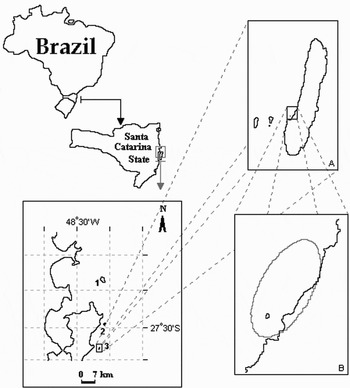
The research was conducted at three coastal islands located on the shelf portion that connects two major adjacent areas of Brazilian coast, namely, the ‘South Brazilian Shelf’ and the ‘South Brazilian Bight’ (Pimenta et al., Reference Pimenta, Melo, Franco and Zavialov2004). These islands are situated within a 35 km range: Arvoredo (27°17′24″S 48°23′33″W), Aranhas (27°29′40″S 48°21′35″W) and Xavier (27°36′61″S 48°23′10″W) (Figure 1). The area is influenced by the Subtropical Convergence (33–38°S), where the warm and salty Brazil Current flowing southward encounters the Falkland Current, flowing northward and give rise to the cold South Atlantic Central Water (SACW) (Silveira et al., Reference Silveira, Schmidt, Campos and Godoi2001). Along the Santa Catarina inner shelf, the water column is stratified during spring and summer, and SACW upwelling occurs during northerly winds. The SACW occurs at 20 m depth and the warm Tropical Shelf Water dominates the surface waters (Carvalho et al., Reference Carvalho, Schettini and Ribas1998). The region is in the intermediate subtropical zone (humid mesothermic group) and is considered the southern limit for tropical fauna. The biological habitats on shallow rocky bottoms are typical of moderately exposed sites of the southern Atlantic shores, with many patches of gravel and sandy sediments extending down to depths of 20 to 40 m. Recreational fishery is allowed at Xavier and Aranhas Islands, and no specific regulation of the fisheries exists, except for a prohibition on lobsters, crabs and fish catching using SCUBA gear. Apart from the southern area, Arvoredo Island is a Marine Protected Area (MPA), a no-take reserve.
Sampling areas along the southern Brazilian coast. (1) Arvoredo Island; (2) Aranhas Island; (3) Xavier Island. (A) Details of Xavier Island and (B) sampling area at Xavier Island.

The study site at Xavier Island is a rocky coastal environment, with rounded rocks forming a soft slope to the sandy bottom. Large rocks can be found forming walls and deep caves used by the lobsters as refuge. The sampled area was rectangular of 545 m2, with a minimum depth of 4 m and maximum of 14 m at the boundary between the rocky and sandy bottom. Laterally, it was delimited by two regions of small rocks. Previous interviews with fishermen and personal observations revealed that Xavier Island has one of the highest concentrations of S. deceptor along the rocky coastline of Santa Catarina state.
Sampling methods
Reproductive and sexual maturity patterns were studied based on females from Xavier Island, because the short distance from the coast and the mild sea conditions favoured regular samplings. During warm months, sampling effort was extended to Arvoredo and Aranhas Islands, where only ovigerous females were sampled. Fecundity and egg size were assessed from eggs of berried females collected from all three islands.
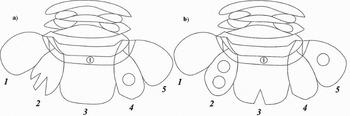
Samples from Xavier Island were collected monthly from December 2002 to December 2003 (Figure 1). Two SCUBA divers searched for slipper lobsters with underwater flashlights, examining crevices and holes until the entire delimited area was surveyed. One unique diver was the main searcher throughout the study. All specimens were brought to the boat in a bag and maintained at the surface water until they were measured and marked. Marks consisted of different cuts (triangles and circles) made at the distal extremity of the uropods and telson. The combination of triangles and circles was used to code different numbers as read from the ventral side of the specimen (Figure 2). Each of the five extremities (the two endopodits and exopodits of the uropods and telson) received different cuts: one cut represented numbers from one to nine, a second cut represented the 10 multiples, and one unique cut represented 100 multiples. One triangle represented numbers 1, 2, 3, 4 or 5 if read on the right exopodit, right endopodit, telson, left endopodit, or left exopodit, respectively. A second triangle on the uropods or telson represented 10, 20, 30, 40 or 50; circles were used for numbers 6 to 9 in an analogous way. One circle in the left exopodit represented 100 and two circles represented 200.
Ventral view of the distal extremity of uropods and telson of a lobster showing examples of the marking system used in the present work, in (A) number 29, two triangles in the second part mean 20 and a circle in the fourth part represents 9, in (B) number 173, a circle in the fifth part represents 100, two circles in the second mean 70 and a triangle in the third means 3.

This technique proved to be simple and should be used only with small samples and short intervals between successive samplings, as the marks probably disappear after the second moult. One lobster of each sex was kept in the laboratory to verify if the marks remained identifiable after moulting and to provide information on size increase. These animals, maintained in an aquarium, kept the cuts readable after one moult. Since the animals were later returned to their habitat, the occurrence of moults (based on the size increase of recaptured lobsters) throughout the year was also recorded. The marking methodology was used to access the relationship between moulting and reproduction. Detailed information about growth increments will be provided in a future paper.
Females were characterized by the presence of sperm mass, and presence and colour of eggs (embryos with eyes or not). The egg mass was collected onboard and maintained in seawater whilst being transported to the laboratory. Water temperature was measured after a few minutes of dive at the sea bottom with a water thermometer. Salinity was measured in the laboratory with a refractometer from a water sample obtained underwater.
Female size at sexual maturity, defined as the size at which 50% of females were reproductively active, was calculated based on the proportion of reproductively active females (lobsters carrying eggs or with evidence of recent spawning, such as egg shells in the abdomen) for each length-class. Fecundity (total number of eggs) was estimated from ovigerous females at all stages of embryonic development. Methodology was adapted from Lipcius et al. (Reference Lipcius, Stockhausen, Eggleston, Marshall and Hickey1997). At the laboratory, eggs were fixed in formalin 5% and stored in alcohol at 70%. The entire egg mass was dried at 60°C and weighed, and fecundity was estimated using the dry-weight of a single 1000-egg aliquot. Subsamples of 30 eggs, randomly selected from the entire egg mass before drying, were measured in diameter (random axis) at 100 x magnification under a Zeiss Stemi 2000 C microscope with an optical micrometer.
Data analysis
Size at sexual maturity was estimated by adjusting a logistic model to the proportion of reproductively active females (ovigerous or with signs of recent spawning) per 5.0 mm length-class. Females caught during the breeding season were used for this estimation. The model employed was proposed by Restrepo & Watson (Reference Restrepo and Watson1991) as follows:
P LC = C/1 + e (a–bLC); where P LC is the proportion of reproductively active females at each size-class LC, and a, b and C are parameters.
This modification of the logistic equation incorporates the parameter C, which allows the maximum proportion of active females to be achieved with values less than or equal to 1. The equation was adjusted using the SOLVER tool in Excel®, including the restriction that C ≤ 1. Size at sexual maturity was calculated by:

The fecundity and the egg diameter–size relationship were estimated by plotting a graph of fecundity versus CL and fitting a linear regression to the data using Excel®.
RESULTS
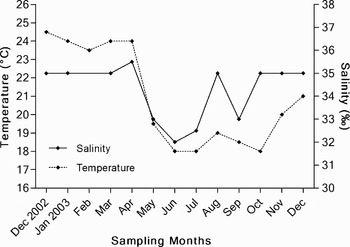
Water temperature and salinity defined two main periods in the year (Figure 3): warm months, with temperatures of around 24°C and salinity around 35‰ (December 2002 to April 2003), and cold months with temperatures below 20°C and salinity of around 33‰ (June to October 2003). May and November were intermediate months, when temperature decreased sharply or started to increase, respectively. Salinities lower than 34‰ were only recorded during cold months.
Water temperature (°C) and salinity (‰) from December 2002 to December 2003 at Xavier Island (southern Brazilian coast).

Throughout the study, a total of 174 animals were caught at Xavier Island, out of which 98 were females. Amongst them, 23 were caught twice and one was caught three times (24.5% of the females were recaptured).
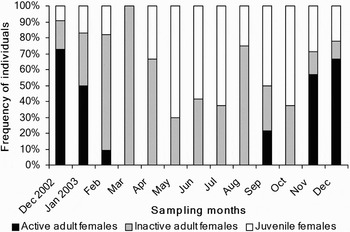
The number of days between mark and recapture (days at liberty) ranged from 14 to 297, with recaptures occurring always in the same area of 545 m2. A few females were captured first unberried and subsequently recaptured in ovigerous condition. Therefore, considering an absolute count of 123 (98 females + 25 recaptures) females in the area (each capture represented also one female), 20.3% were reproductively active. The reproductive females were represented by ovigerous females and one individual with signs of recent spawning, with sizes ranging from 75.60 to 104.80 mm in CL. Females smaller than the smallest reproductive female (CL = 75 mm) were classified as juveniles. These represented 50% or more of all captured females in almost all samplings during cold months (Figure 4).
Frequency (%) of active and inactive adult and juvenile females of Scyllarides deceptor during the sampling months at Xavier Island (southern Brazilian coast).

Recent moults were observed from August to October for five females and one male in the field and in both lobsters kept in the laboratory. Amongst the 41 (24 females + 17 males) recaptured lobsters, four females and three males have moulted. Three berried females were recaptured, one in September and two in November, which were previously captured in August, February and April, respectively. The fourth female was 71.95 mm of CL and, later in the results, considered juvenile. These females, together with the one maintained in the laboratory, increased from 5.60 to 24.40 mm in CL, which represented 6.6 to 34.9% of their previous size. The berried female captured in September moulted, mated and became ovigerous in less than 25 days and showed the highest CL increase. It is noteworthy that one female recaptured in December 2003 was berried without moulting, although she presented the greatest number of days at liberty (297 days).
Males captured in January, February and June were recaptured in May, November and December, respectively. These males, together with the specimen kept in the laboratory, increased in size from 5.15 to 13.35 mm of CL, with a relative increment varying from 7.2 to 20.0%.
A gelatinous sperm mass was observed in three females, one in November and two in December 2003. Two of them were observed carrying eggs simultaneously and therefore, considered active females. Reproductively active females were only observed from September to February, spring and summer months. However, they were more representative from November to January when over 60% of adult females were active, reaching 80% or more in November and December in both years. The percentage of reproductively active females decreased gradually from December 2002 to February 2003 (early to late summer) when only one ovigerous female was caught, and increased from September (early spring) to December 2003 (Figure 4), with the exception of October. Nevertheless, three berried females were found in October, outside the sampling area at the same island, and a berried female was found in August 2002, before this sampling programme (personal observation).
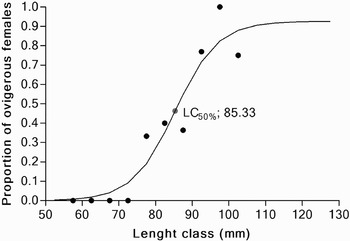
In Xavier Island, 25 females were caught in ovigerous condition and in 28%(7), the eggs were in advanced stages (embryos with eyes). The advanced eggs were registered only in December in both years. Females caught at Xavier Island during the breeding season ranged in size from 59.90 to 104.80 mm CL. Size at maturity was best described by the equation, P LC = 0.92583/1 + e (14.71892–0.172475LC), and size at maturity (LC 50%) for females (N = 66) was estimated in 85.33 (14.71892/0.172475) mm of CL (Figure 5).
Observed (dots) proportions of reproductive Scyllarides deceptor females at Xavier Island (southern Brazilian coast) and best-fit equation (line). Size at sexual maturity (LC50%) is shown in grey.

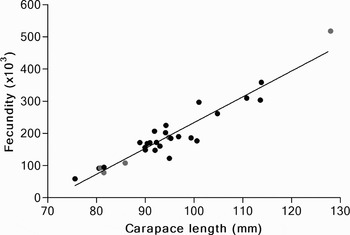
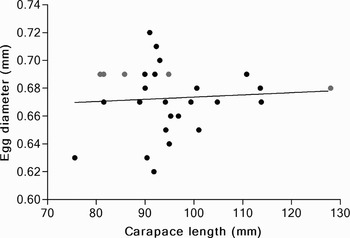
Mean fecundity (F) estimated from 29 females was 191,262 ± 17,811 (SE) eggs, ranging from 58,872 to 517,676 eggs. Mean ovigerous female CL was 94.74 ± 1.86 (SE) mm, with individuals ranging from 75.60 to 128.00 mm. The largest female, showed the highest fecundity and was caught in the vicinity of Arvoredo Island. Fecundity was strongly and linearly proportional to female size as expressed by CL (carapace length) (Figure 6), and was best described by the equation, F = −567,860 + 8,012.4CL (r 2 = 0.90, P < 0.05). Mean egg diameter (N = 28) was estimated in 0.67 (±0.005, SE) mm, ranging from 0.62 to 0.72 mm. Individual egg size (Figure 7) was unrelated (P = 0.78) to female body size.
Linear regression for relationship between fecundity and carapace length (CL) of Scyllarides deceptor off Santa Catarina coast (south of Brazil). Females with eggs at advanced embryological stages are shown in grey.

Scyllarides deceptor mean egg diameters and trend line (p = 0.78) for relationship with carapace length (CL) off Santa Catarina coast (south of Brazil). Females with eggs at advanced embryological stages are shown in grey.

DISCUSSION
For species that breed seasonally, seasonal changes in water temperature have been identified as the most important factor triggering the onset of the reproductive period. However, variations in salinity, photoperiod and availability of food supply to reproductive adults may be critical proximate factors in reproduction (Sastry, Reference Sastry, Vernberg and Vernberg1983). The seasonal occurrence of ovigerous females in the warm season was a pattern for the study area and has been observed in Scyllarides nodifer (Hardwick & Cline, Reference Hardwick and Cline1990), S. latus (Martins, Reference Martins1985; Spanier & Lavalli, Reference Spanier and Lavalli1998) and S. astori (Hearn & Toral-Granda, Reference Hearn and Toral-Granda2007) and, based on larval abundance evidence, in Scyllarus martensii (Rothlisberg et al., Reference Rothlisberg, Jackson, Phillips and McWilliam1994). If timing of breeding is correlated with temperature there may be differences at the onset of the reproductive season occurring between years, which could explain the presence of an ovigerous female in August 2002, but not at the same month in 2003.
While recent moulted individuals were captured from August to October, prior to the reproductive season of Scyllarides deceptor, three berried females increased in size and one presented a period of 25 days from moulting to egg incubation. Hence, it can be suggested that along with all the conditions mentioned above, moulting is essential to the onset of the reproductive period in females, as has been observed for most lobsters (MacDiarmid & Sainte-Marie, Reference MacDiarmid, Sainte-Marie and Phillips2006).
The majority of temperate invertebrate species exhibit a clear peak of hatching in spring and summer when sufficient planktonic food is available for larvae, which demonstrate a clear seasonal reproductive cycle (Anger, Reference Anger2001). Studies have confirmed long larval life (at least 8 months) for the genus Scyllarides (Coutures, Reference Coutures2000; Booth et al., Reference Booth, Webber, Sekiguchi and Coutures2005). Considering that this larval period is also valid for S. deceptor, larvae hatching from September to January would have greater chances of surviving on the food available until April–May. During that period, the SACW upwelling increases nutrients and primary production in the region (Carvalho et al., Reference Carvalho, Schettini and Ribas1998; Borzone et al., Reference Borzone, Pezzuto and Marone1999), which may lead to improved food resources for young phyllosoma larvae.
The occurrence of ovigerous females with advanced eggs only in December may indicate that the species has a long embryonic period (three months or even more). However, Scyllarides species are related to short brooding periods (Spanier & Lavalli, Reference Spanier, Lavalli and Phillips2006) and eggs with a short advanced stage could similarly prevent observations.
Females of most species of the genus Scyllarides can spawn multiple broods in a season (Spanier & Lavalli, Reference Spanier, Lavalli and Phillips2006), however, no record of sperm storage has been reported in these species. Furthermore, the revision of MacDiarmid & Sainte-Marie (Reference MacDiarmid, Sainte-Marie and Phillips2006) mentioned that female spiny lobsters store sperm for varying periods and Panulirus interruptus presents the longest period (four months). The present study extends this period to ten months amongst the Palinuroidea and is the first record for the family Scyllaridae. This capacity may confer greater flexibility in the relative timing of mating and spawning/fertilization (MacDiarmid & Sainte-Marie, Reference MacDiarmid, Sainte-Marie and Phillips2006). Such flexibility is important in species with seasonal reproduction, as they may synchronize with the best moment to spawn and/or spawn multiple broods according to environmental conditions, whilst having to mate only once. The female captured first in February, at the end of the breeding season, was already fertilized. At that time, food resources were starting to decrease and the chances of larval survival were diminishing.
The occurrence of only three females carrying spermatophores, in contrast with all the females registered in ovigerous condition suggests that the attachment of spermatophores occurs during a short period in the species, and probably for the entire genus, as few records have been reported within Scyllarides (Spanier & Lavalli, Reference Spanier, Lavalli and Phillips2006). In addition, Scyllarides deceptor is the second species within the genus to show simultaneous presence of eggs and spermatophores. Thus far, only Scyllarides latus was observed in this condition (Martins, Reference Martins1985; Almog-Shtayer, 1988 cited in Spanier & Lavalli, Reference Spanier, Lavalli and Phillips2006).
The overall recapture rate for the current study (24.5%) was very high compared with most tag–recapture data (e.g. Stewart & Kennelly, Reference Stewart and Kennelly1998; Courtney et al., Reference Courtney, Cosgrove and Die2001; Hearn, Reference Hearn2006), but not considerably lower than data (31%) from a 4-year sampling in the Mediterranean (Spanier et al., Reference Spanier, Tom, Pisanty and Almog1988). Distance between captures (days at liberty) may be related to movement patterns. Few days apart between recaptures suggest that the animals, including ovigerous females, use the island rocky bottom to shelter, avoiding predators during the day and foraging at night. Shells of bivalves were frequently recorded together with sheltered S. deceptor; and the same behaviour was observed for S. latus by Spanier et al. (Reference Spanier, Tom, Pisanty and Almog1988). Conversely, a large number of days between captures and low percentage of adult females during cold months suggest that individuals may also undertake seasonal migrations to avoid low temperatures. However, additional studies are necessary to provide further information on whether ovigerous females observed in the area truly live at Xavier Island all year round, or migrate from other habitats during the warm season in search of sheltered areas to breed. In the Azores Islands, S. latus was found in shallow rocky areas (5–20 m) during the summer, corresponding to their reproductive period, and migrated to deeper areas in late autumn (Martins, Reference Martins1985). According to Spanier & Lavalli (Reference Spanier and Lavalli1998) and Spanier et al. (Reference Spanier, Tom, Pisanty and Almog1988), the same species migrates seasonally to avoid high temperatures off the Mediterranean coast. In contrast, the strong spatial pattern of Scyllarides astori in the Galapagos Islands was more closely related to temperature and prey availability than to seasonal migration (Hearn, Reference Hearn2006). Other scyllarids, such as Ibacus peronii and Ibacus chacei, undertake long migrations to spawn (Stewart & Kennelly, Reference Stewart and Kennelly1998; Haddy et al., Reference Haddy, Courtney and Roy2005).
Our study area is in the centre of S. deceptor's distribution range, where environmental conditions should be optimal for the species, and therefore, the fishery is concentrated over the species patches. The entire size-range of S. deceptor landed by industrial trawlers at Itajaí Harbour (Santa Catarina, Brazil) during the period 1995–2006 was from 17 to 125 mm of CL. However, in 2002, when this research began, there was a peak in the slipper lobster fishing and 87.9% of the females measured in 5% of the landings were less than 85 mm of CL (Oliveira, unpublished data). In that year, most of the females were fished before being reproductively active according to the size of maturity estimated in the present research. In spite of the limited information to confirm that the slipper lobsters caught by the industrial fisheries and those sampled at the islands were from the same population, this new information on the biology of the species is indispensable for initial management purposes.
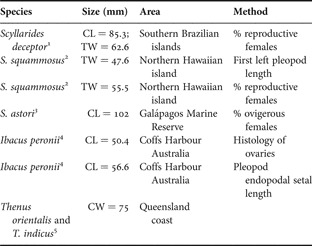
The regression between tail width (TW) and CL showed that the species attains functional maturity at 62.6 mm of TW (Oliveira, personal observation), which is a smaller size than that of S. astori (from data obtained at a Marine Reserve) and a larger size than that of S. squammosus. These are species from the same genus that are as large as other scyllarids (Table 1), although carapace width (CW) measurements are unknown for Scyllarides deceptor. Morphological features such as ovigerous condition can underestimate the incidence of mature individuals. The inability to distinguish truly immature individuals from reproductively inactive mature females generates an inflated ‘immature’ class, and estimates of functional maturity are biased towards larger sizes (DeMartini et al., Reference DeMartini, McCracken, Moffitt and Wetherall2005). This conservative error was partially resolved by using an adjusted logistic equation proposed by Restrepo & Watson (Reference Restrepo and Watson1991), and by analysing only females captured during the breeding season. In addition, the method of estimating size at maturity from the incidence of mated but non-berried, and berried females is considered the most appropriate to provide management advice (Chubb, Reference Chubb, Phillips and Kittaka2000).
Size at maturity for scyllarid species with area of occurrence and method of assessment. Measurements are given in carapace length (CL), tail width (TW) and carapace width (CW).

1This study; 2DeMartini et al. (Reference DeMartini, McCracken, Moffitt and Wetherall2005); 3Hearn & Toral-Granda, Reference Hearn and Toral-Granda2007; 4Stewart et al. (Reference Stewart, Kennelly and Hoegh-Guldberg1997); 5Courtney et al. (Reference Courtney, Cosgrove and Die2001).
Although our sample size was small (N = 29), S. deceptor fecundity was strongly related to carapace length, as described for S. squammosus in Hawaiian waters (DeMartini & Williams, Reference DeMartini and Williams2001), S. latus in the Azores (Martins, Reference Martins1985), Ibacus chacei, I. brucei and I. alticrenatus (Haddy et al., Reference Haddy, Courtney and Roy2005) and I. peronii (Stewart & Kennelly, Reference Stewart and Kennelly1997). Egg production in Scyllarids, such as palinurid lobsters, is a positive function of animal size (pleopod capacity). However, the exact form of this relationship may vary between populations and species (DeMartini & Williams, Reference DeMartini and Williams2001; Haddy et al., Reference Haddy, Courtney and Roy2005).
Reduced broods can be caused by several factors, such as egg losses during oviposition, poor fertilization, aborted development, parasitism, maternal and external predation, mechanical loss due to abrasion against the substratum or by dislodgement during trawl capture (Kuris, 1991 cited in Mori et al., Reference Mori, Biagi and De Ranieri1998). The use of early stage eggs avoids the problem of brood reduction but can artificially elevate fecundity estimates. In our study, all egg stages were used to assess the BF–CL relationship, in order to increase the number of ovigerous females studied. The 5 females with advanced stage eggs showed fecundity similar to that of similar-sized females with early stage eggs. Moreover, the former did not change the high level of significance of the relationship, indicating that egg losses were not occurring in the rocky island environment. Worthy of note is the remarkably high fecundity presented by the largest female, even with late eggs.
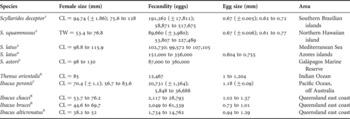
There is a general relationship in Scyllarids which present adult size associated to fecundity and to larval recruitment strategy. Larvae of larger species tend to have longer and more offshore development than larvae of smaller species (Booth et al., Reference Booth, Webber, Sekiguchi and Coutures2005). The fecundity of S. deceptor was the highest among the Scyllarides and much greater than Ibacus and Thenus species; but, egg size was similar to S. latus and S. squammosus (Table 2). A review by Booth et al. (Reference Booth, Webber, Sekiguchi and Coutures2005) demonstrated that adult females of the Scyllarides subfamily (Arctidinae) are large, with very high fecundity. In addition, their eggs are small, with prolonged larval development and phyllosomas that are dispersed to great distances offshore. In agreement with this idea, plankton samples taken during one year (May 2002 to April 2003) around Arvoredo Island did not include any Scyllaridae larva (Koettker & Freire, Reference Koettker and Freire2006).
Scyllarid lobsters: female body size, fecundity, egg size and area of occurrence. Standard errors are given in parentheses (CL, carapace length; TW, tail width).

1This study; 2DeMartini & Williams, Reference DeMartini and Williams2001; 3Almog-Shtayer, 1988 cited in Spanier & Lavalli, Reference Spanier and Lavalli1998; 4Martins Reference Martins1985; 5Hearn & Toral-Granda, Reference Hearn and Toral-Granda2007; 6Hossain, Reference Hossain1975; 7Stewart & Kennelly, Reference Stewart and Kennelly1997; 8Haddy et al. (Reference Haddy, Courtney and Roy2005).
The coastal species Thenus orientalis and Ibacus peronii are relatively less fecund but produce relatively larger eggs than the oceanic S. latus, S. squammosus (DeMartini & Williams, Reference DeMartini and Williams2001) and S. deceptor. This contrasting fecundity–egg size trade-off in oceanic versus coastal species reflects the higher per capita mortality rates of larvae in open-ocean environments (DeMartini & Williams, Reference DeMartini and Williams2001). Species with wider larval dispersal might be expected to recruit in a wider geographical range than those with restricted larval dispersal. Additionally, postlarval recruitment of long-lived larvae may be more irregular from year to year, depending on long-term hydrological and oceanic climate cycles (Booth et al., Reference Booth, Webber, Sekiguchi and Coutures2005).
The small sample size used to assess maturity in this study provided initial, nonetheless unique information, and data obtained from fisheries are currently being analysed (Oliveira, unpublished data). Since the functional maturity of S. deceptor occurred at 85.3 mm of CL and mean fecundity was related to a mean CL of 94.7 mm, we suggest an intermediate size of 90 mm CL as the female MLS. Fisheries closures are most appropriate in populations where breeding is distinctly seasonal (Chubb, Reference Chubb, Phillips and Kittaka2000), which is clearly the case in S. deceptor, and capture of this species should be prohibited from November to January, when the percentage of ovigerous females was greater than 50%.
A study conducted with the Caribbean spiny lobster in two areas of the Florida Keys, one protected and one fished, demonstrated significant differences in fecundity and reproductive season, suggesting the importance of protecting some areas to enhance egg production at the population level (Bertelsen & Matthews, Reference Bertelsen and Matthews2001). In the area covered by the current study, there are around 8 small archipelagos where S. deceptor is found up to 30 km off the coast. All of these populations, including specimens trawled by shrimp fisheries at the sandy bottom, could be connected by planktonic phyllosoma larvae thus establishing a marine metapopulation. Fisheries act over the entire rocky and sandy bottom in the southern coast and therefore, no-take MPA becomes an essential tool to the replenishment of local populations.
Although illegal spear fishing is constantly observed in Xavier Island, S. deceptor is known to be more abundant at Xavier Island than at the other two islands sampled. This information suggests that specific environmental conditions in Xavier Island could be favouring the sheltering of S. deceptor. Further studies comparing abundance, size-range and fecundity in the southern island should support the establishment of a new MPA and the effectiveness of the Arvoredo Island no-take MPA on the Santa Catarina coast.
ACKNOWLEDGEMENTS
This research was supported by the Project Aware Foundation. We would like to thank Edson Faria Junior from the Laboratório de Crustáceos/Plâncton (UFSC) for the egg measurements and everyone who helped in the fieldwork.