Introduction
Atopidae Hupé, Reference Hupé and Piveteau1954 is a little investigated trilobite family based on Atops Emmons, Reference Emmons1844. Family membership has had a long and contentious history (Howell and Stubblefield, Reference Howell and Stubblefield1950) and constituent genera were regularly included in the Conocoryphidae based on their secondary blindness; this assignment continued beyond Hupe's (Reference Hupé and Piveteau1954) erection of the family (Harrington et al., Reference Harrington, Henningsmoen, Howell, Jaanuson, Lochman-Balk, Poulsen, Rasetti, Richter, Richter, Schmidt, Sdzuy, Struve, Stormer, Stubblefield, Tripp, Weller and Whittington1959; Korobov, Reference Korobov1973; Jell et al., Reference Jell, Jago and Gehling1992). In Spain, this genus was doubtfully recognized by Richter and Richter (Reference Richter and Richter1941) as Atops? calanus Richter and Richter, Reference Richter and Richter1941 in the ‘Fauna von Cala’ from Huelva, and that occurrence has been cited by Lotze (Reference Lotze1958, Reference Lotze1961) and Sdzuy (Reference Sdzuy1961, Reference Sdzuy1962). Herein, we describe several cranidia and fragments that enable positive assignment to Atops.
Pseudatops Lake, Reference Lake1940 is described for the first time in the Iberian Peninsula, with recognition of the Taconic North American species Pseudatops reticulatus (Walcott, Reference Walcott1890b). Its presence allows biostratigraphic and paleobiogeographic correlations with other Avalonian and Taconic localities.
Geological setting
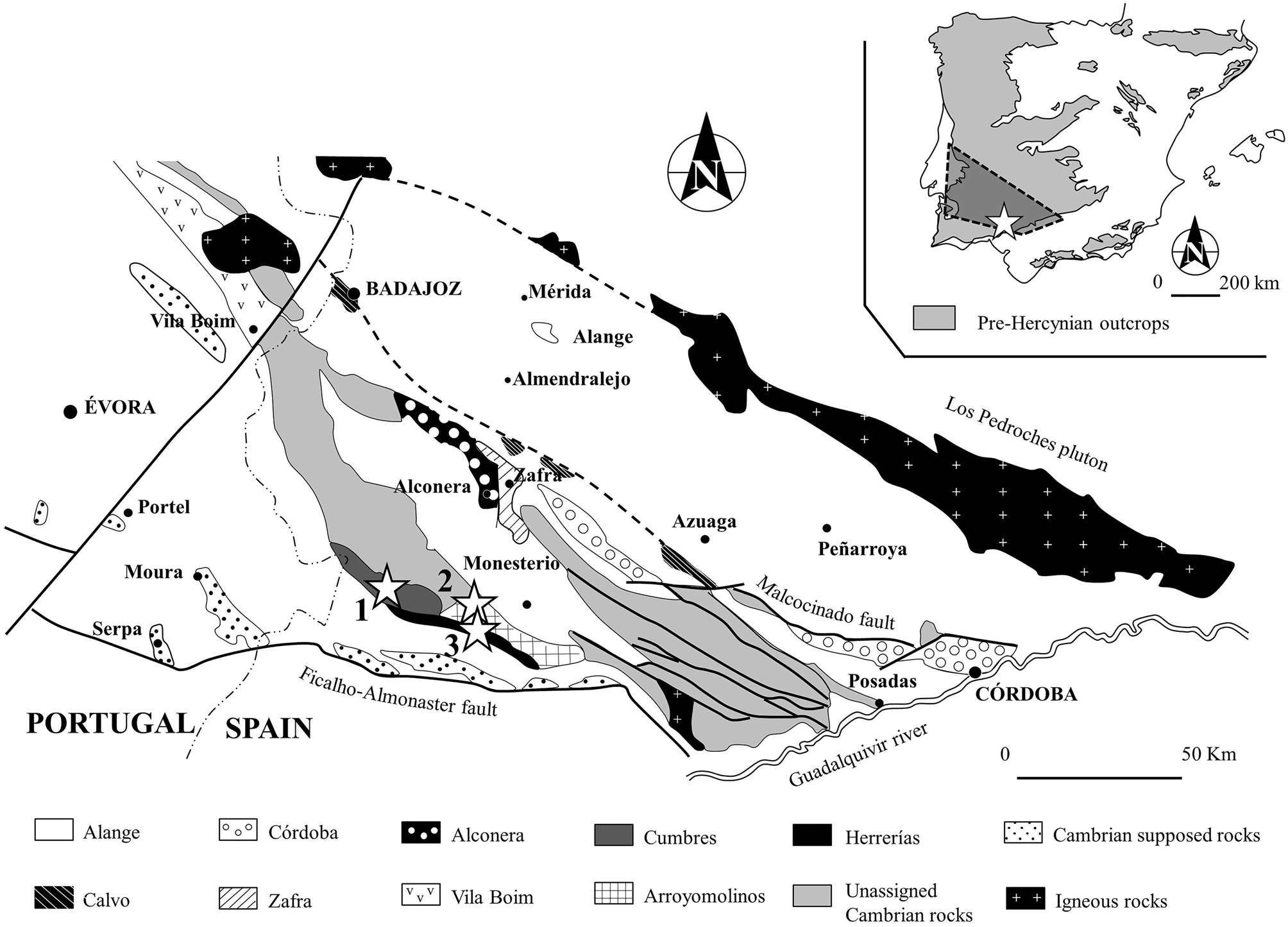
The trilobites were collected in northern Huelva Province, southwestern Spain (Fig. 1), in the Sierra de Aracena y Picos de Aroche Natural Park. Cambrian rocks of the Ossa-Morena Zone are placed in distintict belts or ‘blocks’—named ‘Cubetas’ in Spanish—with a notable change of facies and thickness, most likely related to downthrow and tilting along an active growth fault at the time of sediment deposition (Liñán and Quesada, Reference Liñán, Quesada, Dallmeyer and Martínez García1990) (Fig. 1).
Geological setting of fossil sites in the Cambrian Cubetas (fault-bounded blocks) of the Ossa-Morena Zone, with white stars indicating the positions of the studied fossil sites in each Cubeta. 1 = Cumbres de San Bartolomé site (CU1); 2 = Arroyomolinos de León site (AM1-2); 3 = El Pozuelo site (POZ1). Modified from Liñán and Quesada (Reference Liñán, Quesada, Dallmeyer and Martínez García1990).

The stratigraphy of the different Cambrian blocks in northern Huelva has been little studied. Only early Cambrian formations have been established (Collantes et al., Reference Collantes, Mayoral, Chirivella Martorell and Gozalo2020) although not formally defined.
In the Cumbres block (Cumbres Cubeta), the siliciclastic sandstones and shales of the Cumbres beds (350–1100 m) are dated as middle–late Marianian, based on the trilobites Delgadella Walcott, Reference Walcott1912, Hicksia Delgado, Reference Delgado1904, Rinconia Hupé, Reference Hupé1953, and Triangulaspis Lermontova, Reference Lermontova and Vologdin1940 in the lower part and Serrodiscus Richter and Richter, Reference Richter and Richter1941 and Triangulaspis in the upper part (Liñán and Mergl, Reference Liñán and Mergl1982; Liñán et al., Reference Liñán, Gozalo, Palacios, Gámez Vintaned, Ugidos, Mayoral, Gibbons and Moreno2002). The Cumbres fossil site (CU1) is located in the upper Cumbres beds (Collantes et al., Reference Collantes, Mayoral, Chirivella Martorell and Gozalo2020). The 24-m section at CU1 is between 38°02′45.74″N, 006°43′07.40″W and 38°02′43.90″N, 006°43′07.80″W. Atopid trilobites occur 17, 19, and 20 m from the base in association with Serrodiscus silesius Richter and Richter, Reference Richter and Richter1941, Calodiscus ibericus Sdzuy, Reference Sdzuy1962, Triangulaspis fusca Sdzuy, Reference Sdzuy1962, Hicksia? sp. indet., Marocella morenensis (Yochelson and Gil Cid, Reference Yochelson and Gil Cid1984), brachiopods, and hyoliths.
In the Herrerías block (Herrerías Cubeta), the Herrerías shale (200–500 m) (Schneider in Richter and Richter, Reference Richter and Richter1941) consists of purple shales with spilitic intercalations and has an age ranging from middle to late Marianian, based on Delgadella, Rinconia, Atops, Gigantopygus Hupé, Reference Hupé1953, Hicksia, Protaldonaia Sdzuy, Reference Sdzuy1961, Sdzuyomia Lieberman, Reference Lieberman2001, and Strenuaeva Richter and Richter, Reference Richter and Richter1940 in the lower part and Serrodiscus, Calodiscus Howell, Reference Howell1935, and Triangulaspis in the upper part (Richter and Richter, Reference Richter and Richter1941; Sdzuy, Reference Sdzuy1962; Ruiz López et al., Reference Ruiz López, Fernández Carrasco, Collaut Saenz de Sicilia and Apalategui1979; Liñán and Mergl, Reference Liñán and Mergl1982). The El Pozuelo fossil site (POZ1) is in the upper level Herrerías shale with Serrodiscus silesius, C. ibericus, Protaldonaia morenica Sdzuy, Reference Sdzuy1961, Delgadella sp. indet., Strenuaeva sp. indet., Marocella morenensis, and brachiopods. Base and top of the 48-m section at the collecting site are at 37°58′59.17″N, 006°24′18.92″W and 37°58′56.90″N, 006°24′19.93″W, respectively, with atopid trilobites 7 and 9 m from the base (Collantes et al., Reference Collantes, Mayoral, Chirivella Martorell and Gozalo2020).
In the Arroyomolinos block (Arroyomolinos Cubeta), the Herrerías shale (300–400 m) includes purple, gray, and green shales, with metric intercalations of acid volcanic tuffs and spilites. Base and top of the 65-m section at the AM1 collecting site are at 38°00′49.58″N, 006°44′47.27″W and 38°00′57.50″N, 006°24′50.14″W, respectively. Pseudatops reticulatus occurs with Serrodiscus silesius 46 m from the base. The AM2 section (37°59′15.90″N, 006°21′17.95″W) is no longer accessible.
Materials and methods
The available material consists of isolated cranidia preserved as internal and external molds in purple shales with limonitic mineralization. Most of the studied specimens are deformed and/or fragmented.
Repositories and institutional abbreviations
Figured specimens are housed in the Department of Earth Sciences (Laboratory of Tectonics and Paleontology) of the Faculty of Experimental Sciences, University of Huelva (UHU). Other cited repositories are: SMF = Senckenberg Museum, Frankfurt, Germany; USNM = Smithsonian Institution, National Museum of Natural History, Washington, DC.
Systematic paleontology
Class Trilobita Walch, Reference Walch1771
Order uncertain
Family Atopidae Hupé, Reference Hupé and Piveteau1954
Included genera
Atops Emmons, Reference Emmons1844 (=Ivshiniellus Korobov, Reference Korobov1966), Pseudatops Lake, Reference Lake1940, and Atopina Korobov, Reference Korobov1966.
Diagnosis
See Cotton (Reference Cotton2001, p. 185, 186).
Remarks
Cotton (Reference Cotton2001) carried out a systematic review and a phylogenetic proposal of several blind ptychoparid trilobites, which had been previously included in Conocoryphidae, concluding that it was a polyphyletic group. Within that review, he amended the diagnosis of Atopidae, which he included within the superfamily Ellipsocephaloidea. Given the classification problems, Adrain (Reference Adrain and Zhang2011) proposed not to assign it to any order until a complete revision of the trilobite basal groups was carried out.
Jell et al. (Reference Jell, Jago and Gehling1992) included Ivshiniellus nikolai Korobov, Reference Korobov1966, I. patulus Korobov, Reference Korobov1966, and I. briandailyi Jenkins and Hasenohr, Reference Jenkins and Hasenhohr1989 in Atops. Cotton (Reference Cotton2001) pointed out that in I. briandailyi, the tapering of the glabella represented in their reconstruction (Jenkins and Hasenohr, Reference Jenkins and Hasenhohr1989, fig. 4) is not matched by that of the specimens, and the species closely resembles the other Australian species, Atops rupertensis Jell, Jago, and Gehling, Reference Jell, Jago and Gehling1992. We accept that Ivshiniellus is a junior subjective synonym of Atops as proposed by Jell et al. (Reference Jell, Jago and Gehling1992) and Cotton (Reference Cotton2001).
Jell et al. (Reference Jell, Jago and Gehling1992) suggested that Atopina could be a junior synonym of Pseudatops, arguing that Atopina was erected based on distorted material, in which diagnostic differences compared to Pseudatops are due to tectonic distortion. The holotype of the type species Atopina antiqua Korobov, Reference Korobov1966 (figured by Korobov, Reference Korobov1973, pl. 12, fig. 5) shows several characters that resemble Pseudatops. However, the phylogenetic analysis carried out by Cotton (Reference Cotton2001, figs. 2, 3) shows that Atopina is closer to Atops than to Pseudatops. Therefore, we prefer to keep Atopina as a separate genus, pending better-preserved specimens.
Several conocoryphids from the Sekwi Formation, Mackenzie Mountains, Canada (Fritz, Reference Fritz1973) have been moved to Atops (Jell et al., Reference Jell, Jago and Gehling1992; Cotton, Reference Cotton2001) based on their blindness, the form of the genal ridges, position of the suture, and glabellar taper. Monospecific Avalonia Walcott, Reference Walcott1890a was moved from Atopidae (Jell and Adrain, Reference Jell and Adrain2002) to the order Corynexochida based on the subquadrangular (Walcott, Reference Walcott1890a, p. 647) to anteriorly expanding (Walcott, Reference Walcott1890a, pl. 95, fig. 3) glabellar shape.
Genus Atops Emmons, Reference Emmons1844
Type species
Atops trilineatus Emmons, Reference Emmons1844.
Other species
Atops calanus Richter and Richter, Reference Richter and Richter1941, Atops nikolai (Korobov, Reference Korobov1966), Atops patulus (Korobov, Reference Korobov1966), Atops granulatus Orlowski, Reference Orlowski1985, Atops briandailyi (Jenkins and Hasenhor, Reference Jenkins and Hasenhohr1989), Atops rupertensis Jell, Jago, and Gehling, Reference Jell, Jago and Gehling1992, Atops korobovi Romanenko in Repina et al., Reference Repina, Romanenko, Fedjanina and Pegel1999, Atops sp. indet. of Cotton (Reference Cotton2001), and Conocoryphidae gen. indet. sp. indet. of Fritz (Reference Fritz1973).
Diagnosis
See Jell et al. (Reference Jell, Jago and Gehling1992, p. 192, 195).
Remarks
The most notable differences between Atops and Pseudatops, according to Lake (Reference Lake1940) and Jell et al. (Reference Jell, Jago and Gehling1992), are: (1) in Atops, the glabella extends to the anterior furrow, whereas in Pseudatops, it invades the anterior border; (2) in Atops, the anterior border furrow is deep, and the anterior border is slightly turned upward, whereas in Pseudatops, the anterior furrow is shallow, and the anterior border is flat or even downturned; (3) in Atops, the facial suture extends from the anterior to lateral margin across the anterior furrow, whereas in Pseudatops, the suture only cuts a small portion of the lateral border and the genal spine; and (4) Atops has granular ornament, but Pseudatops has reticulate ornament.
Atops calanus Richter and Richter, Reference Richter and Richter1941
Figure 2
- Reference Richter and Richter1941
Atops? calanus Richter and Richter, p. 55, pl. 3, fig. 41, pl. 4, fig. 63.
- Reference Lotze1958
Atops? calanus; Lotze, p. 743.
- Reference Lotze1961
Atops? calanus; Lotze, p. 164.
- Reference Sdzuy1961
Atops? calanus; Sdzuy, p. 230.
- Reference Sdzuy1962
Atops? calanus; Sdzuy, p. 212, pl. 23, figs. 14, ?15, 16.
- Reference Collantes, Gozalo, Mayoral, Garzón, Vaz and Sá2018
Atops sp. cf. calanus; Collantes et al., p. 567, fig. 4.7.
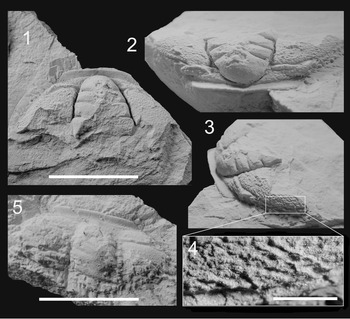
Atops calanus Richter and Richter, Reference Richter and Richter1941: (1–4) UHU-CU1001-20, Cumbres de San Bartolomé, Cumbres beds, late Marianian: (1) dorsal view; (2) frontal view; (3) anterolateral view; (4) detail of the granular ornamentation; (5) UHU-CU1002-20, Cumbres de San Bartolomé, Cumbres beds, late Marianian, dorsal view. Scale bars = 20 mm; scale bar for subfigure 4 is 5 mm.

Holotype
SMF X 1227.
Emended diagnosis
Atops with long, conical, tapered glabella, subtle ridge between anterior border furrow and preglabellar furrow. Glabella extends to marginal border furrow, giving rise to a preglabellar area laterally. Anterior border upturned, slightly convex anteriorly. Prominent occular ridge running laterally from frontal lobe. Suture cutting the gena close to the lateral furrow.
Occurrence
The new specimens come from the upper part of Cumbres beds and Herrerías shale, late Marianian (Cambrian Stage 4). Richter and Richter (Reference Richter and Richter1941) cited Atops? calanus in their horizon cbM2/cbM3, which corresponds with the uppermost middle Marianian.
Description
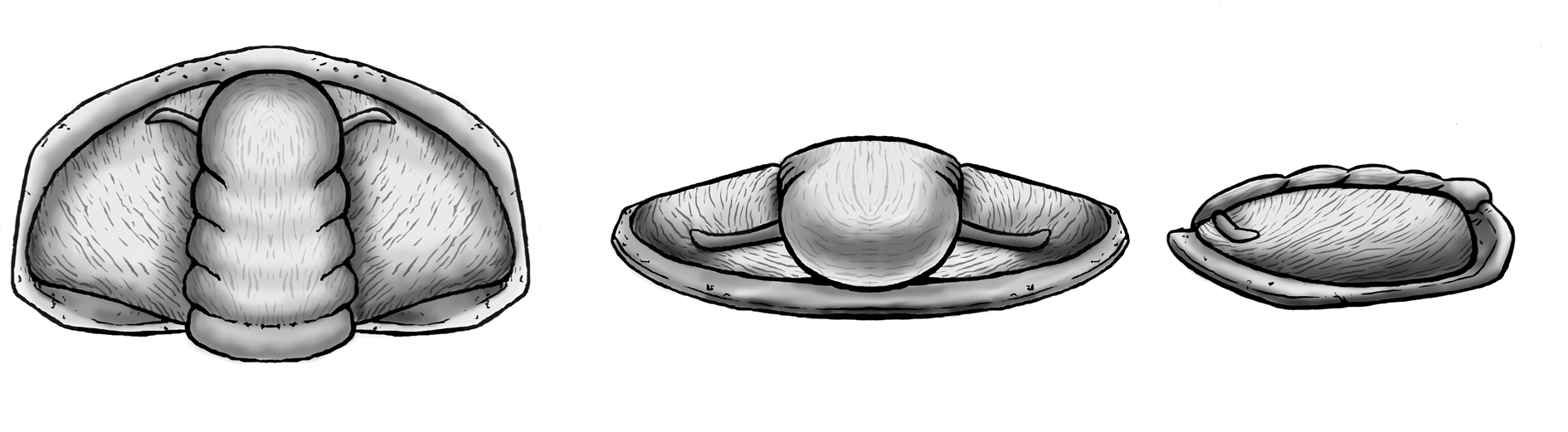
Cranidium subtrapezoidal, of pronounced relief, wider than long, 12.9–22.3 mm long, 19.4–41.8 mm wide. Opistoparian facial suture close to the lateral margin, cutting the gena near the lateral furrow. Straight or slightly curved anterior margin. Anterior border short (sag.), homogeneous, sloping upward from the anterior border furrow, turning upward. Anterior furrow pronounced, deep. Pregrablellar field short, laterally extended, subtrapezoidal. Preglabellar furrow slightly pronounced. Glabella conical, with rounded frontal lobe, gradually widened toward the posterior, with length equivalent to 4/5 of the cephalon, with three pairs of deep, narrow, nontransglabellar furrows (S1–S3), slightly curving toward the posterior, all equal in length. Axial furrows narrow, deep, with a slightly convergent tendency toward the anterior area. Occipital furrow (S0) deep. Occipital lobe subtrapezoidal, planoconvex. Preocular field reduced, triangular. Preocular furrow deep, thin. Ocular ridge pronounced, connected between the frontal lobe of the glabella and the lateral furrow, presenting a slight curvature with convexity toward the front. Subtrapezoidal palpebral area wide, with slightly convex relief. Posterior furrow wide, deep, slightly curved. Posterior border thin (sag.), slightly curved. Subtriangular genal area, exsagital extension. Ornamentation composed of coarse granules with massive structure, more pronounced in the preocular and palpebral aresa and softer in the glabella. For reconstruction of the cephalon, see Figure 3.
Reconstruction of the cephalon of Atops calanus Richter and Richer, Reference Richter and Richter1941, in (left to right) dorsal, frontal, and lateral views.

Materials
Seven partially preserved cranidia (UHU-CU1001-20, CU1010–CU1013-20, POZ020-20, AM1002-20). Additional fragments assigned to Atops calanus are deposited in the same collection.
Remarks
The description above is based solely on the material collected for this study. Richter and Richter (Reference Richter and Richter1941) differentiated Atops? calanus from Atops trilineatus according to the distance between the anterior border furrow and the frontal lobe of the glabella, with a longer glabella reaching the anterior border in Atops trilineatus and a shorter, tapered glabella in Atops? calanus, with a subtle ridge between anterior border furrow and preglabellar furrows. In Huelva specimens, these differences could be due to deformation and are not necessarily taxonomic characters (Fig. 2.1–2.3, note that the frontal lobe of the glabella invades the preglabellar field and reaches the anterior border due to deformation).
Atops rupertensis and Atops briandailyi from Australia are differentiated by the proportions of the cephalon, prominent parafrontal band, and a wide anterior border becoming narrower at the sides. Moreover, the glabella is considerably narrower and shorter with four pairs of thin, lateral, nontransglabellar furrows pointing backward and giving rise to less-pronounced glabellar lobes, and shallower, less-pronounced axial furrows. The palpebral area of both Atops rupertensis and Atops briandailyi is more extensive in proportion to the cephalon than in Atops calanus. In Atops rupertensis, the posterior furrow is shallower and broader than in Atops calanus, becoming thicker at the sides. The posterior border is thin and uniform in both Atops calanus and Atops rupertensis.
Orlowski (Reference Orlowski1985) established Atops granulatus from the early Cambrian of the Holy Cross Mountains, Poland, and argued that Atops? calanus does not belong in Atops. The most distinctive characters of Atops granulatus are the parallel-sided glabella, the lack of a preglabellar field, and the configuration of the glabellar furrows (S1 not parallel to S2 and S3). In contrast, Atops calanus has a tapered glabella and parallel glabellar furrows. In Atops granulatus, the facial suture extends across the lateral border, but in Atops calanus, the facial suture extends across the cheek to the ocular ridge, then to the genal area.
Atops korovobi from Russia is similar to Atops calanus but is distinguished by its more tapered frontal glabella lobe.
Ivshinellus nikolai and I. patulus, now both assigned to Atops (Jell et al., Reference Jell, Jago and Gehling1992), are based on distorted material (Korobov, Reference Korobov1973), but in comparison with Atops calanus, they show a subelliptical outline of the cephalon and a wider anterior border (especially in Atops nikolai). Furthermore, these Russian species have more narrowly triangular glabellae. Both Russian species also have subtler granular ornament.
Rushton (Reference Rushton1966) described Atops? sp. indet. from the Purley Shales, England. The partial cranidium (Rushton, Reference Rushton1966, pl. 5, fig. 19) resembles Atops trilineatus especially in glabellar shape and suture configuration.
Conocoryphidae gen. indet. sp. indet. of Fritz (Reference Fritz1973) has a conical glabella, narrower than in Atops calanus, a shorter plegabellar field, and coarse granular ornament all over the fixigenae and glabella.
Cotton's (Reference Cotton2001, pl. 1, figs. 2–4) Atops sp. indet. from Saltwater Pond, Canada Bay, Newfoundland, has a higher glabella in comparison with the cephalon, a preglabellar field sagittally extended, and a wider anterior border. Despite these differences, it resembles Atops calanus in the outline of the cephalon, geometry of the glabella, and distribution of the granular ornamentation.
Genus Pseudatops Lake, Reference Lake1940
Type species
Conocoryphe reticulata Walcott, Reference Walcott1890b, by original designation (Lake, Reference Lake1940, p. 291).
Other species
Pseudatops viola Woodward, Reference Woodward1888, and Pseudatops perantiquus Korobov, Reference Korobov1973.
Emended diagnosis
Atopidae with flat or slightly downward-turned anterior border; the absence of a preglabellar area due to the invasion of the frontal lobe of the glabella; the glabella reaching the anterior border; a facial suture that cuts only the genal spine and part of the lateral border; and bright, reticulated ornamentation.
Remarks
Lake (Reference Lake1940) established Pseudatops as a result of the differences that he found between Atops trilineatus and Atops reticulatus var. comleyensis Cobbold, Reference Cobbold1936, designating the latter species as type of the new genus.
Pseudatops reticulatus (Walcott, Reference Walcott1890b)
Figure 4
- Reference Walcott1890b
Conocoryphe reticulata Walcott, p. 649, pl. 95, fig. 6, 6a.
- Reference Cobbold1936
Atops reticulatus var. comleyensis Cobbold, p. 231, pl. 15, fig. 1a–e.
- Reference Lake1940
Pseudatops reticulatus; Lake, p. 291, pl. 2, figs. 1–3.
- Reference Cotton2001
Pseudatops reticulatus; Cotton, pl. 2, figs. 1–3.
- Reference Fletcher2006
Pseudatops reticulatus; Fletcher, pl. 27, fig. 21.
- Reference Collantes, Gozalo, Mayoral, Garzón, Vaz and Sá2018
Pseudatops n. sp.; Collantes et al., p. 567, fig. 4.8.
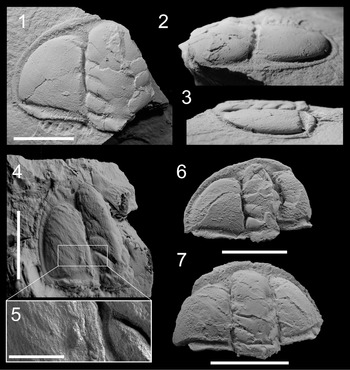
Pseudatops reticulatus (Walcott, Reference Walcott1890b): (1–3) UHU-CU003-20, Cumbres de San Bartolomé, Cumbres beds, late Marianian: (1) dorsal view; (2) frontal view; (3) lateral view; (4, 5) UHU-AM2001-20, Arroyomolinos de León, Herrerías shale, middle-late Marianian: (4) dorsal view; (5) detail of the reticular ornamentation; (6) UHU-CU1004-20, Cumbres de San Bartolomé, Cumbres beds, late Marianian, dorsal view; (7) UHU-CU1005-20, Cumbres de San Bartolomé, Cumbres beds, late Marianian, dorsal view. Scale bars = 20 mm; scale bar for subfigure 5 is 5 mm.

Holotype
USNM 18431.
Emended diagnosis
Pseudatops with trapezoidal cranidium, surrounded externally by a nearly flat border; elongated, subrectangular glabella and facial suture confined to the lateral border.
Occurrence
Pseudatops reticulatus occurs in the Elliptocephala asaphoides Biozone in the Taconic Allochthon; in the Hebediscus attleborensis Subzone of the Callavia broeggeri Biozone in Avalonia; and in the upper Marianian of Iberia (herein).
Description
Cranidium trapezoidal, wider than long, ranging 8.5–26.8 mm in length, 19.5–51 mm in width. Marginal facial suture only cutting the lateral border of the cephalon and not affecting the lateral furrow. Anterior margin slightly curved. Anterior border narrow (sag.), homogeneous, planoconvex, slightly turned downward. Anterior furrow shallow, sagittally invaginated toward the front due to the intrusion of the glabella, with a fairly broad and well-defined subtriangular shaped area originating on each side of the frontal lobe of the glabella. Glabella elongated, extending all along the cranidium, subrectangular, with rounded frontal lobe and deep axial furrows. Three pairs of nontransglabellar furrows with slight curvature pointing toward the posterior area. Occipital furrow deep, curving toward the front (convexity toward the posterior area). Occipital lobe narrow, trapezoidal, slightly curved with convexity toward the posterior area and subtle occipital tubercle. Preocular field slim, convex. Ocular ridge slightly pronounced, inserting toward the frontal lobe of the glabella and reaching the lateral furrow. Palpebral area flat, wide, trapezoid, with slight slope toward the posterior area. Posterior furrow well marked, wide. Posterior border narrow, flat, thickened near the genal area due to an incurved posterior border. Lateral border narrow, homogeneous. Genal angle ~ 90°, with a minimal genal spine. Surface of the cephalon subtly reticulated. For reconstruction, see Figure 5.
Reconstruction of the cephalon of Pseudatops reticulatus (Walcott, Reference Walcott1890b), in (left to right) dorsal, frontal, and lateral views.

Materials
A total of 13 cranidial fragments were available (UHU-CU1002–CU1009-20, CU1014–CU1016-20, POZ021-20, AM2001-20). Additional fragments are deposited in the same collection.
Remarks
The description above is based solely on the material collected for this study.
The differences between North American Pseudatops reticulatus (New York and Newfoundland) and Spanish specimens are minimal: the cephalon, especially the frontal lobe of the glabella, presents a more significant relief in the North American specimens. This could be taphonomic because the American specimens are preserved in limestone and the Spanish ones in shales.
Pseudatops viola has a cephalon with a semiovate outline, in contrast with the trapezoidal to semicircular cephalon of Pseudatops reticulatus. In Pseudatops viola, the facial suture crosses the lateral border furrow and a narrow sliver of the cheek, whereas in Pseudatops reticulatus, it is confined to the lateral border. The more marginal facial suture also occurs in numerous conocoryphids (see Sdzuy, Reference Sdzuy1961; Liñán and Gozalo, Reference Liñán and Gozalo1986).
Korobov (Reference Korobov1973) erected Pseudatops perantiquus from the Ishim River, comparing it with Pseudatops viola and Pseudatops reticulatus. Pseudatops perantiquus differs from Pseudatops viola by a wider anterior border, wider anterior and posterior border furrows, and a subtriangular fixigena (Korobov, Reference Korobov1973). Pseudatops perantiquus has a wider cranidium, posterior border furrows running directly into the occipital furrow, a wider anterior border, and wider anterior and posterior furrows than Pseudatops reticulatus. Korobov (Reference Korobov1973) noted that the Russian specimens have a wider, more uniform border in comparison with that of Pseudatops reticulatus. The smaller, conical glabella pointing forward and the three pairs of deep, wide lateral furrows are especially remarkable. The frontal lobe of the glabella reaches the anterior furrow without invading the anterior border, but it has the characteristic reticulated ornament of Pseudatops.
Discussion
Biostratigraphy
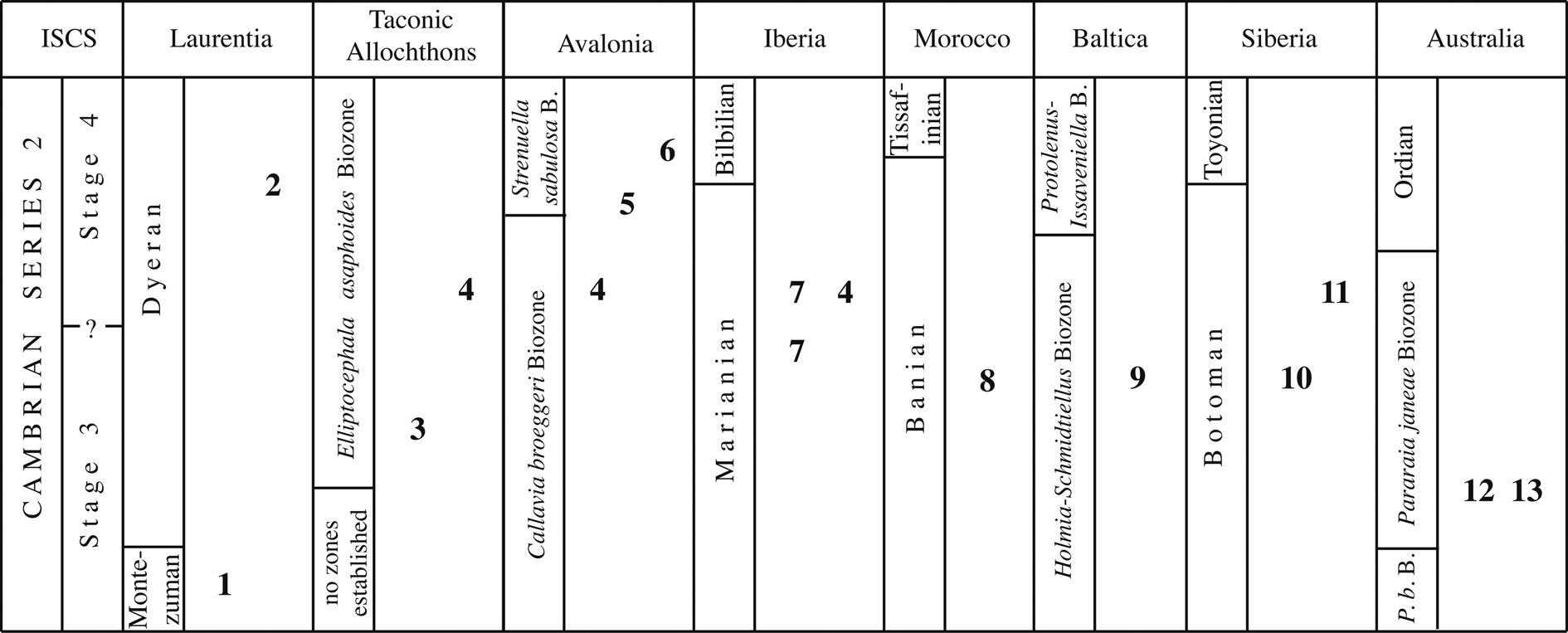
The Atopidae has a worldwide distribution. The stratigraphic distributions of Atops and Pseudatops are summarized in Figure 6.
Correlation chart showing the stratigraphic occurrence of Atopidae. 1 = Conocoryphidae gen. indet. sp. indet. of Fritz (Reference Fritz1973); 2 = Atops sp. indet. of Cotton (Reference Cotton2001); 3 = Atops trilineatus Emmons, Reference Emmons1844; 4 = Pseudatops reticulatus (Walcott, Reference Walcott1890b); 5 = Pseudatops viola (Woodward, Reference Woodward1888); 6 = Atops? sp. indet. of Rushton (Reference Rushton1966); 7 = Atops calanus Richter and Richter, Reference Richter and Richter1941; 8 = Pseudatops sp. indet. of Geyer in Sundberg et al. (Reference Sundberg, Geyer, Kruse, McCollum, Pegel, Żylinska and Zhuravlev2016); 9 = Atops granulatus Orlowski, Reference Orlowski1985; 10 = Atops nikolai (Korobov, Reference Korobov1966), Atops patulus (Korobov, Reference Korobov1966), Atopina antiqua Korobov, Reference Korobov1966, and Pseudatops perantiquus Korobov, Reference Korobov1973; 11 = Atops korobovi Romanenko in Repina et al., Reference Repina, Romanenko, Fedjanina and Pegel1999; 12 = Atops briandailyi (Jenkins and Hasenohr, Reference Jenkins and Hasenhohr1989); 13 = Atops rupertensis Jell, Jago, and Gehling, Reference Jell, Jago and Gehling1992; B. = Biozone; P. b. B. = Pararaia bunyerooensis Biozone. Based on Sundberg et al. (Reference Sundberg, Geyer, Kruse, McCollum, Pegel, Żylinska and Zhuravlev2016); Zhang et al. (Reference Zhang, Ahlberg, Babcock, Choi, Geyer, Gozalo, Hollingsworth, Li, Naimark, Pegel, Steiner, Wotte and Zhang2017); and Geyer (Reference Geyer2019).

Atops trilineatus occurs in the Taconic Allochthon, in the ‘Lower Faunule’ of the E. asaphoides Zone (Lochman, Reference Lochman1956; Rasetti, Reference Rasetti1967). In Baltica, Atops granulatus occurs in the Holy Cross Mountains (Poland), in the middle Holmia-Schmidtiellus Biozone (Orlowski, Reference Orlowski1985; Żylinska, Reference Żylińska2013). Atops calanus occurs in the middle to late Marianian (Cambrian Stage 4) with Serrodiscus, Calodiscus, and Triangulaspis (Richter and Richter, Reference Richter and Richter1941; Sdzuy, Reference Sdzuy1962; Collantes et al., Reference Collantes, Gozalo, Mayoral, Garzón, Vaz and Sá2018). In Australia, Atops rupertensis and A. briandailyi occur in the Pararaia janeae Biozone (Jell et al., Reference Jell, Jago and Gehling1992; Jago et al., Reference Jago, Zang, Sun, Brock, Paterson and Skovsted2006). Atops korobovi occurs in the Sanashtykgol Horizon of the Botomian stage in the Altai-Sayan Fold Belt (Repina et al., Reference Repina, Romanenko, Fedjanina and Pegel1999). Atops nikolai and Atops patulus from Tuva Republic are from the upper Aldan Stage or, possibly, lowermost Lenan Stage (Korobov, Reference Korobov1973, table 1). Because the Lenan is now assigned to the Toyonian Stage (Astashkin et al., Reference Astashkin, Pegel, Shabanov, Sukhov, Sundukov, Repina, Rozanov and Zhuravlev1991), this species is likely upper Botomian. Atops? sp. indet. of Rushton (Reference Rushton1966) from the Purley Shales (locality 2A) occurs with Serrodiscus ctenoa Rushton, Reference Rushton1966 of the Cephalopyge Biozone in the upper Cambrian Stage 4 (Rushton et al., Reference Rushton, Brück, Molyneux, Williams and Woodcock2011; Williams et al., Reference Williams, Rushton, Cooks, Zalasiewicz, Martin, Condon and Winrow2013). Conocoryphidae gen. indet. sp. indet. of Fritz (Reference Fritz1973) in the Mackenzie Mountains, northwestern Canada, assigned here to Atops, occurs in the lower Sekwi Formation, dated as Nevadella Biozone (upper Cambrian Stage 3 to lower Stage 4). Although Cotton (Reference Cotton2001) did not offer information about the stratigraphic position of his Atops sp. indet., Murray studied the Salt Water Pond Series in 1864 (Murray and Howley, Reference Murray and Howley1881; Schuchert and Dunbar, Reference Schuchert and Dunbar1934) and the first three levels are included in the Forteau Formation (Betz, Reference Betz1939, table 2), the horizon of which is assigned to the Bonnia-Olenellus Biozone, Dyeran Stage (Skovsted and Peel, Reference Skovsted and Peel2007; Stouge et al., Reference Stouge, Bagnoli and McIlroy2017).
Pseudatops reticulatus is present in the ‘Upper Faunule’ of the E. asaphoides Zone in the Taconic Allochthon (Lochman, Reference Lochman1956; Basset et al., Reference Bassett, Owens and Rushton1976); in the H. attleborensis Subzone of the C. broeggeri Zone of Avalonia (Fletcher, Reference Fletcher2006); in horizon Ac3 of the Comley Limestones (Cobbold, Reference Cobbold1921, Reference Cobbold1936) of the Callavia Biozone (Thomas et al., Reference Thomas, Owens and Rushton1984; Rushton et al., Reference Rushton, Brück, Molyneux, Williams and Woodcock2011) and Iberia, with Atops calanus, in the middle and lowermost late Marianian. In North Wales and Shropshire, Pseudatops viola appears in the Strenuella sabulosa Biozone (Howell and Stubblefield, Reference Howell and Stubblefield1950; Basset et al., Reference Bassett, Owens and Rushton1976). In Morocco, Pseudatops is present in the Antatlasia guttapluviae Biozone (unpublished data, G. Geyer, according to Sundberg et al., Reference Sundberg, Geyer, Kruse, McCollum, Pegel, Żylinska and Zhuravlev2016). Pseudatops perantiquus occurs in the Tuva Republic, in the Callavia-Olenellus-Holmia Biozone (Korobov, Reference Korobov1973, table 11).
Atopina is restricted to the Aldan Stage in Siberia (Korobov, Reference Korobov1973).
Paleobiogeography
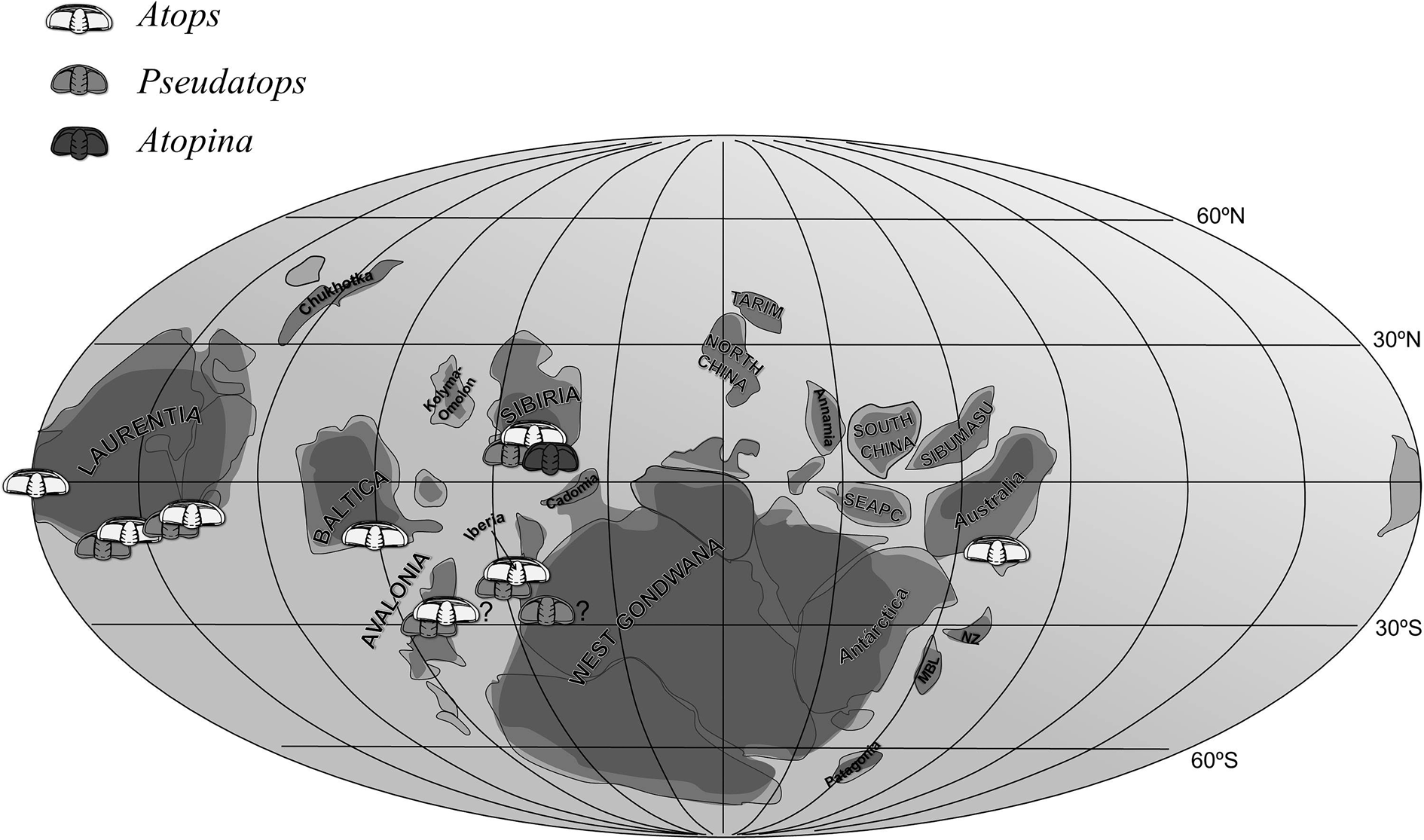
The Atopidae is known from Laurentia (northwestern Canada), the Taconic Allochthon (New York), western Newfoundland, western and eastern areas of Avalonia (eastern Newfoundland and the United Kingdom, respectively), Baltica (Poland), Siberia (Tuva Republic), the western margin of Gondwana (Iberia and Morocco), and Gondwana (Australia). Figure 7 shows that the distribution of Atopidae is mainly in the Southern Hemisphere, close to the equator.
Distribution of the Atopidae, plotted on the Cambrian palaeogeographic map. Based on Dalziel (Reference Dalziel1997), Scotese and McKerrow (Reference Scotese and McKerrow1990), McKerrow et al. (Reference McKerrow, Scotese and Brasier1992), and Malinky and Geyer (Reference Malinky and Geyer2019).

Acknowledgments
We thank P. Jell (Queensland) and F.A. Sundberg (Arizona) for their constructive reviews, N. Hughes for his efforts in editing the article, I. Garzón and J. Ramírez for fieldwork assistance, D. Jaramillo for English language revision, and G. Feria Marquínez for illustrations (Figs. 3, 5). We want to thank the Council of Environment and Territorial Planning from the Junta de Andalucía and the Directorate of Sierra de Aracena y Picos de Aroche Natural Park for providing permission to work in the park. The present work was carried out with funding from the Junta de Andalucía to the RNM 276 Research Group and the Centro Científico-Tecnológico de Huelva to the Department of Applied Geosciences, together with the GIUV2017-395 research group of the University of Valencia. This work is a contribution to the projects IGCP 652 and 668.