I. INTRODUCTION
Transparent conducting oxides (TCOs) combine high transparency in the visible spectral range with high electrical conductivity under ambient conditions.Reference Ginley and Bright1, Reference Fortunato, Ginley, Hosono and Paine2 Post-transition-metal compounds such as zinc oxide (ZnO), indium (III) oxide (In2O3), and tin dioxide (SnO2) are typical TCOs as they have large fundamental band gaps rendering these materials transparent into the ultraviolet (UV) spectral range. Due to their very large gaps, especially magnesium oxide (MgO) and silicon dioxide (SiO2) are transparent into the far UV. The gaps can be modified, e.g., not only by alloying ZnO with MgO or cadmium oxide (CdO) (see Ref. Reference Schleife, Rödl, Furthmüller and Bechstedt3 and references therein), but also by varying their chemistry, for instance when going from SnO2 to SnO.Reference Seko, Togo, Oba and Tanaka4 Free carriers, introduced by intentional as well as unintentional doping, are the reason for the remarkable conductivities of the TCOs.Reference Lany and Zunger5 Prominent examples are aluminum-doped ZnO,Reference Sernelius, Berggren, Jin, Hamberg and Granqvist6 tin-doped indium oxide,Reference Tahar, Ban, Ohya and Takahashi7 antimony-doped SnO2,Reference Li, Yin, Liu, Li, Liu and Song8, Reference White, Bierwagen, Tsai and Speck9 or even zinc–indium–tin oxide.Reference Buchholz, Liu, Marks, Zhang and Chang10
Bulk TCO materials attract great attention due to their outstanding optical,Reference Ginley and Bright1 electrical,Reference Minami11–Reference Bierwagen and Speck13 and electrochemicalReference Badawy14 properties combined with excellent hardness and environmental stability.Reference Ginley and Bright1 This renders them highly interesting for applications as transparent front contacts for solar cells,Reference Fortunato, Ginley, Hosono and Paine2, Reference Minami11, Reference Lunt and Bulovic15, Reference Klein, Körber, Wachau, Säuberlich, Gassenbauer, Harvey, Proffit and Mason16 as next-generation gate oxides for Si-based electronics,Reference Robertson17 and in electrodes for photocatalytic water splitting.Reference Reyes-Gil, Reyes-García and Raftery18 Surfaces of the TCOs are highly interesting since on these an electron accumulationReference Nagata, Bierwagen, White, Tsai, Yamashita, Yoshikawa, Ohashi, Kobayashi, Chikyow and Speck19–Reference Allen, Swartz, Myers, Veal, McConville and Durbin21 as well as an electron depletionReference Bierwagen, Speck, Nagata, Chikyow, Yamashita, Yoshikawa and Kobayashi22 have been observed. Exploring the atomic structure and the termination of surfaces of such oxides is still subject of current research.Reference Allen, Zemlyanov, Waterhouse, Metson, Veal, McConville and Durbin23–Reference Ágoston and Albe25 In addition, the properties of the TCOs are drastically modified when they are prepared as nanobelts,Reference Kong and Wang26 nanotubes,Reference Li, Bando and Golberg27 nanoribbons,Reference Beltrán, Andrés, Longo and Leite28 nanowires,Reference Huang, Zhong, Wang, Sullivan, Xu, Zhang, Mao, Hudak, Liu, Subramanian, Fan, Qi, Kushima and Li29 and nanoparticles.Reference Müller, Rasp, Štefanić, Ba, Günther, Rathousky, Niederberger and Fattakhova-Rohlfing30
Even though the TCOs are highly interesting for these reasons, their most desirable widespread application in semiconductor electronics, for instance as (light-emitting) diodes, is currently hampered by the lack of stable and reproducible p-type TCOs. For other photovoltaic or optoelectronic devices, a deep understanding of intrinsic key properties is necessary. In this context, especially the electronic band structures around the fundamental gaps or the effective electron masses have to be thoroughly described. Also the optical absorption and emission properties near the band-edge and their dependence on the light polarization (due to dipole selection rules) need to be understood. For the TCOs, a plethora of experimental results is available,Reference Wagner, Schulze, Kirste, Cobet, Hoffmann, Rauch, Rodina, Meyer, Röder and Thonke31, Reference Wagner, Callsen, Reparaz, Schulze, Kirste, Cobet, Ostapenko, Rodt, Nenstiel, Kaiser, Hoffmann, Rodina, Phillips, Lautenschläger, Eisermann and Meyer32 however, their interpretation can be challenging, for instance, due to sample-quality issues that depend on the manufacturing technique, the substrate temperature during growth, or the post deposition treatment.Reference Matino, Persano, Arima, Pisignano, Blyth, Cingolani and Rinaldi33 In the case of In2O3, growth can be phase-selective and can lead to both cubic as well as rhombohedral (rh) polymorphs with band gaps differing by as much as 0.7 eV.Reference Wang, Cimalla, Romanus, Kups, Ecke, Stauden, Ali, Lebedev, Pezoldt and Ambacher34 In the case of ZnO (see Ref. Reference Lambrecht, Rodina, Limpijumnong, Segall and Meyer35 and references therein), and also for SnO2 (see Refs. Reference Robertson36–Reference Reimann and Steube38) the details of the valence-band ordering and the band symmetries are not unequivocally determined from experiment.
Due to the continuous development of sophisticated methods and algorithms as well as the increasing power of today’s supercomputers, the ability to precisely describe theoretically various properties of such materials has made substantial progress during the last few years. The accurate parameter-free description of the quasiparticle (QP) electronic structures and the frequency-dependent dielectric functions of complex materials (see the reviews in Refs. Reference Fuchs, Furthmüller, Bechstedt, Shishkin and Kresse39–Reference Bechstedt, Fuchs and Furthmüller42 and references therein) has become possible and leads—hand in hand with modern experimental techniques—to a deep understanding. Many-body perturbation theory is used to take the excitation aspect of important experimental techniques into account and can be applied to compute the electronic and spectral properties of bulk oxides in a given ideal crystal structureReference Schleife, Rödl, Fuchs, Furthmüller and Bechstedt43–Reference Yan, Rinke, Winkelnkemper, Qteish, Bimberg, Scheffler and Van de Walle47 but also for alloys,Reference Schleife, Rödl, Furthmüller and Bechstedt3, Reference Schleife, Eisenacher, Rödl, Fuchs, Furthmüller and Bechstedt48, Reference Schleife and Bechstedt49 oxide systems with defects,Reference Rinke, Schleife, Kioupakis, Janotti, Rödl, Bechstedt, Scheffler and Van de Walle50, Reference Furthmüller, Hachenberg, Schleife, Rogers, Teherani and Bechstedt51 and n-type TCOs.Reference Schleife and Bechstedt49, Reference Schleife, Rödl, Fuchs, Hannewald and Bechstedt52–Reference Ágoston, Körber, Klein, Puska, Nieminen and Albe54
In Sec. II of the present article, we summarize the theoretical and computational approaches that we used to compute QP band structures and the optical absorption of various oxide materials. We present the corresponding band structures and provide detailed information about band gaps and effective masses in Sec. III. The line-shape and the oscillator strength of the optical absorption edges are discussed in Sec. IV. Section V summarizes this review article.
II. THEORETICAL AND COMPUTATIONAL APPROACH
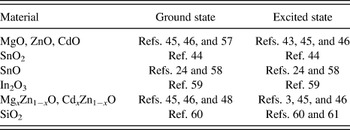
The present review article focuses on the description of excited state properties, such as the QP electronic structure and the optical absorption spectrum, for different oxides by means of an ab initio framework. Their ground state properties and, in particular, determining the equilibrium atomic geometries, e.g., within density functional theory (DFT),Reference Hohenberg and Kohn55, Reference Kohn and Sham56 are not part of the present work. For more information about that as well as about all computational details we want to point the reader to Table I, which indicates the reference(s) in which the respective calculations are presented in more detail.
For each material the references are given that contain more information on the calculations of the ground state and the excited state properties that are reviewed in this work.

A. QP electronic structures
Important experimental techniques such as (inverse) photoelectron spectroscopy or x-ray absorption and emission studies probe excited state properties of a material, since during these processes an electron is added to or removed from the system. Hence, the ground state description provided by a Kohn-Sham (KS) scheme within DFT is not sufficient; instead, QP effects have to be taken into account.Reference Hybertsen and Louie62 Interpreting the KS eigenvalues as excitation energies, typically leads to too small band gaps and wrong band dispersions,Reference Perdew and Levy63, Reference Sham and Schlüter64 since the KS eigenvalues neglect the excitation aspect that is characteristic for the experimental techniques that are used to measure these quantities.
Electronic excitations can accurately be treated by correctly describing the electronic self energy Σ. Expressing Σ as the product of the Green’s function of the electrons G and the screened Coulomb potential W, as it was introduced by L. Hedin in 1965,Reference Hedin65, Reference Hedin, Lundqvist, Seiz and Ehrenreich66 is an essential simplification of the description by neglecting vertex corrections. Nevertheless, the fully self-consistent solution of the resulting QP equation is very demanding from a computational point of view. For that reason, it is common to rely on perturbation theory to compute QP energies in practice: In the G 0W 0 scheme first-order QP corrections are calculated for the eigenvalues of some starting electronic structure. It is immediately clear that any initial electronic structure must not be too far from the final results for first-order perturbation theory to be sufficient.
We found that the range-separated HSE06 hybrid functional,Reference Heyd, Scuseria and Ernzerhof67–Reference Paier, Marsman, Hummer, Kresse, Gerber and Ángyán69 but with a range-separation parameter of 0.15 a.u.−1 = 0.3 Å−1, reasonably fulfills this requirement for several oxides.Reference Schleife, Rödl, Fuchs, Furthmüller and Bechstedt43–Reference Schleife46, Reference Schleife, Rödl, Fuchs, Furthmüller, Bechstedt, Jefferson, Veal, McConville, Piper, DeMasi, Smith, Lösch, Goldhahn, Cobet, Zúñiga-Pérez and Muñoz-Sanjosé70, Reference Schleife, Fuchs, Rödl, Furthmüller and Bechstedt71 In this work, we review results for different TCOs that rely on the HSE functional to obtain the starting electronic structures for the G 0W 0 calculations; the entire approach is called HSE+G 0W 0 in the following. To keep the computational effort reasonable and since spin-orbit induced shifts are smaller than the QP corrections, we assume that the influence of the spin-orbit interaction on the QP corrections is negligible. Therefore, we take the spin-orbit interaction into accountReference Hobbs, Kresse and Hafner72 only when calculating the HSE electronic structure and then apply the QP corrections calculated for spin-paired electrons.Reference Schleife, Fuchs, Rödl, Furthmüller and Bechstedt71–Reference Schleife, Rödl, Fuchs, Furthmüller and Bechstedt73 Overall, we expect the QP energies calculated by the scheme outlined above to be converged within about 0.1 eV.
A shortcoming of the HSE+G 0W 0 approach is its large computational cost. This becomes particularly problematic for the calculation of optical spectra, i.e., when significantly more k-points have to be taken into account for converging, for instance, the macroscopic dielectric function around the absorption edge. In these cases, we pursue a different approach by approximating the results of the HSE+G 0W 0 calculations via a DFT+U+Δ method,Reference Schleife, Rödl, Furthmüller and Bechstedt3, Reference Rödl, Fuchs, Furthmüller and Bechstedt41, Reference Schleife, Rödl, Fuchs, Furthmüller and Bechstedt43–Reference Schleife46, Reference Schleife, Rödl, Fuchs, Furthmüller, Bechstedt, Jefferson, Veal, McConville, Piper, DeMasi, Smith, Lösch, Goldhahn, Cobet, Zúñiga-Pérez and Muñoz-Sanjosé70 where the term “DFT” indicates that either the local-density approximation (in the case of SnO2 and SnO) or the generalized-gradient approximation (for MgO, ZnO, and CdO) is used. Therein, U, which denotes the additional Coulomb interaction term within the DFT+U approach,Reference Anisimov, Zaanen and Andersen74, Reference Dudarev, Botton, Savrasov, Humphreys and Sutton75 is adjusted such that the energy position of the d bands matches the HSE+G 0W 0 result. In addition, Δ describes a scissors operatorReference Aulbur, Jönsson, Wilkins, Ehrenreich and Spaepen76 that rigidly shifts all conduction bands so that the fundamental gap becomes identical to the HSE+G 0W 0 value.
The HSE+G 0W 0 as well as the DFT+U+Δ calculations are carried out using the Vienna Ab initio Simulation Package (VASP).Reference Kresse and Furthmüller77–Reference Shishkin and Kresse79 The wave functions are expanded into plane waves and the electron-ion interaction is described via the projector-augmented wave method.Reference Blöchl80, Reference Kresse and Joubert81
B. Optical absorption
In optical absorption experiments, excitation energies are studied that are not high enough to remove electrons from the system. Instead, upon the irradiation with light, an electron that gets excited from the valence bands into the conduction bands, leaves behind a hole in the valence bands. Due to their having opposite charge, the photocreated hole and the excited electron interact via the screened Coulomb attraction, leading to the formation of excitons in the material. Excitonic effects due to the electron-hole interaction can, for instance, be taken into account in the ab initio description by solving a Bethe–Salpeter equation (BSE) for the optical polarization function.Reference Strinati82, Reference Onida, Reining and Rubio83
For its numerical solution, the BSE is typically rewritten into an eigenvalue problem for the electron-hole pair Hamiltonian.Reference Onida, Reining and Rubio83 We use the KS eigenstates from the DFT+U+Δ calculation to compute the matrix elements of the statically screened Coulomb attraction of the electrons and the holes as well as of the unscreened exchange-like term that accounts for local-field effects.Reference Rödl, Fuchs, Furthmüller and Bechstedt41, Reference Rödl, Fuchs, Furthmüller and Bechstedt84 The DFT+U+Δ KS eigenvalues are used to describe the transition energies of noninteracting electrons and holes. The corresponding optical transition-matrix elements are computed using the longitudinal approximation.Reference Gajdoš, Hummer, Kresse, Furthmüller and Bechstedt85 After constructing the excitonic Hamiltonian, its eigenstates and eigenvalues can be used to calculate the optical properties of the system.Reference Albrecht, Reining, Del Sole and Onida86–Reference Rohlfing and Louie88
The converged calculation of the optical absorption spectrum in the vicinity of the band edge requires a large number of k points.Reference Schleife, Rödl, Fuchs, Furthmüller and Bechstedt43, Reference Fuchs, Rödl, Schleife and Bechstedt89 Since for some of the materials discussed in this work, the lowest optical transitions are confined to the vicinity of the Γ point, this part of the Brillouin zone (BZ) can be sampled more densely to obtain convergence for the absorption edgeReference Fuchs, Rödl, Schleife and Bechstedt89; we use hybrid k-point meshesReference Fuchs, Rödl, Schleife and Bechstedt89 to achieve that goal. However, the computational cost of diagonalizing the resulting excitonic Hamiltonian matrices with ranks N of up to ≈ 100,000 is much too high. Therefore, in this work an efficient time-evolution schemeReference Schmidt, Glutsch, Hahn and Bechstedt90 is used to calculate the dielectric function ε(ω) from the excitonic Hamiltonian.
When very dense k-point meshes are used, the large computational cost prohibits taking enough conduction bands into account for including high-energy optical transitions. This, however, becomes necessary to obtain converged results for the real part of ε(ω) at low photon energies due to the Kramers–Kronig relationReference Kronig91, Reference Kramers92 between the real and imaginary parts. Therefore, as described in detail in Refs. Reference Schleife, Rödl, Fuchs, Furthmüller and Bechstedt43, Reference Schleife45, and Reference Schleife46, we also solve a BSE using a more coarse k-point mesh to include optical transitions at intermediate energies. In addition, the optical transitions lying above this BSE cutoff are included (up to 200 eV) on the KS level. Finally, the absorption coefficient α(ω) is calculated from the resulting dielectric function.
III. QP ELECTRONIC STRUCTURES
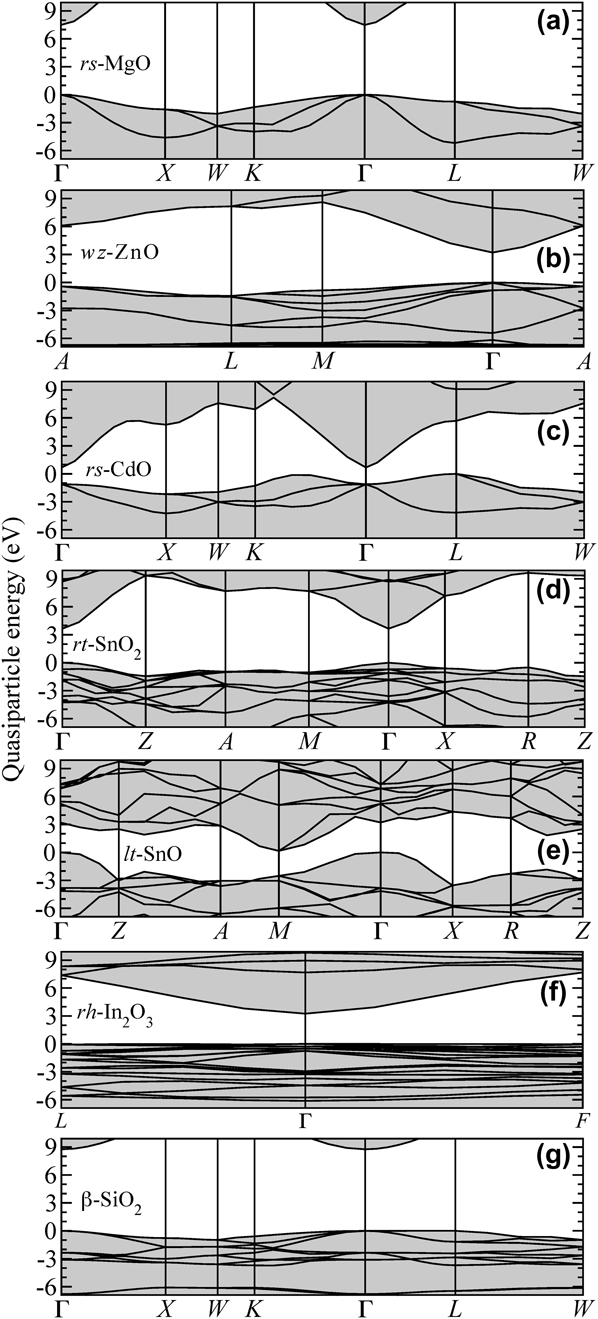
The QP band structures calculated using the HSE+G 0W 0 approach are depicted for MgO, ZnO, CdO, SnO2, SnO, In2O3, and SiO2 in Fig. 1. For the oxides studied in this work the uppermost valence bands are derived from O 2p states and the lowest conduction-band states originate from s states of the respective metal cation.Reference Yin, Wei, Al-Jassim and Yan93
QP band structures in the vicinity of the fundamental gap of (a) MgO, (b) ZnO, (c) CdO, (d) SnO2, (e) SnO, (f) In2O3, and (g) SiO2 calculated using the HSE+G 0W 0 approach. The valence-band maximum has been set to zero energy.
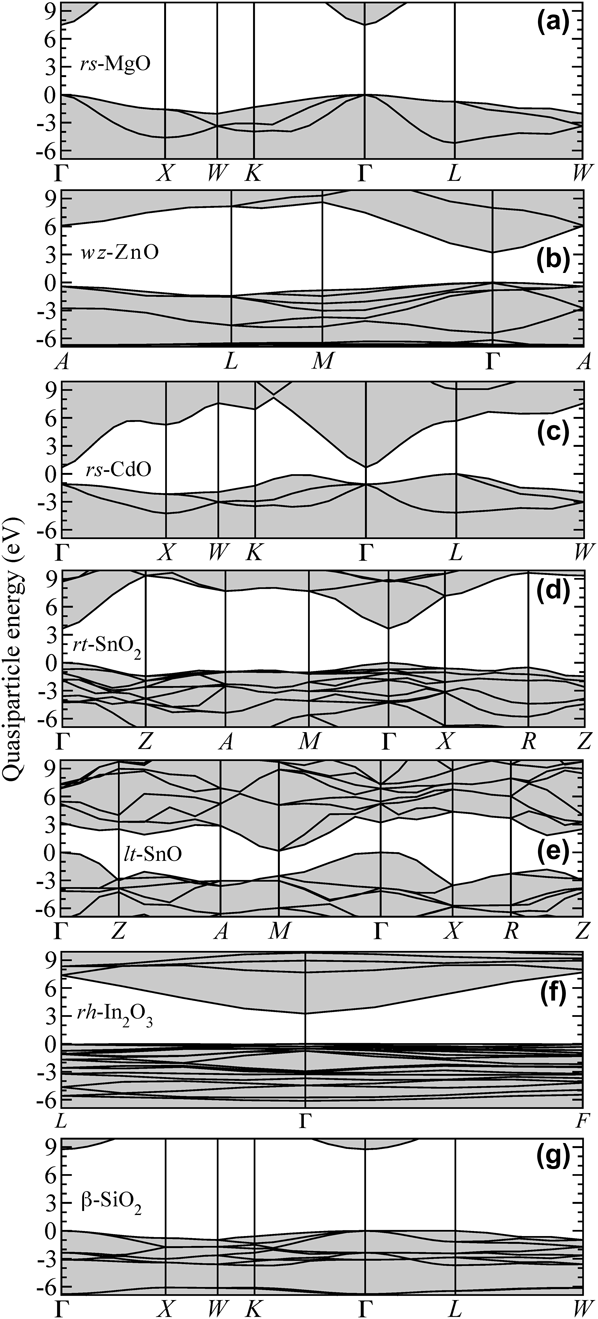
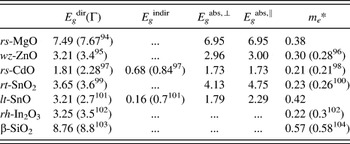
In addition, from Fig. 1 it is obvious that MgO, ZnO, SnO2, In2O3, and SiO2 are direct semiconductors with the fundamental band gap at the Γ point; the two monoxides CdO and SnO are found to be indirect semiconductors. While in CdO the conduction-band minimum occurs at the Γ point and the maximum of the valence bands occurs away from Γ, the situation is different for SnO. In this material the valence-band maximum is located at Γ and the conduction band shows a pronounced minimum at the M point of the BZ, whereas Γ is an M 1 saddle point for the lowest conduction band (see Fig. 1). The direct and the indirect QP band gaps of these oxides are compiled in Table II. These results for the electronic structures have been carefully compared with experimental dataReference Schleife, Varley, Fuchs, Rödl, Bechstedt, Rinke, Janotti and Van de Walle44, Reference Fuchs and Bechstedt59, Reference King, Veal, Schleife, Zúñiga-Pérez, Martel, Jefferson, Fuchs, Muñoz-Sanjosé, Bechstedt and McConville105–Reference Preston, Ruck, Piper, DeMasi, Smith, Schleife, Fuchs, Bechstedt, Chai and Durbin107 (see also Table I for the corresponding references) and the agreement is found to be rather good.
Direct [Eg dir(Γ)] and indirect (Eg indir) QP band gaps as well as optical band gaps for ordinary (Eg abs,⊥) and extraordinary (Eg abs,‖) light polarization are given in eV. Harmonic mean values for the effective electron masses me*, derived from the HSE+G 0W 0 band structure (HSE band structure for In2O3Reference Fuchs and Bechstedt59), are given in units of the free-electron mass. Experimental values for Eg dir, Eg indir, and, if available, for me* are given along with the corresponding reference in parenthesis.

From Table II it also becomes clear that all the oxides studied in this work, with the exception of rocksalt- (rs) CdO and litharge- (lt) SnO, have fundamental band gaps that are large enough for visible light not to be absorbed by the intrinsic materials. Even though the direct gaps at the Γ point are as large as 1.81 eV (rs-CdO) or even 3.21 eV (lt-SnO) the indirect gaps of these two materials are much smaller. Hence, phonon-assisted optical absorption can occur in the visible spectral range for samples of both materials. In addition, in the case of lt-SnO the smallest direct gap of only 2.68 eV occurs at the M point of the BZ.
The HSE+G 0W 0 results are used to derive the effective electron masses along different directions in the BZ via parabolic fitting to the QP band structures in the close vicinity of the Γ point (the M point in the case of SnO). We refer the reader to the literature for the effective masses that have been derived for the rs polymorphs of MgO and CdO,Reference Schleife45, Reference Schleife46rt-SnO2,Reference Schleife, Varley, Fuchs, Rödl, Bechstedt, Rinke, Janotti and Van de Walle44rh-In2O3,Reference Fuchs and Bechstedt59 or the wurtzite (wz) polymorphs of MgO, ZnO, and CdO.Reference Schleife45, Reference Schleife46, Reference Schleife, Fuchs, Rödl, Furthmüller and Bechstedt71 For beta-cristobalite- (β) SiO2, effective electron masses of mL *(ΓCBM) = 0.57, mK *(ΓCBM) = 0.58, and mX *(ΓCBM) = 0.57 are obtained and in the case of lt-SnO, the conduction-band minimum at the M point of the BZ leads to electron masses of mA *(M CBM) = 0.37 and m Γ*(M CBM) = 0.49 (all in units of the free-electron mass). We also use these values to derive the harmonic mean values of the electron masses for all the oxides (see Table II).
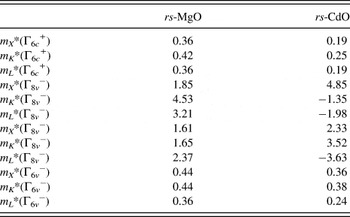
In the case of rs-MgOReference Schleife45, Reference Schleife46 we find a small anisotropy (indicating that the bands are not strictly parabolic within the k range used for the fit) and the two 2-fold degenerate valence bands are heavy-hole related (see Table III). Their masses are of the same order of magnitude in all three high-symmetry directions and are, roughly, one order of magnitude larger than the values for the light-hole band. Also the lowest CB turns out to be almost isotropic. As with rs-MgO, the two uppermost valence bands in rs-CdO are heavy-hole bands and the third one is of light-hole type.Reference Schleife45, Reference Schleife46 Since for rs-CdO the valence-band maximum occurs away from the Γ point in the BZ, the values for the effective mass of the uppermost two valence bands are negative along certain directions in k space (see Table III). This has been traced back to the fact that the p-d hybridization is forbidden at Γ due to the rs lattice symmetry.Reference Schleife45, Reference Schleife46, Reference Schleife, Fuchs, Furthmüller and Bechstedt57 In this material holes are expected to occur at the valence-band maximum between K and Γ. We observe that the effective electron masses for β-SiO2 are very isotropic; the anisotropy of the ones for lt-SnO (at the M point of the BZ) is slightly larger. Comparison to experimental or other theoretical results is given in Refs. Reference Schleife, Varley, Fuchs, Rödl, Bechstedt, Rinke, Janotti and Van de Walle44, Reference Schleife45, and Reference Fuchs and Bechstedt59.
Effective masses m* (in units of the free-electron mass m) at the BZ center along the Γ—X, Γ—K, and Γ—L directions for rs-MgO and rs-CdO as derived from the HSE+SOC+G 0W 0 scheme. Values are given for the lowest conduction band and the uppermost valence bands.

From Table II it becomes clear that the electron masses for the different oxides decrease by almost a factor of two going along the row MgO, ZnO, SnO2, In2O3, and CdO. Contrary, the values of the electron masses for SnO and SiO2 are larger than for the other oxides. Again, we want to emphasize that the parabolic approximation is only fulfilled in the close vicinity around the Γ point. From our calculations of the effective electron masses we conclude that the electron mobilities should be large in rs-CdO, rh-In2O3, and rutile- (rt) SnO2 with the ones of the other oxides being up to a factor of 2.7 smaller.
In addition, we used the electronic structures derived from the HSE+G 0W 0 approach also for the derivation of the charge-neutrality levels and, hence, the band alignment for different materials.Reference Schleife45, Reference Höffling, Schleife, Rödl and Bechstedt61, Reference Schleife, Fuchs, Rödl, Furthmüller and Bechstedt108, Reference Höffling, Schleife, Fuchs, Rödl and Bechstedt109 Furthermore, the HSE+G 0W 0 approach has successfully been applied to describe nitride systems,Reference Fuchs, Furthmüller, Bechstedt, Shishkin and Kresse39, Reference de Carvalho, Schleife, Fuchs and Bechstedt110–Reference de Carvalho, Schleife, Furthmüller and Bechstedt114 antiferromagnetic transition-metal oxides,Reference Rödl, Fuchs, Furthmüller and Bechstedt41, Reference Rödl, Fuchs, Furthmüller and Bechstedt84 biaxially and uniaxially strained ZnO,Reference Schleife45, Reference Schleife, Rödl, Fuchs, Furthmüller and Bechstedt73 and the nonequilibrium wz polymorphs of MgO and CdO.Reference Schleife45, Reference Schleife, Fuchs, Rödl, Furthmüller and Bechstedt71
IV. OPTICAL ABSORPTION
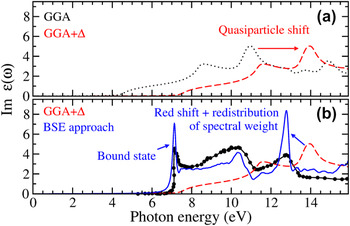
In Fig. 2 we give an overview of how QP corrections as well as excitonic effects influence the imaginary part of the dielectric function in the case of rs-MgO. From Fig. 2(a) it becomes clear that the QP shifts, simulated by a scissors shift Δ, induce a blueshift of the optical spectrum. If actual QP energies were used (instead of the scissors approximation), the shifts for the states at higher energies would be larger.Reference Schleife45Figure 2(b) shows the impact of excitonic and local field effects: We observe a redshift of the BSE curve toward lower photon energies, that does not compensate the blueshift arising from the QP effects discussed above. Aside from the redshift, we observe a strong enhancement of the peak intensities and plateau heights due to the Coulomb interaction. In addition, the BSE curve shows a remarkable feature that dominates the absorption onset, which is attributed to a bound, Wannier-Mott-like electron-hole-pair state. Finally, the comparison with a measured curveReference Bortz, French, Jones, Kasowski and Ohuchi115 in Fig. 2 shows how well the results obtained within the BSE approach agree with experiment and clearly points out the importance of including excitonic effects in the calculations.
Imaginary parts of the dielectric function of rs-MgO calculated using the GGA (dotted black curve), the GGA + Δ (dashed red curve), and the BSE approach (solid blue curve). Experimental results (black circles) from Ref. Reference Bortz, French, Jones, Kasowski and Ohuchi115 are shown for comparison.

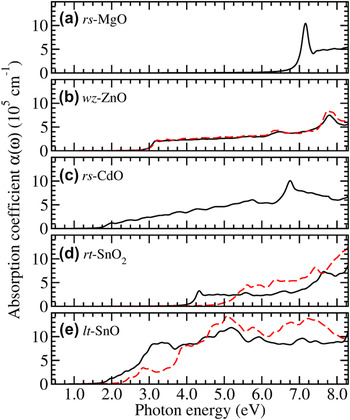
The optical absorption coefficients calculated from the solution of the BSE for rs-MgO, wz-ZnO, rs-CdO, rt-SnO2, and lt-SnO are depicted in Fig. 3. We found that the inclusion of excitonic effects in the description is critically important for all these TCOs as they (i) dominate the spectral features around the absorption onset,Reference Schleife, Rödl, Fuchs, Furthmüller and Bechstedt43–Reference Schleife45, Reference Schleife, Rödl, Fuchs, Furthmüller, Bechstedt, Jefferson, Veal, McConville, Piper, DeMasi, Smith, Lösch, Goldhahn, Cobet, Zúñiga-Pérez and Muñoz-Sanjosé70, Reference Schleife, Rödl, Fuchs, Furthmüller and Bechstedt73 and (ii) strongly influence the overall spectral shape.Reference Schleife, Rödl, Fuchs, Furthmüller and Bechstedt43, Reference Schleife45
Absorption coefficient (in 105 cm−1) around the fundamental band gap for different oxide semiconductors as calculated from the solution of the BSE. Solid black (dashed red) curves represent ordinary (extraordinary) light polarization.

As a consequence, a pronounced excitonic peak is visible around the absorption onset, in particular, of rs-MgO and rt-SnO2 [see Figs. 3(a) and 3(d)]. Such a peak also occurs at the onset of the absorption for wz-ZnO even though this is not as obvious from Fig. 3(b) due to the scale of this plot. However, the influence of such an excitonic bound state is significantly smaller for rs-CdO and lt-SnO [see Figs 3(c) and 3(e)]. One reason is that these two materials have indirect fundamental band gaps and, in addition, the electronic dielectric screening is significantly stronger for these two semiconductors, which is why the excitonic effects are reduced.
The influence of the electron-hole interaction on the overall line shape is referred to as redistribution of oscillator strength in the literature. For all the oxides, peaks at higher photon energies are red-shifted due to the excitonic effects by about 1–2 eV.Reference Schleife, Rödl, Fuchs, Furthmüller and Bechstedt43–Reference Schleife45 In addition, a strong enhancement of the peak intensities and plateau heights due to the Coulomb interaction occurs at low photon energies.
Comparing the dielectric functions calculated from the solution of the BSE to experimental results has shown a very good agreement, for instance, for MgO, ZnO, and CdO,Reference Schleife, Rödl, Fuchs, Furthmüller and Bechstedt43, Reference Schleife45 but also for SnO2.Reference Schleife, Varley, Fuchs, Rödl, Bechstedt, Rinke, Janotti and Van de Walle44 Peak positions and relative peak heights are very well described by the calculations for these materials. We also find good agreement of our results with other computational work on the same theoretical level, for instance, for rs-MgOReference Wang, Rohlfing, Krüger and Pollmann116 or wz-ZnO.Reference Laskowski and Christensen117, Reference Gori, Rakel, Cobet, Richter, Esser, Hoffmann, Del Sole, Cricenti and Pulci118 We want to point out that the scissors operator Δ that is used to mimic the QP gaps does not reproduce the energy dependence of the self-energy operator Σ. Hence, we find a general trend of a slight underestimation of the energy positions of the higher-lying CBs.Reference Schleife45 In addition, the absolute value of the absorption coefficient turns out to be underestimated in the calculations (e.g., for ZnOReference Schleife, Rödl, Fuchs, Hannewald and Bechstedt52), which can be explained, for instance, by imperfect samples, whereas our calculations describe defect-free crystals.
By linearly extrapolating the slope of the absorption curves (see Fig. 3) around the half maximum of the onset to zero absorption, we obtained the optical gaps of the oxides compiled in Table II. We want to point out the strong (noticeable) optical anisotropy of lt-SnO and rt-SnO2 (wz-ZnO). In the case of rs-MgO and wz-ZnO the optical gaps are significantly smaller than the QP gaps also given in Table II. For these two materials this difference arises mostly due to the binding energies of the lowest bound excitonic statesReference Schleife45, Reference Schleife, Rödl, Fuchs, Furthmüller and Bechstedt73, Reference Fuchs, Rödl, Schleife and Bechstedt89 that reduces the optical gaps with respect to the QP gaps. In addition, the Lorentzian broadening of 0.1 eV, which is used to account for temperature, instrumental, and lifetime effects, further leads to a reduction of the optical band gap in our calculations. Both the broadening effect and the exciton-binding energy also play a role for rt-SnO2. However, as elucidated in Ref. Reference Schleife, Varley, Fuchs, Rödl, Bechstedt, Rinke, Janotti and Van de Walle44, the optical transitions between the uppermost valence-band and the lowest conduction-band states are dipole forbidden in this material; consequently, the optical gap is found to be much larger than the QP band gap (see Table II).
In the case of rs-CdO and lt-SnO the optical gap is found to be in between the lowest indirect and the lowest direct QP gap. For these two materials the dielectric screening is much larger which is the reason why there occurs no pronounced peak due to a bound excitonic state at the absorption onset. Nevertheless, excitonic effects are responsible for the optical gap being smaller than the lowest indirect gap for CdO, in addition to the broadening (see above). In the case of lt-SnO, the LDA+U+Δ description of the uppermost valence band at the M point of the BZ differs by 0.73 eV from the HSE+G 0W 0 result. This explains why the optical band gap found in our calculations turns out to be underestimated by this amount; also an influence on the line shape of the spectrum cannot be excluded and will be further investigated in the future.
The results for the dielectric functions obtained from the solution of the BSE have also been used to compute reflectivities as well as the electron energy loss functions for MgO, ZnO, and CdO.Reference Schleife, Rödl, Fuchs, Furthmüller and Bechstedt43, Reference Schleife45 For these materials we identified valence and conduction-band levels (as well as their atomic origin) that are involved in the transitions that cause the main peaks of the spectra. The lowest eigenstates of the excitonic Hamiltonian have been calculated for MgOReference Fuchs, Rödl, Schleife and Bechstedt89 as well as (strained and unstrained) ZnO.Reference Schleife, Rödl, Fuchs, Furthmüller and Bechstedt73 In the case of aluminum nitride (AlN) and calcium oxide (CaO), the BSE approach helped to identify the importance of van Hove singularities and of the excitonic effects for the absorption spectra.Reference Riefer, Fuchs, Rödl, Schleife, Bechstedt and Goldhahn119
V. SUMMARY
In this article, the QP band structures of MgO, ZnO, CdO, SnO2, SnO, In2O3, and SiO2, calculated using the HSE+G 0W 0 approach, have been presented. For these different oxides, we conclude that our results agree well with experimental findings, regarding, for instance, fundamental band gaps and band dispersions or effective electron masses. In addition, we presented the optical absorption spectra of MgO, ZnO, CdO, SnO2, and SnO. We showed that for these oxides the impact of excitonic effects is significant and has to be taken into account in the calculations. We find that this task can be successfully accomplished by solving the BSE. For SnO we conclude that the LDA+U+Δ approach does not reproduce the HSE+G 0W 0 results well enough, hence, a reliable parameter-free description of the optical properties requires future effort.
ACKNOWLEDGMENTS
We acknowledge very much close and longstanding collaborations as well as interesting scientific discussions with (alphabetical) P. Ágoston, O. Bierwagen, C. Cobet, M. Cobet, S. Durbin, F. Fuchs, J. Furthmüller, R. Goldhahn, P. D. C. King, K. Hannewald, B. Höffling, A. Hoffmann, A. Janotti, E. Kioupakis, A. Klein, S. Küfner, W. Lambrecht, C. McConville, B. K. Meyer, L. Piper, P. Rinke, A. Rodina, C. Rödl, D. Rogers, C. G. Van de Walle, J. B. Varley, T. Veal, M. R. Wagner, and S. H. Wei. The research presented here has received funding from the European Community’s Seventh Framework Programme (FP7/2007-2013) under Grant Agreement No. 211956, from the German Federal Government (BMBF Project Nos. 13N9669 and 03SF038D), and from the Deutsche Forschungsgemeinschaft (Project No. Be1346/20-1). Part of this work was performed under the auspices of the U.S. Department of Energy at Lawrence Livermore National Laboratory under Contract DE-AC52-07A27344.