Natural and man-made disasters have increased worldwide during recent years,Reference Rabiee, Ardalan and Poorhoseini 1 and Iran is a disaster-prone country, being the fourth and sixth disaster-prone country in Asia and in the world, respectively. The most common natural disasters in Iran are earthquake, drought, and flood.Reference Asl Hashemi, Taghipour and Dianat 2 Man-made and natural disasters have an important role in the health status of survivors and can lead to extensive disruptions in public resourcesReference Norris, Friedman and Watson 3 and, consequently, result in increased utilization of health resources by those affected, for a much longer time than the disaster duration itself.Reference Asl Hashemi, Taghipour and Dianat 2
Studies have shown that pregnant women were at great risk for undesirable birth outcomes following earthquakes in different countries.Reference Ren, Jiang and Yao 4 – Reference Tan, Li and Zhang 7 Natural disasters can impose negative impacts on pregnant women, causing short-, medium-, and long-term health problems, including preterm delivery, low birth weight (LBW), increased fetal mortality, and a higher incidence of cardiovascular diseases and diabetes in later life.Reference Glynn, Wadhwa and Schetter 8 – Reference Liu, Liu and Tseng-Draft 10 It is not yet exactly known as to why disasters result in these consequences among pregnant women. Economical issues, loss of home, and decreased access to sufficient and nutritious food might be among factors affecting pregnancy outcome. Moreover, aside from the direct effect of the disasters on physical well-being and welfare of the pregnant women, psychological problems are very common among these women under such circumstances and are likely to adversely affect women’s reproductive health as well as pregnancy outcome.Reference Glynn, Wadhwa and Schetter 8 , Reference Nandi, Mazumdar and Behrman 11 Although there is evidence indicating the association between occurrence of natural and man-made disasters and pregnancy outcomes (eg, early pregnancy loss, preterm delivery, LBW, small for gestational age [SGA], and neural tube defects),Reference Ansari, Baradaran and Sadeghi 12 – Reference Yarparvar, Omidvar and Kolestan 15 most of these studies have investigated the outcomes over a couple of days up to less than 1 year after the disaster. Moreover, little has been described regarding the maternal characteristics (mother’s height and weight at her first visit to a health center after pregnancy, pregnancy week, pregnancy order, interpregnancy intervals, and disease history of the mothers) of mothers before delivery in relation to birth characteristics under such circumstances.
East Azerbaijan province located in north-west of Iran is one of the most disaster-prone provinces, that is, around one quarter of all types of natural disasters of Iran occur in this part of the country. Two earthquakes measuring 6.3 and 6.4 on the Richter scale occurred on August 12, 2012, in Ahar, Heris, and Varzaghan in this province, in an area around 5500 km2 and affected 263,693 people, including 136,000 women in total and 44,265 women in childbearing age.Reference Saloor and Salaree 16 According to the reports by the Red Crescent of Iran, on the extent of damages caused by the earthquake in the 4 cities (Varzaghan, Ahar, Heris, and Tabriz), Heris was the most severely affected area. Although the main epicenter of the earthquake was Varzaghan, Heris suffered from greater damages, and more houses in Heris and its surrounding towns had damages above 50% (highly damaged) compared with Varzaghan. 17
There is limited information regarding the effects of the Varzaghan earthquake on the health status of pregnant women and children (2 vulnerable groups in the community). Koosha et al studied the nutritional status of 128 children ages 6 months to 59 months in Varzaghan city 2 months after the earthquake and reported that 28.9% of children had failure to thrive; severe malnutrition was not found, though.Reference Koosha, Fatholahpour and Koosha 14 Bahmanjanbeh et al assessed the indicators of reproductive health among the women affected by the East Azerbaijan earthquake on August 2012; the study was led in the health centers of Ahar, Heris, and Varzaghan cities. Results showed a decrease in live birth rate, general marriage fertility rate, stillbirth rate, contraceptive methods coverage, and the prevalence of a sexually transmitted disease as well as neonatal mortality rate and the percentage of infants screened for breast milk during the disaster year compared with the years before and after. An increase was found in preconception care, visit to a health center after pregnancy, and the rate of a cesarean delivery. The percentage of formula milk-fed infants under 1 year old also increased during the event year compared with the preceding and succeeding years of the disaster year.Reference Bahmanjanbeh, Kohan and Yarmohammadian 18
There is limited evidence regarding the impact of natural disasters on women’s reproductive health, particularly in Iran. Iran is an earthquake-prone country and has suffered many earthquakes, all of which have had unfavorable consequences on pregnant women and their newborns. It is necessary to investigate the probable reasons for the greater suffering of women in the high-damage areas compared with the low-damage areas. This will help with conducting appropriate prevention programs as well as taking proper measures at the time of disaster, to minimize the health problems to which pregnant women are susceptible. Therefore, the aim of this study was to compare the 2 areas (low-damage vs. high-damage) for maternal characteristics of mothers before delivery in relation to pregnancy outcomes, and assess many aspects affecting this, including socioeconomic status of the households in the 2 areas as well as the services they had access to after the earthquake, among women affected by the East Azerbaijan earthquake on August 2012 in rural and urban parts of Heris. The aim of the present study was to compare high-damage and low-damage areas in terms of pregnancy outcomes; therefore, Heris and its towns, with the greatest damages from the disaster (as reported by the Red Crescent of Iran), were more suitable and also representative of the whole affected areas. 17
METHODS
This retrospective descriptive study was carried out on all women who were residents in Heris and pregnant on August 2012 (time of the earthquake), and had complete medical records available in the local health centers; all of the women under the study delivered up to March 2013. Heris is located 63 km northeast of Tabriz, the capital of East Azerbaijan province, and divided into central and Khajeh parts. The north parts of central Heris (including Sarand and north parts of the central area) were very close to the Varzaghan earthquake, and more than half of this area was destroyed and was therefore addressed as “high-damage” areas, whereas the rest of the parts with less than 50% damage were called “low-damage” areas. The women, who had incomplete medical records and missing data, were not included in our study. Based on the statistics from health centers in Heris, there were 504 valid records available for pregnant women in low-damage areas at the time of the earthquake. Seventeen women emigrated and 1 woman got divorced before delivery, all of which were excluded from the analyses. Because divorced women might be more prone to psychological problems,Reference Darghouth, Brody and Alegria 19 which, in turn, can affect the pregnancy outcome,Reference Hobel, Goldstein and Barrett 20 this was believed to confound our results and hence considered an exclusion criterion. In the high-damage area, there were 105 valid pregnancy records for the time of the earthquake, of which 10 women emigrated and 1 woman died. Eventually, the data for 486 women in the low-damage area and 94 women in the high-damage area were included in the final analyses.
Data Collection
All women completed 2 questionnaires validated based on content, by academic staff in the Department of Community Nutrition, Tabriz University of Medical Sciences. The reliability of the questionnaires was above 85% using the α-Cronbach coefficient. Questionnaire A included data about pregnancy- and infant-related variables such as the mother’s age, anthropometric measures at the first visit of pregnancy and shortly after the earthquake, disease history, weight at each trimester of pregnancy up to the delivery, pregnancy complications and outcomes (such as gestational hypertension, gestational diabetes, preeclampsia, stillbirth, hemorrhage, neonatal and infantile mortality, prematurity, LBW), type of delivery, delivery problems, anthropometric measures of infant at birth (including weight, height, and head circumference), and infant complications and diseases. This form was completed based on the women’s health profile at the health center.
Questionnaire B consisted of information about the area, housing and the level of its damage, household sociodemographic status, household income, level of family loss and psychological damage, family food intake (type of food) and nutritional condition before and after the earthquake as well as reproductive health services received during pregnancy and after delivery, place of delivery, infant disease, and breastfeeding or formula-feeding for the newborn child, and so forth. This questionnaire was completed through an interview with the mother.
Ethical Consideration
This research design was approved by the Regional Ethics Committee of Tabriz University of Medical Sciences (IR.TBZMED.REC1395.267) in Tabriz, Iran. An informed written consent was obtained from the study participants, prior to the commencement of the study.
Statistical Analysis
SPSS for Windows, version 16.0 (SPSS Inc., Chicago, IL, USA) was used to analyze the data, and the Kolmogorov-Smirnov test was used to check the normality of the data distribution. Data were presented as the mean (SD) for normally distributed data and the median (25th and 75th percentiles) for data not normally distributed. The extent of house damage was categorized as either low (less than 30%) or high (50%-75%). To compare the 2 areas in terms of damage extent, independent samples t-test and the Mann–Whitney U test were performed for data distributed normally and otherwise, respectively. The chi-square test or Fisher exact test was used to compare qualitative data. Epi Info software was used to analyze malnutrition status in children. P-values lower than 0.05 were considered significant.
RESULTS
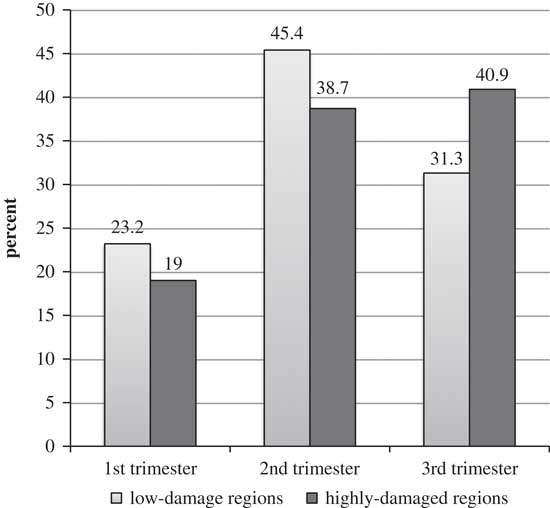
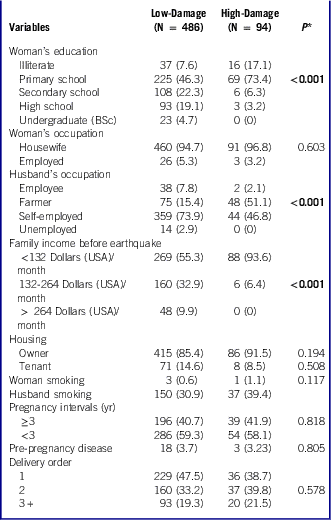
Table 1 presents demographic data of pregnant women’s household before the earthquake in low-damage and high-damage areas in Heris. Results showed that there were significantly more less educated women and spouses in the high-damage area. Also, the households had lower family income before and after the earthquake, and higher home and family member damage in the high- versus low-damage area (P < 0.001 for all). There were no significant differences in pregnancy-related factors such as pregnancy interval, pre-pregnancy diseases, and delivery order between the 2 areas; 96.1% of women in the low-damage areas and 94.7% of women in the high-damage areas were satisfied with the health services provided after the earthquake (P = 0.503). There was a significant difference between the women residing in the 2 areas in terms of body mass index (BMI, P = 0.037); 47.9% of the women in low-damage areas and 46.2% of women in the high-damage areas had a normal BMI. Women from the high-damage area were thinner compared with those in the low-damage area. Underweight was observed in 15.8% and 23.5% of women at the first visit of pregnancy care in low- and high-damage areas. Prevalence of overweight and obesity at the first visit of pregnancy care was 31.8% and 17.5%, respectively, in low-damage areas and 33.3% and 13.9%, respectively, in high-damage areas. Figure 1 shows the percentage of pregnant women at each trimester in the 2 areas. Although there was some difference between the 2 areas regarding the number of women at each trimester, this difference did not reach statistical significance (P = 0.200).
Percent of Pregnant Women at Each Trimester, in Low-Damage and High-Damage Regions in Heris, 2012.

Demographic Data of Pregnant Women’s Household Before the Earthquake in Low-Damage and High-Damage Areas in Heris, 2012

Data are presented as N (%).
*Chi-square test.
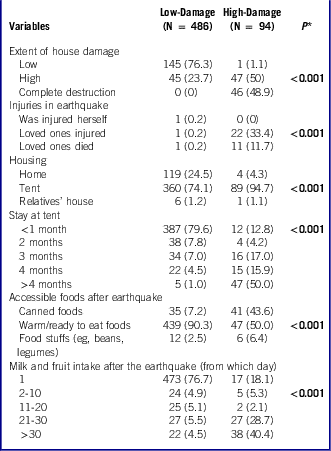
Table 2 compares the extent of house damage, housing, and access to food by pregnant women’s household after the earthquake, between low-damage and high-damage areas in Heris, in 2012. House damage and injuries were significantly greater in the high-damage area, and a significantly greater percent of the households had to live in tents for more than 4 months (P < 0.001). More households in the low-damage area had access to warm foods compared with those living in the high-damage area who mainly received canned foods after the earthquake (P < 0.001). Furthermore, it took more than 30 days to provide about 40% of the households of the high-damage areas with milk and fruit (which are a great source of many essential vitamins and minerals), and 76.7% of households in the low-damage areas had access to these food groups from the first day after the disaster.
Extent of House Damage, Housing, and Access to Food By Pregnant Women’s Household After the Earthquake in Low-Damage and High-Damage Areas in Heris, 2012

Data are presented as N (%).
*Chi-square test.
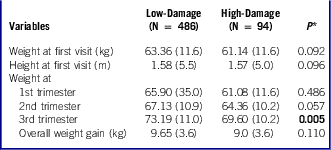
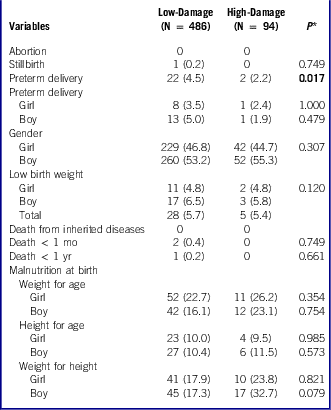
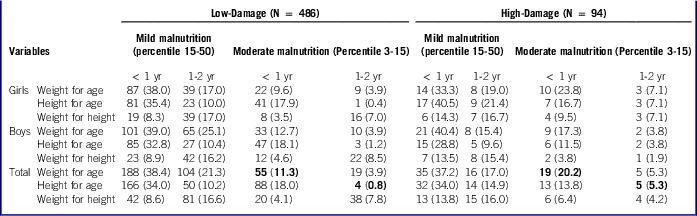
Table 3 presents information on pregnancy status at the earthquake in low-damage and high-damage areas in Heris. The mean height and weight at first visit of the women to the health centers were not significantly different between the 2 areas. There was no significant difference between the areas for overall weight gain of the pregnant women, either; however, the mean weight of the women from the high-damage areas was significantly lower than that of women in the low-damage areas, during the third trimester (P < 0.001). In Table 4, results for pregnancy outcomes and birth indices at the time of the earthquake in low- and high-damage areas in Heris have been summarized. There was a significant difference between the 2 areas for the percent of preterm delivery (P = 0.017). No significant difference was observed between the 2 areas in terms of the newborns’ malnutrition. In the low-damage area, 98.8% of the infants were breastfed, 0.4% received formula, and 0.8% were fed on both breast milk and formula. In the high-damage area, all of the infants were breastfed, and no significant difference was observed between the 2 areas in terms of infant feeding (P = 0.558). Table 5 compares malnutrition of the infants under 1 and 2 years old in the areas affected by the earthquake in Heris, stratified by gender. No child under age 1 year or 2 years suffered from severe malnutrition in low-damage or high-damage areas, and the between-gender differences were statistically nonsignificant in both age groups. Our findings also revealed that when the data of the two genders were pooled, more children under age 1 year were moderately malnourished in terms of weight for age, in the high-damage areas compared with those in the low-damage areas (20.2% vs. 11.3%, P = 0.017). A similar result was obtained for children under age 2 years, based on height for age index (5.3% vs. 0.8%, P = 0.001).
Pregnancy Status at the Earthquake in Low-Damage and High-Damage Areas in Heris, 2012

Data are presented as a mean (SD).
*Two-independent samples t-test.
Pregnancy Outcomes and Birth Indices at the Time of Earthquake in Low-Damage and High-Damage Areas in Heris, 2012

Data are presented as N (%).
*Chi-square test.
Malnutrition of the Infants Under Ages 1 and 2 Years in the Areas Affected by the Earthquake in Heris, 2012

Data are presented as N (%); bold N (%) indicates significant difference between the two areas.
Statistical significance based on chi-square test.
DISCUSSION
Based on the results of our study, women residing in the high-damage areas of Heris (at the time of the Varzaghan 2012 earthquake) had lower education and income, were underweight at the first trimester of pregnancy, and had lower weight gain during the last trimester, compared with those living in the low-damage areas. Birth indices of the infants born to these mothers were not significantly different from those in the low-damage areas; however, in high-damage areas, moderate malnutrition had a higher rate among children under age 1 year (weight for age malnutrition) and those between ages 1 and 2 years (height for age malnutrition).
Underweight and lower weight gain during the last trimester of pregnancy was significantly more prevalent among women residing in the high-damage areas during the Varzaghan earthquake (see Table 3). Lower socioeconomic status (see Table 1) and lower access to nutritious meals (see Table 2) in high-damage areas might, in part, have contributed to this finding in our study. The areas that were highly damaged were those not only closer to the earthquake center, but also less developed in which buildings were not constructed based on the available standards 17 ; also, the residents had lower education and income, compared with those in the low-damage areas (see Table 1). Kamali et al studied 158 earthquake victims in 2 distinct areas of Iran, Roudbar, and Kazerun; in both areas, those who were illiterate and had no previous education on how to confront this natural disaster suffered its consequences to a greater extent.Reference Kamali, Moradi and Arjmand Hesabi 21 Mothers’ education has been frequently shown to have a substantial effect in the prevention of LBW under such circumstances.Reference Ebrahimi-Mameghani, Ahmadi Bakhshmandi and Arefhosseini 22 – Reference Tootoonchi 24 A study on 600 pregnant women revealed that mean weight gain during pregnancy and the infants’ mean birth weight positively correlated with the educational status of the mothers.Reference Delaram and Akbari 25 On the other hand, based on the data acquired in our study, canned foods were the most commonly consumed foods among women in the high-damage areas, whereas those in the low-damage parts had meals prepared from fresh ingredients (see Table 2). According to Ocha et al, the nutritional status of the Bam earthquake victims was also unfavorable, and the chief meal of the residents were reported to be canned foods, which cannot meet all of the nutritional needs of vulnerable groups in a society. 26
Prenatal stress resulting from natural disasters is linked to a broad range of undesirable birth outcomes, and reducing placental blood flow and increasing stress hormones transferred from the placenta to the fetus may cause abortion, preeclampsia, preterm delivery, intrauterine growth retardation, LBW, and increased susceptibility to metabolic and psychological disorders in later life.Reference Suzoki, Yamagata and Kawado 27
Xiong et al reported that women who experienced the Katrina hurricane had a higher rate of preterm delivery and LBW.Reference Xiong, Harvill and Buekens 28 Glynn et al also showed that stress in pregnancy was associated with a shorter gestational length.Reference Glynn, Wadhwa and Schetter 8 In our study, preterm delivery had a higher rate among women living in the low-damage areas (see Table 4). The reason for this might be that a greater percentage of women in the high-damage areas were at their last trimester at the time of the earthquake. Pregnancy is associated with decreased vascular responses to catecholamine infusion, a lower heart rate, and catecholamine responses to physical stressors, as well as smaller blood pressure reactions to mental and physical challenges. It has been proposed that stress in the later stages of pregnancy may lead to less harmful effects, due to this mechanism.Reference Glynn, Wadhwa and Schetter 8 Therefore, it is probable that, although the severity of the stress caused by the earthquake was less in the low-damage areas, the women were more susceptible to preterm delivery due to their pregnancy trimester.
No significant difference was found in our study between the 2 areas in terms of LBW rate (see Table 4). This finding was in agreement with a couple of previous studies. Ganjouei et al studied the effect of the Bam earthquake on pregnancy outcomes of 310 women, and compared the results with those obtained for 310 control women from areas not affected by the disaster; no significant difference was observed between the 2 groups regarding LBW rate.Reference Ganjouei, Mohammadi and Ahmadi-Mousavi 29 The study by Leppold et al also failed to find any significant changes in preterm delivery and LBW rate after the Fukushima Daiichi nuclear power plant disaster, compared with the preceding years.Reference Leppold, Nomura and Sawano 30 Many factors other than prenatal stress play a role in pregnancy outcome, the integration of which determines the LBW rate; moreover, it is likely that the women in both areas of our study had experienced stress to some extent, and this might have led to the nonsignificant difference between them for LBW rate.
In our study, the data of the infants in their first 2 years of life were extracted from the medical records; severe malnutrition was observed neither in children under age 1 year nor in those between ages 1 and 2 years. This was in accordance to the findings of Koosha et al who reported that growth status of the children under age 5 years affected by the Varzaghan earthquake was similar to that of previous years, and no severe malnutrition was observed.Reference Koosha, Fatholahpour and Koosha 14 Weight for age-moderate malnutrition was significantly higher among children under age 1 year in the high-damage areas compared with those in the low-damage areas, in our study (P = 0.017), and children between ages 1 and 2 years had a significantly higher rate of moderated height for age moderate in the high-damage area (P = 0.001, see Table 5). All of the infants in the high-damage area and 98.8% of those in the low-damage area were exclusively fed breast milk. Mothers in the high-damage area had limited access to nutrient-dense foods (see Table 2). Poor maternal nutrition can affect milk quantity, and milk composition varies based on a mother’s diet. Moreover, consequences of poor nutrition, including a suppressed immune system as well as feeling tired, can also affect breastfeeding efficiency.Reference Cox and Carney 31 Earthquakes have been shown to cause stress disorders, particularly among women.Reference Farooqui, Quadri and Suriya 32 The pregnant women in our study were also likely to have experienced stress at the time of the earthquake. Stress and anxiety result in poor let down of breast milk, which consequently leads to a low milk supply. These put together, it is apparent that, during the first year after the earthquake, inefficient breastfeeding led to weight-for-age malnutrition. Height is a late responder to inappropriate nourishment; this may explain the higher height-for-age malnutrition in the second year of the monitoring. As presented in Table 2, compared with the low-damage area, a significantly greater number of pregnant women in the high-damage area lived in tents for more than 4 months, consumed canned food (as the only food available) after the earthquake, and did not have access to fruit and milk (as the rich sources for many micronutrients essential for optimal development of the fetus and growth of breastfed infants) for at least a month.
To the best of our knowledge, this was the first study that comprehensively compared the 2 areas of Heris after the Varzaghan earthquake in terms of mother and infant outcomes, and analyzed the data on the first 2 years of the children’s lives. There were some limitations to our study, though. Medical records of some of the women who had been monitored in the health centers were incomplete, and some women had migrated from the areas during and soon after the earthquake. Incomplete records for some of the women and migration might be associated with lower and higher socioeconomic status (ie, those of the lower did not wish to or were not allowed to be monitored during their pregnancy, and those of the higher could afford moving to safer areas), which might have prevented precise judgment of the data on the socioeconomic status of the residents. Moreover, most of the women were illiterate in the areas under study; therefore, the questionnaires were completed by some female interviewers native to those areas. Completion of socioeconomic questionnaires by an interviewer might prevent the interviewee from being totally honest, particularly about household issues like income (the women might have felt that they should not reveal household data in front of strangers). This also might have decreased the strength of the evidence. A main drawback of the present study was that psychological stress and depression were not recorded in the medical records of the women, and therefore it was not possible for the researchers to compare these key factors between the 2 areas and directly assess their contribution to the results obtained.
CONCLUSIONS
In conclusion, the socioeconomic status of the households were low in both areas under study, but worse in the high-damage area. This was assumed to contribute to the higher rate of moderate malnutrition among the children born to resident pregnant mothers at the time of the 2012 Varzaghan earthquake. The higher rate of preterm delivery among women of the low-damage area was attributed to the greater percentage of women at their last trimester in this area; women who experience stress at the last trimester of their pregnancy are more prone to preterm delivery.
It is essential that appropriate measures be taken to enhance the delivery of health services (particularly, food supplies) to areas with low socioeconomic status, after disasters. Susceptible groups like pregnant women are of great priority in this regard, because their newborns will also be affected by the psychological and physical health of their mothers following these circumstances. This study was conducted in Heris only, and further studies are recommended to be conducted in Ahar, Varzaghan, and Tabriz.
Acknowledgment
The present study was funded by the Research Vice Chancellor of Tabriz University of Medical Sciences, Tabriz, Iran. We herein thank all of the health centers staff and the study subjects for their efficient cooperation.