Japanese knotweed (Polygonum cuspidatum) is a resilient, invasive nonnative plant species in North America. It was originally introduced as an ornamental plant (Beerling et al. Reference Beerling, Bailey and Conolly1994) and has become an aggressive invader of natural areas, where it can outcompete with and eliminate other plant species (Aguilera et al. Reference Aguilera, Alpert, Dukes and Harrington2010; Gerber et al. Reference Gerber, Krebs, Murrell, Moretti, Rocklin and Schaffner2008; Murrell et al. Reference Murrell, Gerber, Krebs, Madalin, Schaffner and Bossdorf2011). Areas characterized by moderate disturbance and ample resource availability, such as roadsides and waterways, are prone to invasion by Japanese knotweed (Beerling et al. Reference Beerling, Bailey and Conolly1994; Claeson and Bisson Reference Claeson and Bisson2013; Dommanget et al. Reference Dommanget, Spiegelberger, Cavaille and Evette2013). It reproduces predominantly by clonal propagation through extension of rhizomes (Beerling et al. Reference Beerling, Bailey and Conolly1994; Smith et al. Reference Smith, Ward, Child and Owen2007) that can grow downward to a depth of 2 m and extend several meters outward from existing stands before producing new shoots (Child and Wade Reference Child and Wade2000). Shoots generally emerge early in the season (Beerling Reference Beerling1990), with emergence thought to be regulated by temperature due to variations in emergence timing across locations and years (Beerling et al. Reference Beerling, Bailey and Conolly1994; Dauer and Jongejans Reference Dauer and Jongejans2013). New shoots emerge in Nova Scotia, Canada in early spring (April to May), produce flowers in August, and are killed by frost in October (Larsen Reference Larsen2013).
Management of Japanese knotweed generally relies on a combination of methods (Bram Reference Bram2002), though effectiveness of different management approaches is variable (Delbart et al. Reference Delbart, Mahy, Weickmans, Henriet, Crémer, Pieret, Vanderhoeven and Monty2012). Mechanical or physical controls include using tarps or wire mesh to stunt the growth of young shoots and cutting stems at different growth stages to inhibit allocation of resources to the rhizomes (Colleran and Goodall Reference Colleran and Goodall2014; Delbart et al. Reference Delbart, Mahy, Weickmans, Henriet, Crémer, Pieret, Vanderhoeven and Monty2012; Dommanget et al. Reference Dommanget, Spiegelberger, Cavaille and Evette2013; Larsen Reference Larsen2013). These methods, however, can be expensive and labor-intensive, require extensive follow-up, and may even promote spread of the plant (Beerling Reference Beerling1990). Biological control with insect and disease organisms is promising (Grevstad et al. Reference Grevstad, Shaw, Bourchier, Sanguankeo, Cortat and Reardon2013; Shaw et al. Reference Shaw, Bryner and Tanner2009), though this approach has not been widely implemented. Symplastic herbicides are generally the most efficient and effective means of managing Japanese knotweed due to translocation to rhizomes following foliar applications (Bashtanova et al. Reference Bashtanova, Beckett and Flowers2009), with glyphosate, imazapyr, and several synthetic auxins (aminopyralid, 2,4-D, dicamba, and triclopyr) most
Management Implications
Japanese knotweed is a common invasive plant species that occurs along waterways, in parks, in abandoned agricultural fields, and in other disturbed areas. An established stand of knotweed outcompetes other vegetation and reduces localized species diversity. It also destabilizes the banks of waterways and can make them more susceptible to erosion. A variety of management techniques have been evaluated, but herbicides are consistently the most cost-effective approach. Our results indicate that an application of aminopyralid at 120 g ae ha−1 when shoots are approximately 30-cm tall will not adequately control knotweed but will suppress shoot growth. POST imazapyr applications at 720 g ae ha−1 are effective when applied any time between maximum height and just before shoot senescence in the fall. By 52 WAT, all imazapyr application timings provided similar levels of control, with multiple imazapyr applications providing no additional benefit. In large stands, early POST aminopyralid applications may suppress knotweed growth and facilitate late-season imazapyr applications. This technique is not recommended along waterways, as it kills most vegetation, leaving areas of bare soil that would be susceptible to erosion.
commonly evaluated (Bashtanova et al. Reference Bashtanova, Beckett and Flowers2009; Delbart et al. Reference Delbart, Mahy, Weickmans, Henriet, Crémer, Pieret, Vanderhoeven and Monty2012; Hagen and Dunwiddie Reference Hagen and Dunwiddie2008; Johnson et al. Reference Johnson, Lloyd, Sellmer and Gover2010). Foliar applications at optimum timings for herbicide translocation to rhizomes are difficult, however, due to the height of established knotweed plants (Weston et al. Reference Weston, Barney and DiTommaso2005). Assimilate translocation to rhizomes is greatest in late summer and early fall (August to September) (Price et al. Reference Price, Gamble, Williams and Marshall2002), when established knotweed stems often exceed 3 m in height (Larsen Reference Larsen2013). Cutting of stems in early summer followed by treatment of regrowth can improve ease of herbicide applications (Johnson et al. Reference Johnson, Lloyd, Sellmer and Gover2010) but is labor-intensive and requires careful disposal of clipped stems due to risk of plant dispersal from stem fragments (De Waal Reference De Waal2001), particularly in riparian habitats (Brock and Wade 1992). Alternatively, initial growth of knotweed stems can potentially be suppressed with early-season herbicide applications. In previous work, Kay (Reference Kay2003) indicated potential suppressive effects of early POST applications of the diglycolamine salt of the synthetic auxin herbicide dicamba on knotweed, which reduced shoot density and, to some extent, shoot height approximately 1 mo after application. Further work with synthetic auxin herbicides as early-season treatments on knotweed are recommended (Clements et al. Reference Clements, Larsen and Grenz2016), but results from field experiments to date are limited.
Synthetic auxins are generally less effective than other herbicides on Japanese knotweed (Delbart et al. Reference Delbart, Mahy, Weickmans, Henriet, Crémer, Pieret, Vanderhoeven and Monty2012) but may improve management when used in conjunction with other herbicides, as they cause less damage to some non-target plants in comparison to other active ingredients (Johnson et al. Reference Johnson, Lloyd, Sellmer and Gover2010; Rudenko and Hulting Reference Rudenko and Hulting2010). In particular, aminopyralid has gained increasing use in Nova Scotia due to recent success with this product for management of wild chervil [Anthriscus sylvestris (L.) Hoffm.] on dykelands (Beaton Reference Beaton2014) and lack of availability of alternative products with similar efficacy (R Hoeg, Nova Scotia Department of Agriculture, personal communication). Aminopyralid is a synthetic auxin herbicide commonly used for early POST and POST control of annual and perennial broadleaf weeds in pastures, rangelands, and non-crop areas (Enloe et al. Reference Enloe, Lym, Wilson, Westra, Nissen, Beck, Moechnig, Peterson, Masters and Halstvedt2007, Reference Enloe, Kyser, Dewey, Peterson and DiTomaso2008; Ferrel et al. Reference Ferrel, Mullahey, Langeland and Kline2006). Weed control is generally most consistent following POST applications (Kyser et al. Reference Kyser, Peterson, Orloff, Wright and DiTomaso2011), but early POST applications control perennial weed seedlings (Ferrel et al. Reference Ferrel, Mullahey, Langeland and Kline2006) and may suppress developing shoots of some perennial plants (Seefeldt et al. Reference Seefeldt, Boydston, Kaspari, Zhang, Carr, Smeenk and Barnes2013). Aminopyralid efficacy on Japanese knotweed is generally more consistent than that observed with other synthetic auxin herbicides (Delbart et al. Reference Delbart, Mahy, Weickmans, Henriet, Crémer, Pieret, Vanderhoeven and Monty2012; Rudenko and Hulting Reference Rudenko and Hulting2010), but control is not as good as observed with products such as imazapyr and glyphosate. It is possible, however, that early season aminopyralid applications to young, rapidly growing knotweed stems may suppress stem growth and facilitate later herbicide applications at phenological stages conducive to assimilate translocation to rhizomes. The objectives of this research were to determine (1) the effect of early POST aminopyralid applications on Japanese knotweed shoot growth and (2) whether early POST aminopyralid applications improve control of Japanese knotweed when used in conjunction with POST applications of imazapyr at multiple growth stages.
Materials and Methods
Species Description
The plants at both sites were identified as Japanese knotweed, and not the hybrid Bohemian knotweed (Polygonum×bohemicum (J. Chrtek & Chrtková) Zika & Jacobson [cuspidatum×sachalinense]). This was established using several identification keys (Barney et al. Reference Barney, Tharayil, DiTommaso and Bhomik2006; Child and Wade Reference Child and Wade2000; Wilson Reference Wilson2007; Zika and Jacobson Reference Zika and Jacobson2003) to differentiate various morphological characteristics such as canopy height (2- to 3-m tall), leaf shape (cuspidate apex and flattened base), leaf size (less than 15-cm long and 12-cm wide), leaf hairs (glabrous), and flowers (female only) (Larsen Reference Larsen2013). Leaf samples were sent to Agriculture and Agri-Food Canada in Lethbridge, AB, in September 2010 for analysis using amplified fragment length polymorphism (AFLP-PCR). They concluded that the specimens were Japanese knotweed Polygonum cuspidatum (R Bourchier, personal communication).
Site Description
Experiments were conducted at Antigonish and Bible Hill, NS, in 2011 and 2012. The Antigonish site was located along the south side of the Rights River (45.622°N, 61.972°W), which flows through the town of Antigonish, NS, Canada. The soil at the site is a silt loam, and research plots were situated at approximately 1 to 2 m above sea level in Japanese knotweed patches found along both sides of the river. A soil analysis of particle-size distribution, as described by Sheldrick and Wang (Reference Sheldrick and Wang1993) and Brewster (Reference Brewster2001), measured 62% sand, 13% clay, and 25% silt. The Bible Hill site was located along the Salmon River, which separates the towns of Bible Hill and Truro, NS (45.371°N, 63.277°W). The soil at the site is a sandy loam, and research plots were situated approximately 13 m above sea level in Japanese knotweed patches along one side of the river. Part of the site had been used as pastureland but had been left fallow for several years before our study was initiated. A soil analysis of particle-size distribution, measured 70% sand, 15% clay, and 15% silt.
Experimental Design
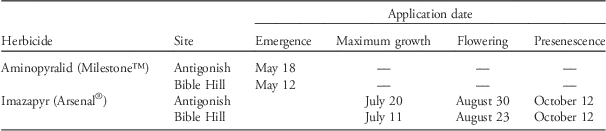
The experiment was a randomized complete block design with three blocks and a two by eight factorial treatment arrangement. The factors were early POST aminopyralid (Milestone™, Dow AgroSciences, Indianapolis, IN 46268) applications (presence vs. absence) and POST imazapyr (Arsenal®, BASF, Research Triangle Park, NC 27709) applications (none, maximum stem height [M], flowering [F], presenescence [S], M+F, M+S, F+S, and M+F+S). Plots were 2 by 2 m with a 2-m buffer between each plot. The buffers between plots were mowed throughout the season to permit travel throughout the site. Aminopyralid was applied at 120 g ae ha−1 using a CO2-pressurized research plot sprayer (Bellspray, Opelousas, LA 70570) outfitted with four 8002VS nozzles (TeeJet®, Springfield, IL 62703) and calibrated to deliver a water volume of 200 L ha−1 at 270 kPa. Aminopyralid applications were made on May 12, 2011, at Bible Hill and May 18, 2011, at Antigonish, when emerged stems were approximately 30-cm tall. Imazapyr was applied at a rate of 720 g ae ha−1 in 1,200 L ha−1 of water in all plots with 0.5% v/v nonionic surfactant (Agral® 90, Syngenta Canada, Guelph, ON N1G 4Z3, Canada). A large spray volume was used to ensure coverage of the thick canopy. Imazapyr was applied using a 15-L Solo® backpack sprayer (Solo®, Newport News, VA 23605) equipped with a single TeeJet® 11004VP nozzle, and all sides and the top of each 4-m2 knotweed plot were treated. The same spray volume was applied to all plots regardless of canopy size. Application timings for imazapyr treatments are provided in Table 1.
Herbicide treatments for Japanese knotweed at two sites in Nova Scotia, Canada in 2011.

Data Collection
Visual estimates of herbicide injury were conducted using a 0 to 100 scale where 0 represents no plant damage and 100 represents complete shoot death. Ratings were conducted at 2, 4, 8, and 52 wk after the final POST herbicide application treatment (WAT). Stem density was counted on a whole-plot basis at 2, 8, and 52 WAT. Stem height was determined on 5 randomly chosen knotweed stems in each plot at 8 and 52 WAT. Knotweed aboveground biomass was measured at 52 WAT by cutting all knotweed stems in each plot and weighing them to the nearest gram on a portable scale in the field to determine fresh weight.
Data Analysis
Data were analyzed using PROC MIXED in SAS v. 9.3 (SAS Institute, Cary, NC 27513) with block as a random factor. Sites were analyzed separately. Normality and constant variance assumptions were verified. In some cases, transformations were used to achieve normality, and back-transformed means are presented. For significant effects, the least-squares means were compared with Tukey’s adjustment (P≤0.05). The subroutine pdmix800.sas (Saxton Reference Saxton1998) was used to provide letter groups. The 2011 data were collected at multiple time points and were analyzed using repeated measures in SAS with week as the time factor. The data for 2012 were collected on a single date, and the analysis was similar, except it was not analyzed as a repeated measure.
Results and Discussion
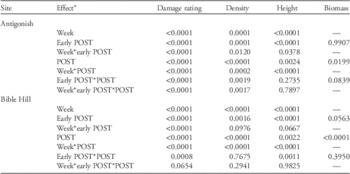
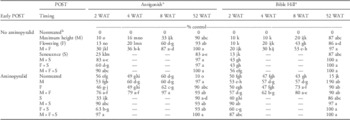
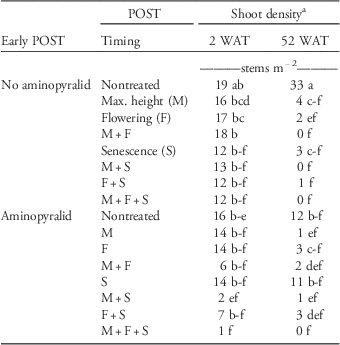
At both sites, early POST aminopyralid and POST imazapyr increased knotweed damage ratings, and the effect changed over time (Table 2). Aminopyralid on its own did not adequately control knotweed, with only 10% to 15% suppression at 52 WAT (Table 3). However, percent control at all POST imazapyr application timings at 2, 4, and 8 WAT tended to be higher at both sites when the application followed early POST aminopyralid, although the differences were not always significant. We also found a reduction in stem density at 52 WAT in Antigonish (Table 4) and 2 WAT in Bible Hill (Table 5) where early POST aminopyralid was applied alone compared with the nontreated control as well as a reduction in height at both sites (unpublished data). We cannot fully explain the increased control observed when imazapyr followed aminopyralid, but given that aminopyralid applications tended to reduce stem density and stem height of Japanese knotweed, it is possible that aminopyralid applications facilitated increased shoot coverage by imazapyr. Adequate coverage is especially difficult to achieve in large infestations, and in this type of situation an early aminopyralid application might play a critical role in facilitating POST herbicide applications.
Significance levels (P-values) for all combinations of herbicide treatments on damage assessments at Antigonish and Bible Hill, NS, in 2011.

a Effects were: week (2, 4, and 8 wk after treatment), early POST (aminopyralid when stems were 30-cm tall), and POST (imazapyr at multiple growth stages), as well as the interaction.
The effect of early POST aminopyralid applications and POST imazapyr applications at maximum knotweed height, flowering, maximum height+flowering, presenescence, maximum height+presenescence, flowering+presenescence, and maximum height+flowering+presenescence on percent Japanese knotweed control at 2, 4, 8 and 52 wk after the final POST herbicide application (WAT) at Antigonish and Bible Hill, NS, in 2011.

a Mean values within a site with the same letter were not significantly different using Tukey’s test at P≤0.05.
b The nontreated control was removed from the analysis.
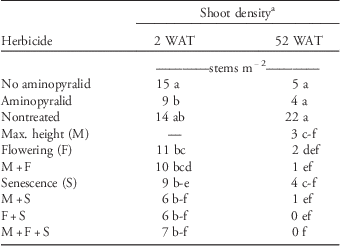
The effect of early POST aminopyralid applications and POST imazapyr applications at maximum knotweed height, flowering, maximum height+flowering, presenescence, maximum height+presenescence, flowering+presenescence, and maximum height+flowering+presenescence on Japanese knotweed density at 2 and 52 wk after the final POST herbicide application (WAT) at Antigonish, NS, in 2011.

a Mean values with the same letter were not significantly different using Tukey’s test at P≤0.05.
The effect of early POST aminopyralid applications and POST imazapyr applications at maximum knotweed height, flowering, maximum height+flowering, presenescence, maximum height+presenescence, flowering+presenescence, and maximum height+flowering+presenescence on Japanese knotweed density at 2 and 52 wk after the final POST herbicide application (WAT) at Bible Hill, NS, in 2011.

a Mean values with the same letter were not significantly different using Tukey’s test at P≤0.05.
Percent control at 2, 4, and 8 WAT where no aminopyralid was applied tended to be higher when imazapyr was applied at maximum height+flowering growth stages versus a single application at maximum height (Table 3). This difference did not occur where aminopyralid was applied. Damage tended to increase from 2 to 4 WAT in all treatments. At 52 WAT, all treatments had 83% to 100% control at both sites. These results suggest that POST imazapyr is as effective as early POST aminopyralid followed by POST imazapyr 1 yr after treatment. All application timings for imazapyr 1 yr after application resulted in similar damage levels, and sequential applications provided no added benefit. These results are somewhat surprising, as Price et al. (Reference Price, Gamble, Williams and Marshall2002) determined that freshly synthesized carbohydrates predominantly remain in the stem in spring and early summer (May and June), with sharp increases in translocation of carbohydrates to the rhizome in late summer or presenescence. Similarly, Bashtanova et al. (Reference Bashtanova, Beckett and Flowers2009) argue that products such as glyphosate are not effective because of limited translocation to the rhizome until the fall, when there is limited protein synthesis. In contrast, Seiger and Merchant (Reference Seiger and Merchant1997) reported season-long allocation to belowground biomass in Japanese knotweed. Imazapyr was equally effective at all application timings 1 yr after application in our research, suggesting that it was translocated to the rhizomes at all growth stages. Our results are in agreement with Seiger and Merchant (Reference Seiger and Merchant1997) and indicate that opportunities for belowground herbicide translocation in Japanese knotweed may exist earlier in the season than previously thought.
Knotweed density varied with time and was affected by both herbicide types at both sites (Table 2). There was a significant early POST by POST interaction at Antigonish but not at Bible Hill. Density did not change over a 1-yr period in the nontreated controls at either site, though density tended to increase at Antigonish (Tables 4 and 5). In Antigonish, where aminopyralid was not applied, there were no differences in density 2 wk after the final POST application (Table 4). Where aminopyralid was applied, densities were lower than the nontreated control, where imazapyr was applied at maturity+senescence and maturity+flowering+senescence. All POST herbicide treatments reduced knotweed density at 52 WAT compared with the nontreated control at both sites.
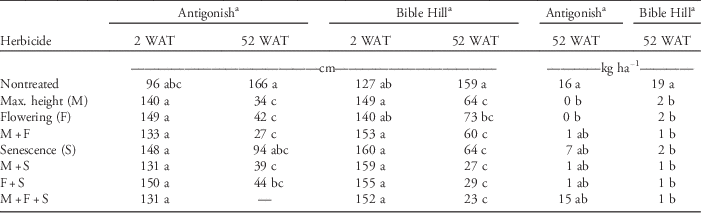
Shoot heights in the plots that received aminopyralid were 21% to 42% shorter than those that did not (unpublished data) at 2, 4, and 8 WAT. POST imazapyr applications did not affect height at 2 WAT, but heights at both sites by 52 WAT were significantly stunted by all herbicide application timings (Table 6). All POST imazapyr application timings caused a significant reduction in biomass at 52 WAT (Table 6).
The effect of POST imazapyr applications at maximum knotweed height, flowering, maximum height+flowering, presenescence, maximum height+presenescence, flowering+presenescence, and maximum height+flowering+presenescence on Japanese knotweed height at 2 and 52 wk after the final POST herbicide application (WAT) and knotweed fresh shoot biomass at Bible Hill and Antigonish, NS, in 2011.

a Mean values with the same letter were not significantly different using Tukey’s test at P≤0.05.
The results indicate that early POST aminopyralid applications did not increase the level of control achieved by 52 WAT. However, aminopyralid applications suppressed knotweed height. Imazapyr is very effective over a wide range of growth stages. Early percent control was greatest with applications at maximum height+flowering<maximum height+senescence=maximum height+flowering+senescence. This difference disappeared by 52 WAT. We conclude that POST imazapyr is an effective management for knotweed across a range of application timings, and early POST aminopyralid may suppress knotweed growth and facilitate POST applications.
Acknowledgments
Funding was provided by the Nova Scotia Department of Transportation and Infrastructure Renewal.