INTRODUCTION
Creutzfeldt-Jakob disease (CJD) is a rare fatal transmissible spongiform encephalopathy characterized by neuronal loss, spongiform changes in brain tissue and astrocytosis, together with a rapidly progressive dementia. This prion disease is classified into three forms: sporadic, inherited, and acquired. In 1996, a new variant form of CJD (vCJD) was identified as a distinct clinico-pathological phenotype of acquired CJD thought to be linked to the epidemic of Bovine Spongiform Encephalopathy in cattle (Will et al., Reference Will, Ironside, Zeidler, Cousens, Estibeiro and Alperovitch1996, Reference Will, Zeidler, Stewart, Macleod, Ironside and Cousens2000). At the time of writing, 166 cases of vCJD have been reported in the UK, 163 of whom have died. Cases reported to date have presented with some common characteristics, such as young age of onset (mean age 28 years; although there have been some exceptions to this) and Methionine/Methionine genotype. Given the potential for older age groups and other genotypes to develop the variant form of the disease, there is good reason to remain vigilant for vCJD in clinical practice.
Cognitive impairment has previously been identified as a key feature in the presentation of sporadic, iatrogenic, and familial CJD (Cordery et al., Reference Cordery, Hall, Cipolotti, Al-Sarraj, O’Donovan and Davidson2003; Snowden, Mann, & Neary, Reference Snowden, Mann and Neary2002; Will et al., Reference Will, Zeidler, Stewart, Macleod, Ironside and Cousens2000), and more recently has been recognized as being present in the early symptomatic stages of vCJD, perhaps even before the onset of psychiatric or neurological symptoms that have often been regarded as constituting the initial clinical presentation (Kapur, Abbott, Lowman, & Will, Reference Kapur, Abbott, Lowman and Will2003).
Kapur et al. (Reference Kapur, Abbott, Lowman and Will2003) described neuropsychological data gathered from 24 vCJD patients, reporting a profile that included measurable impairment on tests of memory, executive function, speed of attention and visuoperceptual reasoning. Subsequent work by Cordery et al. found that 10 patients with vCJD showed similar impairment on tests of verbal and nonverbal memory, executive function, and nominal skills; however, these patients demonstrated possible preserved ability in some components of visuoperception in comparison to patients suffering from sporadic or familial CJD (Cordery et al., Reference Cordery, Alner, Cipolotti, Ron, Kennedy and Collinge2005).
There is a high overlap, and consequent relatively high misdiagnosis rate, between CJD and clinically similar conditions (Geschwind et al., Reference Geschwind, Tan, Lennon, Barajas, Haman and Klein2008; Stone, Archer, & Kiernan, Reference Stone, Archer and Kiernan2008), and it is, therefore, important from this perspective alone to have good documentation of such patients’ neuropsychological profile. The establishment of neuropsychological profiles will, we hope, contribute to a sound foundation of knowledge of the condition, something that is essential if treatments ever appear on the horizon. We report here neuropsychological data relating to a further 11 cases of vCJD, supplementing the 24 cases included in the 2003 study. For such a rare and deadly condition, which generally affects young people in their prime of life and which has eluded any form of treatment, it is important to document the clinical and neuropsychological profile in as many cases as possible.
METHOD
In a continuation of the work reported in 2003 (Kapur et al., Reference Kapur, Abbott, Lowman and Will2003), all cases of vCJD reported to the UK National CJD Surveillance Unit were considered for inclusion in the study. Records for cases reported since the previous study, and those for whom insufficient data had been available at the time of the previous study, were reviewed for neuropsychological data and, where appropriate, further information or clarification was sought from the relevant neuropsychologist. There were no specific inclusion or exclusion criteria relating to age, type of presentation, or severity of illness. By definition, patients who were included had been well enough to perform a series of neuropsychological tests.
Human data included in this study were obtained in accordance with regulations of our institutions, and in compliance with the Helsinki Declaration.
Enlargement of the Series of Variant CJD Cases
In conjunction with data from the original series of 24 cases, data from 11 additional cases of vCJD were available. For cases where raw test scores were not available, and where test performance had been reported using percentile scores or standard scores, these were classified according to clinical cutoff points, as outlined in the earlier article (Kapur et al., Reference Kapur, Abbott, Lowman and Will2003). Not all cases received identical neuropsychological tests. However, where tests could clearly be considered equivalent, all available scores were included (for example, the Adult Memory and Information Processing Battery and Wechsler Memory Scale III story recall test scores were each used to indicate a measure of story recall). Results from the Wechsler Adult Intelligence Scale-Revised (WAIS-R) and the Wechsler Adult Intelligence Scale III (WAIS-III) were considered to be equivalent.
Our new sample of 11 variant cases did not differ significantly from the series of cases previously reported, nor from the broader vCJD population. In this additional series of 11 cases, onset was recorded as psychiatric for 73% and neurological for 27%, in comparison to 63% and 15% of the first 100 recorded cases of vCJD (Spencer, Knight, & Will, Reference Spencer, Knight and Will2002). “Neurological” symptoms include physical signs such as sensory loss and ataxia, whereas cognitive symptoms such as forgetfulness are classified under “psychiatric symptoms.”
There were eight men and three women in the new sample of cases. The mean age of cases at death was 34 years, and the mean duration of illness was 13.5 months; there is no significant difference between our sample and the previous sample on these parameters (29 years and 13 months, respectively, for the earlier sample), nor do they differ from those of the vCJD population as a whole. It should be noted, however, that one case included here was significantly older due to the mode of transmission (blood transfusion). The timing of neuropsychological testing did not differ between our current and previous samples; mean time from onset of symptoms to testing was 8.7 months (range, 7–11 months) for the current sample and 8 months (range, 2–16 months) for the previous sample, while mean delay from testing to death was 4.6 months (range, 1–8 months; this does not include data for one living case), 5 months (range, 3–12 months) in the previously published sample. Crucially, the overall proportion of the illness that had elapsed at the time of testing was 67%, which does not differ significantly from the previous sample (59%), so that any differences observed between the groups could not be accounted for by the stage in the illness at which they were assessed.
Neuropsychological Findings
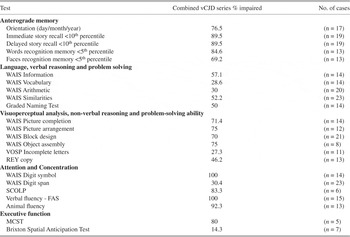
The neuropsychological test scores for the extended sample of vCJD patients are shown in Table 1. Scores on the Wechsler Adult Intelligence Scale (WAIS) were sometimes from the WAIS-R and sometimes from the WAIS-III. As can be seen, patients in this extended series of vCJD cases frequently demonstrate cognitive impairment in anterograde memory and timed attention tasks while demonstrating relative sparing of verbal knowledge and elementary visual processing. All patients were impaired on the WAIS Digit Symbol Substitution test, and on the letter-based verbal fluency test. In the original study, 50% had mild impairment and 50% had moderate impairment on the WAIS Digit Symbol Substitution test; 22.2% had a mild impairment on the verbal fluency test, and 78.2% had a moderate impairment. High rates of deficit were also evident on tests of animal fluency, story recall, words recognition memory, faces recognition memory, Picture Completion, Picture Arrangement and Block Design. By contrast, several tests showed relative sparing across the group—vocabulary, arithmetic problem solving, identifying incomplete letters shapes, and digit span. Only one patient showed impaired performance on a test of spatial anticipation, but it should be noted that data from only seven cases were available for this test.
Neuropsychological test scores for the extended series of 35 vCJD cases

Note
vCJD = variant Creutzfeldt-Jakob Disease (vCJD). WAIS = Wechsler Adult Intelligence Scale: age-scaled scores were used for all patients. Mild impairment (age-scaled score 4±6 or 5±10th percentile); marked impairment (age-scaled score <4 or <5th percentile). VOSP = Visual Object and Space Perception Battery. SCOLP = Speed of Comprehension and Language Processing. FAS: norms taken from Spreen and Strauss (1998). Mild impairment (age-scaled score 4±6 or 1±2 SD from the norm); marked impairment (age-scaled score <4 or > 2 SD from the norm). MCST = Modified Card Sorting Test: mild impairment (4 or 5 categories with <50% perseverative errors), marked impairment <4 categories and/or > 50% perseverative errors). Brixton Spatial Anticipation Test: mild impairment (Brixton-specific scaled score = 3); marked impairment (Brixton-specific scaled score < 3).
DISCUSSION
The test scores reported here support an emerging cognitive profile for patients presenting with vCJD. Consistent with both our previous study and that by Cordery et al. (Reference Cordery, Alner, Cipolotti, Ron, Kennedy and Collinge2005), patients with vCJD demonstrate broad and significant cognitive impairment. Most patients show impairment on immediate and delayed verbal memory and recognition memory for words. A smaller percentage of those with vCJD show difficulty remembering faces.
On tests of vocabulary and arithmetic problem-solving, deficits appear less frequently (although they are sometimes present), and impairment on visuoperceptual tasks is found less consistently among the variant group than in other cognitive areas. In contrast, timed tests of perceptual–motor performance and executive function frequently demonstrate impairment, with every vCJD patient being impaired on the WAIS Digit Symbol subtest and on the letter-based verbal fluency task. Almost all patients were also impaired on a test of animal fluency.
Tests of executive functioning suffer from sparsity of data, although interestingly only one of the seven vCJD patients tested on the Brixton Spatial Anticipation Test showed an impairment. However, it is likely that this test would only be given in circumstances in which the patients were clearly functioning at a relatively intact level, and this finding may be unrepresentative of the vCJD population as a whole.
This study reports the neuropsychological profile of the largest combined series of cases of vCJD to date. We nevertheless accept that there are some limitations to our study, for example, the retrospective nature of the investigation and the relative absence of data points for tests of executive function. It would also be useful to administer a standard assessment battery that included composite scores of executive function, attention, and memory, so as to facilitate analyses such as the relationship between stage of illness and severity of cognitive impairment.
The work reported in 2003 (Kapur et al., Reference Kapur, Abbott, Lowman and Will2003) showed a similar pattern of impairment and sparing, but there now emerged some differences in the proportion of patients showing impairment on two tasks: thus, face recognition memory was impaired in all of the cases reported in 2003, but was impaired in 69% of the current sample. Similarly, performance on the VOSP incomplete letters varied from 50% impaired in the previous sample to normal performance in all patients in the current sample, resulting in an overall incidence of impairment of 27.3%. Cordery et al. (Reference Cordery, Alner, Cipolotti, Ron, Kennedy and Collinge2005) found that visuoperceptual skills appeared to be spared relative to other cognitive areas and relative to sporadic and familial cases, suggesting that this spared area of functioning may reflect the relative preservation of posterior neocortex, at least in the early stages of vCJD.
Variant CJD patients demonstrated impairment in their performance on two attention-executive tasks: the WAIS Digit Symbol substitution test and the FAS verbal fluency test. This suggests that attention-executive dysfunction is a key feature of CJD pathology, regardless of the type. Such tests tend to be generally sensitive to neuropsychological impairment, tapping many cognitive skills in the execution of the assessed task, such that poor performance cannot be seen necessarily to implicate specific cognitive processes. However, having established sensitivity, the next question would be to establish specificity, and to examine how, for example, in vCJD these low test scores may distinctively co-vary with performance on other tests.
Given the difficulty of diagnosing vCJD in its early stages, when a somewhat variable and nonspecific combination of psychiatric and neurological symptoms may present, the identification of other markers to arouse clinical suspicion of vCJD has a potentially important role. With the majority of variant CJD cases initially appearing to exhibit a primarily psychiatric presentation (Spencer et al., Reference Spencer, Knight and Will2002), the presence of comorbid cognitive impairment should prompt the clinician to instigate more extensive investigation than would usually be undertaken in patients with psychiatric complaints. Significant cognitive dysfunction may well appear before (and even be a contributory cause of) more readily recognized psychiatric symptoms in this clinical group, and may provide supportive evidence to suggest a diagnosis of probable vCJD. While differential diagnosis was not the primary concern of this study, further work comparing the cognitive profile seen in both variant and sporadic CJD with that of other similarly presenting clinical conditions may provide a useful contribution for neuropsychological assessment in the diagnosis of this rare and challenging condition. By necessity, our conclusions are limited by the domains for which data were available, and it would be important for further data to be gathered, especially in domains such as executive function, which may be likely to be impaired in view of the subcortical pathology that characterizes the early stages of the condition.
ACKNOWLEDGMENTS
The authors of this study have no conflicts of interest to declare. This work was supported in part by a grant to RW from the European Union: Neuroprion Network of Excellence (subgroup TSELAB) Grant Number: Food CT2004 506579.