

Aviation maintenance errors can have devastating and costly implications (Fogarty, Reference Fogarty2004; Hobbs & Williamson, Reference Hobbs and Williamson2003). Errors are ‘unintended deviations from plans, goals or adequate feedback processing as well as an incorrect action that results from lack of knowledge’ (Van Dyck, Frese, Baer, & Sonnentag, Reference Van Dyck, Frese, Baer and Sonnentag2005, p. 1229). Errors are therefore the accidental result of voluntary or controllable actions, or plans that fail despite the best of intentions. Violations, unlike errors, are deliberate. Routine violations are ‘shortcuts in familiar situations taken to avoid unnecessary effort, to get the job done quickly, to demonstrate skill, or to circumvent procedures considered to be unnecessarily laborious’ (Hobbs & Williamson, Reference Hobbs and Williamson2002, p. 876). Situational violations are committed in an attempt to get the job done in impractical work situations, such as when there are staff shortages, equipment deficiencies, a flawed work design or inadequate procedures (Lawton, Reference Lawton1998; Reason & Hobbs, Reference Reason and Hobbs2003). These violations result from management decisions or procedures that are unworkable in practice (Lawton, Reference Lawton1998; Reason & Hobbs, Reference Reason and Hobbs2003). Situational violations are often tolerated as long as targets are achieved, but incur reprimands when incidents or accidents result (Lawton, Reference Lawton1998).
The traditional approach to managing error is prevention. The aviation industry traditionally took an error prevention approach using rules, regulations and automated systems (Naikar & Saunders, Reference Naikar and Saunders2003). Personnel were expected to operate without error and accidents were attributed to ‘pilot error’ (Wiegmann & Shappell, Reference Wiegmann and Shappell2001). One limitation of this approach was the assumption that errors do not occur if action is directed by rules. This confuses errors with violations and implies that errors are prohibited, which implicates the individual, discourages discussion of error, and may lead to blame, punishment and covering up (Van Dyck, Reference Van Dyck2008). Prior to the early 1990s, accident causation theories directed blame and responsibility at the individual operator and suggested that the elimination of error was achievable. It is now acknowledged that a complex set of organisational and individual factors contributes to errors.
Traditional perceptions of error in aviation were challenged in the early 1990s when organisational factors were implicated in two separate aviation accidents (Haddon-Cave, Reference Haddon-Cave2009). It is now acknowledged that a substantial proportion of aviation maintenance errors can be explained by the interaction of organisational and individual factors, many of which cannot be easily foreseen or resolved (Fogarty, Reference Fogarty2004, Reference Fogarty2005). Error management was developed as an alternative to error prevention and has at its heart the idea that errors are common, inevitable and informative and that the focus needs to be, not on preventing errors themselves, but on minimising the negative consequences of errors. Error management focuses on the quick detection and correct handling of errors (Frese & Altmann, Reference Frese, Altmann, Bainbridge and Quintanilla1989; Van Dyck et al., Reference Van Dyck, Frese, Baer and Sonnentag2005). It also recognises that errors can have positive as well as negative consequences (Van Dyck et al., Reference Van Dyck, Frese, Baer and Sonnentag2005). The negative consequences include cost, time loss, stress, frustration, negative attributions, injuries, incidents and accidents; and positive consequences can include new information, future error prevention, innovation and learning (Van Dyck, Reference Van Dyck2008). Error management supports a no-blame culture and encourages individuals to think about and anticipate errors through the development of skills in planning, monitoring and evaluation. During the 1990s the aviation industry became aware that error is impossible to eliminate and that humans are not only a source of error but also a critical defence against it (Helmreich, Reference Helmreich2000; Naikar & Saunders, Reference Naikar and Saunders2003). By 2000, the ability to learn from error was emphasised in pilot selection, the management of error was being assessed in Line Operation Safety Audits (LOSAs), and error management models had been developed. Standardised methods of investigating, recording and communicating error information and learning had been adopted (Helmreich, Reference Helmreich2000).
An aim of this study is to explore how perceptions of the relative priorities for error prevention and management are related to the reported occurrence of errors and violations in aviation maintenance. ‘Error climate’ refers to employees’ shared perceptions of organisational practices regarding errors (Van Dyck et al., Reference Van Dyck, Frese, Baer and Sonnentag2005). Error management climate (EMC) is conceptualised as one in which ‘employees perceive that there are organisational practices related to communicating about errors, to sharing error knowledge, to helping in error situations and to quickly detecting and handling errors’ (Van Dyck et al., Reference Van Dyck, Frese, Baer and Sonnentag2005, p. 1229). Error avoidance climate (EAC) is characterised by a fear of error and a reluctance to discuss error (Van Dyck, Reference Van Dyck2008). EMCs have been associated with higher organisational performance as well as better safety outcomes than EACs (Cigularov, Chen, & Rosecrance, Reference Cigularov, Chen and Rosecrance2010; Hofmann & Mark, Reference Hofmann and Mark2006; Van Dyck et al., Reference Van Dyck, Frese, Baer and Sonnentag2005). It is expected that a negative relationship between EMC and EAC will be found.
H1: Perceptions of EMC will be negatively related to perceptions of EAC.
Perceptions of an EMC should be associated with fewer errors than perceptions of an EAC. With perceptions of a constructive EMC, errors are less likely to be concealed, allowing opportunities for secondary errors to be prevented through discussion, analysis and learning. Conversely, perceptions of an EAC are likely to be associated with more errors due to concealment and the resulting lack of discussion and learning.
H2: Self-reported errors will be (1) negatively related to perceptions of EMC and (2) positively related to perceptions of EAC.
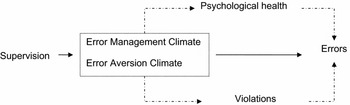
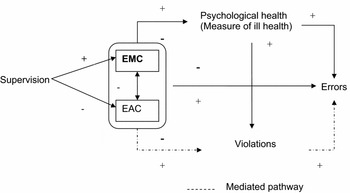
As error climate is a relatively new concept there are few studies or empirical models. Empirical models are also rare in safety climate research; however, those that do exist have been useful for identifying precursors to unsafe acts and explaining associations between variables (Fogarty & Buikstra, Reference Fogarty and Buikstra2008). The model for the current study (Figure 1) has been derived from safety climate research on the understanding that error climate is a facet of safety climate. This model is adapted from Fogarty and Buikstra (Reference Fogarty and Buikstra2008) and is the latest iteration of a model of unsafe acts developed and tested in an Australian military aviation maintenance environment. It is also the first empirical model to incorporate errors and violations as independent links. Fogarty and Buikstra's (Reference Fogarty and Buikstra2008) model successfully explained a large amount of the variance in aviation maintenance errors (58%) and violations (63%).
Hypothesised model of associations for the current study.

Supervisors play a pivotal role in safety and are instrumental in shaping the error climate of their teams (Fischer et al., Reference Fischer, Mazor, Baril, Alper, DeMarco and Pugnaire2006; Hughes, Chang, & Mark, Reference Hughes, Chang and Mark2009; Oliver, Cheyne, Tomas, & Cox, Reference Oliver, Cheyne, Tomas and Cox2002; Simard & Marchard, Reference Simard and Marchand1997; Zohar, Reference Zohar2008; Zohar & Luria, Reference Zohar and Luria2005). Trust, open communication and frequent interactions between supervisors and subordinates create opportunities for the discussion of errors and facilitate the early detection and correction of error. Supervisors who adopt an error management approach are likely to encourage reporting and learning from errors, which can lead to a reduction in errors over time, but supervisors who emphasise error avoidance are likely to foster concealment of errors and this can limit the opportunities to rectify them (Frese & Altmann, Reference Frese, Altmann, Bainbridge and Quintanilla1989; van Dyck et al., Reference Van Dyck, Frese, Baer and Sonnentag2005). It is expected that perceptions of high quality supervision will be positively related to perceptions of EMC and negatively related to perceptions of EAC.
H3: Perceptions of supervision will be (1) positively related to perceptions of EMC and (2) negatively related to perceptions of EAC.
Negative emotions (e.g., frustration, stress, anxiety) can be inadvertently promoted by an EAC. In error avoidance climates, errors that occur are seen as a failure or inability to follow rules. Errors become a source of stress, which is defined as ‘a relationship between the person and the environment (stimulus) that is appraised by the person as taxing or exceeding his or her resources and endangering his or her well-being (response)’ (Lazarus, Reference Lazarus1984, p. 19). In contrast, error management approaches view error as a natural but serious occurrence. When errors are seen as a challenge or learning opportunity, staff are less anxious about error, more willing to discuss it and less likely to experience stress as a result (Edmondson, Reference Edmondson1996). Workplace climate is also related to fatigue, the physical or mental tiredness and lack of alertness brought on by a lack of sleep or work overload. The vigilance required by error avoidance is not in itself problematic, but fatigue can be exacerbated by climates that cover up error, impose sanctions for errors and discourage investigation of causes for error in complex or poorly designed work (Fogarty, Reference Fogarty2004, Reference Fogarty2005). Error climates can also impact on the psychological health of employees (Fogarty, Reference Fogarty2004, Reference Fogarty2005; Fogarty & Buikstra, Reference Fogarty and Buikstra2008; Oliver et al., Reference Oliver, Cheyne, Tomas and Cox2002). General psychological health is related to the balance between positive and negative affect and the ability to deal with life's challenges (Keyes, Shmotkin, & Ryff, Reference Keyes, Shmotkin and Ryff2002). Perceptions of EMC can be associated with better psychological health through good supervision, effective communication, input into decision-making, intrinsic rewards, support and trust (Cropanzano & Wright, Reference Cropanzano and Wright2001; Edmondson, Reference Edmondson1996; Van Dyck et al., Reference Van Dyck, Frese, Baer and Sonnentag2005). In contrast, EACs can be related to poor psychological health if they enhance the negative consequences of errors, such as frustration, negative attributions, and feelings of guilt or shame (Rybowiak, Garst, Frese, & Batinic, Reference Rybowiak, Garst, Frese and Batinic1999). It is therefore proposed that perceptions of EMC will be negatively related to stress, fatigue and psychological ill-health, and perceptions of EAC will be related to more stress, fatigue and psychological ill-health.
H4a: Perceptions of EMC will be related to lower levels of (1) stress, (2) fatigue and (3) psychological ill-health;
H4b: Perceptions of EAC will be related to higher levels of (1) stress, (2) fatigue and (3) psychological ill-health.
The relationships between errors and fatigue, stress and psychological health are well documented (May & Baldwin, Reference May and Baldwin2009; Sussman & Coplen, Reference Sussman and Coplen2000). Stress, fatigue and ill-health can give rise to further errors; for example, by consuming cognitive capacity that could have been dedicated to task completion or error correction, by prompting stressed individuals to stick to habitual responses that may not be optimal, or by the additional demands of having to deal with error consequences (Heimbeck, Frese, Sonnetag, & Keith, Reference Heimbeck, Frese, Sonnentag and Keith2003).
H5: Error will be positively related to (1) stress, (2) fatigue and (3) psychological ill-health.
Stress, fatigue and psychological ill-health have been found to mediate relationships between climate and errors (Fogarty, Reference Fogarty2004; Reference Fogarty2005; Fogarty & Buikstra, Reference Fogarty and Buikstra2008). When error climates are constructive, levels of strain and fatigue are lower and this allows amore cognitive and physical resources to be focused on task completion and error management. In contrast, the high demands and lack of learning from errors associated with error avoidance can foster strain, exhaustion and ill-health and these in turn give rise to further errors.
H6a: The relationship between perceptions of EMC and self-reported errors will be mediated by (1) stress, (2) fatigue and (3) psychological ill-health.
H6b: The relationship between perceptions of EAC and self-reported errors will be mediated by (1) stress, (2) fatigue and (3) psychological ill-health.
Violations
Alper and Karsh (Reference Alper and Karsh2009) claim that there are two ways to view violations. The traditional view is that violations are the actions of ‘bad’ individuals, but the more recent view is that violations are symptoms of poorly designed systems. EMCs are likely to be more closely aligned with the latter view and to regard workers as part of the solution and a valuable source of information. In workplaces perceived as having strong EMCs, there is likely to be a negative relationship between error climate and violations as the system-level causes of violations (e.g., lack of information, competing goals, ineffective work designs, unworkable rules and poor safety climate) are more likely to be addressed. In contrast, a workplace seen as having an EAC may make individuals less willing to discuss and resolve conditions giving rise to violations such as unworkable procedures, rule deficiencies, competing goals and insufficient information.
H7a: Perceptions of EMC will be negatively related to violations.
H7b: Perceptions of EAC will be positively related to violations.
Violations are generally committed under the assumption that doing so is harmless or inconsequential. This view is supported by data from LOSAs of normal flights, which found that although violations were more frequently committed by aircrew than any type of error, only a very small percentage (2%) of violations became consequential (Helmreich, Reference Helmreich2000). However, violations lead to errors (Hobbs & Williamson, Reference Hobbs and Williamson2002; Fogarty & Buikstra, Reference Fogarty and Buikstra2008; McDonald, Corrigan, Cromie, & Daly, Reference McDonald, Corrigan, Cromie and Daly2000). Violations may remove or reduce defences designed to catch errors; for example, if a supervisor signs off maintenance work before it is finished (Parke & Kanki, Reference Parke and Kanki2008). Violations may also lead others to make incorrect assumptions that provoke errors (Reason & Hobbs, Reference Reason and Hobbs2003), and violations that occur frequently may become normalised (Lawton, Reference Lawton1998). Moreover, employees may generalise the violation of one rule to other rules (Lawton, Reference Lawton1998).
H8: Violations will be positively related to errors.
Violations have been implicated in most accidents, but the relationship with accidents is indirect through error (Reason & Hobbs, Reference Reason and Hobbs2003). Fogarty and Buikstra (Reference Fogarty and Buikstra2008) demonstrated that violations mediated the relationship between safety climate and errors in an aviation maintenance environment in the Australian Defence Force. A similar pattern of mediated relationships should apply for error climate.
H9a: Violations will mediate the relationship between errors and (1) perceptions of EMC and (2) perceptions of EAC.
Method
The current study employed a cross-sectional survey. The research was approved by the Chief of Air Force on June 3, 2010, and Massey University Ethics Committee (MUHECN 10/042). Information on the research project and the link to the information page and questionnaire were emailed to commanding officers for distribution. Participation was voluntary and confidential.
Participants
Participants were 189 (36%) Royal New Zealand Air Force (RNZAF) Technical Trade personnel below the rank of Flight Sergeant, who were currently in practical maintenance roles. The majority (77%) were fully qualified technicians with the remaining 23% mechanics (non-qualified technicians) completing on-the-job training. The two main trade specialisations, Aircraft Technicians and Avionics Technicians, constituted 74% of participants, and the remaining 26% were Technicians from the Small Trades (Small Technical Trades, Armament, and Safety & Surface). Fifty-five per cent of participants were from the Force Elements (FE) and 45% were from Maintenance Wing. All participants were over 17 years of age and most were New Zealand citizens. Eighty-six per cent of participants were male.
Measures
Error management climate
Perceptions of EMC were measured by 16 items; for example, ‘When people make an error, they can ask others for advice on how to continue’ (Van Dyck et al., Reference Van Dyck, Frese, Baer and Sonnentag2005). Responses ranged from 1 (never) to 5 (always); higher mean scores reflected a more positive EMC (α = 0.81).
Error avoidance climate
Perceptions of EAC were measured by 11 items (Van Dyck et al., Reference Van Dyck, Frese, Baer and Sonnentag2005). An Error Strain factor comprised five items; for example, ‘People in this organisation are often afraid of making errors’. A Covering up Errors factor comprised six items; for example, ‘Our motto is, why admit an error when no one will find out’. Responses ranged from 1 (never) to 5 (always). Reliabilities were good for total EAC (α = 0.84), Error strain (α = 0.81), and Covering up errors (α = 0.80). Higher mean scores reflected a stronger EAC, more error strain and a greater willingness to cover up errors.
Perceived supervision
The perceived standard of supervision was measured by six items from the Maintenance Environment Survey (MES) Version 1; for example, ‘I trust my supervisor’ (Fogarty, Reference Fogarty2004). Participants responded with reference to their immediate supervisor on a scale from 1 (strongly agree) to 5 (strongly disagree). Higher mean scores reflected a better perceived standard of supervision (α = 0.82).
Stress and fatigue
The measure comprised two subscales from the MES, Version 3 (Fogarty & Buikstra, Reference Fogarty and Buikstra2008). For stress, each item began with the stem ‘How often do you feel stressed at work because of . . .’ (e.g., ‘the task itself’; 1 = never to 5 = always). The score was the mean of four items. Reliability was low (α = 0.66), so results should be interpreted with caution. For fatigue, each item began with the stem ‘How often do you feel fatigued at work because of . . .’ (e.g., ‘the working hours’; 1 = never to 5 = always). The score was the mean of the two items (α = 0.90).
Psychological ill-health
Twelve items from the General Health Questionnaire (GHQ-12; Goldberg, Reference Goldberg1972) measured psychological health problems on a scale from 1 = not at all to 4 = much more than usual. Each item began with the stem ‘Over the past few weeks to what extent have you . . .’ (e.g., ‘lost much sleep over worry’). Six items were reverse coded. Higher mean scores indicated greater psychological ill-health (α = 0.79).
Violations
Violations were measured by nine items from the MES Version 3 (Fogarty & Buikstra, Reference Fogarty and Buikstra2008). The principal component identified two factors explaining 52% of the variance. Situational violations, the perceived need to engage in violations in order to get the job done, was measured by five items (e.g., ‘Managers turn a blind eye to shortcuts/risk taking by supervisors if the flying program or task deadline is met’; 1 = never to 5 = always; α = 0.74). Routine violations, the willingness to defy rules and procedures, was measured by four items (e.g., ‘I will temporarily disconnect or remove a part to make a job easier, but not document the disconnection/removal’; 1 = never to 5 = always). Higher mean scores indicated more inclination to break rules. Reliability was low, so results should be interpreted with caution (α = 0.65).
Errors
The self-reported frequency with which errors were made in the previous 3 months was measured by 10 items (e.g., ‘I have left a tool or some other item in an aircraft’; 1 = never to 5 = always; α = 0.82; Fogarty & Buikstra, Reference Fogarty and Buikstra2008).
Data Analysis
Principal components analysis (PCA) using varimax rotation was conducted for EMC, EAC, Supervision, Psychological health, Violations, and Errors. All scales were suitable for factor analysis with Kaiser-Meyer-Olkin (KMO) statistics over 0.7 and Bartlett's test of sphericity significant. The number of factors chosen was based on Kaisers stopping rule and an analysis of the scree plot. Scale reliabilities were tested using Cronbach's alpha. Analysis of variance (ANOVAs) with Scheffe post-hoc comparisons were conducted to test differences between demographic groups. Bivariate correlations were measured using Pearson's r. Demographic variables were dummy coded as follows: Position: 0 = Mechanic (non-qualified Technicians); 1 = Technician, JNCO and SNCO (qualified Technicians); Trade: 0 = Aircraft Technician, Avionics Technician; 1 = Small Trades; Squadron: 0 = FEs; 1 = Maintenance Support Squadron and Avionics (Maintenance Wing). The dummy coded variables were entered first into the regression analysis when there were significant group differences in the independent, dependent or mediator variables. Mediation was tested using Baron and Kenny's (Reference Baron and Kenny1986) three-step approach, which requires the association between the independent and dependent variables to be established in the first step, the association between the independent variable and the mediator demonstrated in the second step, and the mediation effect on the dependent variable demonstrated in the third step.
Results
Normality checks showed positive skew on violations, errors and EAC: covering-up errors, as well as a negative skew on perceived supervision. These are to be expected in an aviation maintenance environment, and as in Fogarty and Buikstra (Reference Fogarty and Buikstra2008), the degree of skew was not judged to be problematic for the analyses.
Demographic Group Differences
The most junior participants were Mechanics, followed by Technicians, then Junior Non-Commissioned Officers (JNCOs) and Senior Non-Commissioned Officers (SNCOs). EMC scores decreased as position increased and were higher for Mechanics than for SNCOs, F(3,184) = 3.46, p < .05, η2 = .05. Perceived supervision scores also decreased with position and were higher for Mechanics than for JNCOs and SNCOs, F(3,184) = 9.91, p < .01, η2 = .14. Stress and fatigue scores increased with position and were higher for SNCOs than for Mechanics; stress F(3,184) = 3.93, p = .01, η2 = .06; fatigue F(3,184) = 3.19, p < .05, η2 = .05. Situational violations were higher for JNCOs and SNCOs than for Mechanics, F(3,183) = 7.30, p < .01, η2 = .11.
The technical trades involved in this study comprised three groups: Aircraft Technicians, Avionics Technicians and Small Trades Technicians. EAC: Error strain scores were significantly higher for Aircraft Technicians than for Small Trades Technicians, F(2,184) = 4.46, p < .05, η2 = .05. Perceived supervision scores were significantly lower for Small Trades Technicians than for Aircraft and Avionics Technicians, F(2,184) = 6.31, p < .01, η2 = .06. Fatigue scores were significantly lower for Small Trades Technicians than for Aircraft and Avionics Technicians, F(2,184) = 12.93, p < .01, η2 = .12, and were significantly higher for Force Elements than for the Maintenance Wing units, F(4,180) = 16.88, p < .01, η2 = .27. Position, trade and squadron together predicted 28% of the variance in fatigue scores. There were no significant differences in routine violations or errors across position, trade or squadron.
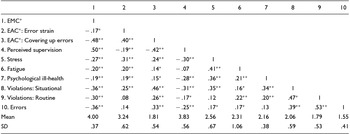
Bivariate correlations are shown in Table 1. Across all groups, better perceptions of supervision were associated with higher perceptions of EMC, lower perceptions of EAC: Error strain, and EAC: Covering up errors, less stress, less psychological ill-health, and fewer errors and violations (Table 1). Perceptions of EMC were negatively related to both facets of EAC across the full sample, supporting hypothesis 1.
Correlation Matrix

Note: *p < .05; **p < .01; EMC = Error Management Climate; EAC = Error Avoidance Climate.
Hypotheses 2 through 9 were examined by regression analyses that included dummy coded variables for position, trade and squadron. Hypothesis 2 was supported. Controlling for position, trade and squadron, the full model explained 16% of the variance in self-reported errors, F(6, 177) = 6.61, p < .001. Perceptions of EMC were negatively related to errors (β = −.26, p < .001). Perceptions of EAC: Covering up errors were positively related to errors (β = .24, p < .05); and Perceptions of EAC: Error strain were unrelated to errors.
Hypothesis 3 was partially supported. The control variables and error climate explained 39% of the variance in perceptions of supervision, F(6, 177) = 20.80, p < .001. Perceptions of EMC were related positively; and Perceptions of EAC: Covering up errors were related negatively to supervision (β = .34, p < .001 and β = −.21, p < .01 respectively).
Testing hypothesis 4a indicated that Perceptions of EMC were negatively related to stress, F(4,179) = 4.21, p < .01; adj. r 2 = .07, β = −.22, p < .01, and fatigue, F(4,179) = 20.48, p < .001; adj. r 2 = .30, β = −.14, p < .05, but unrelated to psychological ill-health. For hypothesis 4b, Perceptions of EAC: Strain were related positively to stress, F(5,178) = 4.87, p < .001; adj. r 2 = .10, β = .25, p < .01, but not to fatigue or psychological ill-health. Perceptions of EAC: Covering up errors were not related to stress, fatigue or psychological ill-health.
For hypothesis 5, self-reported errors were related to stress, F(4,179) = 3.16, p < .01; adj. r 2 = .05, β = .15, p < .05, but not to fatigue or psychological ill-health.
Hypothesis 6, which proposed that stress, fatigue and psychological ill-health would mediate the relationships between (1) Perceptions of EMC and (2) Perceptions of EAC and errors, was not supported. Stress and fatigue did not mediate either relationship and there was no relationship between psychological ill-health and errors.
With regard to violations, hypothesis 7 was partially supported. Perceptions of EMC were negatively related to situational and routine violations (H7a); F(4,179) = 9.38, p < .001, adj. r 2 = .16, β = −.31, p < .001 and F(4,179) = 5.82, p < .001, adj. r 2 = .10, β = −.32, p < .001, respectively. Perceptions of EAC: Covering up errors (H7b) were positively related to situational violations, F(5,178) = 11.28, p < .001, adj. r 2 = .22, β = .36, p < .001, and routine violations, F(5,178) = 3.59, p < .01, adj. r2 = .07, β = .29, p < .01.
Errors were related to situational violations, F(4, 179) = 10.74, p < .001, adj. r 2 = .18, β = .45, p < .001, and routine violations, F(4, 179) = 18.70, p < .001, adj. r 2 = .28, β = .54, p < .001, supporting hypothesis 8.
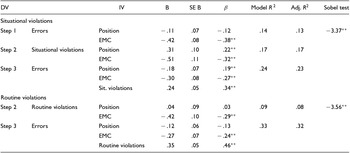
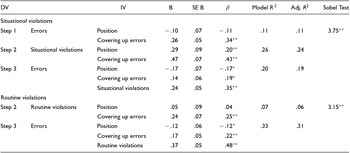
Support was found for hypothesis 9a as violations partially mediated the relationship between perceptions of EMC and errors (Table 2). There was also support for hypothesis 9b. Violations partially mediated the relationship between Perceptions of EAC: Covering up errors, and errors (Table 3), but there was no relationship between Perceptions of EAC: Error strain and errors to mediate.
Violations as a Mediator of the Relationship Between EMC and Errors

Note: *p < .05; **p < .01
Violations as a Mediator of the Relationship Between EAC: Covering up Errors, and Errors

Note: *p < .05; **p <.01
The pathways supported by the analysis are displayed in Figure 2.
Supported pathways in the model of associations for the current study.

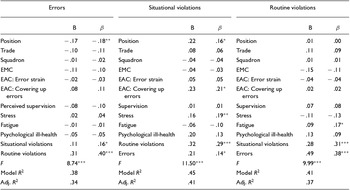
As the relationship between error climate and errors was not mediated by stress, fatigue or psychological ill-health as expected, further analysis was conducted to determine whether the addition of these variables and violations would improve the prediction of errors over the variance accounted for by the error climate variables, perceived supervision and position (Table 4). However, only routine violations and position were significant predictors of errors.
Prediction of Errors and Violations

Note: *p < .05; ** p < .01
Prediction of Violations
Regression was also employed to determine whether psychological health improved prediction of violations over organisational variables and position. The analysis suggested that this model predicted nearly half of the situational violations (Table 4). The specific variables identified as significant predictors were position, Perceptions of EAC: Covering up errors, stress and psychological ill-health. The table also shows predictors of routine violations. Situational violations, errors and fatigue significantly contributed to the prediction of routine violations.
Discussion
Non-punitive climates that support the open analysis and discussion of error and emphasise learning from error can lead to secondary error prevention through learning (Van Dyck et al., Reference Van Dyck, Frese, Baer and Sonnentag2005). In contrast, climates characterised by strain and fear of committing or reporting errors can increase the likelihood of error, inhibit discussion of and learning from errors and make secondary error prevention less likely (Edmondson, Reference Edmondson1996; Hofmann & Mark, Reference Hofmann and Mark2006). The present study supported this view, as Perceptions of EAC: Covering up errors were related to increased self-reported error rates, and Perceptions of EAC: Strain were related to stress.
Positive perceptions of supervision were related to stronger perceptions of EMC to less perception of EAC: Covering up error, supporting the idea that supervision is a key factor in building safety climate and the likelihood that errors will be addressed in constructive ways. Stress was positively related to self-reported errors, but fatigue and psychological health were not. Error climate was also related to violations, providing further evidence that an EMC with open discussion, participative problem-solving and learning is more likely than an EAC that is perceived as punitive to allow individuals to identify and tackle issues and develop workable safety protocols.
Routine violations were related to situational violations and fatigue. Senior staff were more likely to report that they had committed situational violations than more junior staff, perhaps because junior staff were still under training and less likely to risk committing a situational violation or to be in a position where they might feel compelled to do so. Individuals who break rules may do so because procedures are out of date or ill-suited to the situation, although workers often believe that they have the skills and knowledge to carry out a violation without error (Fogarty & Buikstra, Reference Fogarty and Buikstra2008; Helmreich, Reference Helmreich2000; McDonald et al., Reference McDonald, Corrigan, Cromie and Daly2000; Reason & Hobbs, Reference Reason and Hobbs2003). It is possible that when workplace factors act to increase situational violations, individuals come to have less regard for the rules and become more likely to commit routine violations (Lawton, Reference Lawton1998).
Fatigue may also cause individuals to take shortcuts; for example, using informal procedures or ‘cheat sheets’ rather than referring to manuals. Violations were strongly related to errors. Errors are likely to occur when workers are operating outside established procedures and may be unaware of the implications of rule departures. Covering up errors predicted situational violations. This may indicate that individuals commit violations in order to cover up errors, or that those who cover up errors also commit more violations.
As has been found elsewhere, stress and psychological health were also related to situational violations, suggesting that staff under pressure at work may be likely to take shortcuts. Violations, especially routine violations, partially mediated the relationship between error climate and errors, indicating that violations lead to errors, and organisational factors that affect violations can have an indirect impact on error. As the mediation was only partial, error climate also had a direct relationship with error.
Limitations of this Study
This study used self-report data for all measures, which opens up the possibility of common method bias and socially desirable responding. Although single source self-report data is the norm in safety research (Christian, Bradley, Wallace, & Burke, Reference Christian, Bradley, Wallace and Burke2009), the possibility that self-reported errors and violations may not correlate with actual behaviour must be acknowledged. Confidentiality issues meant that data on actual errors and violations could not be linked to individual perceptions of error climate.
It is also possible that the negative wording of some questions may have affected responses. Future surveys could reframe measures in a more positive way; for example, covering up errors could become ‘willingness to report errors’, and safety compliance could be studied rather than violations (Clarke, Reference Clarke2006; Hofmann & Mark, Reference Hofmann and Mark2006).
A final limitation is that the participants in this study were all from one military organisation, which may limit the generalisability of these results. Future research that can address these limitations would be valuable.
Implications of the Findings
This study suggests that perceptions of a strong EMC and weak EAC may be helpful for safety. It also demonstrates that perceptions of an EMC, which acknowledges errors and develops processes to deal with them, does not invite additional error but serves a valuable function in reducing error. Error climate also impacts on violations and these in turn impact on errors. This emphasises the need for organisations to distinguish between errors and violations, and reinforces the idea that violations are symptoms of organisational problems rather than the product of problematic individuals (Alper & Karsh, Reference Alper and Karsh2009).
Organisations intent on reducing error should focus on improving the organisational factors that lead to violations. In this study, the relevant organisational factors were error climate and supervision. Although error climate and supervision scores were high and the rates of self-reported errors and violations were low, violations could potentially be reduced by improving safety climate factors such as policies and procedures, in consultation with employees. This requires the organisation to see employees as part of the solution and to ensure error and safety climates support the opportunity to identify underlying issues affecting violations. This is consistent with perceptions of a strong EMC.
Units or organisations with poor error climates may be able to improve their error management by studying those who excel in this area. This may be an attractive and important opportunity, given that Van Dyck et al. (Reference Van Dyck, Frese, Baer and Sonnentag2005) demonstrated a positive link between EMC and organisational performance.
Directions for Future Research
Although the aviation industry has a long history of human factors research, there is a lack of climate research to provide empirical evidence of organisational precursors to unsafe acts, errors and violations (Fogarty, Reference Fogarty2004; Fogarty & Buikstra, Reference Fogarty and Buikstra2008). Perceptions of EMC and EAC appear to be important in safety, as both had significant relationships with errors and violations.
There are many remaining questions about factors that underpin the relationship between error climates and outcomes. Perceptions of error management climates could, for instance, foster the reporting of errors regardless of actual rates of error, or could represent a self-protective belief that errors are prevalent in the organisation. Error avoidance climates could make errors more salient and memorable, increasing perceived but not actual error rates. Other factors relevant to the likelihood of error commission or consequences may be related to organisational, technological or workplace issues such as organisational change and stability, which could affect perceived error climate. Organisational and situational factors related to error climates require further investigation. It will also be of interest to further explore which aspects of supervisor behaviour are most relevant to fostering constructive error climates.
Models can be developed to assist in explaining the occurrence of unsafe acts, that can then be tested on actual rates of errors and violations (Fogarty, Reference Fogarty2005). Studies that examine the relationship between error climate and consequences of errors and violations such as incidents and accidents are also important, given that error climate is likely to have a bigger impact on error consequences than on errors themselves (Van Dyck, Reference Van Dyck2008).
Longitudinal research, along the lines of that conducted by Neal and Griffin (Reference Neal and Griffin2006) for safety climate, can identify whether error climate has lasting and lagged effects on outcomes. Future research may also examine the pervasiveness of error climate by comparing perceptions across units and hierarchical positions within organisations. Additional research can also explore a range of mediating and moderating variables to explore the processes by which error climates are related to errors.
Conclusion
The findings suggest that error climate is an important factor in safety and aviation maintenance performance. This research could assist aviation maintenance organisations to reduce error and violations as well as improve efficiency. This research could also assist other organisations concerned with safety to reduce the occurrence of and improve the handling of unsafe acts.