Percy Dearmer Goes to America
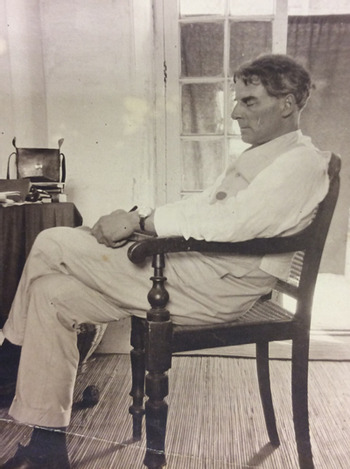
Percy Dearmer arrived at Berkeley Divinity School, a seminary of the Episcopal Church then based in Middletown, Connecticut, in July 1918, a few months before the end of World War I. Dearmer was accompanied by his second wife, Nan, whom he had married two years earlier in London at St James Piccadilly – William Temple, then the rector there, and a friend of the couple, had officiated – and their six-month-old baby, Gillian. In August 1917, William Ladd, Dean-elect of the divinity school (whom Dearmer had met at a conference in England in 1914) had invited him to come as a special lecturer, setting up a tradition at Berkeley of inviting Church of England clerics and scholars to spend time at the seminary as visiting faculty. Percy and Nan were, by then, in India, where he was working for the YMCA, first of all traveling around teaching and lecturing and then at St Stephen’s College in Delhi as a lecturer (see Figure 1). A cable was sent to them from her mother: ‘Professor Ladd Berkeley Middleton [sic] Conn offers paid post and journey wants cable reply.’ Dearmer replied: ‘June earliest.’Footnote 3
Getting Ladd to provide details of the visit proved to be frustrating. In September 1917, a month after the invitation had been issued, they received ‘a nice letter and very cordial’ proposing $1000 salary for four months, but expecting them sooner than they could get there. A month later, in October, they had received a letter from him, but Nan did not find it helpful as she wrote to her mother:
He is not very bright over business, nor has he replied to our ‘June earliest’ cable yet, and he might have answered yes or no. We are assuming the autumn term will work and are intending to go to the States whether he wants Percy or not. P is sure to get some work and we really cannot contemplate another Simla season.
Again in December Nan expressed her frustration to her mother:
Yesterday we got a wire from Mr. Ladd: ‘Expect to arrange middle January. Will cable. Ladd.’ We take this to mean that by the middle of January he will have fixed up with an agent for us; because he knows we shan’t be there before June. He is not very bright and there is always a certain ambiguity about his cables and letters. I don’t think anything will be very clear before we arrive, but as we want to stay in San Francisco a week at least, that will be a chance of extracting the necessary information from him.Footnote 4
Even as the arrangements had been made for their sailing, Ladd sent a telegram: ‘Everything uncertain, doing all possible.’ Nan commented in her biography of Percy that he ‘became deeply depressed and said that there were only three places he was wanted: Delhi, Singapore and Hell, and they were all hot!’Footnote 5 (The Bishop of Singapore had offered him work.) Finally, in May 1918, when they had left India, were in Japan and halfway to the States, they had a cable from Mr. Ladd saying ‘Arranged.’ The vagueness of his previous communications was now explained: as Nan wrote to her mother, this ‘means that he is Dean of Berkeley Div. School and that he does want Percy there. You know the trustees were being tiresome, & our going there rather hung on that.’Footnote 6
Percy Dearmer in India 1917/18 (courtesy of Lambeth Palace Library).

The Dearmers stayed at Berkeley for about six months, until February 1919, and Percy was busy all the time. At Berkeley, he taught liturgy and theology, giving a special lecture on the Ornaments of the Church; gave the Page Lectures (later published as The Power of the Spirit); designed the altar and altar hangings for the school’s temporary worship space – named the Oratory – when the chapel was closed to save coal in the middle of winter; and he got the students and faculty interested in singing traditional English music and hymns. This resulted in a carol concert in the public high school to which many townspeople came, ‘to listen to music which at that time had been seldom heard in this country,’ reported Dean Ladd.Footnote 7
Dearmer’s activities were not confined to Berkeley. He went, with Nan and Gillian in tow, to Harvard to a conference of theological schools where he talked about Christian Art; to a Conference of the Intercollegiate Socialist Society at Delaware Water Gap; and to preach in Hartford, Boston and New York, and in several colleges. He also gave public lectures in Middletown, often illustrated with Lantern slides, and Ladd reports that when Dearmer was invited to lecture to one local group, he gave the committee a choice of 26 subjects: ‘they were much impressed with his versatility.’Footnote 8 Towards the end of his stay, in January 1919, he traveled to Philadelphia to give the Bohlen Lectures, which he repeated during Lent that year in London, at St Martin’s in the Fields, and later published as a book in both countries under the title The Art of Public Worship. This book will be discussed later in this article.
All of this activity was typically Dearmer-esque, not only in its energy and enthusiasm, but also in its content: liturgy, social justice, art, music. These were Dearmer’s primary concerns. Ladd later wrote that the impact of Dearmer’s visit had been considerable in helping to shape Berkeley’s identity just as Ladd began his tenure as Dean. He wrote to Nan Dearmer, ‘I am sure that Dearmer would be gratified to know that Berkeley is now one of the chief centres of the Liturgical Movement and of Anglican principles of ceremonial in the Church of this country. For this we owe much to him.’ The music that Dearmer had introduced had also been long-lasting; as Ladd wrote of the annual carol service, for which the seminary chapel was always crowded: ‘It has become a sort of continuing Dearmer memorial, for not only do we use the books edited by him, but we always mention him and explain how we owe the annual carol singing to him.’Footnote 9
It is significant that Ladd invited Dearmer as his very first English visiting lecturer: it sent a signal about his priorities at Berkeley as Dean. Indeed, he sent the invitation to Dearmer in 1917, when he was still Dean-elect, eager to bring a visiting lecturer who shared so many of his interests, especially the renewal and reform of liturgy; social justice and its relationship to worship, and the role of liturgy as part of an effective mission strategy in a time of declining church attendance.
Percy Dearmer and William Palmer Ladd: Friendship and Shared Concerns
In 1919, when Dearmer went to Berkeley, he was probably best-known for a book he had published 20 years earlier, in 1899, The Parson’s Handbook. An immediate success, in those 20 years it had gone through several editions and migrated around the Anglican Communion. It was designed to guide clergy in the proper conduct of worship according to the Book of Common Prayer, and to provide a remedy for ‘lamentable confusion, lawlessness and vulgarity,’ which, he wrote, were ‘conspicuous in the Church of this time.’Footnote 10 Dearmer was alarmed by the sheer variety of styles of worship across the church, many not adhering to the Book of Common Prayer, and he saved his particular scorn for the Anglo-Catholics who had taken up post-Tridentine Roman practices and incorporated them into Anglican worship (he found six candles on the altar utterly abhorrent, for example). He wanted a true English Catholicism, and at the end of the nineteenth century he belonged to a group that sought to establish and promote that through liturgical scholarship, The Alcuin Club. These men promoted what came to be called ‘English Use,’ focusing especially on Sarum Use (the most widely used of all the late medieval rites), and they were especially obedient to the 1549 Prayer Book in which, they believed, Cramner had got rid of the worst superstitions and accretions of the Middle Ages, while retaining a true, native, English Catholicism. In promoting ‘English Use’ they were a distinctive part of a broader late nineteenth- and early twentieth-century movement for liturgical renewal.
Ladd had been much influenced by this broad liturgical renewal movement, and he shared Dearmer’s intense dislike of the ritualists who adopted modern Roman practices.Footnote 11 He was even more scathing in his criticism of them, writing that the Oxford Movement ‘bequeathed to us an evil heritage.’ In liturgy, the ritualists ‘tore down Anglican tradition and copied all the wrong things.’ They ‘spread the cultus of many forms and ceremonies which are anathema to learned and orthodox leaders of the Roman liturgical movement.’ In terms of architecture, the ritualists had roved around England ‘desecrating its cathedrals and parish churches, spending vast sums on “restoration” and replacing the old by their childish make-believe Gothic.’ Many churches in America had taken up this style and deserved the name ‘St. Obsoletus.’Footnote 12 This critique remained a theme in Dearmer’s own work. Twenty years after he had published the Handbook, in The Art of Public Worship, his lectures in Philadelphia in 1919, he wrote: ‘Anglican Romanism, if we may allow the quaint name, is only a naughty child of Protestantism, and would never have existed in a Church that had been true to its ceremonial traditions. It can never succeed because it has not intellectual, aesthetic or moral justification; and for this reason it can sometimes become strangely unhealthy.’Footnote 13
Ladd was, however, less sympathetic than Dearmer towards any form of Anglo-Catholicism, which, he argued, had ‘produced a strange combination of individualistic piety and submission of the individual, but not vital social gospel.’Footnote 14 Here there may have been a distinct difference between his American experience of the Social Gospel (mainline Protestant in its roots), and Dearmer’s English background where Christian Socialism, which Dearmer embraced as an undergraduate, was often associated with the Anglo-Catholic wing of the Church. The emphasis on ‘English Use’ Catholicism did not hold the appeal for Ladd that it did for Dearmer and his Alcuin Club friends. Ladd had a broader, more ecumenical view of the possibilities of liturgical renewal, and sought to learn from Roman Catholic scholars and communities such as the Benedictine Abbey at Maria Laach in Germany and St John’s Abbey in Collegeville, Minnesota, who were engaged in liturgical renewal. The other major English liturgical scholar whom Ladd referenced in his work was A.G. (Gabriel) Hebert SSM, who was deeply plugged into the ecumenical liturgical movement as well as having a prominent role in the Parish Communion Movement (PCM) in the Church of England, making the case for Holy Communion to be the main act of Sunday morning worship, rather than the then more widely used Matins service. (Hebert was one of the visiting English priest-scholars who came to Berkeley, but after Ladd’s death.)
Dearmer’s context when writing the Handbook was decidedly English and Anglican, and his concern was to instruct Anglican clergy on how to make both the worship and its context beautiful and appealing. The Parson’s Handbook is firmly based in scholarship, but it is above all a thoroughly practical manual, telling priests how to arrange and decorate the church, what to wear (and in what colours and when), and what to do liturgically. Dearmer had written the Handbook while still a curate at St Mark’s, Marylebone Road, where he did not always see eye to eye with the vicar, whom he regarded as rather an extreme high churchman.
Soon after the publication of the Handbook, Dearmer was able to put into practice his ideas, and showcase what he regarded as best practice. In 1901, (after serving four curacies) he became Vicar at St Mary’s Primrose Hill, in north London, where he remained for the next 14 years. This became a model church for this strand of liturgical renewal in England, attracting many people who shared the same values, and therefore functioning not only as a parish church but also as a gathered church. For example, Maude Royden – later, in the 1920s, a campaigner for the ordination of women and well-known lay preacher, with whom Dearmer would go on to collaborate in the founding of an alternative worshipping community – chose St Mary’s Primrose Hill as her place of worship when she first came to live in London, after trying many different churches. She wrote that as soon as she arrived: ‘I felt immediately and utterly at home, and never strayed until Percy Dearmer gave up his ministry in the war.’Footnote 15
At Primrose Hill, Dearmer reordered and redecorated the whole church, paying precise attention to every aspect of the decoration and liturgy. He whitewashed the walls, because he felt that the red brick was an unsuitable backdrop for the liturgical hangings in their appropriate seasonal colors that he recommended. In 1903 he began to compile the other book for which he became especially well known in this period: The English Hymnal, published in 1906. He tried out many of the hymns – such as ‘He Who Would Valiant Be’ (John Bunyan) and ‘In the Bleak Midwinter’ (Christina Rossetti) – at Primrose Hill along the way, and worked with the composer Ralph Vaughan Williams on the music. In 1909, he appointed Martin Shaw, who knew a great deal about English folk music, as the Director of Music at Primrose Hill, and with Vaughan Williams they collaborated on a number of other publications, such as the Oxford Book of Carols.
In his Hymnal, as in his Handbook, Dearmer was attempting to raise artistic and aesthetic standards in the Church. This he cared about profoundly. Influenced by the writings of both John Ruskin and William Morris, beauty was important to his vision. As one of his congregants D.L. Murray wrote, Dearmer’s ‘ceremonial research was directed by a large vision, the holiness of beauty serving the beauty of holiness.’Footnote 16 Dearmer was zealous in getting others alongside him in this vision, and entrepreneurial in making it possible for them to follow his guidance: in 1901 he set up the St Dunstan’s Society and in 1912 the Warham Guild, both for the making of liturgical vestments, hangings, ornaments and so forth, so that readers of the Handbook might be able to buy exactly what Dearmer recommended. It is no surprise that Dearmer brought this zeal to Berkeley, seizing the opportunity to fit out and decorate the seminary’s temporary chapel, when the opportunity arose, and introducing the seminarians, faculty and townspeople to the carols and hymns in the English folk music tradition. He even helped found a Connecticut Church Music Society.
None of this was art for art’s sake. Rather, art was for God’s sake, and for the sake of justice. Dearmer saw a strong link between liturgy, beauty and justice. In the Handbook, he did not simply criticize vulgar church decorations (though he did do that, a lot), but also the appalling working conditions that produced them. An oft-quoted passage from the Handbook illustrates the connections that Dearmer made:
It has been pointed out that a modern preacher often stands in a sweated pulpit, wearing a sweated surplice over a suit of clothes that were not produced under fair conditions, and, holding a sweated book in one hand, with the other he points to the machine-made cross at the jerry-built altar, and appeals to the sacred principles of mutual sacrifice and love.Footnote 17
Vulgarity arose from cheapness, which was related to the use of sweated labor. If something was made under fair working conditions, by a craftsperson or artist using their gifts, then it could better glorify God. This Dearmer had learnt from his reading of William Morris, and had developed into a theological position, much influenced by Christian Socialism – which was for him, inextricably bound up with his simultaneous discovery of high church worship (he had been brought up by a harsh evangelical mother) and the arts and crafts movement, during his undergraduate years at Oxford. It is telling that he decorated his student rooms at Christ Church with William Morris tapestries and took to wearing flamboyant Liberty ties.
It is hard to know precisely how Ladd and Dearmer influenced each other, as there is no evidence in the correspondence and notes in the archives of either man. But it is obvious that they shared certain concerns. In the area of aesthetics, it seems likely that Dearmer influenced Ladd. Ladd only wrote for publication many of his thoughts on the liturgy in short articles in the late 1930s, soon before he died, and these were published as a book, Prayer Book Interleaves, in 1942 after his death. Aesthetics is not a major concern in the book but, where he discusses it, he is very Dearmer-esque. He wrote, almost directly echoing Dearmer in The Art of Public Worship, drafts of which he may have read as Dearmer prepared the Bohlen Lectures: ‘Worship is an art which requires the help of other arts like architecture, music and elocution. These arts can be cultivated even in churches with small resources.’ Never one to miss an opportunity to criticize the Victorian Gothic as a style related to Anglo-Catholicism he said, ‘Modern Gothic Buildings are of course a handicap. They and their furnishings almost always have the mark of the fortuitous and the ready-made.’ Again there are echoes of Dearmer’s emphasis on the virtues of good craftsmanship versus the factory-made. ‘A revival of simple, honest church architecture would be a blessing.’ But he was not quite the pure aesthete that Dearmer was: ‘Beauty is essential to worship, but it must be beauty with a purpose, beauty which makes for edification and Christian living. A religious service is more than a beautiful picture; it is a symbolic drama of the divine redemption in which each worshipper has his part to play.’Footnote 18
Dearmer and Ladd also shared a passion for justice that profoundly shaped, and was shaped by, their faith: what Ladd, in his American context, called the Social Gospel, and Dearmer encountered as Christian Socialism. They had met in 1914 at a Social Service Conference at Swanwick.Footnote 19 Dearmer already knew Ladd’s English wife, Ailsie Taylor, who had been educated at Cambridge and was involved in the women’s suffrage movement (as Dearmer’s first wife, Mabel, had been). Both Ladd and Dearmer were active in the church in ‘social issues.’ Ladd’s concern was expressed, at least during his years as Dean of Berkeley, in church life through his chairing of the Social Service Committee of the Connecticut Federation of Churches (1918–26), and – in the state – through his service as chairman of the Connecticut Child Welfare Commission (1919–26). He also infamously got into trouble for bringing a speaker – who had spent time in Russia – to tell the students about Bolshevism. Dearmer was very actively involved in two Christian Socialist movements: the Guild of St Matthew and the Church Social Union. For both men, their interest in the social gospel meant more than economic change. It was inextricably linked to how they viewed liturgy – as being for the whole people. As Ladd put it: Worship must be ‘of, by and for the people. The wretched medieval idea, sanctioned, alas, to some extent in our Prayer Book, that services are the monopoly of the priest, must be dropped.’Footnote 20
Dearmer and Ladd also both had a sense of their times, and the mission possibilities of liturgy done well. Both articulated the ways in which the church was in a ‘crisis’ moment and knew that it was imperative to grasp the possibilities of that moment. Dearmer wrote, in 1919, in the first of his lectures in Philadelphia: ‘church-going has declined steadily and rapidly; this being a free and honest age, people no longer attend what they do not like.’ Dearmer had a deep sense that, in the wake of World War I, the church had a great deal to do in order to retain its adherents and attract others back. He knew from his observations that something significant had happened in his lifetime – namely, as he put it, ‘the good tradition of thirteen centuries has been broken.’Footnote 21 Statistical work done recently bears out Dearmer’s hunch; church attendance did indeed plateau at the end of the war, and began its steady decline in England from the 1920s onwards.Footnote 22 Dearmer wrote, with feeling: ‘Our sons, even when carefully brought up, and retaining often a definite affection for their religion, do not care, as a rule, to attend its services; nor is it by any means the most thoughtless who attend the least, or the strongest who are most attracted by what we offer.’Footnote 23 And he did mean sons, having a deep awareness that the churches were largely populated and carried, in this period, by laywomen.
Ladd shared Dearmer’s strongly held belief that the churches were failing the younger generation’s thirst for a spiritual life. He wrote, some two decades later: ‘A survey of some of our Sunday morning congregations might lead to the pessimistic conclusion that there is little interest in religion and worship among young people today… but it is basically wrong.’ In support of his claim he cited a report ‘from a New England college of a group of undergraduates who find the college chapel services so far below their ideal that they are meeting by themselves to worship and study worship.’ He admitted that may not have been typical – but he did believe it was significant: ‘There must be many such people. Parishes should study to attract them.’Footnote 24
Ladd also shared Dearmer’s sense of urgency. ‘Nothing is more important than that the liturgical movement should take the right direction in this country at the present time.’ Although this was written in the 1930s, we may presume that he had these concerns throughout his entire career as Dean of Berkeley, which spanned the inter-war years: he began his tenure in that position at the end of World War I and died in 1941, in the early years of World War II. He felt that the urgent question facing the Church – in his context – was whether England, America, and the modern world would ever again listen to the gospel of Jesus Christ.Footnote 25
Both Dearmer and Ladd believed that if liturgy were reformed, that might arrest the decline in church-going. Ladd wrote: ‘adapting our inherited forms of worship to the modern situation’ was essential, so that the church could be prepared ‘to meet the needs of a generation it has done so much to mislead and to alienate.’ The context for his concern was all that competed for people’s time and attention: ‘Today we are in the midst of “gods many and lords many” again – commercialism and humanism in America, fascism, communism, nationalism, and totalitarianism in Europe.’ Writing in the 1930s, he knew that communism and fascism were the two great political movements of his time, both regarded as threats to Western democracy. He therefore believed that the Church had to seize the opportunity to win back souls from these competing interests: ‘My conviction is that we have got to make the Christian religion more dramatic, or our churches will gradually empty while the skating rinks and theaters will fill up with more and more Communists … one step in the right direction would be to restore its dramatic character to Christian worship.’Footnote 26
Dearmer was perhaps less optimistic than Ladd, at least in the short term. At the end of The Art of Public Worship, he wrote: ‘I have no “panacea” for filling our churches. We shall not fill the churches yet, for the teeth of our children have been set on edge.’ Indeed he went on to say that ‘there will be no sudden response, no flocking back into the churches that have been chilled for so long.’ Nevertheless, he was ultimately optimistic: ‘Only, if we do what is right, for the sake of the right, all will come well in the end.’Footnote 27 The whole purpose of The Art of Public Worship was to consider how liturgy might once more be made compelling, even if Dearmer did sound notes of caution. It is therefore fair to say that Ladd and Dearmer shared the dream that liturgy, done well and in tune with the times, could renew the Church; again, how much they influenced each other in their (unrecorded) conversations during those months that Dearmer was at Berkeley is unknown, but we may hazard a guess that their impact on each other about this topic in particular, as World War I ended and they looked at the kind of world that the next generation of seminarians would inherit, was significant.
Berkeley as a Turning Point for Dearmer
The time Dearmer spent at Berkeley marked a major turning point for him; his 1919 lectures published as The Art of Public Worship point to that, and reveal some of what he had learned since first going to serve as a chaplain in World War I. The years between 1915 and 1919 were significant ones, marking a break from his old life and entry into a new phase altogether.
World War I changed everything for Dearmer. War broke out in 1914 and in March 1915 he went to work as a Chaplain to British troops in Serbia. His first wife, Mabel, decided to go as well, to work as a nurse in one of the field hospitals. Six months later, she died of a fever she caught there. Dearmer returned to England and, just a few months later, in October of 1915, he received the news that his son Christopher, serving on the Front, had been killed by a stray shell that landed on his tent. Dearmer returned to work as vicar at St Mary’s, Primrose Hill, but after the trauma of those two deaths, life could not go back to normal. He had had a sense for several years that his time and work were done at Primrose Hill, but no new position had been forthcoming, and he finally made the decision to resign his position without the offer of any further position in the Church of England. He left England on January 1, 1916, and went to work in France with the YMCA for just under four months, giving lectures (on topics such as Russia, France, the Balkans, and Joan of Arc) to troops in the popular YMCA huts, and answering the soldiers’ questions about religious difficulty, an experience that gave him a deep insight into the state of faith amongst that population. During that time, through a series of letters, his romance with Nancy (Nan) Knowles (whom he knew from Primrose Hill) quickly blossomed.Footnote 28 He was 48; she was 27. Returning to England from France in late March, he married Nan in the August of that year, and in October they both sailed for India. In the spring of 1918 they traveled to San Francisco via Singapore, Hong Kong and Japan. From the West coast of America, they finally made their way across the States by train and arrived in Connecticut. It was with some relief that they arrived at Berkeley Divinity School. As Nan had written to her mother in May, when Ladd had finally confirmed Percy’s appointment: ‘It is so delightful to know that is really settled and we shall have a little home to go to after all this wandering.’Footnote 29
When Percy and Nan Dearmer arrived at Berkeley in the summer of 1918, they had been away from England for nearly two years. During that time, and for some time before too, Percy had been out of regular parish ministry, and the opening pages of The Art of Public Worship reflect this. He now had a greater sense of what the person in the pew was experiencing in church. This was to influence his ministry and his writing for the rest of his life, and especially significantly over the next decade and a half. He wrote: ‘I think that many parsons themselves, who have played the laymen in different parts of the world, will agree with me that, on the whole, there is little to draw average, sensible folk to church, and little to help them when they get there. Those who come do so mainly from a sense of duty – all honour to them.’ He continued, with feeling:
When, during the last few years, I have been lecturing all week, and my Sundays have been a day of rest, often and often have I said to myself (apart from the early service) ‘Why should I go to church?’ Matins at home was a helpful little service which two or three could say together in a quarter of an hour. Matins in church was generally a service that took an hour and a half, in a hideous, stuffy, and pretentious building, where the service was marred by bad reading and bad singing, and overlaid under a mass of dreary music, stupid hymns, and sermons that were not interesting. I know that a liturgical student who has long had his own way is tempted to be unworthily critical.
But the ordinary man has been saying ‘Why should I go to church?’ for a long time; he feels the defects, though he is less ready to give them a name; and what to a student appear as specific objections, to other people are little less potent in a vague unrest and discontent.
He goes on to make a pertinent analogy with attending the theater:
A student of Shakespeare would not go to a theatre where Shakespeare was notoriously murdered by bad declamation, bad music, scenery and costume; he would prefer to read him at home. But an ordinary play-goer would also abstain from such a theatre; only he would not read his Shakespeare at home.Footnote 30
Dearmer had, because of his circumstances, now become a ‘passenger’ in church. He had also come to experience worship in the wider Anglican Communion; his context was no longer just the Church of England. Nan Dearmer wrote regularly to her mother of the varieties of church they had experienced in India and elsewhere. On Advent Sunday 1917, she wrote of their worship at St Stephen’s in Delhi, where ‘we made our communion amongst our Indian brothers, the first time I have done that though I have several times been present at Tamil services.’ The service blended Indian and English traditions: ‘The service was in Urdu and they sang Merbecke, which was delightfully homelike’ and the hymns were familiar. Nan sang ‘Great God, what do I see and hear’ in English while everyone around her sang it in Urdu. The seating arrangements were worthy of comment: ‘The men sit on one side and the women on the other, and right behind is a narthex were the poor excommunicates sit humbly.’ Nan was also learning about the Church in her encounters with Anglicanism in India: ‘The Indian Christians have no knowledge of what you mean by C of E – they look blank if you ask if they belong to it – they are S.P.G. Xtian or C.M.S. Xtian.’ Percy and Nan experienced, too, the religious pluralism of India: in New Delhi, they visited the Lady Hardinge Hospital and medical college for women; only Nan could enter, because it was all female. She wrote: ‘The students are Parsee, Hindu, Mohammedan, Sihk [sic], Anglo-Indian and Indian Xtian and they all have separate hostels in the compound.’ They also met Gandhi when he visited the college. Nan described him –before meeting him – as ‘a tremendous saint … a social reformer, a really good person, P. says’ and, after meeting him, as ‘spare and birdlike, dressed all in white with bare feet and he is very fair. It is an attractive face and his manner is simple and kindly.’ They talked mostly about education.Footnote 31
On their journey from India to the USA, they stayed with the bishops of Singapore and Tokyo. In Tokyo, Percy went to a confirmation of Japanese candidates, and before the service ‘all the candidates went up in several lots and stood in a row before the Bishop and bowed, and the Bishop rose from his seat and bowed to them.’ It was not just that Percy was learning about the varieties of worship across parts of the Anglican Communion, but his expertise was being sought too. Nan reported that the Bishop of Singapore was ‘getting a lot out of Percy in the way of ideas. He is always inviting him to a chat and pumps him hard on a variety of subjects.’ She went on to comment that the Bishop was ‘a nice man, but not at all clever – perfectly complaisant about the church and easily shocked … he has no business to be a bishop.’Footnote 32
When Percy Dearmer came to give the lectures in Philadelphia it was not only from his experience of being a parish priest, not only as the author of The Parson’s Handbook and the English Hymnal, and not only has one who had recently been lecturing at an Episcopal seminary, but as one for whom worshipping alongside laypeople in the pew, in a wide range of cultural and religious contexts, had been his most significant, recent church experience. For the most part this had confirmed much of what he already believed: namely, that worship is an art and, like all arts, can be done well or badly. He believed that if people were to be attracted to church then liturgy had to be done well – and that could be taught.
‘There can be no public worship without art.’Footnote 33 This was the premise of Dearmer’s argument. Be it the hymns sung, the rhetoric of the preacher, the translation of the Bible, the prose of the prayer book, the garments worn by the priest, the carving of the pews, or even the architecture of a simple Quaker meeting house for silent meetings; art cannot be avoided. But that art can be bad or good. Dearmer’s task – one might even say vocation – was to encourage and exhort those in the church to make the art good because, he believed, good art – beauty – reflects the glory of God and also has a missional component: it makes the worship attractive and brings people in.
In his lectures, Dearmer made a distinction between ritual and ceremonial in his discussion of the preparation and conduct of public worship. The ritual of public worship – what we do and say – requires four things. First, it requires liturgical propriety and harmony with ancient precedent; but Dearmer regarded this as the least important, though acknowledged that those who study liturgy often think that it matters most. Secondly, the ritual requires beauty. Are the prayers well written? Is the translation of the Bible good? Are the hymns such that they are sing-able by the congregation, and do they open the doors to fresh thoughts in one’s faith? Dearmer was unsparing in his criticism of the authorized hymn books of both the Church of England (Hymns Ancient and Modern) and the Episcopal Church (the Hymnal then in use, and the new one, which he had seen in proof form, which he considered little better). ‘Avoid, then, the frozen mediocrity of an authorized hymnal. …Burn your official hymn books then. Refuse to touch the new ones. Here is the chance to break loose.’Footnote 34 Thus, with great passion, he exhorted the Episcopalians who were listening to him in Philadelphia. Thirdly, convenience is important: no one, he said, will come to a service that is inconvenient: too long, at the wrong time of day, too dreary, or with uncomfortable seating. Fourthly, Truth is required in worship services. There were all kinds of things that many simply did not believe and yet were retained in services; the clergy knew this but did nothing about it. He wrote: ‘I hope the time will come, before it is too late, when the Church will give some help to the faith that lies in honest doubt.’ Again, he had an eye on mission, sensing that there were many people who wanted to believe, but could not believe everything, and wanted help in making sense of that. And so, he said, ‘We do not help them by saying “Repeat this with me”; and we are losing many of the best among the younger generation, to whom this repetition is just their difficulty, and yet who are intensely desirous to be good Christians.’ He praised the Episcopal Church, which was then leading the way in giving permission to omit parts of the Psalter, removing the most egregious verses from public recitation at the offices. Dearmer also felt that there was no need for creeds to be a feature of every service. There had to be some sort of harmony between people’s reason and their faith; the clergy had failed in this, by making too many demands upon people’s reason and therefore the church was no longer ‘the centre of knowledge – of art, of science, of life’ as it once had been.Footnote 35
Ceremonial, by contrast, is ‘the manner in which ritual is used’; it is about the effect of the ritual on the worshipper; it is the psychological component. As Dearmer put it: ‘Worship is not thought but is the orientation of the whole person towards God. … Worship is feeling and action and it must express itself in action.’Footnote 36 Therefore the components that be believed needed to be considered were music, the use of ornament and significant action. The emphasis was on the participation of the congregation, as it was for Ladd.
Here, in The Art of Public Worship, was Dearmer in full force: opinionated, forthright, anti-establishment and yet so much a part of it, and wishing so much for the Church to do the right thing. This would be his position for some time as he sat on the edge of the Church looking in.
Dearmer’s Second Phase (or, the Later Dearmer)
What Dearmer did not know when he was at Berkeley was that when he returned to England he would not have a significant priestly role in the Church of England for another 15 years. He had spent 14 years as a parish priest at Primrose Hill; he now spent a similar period on the margins of the church, with no major church position, beyond helping out in a parish. Nan felt very keenly Percy’s lack of job offers in the Church of England, as they spent time in India. As she wrote to her mother in September 1917: ‘It is all very well for Miss Royden to call loudly for Percy, but tell her when she can point to a really good job for him, I will bring him home, but NOT before. Life without definite work would be demoralizing and expensive, so for the present we look towards the States.’ A few months later, a certain bitterness crept into her comments. Noting that William Temple had left the security of his position as Rector of St James Piccadilly to work full time on the Life and Liberty Movement, she commented to her mother that ‘giving up is good for his [Temple’s] soul, though it does not involve great sacrifice to give up one thing when you have only to lift your little finger at any time to beckon a Bishopric.’Footnote 37
The Dearmers’ return to London was dreary in every way, as Nan recorded: ‘We returned to England in the middle of a wet February, 1919. It was a depressing moment to arrive, because the “Spanish” influenza was raging and we had no house to go to.’Footnote 38 Ahead of their return, Dearmer had written to Ronald Burrows, the Principal of King’s College, to say he had no prospect of work in the Church. Burrows created a professorship in ecclesiastical art at King’s College, in the University of London, and this was offered to Dearmer who was grateful for it. As with all projects, he seized the opportunity and became a popular lecturer to both students and the broader community. Family holidays in Europe were planned around churches and galleries that he wanted to visit in order to plan for his lectures. India and America had prepared him for this teaching role, and students now became the focus of much of his work. From 1926 onwards, he and Nan held a series of At Homes for students in their home, an idea suggested by the Fine Art Group of the Student Christian Movement (SCM). This built on their work at St Stephen’s College in India, too, where they had often held discussion groups. Speakers included the actress Sybil Thorndike, the composer Vaughan Williams, and writers such as Lawrence Housman and Lawrence Binyon, and topics discussed included ‘The Relation of Art to Life’ and ‘The Ultimate Aims of Art.’
Dearmer’s publications in these years were, not surprisingly, primarily on art – the visual arts, church architecture, church music: he published numerous books on the theme, including Art and Religion in 1924, as well as articles in newspapers and journals such as The Spectator throughout the 1920s and 30s. He also liked to work collaboratively on these themes with friends such as Arthur Clutton-Brock and others: on a collection of essays, The Necessity of Art (1924), and with Vaughan Williams and Martin Shaw on a new hymn book Songs of Praise (1925). Recognition came – but not from the Church: in 1924, the Royal Institute of British Architects conferred upon him the degree of Honorary ARIBA, recognizing his contributions to ecclesiastical art and architecture.
This turn to academia rather than work in the Church made Dearmer’s time at Berkeley Divinity School a turning point in a way that could only be understood in retrospect. His lack of church appointment meant that he now had the opportunity to put some of his proposals, such as those outlined in the appendices of The Art of Public Worship, into practice in a less restricted way than any parish church or cathedral would have allowed. He quickly grasped this opportunity by creating a worshipping community called The Guildhouse, which he set up in London with Maude Royden, his one-time Primrose Hill parishioner who, in the intervening years, had become well known as a preacher in some Congregationalist churches even though she remained an Anglican.Footnote 39 At The Guildhouse, Dearmer and Royden attempted, by their worship, ethos and events, to reach out deliberately to those who were disillusioned by the institutional church and those who were seeking.
Dearmer had come to appreciate the possibilities of a non-denominational body when he was working with the YMCA in France and India, and that experience had renewed his interest in church unity. The group that he and Royden began in 1920 was a non-denominational worshipping community. It began by holding fellowship services in Kensington Town hall but within a year the numbers had reached 1000 and that space was too small. In 1921, the group moved to a former Congregationalist chapel in Eccleston Square near Victoria Station in London, and was renamed The Guildhouse.
When they started the community in 1920, Dearmer and Royden made a statement about their perceived need for such a worshipping community, and whom they hoped to serve, echoing some of the analyses Dearmer had made in The Art of Worship.
Our feeling is that the Church of England, like other Churches in this country, is at present appealing to that minority of English people who go to church on Sunday – a minority which appears to be decreasing. She ought to appeal to the public at large, by means of addresses and informal gatherings for discussion, and to speak to the great body of people who are not at home in church, or who do not even know their way about the Prayer-Book. … Among students and the younger generation especially, there is a large number – and those often amongst the ablest and most religious – who are estranged from ‘organized religion,’ who have, as they say, ‘no use’ for churches.
Dearmer and Royden were clear that the community was to be experimental:
There is also a crying need for experiments at the present time in the creation of a more vivid sense of fellowship among Christian people; in the services which may be rendered by the laity; and by women, who have been less valued by the Churches than laymen; in the revision of the Prayer Book, and many other directions.
The Guildhouse was not, however, to be a new church or a schismatic sect. Its services, meetings and study groups were held on Sunday evenings and during the week, in order not to clash with church services on a Sunday morning; and there were no Communion services. There was a great emphasis on the arts in everything: ‘We desire, further, to bring into the service of religion all that is lovely in music and the other arts, and we especially hope – since we belong to the Church of England – to develop the church music of our own country, which was once the peculiar gift of the English Church.’ Dearmer brought his old friend Martin Shaw along to be Master of music.Footnote 40
One of the chief experiments at The Guildhouse was the Sunday afternoon service, devised by Dearmer, called Five Quarters because it went for an hour and a quarter. It regularly attracted some 500 people, and prominent women and men from the arts, academia, politics, industry, and other religions came to speak at the service. Alongside these talks were readings from the Bible and music – hymns, canons, motets, orchestral pieces and solos – sometimes accompanied by a talk given by Martin Shaw. The main worship service followed at 6:30 p.m. at which Royden preached or, if she were absent, Dearmer.
The Guildhouse, in its Ecclestone Square home, was full of activity throughout the week, as well as Sunday evenings: lectures, readings, clubs and societies, a drama group, a branch of the League of Nations Union, and The League of Arts, which had been founded in 1918 and was revived by Dearmer in 1920, who gave it an office at The Guildhouse. The League produced operas, plays and pageants, usually performed in Hyde Park, with concerts at the Victoria and Albert Museum; the composer Gustav Holst was involved, as was the great proponent of English folk music and country dance, Cecil Sharp. Guildhouse members not only made up the majority of The League’s choir but were also the volunteers who served as ushers at the performances.
The experiment of The Guildhouse was successful, maintaining its numbers until the late 1930s (when it closed). The Guildhouse appealed to women and young working people, who made up the majority of the membership: dissatisfied with ordinary church, seeking community and meaning in their lives, they were idealistic, attracted by The Guildhouse’s statement: ‘We take for our principle the pursuit of “the good, the beautiful and the true.”’ They also came for Royden’s preaching: Harold Begbie, a contemporary writer who interviewed Royden, wrote that her sermons were so appealing because she was interested in a form of Christianity that worked for people; that helped them change their lives and the world around them. He described her as ‘one of the most persuasive preachers of the power of Christianity in any English-speaking country.’Footnote 41
Dearmer left The Guildhouse in 1924, sensing that it was now well-established, though he went back from time to time to preach, and remained involved with the League of Arts which was based there. He helped his friend Christopher Cheshire at Holy Trinity, Sloane Street, though the church was rather too conventional for him. In 1931, he was finally given another appointment in the church, his last, as Canon of Westminster Abbey, where he worked until his death aged 69 in 1936.
Conclusion
Dearmer’s time in America marked a turning point between two phases of his life: the first as the somewhat exacting author of The Parson’s Handbook and the parish priest at St Mary’s Primrose Hill; the second as one who worked on the margins of the Church as a university lecturer, writer on art, and co-director of an experimental worshipping community. The experiences he had between these two phases – between 1915 and 1919 – shaped the ‘second’ Dearmer. The grief of loss in the war was followed by the discovery of a second love and the creation of a new family. His time spent in India and then the USA introduced him to other parts of the Anglican Communion and their liturgical practices. As one who was now frequently in the pew, worshipping alongside laypeople, he saw their perspective far more clearly, and therefore had further insight into why people might choose not to attend church services, and what might encourage them to do so. Daily interactions and conversations with his colleague Ladd would have made for a fruitful atmosphere in which he could test new ideas with a new friend.
There were, of course, continuities between the ‘first’ and ‘second’ Dearmer, not least a love of liturgy, art and beauty, and a deep and enduring commitment to Christian Socialism. We might note too that he had what some might have regarded as more ‘marginal’ interests in the first phase of his life, not least his membership of the Society for Psychical Research (he was admitted in 1910, and his proposer was Oliver Lodge) and the formation of the Guild of Health, gathering together those in the Church of England who wanted to explore spiritual healing. Conversely, we should remember the work he did for the Church in the second phase of his life in the 1920s: he made contributions to the revision of the Prayer Book, was consulted about ceremonial and dress by colleagues such as Canon Dwelly at Liverpool Cathedral, and he also joined some liberal theological groups such as the Life and Liberty Movement.
Nan Dearmer described her husband as ‘pre-eminently an originator of new ideas, and to such a man reward rarely comes in a lifetime.’Footnote 42 We should not underestimate the importance of his Parson’s Handbook and innovative work in the creation of hymn and carol books: he was, undoubtedly, such an originator of new ideas throughout his career. However, it is surely fair to say that in the post-American second phase of his life, Dearmer was more experimental, less tied to institutional religion (even if that was at times painful for him) and therefore more open to how people’s spirituality and desire for faith might be met in a period when the churches were often failing to meet those needs.