IntroductionFootnote 1
What is the nature of the material evidence for the movement of people, ideas, and “things” across the Sahara during the age of the great Sudanese empires (Ghana, Mali and Songhay), from the ninth to the sixteenth centuries? There is of course the material excavated at various archaeological sites in the Sahel, the savannah regions of the Western Sudan, and, further to the south, in the forests of West Africa – sites such as Sijilmasa, Tadmekka, Gao, Djenne, Begho, and Igbo Ukwu, to name but a few. There are architectural structures such as the Djinguere Ber mosque in Timbuktu that was established in the twelfth century. But what about portable objects produced in the distant past that have moved through space and time and that continue to have significance for the people who own them; objects whose life histories might provide insights into the intercultural dialogues that were taking place prior to the European age of exploration, dialogues that have contributed to shaping communities both north and south of the Sahara? There are, in fact, very few.
MAP 1: Location of the sites mentioned in the text.

Revisiting the Past
This short article considers an extraordinary group of objects manufactured in Egypt and England over five hundred years ago, objects that managed to find their way to communities in what is today the nation of Ghana. Some of these may still be seen in Bono towns located near the northern edge of the Akan forest or in Asante communities farther to the south. Today, a few are maintained in museum collections in Great Britain, having been taken from the Asante capital of Kumasi by the British as war booty at the end of the nineteenth century. These vessels were the focus of my doctoral research thirty-five years ago.Footnote 2 My return to this material has been prompted by an exhibition project in which I am involved that examines trans-Saharan exchanges during the age of the great Sudanese empires.Footnote 3 Thinking about the exhibition has afforded me an opportunity to return to this body of work and reconsider fundamental questions these objects raise and to reflect upon what they might tell us about precolonial Akan society, about the societies from which the objects originated, and about the relationships these societies may have had with one another.
Over the last thirty-five years there have been a number of lively scholarly conversations that offer new strategies for thinking about material evidence. For instance, one might cite Appadurai’s consideration of the “social life of things,” Kopytoff’s “cultural biography of things,” or Gell’s reflections on the “agency of objects.”Footnote 4 Constructivist theory has yielded new understandings of the dynamics of meaning-making and the discursive nature of the material thing, an awareness that an object’s meanings are always in flux, shaped by the specific temporal and spatial contexts in which they exist, and conversely, shaping the lives of the people who encounter them. I am intrigued with the idea of looking at these vessels again as “objects of knowledge,” attempting to recover the layers of meaning that have accumulated over the last five hundred years by considering the thing itself as well as fragments of contextual evidence.
The Biography of Things
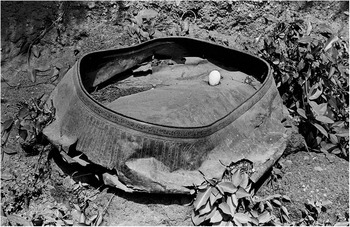
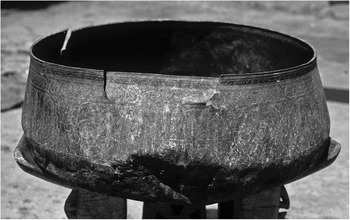
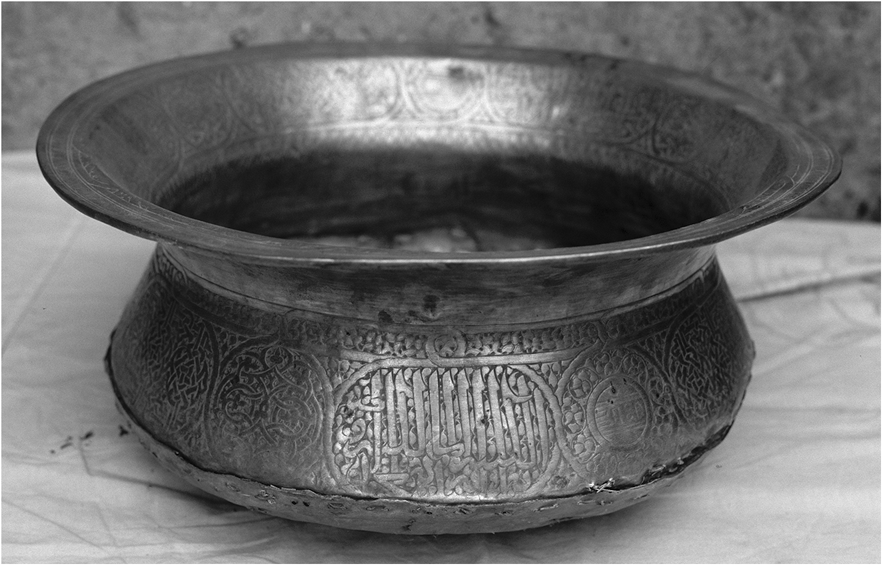
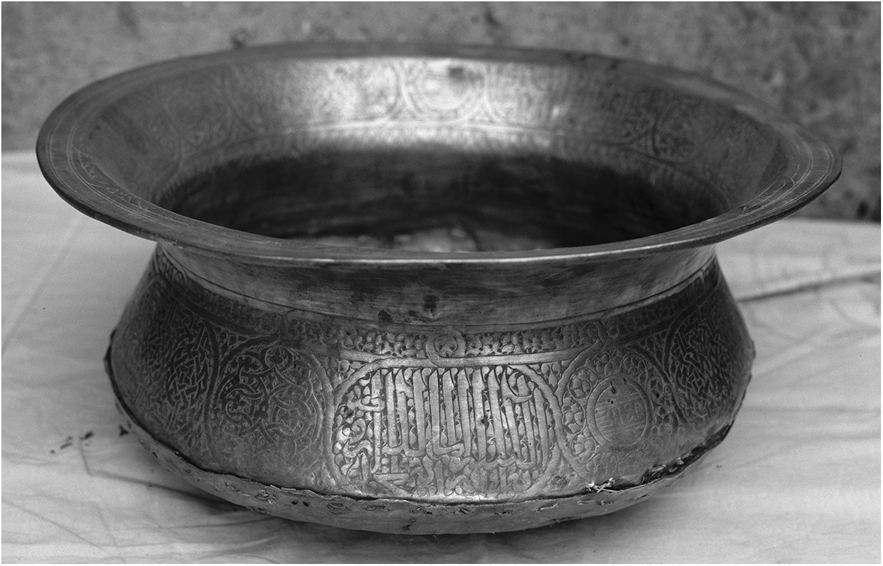
I am just beginning to reexamine these objects. This article therefore presents an overview of the evidence and some of the issues it raises. What we are considering is a small group of containers made from alloys of copper, a metal that was unknown in the Akan region of West Africa prior to the arrival of objects such as these vessels. Six may be described as bowls or basins ranging in size from 30 to 67 centimeters in diameter and carrying as part of their surface decoration Arabic inscriptions.Footnote 5 Five of these containers have inward sloping sides, rounded base, and a thickened vertical rim (Figures 1 and 2). The sixth has a waisted profile with a wide everted rim (Figure 3). The vessels are in various states of repair, the three smaller bowls maintain their original shape (Figures 2 and 3), and the three larger basins are mangled, though it is possible to discern their original shape (Figure 1). Some of the original surface designs are still visible, however some have been obscured due to abrasion or corrosion; in some cases pieces of the vessels have completely broken away and are missing. Three additional vessels are ewers ranging in height from 38 to 60 centimeters.Footnote 6 The largest of these jugs carries an English inscription, the other two are not inscribed. All three are in very good condition.
Arabic-inscribed basin, Ayaa Kenten. Nsoko, Brong Ahafo. Diameter 67 cm. Photo: Raymond A. Silverman, February 1980.

Arabic-inscribed basin, Ayaa Kenten Kumah. Nsoko, Brong Ahafo. Diameter 43 cm. Photo: Raymond A. Silverman, May 1980.

Arabic-inscribed bowl. Nsoko, Brong Ahafo. Diameter 41 cm. Photo: Raymond A. Silverman, February 1980.
In attempting to construct biographies for these containers, in the words of Kopytoff, one could ask questions of each object
(…) similar to those one asks about people: What (…) are the biographical possibilities inherent in its “status” and in the period and culture, and how are these possibilities realized? Where does the thing come from and who made it? (…) What are the recognized “ages” or periods in the thing’s “life,” and what are the cultural markers for them? How does the thing’s use change with its age, and what happens to it when it reaches the end of its usefulness?Footnote 7
The Origins of the Object
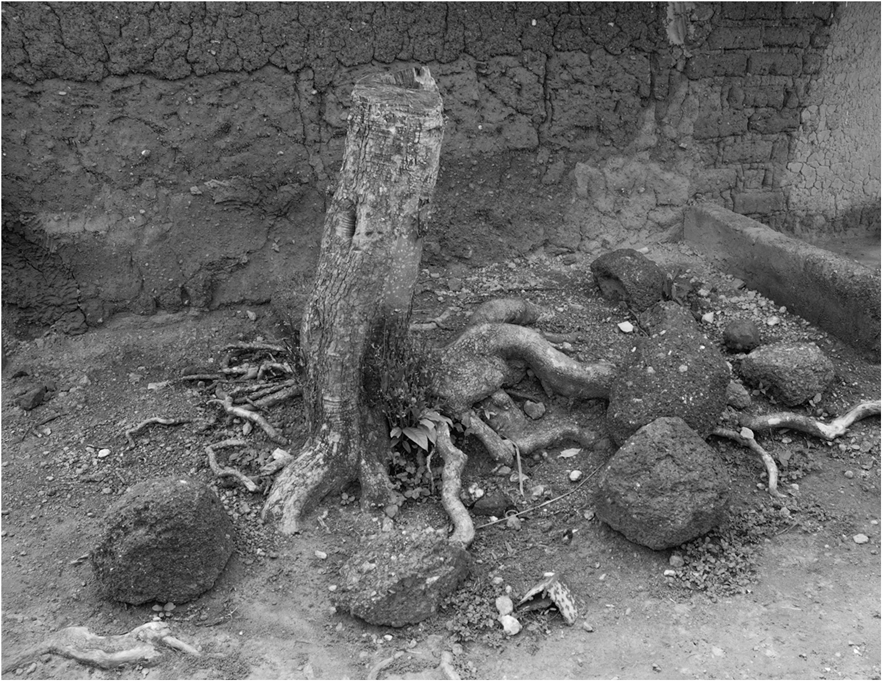
Most of the Arabic-inscribed vessels are located near the northern edge of the Akan forest in communities with histories associated with the pre-European northern gold trade that brought material goods and ideas from the Western Sudan and beyond to what is today central Ghana.Footnote 8 In 1980, I documented these six Arabic-inscribed vessels in situ in Ghana, photographing them and collecting oral traditions about their origins and significance in the communities in which they are maintained. Five were documented in Bono (northern Akan) towns – three in the town of Nsoko, one in Timponem, near Techiman, and another in Atebubu (Map 1). A sixth was documented in the Asante region at Amoaman, near Kumasi. There were two other similar vessels, one maintained in the Bono village of Kranka, the other in the Asante town of Ejisu, that apparently disappeared prior to 1980. We know nothing about the three English ewers except that the British took two of them from Kumasi during the 1896 Anglo-Asante war, and the third was taken during the 1900 Anglo-Asante war.Footnote 9 We do however have a remarkable photograph from 1887 that locates two of the ewers in either an interior court in the palace of the king of Asante or in the royal mausoleum at Bantama in Kumasi.Footnote 10 The jugs are situated at the base of a tree, which in this particular context, suggests they may have served a ritual function.Footnote 11
A good deal of my research in the early 1980s was directed at closely studying the six Arabic-inscribed vessels – bowls and basins that in their heyday were spectacular objects. The inscriptions they carry in some cases are fragmentary; in other cases they are completely intact. The content of the inscription, the style of the script, the profile of the vessel as well as the configuration of the vessel’s surface decoration, provide adequate evidence for suggesting relatively tight attributions for the bowls and basins.Footnote 12 For instance, the inscription on one of the bowls maintained at Nsoko reveals that it was made for a dawadar or secretary working in the court of al-Malik al-Zahir Jaqmaq, a sultan who ruled from 1438 to 1453 (Figure 3):
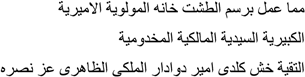
Among the things made for the pantry of the lordly, the amirial,
The great, the masterly, the possessing, the masterful,
Taqi al-Din Khushkaldi, Secretary of al-Malik al-Zahir, may his victory be glorious.Footnote 13
They were all produced in either Egypt or Syria from the mid-fourteenth to the mid-fifteenth centuries during the Mamluk Sultanate. Some were made for specific individuals, a court official, possibly even a sultan, or for the market. It is likely that a few of the vessels were once inlaid with either silver or gold, or on occasion both.
The three copper alloy ewers, one of them carrying an inscription in English that includes the name of King Richard II, who ruled England during the last quarter of the fourteenth century, were produced in England, in the late fourteenth century, at roughly the same time as the Mamluk bowls and basins.Footnote 14
Imagining the Life of the Object
There are contemporary accounts by chroniclers such as al-Maqrizi and ibn Taghri Birdi who describe life in Mamluk society that include descriptions of the manufacture and use of luxury metalwork.Footnote 15 We learn that these items were made for Cairo’s elite, some on commission for specific individuals, or for the open market, and that they were made by a particular group of metalworkers, the nahhasin, specializing in objects made of nuhas, copper or brass. The only contemporary visual images of metalwork are found on occasion in manuscripts where they appear in painted illustrations of specific narratives. Though there are no visual images from this period dealing with their manufacture or sale, it is likely that this work was undertaken in settings similar to those depicted several centuries later in engravings of the Ḫan al-Ḫalili, a suq in Cairo that has long been associated with the production and sale of metalwork, found in some nineteenth-century European accounts of Cairo and Damascus. These bowls and basins were opulent display pieces; some may have been included in a bride’s trousseau, some were certainly used for serving food and drink, or for performing ablutions.
I have not discovered any explicit contemporary references to how and why these objects, especially those produced for specific individuals, would have entered the market for shipment to sub-Saharan destinations.Footnote 16 However, there is tangential evidence that may offer an explanation, such as the devastating impact of the plague during the late fourteenth and fifteenth centuries that led to the dispersal of entire family estates, or the prevalence of the institution of musadara (confiscation) that stripped members of the Mamluk elite of their property, which in turn could have been sold on the market, some of which might have made its way to caravans headed south across the Sahara.Footnote 17 Terence Walz, who studied commerce between Egypt and Africa south of the Sahara during the eighteenth century, references the large amount of “old copper” (qurada) that was being exported to the south.Footnote 18 Still another possible context for acquisition is the Muslim tradition of the hajj; West Africans making the holy pilgrimage would have passed through Cairo and could have acquired such luxury goods on their way back home.Footnote 19
We know very little about how the three English ewers were used in Kumasi, nor do we have any sense of the local histories that might have been associated with them. Similarly we can only speculate about why or how they might have left England. There is, however, a good deal of archaeological evidence of interaction between England and North Africa during the late medieval-early modern periods. One example is the recent discovery of a shipwreck in Salcombe Bay in Devon that included over four hundred gold coins minted in Morocco during the sixteenth and seventeenth centuries. Though a little later than the period we are considering, it provides compelling evidence that things from North Africa were being carried north; it is fairly safe to assume that English goods moved in the opposite direction.Footnote 20 One might speculate, based upon their very similar attributions and their presence in the same place (Kumasi) at the end of the nineteenth century, that the three ewers traveled together as an ensemble to North Africa and subsequently across the Sahara.Footnote 21 Despite the dearth of provenance, these three jugs are additional evidence that there was a lively trans-Saharan trade in luxury metalwork during the century before the dawn of the European age of exploration.
The fact that all nine vessels, without exception, were produced in a relatively tight time period, from the mid-fourteenth to the mid-fifteenth centuries, suggests that they arrived in northern Akan trading communities at roughly the same time, perhaps within fifty to a hundred years of their manufacture. Thirty years ago, when I was writing about these vessels and the metalworking traditions they inspired, I suggested that the Mamluk vessels probably left Egypt and were carried across the Sahara during the late fourteenth and fifteenth centuries, at the height of the northern Akan gold trade. However, I had no concrete evidence for dating their entry into the Akan region. None of the metalwork had been discovered in a datable (e.g., archaeological) context, and the oral traditions associated with the vessels offer no chronological referents. It was only recently that I learned of a German archaeological project in northern Nigeria at the site of Durbi Takusheyi that produced an inscribed brass bowl.Footnote 22 It is very similar in style to the vessels documented at Atebubu, Amoaman, and Timponem in Ghana. Published in 2011, the bowl was excavated in 1992 in a context associated with a prestige burial dated to the fourteenth-fifteenth centuries.Footnote 23 This was an extremely important discovery as it provided firm evidence that these vessels were moving across the Sahara soon after their manufacture.
Reshaping Meaning
How were these vessels integrated into the lives of the individuals and communities that acquired them? The traditions of origin associated with these cuprous containers have nothing to do with Egypt or England – they refer instead to mythic events.Footnote 24 For instance, the large basin at Nsoko called Ayaa Kenten (“brass basket”) is said to have descended from the sky, a gift from Nyame, God (Figure 1). Most of the bowls and basins are said to have similar origins having descended from the sky, but a couple of them are associated with the founding ancestors who carried the vessels when they migrated to the surface of the earth from a mythical underworld. The collection of brassware at Nsoko, for instance, which includes the waisted Mamluk bowl discussed earlier, was brought through a portal located at Begho, an important but now abandoned trading community (Figure 3). This is particularly significant as Begho was a major entrepôt during the fourteenth and fifteenth century, thought to be the southern terminus of a vast trading network through which the Arabic-inscribed vessels and the English ewers are likely to have traveled.Footnote 25 None of the vessels are used for personal ablutions, nor do they function as prestige display pieces. Instead they are instruments used in rainmaking rituals or as objects of memory, mnemonic devices associated with important historic events and individuals.
One of the questions that the current physical state of the Arabic-inscribed containers poses is why some of them appear to be more or less intact retaining their original shape, while others are mangled. Interestingly, perhaps significantly, it is the three larger basins whose sides have been flattened (Figure 1). When and why were they crushed? Is it possible that these three vessels might have arrived from the north in this distressed state? The condition of the bowls and basins begs several questions. Under what circumstances were they incorporated into the communities in which they exist today? Were they carried across the Sahara and Western Sudan as scrap metal, valued primarily for their metal content – perhaps explaining the mangled state of larger basins – or as exotic luxury items? And how and why, upon arrival at the edge of the northern edge of the Akan forest, did they acquire the particular meanings they were ascribed by the people who have lived with them for half a millennium?
New Things
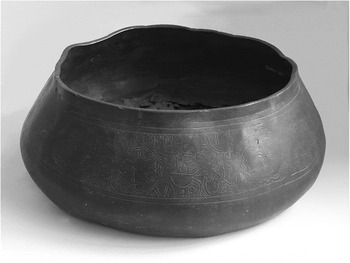
The arrival of these vessels in Ghana seems to have been a catalyst for the development of a local copper alloy metalworking tradition. Vessels known as nkuduo (sing. kuduo) derive their forms as well as much of their surface design from the Mamluk bowls and basins. To date, there is no evidence that suggests the kuduo tradition predates the manufacture and importing of the Mamluk vessels. Comparing the nkuduo and various types of northeast African metalwork offers a compelling visual argument for the close relationship between these two traditions.Footnote 26 The profile and design program on the surface of a bowl-shaped kuduo now maintained in the Ghana National Museum, is strikingly similar to the imported Mamluk bowls and basins (Figure 4).Footnote 27 It is fascinating to observe how the Akan artisan “translated” the Arabic script into what might be referred to as pseudo script and included highly stylized representations of animals – note the bird-like form at the center of the photograph – in the bowl’s incised designs. There is a strong possibility that the technological knowledge associated with producing nkuduo, namely lost wax casting, was introduced in conjunction with the northern trade that brought the Mamluk vessels to the Akan.Footnote 28 Recalling that copper deposits do not exist in this part of West Africa, prior to the arrival of Europeans on the coast at the end of the fifteenth century, the metal used for making things like nkuduo must have been procured through the northern trade, and it is likely that brassware much like the vessels we are considering in this article were recycled. If this was indeed the case, then why were the six Mamluk bowls and basins and three English ewers saved from the crucible and preserved?
Basin-shaped kuduo. 26.6 cm. diameter at rim. Ghana National Museum, 72.1463; gift of Peggy Appiah. Photo: Raymond A. Silverman, December 2014.

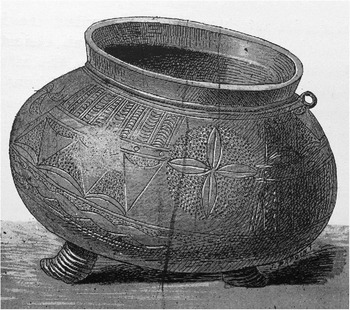
Another dimension of this story of things moving through space and time concerns two examples of nkuduo that were carried to other parts of Africa. One is a kuduo discovered over a century ago in an excavation at Guiangomênou in Côte d’Ivoire, roughly 370 kilometers due west of Kumasi (Figure 5).Footnote 29 Another was purchased in 1949 by Henri Hugot in the suq at Aoulef, Algeria, in the central Sahara, roughly 2,300 kilometers north of Kumasi.Footnote 30 Interestingly, the seller informed Hugot that it had not been produced locally but had come from the region of Timbuktu in Mali, an important node in the West African trade network. Similar questions as those asked of the Mamluk bowls and basins and the English ewers may be asked of these two Akan objects. Ascertaining their biographies may prove even more challenging, nevertheless these relocated nkuduo provide compelling evidence of the extent to which things move across the Sahara and West Africa, not only from north to south, but also from south to north.
Kuduo excavated at Guiangomênou in Côte d’Ivoire. Published in Maurice Delafosse, “Sur des Traces Probables de Civilisation Égyptienne et d’Hommes de Race Blanche à la Côte d’Ivoire,” L’Anthropologie 11 (1900), 683.

The motifs found on the surface of nkuduo are similar to imagery found in other contexts. Labelle Prussin has argued that the arabesque-like bas-relief designs found on the walls of historic Akan architecture, particularly structures associated with political and religious elites, may be derived from Arabic script. And some of the stamped patterns used to create the textiles known as adinkra reveal similar attributes. This distinctive imagery offers further evidence of a northern factor in Akan visual history.Footnote 31
What perhaps is most significant about the Mamluk vessels, the English ewers, and the kuduo tradition they inspired, is that they represent some of the earliest historical evidence for a set of values and practices that are a fundamental characteristic of Akan culture, specifically those associated with the appropriation of exotic goods and ideologies as a strategy for enhancing social, political and religious presence and power, an eclectic and pragmatic means for seeking physical and spiritual well-being.Footnote 32 Indeed, these objects seem to have exercised a certain degree of agency with regard to how they were received in the Akan communities where they are found. Though there has been a good deal of debate concerning the argument that some material things may possess intrinsic meaning or significance that might influence how people engage such objects (i.e., object agency, objecthood), one might speculate that the distinctive material and visual characteristics of these brass vessels may have influenced the specific contexts into which they were integrated as well as the new meanings they were given.Footnote 33 The fact that these were unfamiliar things, made from a material the Akan had not encountered, fabricated using technologies unknown to the Akan, and covered with designs the Akan had never seen, suggests that they were perceived as exotic – their efficacy as spiritually charged objects was derived in large part from being of another world.Footnote 34
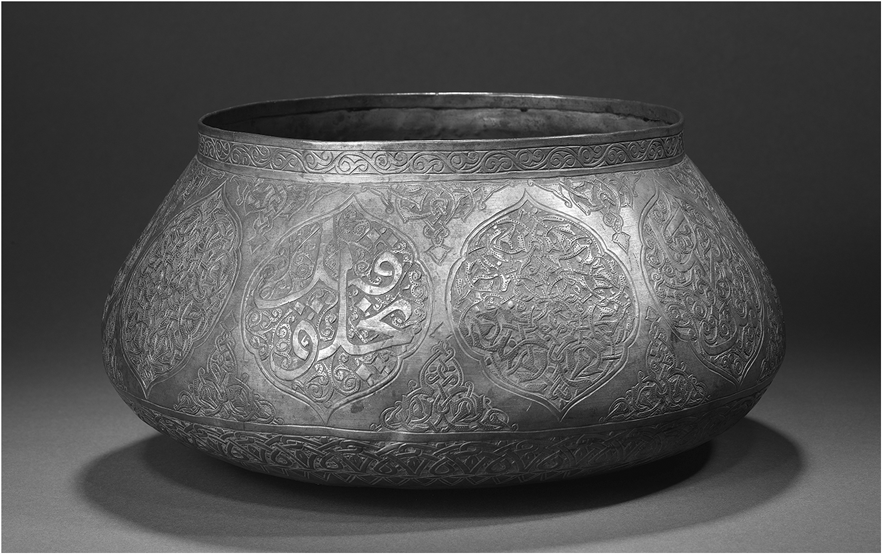
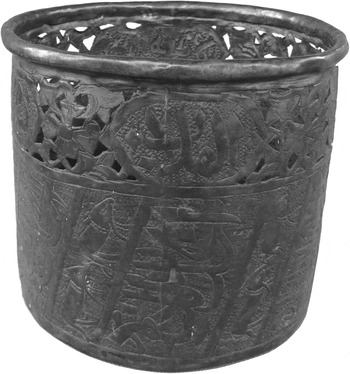
Such objects continue to find their way into Akan communities as evidenced in two recent acquisitions of Arabic-inscribed containers. In the late 1970s Doran Ross purchased two brass vessels from a trader in Kumasi.Footnote 35 Neither has any provenance – the trader did not provide Ross with any information about where he had obtained the containers. Based on its formal characteristics and the inscription it carries, it seems the more refined bowl was made in the second half of the nineteenth century, probably in Cairo (Figure 6).Footnote 36 The other vessel is fabricated from sheet-brass. Its surface decoration is interesting (Figure 7). The Arabic inscription is illegible; though it is possible to identify Arabic letters and a few words, they do not appear to convey a coherent message. Also in the lower register images of pairs of four-legged animals, perhaps representing cattle, have been set between the script panels. It is difficult to ascertain where it was made; it may have been produced in North Africa, or perhaps in northern Nigeria, perhaps during the first half of twentieth century.Footnote 37 These objects, made hundreds of years after the primary group of fourteenth-fifteenth-century bowls, basins and ewers, reveal continuities with historic practices of importing exotic metalwork from far away. These objects, however, were encountered not as objects with spiritual and historical significance but as commodities – things to be traded. We know nothing about the life of these objects prior to their acquisition by the trader from whom Ross purchased them. This brings us back to Kopytoff’s seminal essay, on the cultural biography of things, in which he is particularly interested in how objects move during their lives from being commodities that circulate in markets to what he refers to as “singular objects” that, because of the specific meanings that have been ascribed to them, have been taken out of circulation and no longer function as commodities, they no longer possess trade value. This in effect is what occurred with the primary group of Mamluk bowls and basins and the English ewers when they were integrated into their respective northern Akan communities as spiritually-charged objects, sometimes associated with important events in the distant past.
Nineteenth-century brass bowl from Egypt collected by Doran Ross in Kumasi in the late 1970s. Height 14.6 cm, diameter 27 cm. Fowler Museum at UCLA, X86.2677; gift of Doran Ross. Image, ©courtesy Fowler Museum at UCLA. Photo: Don Cole, 2015.

Brass container of unknown origin dating from the first half of the twentieth century (?) collected by Doran Ross in Kumasi in the late 1970s. Height 13 cm, diameter 14 cm. Private collection. Photo: Raymond A. Silverman.

The Past in the Present and the Future
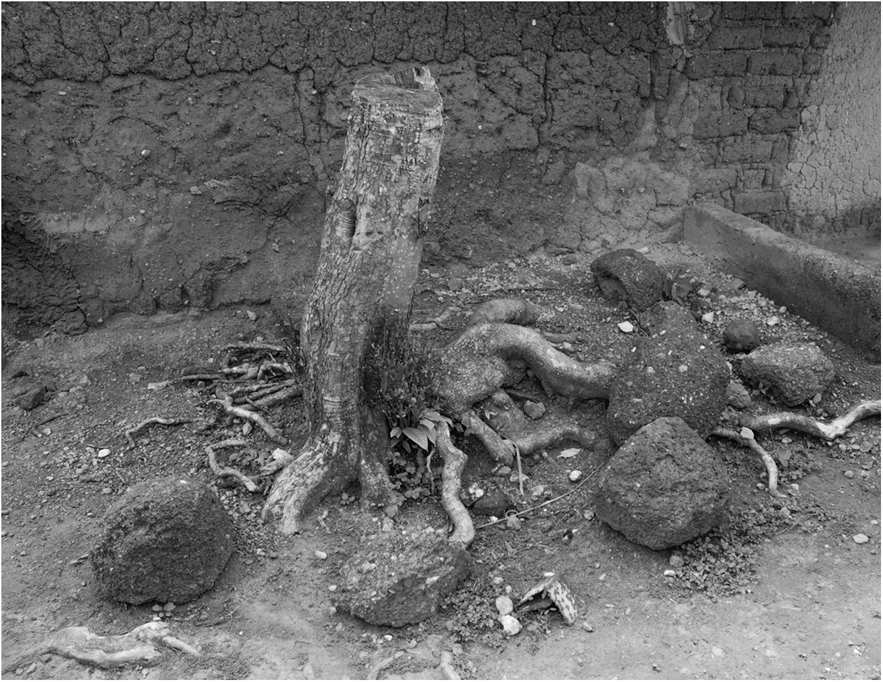
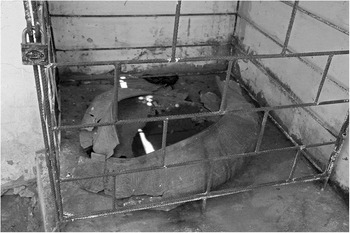
This theoretical framework is perhaps useful in rationalizing the most recent events in the lives of the six Arabic-inscribed vessels I first encountered thirty-five years ago. Since the early 1980s some of these objects have disappeared, “gone missing” as they say in Ghana.Footnote 38 When I returned to Nsoko in 2001, I learned that Ayaa Kenten (Figure 1) had recently been stolen (Figure 8). I visited the small inscribed bowl maintained at Timponem in 2001, but some time between then and 2011, the bowl had been stolen – all that was left was a brass bell that had been kept inside the bowl. I visited the site of the large basin at Amoaman in 2011, all that was left was a small fragment of metal from its base. When I asked about why the containers had been stolen, almost everyone speculated that whoever took them probably sold them as scrap metal. If this is indeed the case, it seems the vessels had acquired a new and perhaps final meaning – recalling Kopytoff’s description of elements that might comprise a biography for a material object – having reached the end of their usefulness. As such, it is noteworthy that they had come full circle, having probably arrived in the northern Akan region as trade items (commodities) and transformed into spiritually charged historic objects (singularities), left unprotected, they were taken and probably sold either as scrap metal or as antiquities (commodities). The circumstances in which this sort of thing occurs is not uncommon, the relevance of these vessels as sacred objects had atrophied to the point that their custodians ceased protecting and preserving them.
The site in Nsoko where Ayaa Kenten used to rest. The basin was stolen in 2001. Photo: Raymond A. Silverman, 2001.
It is important to point out that this is not the case in all the communities. In Amoaman, apparently after most of the basin had disappeared, elders in the community had an enclosure fabricated to protect what was left. And in Atebubu, anticipating potential theft, the family responsible for maintaining the basin built a similar protective enclosure (Figure 9). Observing the current status of the Mamluk vessels raises a couple of interesting questions, particularly regarding those that have been stolen. What do objects mean when they no longer exist? Will the Arabic-inscribed vessels be remembered? If so, how will they be remembered, and what roles will the memories of these lost things play in the lives of the individuals and communities in which they used to exist?
Arabic-inscribed basin at Atebubu maintained in a protective enclosure. Photo: Raymond A. Silverman, June 2011.

To return to where we began, what is most intriguing about examining these material fragments as discursive objects of knowledge is that they offer insights into how people and things shape one another’s lives, and how the meanings ascribed to material things change as they move through space and time.
Raymond A. Silverman is Professor of History of Art and African Studies at University of Michigan. His research, writing, and exhibitions have examined a variety of subjects concerning the movement of material things and the knowledges associated with them through time and space, particularly in Ghana and Ethiopia. Most recently he has been examining the visual cultures of Orthodox Christianity in Ethiopia and exploring “museum culture” in Africa, specifically how local knowledge is translated in national and community-based cultural institutions. He recently published an edited volume, Museum as Process: Translating Local and Global Knowledges (London/New York: Routledge, 2015). E-mail: silveray@umich.edu