1. Introduction
Recent years have seen a rapid rise in the number of bilateral free trade agreements (FTAs) in Northeast Asia. This is especially remarkable given the relative death of regional cooperation in this region. The three main economies in the region – China, Japan, and South Korea (hereafter CJK) – have facilitated the establishment of FTAs. After the Asian financial crisis in 1997–1998, CJK have realized the urgent need for regional economic cooperation and launched their individual FTA initiatives. Even though CJK have tried to form regional trade agreements in East Asia by conducting joint studies and official negotiations, they have not succeeded thus far. Given the complicated process of FTA formation, this study assumes that there may exist variations in outcomes in the different stages of this process. These variations have rarely been examined in previous studies. Most statistical studies on FTA formation have employed a dichotomous dependent variable, coded as 1 when an FTA between two countries enters into force, and 0 otherwise. This approach limits the capacity to examine the variations in the different stages of the FTA formation process. This study disaggregates the process into four stages to examine those variations.
Another limitation that quantitative studies have revealed is that surprisingly few systematic attempts have been made to address the impact of domestic interest groups on FTA formation. This is mainly due to the difficulty encountered in measuring it. Since the composition and power of interest groups vary significantly across countries, it is very hard to compare their activities in the FTA formation process through quantitative means. Among the variety of interest groups, this study focuses more on the impact of industry interest groups (IIGs) because they have strong interests and power, especially in trade policy decision-making. For a better understanding of FTA formation and to make improvements over existing FTA research, this study develops a new measure to identify the extent of political pressure from IIGs.
This study's disaggregation of the FTA formation process into four stages shows that the determinants that work in the initial stages are quite different from those in the advanced ones. Specifically, political institutions (e.g., regime types) are likely to influence FTA formation in the initial stages but are likely to lose their influence as the process moves forward. Most interestingly, the influence of IIGs has a positive impact on FTA formation in the first stage, when two countries start their FTA discussions by establishing joint studies. In contrast, it has a negative impact in the last stage, when the FTA finally enters into force via domestic ratification. The findings of this study collectively support the hypothesis that an FTA is the result of sectoral politics where interests and the power of industries have a significant influence on trade policy decision-making.
The remainder of this study proceeds as follows. First, it begins with a review of the FTA determinants developed in the existing literature and investigates their limitations in improving existing FTA studies. Next, it briefly presents the data and research design, and describes ways to develop a new measure of the influence of IIGs on FTA formation. The subsequent statistical analyses have significant implications for the study of FTA formation, particularly with respect to the influence of interest groups on FTA formation.
2. Existing studies on FTA formation
Many scholars have contributed to a burgeoning literature that sheds light on what factors determine FTA formation. Earlier works, mainly from the field of economics, put more emphasis on the economic welfare factors, such as market size, bilateral trade amounts, and the level of economic growth. Recent studies have argued that FTAs are a result of political games as well as the calculation of economic optimality, and have begun to consider political factors, such as the types of political regime and the role played by veto players (Grossman and Helpman, Reference Grossman and Helpman1995; Frye and Mansfield, Reference Frye and Mansfield2004; Henisz and Mansfield, Reference Henisz and Mansfield2006; Mansfield et al., Reference Mansfield, Milner and Pevehouse2008). These have found that democracies are more likely to form FTAs than autocracies, that political leaders' welfare concerns for the general public are more salient under democracies having larger electorates and median voters who are important for reelection, and that open trade generally works for the benefit of the general public in a positive way (Mansfield et al., Reference Mansfield, Milner and Rosendorff2002; Milner and Kubota, Reference Milner and Kubota2005). Further, political leaders in democracies find it tougher to manipulate the economy for their parochial and personal interests because voters tend to hold political leaders more responsible for economic downturns (Fearon, Reference Fearon1994; Frye and Mansfield, Reference Frye and Mansfield2004; Henisz and Mansfield, Reference Henisz and Mansfield2006).
Realizing that all democracies are not homogenous, more recent studies emphasize their institutional variations. In particular, they have centered on the number of veto players as an impediment to the formation of FTAs (Henisz and Mansfield, Reference Henisz and Mansfield2006; Mansfield et al., Reference Mansfield, Milner and Pevehouse2008). When veto players reflect the preferences of distributional losers from the FTA, FTA formation becomes more difficult and unlikely. As the number of veto players rises, so does the number of groups they represent, and the chances of ratifying an FTA are likely to decrease.
Other studies, emphasizing the demand side rather than the supply side of FTA formation, focus more on the roles of societal actors, such as interest groups (Stolper and Samuelson, Reference Stolper and Samuelson1941; Gourevitch, Reference Gourevitch1986; Rogowski, Reference Rogowski1989; Grossman and Helpman, Reference Grossman and Helpman1995). The political process of trade policy decision-making implicitly assumes that if politicians fail to reflect the preferences of interest groups, one of the most powerful constituents, the groups will try to replace them with those who will. More specifically, legislators are motivated by the desire to be reelected, and therefore try to maximize votes. Since a trade policy has distributional consequences, vote maximization implies that votes gained from supplying industry benefits are balanced by the costs at the margin. In a state of equilibrium, then, interest groups balance the marginal costs and benefits of demanding a certain policy, and politicians balance the costs and benefits of supplying it (O'Halloran, Reference O'Halloran1994). In addition to the preferences, interest groups' political power needs to be considered because they differ in their ability to effectively lobby politicians. For example, some industries that have strong political power and will be harmed by an FTA have either been excluded from trade liberalization, or have provided long periods of adjustment even when these compensations reduce net welfare (Grossman and Helpman, Reference Grossman and Helpman1995).
However, existing studies have revealed several limitations. First, surprisingly few systematic attempts have been made to address the impact of domestic interest groups on FTA formation. This is mainly due to the difficulty encountered in measuring it. Since the composition and power of interest groups vary greatly across countries, it is very hard to compare their activities in the FTA formation process through quantitative means. Mansfield et al. (Reference Mansfield, Milner and Pevehouse2008) argued that a veto player is a useful surrogate for interest group activity because interest groups try to reflect their preferences on trade policy through veto players.Footnote 1 However, a veto player is not enough to capture the influence of interest groups on FTA formation, since it focuses too much on the ‘resistance’ side. The ‘support’ side of trade policy has largely been left unexamined in veto player studies. In short, the impact of interest groups on FTA formation needs to be measured more directly. For a better understanding of FTA formation, this study develops a new measure of the extent of political pressures from IIGs by including four specific components.
Another limitation of existing studies is that few have examined the different explanatory power of each FTA determinant in the different stages of FTA formation. Given the trade policy decision-making process, this study suspects that substantial variations may exist in these stages that have not been examined in most empirical FTA research. By disaggregating the FTA formation process, this study examines the impact of each determinant of FTA formation.
In general, there are four stages in FTA formation: (a) proposing FTAs, (b) negotiating FTAs, (c) signing FTAs, and (d) ratifying FTAs. In the first stage, executives generally propose a trade agreement, by conducting joint studies to calculate the expected benefits and costs. When the expected benefits are greater than the costs, executives may start official negotiations, which is the second stage. According to the two-level game developed by Putnam (Reference Putnam1988), the chief negotiator must seek an agreement that is among the various possible ‘wins’ in his state's ‘win-sets’ at this stage. Win-sets are the possible outcomes that are likely to be accepted by domestic actors – the key players in domestic ratification processes. When there is an overlap between the win-sets of the partner state involved in the agreement, the FTA discussions move on to the third stage – signing the agreement. In the last stage, the agreement needs to be ratified by domestic legislators to enter into force.
Political leaders may have different incentives at each stage because the costs of terminating the discussions rise.Footnote 2 Since there is no firm commitment to move forward yet, for example, the costs of terminating the discussions are relatively low in the initial stages. Thus, political leaders' reputational costs associated with not following through are relatively limited. After FTAs are signed, however, the breakdown of the agreements is likely to lead to higher costs. Spending resources to negotiate and sign FTAs, only to have them rejected, would significantly undercut the reputation and credibility of the politicians involved, especially when it comes to negotiating future accords. Moreover, the breakdown of the agreements (or a long delay in ratification) after they are signed is likely to negatively impact a government's reputation in the international community, resulting in considerable repercussions in negotiations with other countries for similar trade deals. As a result of the different costs incurred at each stage, there may exist substantial variations in the different stages of the FTA process.
For example, Kastner and Kim (Reference Kastner and Kim2007) found that geopolitical and general welfare concerns are significant in the initial stages but less salient in the final ones. In contrast, the role of veto players becomes more salient in the advanced stages when political leaders are increasingly likely to anticipate veto players' reactions to and preferences for proposed FTAs to avoid unexpected results that can undercut their reputation and credibility. As mentioned earlier, however, a veto player is only a surrogate for an interest group activity, reflecting expected distributional losers alone. In other words, employing a veto player variable is limited in fully capturing the impact of interest groups, losers, and winners. Consequently, to overcome the limitations and to improve existing FTA studies, this study develops a new measure of IIGs and disaggregates the FTA formation process.
3. Research design
3.1 Sample and dependent variable
This study collects a dataset that lists all bilateral FTA partners of CJK – as of 2016, 84 countries have established bilateral FTAs with one of the three countries, seven have signed but not yet implemented FTAs, 54 have been officially negotiating FTAs, and 14 have considered entering FTA discussions by conducting joint studies. A complete list of these countries is given in Appendix 1.
The unit of analysis is the undirected dyad-year, including 160 countries in all dyads worldwide that include at least one of the three countries. The sample covers the years from 1998, when East Asian countries launched their FTA initiatives after the Asian financial crisis, to 2016, when the most recent data were available.Footnote 3
The dependent variable is the FTA formation disaggregated into four stages. At each stage, it is coded as 1 if a dyad reaches the status of an agreement, and 0 otherwise. At Stage 1 (Proposed), for example, it is coded 1 if two countries propose an FTA by conducting preparation talks or joining research projects, and 0 if they never discuss it. At Stage 2 (Negotiation), it is coded 1 if they start official negotiations, and 0 if they have proposed the FTA but have not reached the negotiation stage yet. At Stage 3 (Signed), it is coded 1 if they sign the FTA that have reached Stage 2, but the FTA has not entered into force. At Stage 4 (In force), the final stage, it is coded 1 if the FTA finally enters into force through the domestic ratification or legalization process, and 0 if it continues to remain at Stage 3.
3.2 Measuring the influence of IIGs
The main independent variable in this study is the influence of IIGs on FTA formation. In FTA formation, sectoral cleavages between export-oriented industries (i.e., distributional winners) and import-competing industries (i.e., distributional losers) have been observed frequently. Although IIGs' impact on trade policy is longstanding, there exist few systemic analyses. This is mainly due to the difficulty encountered in measuring their influence on trade policy. This study develops the IIG index to measure the influence of sectoral cleavages on FTA formation using four components, namely trade complementarity, trade orientation of an industry, the industry's power in the domestic market, and economic significance of FTA partners.
First, economists emphasize the trade complementarity to predict a country's general propensity for FTAs. The trade complementarity index (TCI) measures the degree to which the export pattern of one country matches the import pattern of another. A high degree of complementarity is assumed to indicate more favorable prospects for an agreement. When two economies are complementary, distributional consequences between expected winners and losers associated with trade liberalization are less likely to be great than when they are competitive. If a huge conflict is expected when an FTA discussion is launched, political leaders are likely to hesitate to start the discussion. In this case, IIGs are less likely to lobby for the FTA, since they may need to spend more resources, given the lower probability of success. In short, the TCI helps estimate general reactions of IIGs on FTAs, given the patterns of pre-existing trade. The TCI of exporter i with importer j is calculated as shown below:
 $${\rm TC}{\rm I}_{ij} = 1-\displaystyle{{\sum\limits_k \vert E_i^k -M_j^k \vert } \over 2}$$
Here,  $E_i^k $ is the share of industry (or goods) k in country i's total exports to the world, and
 $M_j^k $ is the share of industry k in country j's total imports from the world. The IIG index includes the average of the TCIs when country i is an exporter and importer in trade with country j. Data on the TCI are taken from the UNCTAD statistics.
Even though the trade complementarity provides a rough estimate of IIGs' responses to FTAs, the following inter-related questions, to thoroughly examine IIGs' impact on FTA formation, still need to be answered more precisely: Which industry is likely to support an FTA and which one is likely to oppose it? Given the industry's power in the domestic market, how influential is this support (or opposition) likely to be on political leaders' decisions? How strongly is the industry likely to support (or oppose) the FTA given the expected benefits (or costs) from establishing it?
To answer these questions, this study includes three more industry-level indicators.Footnote 4 First, it considers the trade orientation of an industry (i.e., export-oriented or import-competing). If an industry in country i exports more than it imports in bilateral trade with country j, it is more likely to be an export-oriented industry and thus support the FTA with country j, and vice versa. The measure of industry k's trade orientation in country i in the trade with country j is constructed as follows:
 $$O_i^k = \displaystyle{{X_{ij}^k -X_{\,ji}^k } \over {X_{ij}^k + X_{\,ji}^k }}$$
*Country i: China, Japan, or South Korea
*Country j: any from among 160 countries
Here,  $O_i^k $ is the trade orientation of industry k in country i in trade with country j;
 $X_{ij}^k $ is the volume of industry k's exports from country i to country j; and
 $X_{ji}^k $ is the volume of industry k's imports of country i from j (or exports from country j to i). This measure takes on values ranging from −1 to 1. A positive value means that industry k in country i is likely to be export-oriented and thus likely to support an FTA with country j. In contrast, a negative value means industry k is import-competing and, thus, more likely to oppose the FTA. Data on bilateral trade in the commodity level (based on SITC Rev.3) are taken from UNCTAD statistics.
The pre-existing trade patterns are not enough to fully capture the influence of IIGs on FTA formation because of the limited ability to determine how influential an IIG's support for (or opposition to) the FTA is likely to be. For the auto industry in the USA, for example, international trade is far less important than domestic sales. Even if the auto industry's volume of trade is relatively small when compared to other industries, it is still hard for the US government to ignore the auto industry's interests associated with a given FTA. Moreover, some industries enthusiastically support an FTA even though the existing volume of trade is quite small, because they expect a huge increase in this volume after the FTA enters into force (e.g., the pharmaceutical industry in the Korea–US FTA). I measure the power of the industry in the domestic market with the domestic production of industry k as a percentage of country i's gross domestic product (GDP) as follows:
 $$P_i^k = \displaystyle{{D_i^k } \over {G_i}}$$
Here,  $P_i^k $ is the power of industry k in country i's domestic market; G i is the GDP of country i; and
 $D_i^k $ is the domestic production of industry k in country i. Data on each country's GDP classified by economic activity are taken from each national statistical office database.Footnote 5 Data on GDP are taken from the World Bank.
To create a single value for a given dyad-year, these two industry-level measures are multiplied and all 10 values (from 10 industries) are summed as follows:
 $${\rm O}{\rm P}_i = \sum\limits_{k = 1}^{10} {O_i^k\; \ast\; P_i^k } $$
Meanwhile, IIGs do not necessarily react in the same way in all FTA discussions since all partners are not economically significant. For example, IIGs in Korea may attach greater meaning to the Korea–US FTA than the Korea–Peru FTA. If IIGs in country i expect huge benefits (or losses) from an FTA with country j, they are likely to provide stronger support for (or opposition to) the FTA. In short, IIGs are more likely to take action in FTA discussions with major trading partners than with minor ones, given the greater distributional consequences. The economic significance of an FTA is measured as follows:
 $$S_{ij} = \displaystyle{{X_{ij} + X_{\,ji}} \over {G_i}}$$
Here, S ij is the economic significance of an FTA between countries i and j; G i is country i's GDP; X ij is the volume of exports from country i to j; and X ji is the volume of imports of country i from j. Thus, the numerator represents the volume of bilateral trade between countries i and j. This is a single measure for a given dyad-year ranging from 0 to 1. Since the preference, power of IIGs, and economic significance of an FTA partner are inter-related issues associated with FTA formation,  $OP_i^k $ is multiplied by S ij. Finally, the IIG index is constructed, adding TCIij to
 $OP_i^k \ast S_{ij}$ after standardization, as follows:
 $$IIG_{ij} = TCI_{ij} + \lpar OP_i^k\; \ast\; S_{ij}\rpar $$
3.3 Control variables
In this study, it is necessary to control the impacts of other variables that may affect FTA formation. To test the institutional impact, this study includes two institutional variables. Democracy, measured by Polity IV scores, ranging from 10 (most democratic) to −10 (least democratic), is included. Another institutional variable is Veto player, measured by POLCON III, ranging from 0 (least constraint) to 1 (most constraint). Henisz (Reference Henisz2000) developed this measure, capturing the feasibility of policy change within particular governments, based on the number of veto players and distribution of preferences across those veto players. This study averages the Polity IV and POLCON III scores across the two countries in each dyad.
Besides domestic politics, a country decides to enter into an FTA in the context of international politics. Several scholars have argued that it is more likely that FTAs may be formed among countries having favorable political relations, such as allies, since gains from the agreements can be used to increase the states' political–military capability (Gowa and Mansfield, Reference Gowa and Mansfield1993; Gowa, Reference Gowa1994). It has been widely argued that one of the main reasons for the absence of regionalism in Northeast Asia is the national security consideration established during the Cold War era (Buszynski, Reference Buszynski2009; Choi, Reference Choi2013). On the other hand, FTAs can be used as an instrument for cooperative diplomacy between non-favorable countries because economic integration via FTAs can help overcome mutual mistrust and alleviate security competition (Mochizuki, Reference Mochizuki, Solis, Stallings and Katada2009: 54). To measure political–military relations, existing studies have normally investigated whether countries i and j are formal allies. However, the number of formal alliances involving CJK is quite small, so such a variable provides little leverage within the sample. Thus, this study turns instead to an alternative measure, Affinity, ranging from −1 (least similar) to 1 (most similar). This measure captures the similarity between the two countries' voting patterns in the United Nations General Assembly (Voeten et al., Reference Voeten, Strezhnev and Bailey2009).
This study also includes several economic variables. When it comes to investigating political leaders' welfare concerns associated with establishing FTAs, the key issue is that it is quite difficult for political leaders to estimate ex ante whether FTAs will produce net positive or negative welfare gains. Viner (Reference Viner1950) argued that the welfare effects of FTAs depend on the relative magnitude of the ‘trade creation’ and ‘trade diversion’ effects. Wonnacott and Lutz (Reference Wonnacott, Lutz and Schott1989) asserted that an FTA with a ‘natural trading partner’ produces the ‘trade creation’ effect, thereby increasing net welfare. Therefore, FTAs with natural trading partners are more likely to be attractive for political leaders, considering the general economic welfare in FTA formation. Most commonly, two simple criteria have been used in assessing whether or not a country is a natural trading partner: the volume of trade and the transportation cost, measured by geographical proximity (Panagariya, Reference Panagariya1997). Thus, this study includes Trade as the log of bilateral trade amount between countries i and j divided by country i's GDP, and Distance as the bilateral distance between the biggest cities of those two countries. Data on distance are taken from Mayer and Zignago (Reference Mayer and Zignago2011).
Some have argued that countries with large domestic markets are less likely to be open because they tend to depend less on international trade (Katzenstein, Reference Katzenstein1985). To test the impact of domestic market size, this study includes Population via the log of population average between countries i and j. The level of economic development may also affect a country's trade policy (Rodrik, Reference Rodrik1998), and therefore, GDP pc via the log of GDP per capita average between countries i and j is included. The fluctuation in economic growth may also affect political leaders' decisions on FTA formation. Data on population and GDP per capita are drawn from the World Bank.
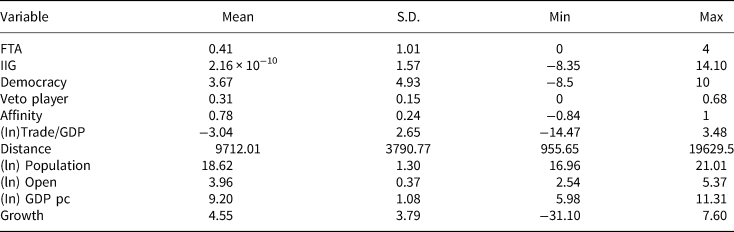
Some studies have indicated that it becomes easier for political leaders to liberalize trade regimes after economic crises (Mattli, Reference Mattli1999; Mansfield and Reinhardt, Reference Mansfield and Reinhardt2003), while others have demonstrated that increased growth is likely to enhance a country's demand for imports and supply of exports, creating an incentive to obtain preferential access, establishing FTAs (Mansfield et al., Reference Mansfield, Milner and Pevehouse2008). To test the impact of the economic condition on FTAs, this study also includes Growth via an average of the percentage changes in GDPs of countries i and j. Lastly, it can easily be expected that a country with a higher level of trade openness is more likely to form FTAs, and thus, Open via the log of an average ratio of trade to GDP between countries i and j is included. Data on economic growth rate and trade openness are taken from the World Bank. Descriptive statistics for all of the variables are presented in Table 1.
Descriptive statistics

4. Empirical results
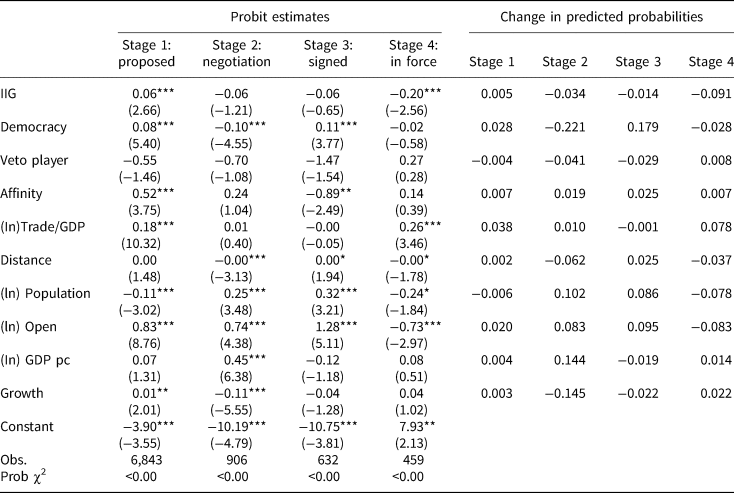
The results of the probit analyses at each stage are presented in Table 2. Stage 1 demonstrates the conditions under which an FTA is proposed with the establishment of joint studies. Stage 2 shows the conditions under which CJK start official negotiations after a certain FTA is proposed. Stage 3 indicates the conditions under which CJK sign it after several rounds of official negotiations. Stage 4 describes the determinants that lead the FTA to finally enter into force through the domestic ratification process (or legalization) after it is signed.
Probit estimates of the determinants of CJK bilateral FTA formation, 1998–2016

Notes: Z scores are in parentheses; ***p < 0.01; **p < 0.05; *p < 0.10 (two-tail test).
This study finds that IIGs have a positive impact on FTA formation in the first stage, when two countries begin to think about entering into an FTA by establishing a joint study. In contrast, it has a negative impact in the last stage, when signed FTAs need to be ratified. For the substantive significance of these results, this study also estimates the change in the predicted probability of the FTA formation process as shown in Table 2, when the value of each variable changes from ½ standard deviation (S.D.) below the mean to ½ S.D. above the mean, while holding all other variables constant at their means. A one S.D. change of IIG increases the probability of an FTA being proposed by approximately 0.5% and decreases the probability of a signed FTA being ratified by approximately 9.1%.
The regime type (Democracy) emphasized in existing studies tends to have a stronger impact in the initial stages but is statistically insignificant in the last stage. This result implies that CJK are more likely to start FTA discussions with democracies, but the regime type does not really matter after the FTA is signed. As presented in Appendix 1, CJK has established FTAs with democratic and non-democratic countries. Another political institutional variable, Veto player, is statistically insignificant in all the stages. These results show that political institutions are not enough to capture the dynamics of domestic politics in FTA discussions.
Another interesting finding is that Affinity shows statistical significance in Stage 1 but is insignificant in Stage 4. The results imply that political leaders in CJK are likely to choose countries with favorable political–military relations as their FTA partners in the first stage but they are less likely to consider international relations in the ratification process. After the FTAs are proposed, in short, CJK are likely to move the FTA discussions to the domestic political arena. In Stage 4, the natural trading partner hypothesis is supported, that is political leaders in CJK are more likely to finally ratify FTAs with countries having larger trade amounts and shorter distances.
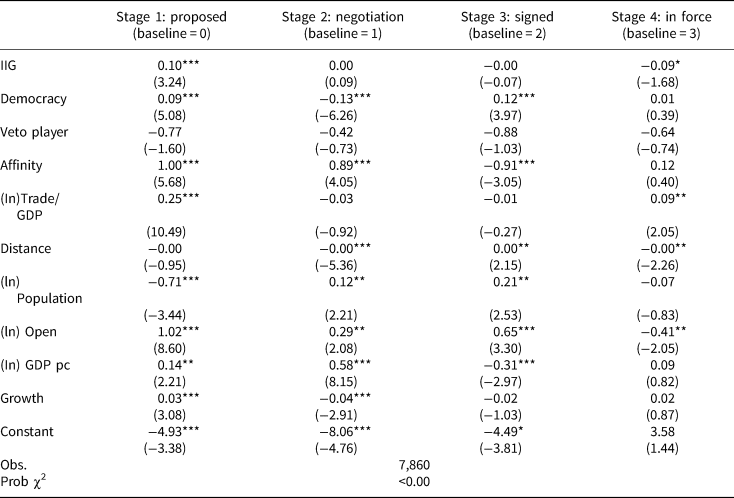
The cumulative results strongly support the argument that IIGs have a profound influence on FTA formation but in a different way, depending on the stage. At the very beginning of the FTA discussions, potential distributional winners rather than losers are more likely to try to reflect their preferences on trade policy and, therefore, lead political leaders to propose a certain FTA expecting some benefits. If the expected benefits from the FTA exceed the cost of lobbying, they will offer policy-contingent campaign contributions to political leaders to start the FTA discussions. Political leaders value these contributions because they are quite important for their reelection. In contrast, distributional losers are likely to try to terminate the FTA discussions by lobbying when costs from lobbying are less than the expected costs from the FTA. However, distributional losers are less likely to be eager to obtain information on a certain FTA in the initial stages when compared to the advanced stages because the probability that the FTA finally enters into force is relatively low. As the FTA discussions move forward, however, they will use more resources to prevent the FTA from entering into force. In sum, political leaders need to spend more energy to coordinate various interests of IIGs, and this unnecessary action impacts FTA formation negatively. It is also important to assess the robustness of these results, particularly with respect to the coding of the dependent variable and the estimation technique. In Table 3, the dependent variable is coded on a five-point scale (0–4), depending on the status of an agreement. Specifically, it is coded as 0 when there are no FTA discussions at all between i and j; 1 when an FTA is proposed by establishing joint studies; 2 when two countries start official negotiations; 3 when the FTA is signed; and 4 when the FTA finally enters into force. Since the dependent variable is nominal, multinomial probit analyses are employed.Footnote 6 By changing the reference category (or the baseline), this study tests different impacts of FTA determinants at each stage. As shown in Table 3, the multinomial probit estimates are quite similar to the probit estimates. In short, the statistical results of this study are not influenced by the different coding of the dependent variable and the estimation technique.
Multinomial probit estimates of the determinants of CJK bilateral FTA formation in the advanced stages of the FTA formation process, 1998–2016

Notes: Z scores are in parentheses; ***p < 0.01; **p < 0.05; *p < 0.10 (two-tail test).
5. Conclusion
This study has the potential to make at least two significant contributions to FTA studies. First, it develops the IIG index to more directly measure the impact of a sectoral cleavage on FTA formation more directly. Even though most scholars have agreed on the significant impact of a sectoral cleavage on FTA formation, hardly any effort has been made to investigate it. Only the role of veto players has been stressed as a surrogate for domestic political activity from interest groups in FTA formation, because it is quite difficult to compare interest group activities across countries. However, this veto player perspective focuses too much on the ‘resistance’ side of the domestic actors, and the ‘support’ side for trade policy is left largely unexamined. To investigate what leads political leaders to establish FTAs more precisely, there is a need to focus on the driving factors as well as impediments. This study attempts to contribute to existing FTA studies by developing a new measure of IIGs.
Second, the analyses in this study can better explain the variations that may exist depending on the stages of the FTA formation process. In contrast to existing studies that are likely to ignore the dynamic process of FTA formation, this study disaggregates the process into four stages and finds that the determinants of FTA formation have different impacts based on the stage of the FTA discussions. This study found that IIGs have a positive impact in Stage 1, when CJK choose their FTA partners, but have a negative impact in Stage 4, when the FTAs finally enter into force. The regime type emphasized in the existing FTA studies is likely to influence FTA formation in the initial stages, but it is likely to lose its influence as the FTA discussions proceed further. Moreover, political–military relations have influence in the first stage but the FTA discussions move from international relations to the domestic political realm after the FTA is proposed. The results of this study collectively support the hypothesis that an FTA is the result of sectoral politics.
Although the focus of this study is on FTA formation in CJK, the main idea and findings of this study have significant implications for the study of FTAs in other countries, which will be examined in future research if industry-level data are available. Furthermore, the results of this study have a bearing on other types of regional trade agreements (RTAs). It is expected that the influence of IIGs on RTA formation grows larger as the proposed level of integration in an agreement goes deeper. As the level of trade liberalization grows higher in deeper regional integration, so does the interest of IIGs in an agreement. A better understanding and measurement of IIGs will be a key factor in improving our understanding of the political economy of FTAs.
Funding information
This research was supported by National Research Foundation of Korea Grant funded by the Korean Government (2017S1A5A8019544).
Supplementary material
The supplementary material for this article can be found at https://dataverse.harvard.edu/dataset.xhtml?persistentId=doi:10.7910/DVN/OJ9QPA
Appendix 1
List of bilateral FTAs of China, Japan, and Korea, 2016

Appendix 2
List of the main industries in CJK