Why do some parties in parliament behave in a more unified manner than others? This is a question of considerable scholarly and substantive interest because lack of party unity threatens the quality of representation and the efficiency of governing, and thereby undermines the stability of democracy. Because of this, party unity is of particular concern in new democracies. Examples of serious consequences arising from Member of Parliament (MP) dissent abound. In Estonia in 2002, the failure of two coalition politicians to vote with their party helped to derail the budgetary process (Parve, Reference Parve2002). Defections within the ruling party have contributed to several significant policy failures in Slovakia including the failure to elect a president in 1993 and the adoption of the opposition proposal for administrative–territorial reform in 2001 (TASR News Agency, 2001). The European Union Lisbon Treaty was ratified in Slovakia only with the help of dissenting opposition members (EU Business, 2008). In 1993, the Polish government fell after intra-party dissent helped to fail a vote on the budget (Perlez, Reference Perlez1993). The Czech government fell in March 2009 with the help of four lawmakers breaking ranks with their party and voting with the opposition (Bos, Reference Bos2009). In 2003, the ruling Czech Social Democratic Party failed to unite and push through their presidential candidate (CTK News Agency, 2003).
A growing literature argues that political institutions influence party unity (Diermeier and Feddersen, Reference Diermeier and Feddersen1998; Mainwaring, Reference Mainwaring1999; Owens, Reference Owens2003; Hix, Reference Hix2004; Morgenstern, Reference Morgenstern2004; Hix et al., Reference Hix, Noury and Roland2005; Sieberer, Reference Sieberer2006; Carey, Reference Carey2009). These studies assume that legislators are primarily motivated by reelection and that institutional structures constrain their voting behavior in pursuit of this goal. If the institutional setting allows this goal to be attained only through party leadership, then legislators will adhere to the party line in their voting. However, the institutional setting can create opportunities to achieve the goal by some other way – for example, through a direct relationship with voters. In this case, party loyalty in parliament becomes less important.
Existing research rarely examines party influence on legislative individualism directly. Parties are not active agents in this theory. Instead, party influence is assumed to result from specific institutional structures. At the same time, recent research has shown that legislators can behave rather differently under the same institutional arrangements (Herron, Reference Herron2002; Morgenstern and Swindle, Reference Morgenstern and Swindle2005; Thames, Reference Thames2005; Desposato, Reference Desposato2006; Tavits, Reference Tavits2009a). Haspel et al. (Reference Haspel, Remington and Smith1998) and Kunicova and Remington (Reference Kunicova and Remington2008), for example, find no significant difference in the discipline of Russian Duma members elected from single-member districts as opposed to party lists. However, they do find significant differences in voting unity across parties, suggesting that party-level factors are likely to have a direct effect on parliamentary behavior.
I show that the strength of political party organization directly and independently influences the level of party unity. I argue, in line with recent research on pork-barrel politics (Lyne, Reference Lyne2008; Keefer and Khemani, Reference Keefer and Khemani2009; Primo and Snyder, Reference Primo and Snyder2010), that party organizational strength influences party unity because the stronger the party organization the more valuable an electoral asset the party is to individual legislators. This may decrease the need to sway voters by building personal reputations in parliament. More importantly, the stronger the party organization, the more valuable the party is to the legislator, and the more credible and effective its threat to withdraw electoral benefits if a legislator undermines party unity.
I test this argument with data on party organizational strength and parliamentary voting from four post-communist democracies: the Czech Republic, Estonia, Hungary, and Poland. Using different measures of party unity and party organizational strength (including party membership size, network of branch offices, and local presence), the results provide consistent evidence that parties with stronger organizations are more unified in parliament. I also provide illustrative examples and narratives to further substantiate the plausibility of the proposed causal mechanism.
By focusing on the role of parties, this study makes a novel contribution to the literature on party unity – a phenomenon of practical concern, especially in new democracies, and a subject of increasing scholarly interest. In addition to party unity, the effect of organizational strength on party performance in different arenas – electoral, legislative, and executive – is also of fundamental interest. Strong parties, that is those with extensive organizations, are often considered to be necessary for democratic consolidation (Mainwaring, Reference Mainwaring1999). Yet scholars consistently argue that parties in post-communist Europe are organizationally weak and that they are likely to remain that way because parties have no incentives to build strong organizations (Kopecky, Reference Kopecky1995; Perkins, Reference Perkins1996; Olson, Reference Olson1998; Toole, Reference Toole2003; van Biezen, Reference van Biezen2003). Having established that party organizational strength increases party unity, this paper provides evidence of one such incentive. The fact that there is a convincing reason for parties to want to build strong organizations bodes well for future prospects of party development and democratic stability in the region.
Party organizational strength and party unity in parliament
I argue that party organizational strength influences party unity in parliament via collective electoral benefits that it helps to provide. A party represents the collective component in the reelection chances of its members (Cox and McCubbins, Reference Cox and McCubbins1993). The more significant this collective component (i.e. the more the party can help maximize the reelection probabilities of its candidates) the more valuable the party is to the legislator as an electoral resource. This is better achieved by parties with strong rather than weak organizations. Being valuable for the legislator gives the party leverage over its legislators to induce unity in parliament. Compliance results from the threat of losing – by being denied nomination or expelled from the party – the electoral benefits that party could otherwise deliver. The threat of punishment is the more effective (i.e. more likely to induce compliance) the more credibly the party can claim to provide electoral benefits (i.e. the stronger its organization). The rest of this section explains this argument in more detail.
It is in the interest of the party to stay unified in parliament, because unity affects parties’ ability to hold onto office, influence policy, and win votes. In contrast, much of the existing literature argues that individual legislators are first and foremost interested in their own reelection (Mayhew, Reference Mayhew1974; Cox and McCubbins, Reference Cox and McCubbins1993). In order to maximize their probability of reelection, they can take various actions in the legislature that help build personal reputations. An attempt to build personal reputations can be manifested, among other things, in individualistic rather than party-oriented behavior in parliament. Personal reputation serves as an electoral resource for legislators – it signals legislators’ ability and preferences to voters (Ashworth and Bueno de Mesquita, Reference Ashworth and Bueno de Mesquita2008).
When parties are weak (or absent), personal reputation is the only electoral resource that legislators have. Strong parties are likely to alter this dynamic. A party can function as a substitute for personal reputation if it is capable of delivering votes for its candidates. This capacity is higher for parties with a strong organization than for those with a weak one. Party organizational strength has been defined in a variety of different ways in the existing literature. For current purposes, party organizational strength consists of the extensiveness and reach of a party. This definition has attracted the highest level of consensus in the existing studies (see, e.g. Janda, Reference Janda1980; Cotter et al., Reference Cotter, Gibson, Bibby and Huckshorn1984; Panebianco, Reference Panebianco1988; Katz and Mair, Reference Katz and Mair1994; Mainwaring, Reference Mainwaring1999; Mudde, Reference Mudde2007). It implies that a party has a strong organization if it has structures, personnel, and activities beyond public office. This includes significant grassroots’ presence in terms of large membership, and extensive organizational structure in terms of a wide network of branch offices. An opposite would be a party with minimal organizational structure and few members beyond those in public office. This definition is appropriate for current purposes. It refers to party organization specifically in terms of structure and avoids stretching the concept to cover non-organizational dimensions (such as party performance, issue orientation, party expenditure, ideological coherence, and programmatic representation; see, e.g. Panebianco, Reference Panebianco1988; Katz and Mair, Reference Katz and Mair1994; Kitschelt and McGann, Reference Kitschelt and McGann1995). Doing so would either make the proposed hypothesis untestable or the organizational effect indistinguishable from the other possible party-level explanations. This definition also corresponds to the one used in studies that link organizational strength to electoral performance – a relationship on which the rest of the argument presented here builds.
The stronger the party organization, the more electorally viable the party in general, and the higher the reelection probabilities of each of its candidates. The extensiveness of party structures outside its function in public office helps parties prosper electorally, mostly by providing effective means of communicating party reputation to the electorate and thereby making it easier for voters to base their voting decision on the party brand rather than an individual candidate's ability or personal reputation.
Specifically, the different attributes of party organizational strength are likely to matter for the following reasons. Membership is related directly to a party's electoral success because members are loyal party voters. Membership signals their deeper identification and commitment to the party – rather than just to a specific candidate – and increased tolerance threshold, that is, the accumulation of disagreeable developments linked to party ideological change or party behavior in office, at which they are likely to abandon the party (Levitsky, Reference Levitsky2003). Furthermore, members can multiply the party's electoral base through their contacts and serve as resources for party campaigns (Scarrow, Reference Scarrow1994). Such one-to-one contacts with party members are effective tools in cultivating support for and attachment to the party.
A wide network of local branches is electorally beneficial to parties because of both the organizational structure it provides and the membership it includes. These structures are necessary to mobilize voters during elections and to sustain mobilization over time (Cutright, Reference Cutright1963; Bartolini, Reference Bartolini2000). Even relatively inactive branches can function as a mobilization and campaign tool for the party. The mere presence of a local branch increases the local visibility of the party. Probably the most effective way local presence can help parties succeed and survive lies in how local branches make it possible for the party to get involved in local politics. A party can gain invaluable experience by testing new campaign techniques or policy initiatives on the local level without affecting the wider party organization at the time of experimentation (Geser, Reference Geser1999). Weak parties, that is those without local presence, have to experiment in high-stake national politics where policy failures and campaign debacles are costly and likely to subtract from rather than add to collective electoral benefit.
In line with these arguments, Tavits (Reference Tavits2009b) provides a country-by-country analysis of party organizational strength and electoral success in four post-communist democracies. That study shows that parties with strong organizations are electorally more successful: the difference in vote share for parties with the strongest and those with the weakest organization is 5–19% depending on the country and the specific measure of organizational strength used.Footnote 1 This effect remains intact when other determinants of electoral success – a popular leader, parliamentary and governmental experience, and party wealth – are controlled for. Furthermore, the study controls for parties’ past electoral performance to tackle concerns of reverse causality and also estimates a fully differenced model (i.e. regressing change in vote shares on change in organizational strength) for the same reason. Case study evidence from Estonia and the Czech Republic further indicated that the most successful long-term electoral survival and success strategies involve the use of the party organization on the ground. Additionally, an increasing number of studies in the general comparative party literature are pointing out the electoral benefits of local presence and members to national parties (Whiteley and Seyd, Reference Whiteley and Seyd1994; Scarrow, Reference Scarrow1996; Carty and Eagels, Reference Carty and Eagels1999; Pattie and Johnston, Reference Pattie and Johnston2003). That strong organizations pay off in votes and that parties use organizations to campaign successfully is also reinforced by several qualitative studies on post-communist countries (see, e.g. Szczerbiak, Reference Szczerbiak2001; Ágh, Reference Ágh2002; Grzymala-Busse, Reference Grzymala-Busse2002; Curry and Urban, Reference Curry and Urban2003; Hanley, Reference Hanley2003; Morlang, Reference Morlang2003; Bakke and Sitter, Reference Bakke and Sitter2005; Enyedi, Reference Enyedi2005). The argument is also in line with the literature on party institutionalization that often conceives of the former as an indicator of the latter (Bielasiak, Reference Bielasiak1997, Reference Bielasiak2002; Coppedge, Reference Coppedge1998; Mainwaring, Reference Mainwaring1998a, Reference Mainwaringb; Roberts and Wibbels, Reference Roberts and Wibbels1999; Kuenzi and Lambright, Reference Kuenzi and Lambright2001; Mozaffar and Scarritt, Reference Mozaffar and Scarritt2005; see also Birch, Reference Birch2003; Tavits, Reference Tavits2008).
A strong party organization can effectively deliver votes for its candidates. Although this provides legislators with an opportunity to rely on the party rather than personal reputation for pursuing reelection, it is not sufficient to guarantee that legislators abandon individualism. From the point of view of the legislator, who wants to maximize his or her reelection potential, it would be more beneficial to use personal resources (personal reputation) and electoral benefits accruing from party membership and nomination simultaneously rather than as substitutes. If the strong party's only function is to provide electoral benefits to its candidates, we are not likely to see party unity in parliament – individual legislators have little incentive to adhere to the party line because they can claim the electoral benefit by belonging to the party regardless of whether they contribute to unity.
In order to avoid such free-riding, electoral benefits provided by a strong party cannot be unconditional. In order to effectively induce compliance, a party can threaten to withhold electoral benefits from a legislator who does not adhere to the party line by denying that legislator a high or indeed any position on the party list, or by expelling him or her from the party altogether.Footnote 2 The more electorally beneficial the party organization is to the legislator, the more consequential such a threat will be to the electoral fate of the legislator. As parties with strong organizations are more likely to succeed electorally, it follows that parties with strong organizations can more effectively enforce party unity than parties with weak organizations. The weaker the party organization, the less consequential that party's threat to withdraw its electoral support from a non-compliant legislator, because the potential electoral benefits that a weak party is able to provide are not likely to be substantial enough to outweigh the benefit of building a personal reputation via individualism in parliament. In the case of weak parties, it is the legislator who is likely to earn votes for the party by his or her personal reputation rather than vice versa, and the legislator can easily change parties without losing much electorally.
In sum, parties that are well organized are better able to capture any potential collective electoral benefits than parties whose organizations are weak or non-existent. Without collective benefits, including strong organizations, individual legislators need to fend for themselves and are therefore likely to behave individualistically in parliament. Party organizational strength, by providing such electoral benefits, gives legislators an alternative way to increase their reelection probabilities: legislators can rely on the party and no longer depend solely on building personal reputations. The fact that a strong party organization is a valuable electoral asset for legislators allows a party with such an organization to effectively enforce compliance with the party line in parliamentary voting. Compliance results from the threat of losing the electoral benefits that party membership and nomination can provide if a legislator breaks party unity.Footnote 3
The proposed argument is in accord with recent research on pork-barrel politics: Keefer and Khemani (Reference Keefer and Khemani2009) show that, in India, legislators are less likely to deliver pork to districts where voter attachment to parties (rather than individual candidates) is strong. Party organizational strength is likely to be an important source of voter attachment and can therefore at least partially explain the relationship. Similarly, Primo and Snyder (Reference Primo and Snyder2010) argue, in the context of the United States, that strong party organizations reduce the need for pork-barreling – a form of personal rather than party reputation building. Lyne (Reference Lyne2008) argues that although the individualistic electoral system predicts otherwise, party unity in the Brazilian Chamber of Deputies is high because party organizations control legislators’ access to important electoral resources. However, the direct effects of party organizations on party unity in the manner hypothesized here have not been established.Footnote 4
Research design
In order to test the theoretical argument, I use data on party organizational strength and party unity from four post-communist democracies – the Czech Republic, Estonia, Hungary, and Poland. Parties in these systems exhibit considerable variance in organizational strength and party unity and therefore serve as appropriate cases for the analysis. Practical concern about party unity and the relevance of strong party organization is also much more heightened in new, including post-communist, democracies than in established ones.
The case selection follows a combination of ‘most similar’ and ‘most different’ systems design (Peters, Reference Peters1998). On the one hand, the four countries are all post-communist democracies from the same geographical region. Such a design allows any regional factors potentially confounding the relationship to be held constant. However, it simultaneously restricts the generalizability of the results to this region. Therefore, testing whether or not the proposed argument is more broadly generalizable beyond the post-communist region remains a task for future studies. On the other hand, the Czech Republic, Estonia, Hungary, and Poland are different on several potentially relevant factors and, therefore, constitute representative cases within the region. First, the four countries exhibit different levels of party system stability, with the Czech Republic and Hungary being the most stable in the region, Poland the least, and Estonia representing a middle category. The countries also differ on another factor potentially relevant for party behavior – historical legacies (Kitschelt et al., Reference Kitschelt, Mansfeldova, Markowski and Toka1999): Estonia was part of the Soviet Union while the three others were not. Another potentially contaminating factor is the electoral system. The four countries represent the variety of electoral systems used in the region: Hungary employs a mixed single-member-district (SMD) and closed-list proportional representation (PR) while the three others have open-list PR electoral systems. The number and size of districts in the latter three countries also differs, with Poland using many and smaller and the Czech Republic and Estonia using few but larger districts. If the hypothesized relationship between party organizational strength and party unity holds despite these differences, then the findings are likely to be generalizable to other post-communist democracies and are not confined to cases with certain levels of party system stability, types of historical legacy, or electoral systems.
The unit of analysis is a party in a given legislative term. The dataset includes information from 13 legislative terms: the Czech Republic 1996–98, 1998–02, 2002–06, 2006–09; Estonia 1999–03, 2003–07; Hungary 1994–98, 1998–02, 2002–06, 2006–10; Poland 1997–01, 2001–05, 2005–07 for all parliamentary parties. MPs’ voting records and/or other data were not available for earlier years. The number of parties included in the analysis per country and parliamentary term is presented in the Supplementary Data.
Dependent variable: party unity
There are several different ways of measuring party unity, but all of these measures are based on MPs’ voting records. In all of the countries included in the analysis, all votes except on a very few exceptional occasions (such as votes on some senior personnel appointment), are publicly recorded ‘roll-call’ votes and included in the current study. This eliminates the concern about the bias that haunts roll-call vote analysis where only certain votes are recorded (Carrubba et al., Reference Carrubba, Gabel, Murrah, Clough, Montgomery and Schambach2006).Footnote 5
For current purposes, I use the Weighted Agreement Index as the measure of the dependent variable. This measure indicates the extent to which members of a given party pick the same voting option (‘yes’, ‘no’, or ‘abstain’) while weighing close votes more heavily. The index simultaneously accounts for two deficiencies of the most common measure of party unity – the regular Rice score (Rice, Reference Rice1925). First, in addition to the two voting options – ‘yes’ and ‘no’ – it also accounts for ‘abstain’. This is a voting option in three of the four countries included in this analysis, and can be a significant manifestation of disagreement with the party.Footnote 6 Second, unlike the regular Rice score, it accounts for the closeness of the vote. Many votes are uncontroversial and therefore the Rice formula overestimates the level of party unity. Existing literature has dealt with each of these concerns separately: Hix et al. (Reference Hix, Noury and Roland2005) developed an Agreement Index in order to account for the former, and Carey (Reference Carey2009) and Morgenstern (Reference Morgenstern2004) used a Weighted Rice score to address the latter. The formulas for calculating each of these measures are given in the Supplementary Data. As a robustness test, I also performed separate analyses with the Weighted Rice and non-weighted Agreement Index, which are presented in the Supplementary Data.Footnote 7
Independent variable: party organizational strength
Party organizational strength was defined as extensive membership and widespread local presence. As with party unity, this concept can also be measured in different ways. First, I considered the number of party members as percent of the total electorate as a measure of organizational strength (variable name Members). An alternative measure – Branches – indicates the number of municipal level party branches divided by the total number of municipalities in a given country. The maximum value on this variable is 1.1 rather than 1 because some parties (the Communist Party of Bohemia and Moravia in the Czech Republic and Democratic Left Alliance in Poland) report multiple branch offices in the same municipality. Both membership and local branches are measured at the start of the parliamentary term and vary for each term.
Although these measures are theoretically straightforward, they are hard to obtain. Parties are reluctant to give out information about their organization, and the secondary literature often presents educated guesses rather than actual membership and branch figures. Because of this, I also use an alternative measure – Participation in local elections – that considers the ability of a party to contest local government (municipal) elections (Deegan-Krause, Reference Deegan-Krause2006; Mudde, Reference Mudde2007). This is measured by the share of local governments nationwide where a given party fields candidates in a local government election.Footnote 8 I have used data from the local election that immediately preceded or occurred in the same year as the start of a given legislative term. This indicator captures the different aspects of party organizational strength: a party that is able to run candidates in all (or most) local governments is (1) likely to have organizational presence in these municipalities, in order to be able to nominate local candidates, and (2) likely to have local members from which to draw nominees. In national elections, even weak parties can manage to find candidates to run full lists in all districts. However, being able to do this much in local elections requires true organizational strength. Because local elections are about local issues and local candidates (Geser, Reference Geser1999), these elections are often contested by independent candidates with strong local roots, or by local candidate lists. Parachuting candidates with no local connections into municipalities is, therefore, not an electorally beneficial strategy. A national party can credibly enter local contests only if it has local presence – a pool of locally known members to choose candidates from and local visibility in terms of either a permanent or temporary branch office (Geser, Reference Geser1999; Clark, Reference Clark2004).Footnote 9 Essentially, thus, organizational strength is a necessary pre-condition for being able to run candidates in local elections nationwide, and the latter therefore serves as a valid and reliable indicator for the concept as defined here. Furthermore, parties themselves and the media in the region use this indicator to compare the strength of parties in different regions and nationwide (Kalmre, Reference Kalmre1996; Ideon, Reference Ideon2009). Unlike information about membership and local branches, reliable information about candidates in local elections is available for all elections and parties included in the dataset from national election officials or national archives.
Furthermore, participation in local elections is significantly correlated with the other measures of organizational strength – pairwise correlation coefficients between the three alternative measures range from 0.5 to 0.6, and all indicators load on the same factor. This further underlines the validity of this measure for current purposes. Instead of combing the measures into a single indicator, I will estimate separate models with each to allow for substantive interpretation of the results. The results do not change when a combined index is used.
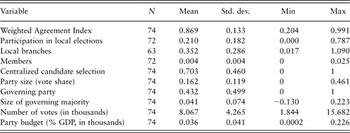
Table 1 reports the descriptive statistics of the organizational strength measures (along with those of other variables used in the analysis). Additionally, Table 2 lists, for each country, the parties (and corresponding years) with the weakest and strongest organization according to each of the three indicators of organizational strength. Although informative, this a very crude classification of parties and one should keep in mind that all measures may not be available for all parties, which is likely to influence this ranking. Still, we see many of the same parties appear as the weakest or the strongest on different measures of organizational strength. Furthermore, while the communist successor parties tend to have strong organizations, they do not occupy the top position in all cases. Similarly, while the weakest parties include some of the later entrants such as the Law and Justice party in Poland, they also include some relatively older parties such as the Coalition Party in Estonia, the Green Party in the Czech Republic, and the Christian Democratic Peoples’ Party in Hungary, all of which were created straight after the regime transition. Ideology does not seem to correlate with these rankings in an obvious way: the strongest parties include leftist communist successor parties as well as centrist and rightist formations (including the Estonian Peoples’ Party and the Hungarian Independent Smallholders’ Party). The weakest parties also include a mixture of ideological positions. What does stand out, however, is that the parties with the strongest organization all primarily target poorer or rural segments of society, whereas those with the weakest organizations (with the exception of the Polish Self-Defense party) are focused on middle-class urban voters. The type of the electorate may, therefore, account for some of the variance in organizational strength. Exploring this and other possible explanations of the origins of strong organizations requires more systematic analysis, and remains beyond the scope of the current study.
Descriptive statistics

Std. dev. = standard deviation; GDP = gross domestic product.
The parties with the weakest and the strongest organization by country and indicator

Party abbreviations: SZ = Green Party; US-DEU = Freedom Union–Democratic Union; KSCM = Communist Party of Moravia and Bohemia; KE = Coalition Party; RE = Reform Party; ERL = Estonian Peoples’ Party; MIEP = Hungarian Justice and Life Party; KDNP = Christian Democratic Peoples’ Party; FKgP = Association of Independent Smallholders; MSzP = Hungarian Socialist Party; PiS = Law and Justice; SO = Self-Defense; ROP = Movement for the Reconstruction of Poland; PSL = Polish Peoples’ Party; SLD = Democratic Left Alliance.
Control variables
The analysis also includes a number of control variables to account for alternative explanations of party unity and accurately isolate the effect of party organizational strength. I have relied on the existing literature to identify these controls.
Centralized candidate selection is measured by a dummy variable coded ‘1’ when the national level party leadership has the final say over candidate selection and ‘0’ otherwise.Footnote 10 If the central party office is in charge of selecting candidates to run in national elections or can revise and veto lower level decisions, then the re-nomination of MPs directly depends on the central party organization. If, however, candidates are selected on the local (district) level, then the re-nomination of an MP depends on his or her reputation on the local level. In order to maintain a good local reputation, an MP may have an incentive, at least sometimes, to go against the party line in parliament. Therefore, the more centralized this procedure, the more unity one should observe (Bowler et al., Reference Bowler, Farrell and Katz1999; Hazan, Reference Hazan2003; Sieberer, Reference Sieberer2006; but see Shomer, Reference Shomer2009).
Party size is measured in vote share for the party in the election preceding a given parliamentary term,Footnote 11 and is included because previous literature has argued that smaller parties tend to be less unified (Desposato, Reference Desposato2005; Sieberer, Reference Sieberer2006).Footnote 12
Governing parties, coded ‘1’ for parties that formed the governing coalition during the given parliamentary term and ‘0’ otherwise, are argued to be more unified given the higher stakes of disunity for governing parties in parliamentary systems (Sieberer, Reference Sieberer2006; Carey, Reference Carey2009).Footnote 13
The Size of governing majority is measured by the difference between half the parliamentary seat share and the seat share of governing parties. The larger the difference the stronger a majority the government commands. For minority governments, this difference is negative. When the governing party or coalition of parties has only a slim majority over the opposition the overall party unity should be greater – every vote becomes more valuable to both sides because a few votes can decide whether the preferences of the governing parties prevail (Sieberer, Reference Sieberer2006).
Number of votes indicates the number of recorded votes in a given parliamentary term (in thousands). There is great variance in the number of times MPs vote even within single countries between different terms (see footnote 5). It is possible that as the volume of voting increases, the overall unity decreases because the significance of any single vote is lower (see also Hix et al., Reference Hix, Noury and Roland2005).
Party budget measures the size of the party income as a percent of gross domestic product (in thousands).Footnote 14 I include this variable because the organizational strength of parties may simply reflect their financial situation.Footnote 15
Country dummies control for any unmeasured country-level effects, including that of the electoral system – one of the most prominent explanations in the existing literature (Carey, Reference Carey2009). The prediction about the effect of electoral system for the current cases is not very straightforward. Carey (Reference Carey2009) argues that unity should be lower in systems where co-partisans compete against each other. As noted above, the Czech Republic, Estonia, and Poland use open-list PR where such intra-party competition can take place. Hungary, on the other hand, uses a mixed SMD-closed list PR electoral system. Although neither of these tiers produces intra-party competition, one could still argue that legislators from SMDs may be more constituency-oriented in their parliamentary behavior and therefore more likely to go against the party than MPs from party lists. Therefore, the mixed system could also decrease rather than increase unity. Because sorting out the electoral system effects is not the goal of this paper, these concerns are less relevant here. However, any potential electoral system effects justify the inclusion of country dummies for the accurate estimation of the effect of party organizational strength.
Results
The models were estimated using ordinary least squares regression. I used robust standard errors to account for potential heteroskedasticity.Footnote 16Table 1 above presented descriptive statistics for the variables included in the models.
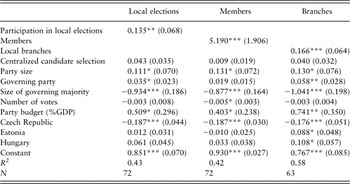
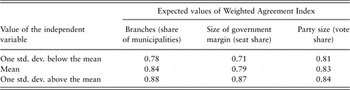
As the findings reported in Table 3 show, all three measures of party organizational strength are significantly related to the party unity as measured by the Weighted Agreement Index. The effects are also substantively significant. I have picked the model that uses local branches as the indicator of organizational strength to illustrate these effects. Table 4 presents the expected values of the Weighted Agreement Index for the mean value and one standard deviation (std. dev.) below and above the mean; all other variables are held at their median value. The change from one std. dev. below to one std. dev. above the mean on local branches increases party unity from about 0.78 to 0.88. The effect of the other organizational strength variables is somewhat weaker: a similar change in (1) membership increases the expected value of the Weighted Agreement Index from 0.90 to 0.94 and (2) participation in local elections from 0.87 to 0.92.Footnote 17
Regression analysis of party organizational strength and voting unity in parliament

GDP = gross domestic product.
*P ⩽ 0.1, **P ⩽ 0.05, ***P ⩽ 0.01.
Note: Dependent variable is the Weighted Agreement Index. Table entries are unstandardized regression coefficients with robust standard errors in parentheses. Poland is the reference category.
Expected values of Weighted Agreement Index for different values of selected independent variables

Std. dev. = standard deviation.
Two other variables that reach the level of statistical significance in all models are government margin and party size. For the sake of comparison, Table 4 presents the substantive effects of these variables as well, using the model with branches as the measure of organizational strength. The effect of the governing margin is very strong: at one std. dev. above the mean, the expected value of the Weighted Agreement Index is only 0.71. In comparison, the expected value of the agreement index is 0.87 for governments that control less than a majority of seats (one std. dev. below the mean).Footnote 18 The effect of party size is somewhat weaker than that of organizational strength: the expected value of the Weighted Agreement Index is 0.81 for the smallest party in the dataset and 0.84 for the largest.
Interestingly, one of the most prominent explanations of party unity in the existing literature – the candidate selection procedure – does not find empirical support. Although the variable has a positive coefficient, it does not reach the level of statistical significance in any of the three models. This suggests that the power to nominate alone may not be a credible threat to induce unity when the party cannot guarantee electoral benefits. Although weak parties may control nominations, they may be reluctant to use this as a disciplinary tool – unlike strong parties where candidates depend on the party for electoral support, weak parties are likely to depend on their candidates if they want to preserve or maximize their presence in parliament. Denying a re-nomination may mean losing a seat for the party. The effect may also appear insignificant because re-nomination is not the only disciplinary tool that strong parties can use – they can also threaten to deny other electoral resources to maverick MPs. Furthermore, even if nomination rights are officially delegated to the local party organization, the local organization may still follow the preferences of the party leadership, or the leadership may have informal power to intervene and deny re-nomination to a maverick.
The size of the party budget is significant when branches and members are used as the organizational strength measures and insignificant in the model with local elections. The effect of organizational strength remains significant in all models. This suggests that while certainly related, party organizational strength is not simply an indicator of the wealth of the party. When exploring the effect of organizational strength on the electoral success and survival of parties, Tavits (Reference Tavits2009b) similarly finds that while party budget and campaign expenditure may or may not have an effect on the electoral performance of the party, these variables do not eliminate the independent effect that of organizational strength on electoral performance.
In sum, the findings strongly suggest that party organizational strength is associated with more party unity in parliament. This result is substantively and statistically significant despite the relatively small sample size, and remains robust against the inclusion of powerful controls.
Narratives and illustrations
The previous section provided a direct systematic test of the theoretical argument. The goal of this section is to provide illustrations of the causal. Recall that the theoretical argument proposes the following causal mechanism: strong party organization is associated with successful electoral performance, which makes parties with such organizations more valuable to legislators; the threat of losing such a valuable electoral asset is more likely to induce compliance in parliamentary voting behavior in the case of parties with strong rather than weak organizations. The empirical tests presented in the previous section offer a test of the relationship between organizational strength and compliance, and previous literature provides evidence that the stronger the party organization the more electorally successful the party. The one link in the causal story that remains untested is that MPs from parties with strong organizations are more likely to consider their parties electorally valuable than legislators from parties with weak organizations. This is best gauged by surveying MPs – a goal that is beyond the scope of the existing study.
That said, the detailed account of the development of party discipline in the Hungarian parliament presented in Montgomery (Reference Montgomery1999) provides a way to illustrate the theoretical argument presented here, including this particular link. That study describes how all MPs initially struggled to establish personal reputations based on the assumption that building such reputations was necessary for reelection (see also Ágh, Reference Ágh1995). The MPs were not only independent in their voting behavior, but also engaged in legislative activism with even the ruling parties’ MPs proposing a large percentage of amendments to government bills – behavior unheard of in advanced parliamentary systems. Evidence from elite surveys suggested that MPs believed that in order to be reelected they needed to build personal reputations and not rely on the party as an electoral resource (Ilonszki, Reference Ilonszki1994). The parties at the time were only starting to build organizations, with the Socialist Party taking the lead and Fidesz following the example. As a result, in subsequent elections it became increasingly clear that ‘there were no safe seats, only safe parties’ (Montgomery, Reference Montgomery1999: 518) and MPs learned that parties were key to achieving their private goals. The first parties to show stronger discipline were those with stronger organizations – the Socialist Party and Fidesz (Montgomery, Reference Montgomery1999). It became very obvious to members of these parties that they could get anything they wanted when they cooperated with the party and lose everything if they did not. Fidesz members explicitly admitted that they followed the party line rather than constituency interests due to the reelection incentive (Pogonyi, Reference Pogonyi2002). In sum, the realization that strong parties provided significant electoral benefits and the threat of losing these induced increased discipline among MPs.
Similar differences between strong and weak parties have been pointed out about other countries under study. Zubek (Reference Zubek2008) reports that Polish parties with strong organization (the Democratic Left Alliance and the Polish Peasant Party) had strict intra-party rules for discipline, whereas those with weak organization (the Solidarity Election Action, AWS) lacked such rules. Several AWS MPs who acted in a non-cooperative manner toward their own party's bills because they thought that they were the decision-makers and vote getters and not just rubber stamps for the party. Unlike in strong parties, disagreements within weak parties often led to a series of defections and the creation of new formations (Nalewajko and Wesołowski, Reference Nalewajko and Wesołowski2007) indicating that the weak party was electorally valueless for the MPs. Similarly, Kopecky (Reference Kopecky2000) describes that contrary to the organizationally strong Civic Democratic Party and Social Democrats in the Czech parliament, the organizationally weak Civic Democratic Alliance was reluctant to impose party discipline because the party essentially relied on its MPs – all prominent personalities – for its existence and lacked any significant organization outside parliament. The Republicans (SPR-RSČ) – another party with a weak organization at first imposed strict discipline, but experienced a party split as a result.
Conclusion
Existing studies usually explain variance in party unity by institutional variables, such as federalism, presidentialism, and the electoral system. At the party level, the most common explanatory variable is the candidate selection procedure, whereas other party effects are generally neglected. This study has shown that party organizations can have a more comprehensive and substantial effect on legislators’ behavior beyond candidate selection procedures. Because of the electoral benefits that strong organizations can provide, strong parties alter the incentive structure for MPs and thereby influence their behavior.
The results of this study have significant implications for several lines of inquiry and policy. First, the findings offer direct evidence of the effect of party organizational strength on legislative behavior, and consequently on policy making. This gives at least one reason for office and policy seeking parties in post-communist countries to build organizations: parties with strong organizations can better serve their own policy (and office) goals. Given the benefits of electoral success, office, and policy provided by strong party organizations, it is also in the interests of individual politicians to invest in building such organizations rather than simply running personal campaigns (see also Schlesinger, Reference Schlesinger1975, Reference Schlesinger1984). Furthermore, my results are also important for understanding the role of parties in supporting democratic development in new democracies. To the extent to which unity contributes to effective governing, public goods provision, and better representation, parties with strong organizations serve to help democracies consolidate.
Second, the importance of party organizational strength on the dynamics of legislative and electoral politics calls for a better understanding of this phenomenon. One of the most intriguing puzzles for future research is to untangle the origins of strong organizations. Why do some parties build organizations while others do not? Post-communist Europe offers a fruitful setting for such an analysis in terms of starting on an equal footing with largely comparable resources. We can, therefore, observe the starting point and the subsequent choices parties made with regard to organizational development to uncover the factors that conditioned these choices. Exploring the origins of strong organizations will take us a step closer to a more general theory of party organizations.
Third, my findings further the growing body of research that explores the various representational linkages that parties offer. Although I am not able to demonstrate exactly the type of representational linkage practiced by strong parties, their tendency to be more unified in parliament suggests a more programmatic rather than a clientelistic appeal. Future research could look more directly at whether and to what extent party organizational strength fosters programmatic representation.
Finally, I would like to reiterate that the focus of this paper is on the party level. It provides a rationale for why some parties are more unified than others. The goal has not been to account for within-party variation. It is likely that within both weak and strong parties some MPs are more or less likely to follow party unity. Furthermore, party organizational strength at other levels – such as the strength of the local party branch in the constituency that an MP is representing – may provide different individual level incentives to adhere or not to adhere to the (national) party line in parliament.
Acknowledgments
I would like to thank Taavi Annus, Brian Crisp, Joshua Potter, and seminar participants at the University of Mannheim for very helpful comments on this manuscript, and Santiago Olivella for excellent research assistance.