Introduction
Throughout the world, there has been a steady increase in disasters of all varieties. Reference Kovács and Spens1,2 From natural disasters such as floods and hurricanes, to (re-)emerging infectious diseases such as pandemic influenza and coronavirus disease (COVID-19), to acts of terrorism, this increasing prevalence has led to a variety of humanitarian challenges. In the wake of a disaster, populations are often displaced and in need of basic support for housing and sustenance. Reference Fitzpatrick, Willis, Spialek and English3,Reference Clay and Ross4 Yet as disasters occur more frequently and impact broader swaths of society, a critical challenge remains in identifying needs and getting the proper supportive resources to the right place, at the right time.
A key component of the response to any disaster is maintaining high levels of situational awareness. Reference Sanquist and Brisbois5 One of the most basic needs throughout the response and recovery phases of a disaster is food distribution. In the United States, rates of food insecurity continue to increase, particularly among lower income adults. Reference Leung and Wolfson6 This trend has been compounded by the COVID-19 pandemic, which has caused an unprecedented surge in food insecurity nationwide. Reference Leung and Wolfson6–Reference Hernandez and Holtzclaw8 Since the beginning of the pandemic, an unprecedented number of food banks experienced supply shortages and many were forced to close. Reference Dzhanova9 While food pantries have traditionally provided critical nutritional resources for clients, including for lower-income populations, during disasters, the magnitude and duration of the COVID-19 pandemic have exposed critical limitations amid unparalleled needs. Reference Kulish10,Reference Morelli, Murphy and Lanerolle11 Simultaneously, as other fields have applied insights from COVID-19 to mature their real-time situational awareness technologies, these efforts have been notably lacking for food distribution agencies. Reference McLoughlin, Fleischhacker and Hecht12,Reference Knorr and Khoo13 Interconnectivity between food banks and those in need is limited by funding, antiquated technology, and a lack of a robust distribution network for the scale of the COVID-19 pandemic or potential future disasters that affect lower-income populations.
Technological innovation represents a key opportunity to address the disconnect between the need and availability of supplemental nutrition in disasters. Throughout all aspects of emergency preparedness and response, technology has revolutionized the ability to effectively respond to all hazards. Reference Freeman, Blacker and Hatt14 From digital command centers and bed-tracking systems, to routine public safety operations, Reference Kane, Scheulen and Püttgen15,Reference Ebbeling, Goralnick and Bivens16 mHealth tools and beyond, effectively aligning resource provision with community health needs, remains a key component of disaster-relevant technology. This application of technology to disasters presents an opportunity to address food insecurity through greater situational awareness. By using real-time data collection, food shortage hotspots can be rapidly identified and supported through surge deliveries or redirecting affected individuals to other sources of food nearby.
Considering the relevance of such innovations for addressing food security challenges in public health emergencies and disasters, we have conducted a scoping literature review to gauge the current state of research regarding the use of technology for assessing and enhancing food security in such contexts. The aims were to:
-
1. Define the scope and type of research regarding digital tools used for food security during disasters
-
2. Describe the tools in terms of key functions, platform, and disaster settings/types/phases
-
3. Identify key gaps in research and development and make recommendations for future work
Methods
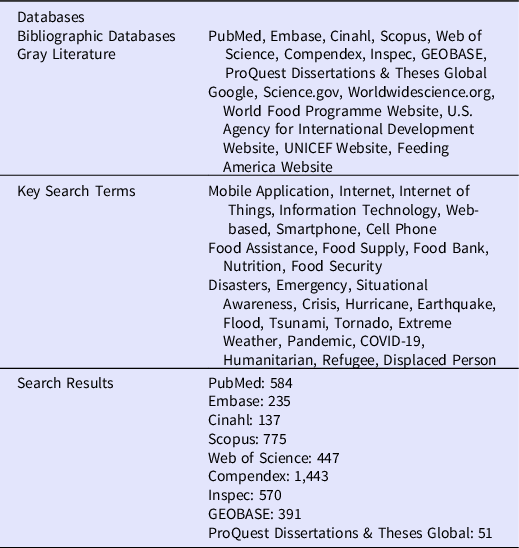
To explore the current literature surrounding digital interventions for addressing food security during disaster situations, we conducted a scoping review of the peer-reviewed and gray literature in December 2020. We searched PubMed, Embase, Cinahl, Scopus, Web of Science, Compendex, Inspec, GEOBASE, and ProQuest Dissertations & Theses Global to identify studies published from 2010 to December 10, 2020. Search terms were developed using a combination of controlled vocabulary and keywords to define the concepts of food assistance, digital technology, and disasters, and terms were adapted for use in each database. Similar search terms were used to develop searches in Google, Science.gov, Worldwidescience.org, the World Food Programme, United States Agency for International Development, UNICEF, and Feeding America websites. The final PubMed search terms and results are presented in Table 1.
Databases included, search terms used, and search results by database

Note: The key search terms were edited/formatted for each database.
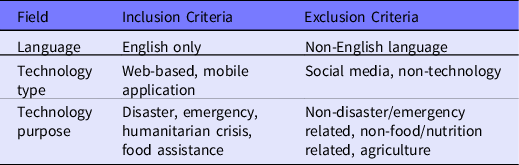
Using the Preferred Reporting Items for Systematic Reviews and Meta-Analyses (PRISMA) Checklist Reference Hayashi, Tokoro, Takahashi and Minazuki17 as a guide throughout, all citations were imported into EndNote citation management system (Clarivate Analytics, Philadelphia, PA) to remove duplicate records, and then imported into Covidence systematic review software (Veritas Health Innovation, Melbourne, Australia) to facilitate screening and full-text review. 18 We used a blinded, dual review process, with 2 levels of review: title/abstract followed by full-text review. Conflicts were resolved by a third reviewer. Inclusion and exclusion criteria are presented in Table 2. We included digital interventions or technology descriptions from any country, provided that the article included technology that was, or could be, used in disaster situations to connect individuals or groups to food resources. A data extraction tool was developed in Covidence to extract then included the article’s title, first author’s last name, year of publication, data type, emergency setting country and city, food emergency cause, study aim, study design, type and purpose of intervention/tool, digital platform type, intervention methods, intended users, and government or non-government classification.
Article inclusion and exclusion criteria

Results
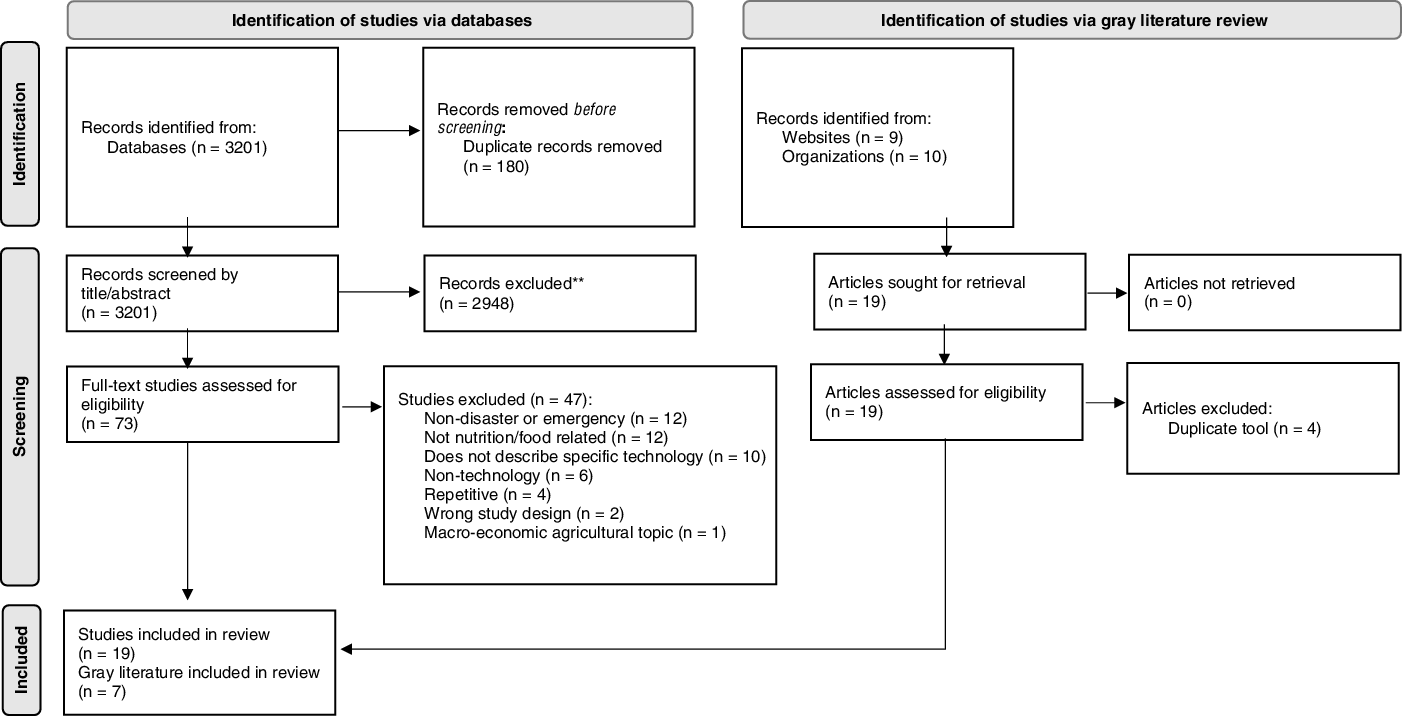
Of the 3021 unique articles identified in the final search (which included 19 articles from the gray literature and 3002 peer-reviewed publications), 2948 were excluded at the title/abstract screening stage. Of the 73 studies included in the full-text review, 47 (64.4%) studies were excluded for the following reasons: 12 were regarding non-disaster or emergency settings (25.5%), 12 were not nutrition/food-related (25.5%), 10 did not describe a specific technology (21.3%), 6 were non-technology (12.8%), 4 were repetitive (8.5%), 2 had the wrong study design (4.3%), and 1 was on macro-economic agricultural topic (2.1%). The PRISMA diagram is presented in Figure 1.
PRISMA flow diagram for new systematic reviews which included searches of databases and gray literature.
From: Page MJ, McKenzie JE, Bossuyt PM, et al. The PRISMA 2020 statement: an updated guideline for reporting systematic reviews. BMJ. 2021;372:n71. doi:10.1136/bmj.n71.

Descriptive Research Statistics
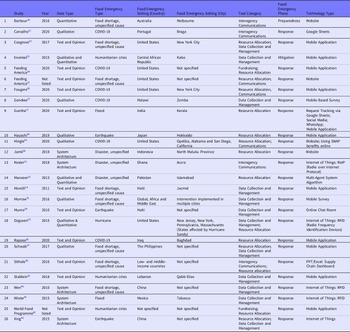
The final synthesis included 26 studies (Table 3). The tools examined in the studies were categorized into a primary platform: Mobile Application (36%), Internet of Things (IoT; 20%), Website (20%), Mobile Survey (8%), and Other (8%).
Characteristics of reviewed articles (N = 26)

The types of data presented in the studies included: qualitative (23.1%), quantitative (3.8%), quantitative and qualitative (11.5 %), text and opinion (42.3%), and system architecture (19.2%). The “system architecture” data type refers to the presentation of the code and other technical components of an emergency system via the Internet, radio, databases, and/or servers. The types of data collected were not distributed evenly across the tool types. For example, of the 15 studies presenting a tool for resource allocation, over half (53.3%) were text and opinion, followed by qualitative (20%), quantitative and qualitative (13.3%), and system architecture (13.3%). There were no purely quantitative studies conducted on the resource allocation tools. This indicates a reliance on non-research-based review and delivery of this type of tool, even though it is the most frequently implemented.
While we limited our search from 2010 to December 2020, over half (61.5%) of the 26 articles were published in the last 5 years. The year with the highest volume of publications was 2020 (26.9%), followed by 2015 (15.4%). There were zero studies published in 2014. Two of the articles (7.7%) did not have a date specified.
We also categorized articles by food emergency type, emergency phase, and intended user. The distribution of food emergency types was fairly spread out across the articles. We categorized the food emergency types by: Food Shortage (general) (30.8%), COVID-19 (23.1%), Humanitarian Crisis (11.5%), Earthquake (11.5%), Disaster (unspecified) (11.5%), Flood (7.7%), and Hurricane (3.8%). All but 2 of these tools address only the response phase of a disaster; zero studies are associated with recovery, 1 is associated with preparedness, and 1 is associated with mitigation.
All the included articles had clearly and intentionally specified the intended users of the various tools (Table 4). There were many different types of intended users ranging from food-insecure community members and food assistance users to healthcare professionals to supply chain stakeholders to government officials. Food-insecure people were the most frequent beneficiaries of the tools, though they were not necessarily the intended users of the tools.
Digital tools for food emergencies research summary

Note: *Some tools were categorized into more than 1 tool type, so while the total number of articles was 26, there were 36 total categorizations.
Digital Emergency Food Security Tools
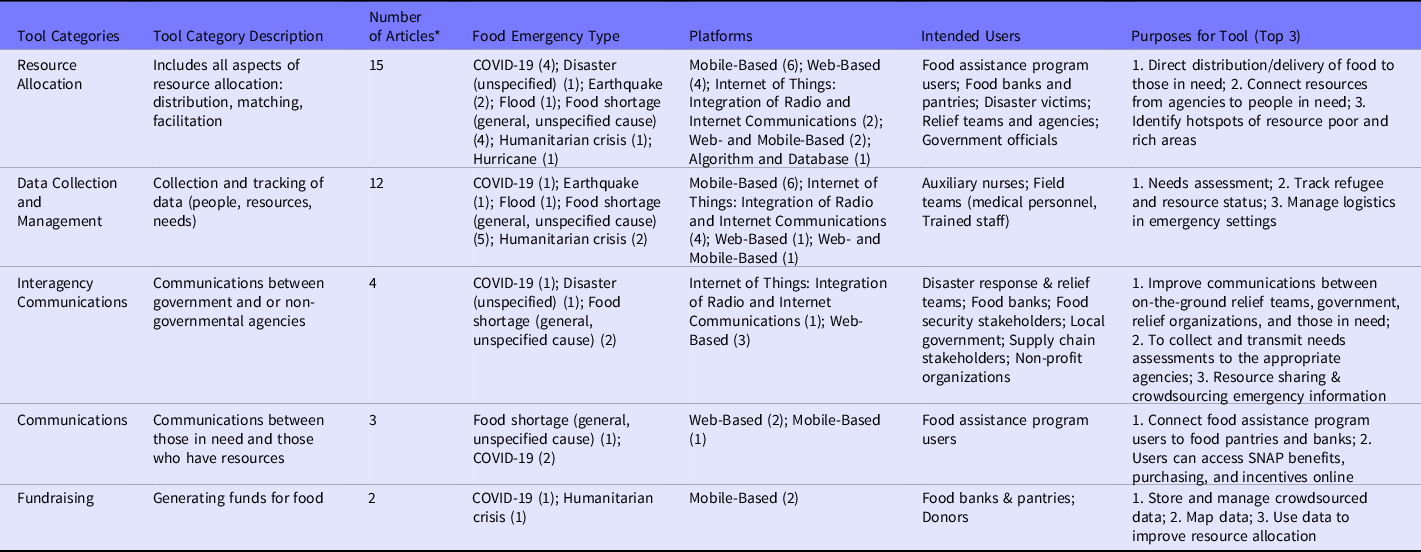
The digital food security tools were grouped into 5 goal categories: Resource Allocation (41.7%), Data Collection and Management (33%), Interagency Communications (15.4 %), Beneficiary Communications (11.5%), and Fundraising (7.7%) (see Table 4). Note that some tools were categorized into more than 1 tool type, therefore the denominator in the calculation of these percentages was 36.
Resource Allocation
Tools to facilitate resource allocation were the most frequently mentioned (41.7%) and covered all aspects of identifying, matching, and distributing food to those in need. The top 3 purposes for using these tools were to direct distribution/delivery of food; connect resources from agencies to people; and identify hotspots of resource poor and rich areas. All disaster types were addressed in this tool category; however, COVID-19 and general food shortages were most frequently cited as reasons for the need for this type of tool. This type of tool is also intended for relief teams and government offices to aid in food distribution, especially when the food-insecure person may not have access to or be able to use digital tools. To support this, mobile applications are most widely implemented to support resource allocation.
Data Management and Collection
The timely and coordinated collection, management, and dissemination of data are key to responding to emergencies and allocating resources where and when they are needed. A challenge for data management during emergencies is that disaster-stricken people may not have access to mobile technology. Thirty-three percent of studies focused on data management and collection tools to address these challenges. Tools were designed, for example, to perform on-site needs assessments, track refugee and resource statuses, and/or mange logistics in emergency settings. Reference Morelli, Murphy and Lanerolle11,Reference Barbour, Palermo, Kleve and Booth19–24 These tools are all designated for technical staff in the field, including auxiliary nurses, medical professionals, and other trained staff. Tools ranged from simple Google-based spreadsheets for mobile- and web-based platforms Reference Fougere25 to highly technical tracking systems. 24,Reference Gondwe26 For example, programmable bracelets worn on refugees can transmit location, food, and hygiene product delivery data from refugees to andfrom command centers. 24,Reference Gondwe26
A subset of these tools incorporates both resource allocation and data management features. Reference Hayashi, Tokoro, Takahashi and Minazuki17,Reference Carvalho and Sousa20,24,Reference Guntha, Rao and Shivdas27 One such tool in development by Xing et al. aims to improve resource allocation via data-driven decision making in post-earthquake settings. Reference Hayashi, Tokoro, Takahashi and Minazuki17 Data related to demand for food, drugs, and other necessities are collected and sent to a command center where decision makers can allocate appropriate resources efficiently.
Interagency Communications
During public health emergencies and disasters, it is imperative that communications between government and/or non-governmental agencies are coordinated, timely, and effective. Tools focusing on this goal aimed to: improve communications between on-the-ground relief teams, government, relief organizations, and those in need; collect and transmit need assessments to the appropriate agencies; and/or share resources and crowdsource emergency information. Reference Fougere25,Reference Hingle, Shanks and Parks28–Reference Kester30 These tools are intended for the resource-providers and coordinators, that is, food banks and assistance programs, donors and supply chain stakeholders, response and relief teams, food security non-governmental organizations, and local emergency departments. Because disaster responders typically use portable radios for communications, one of these tools is designed to integrate incoming radio frequencies with the Internet. Information gets passed to an Emergency Operations Center, which decides how and when to allocate resources. Reference Jamil and Lessy29 The ultimate goal of integrated communications is to better coordinate on the ground responses with government and non-governmental responses through a centralized command network.
Beneficiary Communications
This category is different from interagency communications as it only focuses on interventions that improve communications between those in need and those with resources. All three of the tools included in this review are grouped in the Resource Allocation category. Reference Manzoor, Zubair and Batool31–Reference Munro33 The main goals of these tools are to: connect food assistance program users to food pantries and banks and/or allow users to access Supplemental Nutrition Assistance Program (SNAP) benefits, purchasing, and incentives online. Only 3 studies covered tools that improved direct communications between food sources and people in need of food assistance. For example, a pilot app funded by the World Food Programme, “Share the Meal,” connects displaced disaster refugees with nearby food sources, Reference Ozguven and Ozbay34,Reference Rapose35 and Feeding America has a website that connects those in need with food nearby. Reference Morrow, Mock, Bauer and Browning32
Fundraising
Fundraising tools appeared in only 5.6% of reviewed articles. Reference Ozguven and Ozbay34,Reference Schwab, Omana and Roazol36 This tool’s main purpose is to raise monetary donations for food on behalf of food banks. Both tools are accessed through mobile platforms. The 2 contexts for the creation of the tools are COVID-19 pandemic and humanitarian crisis. For example, through Feeding America’s platform, donors (organizations or individuals/families) can identify where they can donate food to those in need. Reference Schwab, Omana and Roazol36
Tools That Combine Beneficiary Communications and Resource Allocation
A subset of tools, 19.2%, is proof of concept studies to target both beneficiary communications and resource allocation via IoT technology. IoT is the network of devices that are not traditionally associated with the Internet (ie, lights, watches, HVAC systems, etc.) that have built-in sensors that transmit data from 1 object to others within the network. Reference Sithole, Silva and Kavelj37,Reference Stablein38 Different types of IoT sensors (ie, radio waves, wireless signals, satellite, cellular) can be integrated together. These studies test the ability of IoT to theoretically or experientially provide continuous communication and coordination of food supply and demand between the field and relevant agencies such as emergency response centers, local officials, food banks, and pantries. Reference Hayashi, Tokoro, Takahashi and Minazuki17,24,Reference Gondwe26,Reference Jamil and Lessy29,Reference Wen and Zhao39
Many disaster fields have integrated IoT into improving emergency communications as it is interoperable, has low power requirements, and can be cheap to implement (though some forms are quite expensive). Reference Sithole, Silva and Kavelj37,Reference Stablein38,Reference Wister, Pancardo and Acosta40 It also creates backup systems if certain types of communications get knocked out (ie, cellular towers). These technologies have allowed for field teams, for example, to transmit radio signals over the Internet to command centers. Reference Wister, Pancardo and Acosta40 One application for food distribution is tracking of inventory and/or people using IoT technology called Radio Frequency Identification Devices (RFID). RFID overcome the challenges with conventional tracking systems that require labor intensive and error prone manual intervention. 24 RFID provide visibility of resource movement in the disaster supply chain, allowing agencies to make early decisions about pre-stocking, in case there is a possibility of serious interruptions in the supply.
We found that the food emergency sector is behind these modernizations. Of the 5 articles focusing on IoT technologies, all of them were in theoretical, developmental, and prototype phases. They were not ready for widescale implementation.
Discussion
This is the first scoping review to explore the digital strategies that exist to address emergency food assistance. Our findings add to the literature by defining the scope of research and development and identifying gaps in current technology for emergency food assistance. Overall, this review highlights the types of technologies in development and identifies gaps in related publications, use of modern technologies, and breadth of coverage of most disaster types, phases, and locations (ie, no studies were done in low-income countries). Our research revealed several important findings.
One of the main themes of the digital tools presented is to improve situational awareness between emergency food supply and demand. The tools supported this via the following 5 objectives. First, they can be used for the oversight of resource allocation from relief agencies, including food banks and pantries, governmental and non-governmental agencies, and donors to those in need. A second important use is for improving interagency communications between food banks, emergency operations centers, and relief agencies, ensuring that resources are allocated properly to those in need. Third, digital tools can be used for data collection, analysis, and dissemination. These include tracking with wearable technology, inventories of resources, data transmission from field stations to command centers, and data collection by technical field staff. A caveat to a large portion of tools, however, is that they are still in developmental phase and do not have published quantitative and/or qualitative results. Fourth, technologies can facilitate direct communications between food assistance programs and those in need. Fifth, they can be used for fundraising for food and monetary donations for food banks and disaster-affected populations.
However, we found very little published research on digital tools for food assistance during emergencies of any type. This could be because food assistance programs have lower capacity for updating their systems. This could also be because it is assumed that people in an emergency setting and/or humanitarian crisis do not have access to digital technologies. Recent reports have shown that this is outdated information; many people have access to mobile technologies, especially during COVID-19. Reference Sithole, Silva and Kavelj37 Additionally, food assistance programs may be more willing to adopt new solutions, as COVID-19 has forced organizations to adopt and/or suspend in-person activities. Reference McLoughlin, Fleischhacker and Hecht12
Most of the studies reviewed present text and opinion data over more rigorously produced quantitative and/or qualitative data. More research is needed on the tools presented – and additional ones aimed at preparedness, mitigation, and recovery – to measure the impact of the intervention quantitatively and qualitatively. This gap in rigorous research and evaluation mitigates current understanding of the successes and challenges of more widescale implementation of digital tools to address food insecurity in disaster settings. Future work must support widescale deployment and testing of modern technologies in these settings.
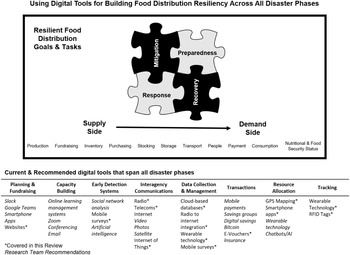
There was a lack of tools focused on non-response phases of disasters (ie, recovery, mitigation, and preparedness). All but 2 of the articles focused on response phase interventions; almost completely neglected were preparedness, mitigation, and recovery tools, consistent with findings from AlHinai et al. and Sakurai et al. 41,Reference Xing, Zhang, Wu and Xie42 Figure 2 outlines the reviewed technologies plus tools frequently used for improving project management that could be adapted for use in these other disaster phases. These include tools for cloud- and Internet-based project management (ie, Google Teams, Slack, Gantt Charts), communications (Messenger, Instagram, Text), crowdsourcing funding (websites like GoFundMe, Patron), and mobile payments (Venmo, PayPal, Cash App). Additionally, an online learning management and capacity building system is urgently needed to provide support and training to food assistance organizations. During these trainings, intended users can be guided through the process of creating preparedness protocols and networks and build necessary responder skills.
Building resilient emergency food distribution systems with digital tools across all disaster phases.

Another gap in the field is the lack of machine learning tools focused solely on emergency food distribution. Machine learning is a rapidly growing branch of artificial intelligence that creates social listening and monitoring trackers on emerging disasters. 43 For example, it can track trends and inform planning of emergency responses during COVID-19. Reference Ranger44 After these considerations, it is recommended to incorporate higher variety of modern digital tools into emergency food distribution that have had success in other emergency settings. For example, researchers and agencies can use IoT or machine learning for social listening to design more targeted mitigation, preparedness, and response interventions. In addition, programs should develop and implement online mitigation and preparedness protocols, training, and educational activities, especially for on-the-ground agencies such as food pantries and food banks.
Surprisingly, we found no studies that used digital strategies to preserve or maintain client choice (where clients can select their own items) during emergencies. Recent research supports the importance of clients’ ability to select their own food items as a means of improving client dignity, agency, reducing food waste, and addressing food preferences and allergies. Reference Remley, Kaiser and Osso45,Reference Remley, Zubieta and Lambea46 Digital apps with client choice features offer a currently unexplored opportunity for food programs to improve services in emergency food settings.
Additionally, the reviewed studies are limited in location and disaster type. The natural disasters covered in these articles – flood, hurricane, and earthquake – were all in middle- to high-income settings. Other natural disaster types have not been covered, such as drought, blizzard, tsunami, and extreme temperatures. As the impact of climate change evolves, examining more varied natural disaster types and developing digital interventions to improve food assistance for these new circumstances will be essential.
Of benefit, these articles highlighted a variety of digital options that could be incorporated more widely into emergency food services, including cell phones with voice, text, and/or data, wearable technology, cloud-based databases such as Google Sheets, radio-based communications, IoT, global positioning system (GPS-) enabled applications, Internet access, presence, and Internet-enabled applications. It is recommended that future work empowers food banks and pantries to modernize, limit inefficiencies, and promote physical distancing with digital tools, that is, smartphone apps, to manage, track, and communicate about resources, food, volunteers, staff, and clients. It has been shown that low-income clients have access and agency to use smartphone apps. Reference Sithole, Silva and Kavelj37 To ensure selecting the right technologies for the intended audience, however, needs and technological assessment of target populations during disaster settings need to be conducted. The assessment should include the ability to use smartphone apps, mobile banking and payments, mobile surveys, messaging, and project management tools in low-income settings.
Unfortunately, there is no guidance on how to choose from these digital strategies based on the type of disaster. While COVID-19 and an earthquake constitute major emergencies per the Federal Emergency Management Agency, each would cause very different impacts on populations and require different technological interventions. Reference Burgess47 For example, telecommunication companies and cellular towers may be knocked out during kinetic natural disasters, while physical infrastructure was not similarly damaged during the COVID-19 outbreak. Overall, there is no guidance for food assistance efforts in the reviewed literature on which technological interventions may be optimal, based on the nature and scale of a disaster. This is a gap in research and practice, and it needs immediate attention as more digital solutions are incorporated.
The identification of tools, gaps, and recommendations covered in this review will help food assistance efforts be more prepared for future disasters as well as improve situational awareness. In the last several years, digital strategies have become critical in improving situational awareness, increasing response efficiency in disasters, and overcoming challenges such as low literacy, limited connectivity, and lack of phone ownership. 41,Reference Ray, Mukherjee and Shu48 The emergency food distribution sector is lagging behind in this evolution toward digital emergency management, as evidenced by clients’ complaints regarding inefficient responses, lack of digital options, and spikes in food insecurity over the COVID-19 pandemic. Reference Niles, Bertmann and Belarmino7,Reference Hernandez and Holtzclaw8,Reference Knorr and Khoo13
Limitations
This review is subject to several limitations. The complexity of food insecurity, especially during a disaster situation, creates many permutations of article types and publication locations. While we built our search iteratively to attempt to capture the broadest possible subset of the literature, it is possible that our search strategy missed critical studies. Additionally, while our inclusion criteria were specifically tailored to English language literature and several key governmental and non-governmental search engines and websites, our approach may have systematically excluded otherwise worthy studies in non-English languages or that are not formally published in the major databases used in our research. Additionally, we did not consider tools used by food assistance programs in non-emergency situations. Last, our study addressed the scope of digital food emergency tools and not the quality of the studies themselves.
Despite the limitations, this study is valuable to highlight the gaps in emergency preparedness interventions and response, as well as to define the scope of existing literature with a food assistance lens.
Conclusions
Given the increasing trends in food insecurity in the United States and worldwide, this review presents an opportunity for innovation and development of intellectual capital. COVID-19 has catalyzed changes in all aspects of the world. In this COVID-19-impacted world, food assistance programs may be more willing – or indeed forced – to adopt new solutions to accommodate social distancing and suspend in-person activities. Reference Dzhanova9 Our research revealed several important findings. A common goal is to improve situational awareness, especially between emergency food supply and demand. Nonetheless, there is very little published research on digital tools for food assistance during emergencies of any type. Furthermore, most of the studies reviewed present text and opinion data over more rigorously produced quantitative and/or qualitative data. A more rigorous and standardized evaluation of all tools will help stakeholders accelerate the process of responding efficiently and effectively to needs. There is also an outdated viewpoint regarding the accessibility of modern technologies in low-income, disaster settings. New, cost-effective advanced digital strategies, especially newer ones such as IoT, mobile applications, machine learning, and wearable technology, are already overcoming past limitations.
While the world is simultaneously currently in a pandemic crisis and preparing for the next crisis, the development and evaluation of tools that address all disaster phases are urgently needed. To mitigate the impacts of the next disaster, digital tools to improve emergency response should be prioritized, along with rigorous qualitative and quantitative measurement of impact. Filling in the research and development gaps identified by this scoping review will maximize the efficacy and uptake of these promising digital food assistance tools for emergency situations.
Acknowledgments
We would like to thank the Bloomberg American Health Initiative for funding support.
Funding statement
The Bloomberg American Health Initiative supported the development of this manuscript.
Conflict(s) of interest
The authors declared no potential conflicts of interest with respect to the research, authorship, and/or publication of this article.