





Early internalizing (e.g., anxiety, depression) and externalizing behaviors (e.g., rule-breaking, aggressive behavior, disruptive behavior) are associated with an increased risk of psychological maladjustment and health risk behaviors in adolescence and adulthood (Arslan et al., Reference Arslan, Lucassen, Van Lier, De Haan and Prinzie2021; Bevilacqua et al., Reference Bevilacqua, Hale, Barker and Viner2018; Shi et al., Reference Shi, Ettekal, Deutz and Woltering2020). Longitudinal studies suggest that early-onset mental, emotional, and behavioral problems are particularly strong risk factors for chronic mental health and quality of life concerns into adulthood (Copeland et al., Reference Copeland, Adair, Smetanin, Stiff, Briante, Coman, Fergusson, Horwood, Poulton, Costello and Angold2013; Korhonen et al., Reference Korhonen, Luoma, Salmelin, Siirtola and Puura2018; Shaw et al., Reference Shaw, Hyde and Brennan2012). Studies have identified familial factors, such as parenting practices and behaviors, as predictors of both internalizing and externalizing behaviors in children (Carneiro et al., Reference Carneiro, Dias and Soares2016; Pinquart, Reference Pinquart2017). Consequently, multiple parenting programs have been developed to reduce behavior problems in children (Jeong et al., Reference Jeong, Franchett, Ramos de Oliveira, Rehmani and Yousafzai2021). Overall, studies report moderate effectiveness for externalizing behaviors and mixed results for internalizing behaviors (Buchanan-Pascall et al., Reference Buchanan-Pascall, Gray, Gordon and Melvin2018, for a review). However, more research is needed to understand the differential effects of parenting programs based specifically on families’ profiles. Despite calls for more comprehensive and effective early childhood mental health intervention (Shonkoff et al., Reference Shonkoff and Fisher2013) and strong national evidence of disparities in early socioemotional readiness for school (Zeraatkar et al., Reference Zeraatkar, Duku, Bennett, Guhn, Forer, Brownell and Janus2020), Canada lacks an approach to early targeted and tailored mental health prevention, particularly for families with high psychosocial needs. This study draws on data from the first Canadian implementation and evaluation of the Family Check-Up® (FCU®), aimed at addressing this gap.
Differential outcomes of parenting programs
Despite growing interest in the differential effects of parenting programs on child outcomes, the potential predictors of response remain poorly understood. Belsky’s Determinants of Parenting model provides a useful framework for identifying factors that could influence the family’s response to parenting programs (Belsky, Reference Belsky1984). This model suggests that a child’s characteristics (e.g., sex, baseline behavior problems), parental psychological resources (e.g., mental and physical health), and broader contextual factors (e.g., social support, socioeconomic stress) may influence parenting behaviors, which, in turn, can influence child development.
One of the most robust individual factors predicting program response is baseline behavior problems. Indeed, a recent individual participant data meta-analysis reported that children with greater initial levels of conduct problems showed a greater response to parenting programs (Leijten et al., Reference Leijten, Scott, Landau, Harris, Mann, Hutchings, Beecham and Gardner2020). Sex and gender have also been investigated as potential predictors of program effects, although the results are not clear. Overall, studies have found that boys are more likely to present with elevated scores of externalizing behaviors, especially when exposed to early life adversity (Holtz et al., Reference Holtz, Fox and Meurer2014). While some studies suggest that boys might benefit the most from parenting programs (Granski et al., Reference Granski, Javdani, Anderson and Caires2019), others have found null results when controlling for baseline behavior problems (Weeland et al., Reference Weeland, Chhangur, Van Der Giessen, Matthys, De Castro and Overbeek2016). Nonetheless, it is theoretically relevant to consider sex and gender when investigating program effects, as they can influence a child’s developmental pathway, especially in the context of early adversity (Bath, Reference Bath2020; Garvin and Bolton, Reference Garvin and Bolton2022). Extending Belsky’s (Reference Belsky1984) determinants of parenting model, differential susceptibility theory (Belsky et al., Reference Belsky and Pluess2009; Ellis et al., Reference Ellis and Boyce2011) proposes that children’s response to intervention may vary depending on their biological sensitivity to environmental influences. Consequently, sex-linked differences in the context of adversity may contribute to divergent developmental pathways, making sex a theoretically relevant moderator of program response.
In addition to individual characteristics, familial and contextual factors have also been examined as potential predictors of parenting program effectiveness (Shaw et al., Reference Shaw, Sitnick, Brennan, Choe, Dishion, Wilson and Gardner2016; Shelleby and Shaw, Reference Shelleby and Shaw2014; Shelleby et al., Reference Shelleby, Shaw, Dishion, Wilson and Gardner2018; Westerlund et al., Reference Westerlund, Hinkka-Yli-Salomäki, Ristkari, Kinnunen, Baumel and Sourander2026). At the parental level, mental health difficulties, namely depression and anxiety, have been the most studied. Some studies have found that children whose parents report high levels of depressive symptoms benefit the most from parenting interventions (Gardner et al., Reference Gardner, Leijten, Mann, Landau, Harris, Beecham, Bonin, Hutchings and Scott2017; Li et al., Reference Li, Baumel, Hinkka-Yli-Salomäki, Kinnunen, Ristkari, Westerlund and Sourander2025), while others have found null or inverse effects (Fossum et al., Reference Fossum, Cunningham, Ristkari, McGrath, Hinkka-Yli-Salomäki and Sourander2018; Westerlund et al., Reference Westerlund, Hinkka-Yli-Salomäki, Ristkari, Kinnunen, Baumel and Sourander2026). Parental alcohol use has also been identified as a relevant factor, as some studies report poorer child outcomes in children of parents with high substance use (Kuppens et al., Reference Kuppens, Moore, Gross, Lowthian and Siddaway2020), and families with a history of parental substance use may show greater improvement following parenting interventions. Beyond parental mental health, parental physical health also warrants attention, as it has been shown to predict parenting self-efficacy, even after accounting for mental health (Riley et al., Reference Riley, Wilson and Poppert Cordts2019). Given that parenting self-efficacy is a mechanism through which parenting programs operate, physical health limitations may represent a compounding yet understudied barrier to program engagement and response.
At a contextual level, socioeconomic adversity, particularly familial income and levels of education, has been extensively studied as a potential moderator of parenting program effects. Earlier studies suggested that economically disadvantaged families benefited less from parenting interventions (Leijten et al., Reference Leijten, Raaijmakers, de Castro and Matthys2013; Lundahl et al., Reference Lundahl, Risser and Lovejoy2006); however, more recent meta-analyses found no differential effects by income, education, or employment status when indicators were examined individually (Gardner et al., Reference Gardner, Leijten, Mann, Landau, Harris, Beecham, Bonin, Hutchings and Scott2017, Reference Gardner, Leijten, Harris, Mann, Hutchings, Beecham, Bonin, Berry, McGilloway, Gaspar, Seabra-Santos, De Castro, Menting, Williams, Axberg, Mørch, Scott and Landau2019 ). Although social support has been theorized within Belsky’s model, existing studies have focused on the effect of varying levels of social support on parental change rather than child outcomes (Alvarez et al., Reference Alvarez, Byrne and Rodrigo2020; Theise et al., Reference Theise, Huang, Kamboukos, Doctoroff, Dawson-McClure, Palamar and Brotman2014). Studies investigating the association between social support and parenting behaviors report that higher perceived social support is associated with higher parenting self-efficacy and more adaptive parenting behaviors (Fierloos et al., Reference Fierloos, Windhorst, Fang, Hosman, Jonkman, Crone, Jansen and Raat2023; Negi & Sattler, Reference Negi and Sattler2026). This suggests that social support may influence families’ capacity to engage with and benefit from parenting intervention.
Taken together, there is empirical evidence that children and families are often exposed to co-occurring adversities that may influence responsiveness to intervention. Yet, to date, most studies have opted for analytical approaches and variable-centered frameworks (e.g., linear regression, latent growth curve models). These analyses do not account for the co-occurrence of multiple risk factors within families and are limited in terms of the number of interactions that can be examined simultaneously (Cooper & Lanza, Reference Cooper and Lanza2014; McMahon et al., Reference McMahon, Goulter and Frick2021). This is further supported by results from an individual participant data meta-analysis evaluating the equity effects of parenting interventions for child behavior problems in Europe (Gardner et al., Reference Gardner, Leijten, Harris, Mann, Hutchings, Beecham, Bonin, Berry, McGilloway, Gaspar, Seabra-Santos, De Castro, Menting, Williams, Axberg, Mørch, Scott and Landau2019). Their findings showed that program effects did not significantly differ by sociodemographic indicators when examined in isolation, underscoring the importance of considering multiple indicators when evaluating program response. Person-centered approaches, such as latent profile analysis (LPA), enable researchers to identify probabilistic subgroups based on multiple characteristics, providing a more nuanced understanding of program effects (Lanza & Rhoades, Reference Lanza and Rhoades2013). This approach is particularly pertinent given the growing evidence that family profiles differ in the adversities to which they are exposed (Lefebvre et al., Reference Lefebvre, Fallon, Fluke, Trocmé, Black, Esposito and Rothwell2024). This suggests that different combinations of exposure to adversity may lead to varying responses to a parenting program.
To date, studies using a person-centered approach to examine program effects are uncommon. One study evaluating the effect of the Incredible Years program among European families in four countries (i.e., England, the Netherlands, Norway, and Portugal) with children aged two to nine years on the basis of family (i.e., caregiver education, age, and mental health), child (i.e., emotional and attention problems), and parenting (i.e., harsh discipline) risk factors found two profiles: high-risk and low-risk. Although the program showed an overall effect, no differential effect between profiles was reported (Weeland et al., Reference Weeland, de Haan, Scott, Seabra-Santos, Webster-Stratton, McGilloway, Matthys, Gaspar, Williams, Mørch, Axberg, Raaijmakers and Leijten2025). Another study examined the differential effect of the FCU® using a person-centered approach in a sample of low-income families of children aged 2-years-old (Pelham III et al., Reference Pelham, Dishion, Tein, Shaw and Wilson2017). They identified five profiles with varying combinations of exposure to adversity. Results showed a greater program effect in families facing greater adversities, such as low income and high mental health difficulties. By contrast, for families in low-adversity groups, changes in children’s behavior did not differ significantly between those who received the FCU® and those in the control condition. Although these results inform us about the potential differential effect of programs depending on families’ adversity, they cannot be directly transposed to the Canadian context. In the Canadian context, where families have access to universal healthcare and broader social support, adversity may stem from psychosocial and structural stressors (e.g., mental health challenges, financial strain, systemic inequities) rather than lack of access to care (Béland & Waddan, Reference Béland and Waddan2017; Zajacova & Siddiqi, Reference Zajacova and Siddiqi2022). Consequently, the composition of family profiles and their responsiveness to parenting programs may also vary. To date, only one study has assessed FCU®’s efficacy in Canada; this study showed a small to moderate effect of FCU® on children’s externalizing behavior problems among preschoolers over 12 months (Bennett et al., Reference Bennett, Georgiades, Gonzalez, Janus, Lipman, Pires and Gross2025). Although this study provides data on the program’s efficacy in Canada, it remains unclear which families benefit most from it and which do not. Understanding for whom the FCU® is more effective will inform case formulation by enabling clinicians to tailor intervention intensity and additional supports to families’ needs and contexts of adversity. It can also guide service navigation by helping providers orient families toward appropriate resources based on their profiles. More broadly, this knowledge can support policy decisions around resource allocation within the health and social services system and ensure that families receive appropriately matched levels of support.
The present study
The present study aims to delineate profiles of parents of preschool-aged children participating in the Family Check-Up® and to examine program effectiveness in relation to these profiles. This study is a secondary analysis of data from the Making the Race Fair Study, a randomized controlled trial evaluating the effectiveness of the Family Check-Up® (FCU®) program in Canada (Bennett et al., Reference Bennett, Georgiades, Gonzalez, Janus, Lipman, Pires and Gross2025). The FCU® is a short-term parenting program designed for caregivers of children aged 2 to 18. The primary goal of this program is to reduce child mental health risk by providing interventions tailored to their needs. The FCU® program integrates two complementary theoretical frameworks, Social Interaction Learning Theory (Patterson et al., Reference Patterson, Forgatch and DeGarmo2010) and the ecological approach to family intervention and treatment (EcoFIT; Dishion & Stormshak, Reference Dishion and Stormshak2007). Patterson’s model proposes that high-risk and chronically stressful living conditions can increase the likelihood of disrupted family environments and interactions; that supporting parents’ use of positive behavior support in early childhood can reduce coercive parenting behaviors, which in turn may lead to fewer behavior problems. Using an ecological approach and the EcoFIT model, the FCU® aims to improve children’s adaptive behaviors by encouraging positive behavioral support across different aspects of the child’s environment. Consistent with the EcoFIT model, the program is designed to be brief and uses information about the child’s behavior across ecological settings to develop an intervention plan tailored to the family’s needs (Dishion & Stormshak, Reference Dishion and Stormshak2007; Dishion et al., Reference Dishion, Shaw, Connell, Gardner, Weaver and Wilson2008). The program comprises three core sessions: (1) an initial visit to establish rapport while exploring caregivers’ perception and goals; (2) a multi-modal assessment session to evaluate the family’s risk and protective factors and the parent–child relationship, and (3) feedback sessions based on assessment results, using motivational interviewing to develop a collaborative plan tailored to the family’s needs.
Guided by Belsky’s Determinant of Parenting model (Belsky, Reference Belsky1984), which posits that child, parent, and contextual factors shape parenting and, in turn, children’s behavior, this study evaluates for whom the FCU® is most effective. More specifically, the present study aims to: (1) identify family profiles based on their socioeconomic conditions, caregiver physical and mental health, and access to social support, (2) evaluate the overall effectiveness of the FCU® on child internalizing and externalizing behaviors, as a function of the family profiles, and (3) for each of the family profiles, assess whether child sex moderates the effect of the program.
Methods
Participants and procedure
Children and their caregivers were recruited in Hamilton, Ontario, and surrounding regions through community settings, early childcare and education settings, referral from healthcare professionals, word of mouth, and self-referrals. After obtaining informed consent from caregivers, families were screened using the following criteria: (1) child aged between two to four years old, (2) presenting with high levels of behavior problems as reported by the caregiver on the Strength and Difficulties Questionnaire (SDQ) (Goodman et al., Reference Goodman, Ford, Simmons, Gatward and Meltzer2003) or above average levels of behavior problems on the SDQ plus one additional family risk factor such as: caregiver challenges (i.e., teen parent status, moderate to severe psychological distress, lone parent status) or socioeconomic risk factors (i.e., family income below the Canadian low-income threshold based on Statistics Canada rates; having a high school diploma or less). Exclusion criteria were: (1) the child being suspected of severe to profound developmental delay, (2) being enrolled in another intervention trial, (3) previous participation in the FCU® (e.g., with another child), (4) insufficient command of English to complete the assessment, (5) serious caregiver or child health condition (e.g., acute suicidality) that, in the judgment of the principal investigators, would compromise safe participation.
After screening, families were randomly assigned by the Juravinski Oncology Clinical Operations Group using a computer-generated sequence stratified by sex at birth, given known sex differences in neurodevelopmental profiles of children associated with behavior problems. The sample comprised 207 children, of whom 104 (1 excluded from final analyses due to the same child being randomized twice because of changes in caregiver custody) were assigned to the FCU® arm, and 103 to the comparison arm (Figure 1). This study was registered at clinicaltrials.gov (NCT02800603; registration date: 2016/06/14) and obtained ethical approval from the Hamilton Integrated Research Ethics Board (#1558). The secondary analyses, outlined in the current study, were not preregistered.
CONSORT flow diagram. One caregiver–child dyad was excluded from the final analyses because the same child was randomized twice due to changes in caregiver custody.

Figure 1. Long description
A flowchart illustrating the stages of a study from referrals to final analyses. The process begins with 415 referrals to the study. Out of these, 101 were not screened due to being unable to contact 46, 28 declining screening, and 27 being ineligible. 314 were screened, of which 77 did not meet eligibility criteria and 30 declined to participate after meeting eligibility criteria. 207 proceeded to the baseline visit. These 207 were randomized into two groups: Family Check-Up® with 104 participants and Community comparison with 103 participants. At the 6-month follow-up, in the Family Check-Up® group, 92 visits were completed, 3 withdrew, 8 were unable to contact, and 1 declined the visit. In the Community comparison group, 88 visits were completed, 5 withdrew, 9 were unable to contact, and 1 declined the visit. At the 12-month follow-up, in the Family Check-Up® group, 90 visits were completed, 7 withdrew, and 7 were unable to contact. In the Community comparison group, 88 visits were completed, 8 withdrew, and 7 were unable to contact. Finally, 103 participants were analyzed in each group, with 1 excluded from the Family Check-Up® group due to the same child being randomized twice.
Families assigned to the comparison group were provided a list of community resources and mental health centers available through self-referral. Families participating in the FCU® received three sessions focused on mindful parenting and goal setting, delivered by trained providers (Gill et al., Reference Gill, Hyde, Shaw, Dishion and Wilson2008). Specifically, during the first visit, clinicians focused on rapport-building and on exploring caregivers’ perceptions and goals regarding the family’s functioning. In the second visit, they conducted a comprehensive assessment of the family’s risk and protective factors, which included video-recorded child–caregiver interactions. In the third session, clinicians provided feedback to caregivers using motivational interviewing to highlight the family’s strengths, support behavior change, and co-create a plan tailored to their needs. During that session, the clinician also provided a referral to mental health or community services. Subsequently, depending on the family’s goals and needs, they were offered up to six optional sessions from the Everyday Parenting (EDP) curriculum, developed by the FCU® authors (Dishion et al., Reference Dishion, Stormshak and Kavanagh2012). Assessment was conducted during the baseline study visit. Clinicians aimed to complete all sessions of the FCU® within one month; however, they attempted to engage families beyond that time frame if required, up to 6 months from study baseline. Time to the initial visit ranged from 5 days to 4.5 months, with 83.6% of families completing it within one month of the baseline study visit. Feedback sessions ranged from 2 weeks to 5.2 months after the baseline visit, with 70.2% of families completing them within 1.5 months of the baseline visit. 81.7% of families completed the initial and feedback sessions within one month of each other.
Clinicians were trained and credentialed in person over 5 days by two credentialed trainers through the REACH Institute at Arizona State University led by the program developer (T. Dishion). Prior to study start, all FCU® clinicians were credentialed after submission of a minimum of two clinical videos each demonstrating competent and adherent fidelity to FCU® and EDP models as rated by REACH trainers using the COACH fidelity coding scheme. During the study, clinicians received biweekly to monthly individual supervision and biweekly group supervision from a clinical child psychologist (PP) and child psychiatrist (TB) trained in the model as providers and supervisors by the REACH team. Supervision included elements such as case formulation and problem-solving support, role-play practice, and video review and feedback in alignment with the FCU® supervision model.
Families from both arms were assessed at baseline, 6 months, and 12 months. In the current study, we use baseline and 12-month follow-up data. Participants received $100 CAD for baseline and 12-month visits. All measures were completed by a single caregiver. For practical reasons, participating caregivers, study coordinators, intervention providers, and supervisors were unblinded. However, research staff responsible for evaluating the study’s outcome, assessing families, and analyzing data remained blinded. More detailed information about the study methodology is available in the primary trial report (Bennett et al., Reference Bennett, Georgiades, Gonzalez, Janus, Lipman, Pires and Gross2025).
Latent profile indicators
Informed by Belsky’s Determinants of Parenting model and prior empirical evidence, seven indicators were used to create the profiles (Belsky, Reference Belsky1984). Socioeconomic adversity was measured using parental level of education and family income. Alcohol use was measured by the frequency of consuming six or more drinks in a single day. Participants’ health was assessed through their perceived physical health, level of psychological distress, and anxiety. Finally, social support was measured to assess participants’ access to formal and informal support.
Socioeconomic characteristics
Families were asked sociodemographic questions using a questionnaire derived from the 2014 Ontario Child Health Study (Boyle et al., Reference Boyle, Georgiades, Duncan, Comeau and Wang2019). Parental level of education was measured on an 11-point ordinal scale ranging from 1 (elementary school) to 11 (postdoctoral). Household income was measured using a 21-point ordinal scale ranging from 1 (less than 5,000 CAD) to 21 (more than 100,000 CAD), with each increment representing a 5,000 CAD increase. Both variables were treated as continuous indicators of socioeconomic adversity.
Alcohol misuse
Participants were asked to rate their alcohol consumption with the following question from the Alcohol Use Disorders Identification Test (AUDIT-C): “How often do you have six or more drinks on one occasion?” The answers ranged from 0 = never to 4 = daily, almost daily. (Babor et al., Reference Babor, de la Fuente, Saunders and Grant1992).
Parental rating of health problems
Participants were asked to rate their perceived physical health using a scale from 1 = excellent to 5 = poor.
Parental distress
Psychological distress was measured using the six-item Kessler Psychological Distress Scale K6 scale (K6; Kessler et al., Reference Kessler, Barker, Colpe, Epstein, Gfroerer, Hiripi, Howes, Normand, Manderscheid, Walters and Zaslavsky2003). Participants were asked to rate how often they experienced symptoms of distress in the past 30 days, on a 5-point scale ranging from 0 (none of the time) to 4 (all of the time). The total score ranges from 0 to 24, with a higher score indicating greater psychological distress. The Cronbach’s α for this scale was 0.83.
Parental anxiety
The General Anxiety Disorder scale (GAD-7; Spitzer et al., Reference Spitzer, Kroenke, Williams and Löwe2006) was used to measure parental anxiety symptoms. Participants were asked to indicate how often they had been bothered by each of the seven symptoms in the past two weeks. The scale ranged from 0 (not at all) to 3 (nearly every day). Total scores range from 0 to 21, with higher scores indicating greater anxiety. The Cronbach’s α for this scale was 0.89.
Social support
We used a six-item questionnaire derived from Parenting in the Middle School Years: Version II to measure the diversity of participants’ social support. The measure various sources of support, such as informal support (e.g., spouse, friend, family), formal support (physician, nurse), and community-based support (e.g., religious leader, coach, mentor). Participants rated how often they received support from each source on a scale from 0 (not at all) to 3 (three or more times), a higher score reflecting stronger social support (Child and Family Center/Oregon Social Learning Center, 1996).
Outcome
Internalizing and externalizing behavior problems
Parents completed the Child Behavior Checklist (CBCL; Achenbach & Rescola, Reference Achenbach and Rescorla2001) for children aged 1 to 5 at baseline and the 12-month follow-up. We used T-scores from the internalizing and externalizing behavior problem subscales in the regression models. A T-score above 65 is considered clinically significant, 60 to 64 = borderline, and lower than 60 = normative/not clinically severe. The Cronbach’s αs for internalizing and externalizing behaviors were 0.86 and 0.91, respectively.
Data analytics plan
Preliminary analyses were conducted using SPSS 30 (IBM Corp., 2023). Complete data were available for 85.4% of participants. Attrition was not associated with intervention status, but was higher among younger, less educated, and low-income caregivers. The main analyses were conducted using Mplus 8 (Muthén & Muthén, Reference Muthén and Muthén2017). Missing data were handled using full information likelihood (FIML) with a robust maximum-likelihood (MLR) estimator, under missing at random (MAR) assumptions, with relevant covariates included as auxiliary variables (Rubin, Reference Rubin1976). This method is robust for non-normal data, while maintaining power (Lanza & Cooper, Reference Lanza and Cooper2016).
Latent profile analysis
LPA is a person-centered approach that identifies probabilistic subgroups of individuals who share similar patterns across continuous indicators (Lanza & Rhoades, Reference Lanza and Rhoades2013). This approach allows us to draw adversity profiles by capturing the co-occurrence of multiple risk factors without losing statistical power. Seven indicators were used: parental level of education, family income, alcohol use, perceived physical health, parental psychological distress, parental anxiety, and social support. To determine the ultimate number of profiles, we used the following fit indices: (1) the Akaike information criterion (AIC; Akaike, Reference Akaike1987), Bayesian information criterion (BIC; Schwarz, Reference Schwarz1978), and adjusted Bayesian information criterion (aBIC; Sclove, Reference Sclove1987), where a lower value indicates a better fit; (2) the bootstrapped likelihood ratio test (BLRT) and the Lo–Mendell–Rubin (LMR) Adjusted Likelihood ratio, which compare the k-profile solution with the k−1 profile solution, a significant p-value suggests that the model with k profile provides a better fit; (3) the entropy indicates profile differentiation. A value above 0.80 is considered excellent. To choose the optimal profile solution, all these indices were considered, as well as interpretability (Lanza & Cooper, Reference Lanza and Cooper2016).
Auxiliary analyses
Once the profile solution was chosen, the profiles were then compared on baseline child behavior problems using the Bolck, Croon, and Hagenaars (BCH; Bolck et al., Reference Bolck, Croon and Hagenaars2004) method in Mplus 8 (Muthén & Muthén, Reference Muthén and Muthén2017). The BCH method is used to compare mean levels of continuous outcomes across profiles while accounting for classification uncertainty and reducing the risk of profile shifts that can occur with hard class assignment approaches (Asparouhov & Muthén, Reference Asparouhov and Muthén2014). All outcomes were included simultaneously using the AUXILIARY command in Mplus. First, we analyzed results from the omnibus chi-square, followed by pairwise comparisons when significant.
Program effect and moderation analyses
To evaluate the program effect within each profile, we conducted separate regression analyses in Mplus 8 using hard profile assignment. Separate models were conducted for internalizing behaviors and externalizing behaviors. In each model, program participation was entered as the independent variable, and baseline behavior problem was entered as a covariate to control for initial symptom severity, with behavior problem at the 12-month follow-up as the dependent variable. Child sex was entered as a moderator variable by testing the interaction between program participation and sex. It should be noted that the use of hard profile assignments does not fully account for the probabilistic nature of profile membership, which represents a limitation of the current approach.
Results
Preliminary analyses
The sample comprised 206 children (57.3% male sex at birth) aged 2 to 4 years (M = 3.42, SD = 0.87) at baseline. Almost one quarter (22.9%) of caregivers had a high school education or less, 37% completed college or technical training, 26.3% reported some university training or having completed a bachelor’s degree, and 13.7% had postgraduate training. Approximately 49.5% of participants had a household income below 60,000 Canadian dollars. Half (49%) of parents rated their health as very good or excellent, 34.5% as good, and 16.6 % as fair or poor. Most participants (62.7%) reported having never consumed six or more drinks on a single occasion. More than a quarter (28%) reported binge drinking less than once a month, 7.3% monthly, and 2% weekly. Mean scores were M = 7.82 (SD = 4.84) for parental distress (16.5% reached the clinical threshold), M = 8.01 (SD = 5.36) for anxiety (47.8% reached the clinical threshold), and M = 8.30 (SD = 3.66) for social support. On average, children had a score of M = 59.86, SD = 9.96 for internalizing behaviors, with 36.4% reaching the clinical threshold, and M = 65.05, SD = 10.47 for externalizing behaviors (48.5% reaching the clinical threshold) at baseline.
LPA model selection
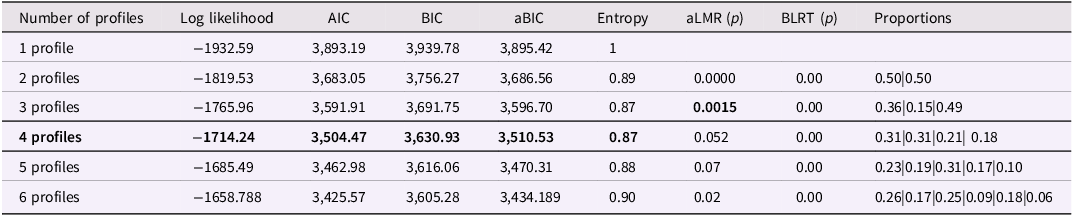
To select the optimal profile solution, we ran six successive latent profile models; the fit indices for each model are shown in Table 1. All models showed entropy values above 0.80, indicating good profile separation. The AIC and BIC decreased until the 6-profile solution, with an elbow effect at the four-profile solutions. Although the aLMR favored the three-profile solution over the four-profile solution, the BLRT was significant for the four-profile solution, and the aLMR result was marginal. Additionally, the AIC and aBIC were lower for the four-profile solution. Consequently, based on the fit indices and interpretability, the four-profile solution was selected.
Fit indices for latent profile models with 1 to 6 profiles

Table 1. Long description
The table presents fit indices for latent profile models with 1 to 6 profiles. It includes columns for Number of profiles, Log likelihood, AIC, BIC, aBIC, Entropy, aLMR (p), BLRT (p), and Proportions. Row 1: 1 profile, -1932.59, 3893.19, 3939.78, 3895.42, 1. Row 2: 2 profiles, -1819.53, 3683.05, 3756.27, 3686.56, 0.89, 0.0000, 0.00, 0.50 | 0.50. Row 3: 3 profiles, -1765.96, 3591.91, 3691.75, 3596.70, 0.87, 0.0015, 0.00, 0.36|0.15|0.49. Row 4: 4 profiles, -1714.24, 3504.47, 3630.93, 3510.53, 0.87, 0.052, 0.00, 0.31|0.31 | 0.21|0.18. Row 5: 5 profiles, -1685.49, 3462.98, 3616.06, 3470.31, 0.88, 0.07, 0.00, 0.23|0.19|0.31|0.17|0.10. Row 6: 6 profiles, -1658.788, 3425.57, 3605.28, 3434.189, 0.90, 0.02, 0.00, 0.26|0.17|0.25|0.09|0.18|0.06.
Note. Bolded values reflect the selection of the four-profile model based on fit indices and interpretability.
The four-profile solution
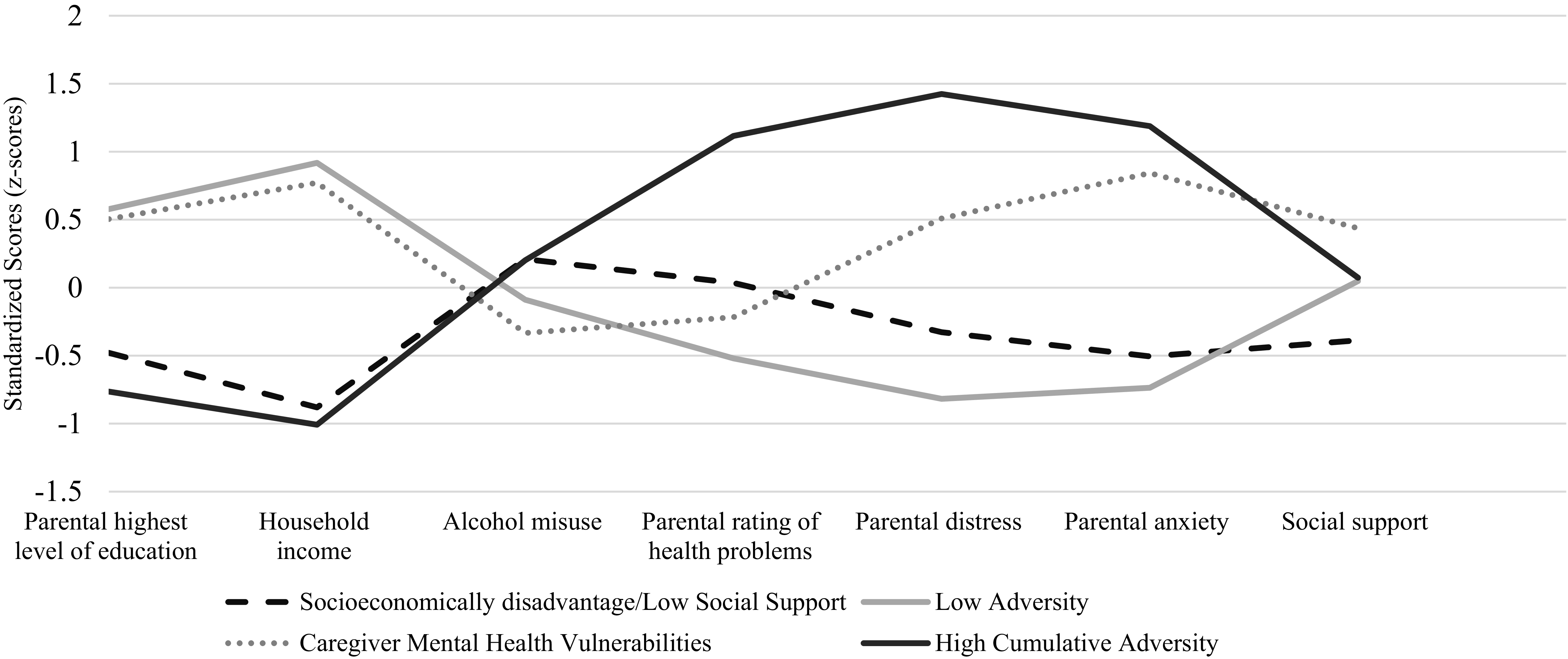
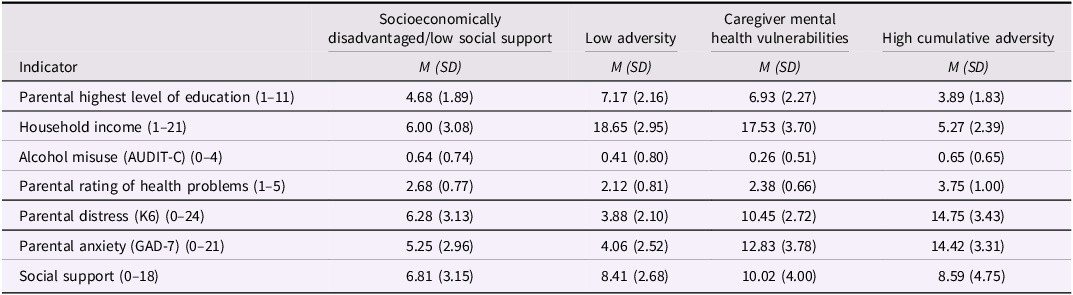
The four profiles based on the seven indicators were as follows: relative to the sample’s mean z score, the first profile, Socioeconomically Disadvantaged/Low Social Support (30.68%), showed low education and income; lowest social support; average binge drinking and self-rated physical health; and below-average psychological distress and anxiety. The second profile, Low Adversity (31.18%), was characterized by high education and income; low psychological distress and anxiety; low binge drinking and average social support. The third profile, Caregiver Mental Health Vulnerabilities (20.57%), reported average-high socioeconomic status, lower than average health problems, and elevated psychological distress and anxiety. The last profile, High Cumulative Adversity (17.57%), reported the highest levels of socioeconomic disadvantage, more perceived health problems, high psychological distress and anxiety, average binge drinking, and social support. Figure 2 presents the four profiles based on standardized scores across each indicator. Unstandardized means and standard deviations of profile indicators across family adversity profiles are shown in Table 2. Exploratory analyses were conducted to examine whether uptake of the optional EDP program differed across adversity profiles. Although the omnibus ANOVA did not reach statistical significance, F(3, 99) = 2.59, p = .057, descriptive differences in EDP attendance were observed across profiles. Families in the Caregiver Mental Health Vulnerabilities profile attended the greatest number of EDP sessions (M = 5.05, SD = 2.04), whereas families in the High Cumulative Adversity profile attended the fewest (M = 3.25, SD = 2.40).
Standardized mean scores on profile indicators across the four identified family adversity profiles. The y-axis represents standardized scores (z-scores), with positive values indicating scores above the sample mean and negative values indicating scores below the sample mean. The x-axis represents the seven indicators used in the latent profile analysis.

Unstandardized means and standard deviations of profile indicators across family adversity profiles
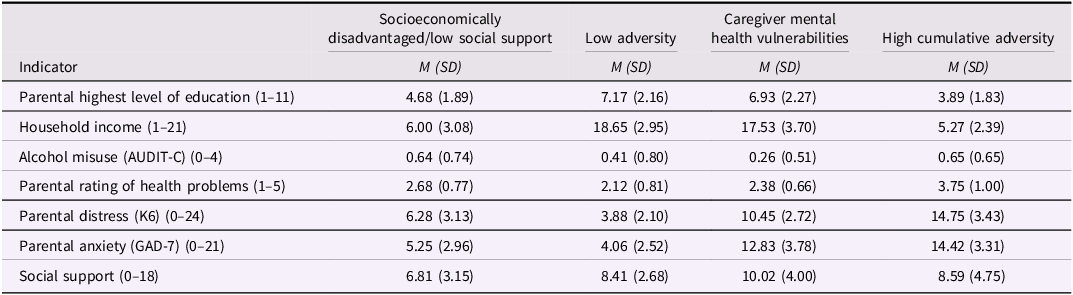
Table 2. Long description
A table with four rows and five columns comparing family adversity profiles across various indicators. The columns are labeled Socioeconomically disadvantaged/low social support, Low adversity, Caregiver mental health vulnerabilities, and High cumulative adversity. Each column provides the mean and standard deviation for each indicator. The indicators include Parental highest level of education, Household income, Alcohol misuse, Parental rating of health problems, Parental distress, Parental anxiety, and Social support. Row 1: Parental highest level of education, Socioeconomically disadvantaged/low social support M 4.68 (SD 1.89), Low adversity M 7.17 (SD 2.16), Caregiver mental health vulnerabilities M 6.93 (SD 2.27), High cumulative adversity M 3.89 (SD 1.83). Row 2: Household income, Socioeconomically disadvantaged/low social support M 6.00 (SD 3.08), Low adversity M 18.65 (SD 2.95), Caregiver mental health vulnerabilities M 17.53 (SD 3.70), High cumulative adversity M 5.27 (SD 2.39). Row 3: Alcohol misuse, Socioeconomically disadvantaged/low social support M 0.64 (SD 0.74), Low adversity M 0.41 (SD 0.80), Caregiver mental health vulnerabilities M 0.26 (SD 0.51), High cumulative adversity M 0.65 (SD 0.65). Row 4: Parental rating of health problems, Socioeconomically disadvantaged/low social support M 2.68 (SD 0.77), Low adversity M 2.12 (SD 0.81), Caregiver mental health vulnerabilities M 2.38 (SD 0.66), High cumulative adversity M 3.75 (SD 1.00). Row 5: Parental distress, Socioeconomically disadvantaged/low social support M 6.28 (SD 3.13), Low adversity M 3.88 (SD 2.10), Caregiver mental health vulnerabilities M 10.45 (SD 2.72), High cumulative adversity M 14.75 (SD 3.43). Row 6: Parental anxiety, Socioeconomically disadvantaged/low social support M 5.25 (SD 2.96), Low adversity M 4.06 (SD 2.52), Caregiver mental health vulnerabilities M 12.83 (SD 3.78), High cumulative adversity M 14.42 (SD 3.31). Row 7: Social support, Socioeconomically disadvantaged/low social support M 6.81 (SD 3.15), Low adversity M 8.41 (SD 2.68), Caregiver mental health vulnerabilities M 10.02 (SD 4.00), High cumulative adversity M 8.59 (SD 4.75).
Profile membership and behavior problems
First, we tested whether the distribution of profiles differed across intervention groups at baseline. No significant differences were found between the FCU® and the comparison group.
Profiles were compared at baseline on children’s internalizing and externalizing behavior problems. Detailed results are reported in Table 3. At baseline, children from the Low Adversity and Socioeconomically Disadvantaged/Low Social Support profiles showed the lowest levels of internalizing behavior problems, while the Low Adversity profile showed the lowest levels of externalizing behaviors.
4-Profiles solution means of outcomes at baseline

Table 3. Long description
A table comparing profiles of children’s internalizing and externalizing behavior problems at baseline. The table has four rows and five columns. The columns are labeled Class 1, Class 2, Class 3, Class 4, and Overall. The rows are labeled Internalizing behaviors and Externalizing behaviors. Row 1: Class 1, Socioeconomically disadvantage/low social support, 30.68 percent, M, 58.04, SE, 1.35. Class 2, Low adversity, 31.18 percent, M, 56.78, SE, 1.10. Class 3, Caregiver mental health vulnerabilities, 20.57 percent, M, 63.00, SE, 1.88. Class 4, High cumulative adversity, 17.6 percent, M, 64.83, SE, 1.63. Overall, 20.82, p, 0.00. Row 2: Class 1, Socioeconomically disadvantage/low social support, 30.68 percent, M, 64.33, SE, 1.40. Class 2, Low adversity, 31.18 percent, M, 61.40, SE, 1.21. Class 3, Caregiver mental health vulnerabilities, 20.57 percent, M, 67.66, SE, 1.77. Class 4, High cumulative adversity, 17.6 percent, M, 69.72, SE, 1.96. Overall, 16.34, p, 0.001.
Internalizing behaviors: Classes 1 and 2 (a) < Classes 3 and 4 (b).
Externalizing behaviors: Class 1 (ab) < Class 4 (c). Class 2 (a) < Class 4 (c). Class 2 (a) < Class 3 (bc). Class 1 (ab) does not differ significantly from Classes 2 or 3. Class 3 (bc) does not differ significantly from Classes 1 or 4.
Change in behavior problems
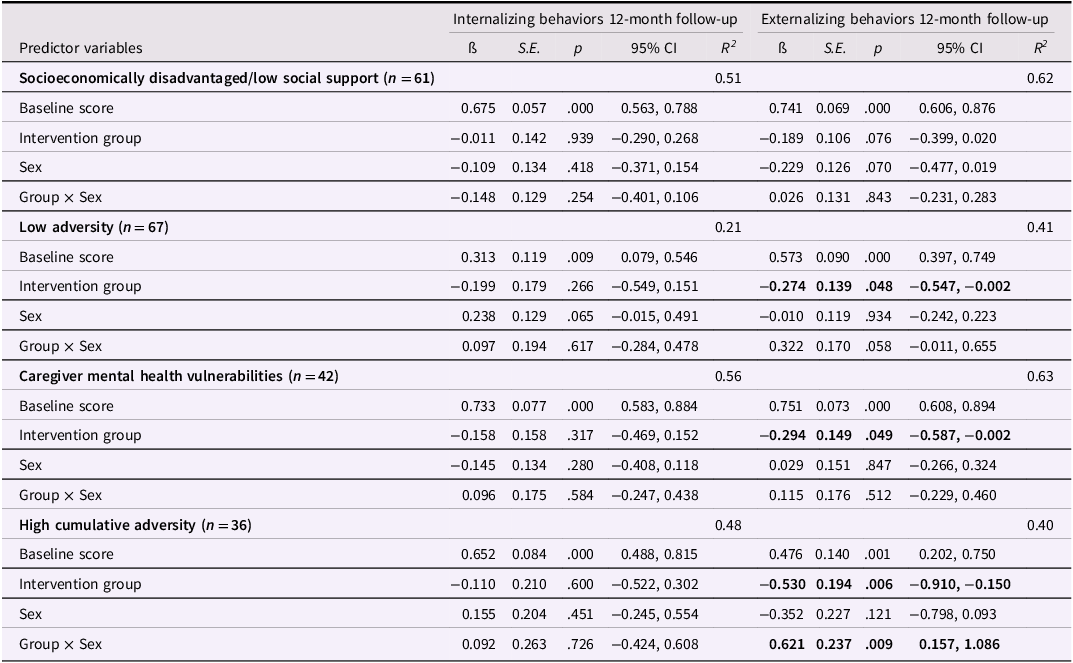
Results showed no program effect for internalizing behaviors across any profile. For externalizing behaviors, program effect was marginal for the Socioeconomically Disadvantaged/Low Social Support profile (ß = −0.189, p = .08) and significant for Low Adversity (ß = −0.274, p = .048), Caregiver Mental Health Vulnerabilities (ß = −0.294, p = .049), and High Cumulative Adversity (ß = −0.530, p = .006) profiles.
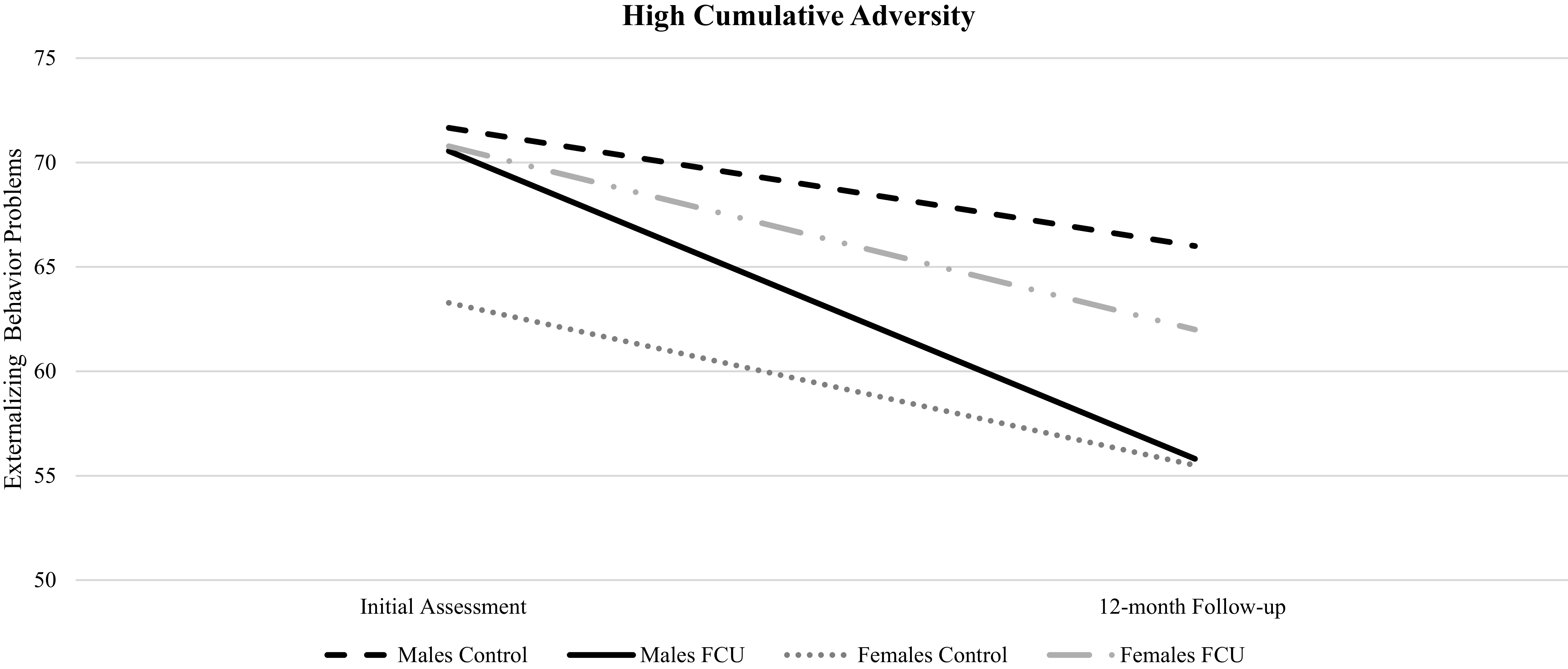
We also tested the moderating effect of sex. The effect was not significant for the Socioeconomically Disadvantaged/Low Social Support and the Caregiver Mental Health Vulnerabilities profiles, marginal for the Low Adversity profile (ß = 0.322, p = .058), and significant for the High Cumulative Adversity profile (ß = 0.621, p = .009). Simple slopes were probed for High Cumulative Adversity profiles, where program effect was significant for males (ß = −0.525, p = .002, 95% CI [−0.861, −0.189]) but not for females (ß = 0.029, p = .826, 95% CI [−0.232, 0.290]) (Figure 3). Detailed results are shown in Table 4.
Change in externalizing behavior problems as a function of intervention group and sex in the High Cumulative Adversity profile. Simple slopes of externalizing behavior problems from initial assessment to 12-month follow-up for boys and girls in the FCU® and control conditions within the High Cumulative Adversity profile. The y-axis represents mean T-scores on the Child Behavior Checklist (CBCL) externalizing subscale. Higher scores indicate greater externalizing behavior problems.

Program effect as a function of sex and profile
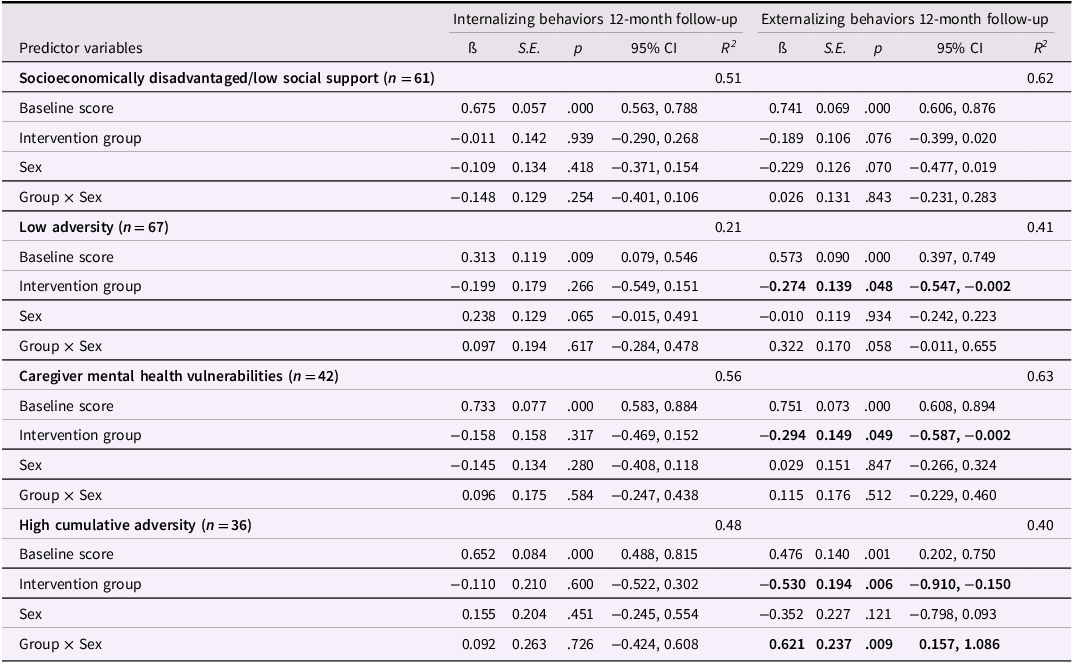
Table 4. Long description
The table presents the effects of intervention on internalizing and externalizing behaviors across different profiles and a 12-month follow-up period. It includes predictor variables, beta coefficients, standard errors, p-values, 95% confidence intervals, and R-squared values for each profile. The profiles include Socioeconomically Disadvantaged/Low Social Support, Low Adversity, Caregiver Mental Health Vulnerabilities, and High Cumulative Adversity. Each profile has rows for baseline score, intervention group, sex, and group by sex interaction. Significant p-values are bolded.
Note. Bolded values reflect profiles for which there were statistically significant (p less than/equal to 0.05) effects for intervention (i.e., ‘group’) and/or interactions between child sex and intervention reflecting a moderating role for child sex at birth.
Discussion
This study aimed to identify adversity profiles among families participating in the Canadian evaluation of the FCU®, and to examine program effectiveness in relation to these profiles. Four profiles emerged: Socioeconomically Disadvantaged/Low Social Support (30.68%), Low Adversity (31.18%), Caregiver Mental Health Vulnerabilities (20.57%), and High Cumulative Adversity (17.57%). To date, only one study examined adversity profiles among FCU® participants (Pelham III et al., Reference Pelham, Dishion, Tein, Shaw and Wilson2017). Compared to the current study, Pelham et. al. identified a higher proportion of socioeconomically disadvantaged families (44.2%) and a lower percentage of low-risk families (24.8%) but similar levels of cumulative adversity (12.7%). The difference in proportion is likely due to a difference in sampling method. Specifically, Pelham’s participants were recruited through the Special Supplemental Nutrition Program for Women, Infants, and Children (WIC) program, which provides services to low-income families, while in the current study, we used a community-based recruitment method. Consequently, our sample included families across a broader range of socioeconomic backgrounds.
Adversity profiles and behavior problems at baseline
At baseline, children from the Socioeconomically Disadvantaged/Low Social Support and Low Adversity showed similar levels of internalizing and externalizing behavior problems. One explanation could be that poor socioeconomic status alone does not necessarily predict behavior problems. A second-order meta-analysis including studies across all age groups and primarily conducted in the United States reported weak associations between socioeconomic status and internalizing problems and a small but significant association for externalizing behaviors for males only (Korous et al., Reference Korous, Causadias, Bradley and Luthar2018). Nonetheless, although the difference between these two profiles in externalizing behavior was not statistically significant, children from the Socioeconomically Disadvantaged/Low Social Support profile scored above the clinical threshold, while those from the Low Adversity profile scored below it. This could be explained by the fact that families in the Socioeconomically Disadvantaged/Low Social Support profile also report low social support, which could exacerbate parenting stress and increase the risk of the child exhibiting behavior problems (Heberle et al., Reference Heberle, Krill, Briggs-Gowan and Carter2015).
Children in the Caregiver Mental Health Vulnerabilities and High Cumulative Adversity profiles had significantly more internalizing and externalizing behavior problems than did children from the Low Adversity group at baseline. These results are consistent with prior studies that have found positive associations between parental mental illness and children’s psychological maladaptation (Flouri et al., Reference Flouri, Sarmadi and Francesconi2019; Sutherland et al., Reference Sutherland, Nestor, Pine and Garber2022). Similar results have also been found in studies using a cumulative risk approach, in which exposure to multiple types of adversity predicts poorer child functioning (Stein et al., Reference Stein, Sheridan, Copeland, Machlin, Carpenter and Egger2022). More recently, using person-centered approaches, Cooper and colleagues (Reference Cooper, Bayly, Tennie, Lupini and Wadsworth2025) also found that children in families exposed to multiple types of adversities were at a higher risk of developing behavior problems (irrespective of type), although the profile of those exposed to high IPV included lower levels of externalizing behaviors compared to the low-risk group.
Program effects
The second objective of our study was to examine whether the effectiveness of the FCU® differed across the identified adversity profiles. First, results indicated a significant overall decrease in externalizing behaviors for three profiles, namely Low Adversity, Caregiver Mental Health Vulnerabilities, and High Cumulative Adversity, with the High Cumulative Adversity group showing the largest effect. Although the FCU® does not directly target parental mental health, clinicians address it explicitly and collaboratively within a motivational interviewing framework and provide referrals to services as needed. The program may also indirectly benefit parents experiencing psychological distress and anxiety by providing them with strategies to strengthen their parenting practices and promote a more stable home environment. This could result in parents in the Caregiver Mental Health Vulnerabilities profile, who otherwise are not faced with other adversities, experiencing fewer barriers to implementing more consistent and supportive parenting strategies, thereby reducing their child’s externalizing behaviors. Although there was no statistically significant difference in the uptake of the EDP program (i.e., non-engagers vs. those who opted into at least one session), of those who participated in follow-up parenting sessions, families in the Caregiver Mental Health Vulnerabilities profile attended the greatest number. This finding may be clinically relevant and aligns with the possibility that caregivers experiencing mental health difficulties may be more likely to actively seek out additional support and engage with optional intervention components.
For children within the Socioeconomically Disadvantaged/Low Social Support profile, the program effect was marginal. Given that this group represented approximately a third of our sample (30.68%), the marginal effects observed are unlikely due to insufficient power alone. This could reflect instead that the FCU® has a relatively smaller effect on externalizing behavior problems in economically disadvantaged Canadian families in the context of having fewer social supports. These findings are consistent with Pelham and colleagues’ study, which also found a small effect size (d = −0.08) for children from families with low income but otherwise low risk (Reference Pelham, Dishion, Tein, Shaw and Wilson2017). One explanation could be that although these parents perceive themselves as being physically healthy and report having a low level of mental health problems, their limited access to social supports might undermine their ability to implement the strategies taught in the program fully. Specifically, parents’ limited access to physical and social resources might reduce their ability to maintain consistent routines and reinforce learned strategies at home (Santiago et al., Reference Santiago, Garbacz, Behar-Zusman, Ramos, Ortega, Dumka and Sigal2021).
For internalizing behaviors, we did not observe a program effect for any of the profiles. This finding is not unexpected, as internalizing behaviors tend to be more difficult to detect in early childhood and often become more apparent during middle childhood and adolescence (Gutman & Codiroli McMaster, Reference Gutman and Codiroli McMaster2020). Moreover, the FCU® primarily targets parenting practices related to behavior management that are more closely associated with externalizing behaviors than with internalizing behaviors (Dishion et al., Reference Dishion, Brennan, Shaw, McEachern, Wilson and Jo2014). Studies investigating the effect of the FCU® on internalizing behaviors among preschoolers remain relatively scarce (Metcalfe, Reference Metcalfe2024). It is possible that the effect on internalizing behaviors is not direct and instead operates through other mechanisms. For example, a longitudinal study found that participation in the FCU® at age two reduced the risk of internalizing behaviors by increasing positive maternal behavior support and reducing maternal depressive symptoms (Wang et al., Reference Wang, Feldman, Lemery-Chalfant, Wilson and Shaw2019). This suggests that while the effect of the FCU® might not be direct in the short term, the strategies parents acquire through the program might help prevent such difficulties over time, especially as internalizing behaviors become more apparent in later years.
Another objective of this study was to investigate, within the profiles, the moderating effect of sex on the change in behavior problems. Results showed that while the program was equally effective for both males and females in the Caregiver Mental Health Vulnerabilities profile, a significant interaction effect was found for the High Cumulative Adversity profile. More specifically, the program showed a significant effect for males in the High Cumulative Adversity profile. Although previous research has found no moderation of sex on the effectiveness of the FCU® (Connell et al., Reference Connell, Magee, Stormshak, Ha, Westling, Wilson and Shaw2021; Smith et al., Reference Smith, Wakschlag, Krogh-Jespersen, Walkup, Wilson, Dishion and Shaw2019; Stormshak et al., Reference Stormshak, Seeley, Caruthers, Cardenas, Moore, Tyler and Danaher2019), studies evaluating other family interventions with high-risk groups have also found a stronger reduction in externalizing behavior in boys (Gardner et al., Reference Gardner, Hutchings, Bywater and Whitaker2010; Lindsey et al., Reference Lindsey, Hayward and DePanfilis2009). This suggests that program effectiveness may be differently associated with child sex, depending on the socioeconomic context or intervention content. Of note, we found no sex difference in externalizing behaviors at baseline, suggesting that this differential response is unlikely due to initial disparities in symptomatology. One explanation could be that a more socially oriented form of aggression, such as relational aggression, which is more commonly observed in girls, was not captured by the measure used in this study (Björkqvist, Reference Björkqvist2018). Consequently, the program’s impact on females’ externalizing behaviors may have been underestimated. Nevertheless, these results should be interpreted with caution, since the sample size for the High Cumulative Adversity was small, which might limit statistical power to detect sex-specific moderation effects reliably. The male-specific effect observed should therefore be considered preliminary and warrants replication using a larger sample size.
Strengths and limitations
This study is the first to evaluate the differential effect of the FCU® in the Canadian context. By drawing adversity profiles at baseline and examining sex differences in program response, we were able to provide a nuanced evaluation of the program. However, some limitations should be noted. First, the number of children per profile was relatively low, which may have contributed to the non-significant findings. Second, children’s behavior problems were assessed by a single informant. Incorporating multiple sources of information, such as child self-reports or early childhood educators, could have provided a more comprehensive evaluation. Third, although socioeconomic status was measured using two indicators (household income and parental levels of education), these variables might not fully capture the breadth of socioeconomic adversity that families can face. Future studies should consider including more comprehensive measures of socioeconomic adversity. Furthermore, because attrition was higher among lower-income and lower-education families, variables used as profile indicators may be underrepresented in our sample, thereby affecting the composition of identified profiles. Consequently, findings should be interpreted with caution regarding their generalizability to the most socioeconomically disadvantaged families. Finally, the sample was relatively homogeneous in terms of ethnicity (88.3% white), which limits the generalizability of findings to more diverse populations. Future studies should prioritize recruitment strategies that reflect more accurately the composition of Canadian families. Nevertheless, this study offers preliminary evidence supporting the relevance of implementing the FCU® in the Canadian setting, especially for families exposed to high adversity.
Implications for practice
Findings from this study are relevant for the implementation of the FCU® in Canada. First, the limited impact of the FCU® among families with socioeconomically disadvantaged families with low social support suggests that although parents are provided with referrals in the feedback, more intensive support might be needed to address more immediate concerns related to social determinants of health (e.g., housing, unemployment). In our implementation, we offered a maximum of six sessions for the EDP portion of the program. Intensifying this component by allowing families to participate in additional sessions, as needed, could be beneficial. Future implementation of the FCU® in Canada could also include a more intensive system navigation component, as has been implemented in a recent US study of the program (Krug et al., Reference Krug, Mendelsohn, Wuerth, Roby and Shaw2025). Beyond formal sources of support, strengthening families’ informal support, for example, integrating peer support components, enhancing social skills, and identifying supportive figures, could provide everyday assistance that enables families to better engage and benefit from interventions.
Conclusion
This study highlighted the differentiated effectiveness of the FCU® across adversity profiles. Our findings suggest that the FCU® is effective in decreasing externalizing behaviors in Canadian families facing adversity. However, effects appeared weaker for females and for families with low social support. Future research should investigate the mechanisms underlying these differential effects and investigate sex-specific pathways of change. Mediation models investigating malleable factors, such as child emotion recognition and parental behaviors, could help identify specific processes underlying program effectiveness. Future studies should also examine whether family adversity profiles predict changes in parent mental health and whether such changes help explain child outcomes. Identifying these mechanisms may inform future implementation of FCU® in Canada, ensuring the program is tailored to the needs of families facing diverse forms of adversity to maximize impact and equity.
Data availability statement
The study was conducted in accordance with the Transparency and Openness Promotion (TOP) guidelines, where feasible. Due to limitations in the original informed consent and the sensitive nature of participant data, the data set cannot be deposited in a public repository. De-identified data and analytic code may be made available upon reasonable request to the corresponding author, subject to institutional ethics approval and data-sharing agreements.
Acknowledgments
We thank the families and clinicians who participated in the study and shared their feedback, as well as our trainers at Arizona State University/REACH and the Universities of Pittsburgh and Oregon, and our community partners from the Hamilton Infant and Early Years Mental Health Roundtable. The research team included Sofia Al Balkhi, Erin Baird, Annie Beatty, Amanda Bonomo, Meghan Dovey, Aisha Farooq, Anne Kang, Oya Pakkal, Mandy Sahota, and Amy Vanderkooy. Our research clinicians were Tamara Krbavac, Angie Burroughsford, Melissa Kimber, Heather Prime, and Andrea Brown. We also thank our independent peer reviewers for their valuable time and feedback. The FCU® is a registered trademark of the University of Oregon.
Funding statement
Dr Laetitia Mélissande Amédée is supported through the Social Sciences and Humanities Research Council (SSHRC) Postdoctoral Fellowship and the Hamilton Health Foundation. Dr Andrea Gonzalez is supported by a Tier II Canada Research Chair in Family Health and Preventive Interventions. Dr Katholiki Georgiades is supported by the David R. (Dan) Offord Chair in Child Studies. Dr Teresa Bennett is supported by the Jack Laidlaw Chair in Patient-Centered Care. This study was funded by a Brain Canada/RBC Foundation Multi-Investigator Team Grant, the Hamilton Health Sciences Foundation, and the Lisa Brown Foundation.
Competing interests
The authors report there are no competing interests to declare.
Ethical standards
All caregivers provided written informed consent for participation and for the use of their data. The research was submitted and approved by the Institutional Review Board (IRB) of the Hamilton Integrated Research Ethics Board (#1558; May 4, 2016).
Pre-registration statement
This trial was registered at Clinicaltrials.gov (#NCT02800603), on June 14, 2016. Full details are available at https://clinicaltrials.gov/study/NCT02800603.
AI statement
No artificial intelligence tools were used to create the intellectual content of this article.



 Open access

