




No CrossRef data available.
The Role of Contrast in the Local Licensing of Scrambling in German: Evidence from Online Comprehension
Published online by Cambridge University Press: 12 April 2006
Abstract
We examine the role of contrast in the local licensing of scrambling in on-line language comprehension in German using event-related brain potentials (ERP). Although contrastive readings give rise to a higher acceptability of scrambled word orders, they do not lead to an attenuation of the processing difficulties observed at the position of the scrambled object itself. Thus, similar to previous findings on givenness, contrast leads to global but not local licensing of scrambled structures, a finding that speaks against an immediate interaction of all relevant information types. The pattern is reversed when the scrambled object induces a corrective focus reading. Here scrambling does not give rise to increased local processing cost, but global acceptability decreases. These findings suggest that corrective focus can override local syntactic requirements on the basis of its extraordinarily high communicative saliency.
Information
- Type
- ARTICLES
- Information
- Copyright
- © 2006 Society for Germanic Linguistics
1. Introduction.
One of the most fundamental questions within the study of language architecture concerns the nature of the interfaces between different domains of the grammar. Thus, both in the theory of grammar (for example, Chomsky 1995, 2000, Jackendoff 2002, Prince and Smolensky 1997) and in psycholinguistics (for example, Frazier 1987, MacDonald et al. 1994), it has been debated whether the relationship between distinct grammatical components is interactive or modular in nature. From the perspective of theoretical linguistics, a precise characterization of the interfaces between different grammatical domains (for example, syntax, semantics, phonology) forms a crucial part of understanding how language is organized as a whole (Jackendoff 2002, Müller 1999). Furthermore, interface considerations are also essential for the modeling of language from the perspective of the speaker and/or hearer, since they can help to specify which pieces of information are taken into account at which point in time during the processing of a linguistic input—an essential aspect of linguistic performance.
Information structure has often been considered a locus of interaction between different grammatical domains such as semantics, pragmatics, syntax and phonology and, as such, appears well suited for the examination of cross-domain dependencies within the grammar. For example, it has often been argued that certain word order phenomena in languages such as German should be attributed to the influence of information structure. This is illustrated in 1, from Lenerz (1977:99).

The embedded sentence in 1b is object-initial, that is, it departs from the default nominative-initial word order, and is therefore substantially more marked than its subject-initial counterpart in a neutral context. However, this clause medial argument order variation (SCRAMBLING) is licensed in the context of a sentence such as 1a, an intuitive impression that has been confirmed by psycholinguistic experiments examining acceptability judgments of naive speakers (Meng et al. 1999). Thus, it seems clear that if an object is given by the context it can felicitously appear clause-medially before the subject.
While the examples in 1 show that syntactic considerations, as well as considerations of information structure (that is, semantics, pragmatics, and phonology), must interact at some point during the derivation, production, and interpretation of 1b, the exact nature of this interaction cannot be specified. A variety of theoretical accounts have been proposed in this regard, including (a) blind generation of alternative word orders in the syntax in combination with licensing at an interface (Fanselow 2001, Haider and Rosengren 2003); (b) overt movement to the specifier of a functional projection (Frey 2000, Meinunger 1995, Pili 2000; see also Rizzi 1997); and (c) a direct interaction of syntactic and non-syntactic (that is, prosodic and information structure) properties in an optimality theoretic (OT) framework (Büring 2001, Büring and Gutiérrez-Bravo 2001, Heck 2000). Some of these approaches may be argued against on purely theoretical grounds (see Fanselow 2003 and Haider and Rosengren 2003 for evidence disfavoring functional projection-based accounts, for example). However, it is often difficult to differentiate between the various alternatives on empirical grounds, since the predicted outcome—the surface behavior of the language—is the same in both cases, namely in showing an interaction between two domains.
One way of approaching this difficulty empirically is to examine the interaction between the different domains in question from the time-sensitive perspective of language comprehension. Indeed, the question of how and when information sources from different grammatical domains interact with one another during the comprehension process has played an important role in shaping psycholinguistic research over the past decades (see Mitchell 1994). A major debate in this regard has focused on the distinction between modular and interactive models. The former assume that only syntactic information (typically even only a word category) is taken into account during a first stage of processing (see, for example, Frazier 1978 and Frazier and Rayner 1982), whereas the latter propose that all available information types interact from the very beginning (see, for example, MacDonald et al. 1994). Importantly, as sentence comprehension is a process that unfolds over time, the modularity versus interactivity distinction does not apply to entire sentences (as in theoretical linguistics), but rather to the processing of each incoming input element (word) during left-to-right, incremental sentence interpretation. Thus, applying this perspective to the licensing of scrambled word orders in German raises the question of how different information types interact at the position of the scrambled object itself.
How, then, might processing effects at the (mid-sentential) position of the scrambled object be used to differentiate between competing theoretical accounts of scrambling? We believe that the answer to this question, that is, the link between the theoretical and the processing domains, can be derived naturally from the following observations. In essence, all theoretical approaches to scrambling share the following two assumptions: (a) the scrambled structure is, in some sense, syntactically more complex or dispreferred (for example, by way of involving an additional movement operation), and (b) the scrambling operation is licensed somehow by a particular factor or combination of factors.
Theories differ fundamentally, however, with respect to the question of how this licensing is accomplished. On the one hand, interface-based models (such as Fanselow 2001, 2003, Haider and Rosengren 2003) are based on the assumption that scrambling is syntactically optional, that is, it may apply whenever the grammar does not forbid it. For example, according to Haider and Rosengren, this is the case in OV languages, which do not rely on positional identification of arguments. From this perspective, the contextual dependency of scrambling arises at a “post syntactic” interface level, where the outcome of the syntactic derivation is mapped onto other grammatical domains (for instance, semantics).
In contrast to such modular approaches, another class of models assumes what might be termed a “direct interaction” between different grammatical domains (see Büring 2001, Büring and Gutiérrez-Bravo 2001, Heck 2000, and Zubizarreta 1998). Models of this type—which are primarily OT-based—assume that scrambling applies in order to satisfy some other grammatical property. In terms of OT this means that the syntactic constraint forbidding scrambling is dominated by some other (non-syntactic) constraint satisfied by a scrambled structure, but not by its unscrambled counterpart.
Finally, models assuming a syntactic trigger for scrambling (Frey 2000, Meinunger 1995, Pili 2000) encode the relevant licensing information into the syntax as features that trigger movement.
In light of these considerations, a fundamental distinction may be drawn between models assuming that the scrambling operation is required by some other property (for example, a triggering feature or a dominating constraint), and those postulating that scrambling may optionally apply in the syntax, with licensing taking place at a post-syntactic level. From a processing perspective, this distinction between “immediate” and “delayed” licensing maps onto the following predictions. On the one hand, if scrambling is required by some other property, it should not be associated with any additional local processing cost (that is, processing cost at the position of the scrambled object itself). On the other hand, if scrambling is licensed at an interface level, local processing cost may still be observable. Thus, if an interaction between word order and information structure is observable locally during language comprehension, this could be viewed as evidence in favor of a direct interaction without the modulating influence of a separate interface level. By contrast, if the interaction is confined to a global or whole sentence-based level, the performance data would correspond more closely to the predictions of interface-based theories.1
Of course, the assumption of a direct correspondence between performance and competence is not trivial. However, in absence of evidence to the contrary, the most parsimonious approach appears to be one that assumes as close a relationship between the two domains as possible, thereby legitimating the use of data from one perspective with regard to the other in the absence of domain-internal evidence. Such an approach also appears desirable in view of the proposed criterion of psychological adequacy (Dik 1991).
In this paper, we present data from real time language comprehension in order to shed light on how information structure influences the syntax in scrambled structures. In particular, previous studies have suggested that the influence of GIVENNESS is confined to the global level.2
The term givenness is used in the sense of “anaphorical recoverability” (Halliday 1967), and the term informational focus in the sense of Kiss 1998.
2. Scrambling: Insights from Language Comprehension.
The processing of word order variations has been of prime concern in the more recent literature on sentence comprehension in German. Studies of scrambling, in particular, have featured prominently, as clause-medial word order variations appear to give rise to much greater processing difficulty than clause-initial word order variations and, additionally, to a characteristic pattern in event-related brain potential (ERP) studies.3
For an introduction to this experimental method, see the appendix.
2.1. Processing Difficulties in the Absence of Context.
In the literature on sentence comprehension in German, it is well documented that scrambled word orders are associated with a higher degree of processing difficulty than their subject-initial counterparts. First, scrambled structures are generally judged to be less acceptable than the corresponding canonical structures, as shown in a questionnaire study by Pechmann et al. (1994), and by means of the speeded grammaticality judgment technique by Bader and Meng (1999). In addition to these global costs (that is, applying to the clause as a whole) related to scrambling, there is also evidence for a more local source of processing difficulties. Thus, Rösler et al. (1998) examined sentences such as 2 using ERPs as the dependent measure. Critical sentence positions (that is, positions to which the experimental measures in question were applied) are indicated in bold.

Rösler et al. (1998) observe a negativity over left-hemispheric electrode sites for the scrambled orders in 2a,b in comparison to the base order in 2c from 300–450 ms post onset of the determiner of the first argument. This effect (SCRAMBLING NEGATIVITY) has been replicated and investigated more closely in a number of further studies (Bornkessel et al. 2002, 2003, Schlesewsky et al. 2003), which indicate (a) that it is unlikely to result from the lower frequency of occurrence of scrambled structures, and (b) that it does not seem to reflect domain-general aspects of processing cost, such as additional working memory load.
Taken together, the results of these studies suggest that the scrambling negativity reflects the processing costs associated with a local violation of syntactic canonicity principles (Bornkessel et al. 2002, Friederici et al. 2003, Schlesewsky et al. 2003). Furthermore, rather than reflecting processing costs associated with word order variations in general, this component is apparently restricted to the processing of scrambling, since it has not been observed for wh-movement (Fiebach et al. 2002) or topicalization (fronting of an object to the clause-initial “prefield” position of the main clause; Matzke et al. 2002). Thus, the local negativity appears to constitute a suitable diagnostic tool for examining the interaction between syntax and other domains with regard to the licensing of scrambled word orders. The logic behind the approach pursued here lies in assuming that the ERP patterns reflect “local licensing” if no difference is observed between a scrambled order and its subject-initial analogue at the position of the scrambled argument.
2.2. Results on the Processing of Scrambling in Context.
The question of whether the increased processing cost observed for scrambled orders in the absence of a context is alleviated or even eliminated by the presence of a licensing context was first examined by Meng et al. (1999). These authors presented question and answer pairs such as those in 3–4 in a self-paced reading paradigm, in which participants were also required to judge whether context and target sentence formed a felicitous question and answer pair after each target sentence.4
In the self-paced reading task, participants read segmented sentences at their own pace by pressing a button to induce the presentation of the next segment. Higher processing difficulty at the position of a particular segment is reflected in higher reading times for that segment, or, in the case of so-called spill over effects, for the following segment(s).


In a neutral context such as 3a, object-initial sentences 4b showed both longer reading times at the position of the sentence-final auxiliary and lower acceptability ratings in comparison to their subject-initial counterparts in 4a. However, both of these differences disappeared when the object-initial sentence was presented in a facilitating context, as in 3c.
The data from Meng et al. (1999) therefore show that, at least sentence-finally, contextually induced differences in information structure influence the processing of scrambled sentences in German, as is to be expected on the basis of the intuitive judgments underlying the theoretical literature on scrambling. However, in view of the fact that the processing difficulties observed in scrambled structures appear to be primarily local in nature (that is, stemming from the processing of the fronted object, as described above), Meng et al.'s (1999) data, though demonstrating sentence-final facilitation, remain inconclusive as to whether a licensing context may facilitate the online processing of scrambled structures.
In order to examine whether the effects of givenness and informational focus would also impact upon the local processing difficulty at the position of the scrambled object, Bornkessel et al. (2003) conducted an ERP study using sentence materials as in 5–6. All object-initial conditions were compared to minimally differing subject-initial counterparts.

In a neutral context, Bornkessel et al. (2003) observed a left negativity between 350 and 550 ms post onset of an initial object in comparison to an initial subject, thereby replicating previous results. In the condition with a contextually given initial object (that is, the constellation in which the theoretical literature would predict scrambling to be licensed), an even more pronounced negativity was observed in comparison to the subject-initial condition. Thus, it appears that either (a) givenness per se is not a sufficient licensing condition for scrambling of an object, or (b) information structure is only a global, but not a local licensing factor with regard to scrambled word orders.
However, in the condition with an initial object that was focused by the context question, a parietal positivity between 280 and 480 ms post onset of the phrase was observed. A similar effect also obtained for initial focused subjects and focused second arguments (for example, der Lehrer in 6 in the context of 5b), thereby leading Bornkessel et al. to interpret this component as a general marker of focus integration (for similar findings, see Hruska and Alter 2004 and Johnson et al. 2003).
Interestingly, in a focus context, the ERP waveforms for initial objects and initial subjects did not differ from one another. In other words, there was no indication that objects elicited both a focus positivity and a scrambling negativity. Bornkessel et al. (2003) interpret these findings as showing that the contextual requirement for an element to fill the slot opened by the wh-pronoun in the constituent question may briefly override sentence-internal syntactic processes. Thus, while the similarity of the ERP response to subject- and object-initial sentences may, at first glance, appear to show that scrambling is indeed licensed locally under these conditions, further findings argue against focus per se as a local licensing factor for scrambling. For example, the contextual prediction established by a constituent question has also been shown to override other (syntactically-based) interpretation strategies (Altmann et al. 1998), thereby providing evidence for a general focus-based processing strategy, rather than for a particular role of focus in the processing of scrambling in German.
In summary, previous results on the processing of scrambled structures in context suggest that a local licensing of the scrambled word order—that is, licensing at the position of the scrambled argument itself rather than sentence finally—cannot be achieved via givenness.
3. The Present Study: Local Licensing via Contrast?
Taking the Bornkessel et al. 2003 study as a point of departure, the present research sought to establish whether more complex manipulations with information structure can license scrambling locally. In particular, we address the question of whether a contrastive reading of the scrambled object may serve as such a local licensing condition. To this end, dialogues such as those shown in 7–8 were constructed. Both dialogue types induce a contrastive reading in the sense of Jakobs 1988:113: “Kontrastiv ist ein Fokus dann, wenn er im jeweiligen sprach-lichen Kontext explizit irgendwelchen Fokusalternativen gegenübergestellt wird.”5
A focus is contrastive when it is explicitly compared to alternative foci in the given context.


In order to ensure that the manipulations in 7 and 8 did not lead to a situation akin to the focus condition in the Bornkessel et al. 2003 study, in which the presence of a focus-integration positivity induced by a wh-question context led to subject- and object-initial sentences behaving similarly to one another, the two control manipulations in 9–10 were constructed. If the interpretation proposed in Bornkessel et al. 2003 that the focus positivity reflects the fulfillment of a contextual prediction is correct, the contexts in 9–10 should not give rise to a focus positivity, since the critical objects in the target sentences are not explicitly questioned by a wh-phrase. Thus, these contexts should induce no confounding influence of focus integration.


In addition to constituting a control for 7, in which the critical argument is not questioned, the target sentence in 9 induces a corrective focus; that is, it corrects an assertion made in the preceding sentence. Even though this arguably introduces a distinction between this type of dialogue and the remaining three dialogue types, the focus involved may nonetheless be considered contrastive, because the object in the target sentence is contrasted with a salient alternative within the context.
All of the critical object-initial target sentences were compared to subject-initial control conditions that were presented in identical contexts and that were identical up to the point of the critical first argument in the subordinate clause of the target sentence, where they differed only in case marking. The complete set of experimental conditions is summarized in table 1.

In addition to the common denominator of inducing contrastive readings, there are several important differences between our four critical dialogue types. On the one hand, the saliency of the contextually introduced minimal range set (for the questioned discourse participants) differs between contexts 7/9 and 8/10, respectively, in that it is explicitly introduced in the last context sentence only in the latter. For contexts 7 and 9, by contrast, the minimal range set is introduced implicitly via the entire discourse. On account of this difference, we refer to dialogues of type 7/9 and dialogues of type 8/10 as implicitly contrastive and explicitly contrastive, respectively (see table 1). Note that this distinction refers solely to how the contrast is set up by the last sentence of the context and not to the relationship between the context and the target sentence.
When taking both context and target sentence into account, dialogues of type 9 may also be described as heightening the saliency of the contrast among two alternatives in that they call for a revision of what was asserted in the preceding sentence by requiring the replacement of one alternative with another (“corrective focus”). Thus, if it is the saliency of the contrast that is relevant for the local licensing of scrambling, we should expect an inverse relationship between the salience of the contrastive reading and the size of the ERP difference between the scrambled and the unscrambled order. More precisely, the less salient the contrastive reading is, the larger we would expect the scrambling negativity to be.
A further potential difference between the experimental conditions is prosodic in nature: While the target sentences in 8 and 10 are most naturally realized with a bridge-contour (that is, a rising pitch accent at the position of the first argument, followed by a falling pitch accent at the position of the second argument), the pitch accent on the initial object in 7 and 9 is falling.6
We will not differentiate between a rise-fall/bridge contour introduced by a pure rise and the one introduced by a fall-rise (the so-called “root contour”). Although it has been argued that there are subtle differences between sentences with these two intonational contours (Jakobs 1997), we assume that both fulfill the basic contrastive requirement of our materials. Moreover, since the present study employed a visual presentation mode, it appears difficult—if not impossible—to base one's line of argumentation on subtle prosodic differences of this type.
The possible availability of a bridge contour reading is particularly important for any study examining scrambling in German, as this contour has been associated with a grammatical operation distinct from that of scrambling proper, which has been referred to as “T-scrambling” (Haider and Rosengren 1998), or “focus fronting” (Haider 2002). T-scrambling is superficially similar to scrambling in that it involves a non-subject at the left edge of the German Mittelfeld. It differs from scrambling, however, in that it applies to a wider range of syntactic categories than scrambling, is not clause-bound and not iterative. Haider and Rosengren (1998) therefore characterize T-scrambling as an instance of A-bar movement targeting the specifier of a functional projection (see also Neeleman 1994 for a similar analysis). Crucially, T-scrambling is thought to obligatorily require the rise portion of a bridge contour for licensing (Haider and Rosengren 1998, Haider 2002). Thus, the potential availability of such a contour may lead the processing system to adopt a completely different syntactic analysis in comparison to a situation when a bridge contour is absent. These considerations are therefore very important for the interpretation of any local licensing effects that may appear in the present study.
Our hypotheses are therefore as follows. If contrast generally suffices for the local licensing of scrambled orders, we should not see any differences between object- and subject-initial sentences at the position of the first argument in the target sentences of all four conditions. By contrast, if it is the saliency of the contrastive reading that is relevant for the local licensing of scrambling, condition 7—in which the contrastive reading is arguably least salient—should be expected to pattern against all of the other conditions, with a local processing disadvantage for the scrambled sentences being observable only in the former. Finally, if local licensing relies on the possible availability of a T-scrambling analysis (and the syntactic consequences associated with it), only conditions 8 and 10 should show comparable ERP patterns for scrambled and canonical sentences, while scrambled objects should give rise to increased processing difficulty in the form of a local negativity in the remaining comparisons.
4. The Experiment.
4.1. Participants and Materials.
Twenty eight undergraduate students from the University of Leipzig participated in the experiment after giving informed consent (15 female; mean age 25.2 years; age range 21–29 years). All participants were right handed, monolingual native German speakers with normal or corrected-to-normal vision.
Eighty sets of the eight dialogue types summarized in table 1 were constructed. The resulting 640 dialogues were assigned to four lists of 160 dialogues each, two with the question context constructions (S/OIQ, S/OEQ) and two with the non-question context constructions (S/OIN, S/OEN). In this way, the presentation of conditions with explicitly questioned critical NPs (S/OIQ, S/OEQ) versus conditions without explicitly questioned critical NPs (S/OIN, S/OEN) was designed as a between-participants factor. Each participant was presented with 40 dialogues per condition in addition to 40 filler dialogues to balance the required answers to the judgment task (see below), thereby resulting in a total of 200 sentences.
4.2. Procedure.
Participants were assigned to one of the two groups at random at the beginning of an experimental session. Stimulus items were presented in two different randomized orders per list of materials.
Dialogues were presented visually in the centre of a computer screen, with context sentences presented in two segments and target sentences presented in a phrase-by-phrase manner (that is, determiners and nouns were presented together). Participants read the context sentences at their own pace and pressed a button to induce the presentation of the target sentence. For the target sentences, single words were presented for 450 ms and phrases for 500 ms with an inter-stimulus interval of 100 ms. Following the presentation of a target sentence, participants were required (a) to judge whether the target sentence was an acceptable continuation of the context (“yes” or “no”) within a 2000 ms time limit, and (b) to complete a probe detection task in which single words from either the context or the target sentence were presented (also within a 2000 ms time limit).
Participants were asked to avoid movements and to only blink their eyes between their response to the comprehension task and the presentation of the next sentence. The experimental session began with a short training session followed by 5 experimental blocks comprising 40 sentences each, between which the participants took short breaks. The entire experiment (including electrode preparation) lasted approximately 2.5 hours.
The EEG was recorded by means of 15 AgAgCl-electrodes fixed at the scalp by means of an elastic cap (Electro Cap International, Eaton OH). The ground electrode was positioned above the sternum. Recordings were referenced to the left mastoid, but rereferenced to linked mastoids offline. The electro-oculogram (EOG) was monitored by means of electrodes placed at the outer canthus of each eye for the horizontal EOG and above and below the participant's right eye for the vertical EOG. Electrode impedances were kept below 5 kOhm.
All EEG and EOG channels were amplified using a Twente Medical Systems DC amplifier (Enschede, The Netherlands) and recorded continuously with a digitization rate of 250 Hz. The plots of grand average ERPs were smoothed off-line with a 10 Hz low pass filter, but all statistical analyses were computed on unfiltered data.
Average ERPs were calculated per condition per participant from the onset of the critical stimulus item (that is, the first NP in the subordinate clause of the target sentence) to 1000 ms post onset, before grand-averages were computed over all participants. Averaging took place relative to a baseline interval from −200 to 0 ms before the onset of the critical NP. Trials for which the probe-detection task was not performed correctly were excluded from the averaging procedure, as were trials containing ocular, amplifier-saturation or other artefacts (the EOG rejection criterion was 40μV. On average, 14% of all trials (approximately 5–6 trials per condition and participant) were excluded from the final data analysis in this way. These were distributed equally across conditions.
4.3. Data Analysis.
For the first behavioral task, the judgment of whether target sentences constituted an acceptable continuation of the context, acceptability ratings and reaction times were calculated for each condition. With regard to the probe detection task, percentages of correct answers and reaction times were computed. Incorrectly answered trials were excluded from the reaction time analysis for the probe detection task. We computed a repeated measures analysis of variance (ANOVA) involving the between participants factor QUEST (question context versus no-question context), the within participants factors ORDER (subject-object versus object-subject), and CONTRAST (explicit versus implicit), and the random factors participants (F1) and items (F2).
For the statistical analysis of the ERP data, repeated measures ANOVAs involving the between participants factor QUEST (question context versus no question context) and the within participants factors ORDER (subject-object versus object-subject) and CONTRAST (explicit versus implicit) were calculated for mean amplitude values per time window per condition in three regions of interest (ROIs). Regions of interest were defined as follows: anterior (F5, F3, FZ, F4, F6), central (C5, C3, CZ, C4, C6), and posterior (P5, P3, PZ, P4, P6). Time windows were chosen on the basis of previous findings and visual inspection of the data. The statistical analysis was carried out in a hierarchical manner, that is, only significant interactions (p ≤ .05) were resolved. In order to avoid excessive type 1 errors due to violations of sphericity, we applied the correction proposed by Huynh and Feldt (1970) when the analysis involved factors with more than one degree of freedom in the numerator.
5. Results.
5.1. Behavioral Data.
The mean acceptability/error rates and reaction times for both behavioral tasks are shown in table 2: acceptability ratings (%) and reaction times (ms) for the acceptability of continuation judgment task, and accuracy rates (%) and reaction times (ms) for the probe detection task. Standard deviations are listed in parentheses.

5.2. Acceptability Judgment Task.
The statistical analysis of the acceptability ratings for the judgment task (“Is the target sentence an acceptable continuation of the context?”) revealed main effects of QUEST (F1 (1,26) = 5.34, p < .03; F2 (1,158) = 23.20, p < .0001) and ORDER (F1 (1,26) = 35.61, p < .0001; F2 (1,158) = 221.84, p < .0001). These effects indicate that target sentences were judged to be more acceptable continuations when they followed question as opposed to non-question contexts, and that object-initial target sentences were generally judged as more acceptable continuations than subject-initial target sentences. In addition, there were interactions CONTRAST × QUEST (F1 (1,26) = 4.65, p < .05; F2 (1,158) = 9.86, p < .01) and CONTRAST × ORDER × QUEST (F1 (1,26) = 7.71, p = .01; F2 (1,158) = 8.97, p < .01). Resolving the interactions by QUEST revealed a main effect of CONTRAST (F1 (1,13) = 7.76, p < .02; F2 (1,79) = 20.22, p < .0001) and an interaction CONTRAST × ORDER (F1 (1,13) = 15.43, p < .01; F2 (1,79) = 20.30, p < .0001) only for non-question dialogues, thus indicating that judgments for subject- and object-initial target sentences differed according to the factor CONTRAST for the non-question conditions. These differences were examined more closely by means of separate analyses within the non-question group, which revealed an effect CONTRAST in the object-initial (F1 (1,13) = 21.07, p < .001; F2 (1,79) = 53.58, p < .001), but not in the subject-initial conditions (F1/F2 < 1).
Thus, object-initial sentences were judged to be more acceptable in the non-question contexts with explicit contrast than in the contexts with implicit contrast (corrective focus). By contrast, there was no difference in acceptability between the subject-initial sentences in these two contexts. This indicates that the acceptability drop in corrective focus contexts is confined to object-initial sentences.
With regard to the reaction times for the judgment task, the analysis revealed only a main effect of ORDER (F1 (1,26) = 11.30, p < .01; F2 (1,158) = 56.95, p < .0001), indicating that participants responded more quickly to object- as opposed to subject-initial sentences.
5.3. Probe Detection Task.
The statistical analysis of the accuracy rates for the probe detection task showed an interaction CONTRAST × ORDER (F1 (1,26) = 27.20, p < .0001; F2 (1,158) = 12.59, p < .001). Separate analyses for the explicit and implicit contrast conditions revealed an effect of ORDER only in the explicit case (F1 (1,26) = 26.17, p < .0001; F2 (1,158) = 10.76, p < .01). Thus, participants were more accurate in performing the probe detection task for object- as opposed to subject-initial orders only in the explicit focus conditions.
A similar pattern was evident for the reaction times, namely in the form of a main effect of CONTRAST (F1 (1,26) = 13.87, p < .01; F2 (1,158) = 4.76, p < .04) and an interaction CONTRAST × ORDER (F1 (1,26) = 26.95, p < .0001; F2 (1,158) = 7.99, p < .01). As for the accuracy rates, resolving this interaction by CONTRAST showed an effect of ORDER only for the explicit contrast conditions (F1 (1,26) = 26.74, p < .0001; F2 (1,158) = 9.85, p < .01).
5.4. ERP Data
Figure 1 shows grand average ERPs for object- versus subject-initial conditions collapsed over all contexts at a subset of nine electrodes. In accordance with previous results (Rösler et al. 1998, Bornkessel et al. 2002, 2003, Schlesewsky et al. 2003), scrambled objects elicited a fronto-central negativity in comparison to initial subjects. For a guide on how to read ERP plots, see the appendix.

Figure 1. Grand average ERPs at the position of the critical first argument in the subordinate clause of the target sentence (onset at the vertical bar) for all subject-initial (solid line) versus object-initial (dash-dotted line) sentences. Negativity is plotted upwards.
A second global comparison is shown in figure 2, in which ERPs elicited by the critical first NP in the target sentence are compared for all question versus all non-question contexts. This comparison was undertaken in order to examine whether the question contexts (S/OIQ, S/OEQ in table 1) elicited a focus integration positivity similar to the one observed in Bornkessel et al. 2003.

Figure 2. Grand average ERPs at the position of the critical first argument in the subordinate clause of the target sentence (onset at the vertical bar) for all non-question (solid line) versus question (dash-dotted line) contexts. Negativity is plotted upwards.
As is apparent from figure 2, initial arguments in target sentences following a question context (S/OIQ, S/OEQ) indeed elicit a parietal positivity with a left focus in comparison to initial arguments following a non-question context (S/OIN, S/OEN). This was confirmed by the statistical analysis in a time window from 350–600 ms, in which a repeated measures ANOVA showed an interaction QUEST × ROI (F (2,52) = 8.34, p < .01). Separate analyses for each of the three ROIs revealed a main effect of QUEST in the posterior region (F (1,26) = 6.16, p < .02), which was due to more positive waveforms in the question versus the non-question conditions. In view of the general difference between question and non-question conditions, all subsequent analyses were computed separately for each of the two condition groups.
Pair-wise comparisons for object- versus subject-initial conditions for the contexts implicit-contrast-question (S/OIQ), explicit-contrast-question (S/OEQ), implicit-contrast-no-question (S/OIN; corrective focus) and explicit-contrast-no-question (S/OEN) are shown in figures 3–6, respectively.

Figure 3. Grand average ERPs at the position of the critical first argument in the subordinate clause of the target sentence (onset at the vertical bar) for subject-initial (SIQ; solid line) versus object-initial (OIQ; dash-dotted line) sentences in the implicit contrast question conditions. Negativity is plotted upwards.

Figure 4. Grand average ERPs at the position of the critical first argument in the subordinate clause of the target sentence (onset at the vertical bar) for subject-initial (SEQ; solid line) versus object-initial (OEQ; dash-dotted line) sentences in the explicit contrast question conditions. Negativity is plotted upwards.

Figure 5. Grand average ERPs at the position of the critical first argument in the subordinate clause of the target sentence (onset at the vertical bar) for subject-initial (SIN; solid line) versus object-initial (OIN; dash-dotted line) sentences in the implicit contrast no-question (= corrective focus) conditions. Negativity is plotted upwards.

Figure 6. Grand average ERPs at the position of the critical first argument in the subordinate clause of the target sentence (onset at the vertical bar) for subject-initial (SEN; solid line) versus object-initial (OEN; dash-dotted line) sentences in the explicit contrast no-question conditions. Negativity is plotted upwards.
For the two explicit contrast and the implicit-contrast-question comparisons, figures 3, 4, and 6 show that scrambled orders elicit increased processing cost—in the form of a negativity between approximately 450 and 650 ms post onset of the scrambled argument—in comparison to their subject-initial counterparts. Figure 6, however, reveals no differences between the processing of object- and subject-initial orders in the implicit-contrast-no-question (corrective focus) comparison.
These descriptive impressions were confirmed by the statistical analysis in the time window 450–650 ms. Here, for question contexts there was a main effect of ORDER (F (1,13) = 5.46, p < .04; object-initial orders more negative) and a marginal main effect of CONTRAST (F (1,13) = 4.15, p < .07; explicit contrast conditions more positive). For non-question-contexts, by contrast, there was a marginal main effect of CONTRAST (F (1,13) = 4.65, p < .06; explicit contrast conditions more positive) and an interaction CONTRAST × ORDER × ROI (F (2,26) = 5.65, p < .03). Separate analyses in each of the ROIs showed an interaction CONTRAST × ORDER in the posterior region only (F (1,13) = 4.67, p = .05). Resolving this interaction by CONTRAST revealed an effect of ORDER only for the explicit contrast (F (1,13) = 5.24, p < .04; object-initial structures more negative), but not for the implicit contrast conditions (F < 1).
6. Discussion.
The present study examined the role of contrast in the local licensing of scrambled word orders in German. The data show that the processing of an object at the left edge of the German Mittelfeld gives rise to increased processing cost in comparison to a subject in the same position even in contexts that induce a contrastive reading of the initial argument. In terms of ERP effects, this increased processing difficulty is reflected in a fronto-central negativity between 450 and 650 ms post-onset of the scrambled object. However, no differences were observed between the ERPs elicited by object- and subject-initial sentences when the scrambled argument gave rise to a corrective focus (S/OIN), thereby suggesting that this type of focus is a candidate for local licensing. Finally, the experiment also revealed a parietal positivity for the initial argument in target sentences preceded by a question in comparison to a non-question context. This replication of the “focus positivity” observed in Bornkessel et al. 2003 indicates that this component, which has been interpreted in terms of “context updating,” occurs only in response to an integration into a slot explicitly opened by the context (for instance, in the form of a wh-pronoun), but not when previous contextual assumptions must be revised.
6.1. Givenness, Contrast Saliency, and T-Scrambling.
With regard to scrambling, the data indicate that contrast behaves very similarly to givenness (compare Bornkessel et al. 2003) in terms of local licensing capacity. Thus, contrast does not appear to be a suitable factor for local licensing, because, had this been the case, additional processing costs should not have been apparent for object- versus subject-initial sentences in any of the comparisons. Contrastive readings do, however, appear to increase the acceptability of scrambling, as shown by the higher acceptability ratings for scrambled versus canonical sentences in the first behavioral task.7
It may appear somewhat unexpected that the scrambled sentences were generally judged to be better continuations of the context than their subject-initial counterparts. This may have been due to the fact that the contexts were constructed with the intention of inducing an object-initial continuation. Moreover, the subject-initial control conditions were restricted by the need to keep target sentences identical up to the point of the critical first argument.
In terms of the more fine-grained hypotheses outlined in the introduction, the data support the assumption of local licensing neither via contrastive readings that are high in saliency, nor via the possible availability of a T-scrambling analysis. Consider first the role of a possible T-scrambling analysis as made available by the compatibility of the explicit contrast conditions with a bridge contour. As it has been suggested on theoretical grounds that this prosodic contour serves to signal reconstruction, and that it is thereby associated with a syntactic operation distinct from scrambling proper (namely, T-scrambling; see Haider and Rosengren 1998), one hypothesis with regard to the present materials was that under a T-scrambling analysis, the language processing system may be able to avoid the increased processing costs associated with scrambling. This proposal hinges on the assumption that T-scrambling may be more easily licensed than scrambling proper, which appears plausible in view of the fact that this operation has been characterized as A-bar movement to a functional specifier position (Haider and Rosengren 1998; see also Neeleman 1994). As such, it should be associated with a syntactic trigger and need not rely on cross-domain (interface) licensing.
In the present experiment, however, there was absolutely no advantage associated with the processing of a scrambled object in the explicit contrast conditions. This result leaves open two possible interpretations. On the one hand, it may be the case that a T-scrambling analysis was not readily accessible in these conditions, possibly due to the absence of overt prosodic information. Alternatively, however, it is also possible that T-scrambling is subject to similar local licensing difficulties as scrambling proper and, therefore, also engenders ERP signatures of increased local processing cost. These two alternative accounts will need to be examined further in subsequent experiments using auditory presentation. Nonetheless, we believe that our data speak against the strongest possible version of an analysis assuming that the processing system distinguishes between T-scrambling and scrambling proper to avoid additional local processing cost. If this were the case, the system should be expected to opt for a T-scrambling analysis when at all possible, which clearly does not seem to be the case.
Turning now to the second hypothesis proposed in the introduction, namely the role of contrast saliency in local licensing, the expected pattern for salient versus less salient contrastive readings also did not obtain. There was neither a clustering of conditions involving explicit as opposed to implicit contrast, nor a clustering of the implicit question condition (OIQ) against the remaining three object-initial conditions (OEQ, OIN, OEN). Nonetheless, the data do not appear entirely incompatible with a saliency-based approach, since one might argue that the corrective focus condition (OIN), in which no additional processing costs were observable for scrambled objects, is the most salient possible instantiation of contrast. From this perspective, the local syntactic processing costs arising when an object precedes a subject in the German Mittelfeld can only be overridden when necessitated by an extra-ordinarily strong information structure requirement, that is, corrective focus. In principle, this observation appears compatible with two interpretations. Either corrective focus is a property that gives rise to local licensing of scrambling, or the processing of structures involving corrective focus differs generally from the processing of the remainder of our experimental materials. These two possibilities are discussed in more detail in the following section.
6.2. Corrective Focus and the Processing of Scrambled Orders.
In essence, the data present us with the following puzzle concerning the relationship between corrective focus and scrambling. Despite the fact that, to the best of our knowledge, corrective focus has never been proposed as a candidate for licensing scrambling in German, only the corrective focus conditions fail to show a local ERP difference between initial objects and initial subjects. Should this absence of local processing difficulty thus be taken as evidence for local licensing and, if so, which property or properties of corrective focus should be held responsible for this licensing potential?
One very tentative suggestion as to why the local licensing capacity of corrective focus may differ from that of the other conditions examined here is that the information structure requirements may be stronger in the case of corrective focus than in other types of contrastive focus.8
Alternatively, it might be more appropriate to view corrective focus as completely distinct from contrastive focus (Umbach 2004).
The possible interpretation that corrective focus can override local syntactic preferences on the basis of its extreme information structure saliency is supported by a further piece of evidence from Bornkessel et al. 2003. In addition to the conditions examining the influence of givenness and informational focus in the processing of scrambled structures, this experiment also involved two “mismatch” conditions in which the expectation generated by the wh-pronoun in the context question was not perfectly fulfilled. In one of these conditions, illustrated in example 11, no differences obtain between object- and subject-initial structures at the position of the critical NP in the target sentence.

The target sentence 11b is not a perfect answer to the question in 11a, as it requires a revision of the role played by the accusative NP den Gärtner in the context question, where it appeared in the nominative. This is reminiscent of the corrective focus condition of the present experiment, which leads to a revision of which of the two participants explicitly referred to in the preceding context is involved in the critical event. In this way, the presence of a correction appears to be the common denominator between the two conditions leading to the absence of local processing difficulty in the scrambled structures.
Further evidence for the connection between extraordinarily strong information structure requirements—of which corrections appear to be a particularly good example—and scrambling stems from the newspaper excerpt found in 12.

The mere existence of such an example initially appears very surprising, as the sentence involves scrambling of a PP (für sie) to a position to the left of a subject pronoun, which is normally impossible in German. Similar to the corrective focus condition in our experiment and in Bornkessel et al. 2003, however, this example involves a particularly salient form of contrast, thereby allowing the overriding of principles that appear virtually inviolable under other circumstances.
In this way, sentence 12 serves to highlight what may, in fact, constitute a crucial difference between comprehension and production. On the one hand, the motivation of a speaker to produce an utterance such as 12 appears perfectly clear, being grounded in the high topicality of the prepositional phrase für sie, as well as in the contrast implied with respect to the relationship between the two protagonists under discussion (Harald Schmidt and the train company). From the perspective of the hearer, on the other hand, this information flow-based requirement does not appear strong enough to override the constraint that no material should intervene between the complementizer and a subject pronoun: the sentence remains unacceptable.
Converging evidence for this seemingly speculative hypothesis stems from recent work in bidirectional OT (Blutner 2000), which emphasizes that the forces governing sentence optimality may differ substantially between the perspective of the speaker and that of the hearer. Applying these considerations to the question at hand, the absence of a scrambling negativity for the object-initial corrective focus condition might be taken to result from the hearer's online reconstruction of the speaker's intention, thereby leading to a form of local licensing for the scrambled structure.
However, the idea that corrective focus can, by whatever means, lead to the local licensing of a scrambled structure seems to be called into question by the acceptability judgments of our participants. Thus, the acceptability of the object-initial corrective focus condition is significantly reduced in comparison to all remaining object-initial conditions (see table 2). This observation is confirmed by the statistical analysis. Although there is no difference in acceptability between the corrective focus context and the explicit non-question context for the subject-initial sentences, there is a pronounced acceptability drop for the object-initial corrective focus condition in comparison to its explicit contrast counterpart. The data pattern therefore suggests that it is the combination of a scrambled word order and corrective focus that gives rise to an acceptability drop rather than corrective focus per se.9
A potential caveat to take note of here relates to the stimulus-specific acceptability issues raised in note 7. However, the point made there was related to general differences between the subject- and object-initial conditions in our study, while the comparisons under discussion here were undertaken within subject- and object-initial sentences, respectively. In view of this consideration and on account of the sizeable difference in acceptability between the object-initial corrective focus condition and all other object-initial conditions, this acceptability contrast calls for an explanation.
Thus, the idea that—in case of corrective focus—the absence of local processing difficulty should be equated with licensing, appears difficult to reconcile with the concomitant decrease in acceptability. If licensing takes place via grammatical principles at a particular point in time, this should never be revoked by the grammar at a later point. (Note that, conversely, the late application of certain licensing principles is a straightforwardly logical possibility.) On the basis of this observation, it appears reasonable to call into question the grammar-based account of licensing via corrective focus.
An alternative proposal might attribute the corrective focus influence to an extra-grammatical override, which is only possible under extraordinary circumstances. Indeed, as briefly discussed above, the corrective focus condition differs from all of the other conditions in the present experiment in that it might be described as “backward-looking.” Thus, rather than providing an additional specification of a discourse model (perhaps even of a language-external mental model), corrective focus engenders a revision of the model(s). In this respect, the circumstances giving rise to corrective focus call for a degree of communicative—and thereby, speculatively, extra-grammatical—saliency that other forms of contrast lack.
This line of argumentation therefore appears more naturally compatible with the second possible interpretation of our findings proposed above, namely that the processing of corrections differs from the processing of all of our other critical conditions in some more general way. From this perspective, corrective focus should be viewed as behaving in a similar manner to the focus condition in Bornkessel et al. 2003. In both cases, what appears to be local licensing (that is, the absence of a scrambling negativity) is in fact a by-product of some other process. However, in contrast to these previous results (see the introduction), the present data neither provide additional evidence for the existence of such a separate process (for instance, in the form of an ERP component such as the focus positivity), nor make it straightforwardly apparent why such a process should exist. While a simple focus-based processing strategy can be plausibly derived on the basis of the assumption that a wh-question generates an expectation that the slot opened by the wh-pronoun will be filled by a referent in the answer sentence, no such strategy is possible in the case of corrective focus. Thus, while the acceptability data appear to speak against corrective focus as a possible local licenser for scrambling in German, the alternative (extra-grammatical) account outlined here also requires backing up with further evidence.
6.3. Implications for Language Architecture.
Finally, let us turn to the question of whether the information structure influences on scrambling in German should be viewed as originating from an interactive language architecture, in which semantic, pragmatic, and prosodic requirements can influence the generation of syntactic structures, or, alternatively, whether the data are better explained under the assumption that autonomous grammatical domains interact at a restricted number of interface levels (see Jackendoff 2002). Most generally, truly interactive models cannot easily account for the observation that contrast induces global, but not local licensing; they lead to high acceptability judgments of scrambled sentences, but not to an attenuation of the processing difficulties at the position of the scrambled argument itself. If all relevant pieces of information were actively taken into account during the generation of syntactic structure, no additional licensing factors should come into play as processing proceeds. Thus, these aspects of the present findings appear to support autonomous models of scrambling (Fanselow 2001, Fanselow 2003, Haider and Rosengren 2003) rather than interactive ones (Büring 2001, Büring and Gutiérrez-Bravo 2001, Heck 2000).
What remains to be specified in this overall picture is the precise nature of the processes taking place in the corrective focus condition. The experiment described in this paper revealed no evidence for increased processing cost at the position of the scrambled object in comparison to an initial subject under these circumstances, thereby prima facie meeting our criterion for local licensing. We have proposed two possible interpretations for the absence of a scrambling negativity in combination with a sentence-final decrease in acceptability: either (a) corrective focus induces local licensing via a reconstruction of the speaker's perspective (which may conflict with that of the hearer) during online comprehension, or (b) corrective focus activates some more general (extra-grammatical) processing mechanism that allows scrambled objects to be processed in a similar manner to initial subjects even in the absence of local licensing.
The consequences for language architecture differ substantially depending on which of these alternatives turns out to be correct. In the first case, direct interaction between the syntax and other grammatical domains would, in principle, be possible, but only under certain circumstances, thereby leading to an undesirably complex architecture. From the perspective of the second alternative, syntactic preferences would be overridden by factors external to the grammar. Hence, syntactic autonomy would be preserved within the grammar proper, but an interaction with language-related but extra-grammatical systems would be possible in certain cases. In both conceptualizations, therefore, syntax cannot be viewed as completely encapsulated. What remains to be specified in further research, however, is the nature of the system that can (occasionally) override syntactic processing, and the precise circumstances under which such an override is possible.
7. Summary and Conclusion.
Our experimental findings suggest that, like givenness, contrast may serve as a global but not a local licensing factor for scrambling in German. The data therefore support autonomous models of scrambling. A data pattern compatible with local licensing was only observed when the scrambled object induced a corrective focus reading. However, the absence of increased local processing cost observed here was accompanied by a global acceptability decrease, thereby calling into question the grammatical origin of this effect. We thus tentatively suggest that the local licensing power of the corrective focus condition may be attributable to its extreme communicative saliency.
Appendix: Brief Introduction to Event-Related Brain Potentials (ERPs)
Event-related brain potentials (ERPs) are small changes in the spontaneous electrical activity of the brain that occur in response to sensory or cognitive stimuli, which may be measured non-invasively by means of electrodes applied to the scalp. ERPs provide a very high temporal resolution, which is particularly useful as a means of tracking real time language processing. Furthermore, ERP patterns (components) can be characterized along a number of different dimensions, thus providing a qualitative measure of the different processes involved in language comprehension. These dimensions are: polarity (negative versus positive), topography (at which electrode sites an effect is visible), latency (the time at which the effect is visible relative to the onset of a critical stimulus), and amplitude (the “strength” of an effect). While a number of language-related ERP components have been identified (see, for example, Friederici, 2002), we do not introduce these here for the sake of brevity. For a more detailed description of the ERP methodology and how it has been applied to psycholinguistic domains of investigation, the reader is referred to the overviews presented in Coles and Rugg 1995, Garnsey 1993, and Kutas and Van Petten 1994.
The ERP methodology only provides relative measures, that is, an effect always results from the comparison of a critical condition with a minimally differing control condition. For example, at the position of socks in He spread the warm bread with socks in comparison to the position of butter in He spread the warm bread with butter, a negativity with a centro-parietal distribution and a maximum at 400 ms post critical word onset (N400) is observable (Kutas and Hillyard 1980). Thus, in the experiment presented here, we always compare the response to a critical condition with that to a control condition at a particular (critical) position in the sentence.
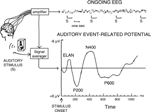
A schematic illustration of the ERP methodology is shown in the figure below.

Schematic depiction of the setup of an ERP experiment on language processing (adapted from Coles and Rugg 1995).
The ongoing EEG is recorded while participants read or listen to linguistic stimuli. Critical stimulus-related activity is isolated from the background electrical activity of the brain by means of an averaging procedure, which applies to a set of stimuli (typically 30–40) of the same type. The resulting event-related brain potential, which is shown in the bottom right-hand corner of the figure, consists of a series of negative and positive potential changes. Note that, by convention, negativity is plotted upwards. The x-axis depicts time (in miliseconds or seconds) from critical stimulus onset (which occurs at the vertical bar), while the y-axis depicts voltage in microvolts. ERP components are typically named according to their polarity (N for negativity versus P for positivity) and latency (an N400, for example, is a negativity with a peak latency of approximately 400 ms relative to critical stimulus onset). ERP comparisons are always relative, meaning that negativities or positivities in a critical condition can only be interpreted relative to a control condition and not in absolute terms (that is, relative to the zero-line).
References
Altmann Gerry T. M.,
K. Y. van Nice,
Alan Garnham, and
Judith-Ann Henstra.
1998.
Late closure in context.
Journal of Memory and Language
38.
459–
484.Google Scholar
Bader Markus.
1996.
Sprachverstehen.
Syntax und Prosodie beim Lesen.
Opladen:
Westdeutscher Verlag.
Bader Markus, and
Michael Meng.
1999.
Subject-object ambiguities in German embedded clauses: An across-the-board comparison.
Journal of Psycholinguistic Research
28.
121–
143.Google Scholar
Blutner Reinhard.
2000.
Some aspects of optimality in natural language interpretation.
Journal of Semantics
17.
189–
216.Google Scholar
Bornkessel Ina,
Matthias Schlesewsky, and
Angela D. Friederici.
2002.
Grammar overrides frequency: Evidence from the online processing of flexible word order.
Cognition
85.
B21–
B30.Google Scholar
Bornkessel Ina,
Matthias Schlesewsky, and
Angela D. Friederici.
2003.
Contextual information modulates initial processes of syntactic integration: The role of inter-versus intra-sentential predictions.
Journal of Experimental Psychology: Learning, Memory, and Cognition
29.
269–
298.Google Scholar
Büring Daniel.
1994.
Topic.
Focus and natural language processing
vol. 2.
Semantics, ed. by
Peter Bosch and
Rob van der Sandt,
271–
280.
Heidelberg:
IBM Germany.
Büring Daniel.
2001.
Let's phrase it! Focus, word order, and prosodic phrasing in German double object constructions.
Competition in syntax, ed. by
Gereon Müller and
Wolfgang Sternefeld,
69–
105.
Berlin:
Mouton de Gruyter.
Büring Daniel, and
Rodrigo Gutiérrez-Bravo.
2001.
Focus related word order variation without the NSR: A prosody-based crosslinguistic analysis.
Syntax and Semantics at Santa Cruz
3,
341–
58.Google Scholar
Chomsky Noam.
1995.
The minimalist program.
Cambridge, MA:
MIT Press.
Chomsky Noam.
2000.
Minimalist inquiries: The framework.
Step by step: Essays in minimalist syntax in honor of Howard Lasnik, ed. by
Roger Martin, David Michaels, and
Juan Uriagereka,
89–
155.
Cambridge, MA:
MIT Press.
Coles Michael G. H., and
Michael D. Rugg.
1995.
Event-related brain potentials: An introduction.
Electrophysiology of mind: Event-related brain potentials and cognition, ed. by
Michael D. Rugg and
Michael G. H. Coles,
1–
26.
Oxford:
Oxford University Press.
Dik Simon.
1991.
Functional grammar.
Linguistic theory and grammatical description, ed. by
Flip G. Droste and
John E. Joseph.
Amsterdam:
John Benjamins,
247–
274.
É Kiss Katalin.
1998.
Identificational focus versus information focus.
Language
74.
245–
273.Google Scholar
Fanselow Gisbert.
2001.
Features, _-roles, and free constituent order.
Linguistic Inquiry
32.
405–
437.Google Scholar
Fanselow Gisbert.
2003.
Free constituent order: A minimalist interface account.
Folia Linguistica
37.
191–
231.Google Scholar
Fiebach Christian J.,
Matthias Schlesewsky, and
Angela D. Friederici.
2002.
Separating syntactic memory costs and syntactic integration costs during parsing: The processing of German wh-questions.
Journal of Memory and Language
47.
250–
272.Google Scholar
Frazier Lyn.
1978.
On comprehending sentences: Syntactic parsing strategies.
Doctoral dissertation,
University of Connecticut.
Frazier Lyn.
1987.
Sentence processing: A tutorial review.
Attention and Performance,
vol. 12.
The psychology of reading, ed. by
Max Coltheart.
Hove:
Erlbaum,
559–
586.
Frazier Lyn, and
Keith Rayner.
1982.
Making and correcting errors during sentence comprehension: Eye movements in the analysis of structurally ambiguous sentences.
Cognitive Psychology
14.
178–
210.Google Scholar
Frey Werner.
Über die syntaktische Position der Satztopiks im Deutschen.
Unpublished manuscript,
ZAS,
Berlin.
Friederici Angela D.
2002.
Towards a neural basis of auditory sentence processing.
Trends in Cognitive Sciences
6.
78–
84.Google Scholar
Friederici Angela D.,
Matthias Schlesewsky, and
Christian J. Fiebach.
2003.
Wh-movement versus scrambling: The brain makes a difference.
Word order and scrambling, ed. by
Simin Karimi,
325–
344.
Oxford:
Blackwell.
Garnsey Susan M.
1993.
Event-related brain potentials in the study of language: An introduction.
Language and Cognitive Processes
8.
337–
356.Google Scholar
Haider Hubert, and
Inger Rosengren.
1998.
Scrambling. (Sprache und Pragmatik, 49.)
Lund:
Germanistisches Institut.
Haider Hubert.
2002.
Mittelfeld phenomena.
The syntax companion, ed. by
Henk van Riemsdijk and
Martin Everaert,
case #64. Available electronically at: http://www-uilots.let.uu.nl/syncom.
Haider Hubert, and
Inger Rosengren.
2003.
Scrambling: Nontriggered chain formation in OV languages.
Journal of Germanic Linguistics
15.
203–
267.Google Scholar
Halliday Michael A. K.
1967.
Notes on transitivity and theme in English, part 2.
Journal of Linguistics
3.
199–
244.Google Scholar
Heck Fabian.
2000.
Tiefenoptimierung: Deutsche Wortstellung als wettbewerbsgesteuerte Basisgenerierung.
Linguistische Berichte
184.
441–
468.Google Scholar
Hill Robin L., and
Wayne Murray.
2000.
Commas and spaces: Effects of punctuation on eye movements and sentence parsing.
Reading as a perceptual process, ed. by
Allan Kennedy,
Ralph Radach,
Dieter Heller, and
Joél Pynte,
565–
589.
Amsterdam:
Elsevier.
Hruska Claudia, and
Kai Alter.
2004.
Prosody in dialogues and single sentences: How prosody can influence speech perception.
Language context and cognition,
vol. 1.
Information structure: Theoretical and empirical aspects, ed. by
Anita Steube,
211–
226.
Berlin:
Walter de Gruyter.
Jackendoff Ray.
2002.
Foundations of language.
Oxford:
Oxford University Press.
Jakobs Joachim.
1988.
Fokus-Hintergrund-Gliederung und Grammatik. Intonationsforschungen.
(Linguistische Arbeiten, 200.), ed. by
Hans Altmann.
Tübingen:
Max Niemeyer.
Johnson Shaun M.,
Mara Breen,
Charles Clifton, Jr., and
Joanna Morris Floral.
2003.
ERP investigations of prosodic and semantic focus.
Journal of Cognitive Neuroscience Supplement.
Krifka Manfred.
1998.
Scope inversion under the rise-fall contour in German.
Linguistic Inquiry
29.
75–
112.Google Scholar
Kutas Marta, and
Steven A. Hillyard.
1980.
Reading senseless sentences: Brain potentials reflect semantic incongruity.
Science
207.
203–
205.Google Scholar
Kutas Marta, and
Cyma Van Petten.
1994.
Psycholinguistics electrified: Event-related brain potential investigations.
Handbook of psycholinguistics, ed. by
Morton A. Gernsbacher,
83–
143.
New York:
Academic Press.
Lenerz Jürgen.
1977.
Zur Abfolge nominaler Satzglieder im Deutschen.
Tübingen:
Gunter Narr Verlag.
MacDonald Maryellen C.,
Neal J. Pearlmutter, and
Mark S. Seidenberg.
1994.
Lexical nature of syntactic ambiguity resolution.
Psychological Review
101.
676–
703.Google Scholar
Matzke Mike,
H. Mai,
W. Nager,
Jascha Rüsseler, and
Thomas F. Münte.
2002.
The costs of freedom: An ERP study of non-canonical sentences.
Clinical Neurophysiology
113.
844–
852.Google Scholar
Meinunger André.,
1995.
Discourse dependent DP (de-)placement.
Doctoral dissertation,
University of Potsdam.
Meng Michael, Markus Bader, and
Josef Bayer.
1999.
Die Verarbeitung von Subjekt-Objekt Ambiguitäten im Kontext.
Proceedings der 4. Fachtagung der Gesellschaft für Kognitionswissenschaften, ed. by
Ipke Wachsmuth and
B. Jung,
244–
249.
St. Augustin:
Infix Verlag.
Mitchell Don C.
1994.
Sentence parsing.
Handbook of psycholinguistics, ed. by
Morton Ann Gernsbacher,
375–
409.
New York:
Academic Press.
Müller Gereon.
1999.
Optimality, markedness and word order in German.
Linguistics
37.
777–
818.Google Scholar
Neeleman Ad.
1994.
Complex predicates.
Utrecht:
Led.
Pechmann Thomas, Hans Uszkoreit, J. Engelkamp, and
Dieter Zerbst.
1994.
Word order in the German middle field: Linguistic theory and psycholinguistic evidence.
(= Computational Linguistics at the University of the Saarland, 43.)
Pili Diana.
2000.
On A and A' dislocation in the left periphery.
Doctoral dissertation,
University of Potsdam.
Prince Alan, and
Paul Smolensky.
1997.
Optimality: From neural networks to universal grammar.
Science
275.
1604–
1610.Google Scholar
Rizzi Luigi.
1997.
The fine structure of the left periphery. Elements of Grammar.
Handbook in generative syntax, ed. by
Liliane Haegeman,
281–
337.
Dordrecht:
Kluwer.
Roberts Craige.
1996.
Information structure: Towards an integrated formal theory of pragmatics.
OSUWPL,
vol. 49.
Papers in semantics, ed. by
Jae Hak Yoon and
Andreas Kathol,
91–
136.
Department of Linguistics, Ohio State University.
Rösler Frank,
Thomas Pechmann, Judith Streb, Brigitte Röder, and
Erwin Hennighausen.
1998.
Parsing of sentences in a language with varying word order: Word-by-word variations of processing demands are revealed by event-related brain potentials.
Journal of Memory and Language
38.
150–
176.Google Scholar
Schlesewsky Matthias, Ina Bornkessel, and
Stefan Frisch.
2003.
The neurophysiological basis of word order variations in German.
Brain and Language
86.
116–
128.Google Scholar
Steinhauer Karsten.
2003.
Electrophysiological correlates of prosody and punctuation.
Brain and Language
86.
142–
164.Google Scholar
Umbach Car.
2004.
On the notion of contrast in information structure and discourse structure.
Journal of Semantics
21.
155–
175.Google Scholar
van Hoof Hanneke.
2003.
The rise in the rise-fall contour: Does it evoke a contrastive topic or a contrastive focus?
Linguistics
41.
515–
563.Google Scholar
Zubizarreta Maria Luisa.
1998.
Prosody, focus, and constituent order.
Cambridge, MA:
MIT Press.
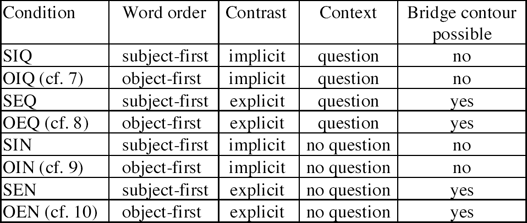
Table 1. Schematic summary of the eight critical conditions in the present experiment.
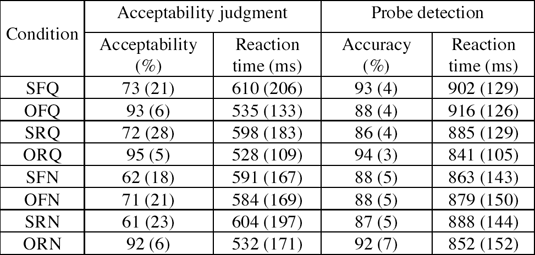
Table 2. Summary of the results for the two behavioral tasks.
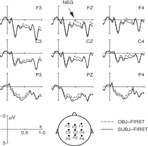
Figure 1. Grand average ERPs at the position of the critical first argument in the subordinate clause of the target sentence (onset at the vertical bar) for all subject-initial (solid line) versus object-initial (dash-dotted line) sentences. Negativity is plotted upwards.
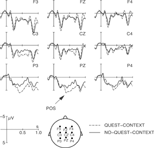
Figure 2. Grand average ERPs at the position of the critical first argument in the subordinate clause of the target sentence (onset at the vertical bar) for all non-question (solid line) versus question (dash-dotted line) contexts. Negativity is plotted upwards.
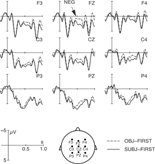
Figure 3. Grand average ERPs at the position of the critical first argument in the subordinate clause of the target sentence (onset at the vertical bar) for subject-initial (SIQ; solid line) versus object-initial (OIQ; dash-dotted line) sentences in the implicit contrast question conditions. Negativity is plotted upwards.
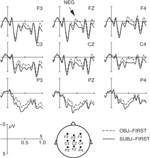
Figure 4. Grand average ERPs at the position of the critical first argument in the subordinate clause of the target sentence (onset at the vertical bar) for subject-initial (SEQ; solid line) versus object-initial (OEQ; dash-dotted line) sentences in the explicit contrast question conditions. Negativity is plotted upwards.
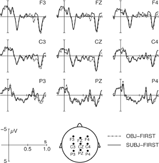
Figure 5. Grand average ERPs at the position of the critical first argument in the subordinate clause of the target sentence (onset at the vertical bar) for subject-initial (SIN; solid line) versus object-initial (OIN; dash-dotted line) sentences in the implicit contrast no-question (= corrective focus) conditions. Negativity is plotted upwards.
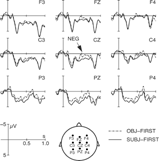
Figure 6. Grand average ERPs at the position of the critical first argument in the subordinate clause of the target sentence (onset at the vertical bar) for subject-initial (SEN; solid line) versus object-initial (OEN; dash-dotted line) sentences in the explicit contrast no-question conditions. Negativity is plotted upwards.
Schematic depiction of the setup of an ERP experiment on language processing (adapted from Coles and Rugg 1995).
 You have
Access
- 26
- Cited by