Introduction
Psychotropic medications such as sedatives, antipsychotics and antidepressants are commonly prescribed in the nursing home setting. More specifically, studies indicate that between 47% and 59% of the residents are prescribed some type of psychotropic medication (Ruths et al., Reference Ruths, Straand and Nygaard2001; Lakey et al., Reference Lakey, Gray, Sales, Sullivan and Hedrick2006; Snowdon et al., Reference Snowdon, Day and Baker2006; Tucker and Hosford, Reference Tucker and Hosford2008). In a study in which almost 70% of the residents were diagnosed with dementia, almost 80% of the total sample was regularly given psychotropic medication (Hosia-Randell and Pitkälä, Reference Hosia-Randell and Pitkälä2005). In view of this frequent use of psychotropic medication, possible adverse effects are a matter of concern. For instance, in the general population, consumption of psychotropic medication may lead to impairments of memory, attention and executive functioning (Brooks and Hoblyn, Reference Brooks and Hoblyn2007). Results of studies examining the relationship between psychotropic medication and cognition in older community-dwelling adults, however, have been mixed. Several studies show worse cognitive performance in psychotropic medications users, e.g. users of benzodiazepines (Wadsworth et al., Reference Wadsworth, Moss, Simpson and Smith2005; Bierman et al., Reference Bierman2007), or improved cognition after cessation of treatment with benzodiazepines (Curran et al., Reference Curran, Collins, Fletcher, Kee, Woods and Iliffe2003; McAndrews et al., Reference McAndrews, Weissm, Sandor, Taylor, Carlen and Shapiro2003). On the other hand, positive effects of psychotropic use on cognition have been reported as well (Brooks and Hoblyn, Reference Brooks and Hoblyn2007).
It has been suggested that presence of an underlying dementia process that does not exhibit apparent cognitive impairment during assessment (i.e. preclinical dementia), often accompanied by depression (Palmer et al., Reference Palmer, Berger, Monastero, Winblad, Bäckman and Fratiglioni2007), may play a role in the relationship between psychotropic use and cognition, i.e. memory, in older people (Allard et al., Reference Allard, Artero and Ritchie2003). Older community-dwelling people with dementia who use psychotropic medication show a more rapid global cognitive deterioration, as measured by a dementia scale, compared to people with dementia who do not use psychotropic medication (Schäufele et al., Reference Schäufele, Bickel and Weyerer2002). Studies examining the relationship between certain subtypes of psychotropic medication (i.e. sedatives, antidepressants and antipsychotics) and cognition in older persons with dementia have found inconsistent results. Some studies show that Alzheimer's disease (AD) patients who were given antipsychotics showed the same rate of cognitive decline as those who were not (Caballero et al., Reference Caballero, Hitchcock, Scharre, Beversdorf and Nahata2006; Livingston et al., Reference Livingston, Walker, Katona and Cooper2007). In contrast, other studies with AD patients have revealed positive (De Deyn et al., Reference De Deyn2004) and negative effects (Kennedy et al., Reference Kennedy2005) on global measures of cognitive functioning after treatment with antipsychotic medication. After adjustment of depressive symptoms, antidepressant use was associated with a reduced cognitive decline (as measured by the Mini-mental State Examination (MMSE; Folstein et al., Reference Folstein, Folstein and McHugh1975) in older persons with AD (Mossello et al., Reference Mossello2008). No studies have looked at the relationship between sedatives and cognition in older persons with dementia. Although some studies focus on a specific cognitive function, such as autobiographical memory (Harrison and Therrien, Reference Harrison and Therrien2007), most studies focus on global cognitive functioning. The present study takes a next step by examining whether certain subtypes of psychotropic medication use are associated with impairment in specific cognitive functions, e.g. memory, executive/attentional function, and overall cognition in institutionalized older people with dementia.
Methods
Subjects
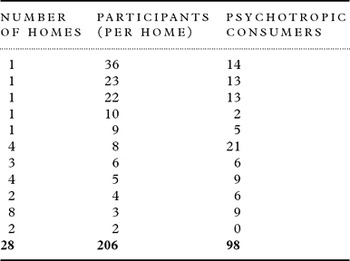
A sample of older persons with dementia was recruited from 28 nursing homes and homes for the elderly in the Netherlands. The present study used baseline data from a non-pharmacological intervention study in institutionalized older adults with dementia for which approval was granted by the local Medical Ethical Committee. This intervention study offered a scheduled activity over six weeks and therefore required commitment to the study for a longer period of time. Some 668 older residents (distributed over the 28 homes) were screened for possible inclusion in the intervention study. Inclusion criteria for participation were: (i) >70 years old; (ii) diagnosis of dementia or presence of cognitive impairment reported in the medical chart. Exclusion criteria included: (i) an MMSE (Folstein et al., Reference Folstein, Folstein and McHugh1975) score of < 10 or > 24 (the focus was on participants in a mild to moderately advanced stage of dementia since they may still be capable of performing the neuropsychological tests administered in the present study); and (ii) presence of acute psychiatric disorders that may preclude participation in cognitive assessment (e.g. psychosis and delirium, and disturbances of consciousness). A total of 462 residents were excluded from participation in the intervention study: 303 residents did not meet the inclusion criteria; 131 residents refused to participate; and 28 declined because of other reasons (because either the family or carer did not agree, or participants could not perform the neuropsychological test assessment due to reasons of illness, temporal hospitalization, or sudden transfer to another place of residence). Consequently, baseline data were available for 206 residents. For distribution of participants over the 28 nursing homes and homes for the elderly see Table 1.
Distribution of participants over the 28 nursing homes and homes for the elderly

Subtype of dementia, education, and comorbidity
Subtype of dementia was extracted from the medical status by the primary investigator (L.E.) and combined with the data resulting from the neuropsychological assessment. To establish subtype of dementia, DSM-IV criteria were used (American Psychiatric Association, 1994). Level of education was determined on a seven-point scale ranging from 1 (less than elementary school) to 7 (university) (Verhage, Reference Verhage1964). Comorbid conditions were reported from notes in the medical chart and classified into specific categories, including: cardiovascular conditions, skin disorders, tumors, gastrointestinal disease, locomotor disturbances, neuro- and radiculopathy, renal disease, pneumonic disease, and endocrine disorders.
Assessment of mood
In view of the close relationship between cognitive function and mood (Steffens, Reference Steffens2008), symptoms of depression and anxiety were determined by the Geriatric Depression Scale (GDS; Kok et al., Reference Kok, Heeren and Van Hemert1993), and the Symptom Checklist (SCL; Arrindell and Ettema, Reference Arrindell and Ettema1986), respectively.
Assessment of specific cognitive functions
To assess various aspects of cognitive functioning, neuropsychological tests were administered by trained research assistants who were blinded to study design. The memory tests comprised “Face and Picture Recognition” from the Rivermead Behavioural Memory Test (RBMT), which is considered a test for measuring everyday memory problems (Wilson et al., Reference Wilson, Cockburn and Baddeley1987), and the “Eight Words Test” (Lindeboom and Jonker, Reference Lindeboom and Jonker1989). This word learning test includes three conditions: direct recall, delayed recall, and delayed recognition. This episodic memory test is specifically designed for persons with memory problems (Lindeboom and Jonker, Reference Lindeboom and Jonker1989).
The executive/attentional function tests comprised “Digit Span,” a subtest of the Wechsler Memory Scale-Revised (WMS-R), frequently administered in the clinical setting (Loewenstein et al., Reference Loewenstein, Rubert, Argüelles and Duara1995) to measure attention and working memory (Wechsler, Reference Wechsler1987), and “Category Fluency,” which provides a measure of a participant's ability to retrieve familiar information from semantic memory (Snijders and Verhage, Reference Snijders and Verhage1983) and is widely used in older persons with cognitive impairment (Beinhoff et al., Reference Beinhoff, Hilbert, Bittner, Gron and Riepe2005).
Classification of psychotropic medication
Use of psychotropic medication was extracted from the medical chart at the same time as the neuropsychological assessment by the primary investigator (L.E.). The medical status provided detailed information on subtypes of drugs, date of prescription, and information of the pharmacist. Psychotropics were classified into three major classes (Brooks and Hoblyn, Reference Brooks and Hoblyn2007): (i) anxiolytics/hypnotic/sedatives (including benzodiazepines and non-benzodiazepine sleeping pills); (ii) antidepressants (including tricyclic antidepressants and selective serotonin reuptake inhibitors); and (iii) antipsychotics (including neuroleptics and atypical antipsychotics).
Statistical analysis
Characteristics of the psychotropic medication consumers and non-consumers were compared by means of χ2 tests, Mann-Whitney U tests, or independent-samples t-tests. For data reduction purposes, the separate variables of the neuropsychological tests were transformed into z-scores and combined to form three cognitive domains, based on a principal components factor analysis. Differences between characteristics of psychotropic consumers and non-consumers were used as covariates. Analyses of covariance (ANCOVA) were conducted on the cognitive domains. Comparisons were made between psychotropic consumers versus non-consumers and between consumers of each psychotropic class separately. In the separate analyses of the specific classes of psychotropic medication, only factors that differed significantly between specific psychotropic consumers and non-consumers were used as covariates. Effect sizes were estimated using partial eta squared (ηp2), and interpreted as: small (ηp2 ≈ 0.01), medium (ηp2 ≈ 0.06), and large (ηp2 > 0.13), following Cohen's standard (Cohen, Reference Cohen1992). The relationships between the number of classes of psychotropic medications and the cognitive domains were explored by means of Spearman's correlations. Level of significance was set at 0.05.
Results
Participant characteristics
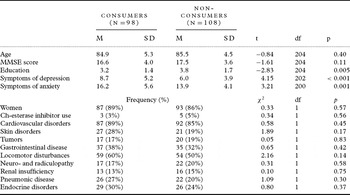
Mean age of all participants was 85.22 years (range 74–99 years). The total group consisted of 180 female and 26 male participants. Mean MMSE score was 17.1 (ranges 10–24). Almost half of the participants were using psychotropic medication (47.6% consumers: n = 98, versus 52.4% non-consumers: n = 108). Details on psychotropic medication use are presented in Table 2. There were no differences between consumers and non-consumers with respect to age, MMSE score, gender, comorbidity and use of cholinesterase-inhibitors (Table 3). Participants revealed diagnoses in their medical status of AD (n = 68), vascular dementia (VaD) (n = 31), a combination of AD and VaD (n = 15), frontotemporal dementia (n = 2), or dementia not otherwise specified (n = 90). The different dementia subtypes were equally distributed between psychotropic consumers and non-consumers (Mann-Whitney U: z = −0.58, p = 0.562). There was a significant difference in the level of symptoms of depression and anxiety between psychotropic consumers and non-consumers, and psychotropic consumers showed lower levels of education compared to non-consumers (see Table 3).
Number of psychotropic drugs of the entire study sample

Characteristics of the psychotropic medication consumers and non-consumers

Ch = choline; MMSE = Mini-mental State Examination.
Cognitive functioning
The separate neuropsychological test variables were combined using factor analysis to form three domains: (i) a domain based on tests appealing to executive/attentional functioning (EF/attention domain); (ii) a domain formed by tests appealing to memory (memory domain); and (iii) all the test variables together (overall cognition). The four neuropsychological test variables that formed the EF/attention domain were the digit span forward, digit span backward, category fluency, and eight words test immediate recall (Cronbach's α = 0.55). The four neuropsychological variables that formed the Memory domain were RBMT face recognition, RBMT picture recognition, eight words test delayed recall, and the eight words test recognition (Cronbach's α = 0.67). All the neuropsychological test variables together formed overall cognition (Cronbach's α = 0.66).
Psychotropic medication consumers versus non-consumers
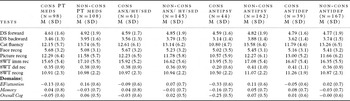
Since level of education and symptoms of depression and anxiety differed significantly between psychotropic medication consumers and non-consumers, all three variables were used as covariates. The ANCOVA revealed that consumers of psychotropic medication showed a significantly worse performance on the EF/attention domain compared to non-consumers (F(1,197) = 4.79, p = 0.030, ηp2 = 0.024). There were no significant differences between the memory domain and overall cognition domain between consumers and non-consumers of psychotropic medication (F(1,197) =0.59, p = 0.444, ηp2 = 0.003 and F(1,197) = 0.40, p = 0.526, ηp2 = 0.002, respectively). See Table 4 for means and standard deviations of the separate cognitive tests and domains.
Means and standard deviations of the different neuropsychological test variables and the separate cognitive test variables and the 3 cognitive domains.

8WT = Eight words test; antidep = antidepressants; antipsy = antipsychotics; anx/hyp/sed = anxiolytics/hypnotics/sedatives; cat = category; cog = cognition; cons = consumers; del = delayed; DS = digit span; EF = executive function; imm = immediate; M = mean; meds = medications; PT = psychotropic; rec = recall; recog = recognition; SD = standard deviation
§The cognitive domain scores are z-scores.
Different classes of psychotropic medication
The ANCOVA correcting for age and symptoms of depression, revealed no differences on the three cognitive domains between people taking antidepressants and people who did not take antidepressants (EF/attention: F(1,200) = 0.15, p = 0.695, ηp2 =0.001; memory: F(1,200) = 0.42, p = 0.520, ηp2 =0.002; overall cognition: F(1,200) = 0.02, p = 0.883, ηp2 = 0.000). The ANCOVA correcting for symptoms of depression and anxiety showed that people taking anxiolytics/hypnotic/sedatives also did not differ from those not taking anxiolytics/hypnotic/sedatives on the three cognitive domains (EF/attention: F(1,198) = 1.47, p = 0.226, ηp2 = 0.007; memory: F(1,198) = 0.19, p = 0.663, ηp2 = 0.001; overall cognition: F(1,198) = 0.11, p = 0.741, ηp2 = 0.001). An ANCOVA correcting for MMSE score, education, symptoms of depression and symptoms of anxiety revealed that compared to people not taking antipsychotics, people who were taking antipsychotics showed worse performance on the EF/attention domain (F(1,196) = 4.28, p = 0.040, ηp2 = 0.021), but not on the memory domain and overall cognition domain (F(1,196) = 0.09, p = 0.767, ηp2 = 0.000, and F(1,196) = 2.09, p = 0.150, ηp2 = 0.011 respectively).
Number of classes of psychotropic medication use
Spearman's correlations between number of classes of psychotropic agents and the EF/attention domain were significant and negative (Spearman's ρ = 0.22, p = 0.002), whereas the correlations between number of classes and either memory or overall cognition were not (Spearman's ρ = −0.02, p = 0.811, and Spearman's ρ = −0.13, p = 0.065, respectively).
Discussion
This is the first study to determine the relationship between the use of different types of psychotropic use (i.e. antidepressants, anxiolytics/hypnotic/sedatives, and antipsychotics) and cognition in institutionalized older adults with dementia. As in other studies in a nursing home setting, psychotropic medication was used by a large proportion of participants (Ruths et al., Reference Ruths, Straand and Nygaard2001; Snowdon et al., Reference Snowdon, Day and Baker2006; Tucker and Hosford, Reference Tucker and Hosford2008). Almost half of the current older residents were taking one or more classes of psychotropic medication. Results show that the use of psychotropic medication, particularly antipsychotics, and an increased number of psychotropic agents used was inversely related to executive/attentional functioning. In another study including older people with dementia, antipsychotic medication use was associated with overall cognitive impairment, but that study did not specify particular cognitive domains (Schneider et al., Reference Schneider, Dagerman and Insel2006a).
Previous research suggests that older people with worse executive/attentional functioning may be at higher risk for certain adverse events. More specifically, it has been shown that executive function impairments in older people in assisted living facilities require increased levels of care (Burdick et al., Reference Burdick2005). Additionally, executive function impairments in older people with dementia are associated with falls (Sheridan and Hausdorff, Reference Sheridan and Hausdorff2007). Similarly, a direct relationship between psychotropic medication use and falls was found in older persons living in a nursing home (Cooper et al., Reference Cooper, Freeman, Cook and Burfield2007). Consequently, the participants of the present study taking antipsychotics are in need of enhanced care, and may be at increased risk for falls. Moreover, antipsychotic use in older persons with dementia is associated with adverse events including increased risk of cerebrovascular events and increased risk of mortality (Valiyeva et al., Reference Valiyeva, Herrmann, Rochon, Gill and Anderson2008). Clarifying the other risks of nursing home residents with dementia using antipyschotic medication should be the focus of future research efforts.
The strengths of the present study include specification of different classes of psychotropic medication, the extensive neuropsychological test battery and the nature of the studied population, i.e. institutionalized older adults with dementia who are difficult to include in lengthy neuropsychological assessments (Teng and Manly, Reference Teng and Manly2005). Short-comings of the present study should be noted as well. The first limitation is that baseline data were used from an intervention study which may have resulted in a reduced generalizibility of the findings. On the other hand, willingness to participate in a non-pharmacological intervention study is not directly related to the present research question. In addition, persons were recruited from several different nursing homes and homes for the elderly that were not part of the same care organization, avoiding the influence of possible treatment tendencies in certain homes. Secondly, the present study did not account for duration of psychotropic treatment. It has been shown in older people that longer treatment duration of a certain subtype of psychotropic medication can have a different effect on cognition; antidepressants can have a positive effect (Allard et al., Reference Allard, Artero and Ritchie2003), but non-benzodiazepines can have a negative effect (Dealberto et al., Reference Dealberto, McAvay, Seeman and Berkman1997). The relationship between treatment duration and cognition in older persons with dementia remains unclear. Thirdly, to determine the level of depressive symptoms, the GDS was used which may not have been appropriate in persons with moderately advanced dementia (Kørner et al., Reference Kørner2006). In future studies it is recommended that an instrument specifically designed for people with dementia be used, e.g. the Cornell Scale for Depression in Dementia (Alexopoulos et al., Reference Alexopoulos, Abrams, Young and Shamoian1988). Another limitation of the present study is the moderate Cronbach's α of the cognitive domains. Domains were formed to avoid multiple testing and thus potential spurious results. Ideally, Cronbach's α would have been higher; some cognitive tests, however, load on both executive function and memory domains, but were included in the domain that resulted in the highest Cronbach's α. Finally, the cross-sectional design of the present study does not allow inferences about the causation of the findings. More specifically, it is known that a decline in executive function in dementia may lead to symptoms such as impaired judgment, disinhibition, and anxiety (Hannisdottir and Morris, Reference Hannesdottir and Morris2007; Tsoi et al., Reference Tsoi, Baillon and Lindesay2008). One may argue that these symptoms may have led to the behavioral disturbances, such as agitation and aggression, for which antipsychotic medication was prescribed (Alexopoulos et al., Reference Alexopoulos, Strein, Carpenter and Dochtery2004).
Although effect sizes in the present study are small, there appears to be an association between antipsychotic medication use and impairment in executive/attentional functioning in these older institutionalized adults with dementia. Although several studies have shown that a large proportion of patients with dementia with accompanying psychiatric symptoms are free of symptoms after a cessation of antipsychotic medication (Reekum et al., Reference Reekum2002; Ruths et al., Reference Ruths, Straand, Nygaard and Aarsland2008), in view of the possible side effects of antipsychotic treatment (Schneider et al., Reference Schneider2006b; Ballard et al., Reference Ballard2008), and its association with decreased executive function, frequent reconsideration of treatment with antipsychotics is recommended. This recommendation is in line with the current recommendations of international guidelines concerning antipsychotic use in dementia (Alexepoulos et al., Reference Alexopoulos, Strein, Carpenter and Dochtery2004; Rabins et al., Reference Rabins2007). Longitudinal studies are needed to further clarify the association between antipsychotic medication use and executive/attentional functioning in institutionalized older people with dementia.
Conflict of interest
None.
Description of authors' roles
L. Eggermont designed the study, coordinated the data collection and wrote the paper; K. de Vries provided expertise on all issues that concerned psychotropic medication; E. Scherder was responsible for critical revision of the manuscript.
Acknowledgments
We are grateful to Osiragroep Amsterdam, The Netherlands, for funding this research.